

Breast Cancer Diagnostic Market Size and Forecast – 2026 to 2033
The Breast Cancer Diagnostic Market is anticipated to grow at a CAGR of 8.9% with USD 6.4 Bn in 2026 and is expected to reach USD 11.8 Bn in 2033. The Breast Cancer Diagnostic Market is driven by increasing breast cancer incidence, greater awareness of early detection, wider adoption of mammography and advanced imaging technologies, and growing access to personalized and precision diagnostic solutions worldwide. According to the WHO, an estimated 2.4 million women were diagnosed with breast cancer worldwide in 2024, resulting in approximately 694,000 deaths globally.
Key Takeaways
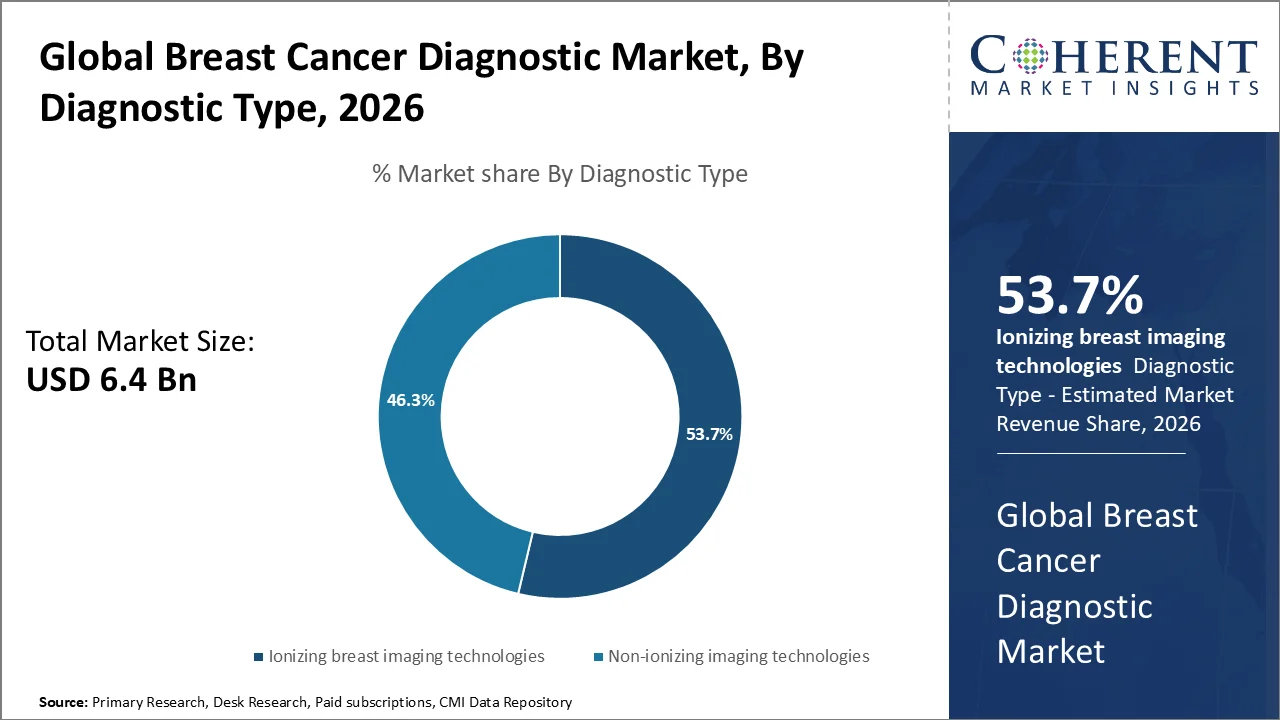
- Ionizing breast imaging technologies hold the largest market share of 53.7% in 2026 owing to its growing breast cancer incidence. Ionizing breast imaging techniques, including conventional and 3D mammography, use low-dose X-rays to detect breast cancer and other abnormalities at an early stage.
- Hospitals expected to hold largest market share of 38.6% in 2026 owing to the increasing breast cancer patient volumes.
- North America is expected to acquire the dominant share of 43.6% in 2026 owing to its strong adoption of advanced breast imaging. In the United States, a woman’s lifetime risk of developing breast cancer is approximately 13%.
Current Events and Their Impact on the Breast Cancer Diagnostic Market
Current Event | Description and its Impact |
U.S. FDA implementation of new Mammography Quality Standards Act (MQSA) requirements – September 2024 |
|
Medicare coverage of screening mammography and digital breast tomosynthesis (U.S.) |
|
Segmental Insights
- Current Industry Events of 2026
- Market Size Estimation
- Regional Breakdown
- Competitive Landscape
- Customer Intelligence
- Segmental Analysis
- Pricing Analysis
- Key Market Drivers, Challenges & Future Trends
- Customized Insights Section
Why is Ionizing breast imaging technologies Acquiring the Largest Market Share?
Ionizing breast imaging technologies hold the largest market share of 53.7% in 2026. The ionizing breast imaging technologies segment benefits from the growing burden of breast cancer, increasing focus on early and timely diagnosis, and the continued use of mammography as a primary screening tool. Healthcare providers increasingly adopt digital mammography and digital breast tomosynthesis to improve cancer detection and image quality. Technological innovations, equipment upgrades, expanding screening programs, and rising healthcare investments further drive demand. Digital breast tomosynthesis also enhances diagnostic capabilities by providing additional imaging information compared with conventional mammography. For instance, in April 2026, QT Imaging Holdings, Inc. launched the QTI Imaging-Olea Viewer with Olea Medical, enhancing its Breast Acoustic CT system with advanced imaging software for true 3D breast imaging without radiation or painful compression.
Which End User segment dominates the market?
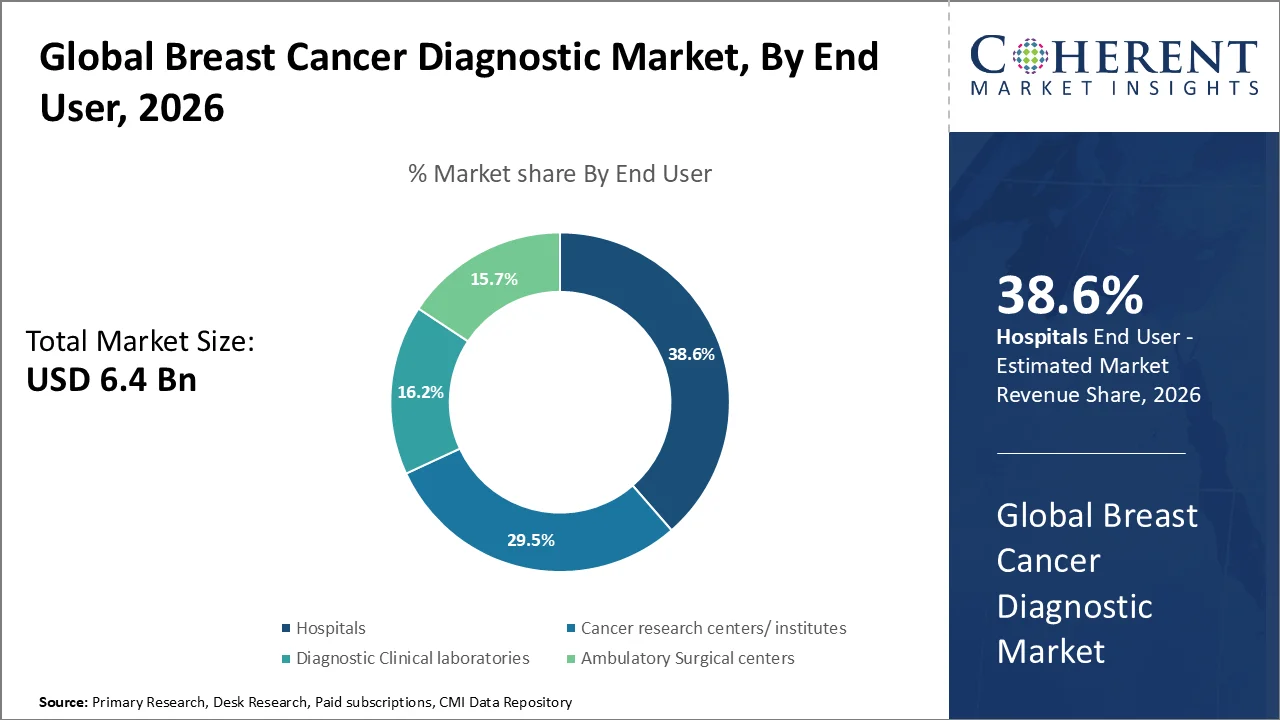
Hospitals expected to hold largest market share of 38.6% in 2026. The hospitals segment in the Breast Cancer Diagnostic Market grows as breast cancer cases increase and patients demand timely and accurate diagnosis. Hospitals expand their diagnostic capabilities by offering integrated imaging, tissue sampling, pathology, and specialist consultation services. Healthcare providers adopt advanced diagnostic technologies, multidisciplinary care models, efficient referral pathways, and patient-navigation programs to improve diagnosis and treatment. Hospitals also invest in infrastructure and comprehensive breast cancer centers, enabling them to coordinate diagnostic and treatment services more effectively.
Breast Cancer Diagnostic Market Trends
- Growing adoption of advanced breast imaging technologies such as digital mammography and digital breast tomosynthesis (DBT) is improving breast lesion visualization and supporting early cancer detection. The U.S. Preventive Services Task Force (USPSTF) recognizes both digital mammography and DBT (3D mammography) as effective screening modalities. Its 2024 modeling estimated that biennial DBT screening from ages 40–74 could reduce breast cancer mortality by approximately 30% compared with no screening.
- Rising awareness of breast density and personalized screening is increasing attention toward risk-based breast imaging. According to the U.S. National Cancer Institute (NCI), nearly half of women aged 40 years and older who undergo mammography have dense breasts; approximately 40% have heterogeneously dense breasts and 10% have extremely dense breasts. Dense tissue can make mammograms more difficult to interpret and is also associated with increased breast cancer risk.
- Expansion of breast cancer screening recommendations is increasing the addressable screening population. In April 2024, the USPSTF recommended biennial mammography for women aged 40–74 years, including women aged 40–49 years for whom screening had previously involved individualized decision-making. In the United States, CDC data showed that in 2023, 80.0% of women aged 50–74 years were up to date with breast cancer screening, while 62.1% of women aged 40–49 years had received a mammogram within the previous two years.
Regional Insights
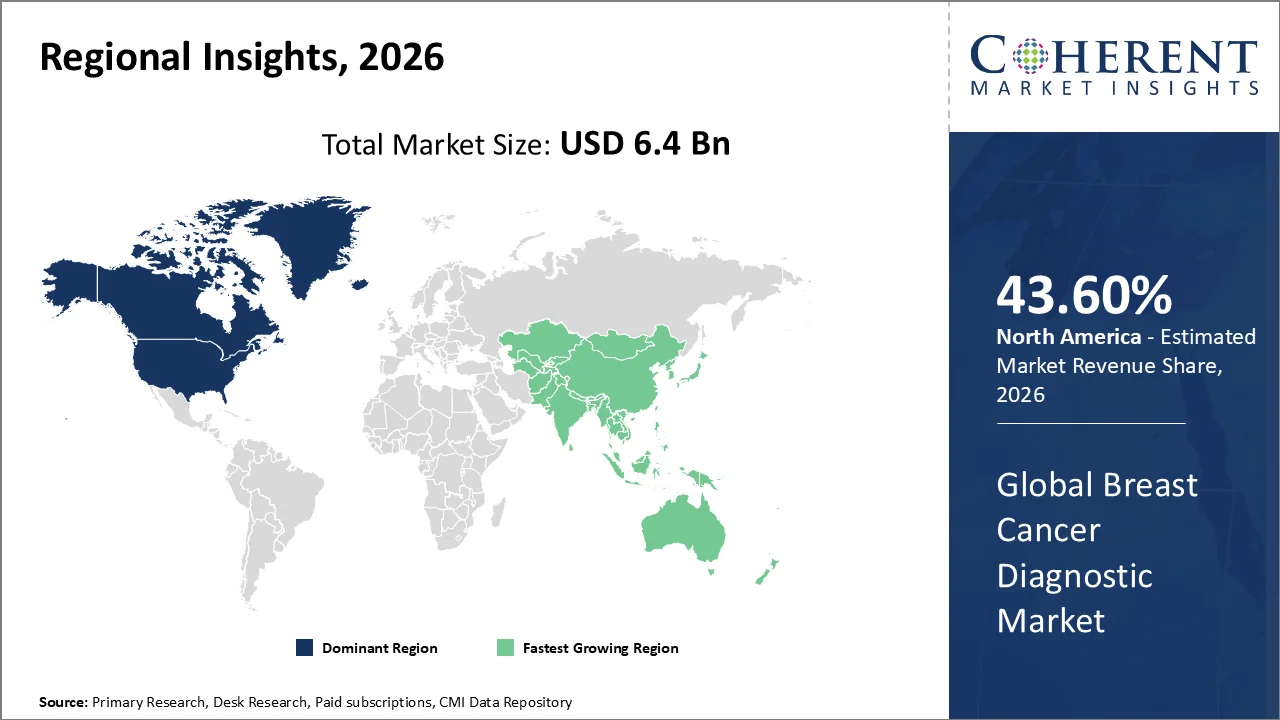
North America dominates owing to growing focus on early detection
North America is expected to acquire the dominant share of 43.60% in 2026. The North American breast cancer diagnostic market benefits from the region’s high breast cancer burden, widespread screening programs, and strong focus on early detection. Healthcare providers increasingly adopt advanced mammography, digital breast tomosynthesis, ultrasound, biopsy, and MRI to enhance diagnostic accuracy. Robust healthcare infrastructure, greater disease awareness, supportive screening guidelines, technological advancements, and expanding use of artificial intelligence continue to drive market demand. Healthcare systems also expand personalized and risk-based screening approaches, further increasing the use of breast cancer diagnostic services across North America. For instance, in January 2026, SAGA Diagnostics launched its Pathlight MRD test for colorectal cancer patients, expanding its use beyond its initial application in early-stage breast cancer.
Asia Pacific Breast Cancer Diagnostic Market Trends
The Asia Pacific breast cancer diagnostic market grows as rising breast cancer incidence, increasing awareness of early detection, and expanding national screening programs drive demand. Governments and healthcare providers are increasing healthcare investments and strengthening hospital and diagnostic infrastructure, improving access to mammography, ultrasound, biopsy, and molecular testing. Diagnostic companies are also advancing digital imaging and AI-assisted technologies to enhance detection accuracy. China, India, Japan, and South Korea further stimulate market demand by expanding healthcare services and adopting advanced breast cancer diagnostic solutions. For instance, in August 2026, India Turns Pink and Pink Ribbon International launched a collaboration to strengthen breast cancer awareness and screening across India. India Turns Pink has promoted early detection through awareness campaigns and free screening programs.
United States Breast Cancer Diagnostic Market Trends
The United States breast cancer diagnostic market is expanding as the high prevalence of breast cancer, greater awareness of early detection, and strong demand for routine screening drive growth. Healthcare providers increasingly adopt digital mammography, 3D breast tomosynthesis, and AI-assisted imaging to enhance diagnostic accuracy and efficiency. Concerns about breast density also encourage clinicians to use supplemental imaging and advanced diagnostic tests. Furthermore, favorable regulations, insurance coverage, technological advancements, genomic profiling, liquid biopsy development, and growing investments in precision medicine continue to support market growth. In June 2026, Following the OPTIMA trial results presented at ASCO, Veracyte launched the Prosigna Breast Risk of Recurrence (ROR) test in the U.S. for patients with early-stage HR+ breast cancer.
China Breast Cancer Diagnostic Market Trends
China’s breast cancer diagnostic market is expanding as the country faces a growing breast cancer burden and rising awareness of early detection. Government-supported screening programs and national guidelines promote the use of mammography and ultrasound, while healthcare providers increasingly use ultrasound for women with dense breasts and in areas with limited mammography access. Rising healthcare spending, hospital modernization, advanced imaging adoption, AI-assisted diagnostic technologies, and broader screening services across rural and county-level regions continue to strengthen market demand.
Who are the Major Companies in Breast Cancer Diagnostic Industry
Some of the major key players in Breast Cancer Diagnostic are Hologic Inc., GE Healthcare, Phillips Healthcare, Fujifilm Holdings Corporation, Gamma Medica Inc., Toshiba Corporation, Aurora Imaging Technology Inc., and Dilion Technologies Inc.
Key News
- In June 2026, Huíla launched a Roche-funded breast and cervical cancer prevention and early diagnosis project with technical support from WHO, focusing on scientific expertise, local capacity building, and community engagement.
Market Report Scope
Breast Cancer Diagnostic Market Report Coverage
| Report Coverage | Details | ||
|---|---|---|---|
| Base Year: | 2025 | Market Size in 2026: | USD 6.4 Bn |
| Historical Data for: | 2020 To 2024 | Forecast Period: | 2026 To 2033 |
| Forecast Period 2026 to 2033 CAGR: | 8.9% | 2033 Value Projection: | USD 11.8 Bn |
| Geographies covered: |
| ||
| Segments covered: |
| ||
| Companies covered: | Hologic Inc., GE Healthcare, Phillips Healthcare, Fujifilm Holdings Corporation, Gamma Medica Inc., Toshiba Corporation, Aurora Imaging Technology Inc., and Dilion Technologies Inc. | ||
Analyst Opinion
- Breast cancer diagnostics are not a discretionary healthcare category—they are becoming an essential component of cancer management. More than 2.3 million women were diagnosed with breast cancer globally in 2022, while approximately 670,000 died from the disease. In our view, this disease burden creates a structurally resilient diagnostic opportunity because every suspected case requires imaging, tissue diagnosis, or both to guide treatment decisions.
- Early and accurate detection will remain the strongest demand driver, particularly as healthcare systems shift toward diagnosing smaller and earlier-stage tumors. Evidence increasingly supports multimodal screening rather than reliance on mammography alone. In a study of 5,707 women with dense breasts, mammography combined with ultrasound achieved a cancer detection rate of 5.6 per 1,000 examinations and sensitivity of 97.0%, compared with 3.5 per 1,000 and 60.6% for mammography supported by AI. These results reinforce the commercial importance of ultrasound, advanced imaging, and complementary diagnostic technologies in difficult-to-screen populations.
- AI is moving from an experimental technology toward a practical diagnostic productivity tool, but we do not view it as a replacement for radiologists or conventional imaging. Clinical evidence shows that AI can improve interpretation efficiency and diagnostic specificity. One study found that AI-assisted mammography achieved 95.3% specificity versus 94.3% for mammography alone, while another real-world analysis reported an increase in cancer detection from 6.23 to 7.57 cases per 1,000 examinations following AI adoption. Importantly, the latter study also found more cancers detected in dense breasts and a reduction in mean invasive tumor size from 12.16 mm to 10.74 mm. This ability to identify clinically meaningful cancers without materially increasing recall rates will accelerate AI integration into breast diagnostic workflows.
Speak to the analyst
Want personalized insights?
Take the findings above to one of our principal consultants, or have the report rebuilt around the segments, geographies and competitors you actually track.
Market Segmentation
- By Diagnostic Type (Revenue, USD Bn, 2021-2033)
- Ionizing breast imaging technologies
- Analog Mammography
- Full-field digital mammography (FFDM)
- 3D breast tomosynthesis
- Positron emission tomography/ Computed tomography (PET/CT)
- Molecular Breast imaging/ breast specific gamma imaging (MBI/BSMI)
- Positron emission mammography
- Others
- Non-ionizing imaging technologies:
- Breast MRI (Magnetic Resonance Imaging)
- Breast Ultrasound
- Optical Imaging
- Automated whole breast ultrasound (AWBU)
- Breast thermography
- Ionizing breast imaging technologies
- By End User (Revenue, USD Bn, 2021-2033)
- Hospitals
- Cancer research centers/ institutes
- Diagnostic Clinical laboratories
- Ambulatory Surgical centers
- By Region (Revenue, USD Bn, 2021-2033)
- North America
- U.S.
- Canada
- Latin America
- Brazil
- Mexico
- Argentina
- Rest of Latin America
- Europe
- Germany
- U.K.
- France
- Italy
- Spain
- Russia
- Rest of Europe
- Asia Pacific
- China
- India
- Japan
- Australia
- South Korea
- ASEAN
- Rest of Asia Pacific
- Middle East
- GCC
- Israel
- Rest of Middle East
- Africa
- South Africa
- Central Africa
- North Africa
- North America
Sources
Primary Research interviews
- Oncologists and breast cancer specialists
- Breast radiologists and diagnostic imaging specialists
- Pathologists and molecular pathologists
- Breast surgeons and surgical oncologists
- Clinical laboratory directors and laboratory medicine specialists
- Hospital and diagnostic-center administrators
- Breast cancer screening program coordinators
- Molecular diagnostics and pathology laboratory professionals
- Medical device and diagnostic technology experts
- Healthcare procurement and laboratory purchasing professionals
Databases
- National Cancer Institute (NCI) – Surveillance, Epidemiology, and End Results (SEER) Program
- Centers for Disease Control and Prevention (CDC) – U.S. Cancer Statistics
- National Center for Biotechnology Information (NCBI) / PubMed
- World Health Organization (WHO) Global Health Observatory
- International Agency for Research on Cancer (IARC) – Global Cancer Observatory (GLOBOCAN)
- National Cancer Institute – Cancer Data and Statistics
- U.S. Food and Drug Administration (FDA) databases
- ClinicalTrials.gov
- National Library of Medicine (NLM) databases
- OECD Health Statistics
- World Bank health-related datasets
- Eurostat healthcare databases
Magazines
- Diagnostic Imaging
- Applied Radiology
- AuntMinnie
- Cancer Therapy Advisor
- Oncology Nursing News
- Radiology Business
- Lab Manager
- CAP TODAY
- Diagnostic Pathology and Laboratory Medicine publications
Journals
- Journal of Clinical Oncology
- JAMA Oncology
- The Lancet Oncology
- Breast Cancer Research
- Breast Cancer Research and Treatment
- npj Breast Cancer
- Radiology
- European Radiology
- American Journal of Roentgenology (AJR)
- Journal of the American College of Radiology
- Modern Pathology
- Journal of Molecular Diagnostics
- Clinical Cancer Research
- Cancer Research
- Nature Reviews Cancer
- Cancers
- Diagnostics
- BMC Cancer
- PLOS ONE
- British Journal of Cancer
Newspapers
- The New York Times
- The Wall Street Journal
- The Washington Post
- The Guardian
- Financial Times
- Reuters
- Associated Press
- The Times of India
- The Hindu
- Indian Express
- Economic Times
Associations
- American Cancer Society (ACS)
- American Society of Clinical Oncology (ASCO)
- American Society for Clinical Pathology (ASCP)
- College of American Pathologists (CAP)
- American College of Radiology (ACR)
- Radiological Society of North America (RSNA)
- Society of Breast Imaging (SBI)
- National Comprehensive Cancer Network (NCCN)
- European Society for Medical Oncology (ESMO)
- European Society of Breast Imaging (EUSOBI)
- European Society of Radiology (ESR)
- Association for Molecular Pathology (AMP)
- Breast Cancer Research Foundation (BCRF)
- Indian Council of Medical Research (ICMR)
- Indian Cancer Society (ICS)
Public Domain sources
- U.S. Food and Drug Administration (FDA)
- National Cancer Institute (NCI)
- Centers for Disease Control and Prevention (CDC)
- National Institutes of Health (NIH)
- U.S. National Library of Medicine (NLM)
- SEER Program
- U.S. Census Bureau
- World Health Organization (WHO)
- International Agency for Research on Cancer (IARC)
- Global Cancer Observatory (GLOBOCAN)
- World Bank
- OECD
- Eurostat
- Government health ministries and national cancer registries
- National cancer surveillance programs
- ClinicalTrials.gov
- PubMed/NCBI
- Government regulatory and public-health publications
- Publicly available hospital and healthcare-system reports
Proprietary Elements
- CMI Data Analytics Tool
- Proprietary CMI Existing Repository of Information for the Last 10 Years
Get access to 250+ pages report
Every segment, forecast, competitor profile and data table behind the analysis above — available for instant download.
- ESOMAR Member
- ISO 9001:2015 Certified
- D-U-N-S Registered
- GDPR & CCPA Compliant
Missing comfort of reading report in your local language? Find your preferred language:
Transform your Strategy with Exclusive Trending Reports
Frequently Asked Questions
The Breast Cancer Diagnostic Market is anticipated to grow at a CAGR of 8.9% with USD 6.4 Bn in 2026 and is expected to reach USD 11.8 Bn in 2033.
The market is primarily driven by the rising global burden of breast cancer, greater emphasis on early detection, expanding screening programs, and advances in diagnostic imaging.
Mammography remains the most widely used breast cancer screening modality.
Dense breast tissue can obscure tumors on mammograms and reduce mammographic sensitivity. NCI data indicate that 43% of women aged 40–74 have dense breasts, creating a significant clinical need for complementary imaging and improved interpretation technologies.
AI is increasingly being integrated into mammography and other imaging workflows to assist radiologists in identifying suspicious lesions, prioritizing cases, and improving interpretation efficiency.
Yes. Ultrasound provides an important complementary modality, particularly for evaluating abnormalities and assessing dense breast tissue.