

Cable Cars & Ropeways Market Size and Forecast – 2026 to 2033
The cable cars & ropeways market is estimated to be valued at USD 8,134.5 Mn in 2026 and is expected to reach USD 18,095.6 Mn by 2033, exhibiting a compound annual growth rate (CAGR) of 12.1% from 2026 to 2033.
Key Takeaways
- By Component, Services hold the largest market share in 2026 owing to its urbanization & congestion relief.
- By Propulsion, Electric acquired the prominent share of 69.3% in 2026 as push for sustainable, low-carbon mobility.
- By Application, Tourism and Public Transit dominates the overall market share in 2026 owing to the scenic experience & accessibility.
- By Region, Europe dominates the overall market with an estimated share of 37.2% in 2026 owing to the innovation & system modernization.
Market Overview
The Cable Cars & Ropeways market demand continues to grow as cultural tourism and urban transport needs drive demand. Operators are deploying these systems to provide efficient, eco-friendly mobility in mountainous terrains and crowded cities. Governments and private players actively invest in modernizing infrastructure, promoting sustainability, and adopting smart technologies to boost adoption. Countries in Europe, Asia, and Latin America lead new developments, backed by policy support and collaborations. Established manufacturers expand their presence as public transit and leisure applications increase globally.
Current Events and their Impact on the Cable Cars & Ropeways Market
Current Events | Description and its impact |
Macroeconomic Recovery & Infrastructure Stimulus |
|
Climate Change & Sustainable Urban Mobility Initiatives |
|
Regional Geopolitical Tensions & Trade Policies |
|
End-user Feedback and Unmet Needs in the Cable Cars & Ropeways Market
- Demand for Shorter Wait Times: End-users frequently express dissatisfaction with long queues during peak hours, especially at tourist destinations. They want improved scheduling, better capacity management, and faster boarding systems to enhance the overall user experience and reduce waiting times that impact travel plans and enjoyment.
- Accessibility for All Passengers: Many users highlight the lack of proper accessibility features for elderly individuals and people with disabilities. Feedback suggests a need for more inclusive designs, such as level boarding, ramps, audio guidance, and visual cues to ensure comfortable and safe access for everyone.
- Desire for Real-Time Information: Passengers often face uncertainty due to limited updates on wait times, operational status, and weather-related delays. End-users call for digital platforms or apps that provide real-time information, allowing them to plan trips efficiently and avoid unnecessary inconvenience.
- Current Industry Events of 2026
- Market Size Estimation
- Regional Breakdown
- Competitive Landscape
- Customer Intelligence
- Segmental Analysis
- Pricing Analysis
- Key Market Drivers, Challenges & Future Trends
- Customized Insights Section
Segmental Insights
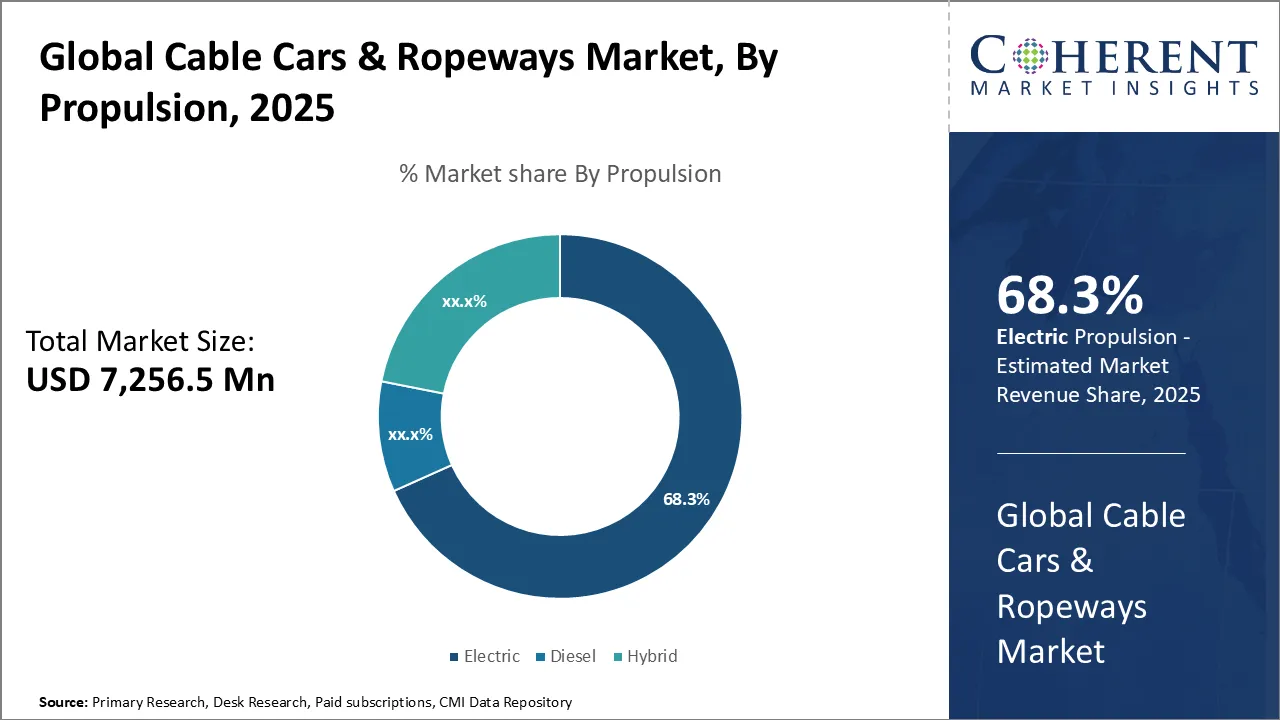
Cable Cars & Ropeways Market Insights, By Propulsion: Electric contribute the highest share of the market owing to its increasing integration of renewable energy
Electric segment acquired the prominent share of 69.3% in 2026. The demand for clean, efficient, and sustainable transportation drives growth in the electric segment of the Cable Cars & Ropeways market. Operators adopt electric-powered systems to cut carbon emissions and lower operational costs, benefiting both urban transit and tourism. Improvements in battery technology and energy management enhance system reliability and performance. Governments implement environmental regulations and offer incentives that encourage the use of electric cable cars and ropeways, actively promoting greener mobility solutions across regions worldwide. For instance, in May 2025, Mussoorie Sky Car unveiled India’s longest passenger ropeway between Dehradun and Mussoorie. The 5.2 km mono-cable detachable gondola system will significantly cut down travel time. Designed for year-round operation, the fully electric and waterproof system will remain functional in all weather conditions.
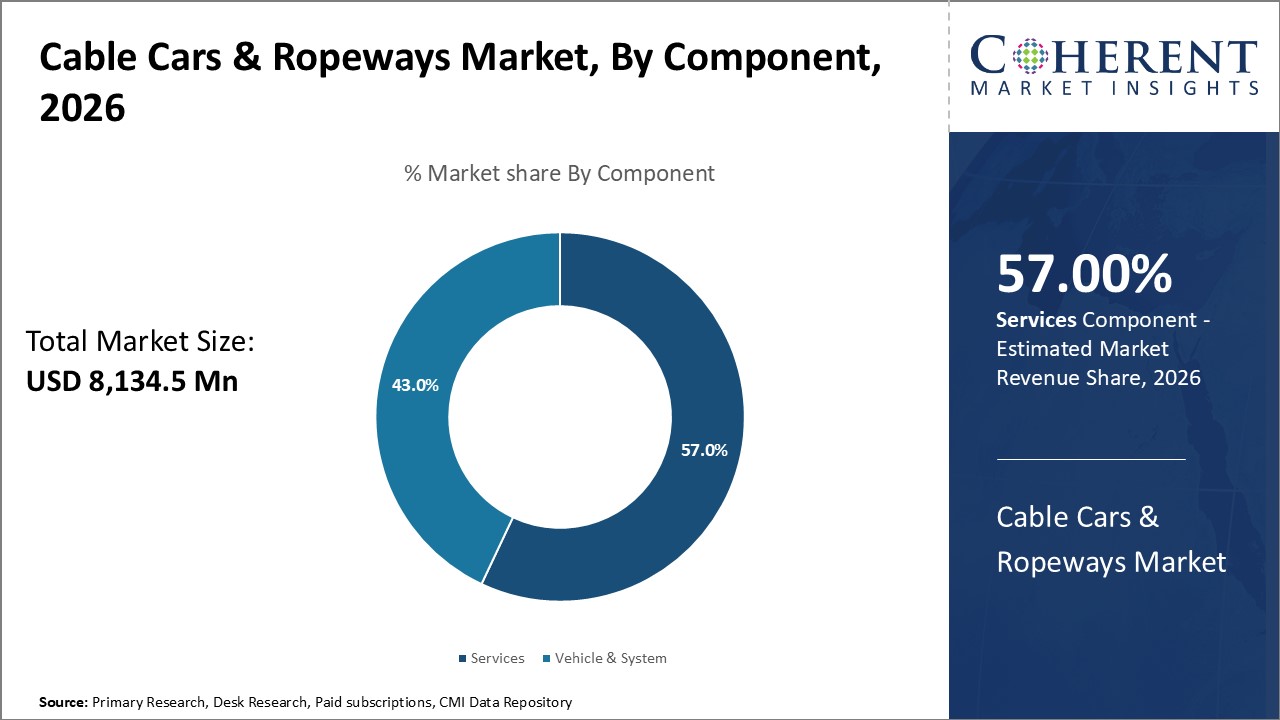
Cable Cars & Ropeways Market Insights, By Component: Services contribute the highest share of the market owing to its tourism & scenic transport
The growing need for maintenance, modernization, and operational support drives the services segment in the Cable Cars & Ropeways market to ensure safety and efficiency. Customers increasingly demand reliable after-sales services such as inspections, repairs, and upgrades, fueling market growth. Technological advancements prompt providers to offer specialized training and support. As ropeway systems expand in tourism and urban transit, service companies actively deliver comprehensive solutions that improve system performance, extend lifespan, and enhance the passenger experience. For instance, in June 2025, London’s cable car introduced an exciting new glass floor experience. Already one of the most daring ways to travel across the capital, the service now lets passengers book an even more thrilling ride.
Cable Cars & Ropeways Market Insights, By Application: Tourism and Public Transit contribute the highest share of the market owing to its alleviating urban congestion & terrain constraints
Tourism and public transit actively drive the Cable Cars & Ropeways market share by offering convenient and scenic transportation options. Operators use these systems to improve access to remote and mountainous areas, enhancing visitor experiences. In urban areas, cable cars provide an efficient, eco-friendly alternative to reduce traffic congestion and pollution. As urbanization rises and tourist destinations expand, stakeholders invest in and innovate aerial mobility solutions that support both leisure travel and everyday commuting needs. For instance, in August 2025, Hyderabad unveiled a ropeway, connecting Golconda Fort and the Qutub Shahi Tombs. Spanning two kilometers, the ropeway aims to make travel easier for tourists and will cut down travel time between the two historic sites. Each cable car will carry up to six passengers.
Regional Insights
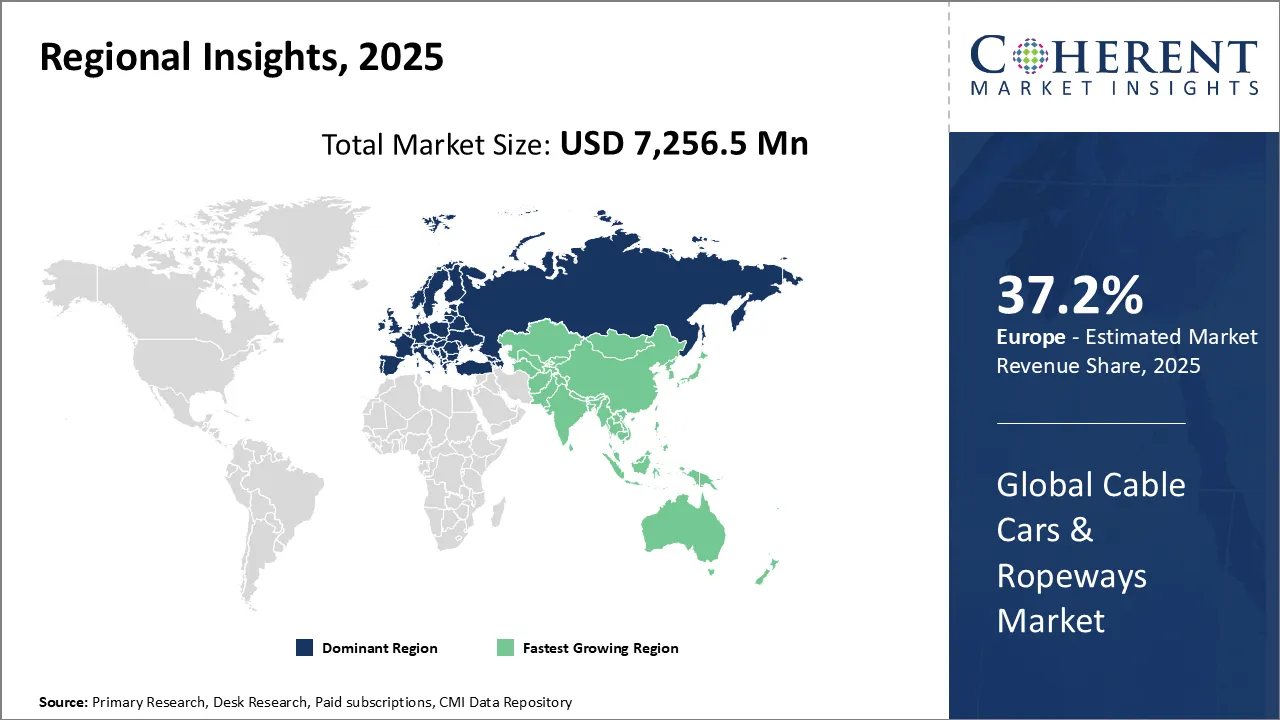
Europe Cable Cars & Ropeways Market Trends
Europe dominates the overall market with an estimated share of 37.2% in 2026. Rising demand for sustainable transport and modern tourism infrastructure drives strong growth in the Europe Cable Cars & Ropeways market revenue. Countries across the region actively invest in ropeway systems to improve connectivity in mountainous regions and support eco-friendly urban mobility. Developers integrate energy-efficient technologies and smart control features into new projects. Leading manufacturers continue to advance system innovations, while governments actively promote ropeways within green transport strategies, accelerating their adoption in both public transit and tourism across the region. For instance, in December 2024, Switzerland unveiled the world’s steepest cable car, which leads up to the James Bond revolving restaurant. The cable car connects the valley-floor village of Stechelberg with Mürren, climbing a track with a gradient of 159.4 percent.
Asia Pacific Cable Cars & Ropeways Market Trends
Countries across Asia Pacific are actively expanding tourism infrastructure and developing efficient urban transport, driving steady growth in the Cable Cars & Ropeways market share. Governments invest in ropeway projects to enhance access to remote regions and ease urban traffic congestion. Growing environmental awareness encourages the use of electric and energy-efficient systems. Public-private partnerships and ongoing technological advancements further accelerate market growth. The region continues to benefit from a combination of new installations and upgrades to existing systems in both tourism and city transport networks. For instance, in January 2024, Udaipur, known for its stunning natural and architectural beauty, launched a ropeway that offers panoramic views of the city from a great height. The ropeway connects a major tourist destination to the heart of Udaipur.
United States Cable Cars & Ropeways Market Trends
Cities and resorts across the United States are exploring innovative solutions for mobility and tourism. Urban planners are showing increased interest in ropeways for commuting, especially in areas with challenging terrain. Ski resorts actively upgrade lift systems to improve safety and enhance the visitor experience. Sustainability goals and distinctive urban development strategies are prompting stakeholders to adopt ropeways as efficient and visually attractive alternatives to traditional transportation options.
China Cable Cars & Ropeways Market Trends
China continues to advance its Cable Cars & Ropeways industry by actively developing large-scale tourism areas and modern transport systems. The government is building ropeway networks to link scenic destinations, cultural sites, and mountainous regions, boosting domestic and international tourism. Urban planners are incorporating ropeways into city designs to ease congestion in crowded areas. Backed by strong policy support, major construction companies and technology providers are driving the expansion and modernization of ropeway infrastructure across the country. China has constructed a ropeway near the Torsa Nala on its side of the India-Bhutan-China tri-junction and is actively enhancing roads and related infrastructure throughout the eastern sector.
Market Report Scope
Cable Cars & Ropeways Market Report Coverage
| Report Coverage | Details | ||
|---|---|---|---|
| Base Year: | 2025 | Market Size in 2026: | USD 8,134.5 Mn |
| Historical Data for: | 2020 To 2024 | Forecast Period: | 2026 To 2033 |
| Forecast Period 2026 to 2033 CAGR: | 12.1% | 2033 Value Projection: | USD 18,095.6 Mn |
| Geographies covered: |
| ||
| Segments covered: |
| ||
| Companies covered: | BartholetMaschinenbauAG (BMF), FUJITSU, Conveyor & Ropeway Services Pvt. Ltd.oSrl, DamodarRopeways & Infra Ltd., Doppelmayr/ GaraventaGroup, LEITNER AG, MND Group | ||
| Growth Drivers: |
| ||
| Restraints & Challenges: |
| ||
Cable Cars & Ropeways Market Trend
- Urban Mobility Transformation
Cities are increasingly adopting ropeways as a part of smart urban mobility solutions. These systems offer a cost-effective way to navigate congested or topographically challenging areas without major infrastructure disruption. Urban planners view them as ideal for linking neighborhoods, reducing road traffic, and cutting emissions. With growing interest in sustainable tourism, more cities are conducting feasibility studies or launching pilot projects to integrate cable cars into public transit networks, reshaping how people move within densely populated environments.
- Shift Toward Eco-Friendly Systems
Environmental concerns are pushing the industry toward greener technologies. Operators are now investing in electric-powered systems, regenerative braking, and solar energy integration. This shift reflects growing pressure to reduce the carbon footprint of transportation, especially in sensitive tourist zones like mountains and heritage sites. Manufacturers are also redesigning cabins and stations with sustainable materials and energy-efficient features. As climate change policies tighten, stakeholders view eco-friendly ropeways as a long-term solution that aligns with global emission-reduction goals.
Cable Cars & Ropeways Market Opportunity
- Expanding Urban Transit Networks
With urban areas facing increasing traffic congestion and pollution, ropeways offer an untapped opportunity to provide sustainable, elevated transport solutions. Cities with challenging terrains or limited space can integrate cable cars to connect suburbs, business districts, and transit hubs. This opportunity allows governments and developers to offer innovative mobility options that reduce road strain and enhance commuter convenience, especially in rapidly growing metropolitan regions looking for cost-effective alternatives to traditional rail or road infrastructure.
Cable Cars & Ropeways Market News
- In February 2025, the Sikkim government initiated efforts to develop cable cars as an alternative mode of public transport in Gangtok, responding to the growing traffic burden and limited space for road expansion.
- In January 2025, the Himachal government launched ropeway between Shimla and Parwanoo to ease traffic congestion and reduce travel time to Shimla. Authorities plan to float a global tender by this month or early next month for the project.
- In August 2024, the Kingdom of Saudi Arabia (KSA) announced plans to launch a cable car system in 2025 to improve access to the Cave of Hira on Makkah’s Jabal Al Noor. Located 634 metres above sea level and around 4 kilometres from the Grand Mosque, the site will be more easily reachable through this new system.
- In April 2024, Mount Faber Leisure Group launched the new futuristic SkyOrb Cabins on the Singapore Cable Car – Mount Faber Line. The launch event took place at Mount Faber Peak as part of the Singapore Cable Car’s 50th anniversary celebrations.
Analyst Opinion (Expert Opinion)
- The Cable Cars & Ropeways market is at a pivotal juncture, driven not just by traditional tourism demand but by an evolving paradigm in urban mobility and sustainability. From an expert perspective, the sector’s most compelling growth vector lies in its integration within smart city frameworks and eco-conscious transport strategies. For instance, Medellín’s Metrocable system in Colombia exemplifies how ropeways can transform urban transit in densely populated, topographically complex cities. This project has slashed commute times by up to 70%, proving that cable cars are no longer niche tourism assets but viable urban infrastructure.
- Furthermore, technology adoption is accelerating the market’s sophistication. The integration of IoT and AI-driven predictive maintenance, as seen in Austria’s innovative installations by Doppelmayr, dramatically reduces downtime and enhances safety. This is crucial because the public’s tolerance for system failures in urban transit is virtually zero, requiring operators to leverage real-time data analytics for operational resilience.
- However, despite these strengths, the market faces structural challenges, notably the high upfront capital investment and complex regulatory approvals, which often deter smaller urban centers from adopting ropeways. This creates a clear opportunity for innovative financing models and streamlined regulatory frameworks to unlock broader deployment.
- In sum, the Cable Cars & Ropeways market is evolving from a predominantly leisure-oriented niche into a core component of urban mobility and sustainable transport solutions. Its success will hinge on technological innovation, policy support, and strategic investments that prioritize integration and operational excellence.
Speak to the analyst
Want personalized insights?
Take the findings above to one of our principal consultants, or have the report rebuilt around the segments, geographies and competitors you actually track.
Market Segmentation
- Global Cable Car & Ropeways Market, By Component, 2021 - 2033, Value (USD Mn) & Volume (Units)
- Vehicles & System, 2021 - 2033
- Fixed Grip
- Detachable
- Gondola, 2021 - 2033
- Surface Lifts, 2021 - 2033
- Material Lifts, 2021 - 2033
- Aerial Tramway, 2021 - 2033
- Funicular, 2021 - 2033
- Inclined Lifts, 2021 - 2033
- Services, 2021 - 2033
- Installation, 2021 - 2033
- Maintenance, 2021 - 2033
- Operations & Management, 2021 - 2033
- Others (Consulting, Design Services, Inspection & Testing), 2021 - 2033
- Vehicles & System, 2021 - 2033
- Global Cable Car & Ropeways Market, By Propulsion, 2021 - 2033, Value (USD Mn) & Volume (Units)
- Electric, 2021 - 2033
- Diesel, 2021 - 2033
- Hybrid, 2021 - 2033
- Global Cable Car & Ropeways Market, By Application, 2021 - 2033, Value (USD Mn) & Volume (Units)
- Tourism and Public Transit, 2021 - 2033
- Material Transport, 2021 - 2033
- Global Cable Car & Ropeways Market, By Region, 2021 - 2033, Value (USD Mn) & Volume (Units)
- North America
- U.S.
- Canada
- Latin America
- Brazil
- Argentina
- Mexico
- Rest of Latin America
- Europe
- Germany
- U.K.
- Spain
- France
- Italy
- Russia
- Rest of Europe
- Asia Pacific
- China
- India
- Japan
- Australia
- South Korea
- ASEAN
- Rest of Asia Pacific
- Middle East
- GCC Countries
- Israel
- Rest of Middle East
- Africa
- South Africa
- North Africa
- Central Africa
- North America
- Key Players Insights
- BartholetMaschinenbauAG (BMF)
- FUJITSU
- Conveyor & Ropeway Services Pvt. Ltd.oSrl
- DamodarRopeways & Infra Ltd.
- Doppelmayr/ GaraventaGroup
- LEITNER AG
- MND Group
Sources
Primary Research Interviews
- Industry experts and engineers from leading ropeway manufacturing companies
- Project managers from tourism and urban transportation infrastructure projects
- Procurement officers from government transport departments
- Operators and maintenance heads of operational cable car systems
- Suppliers of mechanical components and drive systems
Databases
- World Bank Open Data
- UN Comtrade Database
- Statista (for general statistical references)
- International Trade Centre (ITC) Trade Map
- Eurostat
- Indian Ministry of Statistics and Programme Implementation (MoSPI)
Magazines
- International Cableway Review
- Urban Transport News
- Mass Transit Magazine
- Modern Transport
- Engineering Review Magazine
Journals
- Journal of Transportation Engineering
- IEEE Transactions on Intelligent Transportation Systems
- Transport Policy Journal
- Case Studies on Transport Policy
- European Transport Research Review
Newspapers
- The Economic Times
- The Hindu Business Line
- South China Morning Post
- The Times of India
- The Guardian (UK)
Associations
- International Organization for Transportation by Rope (OITAF)
- Cableway Manufacturers of the World (CWA)
- Urban Transport Institutions of respective national governments (e.g., U.S. Department of Transportation, India's Ministry of Housing and Urban Affairs)
- International Association of Public Transport (UITP)
- European Ropeway Association
Public Domain Sources
- Annual reports and investor presentations of publicly listed companies
- Government project tenders and transport department documents
- UN Habitat reports
- Environmental impact assessments published by public authorities
- World Tourism Organization (UNWTO) publications
Proprietary Elements
- CMI Data Analytics Tool, and Proprietary CMI Existing Repository of information for last 8 years
Get access to 250+ pages report
Every segment, forecast, competitor profile and data table behind the analysis above — available for instant download.
- ESOMAR Member
- ISO 9001:2015 Certified
- D-U-N-S Registered
- GDPR & CCPA Compliant
Missing comfort of reading report in your local language? Find your preferred language:
Transform your Strategy with Exclusive Trending Reports
Frequently Asked Questions
The cable cars & ropeways market is estimated to be valued at USD 8,134.5 Mn in 2026 and is expected to reach USD 18,095.6 Mn by 2033.
The CAGR of the Cable Cars & Ropeways Market is projected to be 12.1% from 2026 to 2033.
Moving people conveniently and growth in adventure tourism are the major factors driving the growth of the Global Cable Cars & Ropeways Market.
High initial investment cost and seasonal operations & dependability on weather conditions are the major factors hampering the growth of the Global Cable Cars & Ropeways Market.
BartholetMaschinenbauAG (BMF), FUJITSU, Conveyor & Ropeway Services Pvt. Ltd.oSrl, DamodarRopeways & Infra Ltd., Doppelmayr/ GaraventaGroup, LEITNER AG, MND Group are the major players.
Europe is expected to lead the Global Cable Cars & Ropeways Market in 2026.