

Cell Counting Devices Market Analysis & Forecast 2026-2033
Cell counting devices market is estimated to be valued at USD 11,600 Mn in 2026 and is expected to reach USD 19,600 Mn in 2033, exhibiting a compound annual growth rate (CAGR) of 7.8% from 2026 to 2033.
Key Takeaways
- Based on Product Type, the Instruments segment is expected to hold 65% share of the market in 2026.
- Based on End User, the Hospital segment is expected to lead the market with 37% share in 2026.
- Based on Region, North America is set to lead the cell counting devices market with 39% share in 2026. While, Asia Pacific is anticipated to be the fastest growing region.
Market Overview
Cell counting is a method of counting or quantifying the cells. This method is used to determine the concentration and viability of cells. There are various types of methods present for counting of cells such as counting chambers, by plating and calculating colony forming unit, or by automation, which includes electrical resistance mechanism, flow cytometer, image analysis, and stereologic cell counting. Some of the indirect methods of cell counting are spectrophotometry and impedance microbiology technique. Cell counting is important for diagnosis and treatment of diseases. It is also used by researchers to study the behavior of pathogens including viruses, bacteria, etc. and to estimate the amount for addition of reagents in an experiment. Life expectancy of cancerous cells is determined through cell counting method.
Current Event and Its Impact on Cell Counting Devices Market
Current Event | Description and its Impact |
Global AI and Machine Learning Integration in Healthcare |
|
China's Biotechnology Sector Growth and Trade Relations |
|
How is AI driving accuracy, speed, and growth in the Cell Counting Devices Market?
AI (artificial intelligence) is altering the Cell Counting Devices Market by making cell analysis more accurate, faster, and easier to repeat. AI-powered algorithms make it possible to automatically find, assess, and classify cells, which lowers the risk of human error and makes research and clinical diagnostics more reliable. Combining AI with advanced imaging and flow cytometry systems makes it possible to do high-throughput analysis, which is very important for cancer research, stem cell therapies, and drug development. As clinical trials and regenerative medicine grow, AI-powered cell counting devices are likely to become more popular. These devices give labs smarter, more efficient tools that improve precision medicine and speed up scientific discoveries.
For instance, in April 2025, Scientists made a microfluidic device that uses AI to quickly count CD4+ T-cells in whole blood. The system uses microfluidics and artificial intelligence to provide quick, accurate, and portable immune monitoring. This new idea is highly significant for HIV care because it makes tests available and affordable for hospitals and clinics all over the world, especially in areas with few resources.
- Current Industry Events of 2026
- Market Size Estimation
- Regional Breakdown
- Competitive Landscape
- Customer Intelligence
- Segmental Analysis
- Pricing Analysis
- Key Market Drivers, Challenges & Future Trends
- Customized Insights Section
Segmental Insights
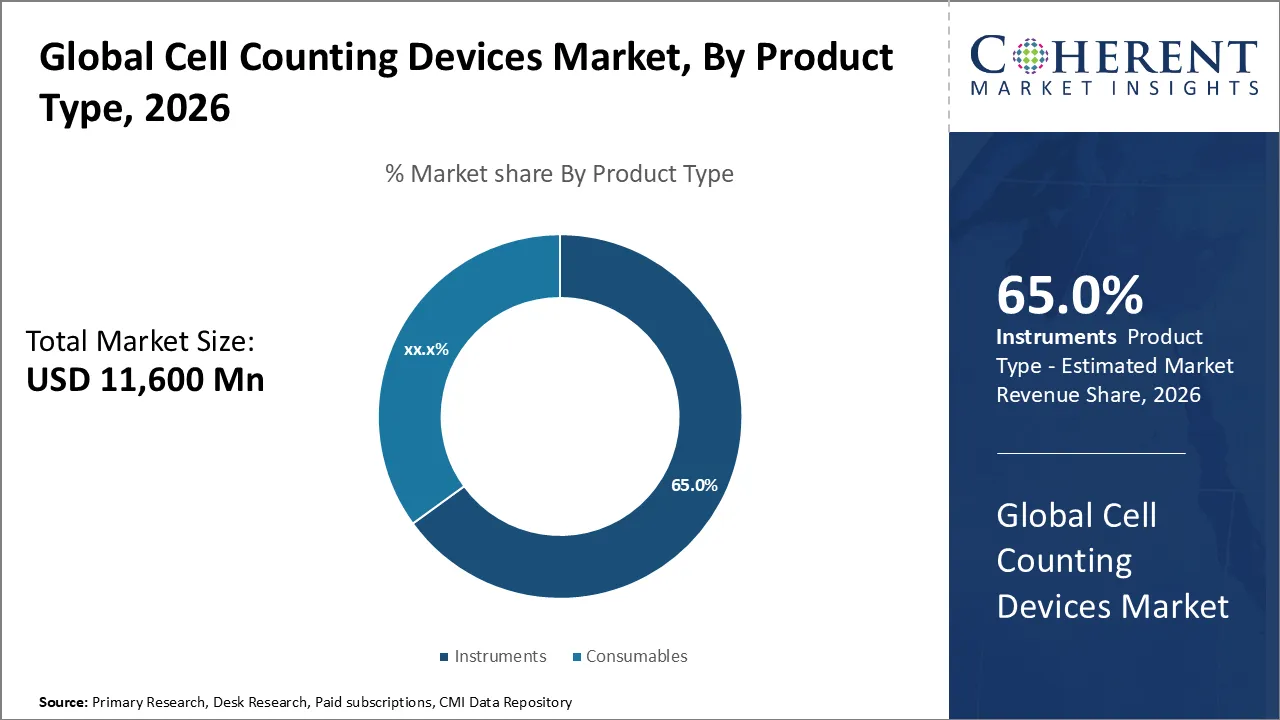
Cell Counting Devices Market Insights, By Product Type: Instruments is driven by automation, accuracy, and speed
In terms of product type, the instruments segment is expected to hold 65% share of the market in 2026. They are essential for cancer research, immunology, and diagnostics as they are accurate, fast, and flexible. Spectrophotometers and hemocytometers contribute but automated instruments drive most revenue. Consumables are growing quickly, but instruments remain the most important part of the market.
For instance, in May 2025, BD announced that they are releasing a groundbreaking cell analyzer that uses new spectral and real-time cell imaging technologies. This new feature improves cell counting by making it more accurate, faster, and flexible. The device is meant to help with cancer research, immunology, and diagnostics, which makes hospitals around the world even more dependent on advanced tools.
Cell Counting Devices Market Insights, By End User: Hospitals lead is driven by diagnostics and personalized medicine
In terms of end user, the hospital segment is expected to lead the market with 37% share in 2026. The need for accurate blood counts, cancer diagnostics, and monitoring of infectious diseases in patient care is growing, drives their leadership. As personalized medicine becomes becoming increasingly vital in treatment, hospitals depend on advanced tools, which give them the highest market share in the world.
For instance, in December 2025, Newton Optics stated that China has a new national standard for counting cells (GB/T 42076.2-2025). Starting in February 2026, it focuses on advanced automated fluorescence
Regional Insights
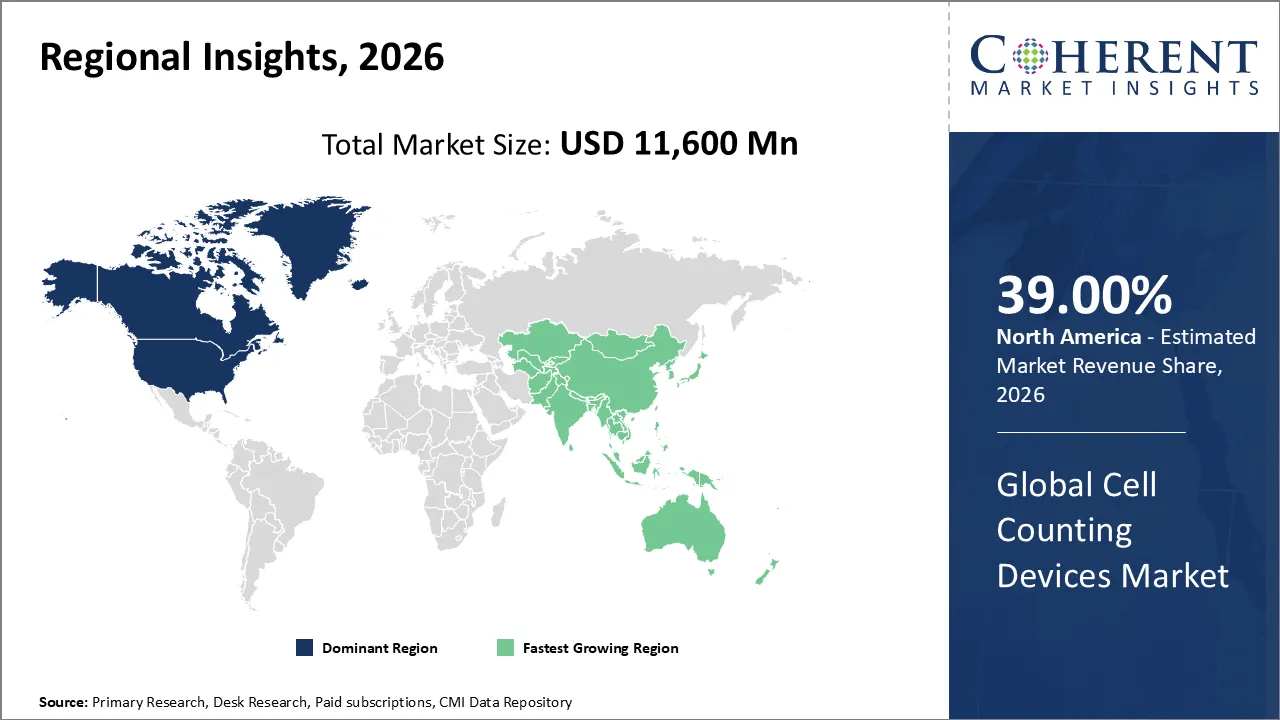
North America Cell Counting Devices Market Analysis & Trends
North America is expected to lead the cell counting devices market with 39% share in 2026, due to strong research and development in the pharmaceutical and biotechnology industries, an increase in cancer cases, and the widespread use of automated tools like flow cytometers. Strong healthcare infrastructure, government funding, and big companies in the industry all help the region grow and keep its top market position.
For instance, in April 2025, Denovix demonstrates the way flow cytometry and image-based automated cell counting offer more accurate, faster, and more consistent. Traditional hemocytometers lack in accuracy, but new tools like the CellDrop counter and imaging cytometers give exact counts. These technologies help with cancer research, immunology, and diagnostics, which shows how important advanced cell counting devices are around the world.
Asia Pacific Cell Counting Devices Market Analysis & Trends
Asia Pacific is expected to exhibit the fastest growth, owing to rising investment into biotechnology, better healthcare infrastructure, and more clinical trials in stem cell and regenerative medicine. The rise in chronic diseases and government support for life sciences research is also driving adoption, making this the fastest-growing region in the world.
For instance, in April 2025, Logos Biosystems released the LUNA-BX7 Automated Cell Counter, which uses advanced optics and AI-powered software to accelerate and improve cell analysis. The device makes research and clinical labs more efficient by making it easier to use and more accurate. It supports studies in cancer, stem cells, and drug development.
Cell Counting Devices Market Outlook Country-Wise
The U.S. Cell Counting Devices Market Trends
The U.S. Cell Counting Devices Market is going to be in high demand in 2026 due to rising prevalence of cancer, strong research and development in pharmaceuticals and biotechnology, and automated instruments are becoming more common. Strong healthcare infrastructure, government funding for life sciences, and the leading businesses in the industry all help to drive innovation, which keeps North America as the largest market in the world.
For instance, in January 2026, Researchers created an open-source robotic system that automates cell culture tasks by combining a custom cell counting imager with the Opentrons OT-2 robot. The system makes 96-well plate seeding more consistent, cuts down on hands-on time by 61%, and makes it easier to repeat experiments. It is a low-cost option for laboratories conducting high-throughput experiments.
China Cell Counting Devices Market Trends
In 2026, China's cell counting devices market is in high demand considering the biotechnology and pharmaceutical industries are growing quickly, the government supports stem cell and regenerative medicine, and chronic diseases has high prevalence. The growth of advanced automated devices is driven by the expansion of healthcare infrastructure and the rise in clinical trials. This leads to strong market growth.
Market Report Scope
Cell Counting Devices Market Report Coverage
| Report Coverage | Details | ||
|---|---|---|---|
| Base Year: | 2025 | Market Size in 2026: | USD 11,600 Mn |
| Historical Data for: | 2020 To 2024 | Forecast Period: | 2026 To 2033 |
| Forecast Period 2026 to 2033 CAGR: | 7.8% | 2033 Value Projection: | USD 19,600 Mn |
| Geographies covered: |
| ||
| Segments covered: |
| ||
| Companies covered: | Paul Marienfeld GmbH & Co. KG, ChemoMetec A/S, BioTek Instruments, Inc., Becton, Dickinson and Company, Tip Biosystems, Corning Inc., Bio-Rad Laboratories, Inc., Agilent Technologies, Inc., GE Healthcare, and Thermo Fisher Scientific. | ||
| Growth Drivers: |
| ||
| Restraints & Challenges: |
| ||
Cell Counting Devices Market Driver
Rising Prevalence of Chronic Diseases
As the number of chronic diseases like cancer, HIV, and blood-related disorders rises, the need for accurate cell analysis for diagnosis and treatment monitoring grows. As the number of people with cancer around the world continues to rise, a rising number of healthcare providers are using hematology analyzers and flow cytometers to make sure the results are accurate. This trend greatly increases the cell counting devices market share as hospitals and diagnostic centers depend on cutting-edge technologies to meet the needs of more patients.
Expansion of Biotechnology & Pharmaceutical R&D
Biotechnology and pharmaceutical companies are intensifying into research to find and make new drugs. Cell viability and proliferation studies are very important for this work. Companies are investing into high-throughput screening and automated cell counting systems that make things faster and more accurate in order to speed up innovation. The rise in research activity is directly driving the cell counting devices market demand, as laboratories and research and development facilities need reliable tools to support large-scale experiments and clinical trials, which in turn leads to growth in the global life sciences sector.
Cell Counting Devices Market Opportunity
Stem Cell & Regenerative Medicine
Stem cell therapies and regenerative medicine depend on accurate cell counting to make sure that treatments work and are correct. As increasing amounts of clinical trials are conducted in these fields, the need for advanced cell counting devices is growing. Researchers and clinicians need reliable tools to measure cell viability and proliferation. This increase in activity is a big chance for companies that make specialized tools for stem cell use to strengthen their position in the changing healthcare landscape. This is especially true since the cell counting devices market forecast to keep growing in the coming years.
Analyst Opinion (Expert Opinion)
The cell counting devices market value is thriving as there is a high demand for them in laboratories, clinics, and biopharmaceutical companies, driven by the need to count cells accurately and quickly. Automated cell counters are now the most popular type of product. They have taken a large share of installations because they can give quick, accurate results, reduce on human error, and add digital analysis tools to workflows. Manual counters and traditional hemocytometers remain useful in academic and cost-sensitive settings, but their use is going down as automation grows.
Consumables and accessories like reagents, assay kits, and tools for preparing samples are a big source of recurring revenue, reflecting labs continue to require these materials to count cells consistently. Flow cytometers, hematology analyzers, and image-based counters are important tools for advanced research and diagnosis, especially in fields like oncology, immunology, and regenerative medicine where accurate cell analysis informs decision-making.
North America has the largest market share in terms of regions, propelled by extensive biomedical research infrastructure and was one of the first places to use advanced technologies. Asia-Pacific is one of the fastest-growing regions, due to rising investment on life science research and modernizing healthcare.
Speak to the analyst
Want personalized insights?
Take the findings above to one of our principal consultants, or have the report rebuilt around the segments, geographies and competitors you actually track.
Recent Developments
- In May 2025, the Cell Counter ICC introduced an optical somatic cell counting device that DeLaval made to save time and money on tests. When used with an iPod touch, it gives results in less than a minute. It is portable and runs on batteries. It tracks cow-specific data through an app, which makes it easier to monitor and manage the health of dairy herds.
- In March 2025, Cytek Biosciences introduced the Muse Micro cell analyzer to its line of cell analysis tools. This new tool is affordable and easy to use. The advanced microcapillary technology, intuitive software, and pre-optimized assays make flow cytometry easier with this small system. It is made for a wide range of uses and makes drug discovery, biopharma, and academic labs more accessible, enabling accurate and dependable cell analysis all over the world.
Market Segmentation
- By Product Type
- Instruments
- Hemocytometer
- Flow Cytometer
- Spectrophotometer
- Others
- Consumables
- Instruments
- By End User
- Research Institutes
- Diagnostic Centers
- Hospitals
- Others
- By Region
- North America
- U.S.
- Canada
- Latin America
- Brazil
- Argentina
- Mexico
- Rest of Latin America
- Europe
- Germany
- U.K.
- Spain
- France
- Italy
- Russia
- Rest of Europe
- Asia Pacific
- China
- India
- Japan
- Australia
- South Korea
- ASEAN
- Rest of Asia Pacific
- Middle East & Africa
- GCC Countries
- Israel
- Rest of Middle East & Africa
- North America
- Cell Counting Devices Market Companies
- Paul Marienfeld GmbH & Co. KG
- ChemoMetec A/S
- BioTek Instruments, Inc.
- Becton
- Dickinson and Company
- Tip Biosystems
- Corning Inc.
- Bio-Rad Laboratories, Inc.
- Agilent Technologies, Inc.
- GE Healthcare
- Thermo Fisher Scientific.
Sources
Primary Research Interviews
- Cell Counting Device Manufacturers
- Flow Cytometry & Imaging System Providers
- Biotechnology & Life Sciences R&D Managers
- Clinical Diagnostics Laboratory Heads
- Pharmaceutical & Biopharmaceutical Researchers
- Academic & Research Institute Scientists
- Others
Databases
- Bloomberg Terminal
- Thomson Reuters Eikon
- PitchBook
- Factiva
- Others
Magazines
- Genetic Engineering & Biotechnology News (GEN)
- Lab Manager Magazine
- BioProcess International
- The Scientist Magazine
- Nature Biotechnology (Industry Section)
- Others
Journals
- Nature Methods
- Journal of Biotechnology
- Cytometry Part A & B
- Analytical Biochemistry
- Journal of Biomedical Optics
- Others
Newspapers
- Financial Times
- The Wall Street Journal
- Reuters
- Bloomberg News
- The Economic Times
- Others
Associations
- International Society for Advancement of Cytometry (ISAC)
- Biotechnology Innovation Organization (BIO)
- American Society for Cell Biology (ASCB)
- Clinical & Laboratory Standards Institute (CLSI)
- European Society for Cell Biology (ESCB)
- Others
Public Domain Sources
- U.S. Food & Drug Administration (FDA) – Medical Devices Database
- National Institutes of Health (NIH)
- World Health Organization (WHO)
- European Medicines Agency (EMA)
- National Center for Biotechnology Information (NCBI)
- Others
Proprietary Elements
- CMI Data Analytics Tool
- Proprietary CMI Existing Repository of Information for the Last 8 Years
Get access to 250+ pages report
Every segment, forecast, competitor profile and data table behind the analysis above — available for instant download.
- ESOMAR Member
- ISO 9001:2015 Certified
- D-U-N-S Registered
- GDPR & CCPA Compliant
Missing comfort of reading report in your local language? Find your preferred language:
Transform your Strategy with Exclusive Trending Reports
Frequently Asked Questions
The cell counting devices market is estimated to be valued at USD 11,600 Mn in 2026, and is expected to reach USD 19,600 Mn by 2033.
Major players operating in the global cell counting devices market include Paul Marienfeld GmbH & Co. KG, ChemoMetec A/S, BioTek Instruments, Inc., Becton, Dickinson and Company, Tip Biosystems, Corning Inc., Bio-Rad Laboratories, Inc., Agilent Technologies, Inc., GE Healthcare, and Thermo Fisher Scientific.
High cost of advanced instruments is expected to hamper growth of the market over the forecast period.
Rising prevalence of chronic diseases and expansion of biotechnology & pharmaceutical R&D are expected to propel growth of the market over the forecast period.
The global cell counting devices market is estimated to exhibit a CAGR of 7.8% over the forecast period.
Among regions, North America is expected to hold dominant position in the global cell counting devices market over the forecast period.