

Cellulose Gel Market Size and Share Analysis- Growth Trends and Forecasts (2026-2033)
The Cellulose Gel Market size is anticipated to grow at a CAGR of 6.1%, with USD 1.53 Bn in 2026, and is expected to reach approximately USD 2.31 Bn by 2033. The primary drivers are largely defined by the rising demand for cellulose gel across food and beverage, pharmaceutical, personal care, and industrial applications, increasing use of stabilizers and texture-enhancing ingredients in processed foods, growing preference for plant-based and functional ingredients, and wider utilization of cellulose gel as a thickener, emulsifier, suspending agent, and moisture-retention ingredient across multiple end-use industries. A 2025 peer-reviewed study covering packaged foods across five Latin American countries found that 77.7% of analyzed products contained at least one food additive, with country-level prevalence reaching 84.0% in Ecuador.
Key Takeaways
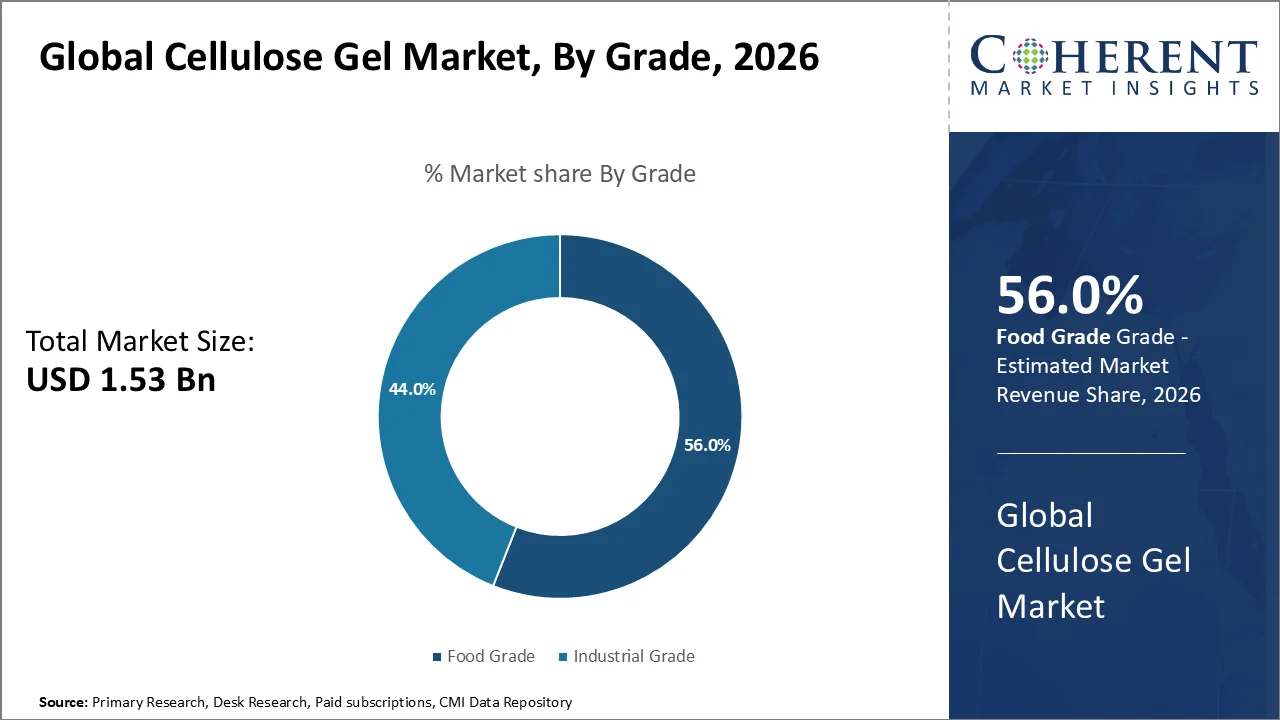
- The food grade segment is likely to dominate the cellulose gel market with 56.0% in 2026. The segment’s growth is owing to the extensive use of purified cellulose gel as a stabilizer, thickener, formulation aid, humectant, and texture-modifying ingredient across processed foods, dairy products, bakery products, beverages, and nutritional formulations. According to the U.S. Centers for Disease Control and Prevention (CDC), in August 2025, ultra-processed foods accounted for 55.0% of total calories consumed by Americans aged one year and above.
- The food and beverages segment is expected to hold the largest share of 36.0% in the cellulose gel market by 2026. This is due to the increasing use of cellulose gel as a viscosity controller, suspension agent, stabilizer, moisture retainer, and texture improver in dairy, bakery, and weight-management products. According to the USDA Dairy Products 2025 Summary, published April 24, 2026, in 2025, the U.S. produced 845 million gallons of regular ice cream, 381 million gallons of low-fat ice cream, and 34.1 million gallons of frozen yogurt, demonstrating the large production base of dairy categories that often require stabilizers and texture-control ingredients.
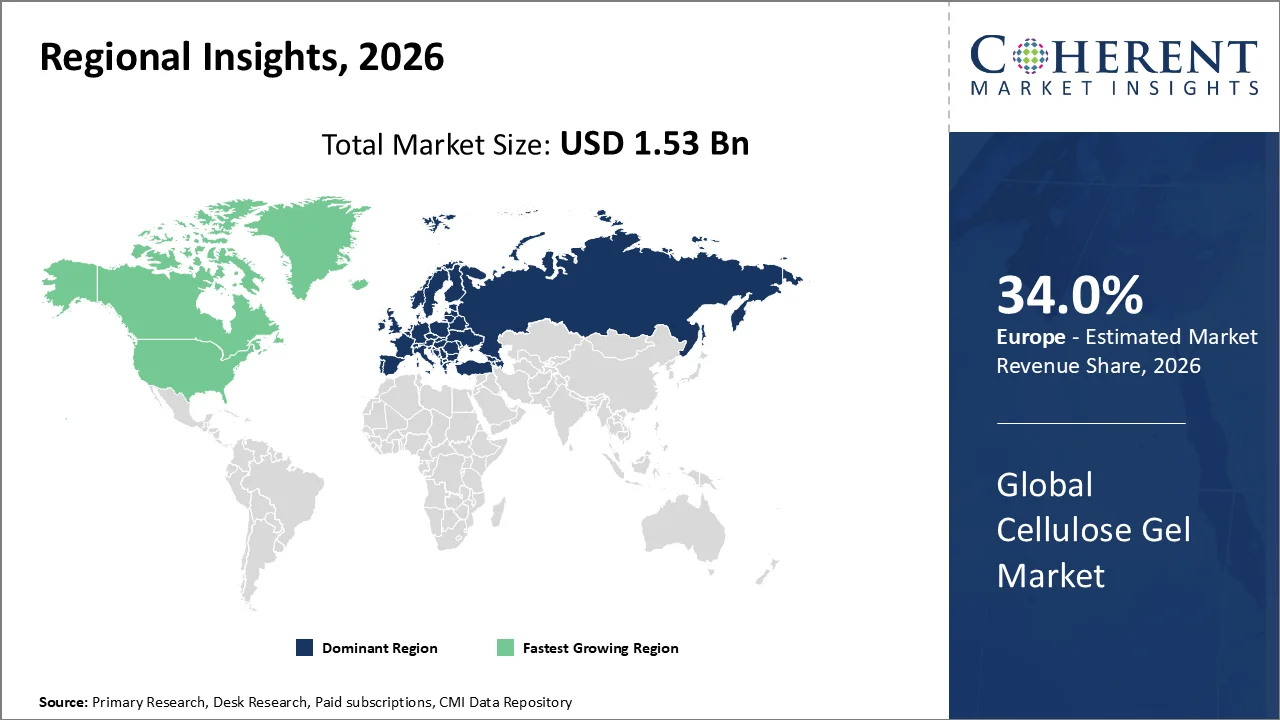
- Europe is projected to lead the cellulose gel market with about 34.0% in 2026. The region’s leadership is reinforced by its large food-processing, pharmaceutical and personal-care manufacturing base, where cellulose gel is used for stabilization, thickening, binding, suspension and formulation consistency. According to Eurostat data suggest the value of EU food-product manufacturing grew by some €17 Bn in 2024 compared to 2023.
Market Drivers
Expanding Food Processing and Formulated Food Consumption is Driving Food-Grade Cellulose Gel Demand
The cellulose gel market is gaining traction due to its wide application in processed foods, beverages, dairy products, bakery formulations, sauces, desserts, and nutritional products. Microcrystalline cellulose, or cellulose gel, is an important formulation function providing stabilization, thickening, moisture management and texture modification. The U.S. FDA specifically identifies cellulose gel for use as a stabilizer or thickener, humectant, formulation aid, and anticaking/free-flow agent in food applications.
As of June 1, 2026, total spending on food in the United States was USD 2.51 trillion, of which USD 1.10 trillion was spent on food eaten at home in 2025 (USDA Economic Research Service). Opportunities continue for food grade cellulose gel in packaged and formulated food consumption, in products requiring viscosity control, suspension stability, better mouthfeel and longer physical stability.
Growth in Pharmaceutical Manufacturing is Expanding High-Purity Cellulose Gel Applications
Pharmaceutical manufacturing is another significant driver for cellulose gel, as microcrystalline cellulose is widely used as an excipient in solid oral dosage forms. It imparts function in tablet manufacture by binding, bulking, flow improvement and formulation consistency. The continued expansion of pharmaceutical production is therefore increasing the addressable demand for pharmaceutical-grade cellulose ingredients.
In July 2025, Eurostat announced that the value of EU production of basic pharmaceutical products and pharmaceutical preparations increased by 12.7% between €234 billion in 2023 and €263 billion in 2024. Meanwhile, the U.S. FDA has announced 46 new drug approvals for 2025, indicating ongoing pharmaceutical product-development work.
Current Events and Their Impact on the Cellulose Gel Market
Current Event | Description and its Impact |
European Commission Tightens Specifications for Cellulose-Based Food Additives (2025–2026) |
|
U.S. FDA Strengthens Oversight and Post-Market Review of Food Ingredients (2026) |
|
- Current Industry Events of 2026
- Market Size Estimation
- Regional Breakdown
- Competitive Landscape
- Customer Intelligence
- Segmental Analysis
- Pricing Analysis
- Key Market Drivers, Challenges & Future Trends
- Customized Insights Section
Segmental Insights
Why is Food Grade Acquiring the Largest Share?
On the basis of grade, the food grade segment is projected to account for the largest cellulose gel market share of 56.0% in 2026. The segment’s dominance is owing to the extensive use of purified cellulose gel in processed foods, dairy products, bakery formulations, sauces, beverages, desserts, and nutritional products. Its stabilizing, thickening, moisture-retention, suspension, and texture-modifying properties make it suitable for large-scale food manufacturing.
The USDA Foreign Agricultural Service said that Brazil’s food processing industry had an estimated revenue of USD 248 billion in 2025, up 8% from the previous year, on March 31, 2026. The report additionally emphasizes the sector’s dependence on imported high-value micro-ingredients and a strong demand for specialty functional ingredients in food formulations.
In January 2026, J. Rettenmaier & Sohne (JRS) has introduced a new concept for plant-based beverage formulations with VIVAPUR MCG, its co-processed stabilizing system of cellulose gel and cellulose gum.
Food and Beverages Holds the Largest Market Share
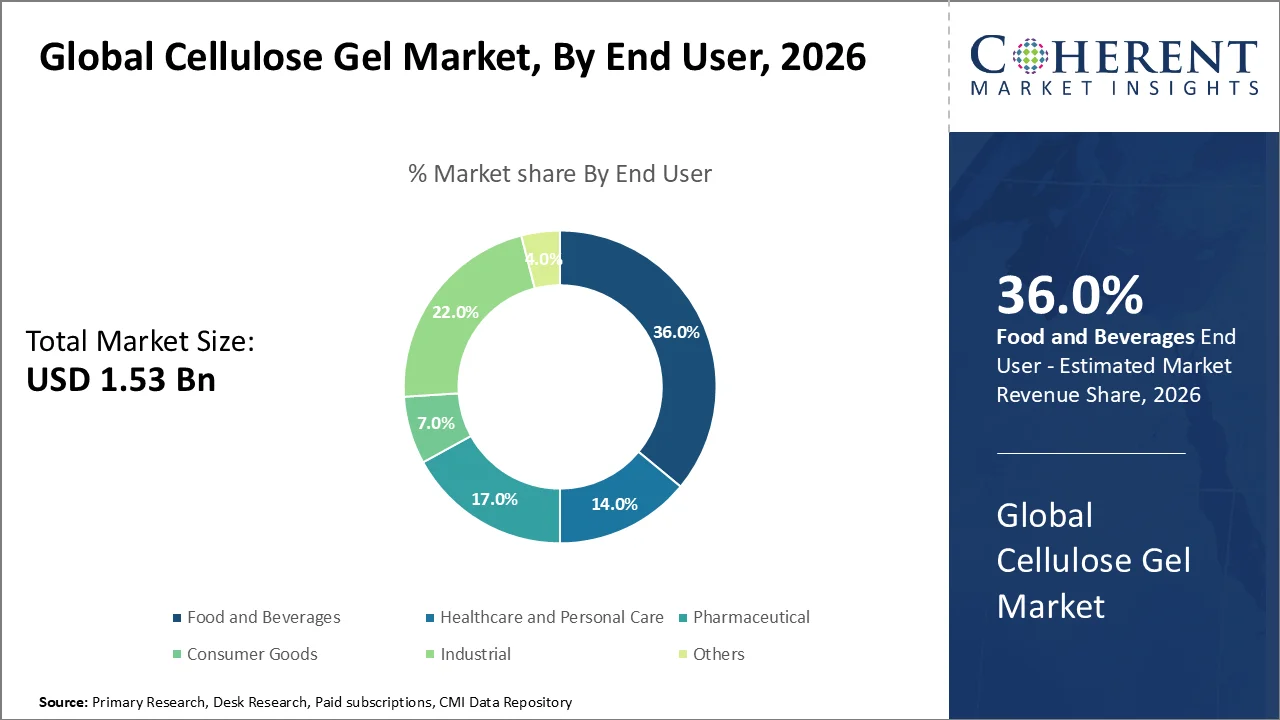
On the basis of end user, the food and beverages segment is set to lead with 36.0% share in 2026. The segment’s growth is owing to the widespread incorporation of cellulose gel for viscosity control, emulsion stabilization, water binding, suspension, texture enhancement, and product consistency. Demand is particularly strong across dairy, bakery, beverages, processed foods, and specialized nutritional formulations.
According to FoodDrinkEurope in February 2026, the EU food and drink industry recorded a year-on-year turnover growth of 3.8% in Q3 2025, with employment in the food sector up 2.4% year-on-year. EU exports of food and drink also reached some USD 56 billion (€48.5 billion) in Q3 2025. The large and growing production base is favorable for the sustained consumption of functional food ingredients such as cellulose gel.
In June 2025, Sigachi Industries announced an expansion of its microcrystalline cellulose portfolio to over 60 MCC grades supported by around 22,000 metric tons per year of manufacturing capacity.
Cellulose Gel Market Trends
- The growing demand for reduced-fat, reduced-sugar and reformulated products, the use of multifunctional texturizers and stabilizers, such as cellulose gel, is on the rise in the manufacture of packaged foods. In January 2025, the U.S. FDA proposed front-of-package nutrition labeling for most packaged foods, including saturated fat, sodium, and added sugars.
- Hydrocolloid and cellulose-based stabilization systems are gaining importance as the emphasis on texture and sensory performance in plant-based foods increases. In a 2026 sensory benchmarking study of 2,684 consumers with >11,000 product evaluations and nearly 800,000 data points, selected plant-based chicken and burger products were suggested to be approaching sensory parity with conventional products.
- The transition toward co-processed cellulose excipients and continuous pharmaceutical manufacturing is driving the demand for application-specific MCC grades with enhanced flow, mixing, compressibility and process stability. In February 2025, Roquette introduced co-processed AVICEL SMCC, which combines MCC with colloidal silicon dioxide, for the manufacture of stronger tablets in direct-compression continuous manufacturing.
Regional Insights
Europe Dominates Owing to the Strong Food, Pharmaceutical, and Personal Care Manufacturing Base
The Europe region accounts for approximately 34.0% of the cellulose gel market share in 2026. The region’s dominance is owing to its established food processing, pharmaceutical, cosmetics, and personal-care industries, where cellulose gel and related cellulose derivatives are extensively utilized as stabilizers, thickeners, binders, suspension agents, and rheology modifiers.
The pharmaceutical manufacturing ecosystem in Europe creates a sizeable application base for pharmaceutical-grade cellulose ingredients. Eurostat said that as of April 28, 2026, EU pharmaceutical exports supported about 926,000 jobs, including about 325,000 jobs directly in the pharmaceutical industry. This highlights the scale of pharmaceutical production and exports across the region, supporting sustained consumption of high-purity cellulose excipients.
North America Cellulose Gel Market Trends
North America is expected to emerge as the fastest-growing region in the cellulose gel market over the forecast period. Growth is supported by expanding pharmaceutical production, high consumption of formulated food products, increasing use of functional ingredients, and continued innovation in food, nutraceutical, and personal-care formulations.
The region has a particularly strong food-processing base. In its June 11, 2026 National Food Security Strategy, the Government of Canada stated that food, seafood, and beverage processing is Canada's largest manufacturing sector and supplies approximately 70% of all processed food and beverage products consumed domestically.
In June 2026, Barentz North America announced an expanded partnership with Roquette, under which Barentz Personal Care became the exclusive U.S. distributor for several Roquette ingredients acquired through IFF Pharma Solutions.
U.K. Cellulose Gel Market Trends
The U.K. Cellulose Gel market is expected to grow at a steady rate during the forecast period. Growth is being driven by the country’s high food and beverage consumption, a well-established pharmaceutical sector and rising investment in domestic life-sciences manufacturing. These industries generate the demand for food and pharmaceutical grade cellulose ingredients used for texture modification, viscosity control, stabilization, binding and consistency in formulation.
Consumer expenditure on food and alcoholic beverages hit £303.3 billion in 2025 and UK food and drink exports were £25.7 billion, according to the latest Food Statistics Pocketbook from the UK Department for Environment, Food & Rural Affairs. The wider agri-food sector also employed approximately 4.1 million people in 2025.
U.S. Cellulose Gel Market Trends
The U.S. Cellulose Gel Market is witnessing steady growth, driven by the country’s large processed-food industry, expanding pharmaceutical manufacturing capacity, and the broad usage of cellulose-based ingredients in food, nutraceutical, personal-care, and oral-solid pharmaceutical formulations. Cellulose gel is particularly useful in these applications for stabilization, thickening, binding, suspension, moisture management and texture control.
According to the U.S. Bureau of Labor Statistics on July 1, 2026, the U.S. food and beverage manufacturing sector employed approximately 2.1 million people in 2024 and is projected to exceed 2.2 million by 2034. The sector accounted for around 16% of total U.S. manufacturing employment, the highest among major manufacturing industries.
Who are the Major Companies in Cellulose Gel Industry
Some of the major key players in Cellulose Gel Market are FMC Corporation, Sigachi Industrial Pvt. Ltd., DFE Pharma GmbH & Co. KG, Libraw Pharma, Asahi Kasei Corporation, Juku Orchem Private Limited, Avantor Performance Materials, Inc., J. Rettenmaier & Sohne GmbH + Co KG Mingtai Chemical Co., Ltd., Blanver Farmoquímica Ltd and Accent Microcell Pvt. Ltd.
Key News
- In August 2025, Sigachi Industries Limited announced the initiation of civil works for a new 12,000 MTPA microcrystalline cellulose (MCC) manufacturing project at its Dahej SEZ facility in Gujarat.
- In February 2026, DFE Pharma launched a new Continuous Manufacturing platform in collaboration with Gericke at its C2F Center of Excellence in Hyderabad. The platform combines CM-ready pharmaceutical excipients with continuous feeding, blending, formulation assessment, and process-development capabilities.
Market Report Scope
Cellulose Gel Market Report Coverage
| Report Coverage | Details | ||
|---|---|---|---|
| Base Year: | 2025 | Market Size in 2026: | USD 1.53 Bn |
| Historical Data for: | 2020 To 2024 | Forecast Period: | 2026 To 2033 |
| Forecast Period 2026 to 2033 CAGR: | 6.1% | 2033 Value Projection: | USD 2.31 Bn |
| Geographies covered: |
| ||
| Segments covered: |
| ||
| Companies covered: | FMC Corporation, Sigachi Industrial Pvt. Ltd., DFE Pharma GmbH & Co. KG, Libraw Pharma, Asahi Kasei Corporation, Juku Orchem Private Limited, Avantor Performance Materials, Inc., J. Rettenmaier & Söhne GmbH + Co KG Mingtai Chemical Co., Ltd., Blanver Farmoquímica Ltd and Accent Microcell Pvt. Ltd. | ||
| Growth Drivers: |
| ||
| Restraints & Challenges: |
| ||
Analyst Opinion
- The Cellulose Gel Market is gradually shifting toward higher-purity and differentiated cellulose grades, particularly for pharmaceutical and personal-care applications. In its July 28, 2026 results, Ashland announced that Life Sciences sales grew 11% to USD 180 million year-on-year and pharmaceutical sales delivered double-digit growth for the fifth quarter in a row. The company specifically pointed to momentum in differentiated cellulose grades, high-purity excipients and low-nitrite products, indicating growing favor for specialized versus commodity cellulose ingredients.
- Investments in pharmaceutical cellulose capacity and supply-chain diversification are rising among manufacturers. Shin-Etsu Chemical will invest about ¥10 billion (roughly USD 67 million) in Japan and Germany, it said March 28, 2025. The program includes a new pharmaceutical cellulose facility in Germany and a doubling of warehouse capacity at its plant in Naoetsu, Japan. The new German facility is expected to be operational in the second half of 2026, driven by increasing global demand for high-performance cellulose excipients and a greater focus on multiple production bases.
- Supply reliability is expected to become an increasingly important competitive factor in the cellulose gel and MCC market. In July 2025, Sigachi Industries’ Telangana MCC plant was closed for around 90 days following a major industrial accident. The plant accounted for more than 25 percent of the company’s total MCC capacity of about 21,700 metric tons per year. This emphasizes the importance of geographically diversified manufacturing, inventory buffers and multi-sourcing strategies for pharmaceutical, food and personal-care customers dependent on cellulose-based functional ingredients.
Speak to the analyst
Want personalized insights?
Take the findings above to one of our principal consultants, or have the report rebuilt around the segments, geographies and competitors you actually track.
Market Segmentation
- By Grade (Revenue, USD Bn, 2021-2033)
- Food Grade
- Purified
- Industrial Grade
- Technical
- Semi-Purified
- Food Grade
- By End User (Revenue, USD Bn, 2021-2033)
- Food and beverages
- Dairy
- Baking
- Weight Management
- Healthcare and Personal Care
- Pharmaceutical
- Consumer Goods
- Industrial
- Paper
- Textile
- Oil and Gas
- Detergent
- Others
- Food and beverages
- By Region (Revenue, USD Bn, 2021-2033)
- North America
- U.S.
- Canada
- Latin America
- Brazil
- Mexico
- Argentina
- Rest of Latin America
- Europe
- Germany
- U.K.
- France
- Italy
- Spain
- Russia
- Rest of Europe
- Asia Pacific
- China
- India
- Japan
- Australia
- South Korea
- ASEAN
- Rest of Asia Pacific
- Middle East
- GCC
- Israel
- Rest of Middle East
- Africa
- South Africa
- Central Africa
- North Africa
- North America
Sources
Primary Research Interviews
- Cellulose gel and microcrystalline cellulose (MCC) manufacturers
- Food ingredient and hydrocolloid formulation specialists
- Food and beverage product development professionals
- Pharmaceutical excipient and formulation scientists
- Personal care and cosmetics formulation experts
- Procurement managers from food, pharmaceutical, and consumer goods companies
- Distributors and suppliers of cellulose-based functional ingredients
- Industrial users across paper, textile, detergents, and oil & gas applications
- Key opinion leaders (KOLs) in cellulose chemistry, food science, and pharmaceutical excipients
Databases
- U.S. Food and Drug Administration (FDA) – Inactive Ingredient Database
- U.S. Department of Agriculture (USDA) – Economic Research Service and FAS GAIN Database
- European Food Safety Authority (EFSA) – OpenFoodTox
- Eurostat
- FAOSTAT
- UN Comtrade Database
- U.S. Census Bureau – Manufacturing and Trade Statistics
- European Chemicals Agency (ECHA)
Magazines
- Food Business News
- Food Ingredients First
- Pharmaceutical Technology
- European Pharmaceutical Review
- Cosmetics & Toiletries
- Chemical & Engineering News
- Food Manufacture
Journals
- Food Hydrocolloids
- Carbohydrate Polymers
- International Journal of Biological Macromolecules
- Journal of Food Engineering
- International Journal of Pharmaceutics
- AAPS PharmSciTech
- European Journal of Pharmaceutics and Biopharmaceutics
- Cellulose
Newspapers
- Reuters
- Financial Times
- The Wall Street Journal
- The Guardian
- The Economic Times
- Business Standard
Associations
- Institute of Food Technologists (IFT)
- International Pharmaceutical Excipients Council (IPEC)
- FoodDrinkEurope
- Cosmetics Europe
- Personal Care Products Council (PCPC)
- European Federation of Pharmaceutical Industries and Associations (EFPIA)
- American Association of Pharmaceutical Scientists (AAPS)
Public Domain Sources
- Company Annual Reports and Investor Presentations
- Company Product Catalogs, Technical Data Sheets, and Safety Data Sheets
- U.S. FDA Food Ingredient and Pharmaceutical Excipient Publications
- EFSA Food Additive Assessments and European Commission Regulations
- USDA Food Processing and Ingredient Industry Reports
- Government Food, Pharmaceutical, and Manufacturing Statistics
- Pharmacopoeial Standards including USP–NF and European Pharmacopoeia
- University and Academic Research Publications on Cellulose, MCC, and Cellulose Derivatives
- Patent Databases such as WIPO, USPTO, and Google Patents
- Regulatory Publications Related to Food Additives, Pharmaceutical Excipients, and Chemical Safety
Proprietary Elements
- CMI Data Analytics Tool
- Proprietary CMI Existing Repository of Information for the Last 10 Years
Get access to 250+ pages report
Every segment, forecast, competitor profile and data table behind the analysis above — available for instant download.
- ESOMAR Member
- ISO 9001:2015 Certified
- D-U-N-S Registered
- GDPR & CCPA Compliant
Missing comfort of reading report in your local language? Find your preferred language:
Transform your Strategy with Exclusive Trending Reports
Frequently Asked Questions
The Cellulose Gel Market is expected to reach approximately USD 2.31 Bn in 2033, compared with USD 1.53 Bn in 2026.
Major players operating in the global Cellulose Gel Market include FMC Corporation, Sigachi Industrial Pvt. Ltd., DFE Pharma GmbH & Co. KG, Libraw Pharma, Asahi Kasei Corporation, Juku Orchem Private Limited, Avantor Performance Materials, Inc., J. Rettenmaier & Sohne GmbH + Co KG, Mingtai Chemical Co., Ltd., Blanver Farmoquímica Ltd., and Accent Microcell Pvt. Ltd.
The high raw material and purification costs and stringent food and pharmaceutical quality requirements are among the key factors hampering growth of the Cellulose Gel Market.
The increasing adoption of cellulose gel in processed food and beverage formulations and its rising use as a stabilizer, thickener, and texture modifier are key factors driving market growth. Growing pharmaceutical manufacturing is also supporting demand for high-purity cellulose excipients.
The Cellulose Gel Market is anticipated to grow at a CAGR of 6.1% between 2026 and 2033.
Among regions, Europe is expected to dominate the global Cellulose Gel Market with approximately 34.0% market share in 2026. The region benefits from an established food processing, pharmaceutical, cosmetics, and personal-care manufacturing base.
North America is expected to emerge as the fastest-growing region over the forecast period. The growth is supported by expanding pharmaceutical production, high consumption of formulated foods, and increasing use of functional ingredients across food, nutraceutical, and personal-care applications.