

Colombia, Chile and Peru Wilson’s Disease Treatment Market Size and Share -2026 to 2033
The Colombia, Chile and Peru Wilson’s Disease Treatment market size is estimated to reach around USD 0.80 Mn in 2026 and is projected to grow at a CAGR of 5.1% during the forecast period (2026-2033), totalling USD 1.19 Mn by 2033.
Key Takeaways from the Colombia, Chile and Peru Wilson’s Disease Treatment Market Report
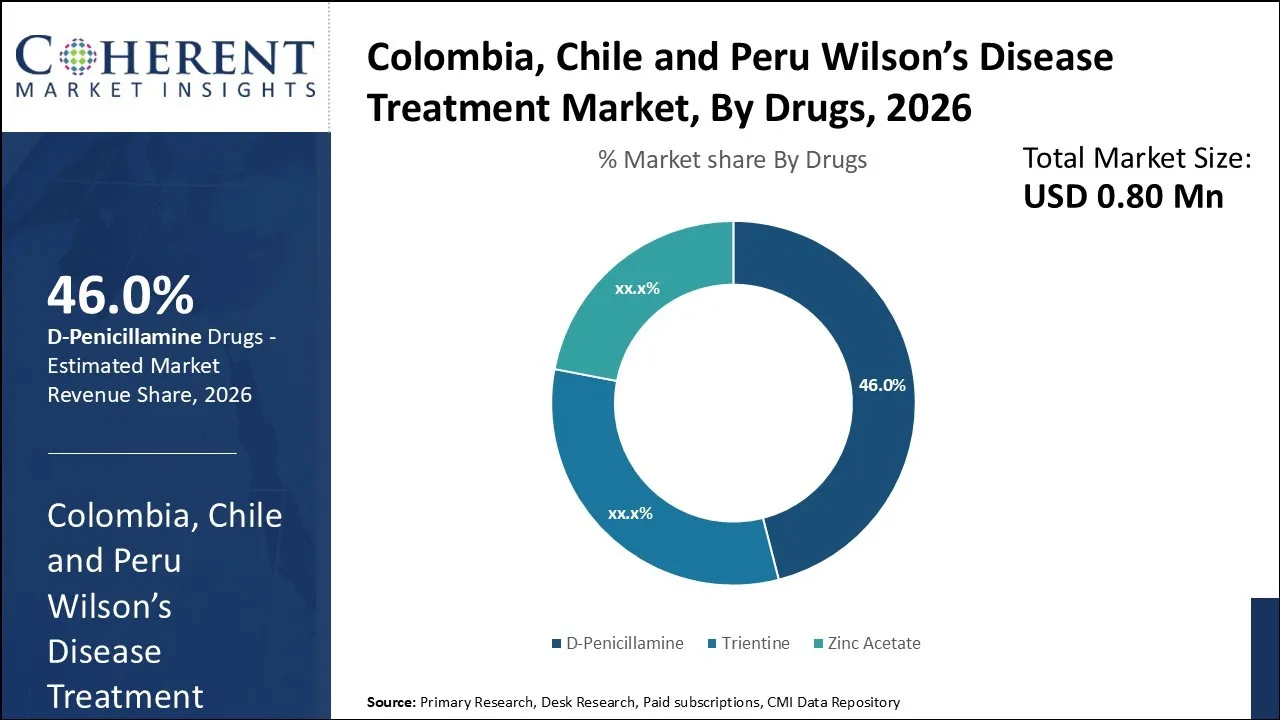
- D-Penicillamine are expected to remain the most sought-after product type, accounting for a market revenue share of 46% in 2026, D-Penicillamine has been the cornerstone of Wilson’s Disease treatment for decades
- By Distribution Channel, hospital pharmacies segment is slated to dominate the market during the forecast period.
- The Colombia is projected to lead the market, accounting for an 85% share in 2026.
Colombia, Chile and Peru Wilson’s Disease Treatment Market Overview
Colombia, Chile and Peru Wilson’s Disease Treatment market is projected to grow steadily during the forecast period. This is primarily due to the adoption of genetic testing for early diagnosis. Wilson’s Disease, a rare genetic disorder characterized by copper accumulation leading to liver and neurological damage, poses considerable diagnostic challenges, often leading to delayed treatment. In recent years, these countries have increasingly integrated genetic testing into clinical practice, facilitating earlier and more accurate identification of affected individuals, particularly in at-risk populations.
Wilson’s Disease, a rare genetic disorder characterized by excessive accumulation of copper in the body, primarily requires therapies that facilitate copper removal or prevent its absorption. Chelation agents, such as penicillamine and trientine, work by binding excess copper and facilitating its excretion, while zinc-based therapies inhibit the absorption of copper from the gastrointestinal tract.
Increasing awareness of Wilson's disease has played a pivotal role in driving the growth of the Wilson’s Disease Treatment Market across Colombia, Chile, and Peru. Historically, Wilson’s disease, a rare genetic disorder characterized by excessive copper accumulation in tissues, remained underdiagnosed in these countries due to limited public and physician awareness, coupled with inadequate diagnostic facilities. For instance, to address these issues, the Wilson Disease Association (WDA) marked the 2nd International Wilson Disease Awareness Day on December 6, 2025, to celebrate the progress made in the global Wilson disease community. This event highlights the efforts to raise awareness about the disease, which affects approximately 1 in 30,000 people worldwide.
Wilson’s disease is a rare genetic disorder characterized by excess copper stored in various body tissues, particularly in the liver, brain, and corneas of the eyes. The disease is progressive, and if left untreated, it may cause liver (hepatic) disease, central nervous system dysfunction, and death. The signs and symptoms of Wilson’s disease usually first appear between the ages of 6 and 45 years; however, they most often begin during the teenage years. Wilson’s disease is also known as hepatolenticular degeneration and lenticular degeneration.
Current Events and Their Impact on the Colombia, Chile and Peru Wilson’s Disease Treatment Market
Current Event | Description and its Impact |
Rising Healthcare Expenditures and Government Health Investment |
|
Government-Backed Insurance Programs and Policy Support |
|
Segmental Insights
- Current Industry Events of 2026
- Market Size Estimation
- Regional Breakdown
- Competitive Landscape
- Customer Intelligence
- Segmental Analysis
- Pricing Analysis
- Key Market Drivers, Challenges & Future Trends
- Customized Insights Section
Colombia, Chile and Peru Wilson’s Disease Treatment Market Insights, By Drugs: D-Penicillamine Remain Top-Selling Drug
Based on drugs, D- Penicillamine segment is expected to dominate the market, with a revenue share of about 46% in 2026. D-Penicillamine has been the cornerstone of Wilson’s Disease treatment for decades, primarily due to its mechanism as a chelating agent that binds to excess copper in the body, facilitating its excretion through the urine.
This drug’s widespread recognition among healthcare professionals across Colombia, Chile, and Peru is bolstered by numerous clinical guidelines and treatment protocols established by regional health authorities and international organizations, such as the Wilson Disease Association and the Pan American Health Organization (PAHO).
Colombia, Chile and Peru Wilson’s Disease Treatment Market Insights, By Distribution Channel: Hospital Pharmacies Dominates Distribution Channel Segment
By distribution channel, hospital pharmacies segment is slated to hold a dominant position in market over the forecast period. Hospital pharmacies in these countries serve as primary hubs for the dissemination of specialized medications like chelating agents (e.g., penicillamine and trientine) and zinc salts, which are critical in managing copper accumulation in Wilson’s Disease patients.
The dominance of Hospital Pharmacies is strongly linked to the fact that treatment initiation and monitoring for Wilson’s Disease necessitate close clinical supervision and periodic evaluation of biochemical parameters, activities primarily coordinated within hospital settings. For example, in Colombia, major tertiary care hospitals such as the Fundación Santa Fe de Bogotá and Clínica Universitaria Colombia are equipped with specialized liver units and provide comprehensive care pathways for patients with genetic liver disorders, including Wilson’s Disease.
Colombia, Chile and Peru Wilson’s Disease Treatment Market Outlook – Country-wise
Colombia Remains at the Epicenter of Market Growth
The Colombia is expected to remain the market leader, accounting for a share of about 85% in 2026. The country has established one of the most comprehensive healthcare systems in Latin America, known for wide accessibility, government-supported health initiatives, and a robust network of healthcare facilities specializing in rare diseases like Wilson’s Disease. A key driver of this success has been the country’s commitment to rare disease awareness and treatment.
For instance, as detailed in an article published by Uncommon Cure in December 2024, Law 1392, passed in 2010, mandates social protection for individuals with rare diseases, ensuring they have access to medicines and diagnostics, while promoting the development of centers of excellence. In line with this law, Colombia created a national registry for rare diseases, which, as of 2017, included over 13,000 patients across 653 different conditions. Moreover, the Federación Colombiana de Enfermedades Raras (FECOER) plays an active role in advocacy and policy development, contributing to growing public awareness. The country has also participated in Rare Disease Day since 2009, raising awareness and encouraging collaboration among stakeholders.
Colombia, Chile and Peru Wilson’s Disease Treatment Industry News
- In June 2025, Orphalan SA, a global pharmaceutical company focused on rare diseases, has partnered with MAP International and the Wilson Disease Association (WDA) to provide Cuvrior (trientine tetrahydrochloride) to patients with Wilson’s Disease in developing countries worldwide, including Colombia.
- In June 2025, The Wilson Disease Association (WDA) has teamed up with MAP International, along with pharmaceutical companies like Bausch and Orphalan, to provide free supplies of Cuprimine®, Syprine®, and Cuvrior® to patients outside the U.S.
Market Report Scope
Colombia, Chile and Peru Wilson’s Disease Treatment Market Report Coverage
| Report Coverage | Details | ||
|---|---|---|---|
| Base Year: | 2025 | Market Size in 2026: | USD 0.80 Mn |
| Historical Data for: | 2020 To 2024 | Forecast Period: | 2026 To 2033 |
| Forecast Period 2026 to 2033 CAGR: | 5.1% | 2033 Value Projection: | USD 1.19 Mn |
| Geographies covered: |
| ||
| Segments covered: |
| ||
| Companies covered: | Teva Pharmaceuticals Industries Ltd., Bausch Health Companies Inc., Alexion Pharmaceutical, Inc., and Sanofi S.A. | ||
| Growth Drivers: |
| ||
| Restraints & Challenges: |
| ||
Colombia, Chile and Peru Wilson’s Disease Treatment Market Drivers
Rising healthcare expenditures in South American nations
Rising healthcare expenditures in South American nations, particularly Colombia, Chile, and Peru, have significantly contributed to the expansion of the Wilson’s Disease treatment market in these countries. Governments in this region have been increasing their budgets to improve healthcare infrastructure and ensure broader access to specialized treatments for rare genetic disorders like Wilson’s Disease.
According to the OECD 2025 report, many Central and Eastern European countries, as well as newer OECD members in Latin America, spend between 6-9% of their GDP on healthcare. Mexico and Türkiye are exceptions, with spending below 6% of their GDP on healthcare. As healthcare investments continue to rise in nations like Colombia, governments are focusing on expanding access to specialized treatments for conditions like Wilson’s Disease, which is driving market growth in these regions.
Stringent Government and Law Enforcement Regulations
Targeted government initiatives in Colombia, Chile, and Peru have significantly catalyzed advancements in the management of rare diseases such as Wilson’s Disease, thereby positively influencing the development of the Wilson’s Disease treatment market in these countries. Governments in these Latin American nations have increasingly prioritized rare disease policies, focusing on enhancing early diagnosis, patient registries, and access to specialized treatment.
For example, Chile’s Ministry of Health has implemented a national strategy specifically aimed at rare diseases, which includes subsidized access to medications and improved diagnostic infrastructure at public hospitals. This approach ensures that patients with Wilson’s Disease, a rare genetic disorder characterized by copper accumulation, receive timely and adequate treatment.
Colombia, Chile and Peru Wilson’s Disease Treatment Market Trends
Competing therapies including novel drug delivery methods and gene therapies challenging conventional treatments
The emergence of novel therapeutic approaches is fundamentally reshaping treatment paradigms in the Colombia, Chile, and Peru Wilson's Disease market by challenging the dominance of conventional chelating agents that have been the standard of care for decades. Traditionally, D-Penicillamine and Trientine have served as the primary copper-removal therapies, but the pharmaceutical industry is now actively exploring alternative delivery systems and mechanism-based interventions.
Colombia, Chile and Peru Wilson’s Disease Treatment Market Opportunities
Development of enhanced patient support systems and diagnostic tools to improve early detection rates
The development of enhanced patient support systems and diagnostic tools represents a critical opportunity to address the significant diagnostic gaps currently limiting Wilson's disease detection and treatment in Colombia, Chile, and Peru. Wilson's disease remains an orphan disease in Colombia with insufficient epidemiological understanding despite its potential for serious complications when left undiagnosed.
Growing demand through national health insurance schemes and partnerships to improve patient care in remote areas
The growing demand for Wilson’s Disease treatment in Colombia, Chile, and Peru is being significantly bolstered by the expansion of national health insurance schemes and strategic partnerships aimed at enhancing patient care in remote and underserved regions. These countries have increasingly recognized the need to address rare and chronic diseases like Wilson's Disease, which requires lifelong management involving chelation therapy and other treatments.
Analyst Opinion (Expert Opinion)
- The Wilson’s Disease treatment market in Colombia, Chile, and Peru is poised for steady advancement, driven primarily by increasing disease awareness and improved diagnostic capabilities across these countries. Rising prevalence of Wilson’s Disease, coupled with enhanced healthcare infrastructure and government initiatives aimed at managing rare genetic disorders, act as key growth drivers. In particular, Chile and Colombia are witnessing strengthened healthcare reforms and increased availability of advanced treatment modalities, which support better patient outcomes.
- However, market growth faces challenges such as limited access to specialized healthcare facilities in rural areas and high treatment costs, which can hinder widespread adoption of standard therapies. Additionally, lack of extensive clinical data and patient registries in these regions may slow targeted drug development and personalized treatment options.
- Opportunities exist in expanding patient education programs and fostering collaborations between local healthcare providers and global pharmaceutical companies to introduce innovative therapies. The ongoing investments in research and development to enhance the efficacy and safety profiles of chelating agents and zinc-based treatments are promising.
Speak to the analyst
Want personalized insights?
Take the findings above to one of our principal consultants, or have the report rebuilt around the segments, geographies and competitors you actually track.
Market Segmentation
- By Drugs Insights (Revenue, USD Mn, 2020 - 2033)
- D- Penicillamine
- Trientine
- Zinc Acetate
- By Distribution Channel Insights (Revenue, USD Mn, 2020 - 2033)
- Hospital Pharmacies
- Government Distribution Channels
- By Region Insights (Revenue, USD Mn, 2020 - 2033)
- Colombia
- Chile
- Peru
- Key Players
- Teva Pharmaceuticals Industries Ltd.
- Bausch Health Companies Inc.
- Alexion Pharmaceutical, Inc.
- Sanofi S.A.
Sources
Primary Research interviews
- Key Opinion Leaders (KOLs) in Hepatology and Neurology from Colombia
- Pharmaceutical Manufacturers and Distributors in Chile
- Healthcare Providers and Treatment Centers from Peru
- Healthcare Payers and Insurance Representatives
- Others
Databases
- PubChem
- FDA (U.S. Food and Drug Administration) Device Databases
- CDC (Centers for Disease Control and Prevention) DataPortal
- EvaluatePharma
- Pharmaprojects
Magazines
- Pharma Times Latin America
- Latin American Pharmaceutical Review
- MedTech Insight Latin America
- Others
Journals
- Journal of Hepatology
- Movement Disorders Journal
- Neurology Latin America
- Others
Newspapers
- El Tiempo (Colombia)
- El Mercurio (Chile)
- El Comercio (Peru)
- The Santiago Times
- Others
Associations
- Colombian Association of Neurology
- Chilean Liver Foundation
- Peruvian Society of Neurology
- Latin American Society for Wilson’s Disease Research
- Others
Public Domain sources
- World Health Organization (WHO) Regional Office for the Americas
- Pan American Health Organization (PAHO)
- National Ministry of Health Websites for Colombia, Chile, and Peru
- ClinicalTrials.gov
- Others
Proprietary Elements
- CMI Data Analytics Tool
- Proprietary CMI Existing Repository of information for last 8 years
Get access to 250+ pages report
Every segment, forecast, competitor profile and data table behind the analysis above — available for instant download.
- ESOMAR Member
- ISO 9001:2015 Certified
- D-U-N-S Registered
- GDPR & CCPA Compliant
Missing comfort of reading report in your local language? Find your preferred language:
Transform your Strategy with Exclusive Trending Reports
Frequently Asked Questions
The Colombia, Chile and Peru Wilson’s Disease Treatment market is estimated to be valued at USD 0.80 Mn in 2026.
Colombia, Chile and Peru Wilson’s Disease Treatment Market value is expected to surpass USD 1.19 Mn by 2033.
Colombia, Chile and Peru Wilson’s Disease Treatment market is poised to exhibit a CAGR of 5.1% from 2026 to 2033.
Major growth factors include the increasing number of drug approvals from regulatory bodies.
The high price of drugs (including branded and generic) for the treatment of Wilson’s disease and low affordability among patients for such drugs in Colombia, Chile, and Peru is a major hurdle for the market growth.
D- Penicillamine segment, with about 46% market share in 2026, dominates the market.
Teva Pharmaceuticals Industries Ltd., Bausch Health Companies Inc., Alexion Pharmaceutical, Inc., and Sanofi S.A. are the major players.