

Conductive Carbon Black Market Size and Share Analysis - 2026 To 2033
The conductive carbon black market size is anticipated to grow at a CAGR of 9.1% with USD 420 Mn in 2026 and is expected to reach USD 730 Mn in 2033. The primary drivers are largely defined by battery-electrification growth, as the U.S. DOE noted that the U.S. has built a pipeline of more than 1,100 GWh per year of battery-cell manufacturing capacity. Other drivers include high-voltage cable upgrades, demand for conductive plastics in electronics and automotive parts, carbon-black dispersion needs, and low-carbon additive development.
Key Takeaways
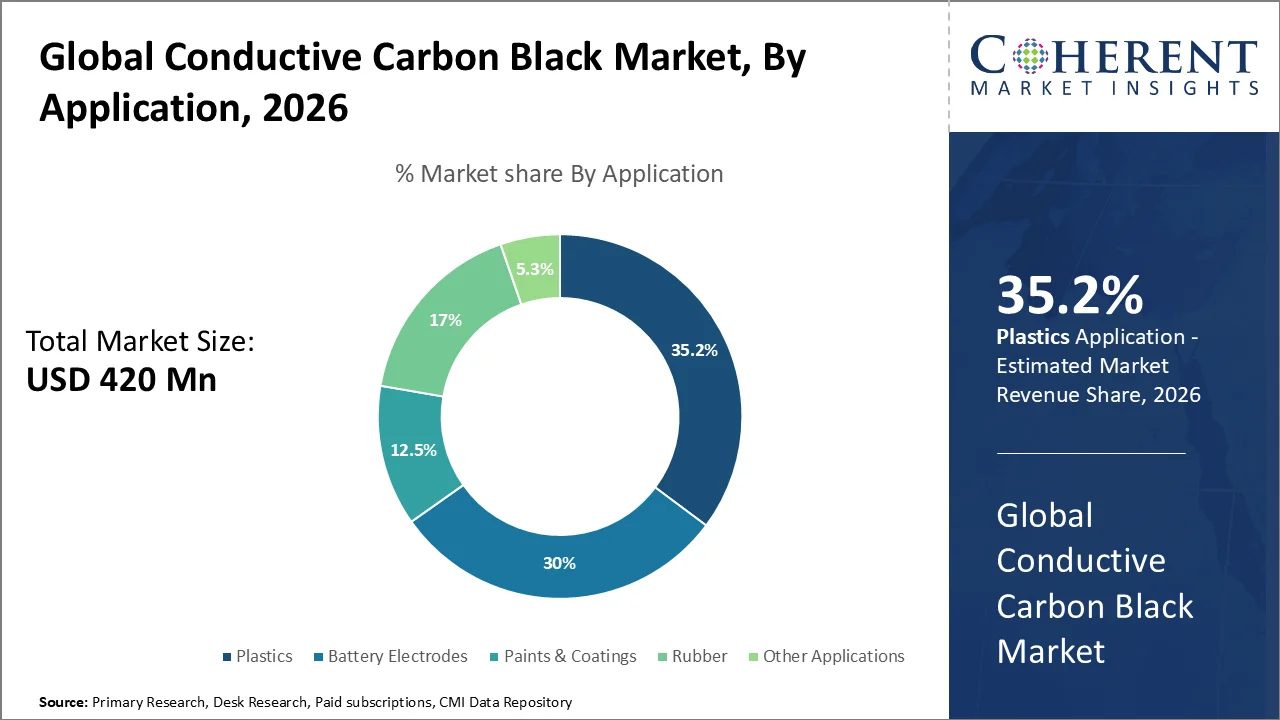
- Plastics is set to lead with 35.2% in 2026. The segment’s growth is owing to increasing use of conductive and anti-static plastic compounds in electronics packaging, automotive parts, wire and cable insulation, industrial containers, and ESD-safe plastic components. Conductive carbon black helps plastics achieve surface conductivity, static-dissipation, durability, and cost-effective performance across high-volume polymer applications.
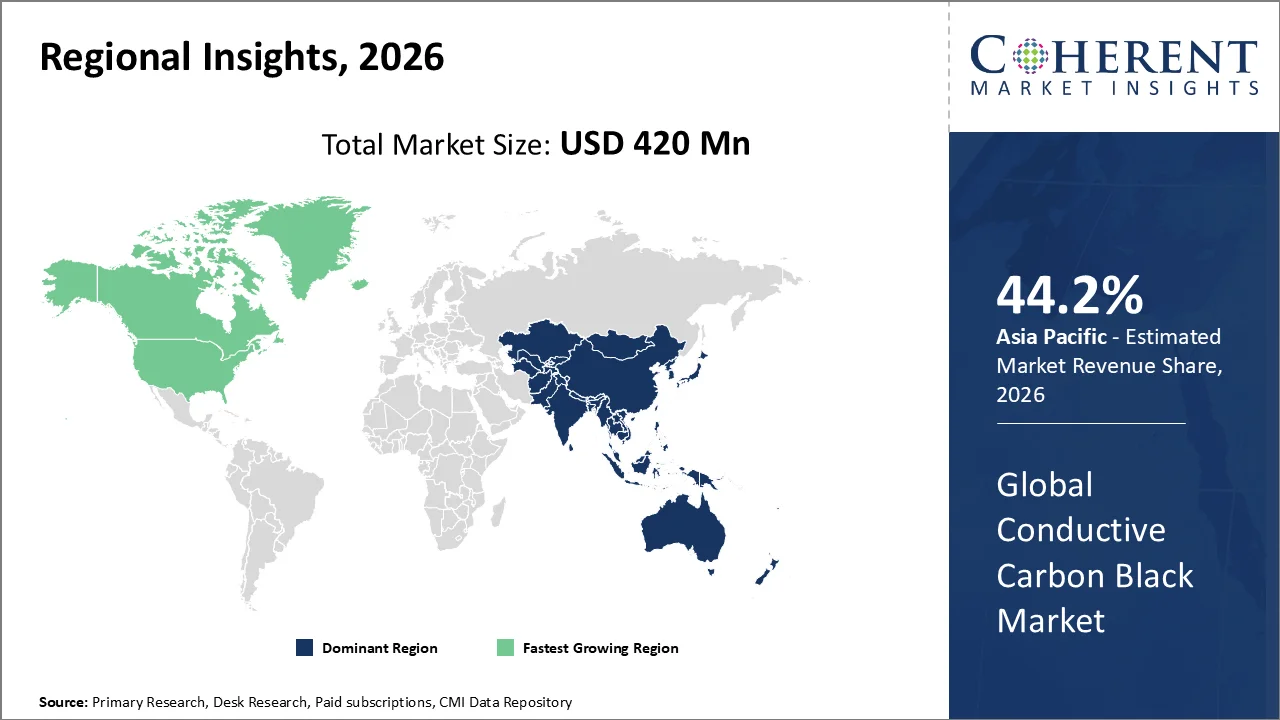
- Asia Pacific is expected to acquire the prominent share of 44.2% in 2026. This is due to region’s strong electronics manufacturing, rapid EV battery production, expanding polymer compounding capacity, and rising demand for conductive additives in lithium-ion batteries, cables, and engineering plastics. The IEA reported that China sold over 11 Mn electric cars in 2024, supporting regional market demand for battery-grade conductive carbon black.
Segmental Insights
Why is Plastics Acquiring the Largest Share?
On the basis of application, plastics is projected to account for the largest conductive carbon black market share of 35.2% in 2026. The segment is gaining the highest share because of the broad use of conductive carbon black in plastic compounds. It assists in improving electrical conductivity, electrostatic discharge protection, UV resistance, and overall material performance.
It is widely used in packaging films, automotive plastic parts, electronic housings, wire and cable insulation, and industrial plastic products. Growing plastic production is further strengthening demand for conductive additives. According to the U.S. Department of Energy, U.S. plastics production reached 130 billion pounds in 2023, creating a strong consumption base for specialty additives like conductive carbon black.
In addition, in January 2026, the U.S. Environmental Protection Agency (EPA) finalized guidelines to improve plastics recycling are expected to support higher use of conductive additives in recycled plastics for advanced applications, especially in automotive, electronics, and packaging sectors.
- Current Industry Events of 2026
- Market Size Estimation
- Regional Breakdown
- Competitive Landscape
- Customer Intelligence
- Segmental Analysis
- Pricing Analysis
- Key Market Drivers, Challenges & Future Trends
- Customized Insights Section
Market Drivers
Growth in Electronics and ESD Plastics is Transforming the Conductive Carbon Black Market in the US
The fast growth in consumer electronics and ESD plastics is transforming the conductive carbon black market in the United States by shifting demand from conventional pigmentation toward static-control, shielding, and conductive polymer performance.
In 2024, the U.S. computer and electronic product manufacturing generated USD 299.78 billion in GDP, thereby showing the large domestic base for electronics housings, packaging, trays, components, and handling systems which require ESD-safe materials. At the same time, the plastics and rubber products manufacturing generated USD 101.47 billion in GDP in 2024, thus facilitating steady consumption of conductive additives in molded parts, sheet extrusion, packaging, and wire-and-cable protection.
One such relevant launch was Premix Group’s May 2025 opening of its U.S. facility in North Carolina for electrically conductive PE- and PP-based compounds and concentrates, designed for extrusion, injection molding, and electrostatic discharge protection. This strengthens local ESD-compound supply and also contributes to the conductive carbon black demand.
Major Breakthrough in Conductive Carbon Black Market: Low-carbon and Circular Carbon Black Solutions
A major innovation in the conductive carbon black industry is the shift from fossil oil-based production toward low-carbon and circular carbon black made from end-of-life tire streams and alternative carbon sources. This is highly relevant for conductive grades used in batteries, cables, plastics, coatings, and rubber, because buyers are increasingly asking for lower Scope 3 emissions without losing conductivity, dispersion, or reinforcement performance.
The European Commission’s CORDIS project notes that traditional virgin carbon black production emits about 1.5–2.5 tonnes of CO2 per tonne of product, while recovered carbon black from tire recycling can emit less than 0.5 tonne of CO2 per tonne. This emission gap is prompting producers to commercialize cleaner feedstocks as well as pyrolysis-based processes.
For example, in March 2025, a firm named Orion reported that it had launched its Clean Carbon Black Research and Development Project. The project focused on developing a climate-neutral process for producing This facilitates circular conductive additive development for battery, cable, and specialty polymer applications in industrial supply chains.
Current Events and Their Impact on the Conductive Carbon Black Market
Current Event | Description and its Impact |
EU Battery Regulation and New Waste Battery Rules (2025) |
|
U.S. DOE Battery Manufacturing and Materials Funding Support (2024–2026) |
|
Conductive Carbon Black Market Trends
- The global rise in electric vehicle and lithium-ion battery production is propelling the demand for conductive carbon black in cathodes, anodes, and battery conductive networks. In 2024, the global electric car sales exceeded 17 million units, with China accounting for more than 11 million units, thereby supporting demand for battery-grade conductive additives.
- The growth of battery energy storage systems is speeding up the shift toward high-purity conductive carbon black grades. In the US, the developers are planning to add 24 GW of utility-scale battery storage in 2026 compared with 15 GW added in 2025. This increases the demand for conductive additives used in lithium-ion energy storage batteries.
- The high-voltage cable and grid modernization applications are gaining traction, particularly for semiconductive cable compounds used in underground and submarine transmission systems. The firm, Orion, stated that its conductive additives have been qualified by leading suppliers in the wire and cable value chain. This is supporting the wider use in high- and extra-high-voltage cable applications.
- Conductive plastics and rubber applications are expanding as manufacturers use conductive carbon black to make insulating materials antistatic, electro-dissipative, or conductive. This is increasing the conductive carbon black use in electronic packaging, mining safety products, wire & cable components, automotive parts, as well as industrial plastic compounds.
- The product development is strengthening the market, especially in energy storage applications. For instance, in July 2025, Cabot launched LITX 95F conductive carbon for
- The regulatory shifts related to battery sustainability are creating stronger demand for cleaner as well as traceable conductive carbon black grades. The EU Battery Regulation focuses on carbon footprint, recycling efficiency, and recovery of battery materials, thereby encouraging battery suppliers to improve material documentation and sustainability performance.
Regional Insights
Asia Pacific Dominates Owing to the Battery Manufacturing and EV Adoption
The Asia Pacific region accounts for 44.2% of the market share in 2026. The region’s growth is owing to battery manufacturing, EV adoption, and electronics/plastics production, where conductive carbon black is used to improve electrical conductivity, antistatic performance, and current flow in lithium-ion battery materials.
The country of China is one of the largest demand anchors. The official data reported 31.4 million new energy vehicles in use by the end of 2024, thereby supporting higher consumption of battery-grade conductive additives. India is also expanding demand, with the Ministry of Heavy Industries reporting 19.50 lakh EVs sold in 2024, equal to 7.44% of total vehicle sales.
In February 2025, Birla Carbon announced the launch of Conductex i10 at InterBattery 2025, a battery-grade conductive carbon black produced at its South Korea plant, strengthening Asia Pacific’s position in advanced battery materials.
North America Conductive Carbon Black Market Trends
North America is expected to witness strong growth in conductive carbon black market over the forecast period. The region’s growth is owing to rising demand for conductive additives in lithium-ion batteries, battery energy storage systems, high-voltage cables, and conductive plastics used in automotive and electronics applications.
In February 2026, the U.S. Energy Information Administration stated that developers plan to add 24 GW of utility-scale battery storage in 2026, supporting strong demand for battery-grade conductive carbon materials. In addition, the U.S. Department of Energy reported in December 2024 that the country had a pipeline of more than 1,100 GWh per year of battery cell manufacturing capacity. This created a larger domestic base for conductive additive consumption.
In November 2025, Orion announced commercial traction for PRINTEX kappa 100 acetylene black in battery energy storage systems and high-voltage cable compounds. This supports regional localization for battery, cable, and electrification applications, creating stable offtake opportunities for producers across the U.S., Canada, and Mexico markets.
Rapid Expansion in New Energy Vehicles (NEVs) is Accelerating the Conductive Carbon Black Demand in China
The demand for conductive carbon black in the China is being owing to the swift expansion in new energy vehicles (NEVs) and battery manufacturing, where conductive carbon black is used in enhancing electrical conductivity in lithium‑ion as well as emerging battery systems.
According to official Chinese statistics, the new energy vehicles registered a record 5.62, thereby reflecting a surging EV adoption along with downstream battery demand.
In addition, the national industrial data showed NEV production reached 16.524 million units in 2025, up 25.1% over the previous year. This facilitated a higher material consumption in conductive additives.
United States Conductive Carbon Black Market Trends
In the United States, the conductive carbon black use is tied to electrification and energy storage manufacturing. According to the U.S. Energy Information Administration (EIA), the utility‑scale battery storage capacity has grown substantially, thereby reflecting supportive infrastructure trends that indirectly bolster demand for conductive additives in lithium‑ion battery electrodes.
The EIA reports that the U.S. installed battery storage capacity more than doubled between 2024 and 2025, thus underlining expanded energy storage deployment. The U.S. Department of Energy also projects the U.S. energy storage systems to reach approximately 1,000 GWh by 2030, thereby expanding opportunities for conductive carbon black in batteries.
In commercial product developments, in October 2025, Orion S.A. is building a new acetylene black production facility in La Porte, Texas, expected online in H1 2026, to supply its high‑conductivity PRINTEX kappa 100 additive optimized for lithium‑ion batteries and conductive plastics.
Who are the Major Companies in Conductive Carbon Black Industry
Some of the major key players in conductive carbon black market are AkzoNobel N.V., Orion Engineered Carbons, Cabot Corporation, Denka Company Limited, Tokai Carbon Co. Ltd, and Phillips Carbon Black Limited.
Key News
- In May 2026, NanoXplore has launched xGnP D500-HP, a high-purity graphene powder designed for conductive applications like energy storage and electronics. With a purity of 99.8% and a surface area of 500 m²/g, it matches the conductivity of leading carbon blacks. The D500-HP offers superior bending strength and stiffness, eliminating the need to compromise between strength and conductivity.
- In September 2025, Birla Carbon showcased its products at RubberTech 2025, held from at the Shanghai New International Expo Centre in Shanghai, China. The firm featured its extensive range of advanced carbon black solutions for the rubber and tire industries. A special emphasis was on the debut of its BC1060 carbon black grade.
Market Report Scope
Conductive Carbon Black Market Report Coverage
| Report Coverage | Details | ||
|---|---|---|---|
| Base Year: | 2025 | Market Size in 2025: | USD 420 Mn |
| Historical Data for: | 2020 To 2024 | Forecast Period: | 2026 To 2033 |
| Forecast Period 2026 to 2033 CAGR: | 9.1% | 2032 Value Projection: | USD 730 Mn |
| Geographies covered: |
| ||
| Segments covered: |
| ||
| Companies covered: | AkzoNobel N.V., Orion Engineered Carbons, Cabot Corporation, Denka Company Limited, Tokai Carbon Co. Ltd, and Phillips Carbon Black Limited | ||
| Growth Drivers: |
| ||
| Restraints & Challenges: |
| ||
Analyst Opinion
- Conductive carbon black is driven by electrification pressure, not just material substitution. Electric car sales exceeded 17 million units globally in 2024, while EV battery demand grew to over 950 GWh, creating strong need for conductive additives that improve electrode conductivity, charging performance, and battery efficiency. This supports the demand from lithium-ion batteries, lead-acid batteries, stop-start systems, as well as energy storage applications.
- The market is also witnessing growth with the large-scale plastics, cable, and ESD applications. The global plastics production reached around 413.8 million tonnes in 2023. Also, the conductive carbon black is widely used to provide conductivity, electrostatic discharge protection, UV protection, and cable shielding. This is creating steady demand from wire & cable, conductive plastics, electronic packaging, pipes, and industrial components.
- The performance requirements are shifting demand toward high-structure and high-purity grades. The conductive carbon black is still a cost-effective option compared with graphene, CNTs, carbon fiber, and metal-based additives. In wire and cable applications, carbon black loading can range from around 22% to 44% by weight, depending on conductivity needs, making dispersion, cleanliness, surface area, and lower loading performance key purchasing factors for compounders and battery material producers.
Speak to the analyst
Want personalized insights?
Take the findings above to one of our principal consultants, or have the report rebuilt around the segments, geographies and competitors you actually track.
Market Segmentation
- By Application (Revenue, USD Mn, 2021-2033)
- Plastics
- Battery Electrodes
- Paints & Coatings
- Rubber
- Other Applications
- By Region (Revenue, USD Mn, 2021-2033)
- North America
- U.S.
- Canada
- Latin America
- Brazil
- Mexico
- Argentina
- Rest of Latin America
- Europe
- Germany
- U.K.
- France
- Italy
- Spain
- Russia
- Rest of Europe
- Asia Pacific
- China
- India
- Japan
- Australia
- South Korea
- ASEAN
- Rest of Asia Pacific
- Middle East
- GCC
- Israel
- Rest of Middle East
- Africa
- South Africa
- Central Africa
- North Africa
- North America
- Key Players
- AkzoNobel N.V.
- Orion Engineered Carbons
- Cabot Corporation
- Denka Company Limited
- Tokai Carbon Co. Ltd
- Phillips Carbon Black Limited
Sources
Primary Research Interviews
- Carbon Black Manufacturers
- Conductive Carbon Black Suppliers
- Specialty Chemical Companies
- Electronics and Semiconductor Manufacturers
- Polymer & Rubber Manufacturers
- Battery and Supercapacitor Manufacturers
- Others
Databases
- Bloomberg Terminal
- Thomson Reuters Eikon
- Others
Magazines
- Chemical Engineering Magazine
- Specialty Chemicals Magazine
- Advanced Materials Magazine
- Journal of Industrial & Engineering Chemistry
- Others
Journals
- Journal of Applied Polymer Science
- Journal of Materials Science
- Carbon (Elsevier)
- Journal of Electronic Materials
- Others
Newspapers
- The Wall Street Journal
- Reuters
- Financial Times
- Bloomberg News
- Others
Associations
- International Carbon Black Association (ICBA)
- European Carbon Black Association (ECBA)
- International Association of Plastics Distribution (IAPD)
- Rubber Manufacturers Association (RMA)
- Others
Public Domain Sources
- U.S. Department of Energy (DOE) – Office of Energy Efficiency & Renewable Energy
- International Energy Agency (IEA)
- European Commission – Energy Directorate
- National Renewable Energy Laboratory (NREL)
- U.S. Environmental Protection Agency (EPA)
- Others
Proprietary Elements
- CMI Data Analytics Tool
- Proprietary CMI Existing Repository of Information for the Last 10 Years
Get access to 250+ pages report
Every segment, forecast, competitor profile and data table behind the analysis above — available for instant download.
- ESOMAR Member
- ISO 9001:2015 Certified
- D-U-N-S Registered
- GDPR & CCPA Compliant
Missing comfort of reading report in your local language? Find your preferred language:
Transform your Strategy with Exclusive Trending Reports
Frequently Asked Questions
The conductive carbon black market is expected to reach USD 730 Mn in 2033.
Major players operating in the global conductive carbon black market include AkzoNobel N.V., Orion Engineered Carbons, Cabot Corporation, Denka Company Limited, Tokai Carbon Co. Ltd, and Phillips Carbon Black Limited.
The strict environmental regulations regarding hazardous emissions, high production costs due to volatile raw material (oil/tar) prices, and intense competition from alternative filler materials like silica are the key factors hampering growth of the market.
The surging demand for electric vehicle (EV) batteries, high-performance electronics, and conductive polymers is boosting the demand for conductive carbon black.
The Conductive Carbon Black Market is anticipated to grow at a CAGR of 9.1% between 2026 and 2033.
Among regions, Asia Pacific is expected to account for a largest market share in the global conductive carbon black market over the forecast period.
Conductive carbon like carbon black, graphite, and graphene, is mainly used to enhance electrical and thermal conductivity in materials.