

Confectionery Packaging Market Size and Share Analysis- 2026 To 2033
The Confectionery Packaging Market size is anticipated to grow at a CAGR of 5.8%, with a market value of USD 16.76 Bn in 2026, and is expected to reach USD 24.85 Bn by 2033. The primary drivers are largely defined by the rising consumption of packaged chocolates, candies, and other confectionery products, increasing demand for convenient and visually appealing packaging, growing adoption of sustainable and recyclable packaging materials, and expanding sales through supermarkets, convenience stores, and e-commerce platforms. According to Mondi, confectionery packaging solutions are increasingly focusing on recyclable materials, lightweight structures, product protection and shelf appeal.
Key Takeaways
- The rigid packaging segment is likely to dominate the market with 42.0% in 2026. The growth of the segment is due to increasing demand for premium chocolate boxes, gift packaging, protective containers, and shelf ready confectionery packaging. Rigid packaging provides structural strength, product protection and enhances brand presentation. The demand for durable packaging formats was reflected in Euromonitor International’s September 2026 report, which showed that the rigid plastic confectionery packaging in the UAE grew by 7% to 48 million units in 2025.
- The paper and board segment is expected to account for the largest share of the market, at 43.0%, in 2026. The segment is driven by the increase in adoption of recyclable packaging, rising demand for substitutes of plastic, and focus of manufacturers on sustainable confectionery packaging solutions. Mondi’s 2025 Sustainable Development Report states 88% of its packaging and paper products by revenue were reusable, recyclable or compostable in 2025, up from 87% in 2024.
- The chocolate bars segment is estimated to have the largest market share of 38.0% in 2026. The segment is expected to grow owing to the wide consumption of individually wrapped chocolates, demand for portion-controlled packaging, growing product varieties, and increasing demand for moisture-proof and high-barrier packaging materials. The International Cocoa Organization (ICCO) reported that the world ground 4.63 million tons of cocoa beans in the 2024/25 cocoa year, highlighting the vast scale of global processing of cocoa for chocolate making and the consequent demand for packaging.
- North America is expected to hold the largest market share of 32.0% in 2026. The region’s growth is driven by significant consumption of packaged confectionery, healthy demand for seasonal and gifting products, strong retail distribution channels and increasing use of innovative packaging formats. As per the National Confectioners Association’s March 2026 State of Treating report, U.S. confectionery sales reached USD 55 Bn in 2025, with 99.8% of American households buying confectionery products at least once in the year.
Market Drivers
Increasing Adoption of Sustainable and Recyclable Materials is Accelerating Confectionery Packaging Market Growth
Sustainability initiatives are a key growth driver in the Confectionery Packaging Market as manufacturers are moving toward recyclable paper, fiber-based packaging and reduced-plastic solutions. Environmental concerns, corporate sustainability promises and regulatory requirements are driving confectionery companies to rethink packaging designs while maintaining product protection, moisture resistance and shelf-life efficiency.
In September 2025, Nestlé France announced that the company would start to use paper outer packaging for KitKat multipacks, including a variety of formats, including 3-, 6- and 10-bar packs. Based on sales volumes for 2024, the company estimated that the switch would reduce the company’s annual consumption of plastic by about 22 metric tons.
Current Events and Their Impact on the Confectionery Packaging Market
Current Event | Description and its Impact |
European Union Implements New Packaging and Packaging Waste Regulation (August 2026) |
|
U.S. FDA Withdraws Authorization for 35 PFAS-Related Food Packaging Substances (January 2025) |
|
- Current Industry Events of 2026
- Market Size Estimation
- Regional Breakdown
- Competitive Landscape
- Customer Intelligence
- Segmental Analysis
- Pricing Analysis
- Key Market Drivers, Challenges & Future Trends
- Customized Insights Section
Segmental Insights
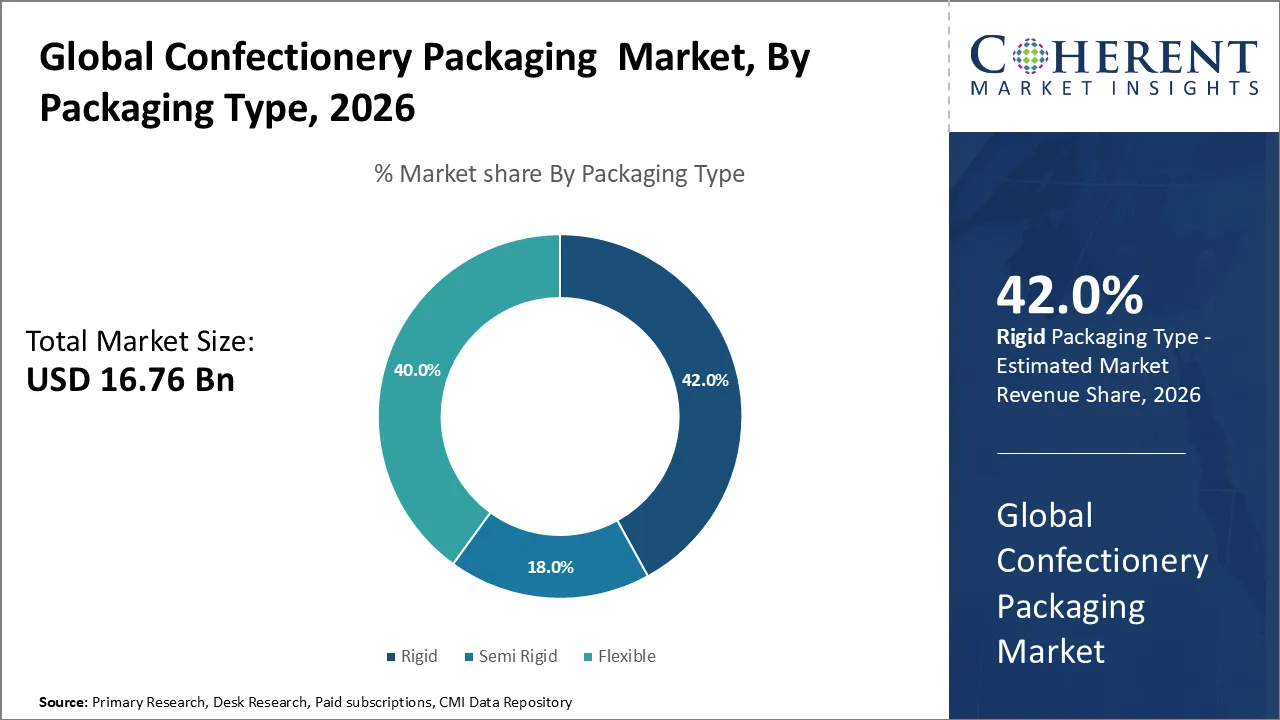
Why is Rigid Packaging Acquiring the Largest Market Share?
On the basis of packaging type, the rigid packaging segment is projected to account for the largest Confectionery Packaging Market share of 42.0% in 2026. The segment’s growth is attributed to increasing demand for premium chocolate gift boxes, decorative tins, protective cartons, and rigid plastic containers. These packaging formats provide structural stability, improved product protection and premium shelf presentation, particularly for assorted chocolates, seasonal confectionery products and gifting applications.
According to Euromonitor International’s September 2026 Confectionery Packaging reports, the number of paper-based confectionery containers in Saudi Arabia increased by 7% to 218 million units in 2025, driven by a rising appetite for packaged confectionery and premium gifting formats.
Why is Paper and Board Holding the Largest Market Share?
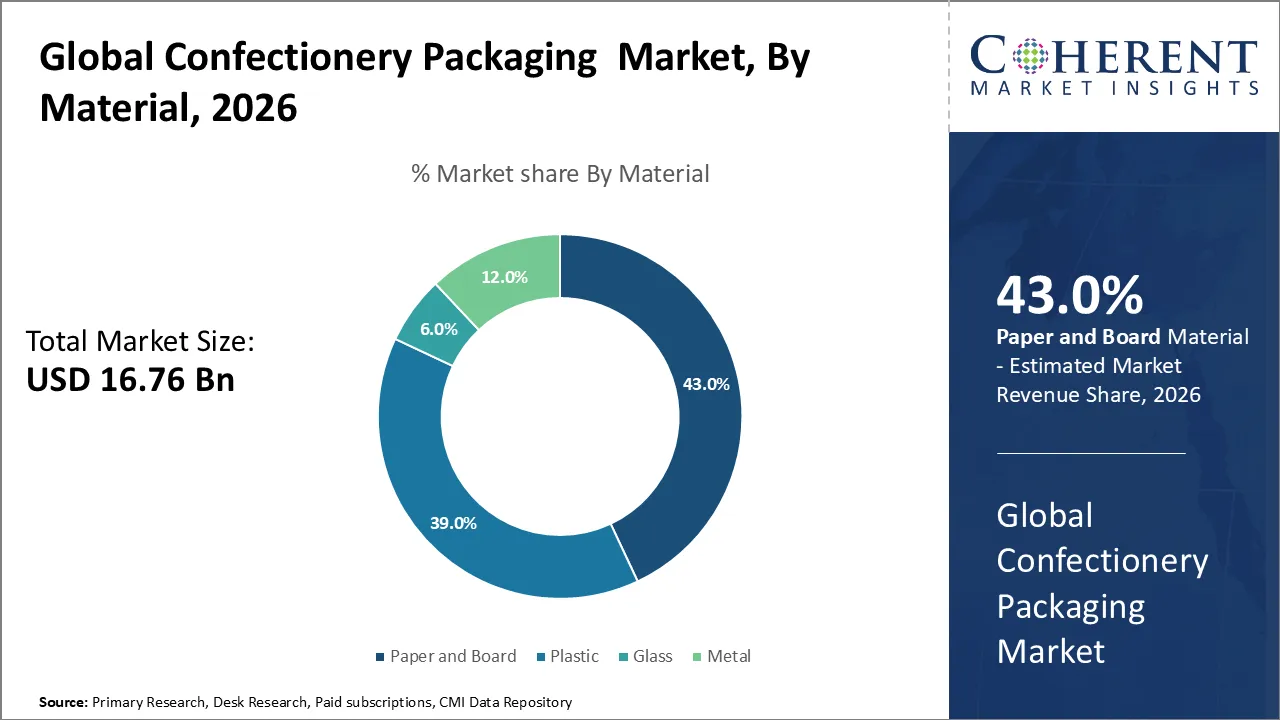
On the basis of material, the paper and board segment is projected to account for the largest share of the 43% in 2026. The segment growth is due to growing use of recyclable fiber-based packaging, rising demand for alternatives to conventional plastic wrappers, and development of grease-resistant and oxygen-barrier paper materials. Confectionery manufacturers are using more paper-based packaging for environmental performance while protecting the product and maintaining packaging-line efficiency.
In September 2025, UPM Specialty Papers unveiled recyclable paper-based chocolate wrappers in collaboration with EvoPak and Walkers Chocolates. The solution employs UPM Solide Lucent 45 g/m² barrier base paper and EvoPak’s coating technology, offering oxygen and grease resistance while replacing traditional plastic packaging.
In December 2025, Coveris and pladis Global introduced fully recyclable paper confectionery bags in the U.S., replacing non-recyclable OPP/paper composite packaging. The move is a sign of the growing commercialization of fiber-based packaging solutions among established confectionery brands.
Why are Chocolate Bars Holding the Largest Market Share?
Based on application, the chocolate bars segment is projected to lead the Confectionery Packaging Market with a share of 38.0% in 2026. The segment’s growth is driven by high-volume consumption of individually packaged chocolate products, expanding product portfolios and increasing demand for convenient, portion controlled and high-barrier packaging. To maintain the quality of the chocolate and improve packaging efficiency, manufacturers are increasingly looking to lightweight flow wraps, recyclable films and advanced sealing technologies.
According to Nestlé's August 2025 announcement, its KitKat brand sells more than 5 billion bars annually across over 85 countries. The brand also offers more than 300 flavor variations worldwide, highlighting the large-scale demand for individual chocolate bar packaging and differentiated packaging formats.
In April 2025, The Hershey Company opened its new Reese Chocolate Processing facility, part of a USD 1 billion investment in its supply chain. The expansion includes 13 new production lines and 11 upgrades to existing lines at its North American sites, supporting chocolate manufacturing capacity and the corresponding demand for efficient confectionery packaging operations.
Confectionery Packaging Market Trends
- Recyclable paper-based packaging is catching on, accelerating the shift away from traditional plastic and aluminum wrappers for confectionery. In February 2026, Amcor partnered with Alter Eco to launch its recyclable AmFiber Performance Paper packaging for its 200 g chocolate range, reducing packaging weight by up to 61% while still protecting against moisture and grease.
- The increasing use of post-consumer recycled content in confectionery packaging is encouraging manufacturers to reduce virgin plastic and improve packaging circularity. In March 2026, Amcor and Mondelēz International introduced Cadbury Mini Eggs packaging containing 65% certified recycled plastic and selected Cadbury Easter chocolate bars containing 80% certified recycled plastic, calculated using a mass balance approach.
- Interactive and personalized confectionery packaging is in demand and this is driving brands toward temperature-responsive inks, new printing technologies and seasonal packaging designs. Amcor and Mondelēz International launched the Cadbury Dairy Milk Chill to Reveal packaging in the U.K. in September 2025. The packaging uses thermochromic inks to reveal hidden designs when chilled to between 5°C and 12°C. This innovation helps boost consumer engagement and opens up opportunities for value-added packaging solutions.
Regional Insights
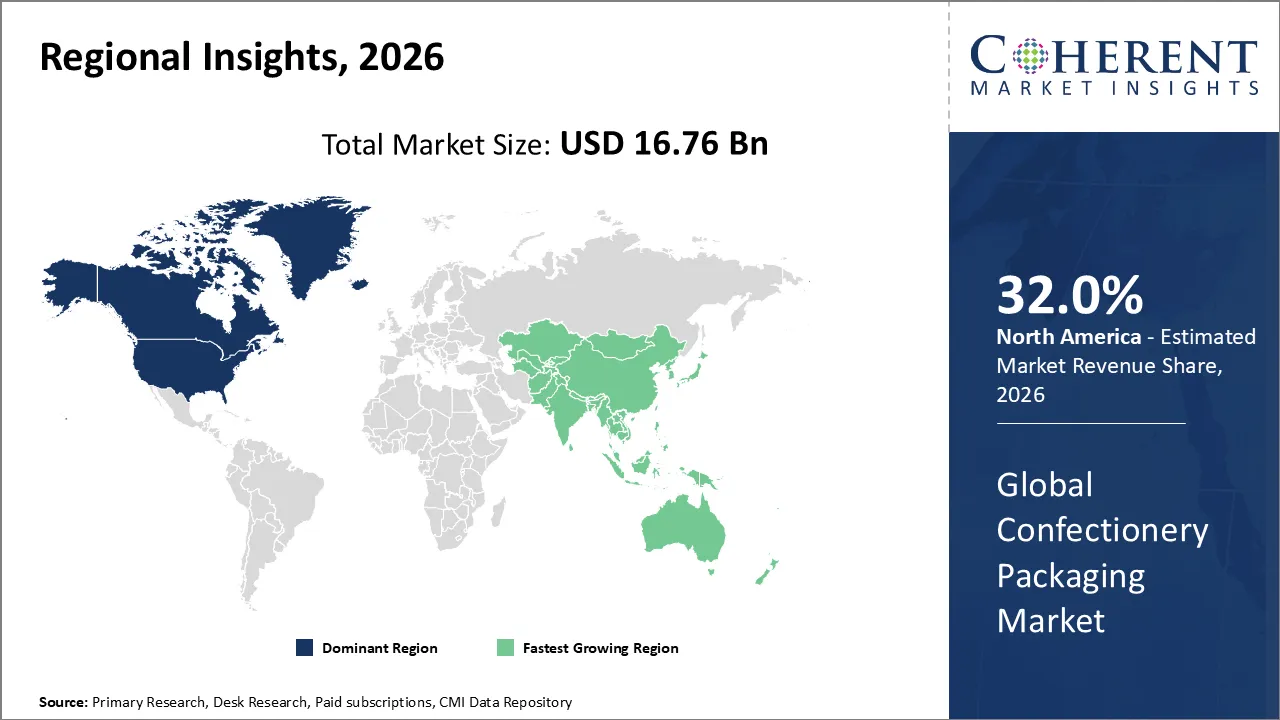
North America Dominates Owing to Strong Confectionery Consumption and Expanding Packaging Infrastructure
The North America region is expected to dominate the global Confectionery Packaging Market with a 32.0% share in 2026. The region’s growth is driven by the high consumption of packaged chocolates and candies, established manufacturing infrastructure for confectionery, increased demand for premium and convenient packaging formats, and continued investments in automated packaging technologies. The presence of big confectionery manufacturers such as Mars, Hershey and Mondelēz International further drives demand for flexible films, rigid containers and sustainable packaging materials.
In July 2025, Mars, Incorporated announced plans to invest approximately USD 2 Billion in U.S. manufacturing operations by the end of 2026. The company says 94% of the Mars products sold in the U.S. are made in the country, demonstrating the breadth of its local production network. The investment is expected to boost manufacturing capacity and enable packaging innovation across its confectionery and wider snacking portfolio.
In June 2026, portion-controlled products or reduced- and no-sugar alternatives accounted for about one-third of The Hershey Company’s portfolio retail sales, the company said. The company also highlighted continued work on packaging optimization, aimed at reducing material use and improving recyclability while maintaining product quality.
Asia Pacific Confectionery Packaging Market Trends
Asia Pacific is expected to emerge as the fastest-growing region in the Confectionery Packaging Market during 2026–2033. Regional growth is driven by expanding chocolate and sugar confectionery consumption, increasing disposable incomes, growing organized retail penetration, and rising demand for individually packaged confectionery products. China, India, Japan and Southeast Asian countries are providing opportunities for value-for-money flexible packaging, premium paperboard cartons and recyclable packaging materials.
In February 2026, SCG Packaging (SCGP) announced an investment budget of THB 10 billion (around USD 320 million) for 2026 to strengthen its consumer packaging business, improve manufacturing efficiency through automation and artificial intelligence, and expand business opportunities across ASEAN.
Sustainable Packaging Innovation and Material Optimization are Accelerating the Confectionery Packaging Market in the United States
The U.S. confectionery packaging market is experiencing consistent growth driven by the growing adoption of recyclable packaging materials, increasing demand for convenient confectionery formats, and growing emphasis on reducing packaging waste. Manufacturers are increasingly looking to lightweight paper-based wrappers, mono-material packaging and high barrier solutions as they try to enhance recyclability without compromising product quality and shelf life.
According to Mars and Mondelēz International have increased the share of packaging portfolio it designed to be reusable, recyclable or compostable to 67.6% in 2025 from 64.1% in 2024 in its 2025 sustainability disclosures reviewed in June 2026. These efforts are prompting packaging suppliers to invest in recyclable flexible films, material optimization and advanced barrier technologies for confectionery applications.
In May 2025, Mars-owned KIND launched its first curbside-recyclable paper wrapper in the U.S. The new wrapper replaced the traditional packaging for its Dark Chocolate Nuts & Sea Salt bars at select Whole Foods Market locations. The pilot operated across eight U.S. states and utilized recyclable paper materials prequalified under the How2Recycle program. This development demonstrates the growing commercial adoption of fiber-based packaging in chocolate-containing snack products.
China Confectionery Packaging Market Trends
China is expected to witness significant growth opportunities in the Confectionery Packaging Market during the forecast period. The country is developing owing to the large-scale food manufacturing industry, growing online retail distribution, rising demand for packaged chocolates and candies, and ongoing investments in recyclable packaging materials. Manufacturers are seeking to enhance packaging efficiency, food-contact safety and recycling compatibility in response to changing regulatory and consumer demands.
In August 2025, the State Administration for Market Regulation and the Standardization Administration of China released new national recommended standards for recycling-oriented plastic packaging design, including PET packaging. The standards reference the Consumer Goods Forum's Golden Design Rules and are intended to improve recycling compatibility and material circularity.
Who are the Major Companies in Confectionery Packaging Industry
Some of the major key players in Confectionery Packaging Market are Bemis Company Inc., Sonoco Products Company, WestRock Company, Printpack Inc., International Paper Company, Amcor Limited, Smurfit Kappa Group, Sealed Air Corporation, Crown Holdings, Inc., and Berry Global, Inc.
Key News
- In May 2026, Smurfit Westrock unveiled ActiBlu, a prototype paper-based packaging solution designed to eliminate conventional gluelines during box assembly. The technology uses a water mist-activated adhesive that allows immediate sealing without the traditional glue application process.
- In September 2026, Amcor announced plans to showcase its advanced food packaging portfolio at CibusTec 2026, including recyclable rigid containers, tubs, pots, and canisters targeting confectionery and other food applications.
Market Report Scope
Confectionery Packaging Market Report Coverage
Report Coverage | Details | ||
Base Year: | 2025 | Market Size in 2026: | USD 16.76 Bn |
Historical Data for: | 2020 to 2024 | Forecast Period: | 2026 to 2033 |
CAGR: | 5.8% | 2033 Value Projection: | USD 24.85 Bn |
Geographies covered: |
| ||
Segments covered: |
| ||
Companies covered: | Bemis Company Inc., Sonoco Products Company, WestRock Company, Printpack Inc., International Paper Company, Amcor Limited, Smurfit Kappa Group, Sealed Air Corporation, Crown Holdings, Inc., and Berry Global, Inc. | ||
Growth Drivers: |
| ||
Restraints & Challenges: |
| ||
Analyst Opinion
- The Confectionery Packaging Market is increasingly influenced by the shift toward recyclable and high-performance flexible packaging materials. The manufacturers are working on improving recyclability while maintaining moisture resistance, product freshness and packaging efficiency. Coveris launched its MonoFlexFibre Pure Twist packaging solution for candies and confectionery products in April 2026, which conforms to 95/5 paper recyclability standards and is suitable for high-speed packaging lines. This trend demonstrates the growing commercial opportunities for recyclable barrier materials and sustainable packaging technologies.
- The demand for light and low-cost confectionery packaging formats is driving the evolution of the use of confectionery packaging. Manufacturers are always looking to improve wrapper thickness, pack sizes and material consumption to keep costs under control, but at the same time protect the product. Euromonitor International reported in September 2026 that the U.S. confectionery packaging market contained 46.1 billion packaging units in 2025, of which flexible films accounted for 79%.
- The premiumization trend and growth in confectionery consumption in developing markets provide long-term opportunities for packaging manufacturers. Investments are being driven by the demand for attractive gift boxes, individually wrapped chocolates and differentiated packaging formats, as well as printing, finishing and customized packaging solutions. According to Euromonitor International’s assessment in September 2025, the confectionery packaging volume in India is expected to reach 139 billion units by 2029, with a CAGR of around 2%. This growth is expected to support opportunities for packaging converters supplying cost-effective flexible films, premium paperboard cartons, and innovative packaging formats.
Speak to the analyst
Want personalized insights?
Take the findings above to one of our principal consultants, or have the report rebuilt around the segments, geographies and competitors you actually track.
Market Segmentation
- By Packaging Type (Revenue, USD Bn, 2021-2033)
- Rigid
- Semi Rigid
- Flexible
- By Material (Revenue, USD Bn, 2021-2033)
- Paper and Board
- Plastic
- Glass
- Metal
- By Application (Revenue, USD Bn, 2021-2033)
- Chocolate Bars
- Sugar and Breads Confectionery
- Toffies and Candies
- Assorted Chocolates
- By Region (Revenue, USD Bn, 2021-2033)
- North America
- U.S.
- Canada
- Latin America
- Brazil
- Mexico
- Argentina
- Rest of Latin America
- Europe
- Germany
- U.K.
- France
- Italy
- Spain
- Russia
- Rest of Europe
- Asia Pacific
- China
- India
- Japan
- Australia
- South Korea
- ASEAN
- Rest of Asia Pacific
- Middle East
- GCC
- Israel
- Rest of Middle East
- Africa
- South Africa
- Central Africa
- North Africa
- North America
Sources
Primary Research Interviews
- Confectionery packaging manufacturers and suppliers
- Chocolate, candy, and sugar confectionery manufacturers
- Packaging material scientists and food packaging engineers
- R&D heads from flexible and rigid packaging companies
- Paperboard, plastic film, and barrier coating manufacturers
- Packaging procurement and supply chain managers
- Sustainable packaging and recycling technology experts
- Key opinion leaders (KOLs) in food-contact packaging and confectionery packaging technologies
Databases
- World Bank
- Organisation for Economic Co-operation and Development (OECD)
- United Nations Comtrade Database (UN Comtrade)
- Eurostat – Packaging Waste and Recycling Statistics
- U.S. Census Bureau – Annual Survey of Manufactures
- U.S. International Trade Commission (USITC) DataWeb
- Food and Agriculture Organization of the United Nations (FAOSTAT)
- International Trade Centre (ITC Trade Map)
Magazines
- Packaging World
- Packaging Europe
- Packaging Digest
- Confectionery Production
- Candy Industry Magazine
- Packaging Strategies
Journals
- Packaging Technology and Science
- Food Packaging and Shelf Life
- Journal of Food Engineering
- Food and Bioprocess Technology
- Journal of Packaging Technology and Research
- Sustainable Materials and Technologies
Newspapers
- The New York Times
- The Guardian
- The Wall Street Journal
- Financial Times
- The Economic Times
- Reuters
Associations
- National Confectioners Association (NCA)
- Flexible Packaging Association (FPA)
- Fibre Box Association (FBA)
- European Carton Makers Association (ECMA)
- European Paper Packaging Alliance (EPPA)
- International Cocoa Organization (ICCO)
- Packaging and Packaging Waste Regulation (PPWR) – European Commission
- Institute of Packaging Professionals (IoPP)
Public Domain Sources
- Company Annual Reports and Investor Presentations
- Government Packaging Waste and Recycling Statistics
- U.S. Food and Drug Administration (FDA) – Food Contact Materials Regulations
- European Food Safety Authority (EFSA) – Food Contact Materials Publications
- European Commission – Packaging and Packaging Waste Regulation Publications
- Confectionery Manufacturers' Sustainability and Packaging Reports
- Publicly Available Packaging Material Innovation and Product Launch Announcements
- Patent Databases such as WIPO, USPTO, and Google Patents
- Packaging Recycling, Extended Producer Responsibility (EPR), and Food Safety Regulatory Publications
Proprietary Elements
- CMI Data Analytics Tool
- Proprietary CMI Existing Repository of Information for the Last 10 Years
Get access to 250+ pages report
Every segment, forecast, competitor profile and data table behind the analysis above — available for instant download.
- ESOMAR Member
- ISO 9001:2015 Certified
- D-U-N-S Registered
- GDPR & CCPA Compliant
Missing comfort of reading report in your local language? Find your preferred language:
Frequently Asked Questions
The Confectionery Packaging Market is expected to reach USD 24.85 Bn in 2033, increasing from USD 16.76 Bn in 2026.
Major players operating in the global Confectionery Packaging Market include Bemis Company Inc., Sonoco Products Company, WestRock Company, Printpack Inc., International Paper Company, Amcor Limited, Smurfit Kappa Group, Sealed Air Corporation, Crown Holdings, Inc., and Berry Global, Inc.
High costs of sustainable and recyclable packaging materials, fluctuations in raw material prices, stringent food-contact packaging regulations, and recycling challenges associated with multilayer packaging are the key factors hampering market growth.
Rising consumption of packaged chocolates and candies, increasing demand for sustainable and recyclable packaging materials, growing preference for premium confectionery packaging, and advancements in high-barrier packaging technologies are driving market growth.
The Confectionery Packaging Market is anticipated to grow at a CAGR of 5.8% between 2026 and 2033.
North America is expected to account for the largest share of the global Confectionery Packaging Market, with an estimated 32.0% market share in 2026, while Asia Pacific is projected to emerge as the fastest-growing region during the forecast period.
Confectionery packaging refers to protective and decorative packaging materials and formats used for chocolates, candies, toffees, and other confectionery products. It includes rigid, semi-rigid, and flexible packaging designed to maintain product freshness, prevent damage, extend shelf life, and enhance visual appeal.