

Contact Center Software Market Size and Forecast – 2026 to 2033
Contact Center Software Market is estimated to be valued at USD 67.16 Bn in 2026 and is expected to reach USD 243.45 Bn in 2033, exhibiting a compound annual growth rate (CAGR) of 20.2% from 2026 to 2033.
Key Takeaways
- By Solution, Interactive Voice Responses (IVR) hold the largest market share of 26% in 2026 owing to the demand for automation and cost-efficient customer service.
- By Service, Support & Maintenance expected to hold largest market share in 2026 owing to the shift to cloud-based / hosted contact center solutions.
- By Deployment, Hosted acquired the prominent market share in 2026 owing to the digital transformation & migration from legacy systems.
- By Enterprise Size, Small & Medium Enterprises hold the largest market share in 2026 owing to the lower cost and minimal upfront investment.
- By End Use, IT & Telecom dominates the overall market share in 2026 owing to the very high volume and complexity of customer & technical interactions.
- By Region, North America dominates the overall market with an estimated share of 29.0% in 2026 owing to the high level of digital maturity & early adoption of advanced technologies.
Market Overview
The contact center software market is growing as organizations focus on delivering efficient, seamless customer engagement across voice, chat, email, and digital channels. Companies are increasingly adopting cloud platforms, AI-driven automation, and analytics to transform customer support, speed up issue resolution, and provide personalized interactions. Enterprises in telecom, retail, BFSI, and healthcare are upgrading legacy systems to enhance service quality and operational efficiency. Rising expectations for round-the-clock support and the move toward remote and hybrid work models further drive market adoption.
Current Events and Its Impacts on the Contact Center Software Market
Current Events | Description and its impact |
Geopolitical Developments |
|
Technological Advancements |
|
Industry-Specific Regulations and Standards |
|
Segmental Insights
- Current Industry Events of 2026
- Market Size Estimation
- Regional Breakdown
- Competitive Landscape
- Customer Intelligence
- Segmental Analysis
- Pricing Analysis
- Key Market Drivers, Challenges & Future Trends
- Customized Insights Section
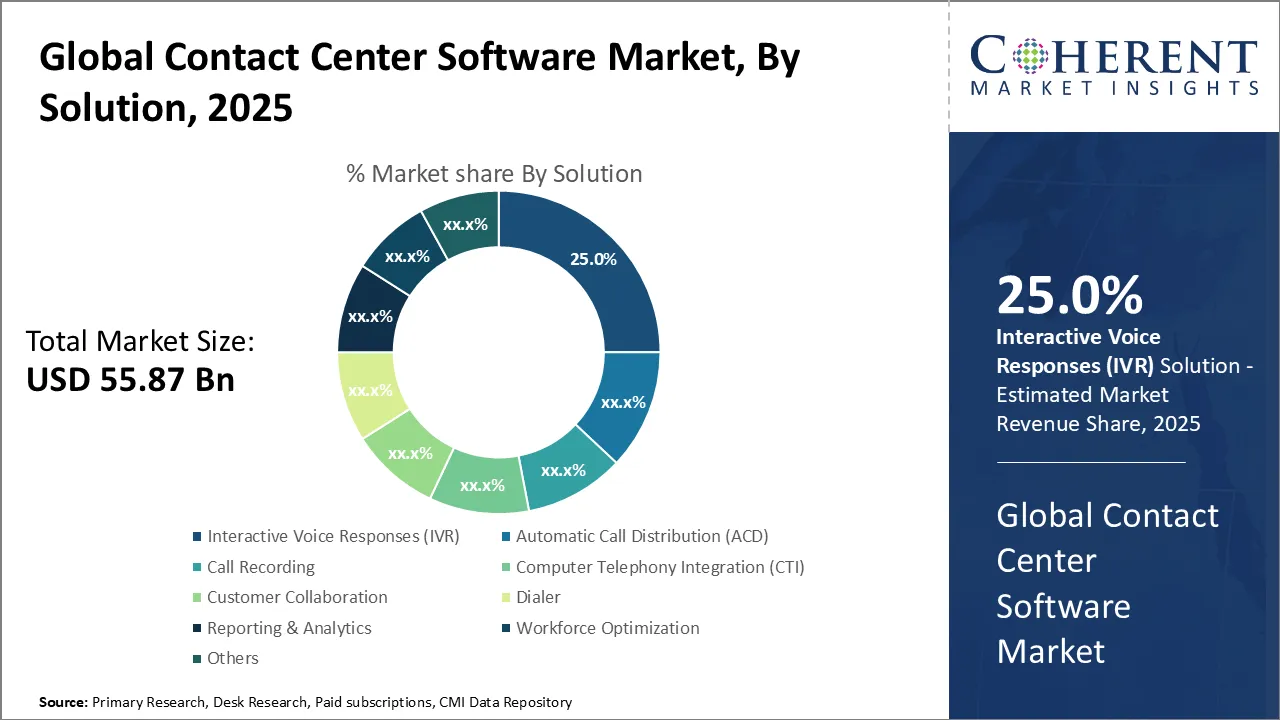
Contact Center Software Market Insights, By Solution: Interactive Voice Responses (IVR) contribute the highest share of the market owing to its rising customer expectations & need for 24/7 / instant support.
Interactive Voice Responses (IVR) hold the largest market share of 26.0% in 2026. Interactive voice response adoption in the contact center software market grows as organizations seek automated customer service, quicker issue resolution, and lower operational costs. Companies deploy IVR to handle large call volumes, optimize routing, and deliver round-the-clock self-service. Advancements in speech recognition, AI, and natural language processing improve IVR accuracy and user experience, prompting wider implementation across industries. As customers expect faster, more convenient support, businesses increasingly rely on IVR to boost efficiency and elevate service quality. For instance, in July 2025, PayJunction, a leading tech-driven payments company, has integrated with Twilio to help businesses automate and scale phone payment operations. The integration lets PayJunction merchants use AI-powered IVR systems to securely process phone payments and remove manual steps, reducing time and costs.
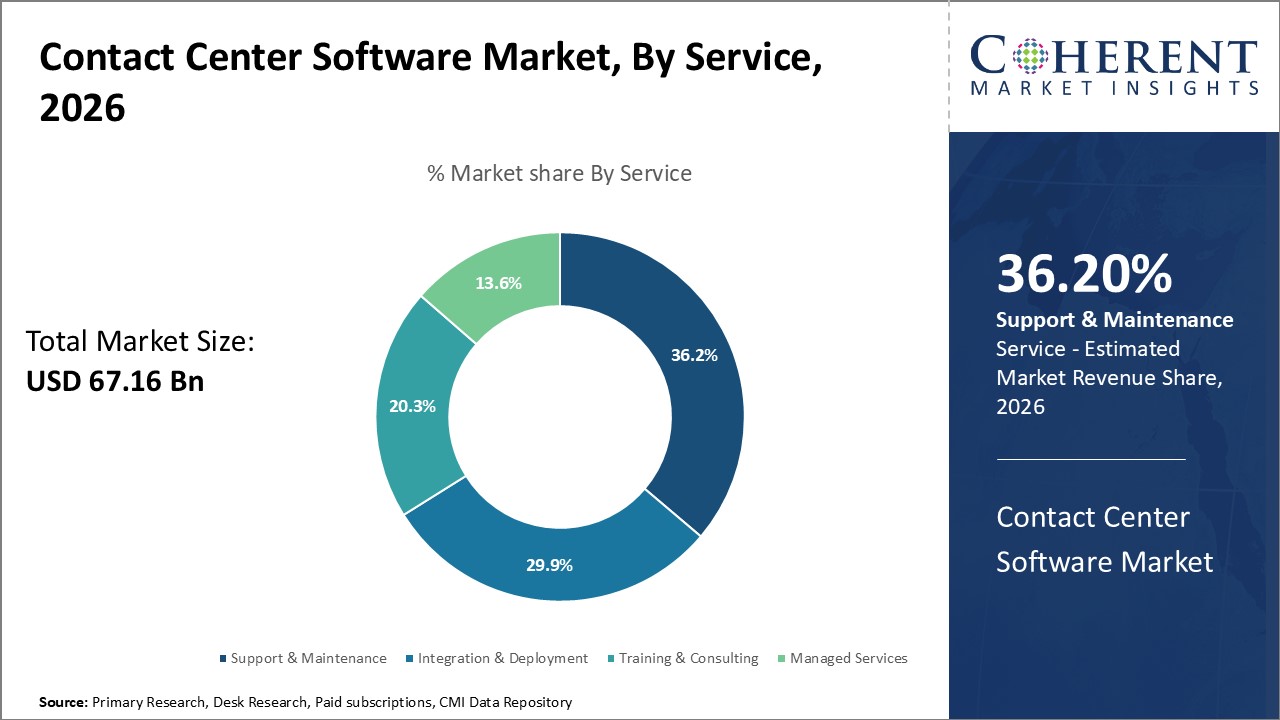
Contact Center Software Market Insights, By Service: Support & Maintenance contribute the highest share of the market owing to its growing demand for business continuity, reliability & uptime.
Support and maintenance services in the contact center software market expand as organizations depend on continuous system updates, efficient operations, and robust technical support. Companies implement these services to maintain high availability, secure performance, and seamless integration with evolving technologies. Increasing adoption of cloud platforms, AI, and omnichannel communication drives the need for ongoing maintenance to keep systems running optimally. As businesses focus on reliable customer service and minimizing downtime, they actively invest in support and maintenance to boost efficiency and service quality.
Contact Center Software Market Insights, By Deployment: Hosted contribute the highest share of the market owing to its lower upfront CAPEX and reduced total cost of ownership (TCO).
Organizations drive the growth of hosted contact center solutions by seeking flexible, scalable, and cost-effective customer support platforms. Companies adopt cloud-based deployments to cut infrastructure costs, implement systems quickly, and support remote and distributed workforces. Hosted solutions integrate seamlessly with omnichannel communication, AI, and analytics tools, enhancing customer experience and operational efficiency. As businesses focus on agility, round-the-clock availability, and disaster recovery, they increasingly use hosted contact center software to streamline support, boost performance, and meet evolving customer expectations. For instance, in July 2025, as telecom compliance pressures rise in India, enterprises are reassessing the resilience and legality of their contact center systems. To address this, Simple2Call, a US-based CCaaS provider, has launched its AI-powered, hosted Contact Center Suite (CCS) in India to meet evolving regulatory and operational needs.
Contact Center Software Market Insights, By Enterprise Size: Small & Medium Enterprises contribute the highest share of the market owing to its flexibility and scalability to match growth or demand fluctuations.
Small and medium enterprises are driving the adoption of contact center software to boost customer service and strengthen competitiveness. They leverage cloud-based solutions for low upfront costs, scalability, and flexibility, enabling efficient management of seasonal demand and business growth. By accessing enterprise-grade features such as AI-powered chatbots, omnichannel communication, and analytics, SMEs enhance customer engagement without heavy infrastructure investments. They also utilize platforms that support remote and distributed workforces to ensure operational continuity while delivering responsive, personalized, and high-quality customer experiences across all channels. For instance, Unicredit Bulbank, together with Microsoft and Crayon, launched the Together4Digital initiative in Bulgaria to help small and medium businesses advance digitalization and cybersecurity by offering free consultations, financial guidance, skills support, and digital tool recommendations for sustainable growth.
Contact Center Software Market Insights, By End Use: IT & Telecom contribute the highest share of the market owing to its digital transformation and adoption of advanced technologies.
The IT and telecom sector fuels demand for contact center software as companies manage large volumes of customer interactions, technical support requests, and service inquiries. Organizations in this industry implement advanced solutions to deliver omnichannel support, streamline workflows, and enhance the customer experience. Expanding digital services, network growth, and competitive pressures drive businesses to increase operational efficiency and shorten response times. By leveraging AI, analytics, and automation, IT and telecom companies optimize support, resolve issues faster, and maintain high customer satisfaction. For instance, in November 2025, Indosat Ooredoo Hutchison, Nokia, and NVIDIA have opened an AI-RAN research center in Surabaya, Indonesia. This first phase of their partnership, announced at MWC 2025, aims to advance AI-powered telecom networks by combining Nokia’s RAN technology, NVIDIA’s accelerated computing, and Indosat’s commercial network.
Regional Insights
North America Contact Center Software Market Trends
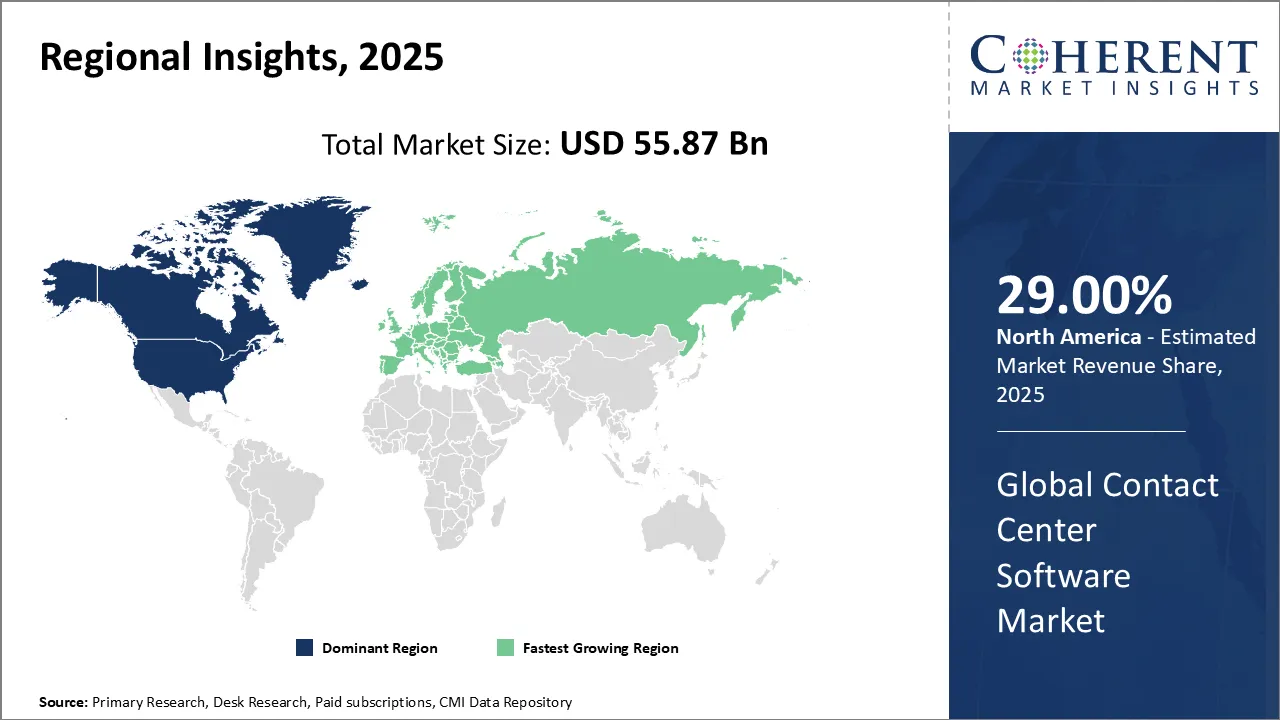
North America dominates the overall market with an estimated share of 29.0% in 2026. Businesses in North America are driving the evolution of the contact center software market by prioritizing digital transformation and customer-focused strategies. They adopt cloud-based platforms, AI-powered analytics, and omnichannel communication to improve service efficiency and engagement. The rise of remote and hybrid workforces increases demand for flexible, scalable solutions, while companies actively address regulatory compliance and data security. Leading regional technology providers innovate continuously, enabling organizations to deliver seamless, personalized, and reliable customer experiences across various industries. For instance, in December 2025, NobelBiz, a leading contact center software provider and voice carrier, has partnered with Callers, an AI-driven conversation platform, to offer the industry’s first carrier-grade AI communication solution.
Europe Contact Center Software Market Trends
Organizations in Europe are advancing the contact center software market by focusing on improving customer experience and operational efficiency. They implement cloud-based solutions, AI-driven analytics, and omnichannel communication to streamline interactions and enhance service quality. The rise of remote and hybrid work models drives their demand for flexible, scalable platforms, while companies actively navigate strict data privacy regulations when selecting and deploying software. Regional technology providers continually innovate, enabling businesses across industries to deliver consistent, personalized, and efficient customer support. For instance, in May 2026, Helport AI Limited, a provider of intelligent customer communication solutions, has launched Helport Remote, a workforce monitoring and management tool designed for modern remote contact centers.
United States Contact Center Software Market Trends
Organizations in the United States are driving the contact center software market by focusing on delivering exceptional customer experiences and enhancing operational agility. They adopt cloud-based platforms, AI-powered tools, and omnichannel communication to manage growing customer interactions efficiently. The rise of remote and hybrid workforces increases demand for scalable, flexible solutions, while companies actively address data security and regulatory compliance. Technology providers continue to innovate, enabling U.S. businesses to offer fast, personalized, and reliable customer support across multiple industries. For instance, in April 2026, Microsoft has introduced a new contact center integration model for Teams, bringing the total to three. The Unify model lets solution providers build native CCaaS applications on Azure Communication Services (ACS) while using Teams’ calling infrastructure.
United Kingdom Contact Center Software Market Trends
Organizations in the United Kingdom are driving the evolution of the contact center software market by focusing on improving customer engagement and streamlining operations. They adopt cloud-based solutions, AI-driven analytics, and omnichannel communication to manage interactions efficiently and deliver personalized experiences. The rise of remote and hybrid work increases demand for flexible, scalable platforms, while companies actively comply with strict data protection regulations when deploying software. Local technology providers continue to innovate, helping businesses automate processes, integrate systems, and provide reliable, responsive, high-quality customer support.
End-user Feedback and Unmet Needs in the Contact Center Software Market
- Need for Seamless Omnichannel Integration: End-users emphasize the need for platforms that unify voice, chat, email, social media, and messaging into a single interface. Fragmented systems increase agent workload and reduce efficiency. Businesses seek solutions that provide consistent customer experience, streamlined workflows, and centralized data access across multiple communication channels.
- Desire for Advanced AI and Automation: Users report unmet needs for AI-driven features such as predictive routing, virtual assistants, and automated ticket handling. Current systems often lack accurate natural language processing and intelligent automation, limiting efficiency. Organizations want tools that reduce manual effort, improve first-contact resolution, and allow agents to focus on complex queries.
- Requirement for Enhanced Analytics and Reporting: Many end-users express the need for deeper, real-time insights into customer interactions and agent performance. Existing reporting tools often provide static or delayed data, limiting decision-making. Companies seek advanced analytics that support predictive trends, customer behavior understanding, and actionable insights to improve service quality and operational efficiency.
Contact Center Software Market Trend
Adoption of Cloud-Based Contact Centers
Businesses increasingly shift from on-premise solutions to cloud-based platforms, driven by the need for scalability, flexibility, and lower infrastructure costs. Cloud deployments enable rapid implementation, remote workforce support, and seamless updates. Organizations benefit from centralized management, real-time monitoring, and easy integration with AI, analytics, and omnichannel communication tools, allowing them to enhance operational efficiency and deliver a more consistent and personalized customer experience across all touchpoints.
Contact Center Software Market Opportunity
Expansion of Cloud-Based Solutions
The shift to cloud-based contact center platforms presents a significant opportunity for vendors and businesses. Organizations seek scalable, cost-effective solutions that enable remote work, faster deployment, and seamless software updates. Cloud platforms also allow integration with AI, analytics, and omnichannel tools, providing a unified environment. Companies can leverage this opportunity to offer flexible subscription models, improve service reliability, and cater to businesses aiming to modernize legacy systems while enhancing customer experience.
Market Report Scope
Contact Center Software Market Report Coverage
| Report Coverage | Details | ||
|---|---|---|---|
| Base Year: | 2025 | Market Size in 2026: | USD 67.16 Bn |
| Historical Data for: | 2020 To 2024 | Forecast Period: | 2026 To 2033 |
| Forecast Period 2026 to 2033 CAGR: | 20.2% | 2033 Value Projection: | USD 243.45 Bn |
| Geographies covered: |
| ||
| Segments covered: |
| ||
| Companies covered: | 8X8, Inc., ALE International, Altivon, Amazon Web Services, Inc., Ameyo, Amtelco, Aspect Software, Avaya Inc., Avoxi, Cisco Systems, Inc., Salesforce Inc., Oracle. | ||
| Growth Drivers: |
| ||
| Restraints & Challenges: |
| ||
Contact Center Software Market News
- In September 2024, ai, a leader in enterprise conversational and generative AI, has listed its XO Automation and Contact Center AI products in AWS Marketplace, making them easier for customers to find, buy, and deploy.
- In November 2024, Dialpad, a leading AI-powered communications platform, has launched Dialpad Support, advancing its AI Contact Center into a next-generation customer service platform.
- In July 2024, Amazon Web Services Inc. has introduced a new feature for Connect Contact Lens, its AI tool for call centers, to help workers with after-call tasks.
Analyst Opinion (Expert Opinion)
- The contact‑center software market is entering a transformative phase largely because enterprises are no longer treating their customer‑service platforms as mere support tools — they see them as strategic assets for competitive advantage. Evidence of this shift is apparent: roughly 36 % of contact centers globally now use “contact‑center as a service” (CCaaS) as their primary platform, while increasing numbers migrate legacy deployments to cloud‑native suites to gain flexibility and rapid feature access.
- Enterprise buyers are driving this trend by demanding end‑to‑end solutions combining omnichannel routing, AI-powered analytics, and workforce optimization. For instance, omnichannel routing recently accounted for a substantial portion of market share — highlighting how firms move beyond voice-only solutions toward unified, cross‑channel engagement.
- Moreover, the surge in adoption of AI technologies adds significant momentum. Organizations deploying AI within contact center platforms report reductions in agent workload, improved first‑contact resolution rates, and shorter handle times — outcomes that decisively boost ROI and service quality. Some providers now handle tens of millions of interactions monthly, using sentiment analysis, predictive routing, and context‑aware automation to deliver consistent, high‑quality support.
- Besides this, the shift toward remote and hybrid workforce models is reshaping the operational needs of customer‑service organizations. Cloud-based contact center software allows companies to onboard distributed agents rapidly, scale up during peak demand, and ensure continuity without heavy infrastructure overhead — a critical advantage in volatile or growth‑oriented environments.
Speak to the analyst
Want personalized insights?
Take the findings above to one of our principal consultants, or have the report rebuilt around the segments, geographies and competitors you actually track.
Market Segmentation
- Global Contact Center Software Market, By Solution
- Automatic Call Distribution (ACD)
- Call Recording
- Computer Telephony Integration (CTI)
- Customer Collaboration
- Dialer
- Interactive Voice Responses (IVR)
- Reporting & Analytics
- Workforce Optimization
- Others
- Global Contact Center Software Market, By Services
- Integration & Deployment
- Support & Maintenance
- Training & Consulting
- Managed Services
- Global Contact Center Software Market, By Deployment
- Hosted
- On-premise
- Global Contact Center Software Market, By Enterprise Size
- Large Enterprises
- Small & Medium Enterprises
- Global Contact Center Software Market, By End use
- BFSI
- Consumer Goods & Retail
- Government
- Healthcare
- IT & Telecom
- Travel & Hospitality
- Others
- Regional Insights (Revenue, USD Bn, 2021 - 2033)
- North America
- U.S.
- Canada
- Latin America
- Brazil
- Argentina
- Mexico
- Rest of Latin America
- Europe
- Germany
- U.K.
- Spain
- France
- Italy
- Russia
- Rest of Europe
- Asia Pacific
- China
- India
- Japan
- Australia
- South Korea
- ASEAN
- Rest of Asia Pacific
- Middle East
- GCC Countries
- Israel
- Rest of Middle East
- Africa
- South Africa
- North Africa
- Central Africa
- North America
- Key Players Insights
- 8X8, Inc.
- ALE International
- Altivon
- Amazon Web Services, Inc.
- Ameyo
- Amtelco
- Aspect Software
- Avaya Inc.
- Avoxi
- Cisco Systems, Inc.
- Salesforce Inc.
- Oracle
Sources
Primary Research interviews
- Executives and decision-makers from contact center software vendors
- IT managers and operations heads from large enterprises using contact center solutions
- End-users and technical staff involved in implementation and support
Databases
- Crunchbase
- GitHub repositories for software trends
- Statista (for industry statistics)
- OpenCorporates
Magazines
- CIO Magazine
- InformationWeek
- TechRepublic
- Customer Contact Week (CCW)
Journals
- Journal of Service Research
- International Journal of Information Management
- Journal of Operations Management
- MIS Quarterly
Newspapers
- The Wall Street Journal (Technology Section)
- The New York Times (Tech Section)
- Financial Times (Technology Coverage)
- The Guardian (Technology Section)
Associations
- International Customer Management Institute (ICMI)
- Contact Center World
- Association for Information Systems (AIS)
- Society for Information Management (SIM)
Public Domain sources
- Government digital services and IT policy publications
- Open data portals on technology adoption and IT spending
- Regulatory filings of publicly listed software companies
- Press releases and company annual reports
Proprietary Elements
- CMI Data Analytics Tool
- Proprietary CMI Existing Repository of information for last 8 years
Get access to 250+ pages report
Every segment, forecast, competitor profile and data table behind the analysis above — available for instant download.
- ESOMAR Member
- ISO 9001:2015 Certified
- D-U-N-S Registered
- GDPR & CCPA Compliant
Missing comfort of reading report in your local language? Find your preferred language:
Transform your Strategy with Exclusive Trending Reports
Frequently Asked Questions
The Contact Center Software Market is estimated to be valued at USD 67.16 Bn in 2026, and is expected to reach USD 243.45 Bn by 2033.
The market is estimated to surpass US$ 139.3 Billion by 2033.
Major players operating in the market include 8X8, Inc., ALE International, Altivon, Amazon Web Services, Inc., Ameyo, Amtelco, Aspect Software, Avaya Inc., Avoxi, Cisco Systems, Inc., Salesforce Inc., Oracle.
Among Solution type, the interactive voice response (IVR) segment held the dominant position in the market in 2026, and is expected to retain its dominance throughout the forecast period.
Increasing demand of enhanced customer experience, increasing demand for automated customer care services and increasing use of Omni channel services.
The CAGR of the Contact Center Software Market is projected to be 20.2% from 2026 to 2033.