

Continuous Passive Motion Devices Market Size and Share Analysis (2026–2033)
The Continuous Passive Motion Devices Market is expected to grow at a CAGR of 5.2%, from around USD 948.2 Mn in 2026 to close to USD 1,352.1 Mn in 2033. The market is driven mainly by the increase in orthopedic surgeries, increasing prevalence of joint and musculoskeletal disorders, growing adoption of post-surgery rehabilitation treatments, and the increasing demand for home-based rehabilitation solutions. As per WHO estimates, around 2.4 billion people globally had health conditions that would have benefited from rehabilitation in 2024.
Key Takeaways
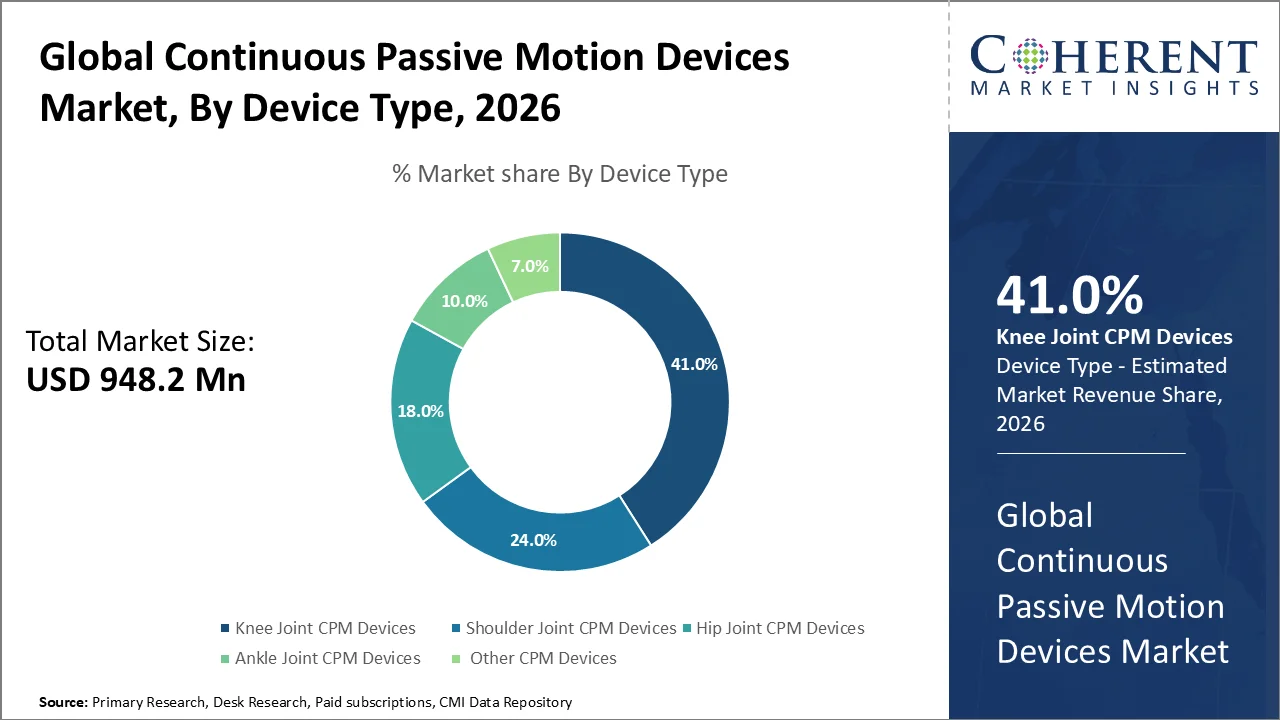
- The knee joint CPM devices segment is likely to dominate the market with 41.0% in 2026. The segment’s growth is owing to the high volume of total knee replacement procedures, rising knee osteoarthritis prevalence, and frequent requirement for controlled postoperative knee movement. According to the OECD’s Health at a Glance 2025, the average knee replacement rate across OECD countries reached 156 procedures per 100,000 people in 2023, while hip and knee replacement rates increased in nearly all OECD countries over the preceding decade.
- The adult segment is set to lead with 56.0% in 2026. The segment’s growth is owing to the high prevalence of osteoarthritis among middle-aged and elderly adults, increasing joint replacement procedures, sports-related ligament injuries, and age-associated mobility impairment. An IHME-led study reported that approximately 595 Mn people had osteoarthritis, equivalent to around 15% of the global population aged 30 years and above, with the number projected to approach 1 billion by 2050.
- The portable CPM devices segment is anticipated to dominate with 57.0% in 2026. The segment’s growth is owing to the increasing transition toward home-based rehabilitation, shorter hospital stays, ease of transportation, rental-based access, and the ability to continue prescribed joint movement after discharge. The CMS Durable Medical Equipment coverage policy, effective in 2025, covers CPM devices following total knee replacement when use begins within two days of surgery and limits coverage to the portion of the following three-week period during which the device is used in the patient’s home.
- The hospital segment is expected to lead with 57.4% in 2026. The segment’s growth is owing to the concentration of orthopedic surgeries in hospital settings, availability of orthopedic surgeons and physiotherapists, immediate postoperative monitoring, and institutional procurement of rehabilitation equipment. The AAOS American Joint Replacement Registry’s 2025 Annual Report analyzed more than 4.4 Mn hip and knee arthroplasty procedures performed, representing an 8.8% increase compared with the previous report, indicating a substantial and expanding procedural base for postoperative rehabilitation equipment.
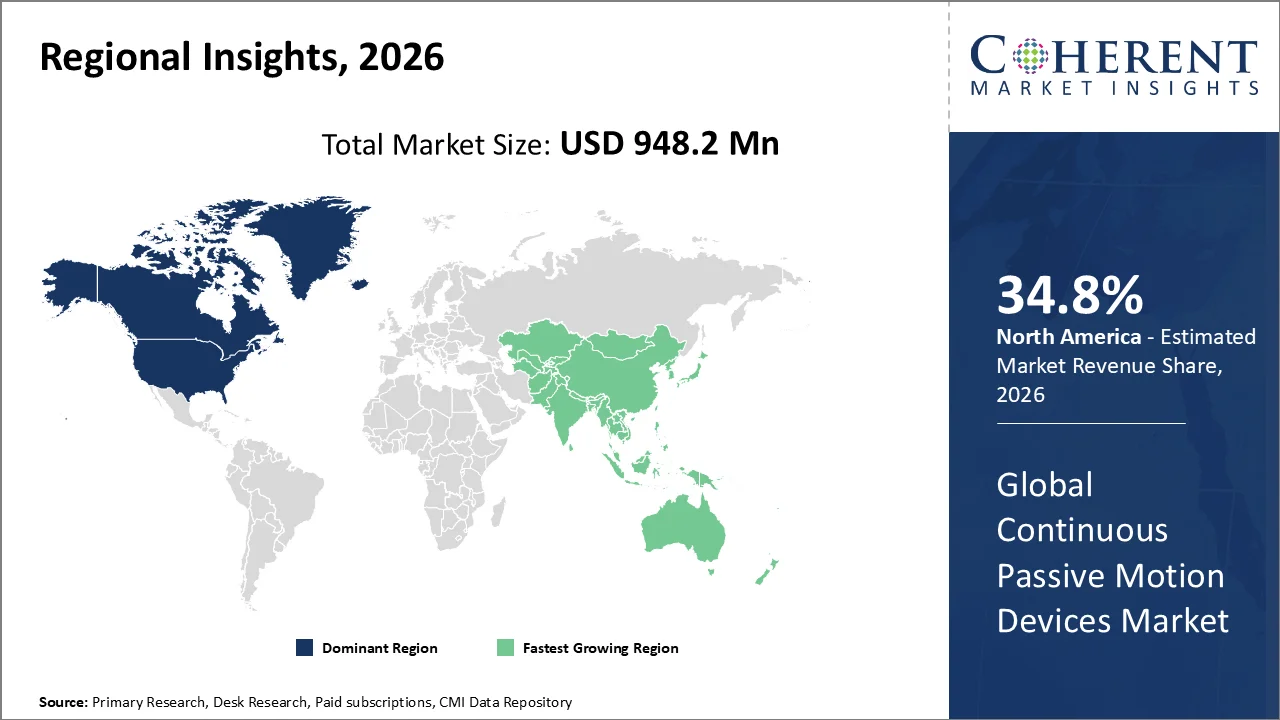
- The North America segment is likely to dominate the global continuous passive motion devices market with approximately 34.8% in 2026. The region’s dominance is owing to the high volume of knee and hip replacement procedures, advanced orthopedic rehabilitation infrastructure, established medical-device rental networks, favourable access to postoperative care, and adoption of CPM systems across hospitals and home-care settings. S. Medicare policy permits home-use CPM coverage for up to 21 days following total knee replacement or revision surgery, supporting demand for postoperative CPM equipment in the region.
Market Drivers
Rising Joint Replacement Procedures are Expanding the Postoperative Rehabilitation Pool
The increasing volume of knee and hip replacement procedures is a major driver of the continuous passive motion devices market. CPM devices are used in selected postoperative rehabilitation protocols to provide controlled joint movement, maintain range of motion, and reduce the effects of prolonged joint immobilisation.
The U.K. National Joint Registry recorded 263,865 joint replacement procedures in 2024, including 134,652 knee procedures and 116,901 hip procedures. The substantial annual volume of knee and hip surgeries creates a large potential patient population requiring physiotherapy, mobility restoration and, in selected cases, CPM-based rehabilitation.
Global Population Ageing is Increasing the Need for Joint Mobility Restoration
Population ageing is strengthening demand for orthopedic interventions and postoperative mobility support. Older adults have a higher likelihood of degenerative joint damage, reduced mobility, joint stiffness, and surgical treatment, creating a sustained requirement for rehabilitation equipment across developed and emerging healthcare markets.
The United Nations’ World Population Prospects 2024 projects that the global population aged 80 years and above will reach approximately 265 million by the mid-2030s, exceeding the number of infants worldwide. By the late 2070s, the population aged 65 years and above is projected to reach approximately 2.2 billion.
Current Events and Their Impact on the Continuous Passive Motion Devices Market
Current Event | Description and its Impact |
FDA Implements the Quality Management System Regulation for Medical Devices (2026) |
|
CMS Maintains Restricted Medicare Coverage for Home-Use CPM Devices and Updates the 2026 DMEPOS Payment Framework |
|
- Current Industry Events of 2026
- Market Size Estimation
- Regional Breakdown
- Competitive Landscape
- Customer Intelligence
- Segmental Analysis
- Pricing Analysis
- Key Market Drivers, Challenges & Future Trends
- Customized Insights Section
Segmental Insights
Why are Knee Joint CPM Devices Acquiring the Largest Share?
On the basis of device type, the knee joint CPM devices segment is projected to account for the largest Continuous Passive Motion Devices Market share of 41.0% in 2026. The segment’s growth is owing to the comparatively high volume of knee replacement and reconstruction procedures, broad availability of knee-specific CPM systems, and their use in selected postoperative protocols to provide controlled flexion and extension. The latest New Zealand Joint Registry 26-Year Report recorded 12,312 new knee arthroplasty registrations in 2024.
In July 2026, rehabilitation-technology company Techno Concept, in collaboration with Kinetec, announced the publication of the first randomized controlled trial evaluating continuous passive motion combined with its Vibramoov functional proprioceptive stimulation technology after anterior cruciate ligament reconstruction.
High Orthopedic Disease Burden Strengthens Adult Segment Dominance
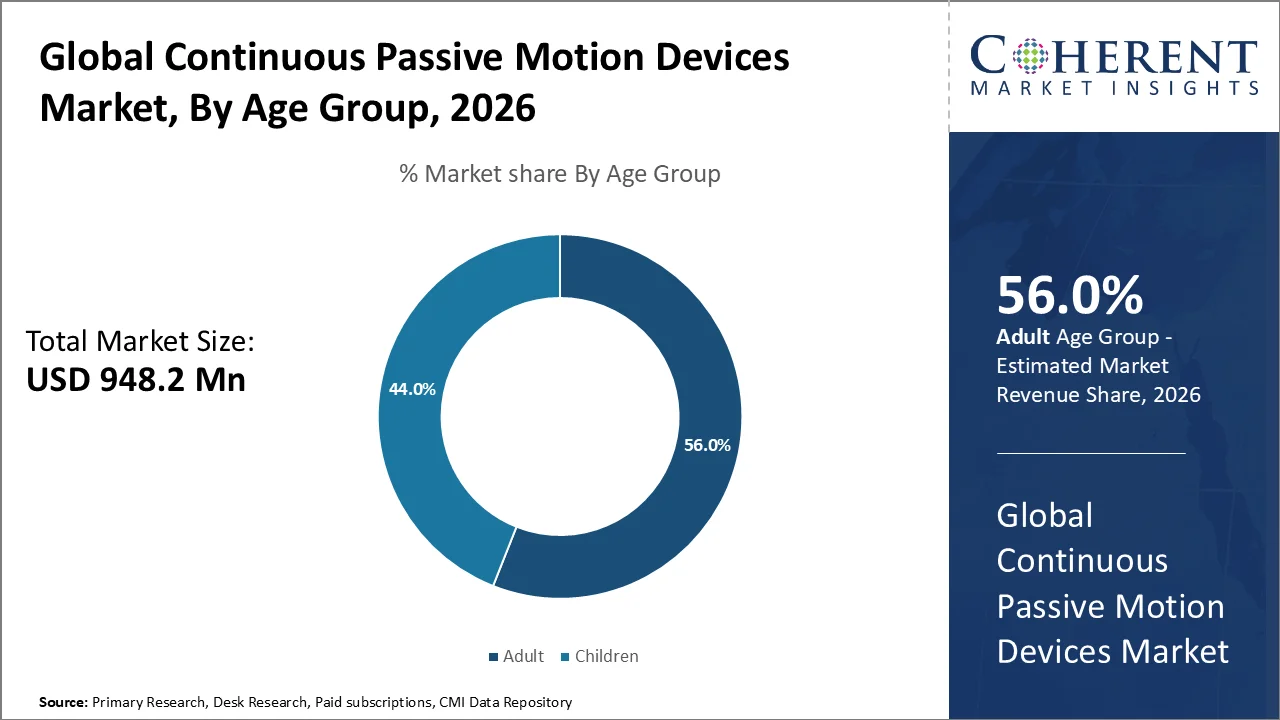
On the basis of age group, the adult segment is projected to account for the largest Continuous Passive Motion Devices Market share of 56.0% in 2026. The segment’s dominance is owing to the higher incidence of degenerative joint conditions, orthopedic trauma, sports injuries, ligament reconstruction, and hip and knee replacement procedures among adult and elderly populations.
According to the U.S. Census Bureau’s June 2025 population estimates, the U.S. population aged 65 years and above reached 61.2 million in 2024, increasing by 3.1% within one year.
Why are Portable CPM Devices Acquiring the Largest Share?
On the basis of design, the portable CPM devices segment is projected to account for the largest Continuous Passive Motion Devices Market share of 57.0% in 2026. The segment’s growth is owing to shorter hospital stays, increasing outpatient joint procedures, easier transfer of therapy from hospitals to homes, equipment-rental availability, and the ability to continue controlled joint movement after discharge.
In May 2026, ROMTech announced that its PortableConnect system received the Best Home Health Care Solution award in the 2026 MedTech Breakthrough Awards.
Hospital-Based Surgical Volumes Sustain End-User Leadership
On the basis of end user, the hospital segment is projected to account for the largest Continuous Passive Motion Devices Market share of 57.4% in 2026. The segment’s dominance is owing to the concentration of orthopedic surgeries in hospitals, availability of surgeons and rehabilitation professionals, immediate postoperative monitoring, and hospital responsibility for coordinating rehabilitation and discharge planning.
In January 2025, rehabilitation-technology company DIH Holding US, Inc. announced a strategic partnership with Nobis Rehabilitation Partners to integrate the Andago V2.0 lower-extremity rehabilitation system into every newly established Nobi’s rehabilitation hospital.
Continuous Passive Motion Devices Market Trends
- The increasing integration of digital monitoring, mobility analytics and remote clinician oversight is encouraging CPM manufacturers to incorporate range-of-motion tracking, adherence measurement and connected-care functions. In December 2025, Zimmer Biomet and OneStep announced the integration of smartphone-based gait and mobility analytics into the mymobility platform. OneStep’s technology analyses more than 1 million gait cycles each day, demonstrating the scale at which objective movement data are entering postoperative orthopedic care.
- The continuing shift of joint-replacement procedures toward ambulatory surgical centres and shorter hospital stays is increasing demand for portable CPM devices that can transition from surgical facilities to patients’ homes. The American Joint Replacement Registry’s 2024 Annual Report recorded a 70% increase in ambulatory surgical centre cases compared with the previous report, while postoperative length of stay continued to decline. This trend favours lightweight devices, simplified setup and short-term rental models.
- The growing adoption of multimodal rehabilitation protocols is shifting CPM devices from stand-alone systems toward platforms used alongside muscle-strengthening and active-movement therapies. A randomized clinical trial protocol published in August 2025 is evaluating preoperative blood-flow-restriction training combined with postoperative CPM in 160 elderly knee-replacement patients, with 80 patients in each study group. The development indicates increasing clinical interest in combining passive movement with interventions that address muscle weakness and functional recovery.
Regional Insights
North America Dominates Owing to Advanced Orthopedic Care and Rehabilitation Infrastructure
The North America region is projected to account for the largest Continuous Passive Motion Devices Market share of approximately 34.8% in 2026. The region’s dominance is owing to its established orthopedic-care infrastructure, high adoption of postoperative rehabilitation technologies, favourable access to durable medical equipment, and extensive hospital and home-care distribution networks.
The American Joint Replacement Registry’s 2025 Annual Report reported that 751 healthcare institutions submitted patient-reported outcome measures, representing a 19% increase over 2024. The expanding collection of mobility, pain and functional-recovery outcomes demonstrates the region’s mature clinical infrastructure for monitoring patients following hip and knee replacement procedures.
In March 2024, Kinetec USA, a major supplier of continuous passive motion devices, announced that it had moved to a new U.S. office and warehouse in Jackson, Wisconsin.
Asia Pacific is Expected to Record the Fastest Market Growth
The Asia Pacific region is expected to witness the fastest growth in the Continuous Passive Motion Devices Market during 2026–2033. Regional growth is owing to the rapidly ageing population, increasing volumes of orthopedic procedures, expansion of private and public hospital capacity, improving access to physiotherapy, and rising adoption of postoperative rehabilitation equipment in Japan, China, India, South Korea and Australia.
According to the World Health Organization, the Western Pacific region currently has more than 245 million people aged 65 years and above, and this population is expected to double by 2050.
High Arthritis Burden and Broad Rehabilitation Infrastructure are Supporting the U.S. Market
The U.S. Continuous Passive Motion Devices Market is supported by a large adult population affected by arthritis, an extensive hospital network, established postoperative rehabilitation pathways, and access to durable medical equipment across institutional and home-care settings. Knee-specific and portable CPM systems are primarily used for selected patients following orthopedic procedures or where controlled passive mobilisation is clinically prescribed.
According to the U.S. Centers for Disease Control and Prevention, 21.3% of American adults aged 18 years and above had diagnosed arthritis in 2024. The prevalence was substantially higher among adults aged 65 years and above, reaching 47.8%. This considerable joint-disease burden supports continued demand for orthopedic treatment, mobility restoration and postoperative rehabilitation equipment.
Rehabilitation Pricing Reform and Expanding Hospital Utilization are Accelerating China’s Market
The China Continuous Passive Motion Devices Market is expected to witness strong growth owing to the expansion of hospital-based rehabilitation services, increasing standardization of rehabilitation pricing, domestic medical-device manufacturing and rising adoption of active-passive and digitally assisted movement-therapy systems.
According to China’s National Health Commission, the country had 38,710 hospitals and approximately 8.12 million hospital beds at the end of 2024. The number of hospitals increased by 355, while hospital beds increased by approximately 115,000 compared with 2023.
In July 2025, Shanghai-based ZD MedTech announced that its LoopGO Pro upper- and lower-limb active-passive rehabilitation training systems had received two Chinese medical-device registration certificates.
Who are the Major Companies in Continuous Passive Motion Devices Industry
Some of the major key players in Continuous Passive Motion Devices Market are DJO global, Inc., Bio-Med Inc., BTL Corporate, Furniss Corporation, Chinesport S.p.a, RIMEC S.R.L. and OPED GmbH, Kinetec Medical Products UK Ltd., Comfortland Medical, and Mettler Electronic Corp.
Key News
- In October 2024, BTL Industries announced expanded U.S. FDA clearance for EMSCULPT NEO® for neuromuscular stimulation of the arms and legs for rehabilitative purposes.
- In December 2025, RIMEC S.r.l. announced its participation at MEDICA 2025 in Düsseldorf, followed by its presence at World Health Expo Dubai in February 2026.
Market Report Scope
Continuous Passive Motion Devices Market Report Coverage
| Report Coverage | Details | ||
|---|---|---|---|
| Base Year: | 2025 | Market Size in 2026: | USD 948.2 Mn |
| Historical Data for: | 2020 To 2024 | Forecast Period: | 2026 To 2033 |
| Forecast Period 2026 to 2033 CAGR: | 5.2% | 2033 Value Projection: | USD 1,352.1 Mn |
| Geographies covered: |
| ||
| Segments covered: |
| ||
| Companies covered: | DJO global, Inc., Bio-Med Inc., BTL Corporate, Furniss Corporation, Chinesport S.p.a, RIMEC S.R.L. and OPED GmbH, Kinetec Medical Products UK Ltd., Comfortland Medical, and Mettler Electronic Corp. | ||
| Growth Drivers: |
| ||
| Restraints & Challenges: |
| ||
Analyst Opinion
- The Continuous Passive Motion Devices Market is supported by the expanding volume of knee and hip surgeries, but future demand will be concentrated in clinically selected postoperative patients rather than routine use after every procedure. The American Joint Replacement Registry’s 2025 report analysed more than 4.4 million hip and knee arthroplasty procedures performed in 2024, representing an 8.8% increase. This growing surgical base creates a substantial rehabilitation opportunity, particularly for patients with limited active mobility, postoperative stiffness, complex reconstruction or delayed functional recovery.
- Clinical evidence is expected to push manufacturers toward outcome-based and indication-specific positioning. A 2024 systematic review covering six studies and 557 patients found that adding CPM to physical therapy did not significantly improve long-term knee range of motion or patient satisfaction compared with physical therapy alone and was associated with higher treatment costs. Therefore, companies that demonstrate measurable short-term mobility improvements, reduced stiffness, better adherence and clear benefits in defined patient groups will be better positioned than suppliers offering conventional stand-alone CPM machines.
- Reimbursement policies will continue to shape product design and commercial models, particularly in the U.S. CMS covers home-use knee CPM after total knee replacement only when treatment begins within two days of surgery, with coverage restricted to the applicable portion of the following three-week period. This limited window supports short-term rental, hospital-to-home distribution and portable-device models, while restricting broader reimbursed use for shoulder, hip, ankle and longer-duration applications.
Speak to the analyst
Want personalized insights?
Take the findings above to one of our principal consultants, or have the report rebuilt around the segments, geographies and competitors you actually track.
Market Segmentation
- By Device Type (Revenue, USD Mn, 2021-2033)
- Knee Joint CPM devices
- Shoulder Joint CPM devices
- Hip Joint CPM devices
- Ankle Joint CPM devices
- Other CPM devices
- By Age Group (Revenue, USD Mn, 2021-2033)
- Children
- Adult
- By Design (Revenue, USD Mn, 2021-2033)
- Portable
- Fixed
- By End User (Revenue, USD Mn, 2021-2033)
- Hospitals
- Ambulatory Surgical Centers
- Home-based user
- By Region (Revenue, USD Mn, 2021-2033)
- North America
- U.S.
- Canada
- Latin America
- Brazil
- Mexico
- Argentina
- Rest of Latin America
- Europe
- Germany
- U.K.
- France
- Italy
- Spain
- Russia
- Rest of Europe
- Asia Pacific
- China
- India
- Japan
- Australia
- South Korea
- ASEAN
- Rest of Asia Pacific
- Middle East
- GCC
- Israel
- Rest of Middle East
- Africa
- South Africa
- Central Africa
- North Africa
- North America
Sources
Primary Research Interviews
- Orthopedic surgeons and joint-replacement specialists
- Physiotherapists and rehabilitation medicine professionals
- Hospital rehabilitation department heads
- Procurement managers from hospitals and ambulatory surgical centres
- Durable medical equipment suppliers and CPM rental providers
- Home-healthcare and postoperative rehabilitation service providers
- Product managers and R&D professionals from rehabilitation-device manufacturers
- Key opinion leaders in orthopedic recovery and mobility rehabilitation
Databases
- World Health Organization Global Health Observatory
- Organisation for Economic Co-operation and Development Health Statistics
- U.S. Centers for Medicare & Medicaid Services
- U.S. Food and Drug Administration Medical Device Database
- ClinicalTrials.gov
- Eurostat Health Database
- Australian Register of Therapeutic Goods
- China National Health Commission Statistics Database
- National joint replacement and arthroplasty registries
Magazines
- Medical Device Network
- MedTech Dive
- Medical Device and Diagnostic Industry
- Rehab Management
- HME Business
- Orthopedics This Week
- Healthcare Purchasing News
Journals
- Journal of Orthopaedic Surgery and Research
- The Journal of Arthroplasty
- Archives of Physical Medicine and Rehabilitation
- Clinical Rehabilitation
- Physical Therapy and Rehabilitation Journal
- Cochrane Database of Systematic Reviews
- BMC Musculoskeletal Disorders
- Frontiers in Rehabilitation Sciences
Newspapers
- Reuters
- The Wall Street Journal
- Financial Times
- The Guardian
- The Economic Times
- Business Standard
- China Daily
Associations and Clinical Registries
- American Academy of Orthopaedic Surgeons
- American Association of Hip and Knee Surgeons
- American Physical Therapy Association
- International Society of Physical and Rehabilitation Medicine
- American Joint Replacement Registr
- U.K. National Joint Registry
- Australian Orthopaedic Association National Joint Replacement Registry
- Canadian Joint Replacement Registry
- New Zealand Joint Registry
- Japanese Orthopaedic Association National Registry
Public Domain Sources
- Company annual reports, press releases and investor presentations
- CPM device product catalogues, technical brochures and user manuals
- FDA, EU MDR, TGA and other medical-device regulatory publications
- Medicare coverage decisions and durable medical equipment fee schedules
- Government hospital procurement and tender databases
- National orthopedic surgery and rehabilitation statistics
- Peer-reviewed clinical studies and systematic reviews
- Patent databases such as WIPO, USPTO and Google Patents
- Hospital, physiotherapy and home-rehabilitation programme publications
Proprietary Elements
- CMI Data Analytics Tool
- Proprietary CMI repository of historical market information for the last 10 years
Get access to 250+ pages report
Every segment, forecast, competitor profile and data table behind the analysis above — available for instant download.
- ESOMAR Member
- ISO 9001:2015 Certified
- D-U-N-S Registered
- GDPR & CCPA Compliant
Missing comfort of reading report in your local language? Find your preferred language:
Transform your Strategy with Exclusive Trending Reports
Frequently Asked Questions
The Continuous Passive Motion Devices Market is expected to increase from approximately USD 948.2 Mn in 2026 to USD 1,352.1 Mn in 2033.
The Continuous Passive Motion Devices Market is anticipated to grow at a CAGR of 5.2% between 2026 and 2033.
Major companies operating in the market include DJO global, Inc., Bio-Med Inc., BTL Corporate, Furniss Corporation, Chinesport S.p.a, RIMEC S.R.L. and OPED GmbH, Kinetec Medical Products UK Ltd., Comfortland Medical, and Mettler Electronic Corp.
The market is primarily driven by the increasing volume of knee and hip replacement procedures, rising prevalence of osteoarthritis and joint disorders, expansion of postoperative rehabilitation programmes, and growing demand for portable and home-based recovery solutions.
The major challenges include the high purchase and maintenance cost of advanced CPM devices, limited reimbursement coverage, inconsistent clinical evidence for routine use, and the availability of alternative physiotherapy methods.
The knee joint CPM devices segment is expected to hold the largest share of approximately 41.0% in 2026, owing to the high volume of knee replacement and reconstruction procedures.
The portable CPM devices segment is projected to account for approximately 57.0% of the market in 2026, supported by shorter hospital stays, home-based rehabilitation and rental-based access.