Data Center Liquid Immersion Cooling Market Analysis & Forecast: 2026-2033
The Data Center Liquid Immersion Cooling Market is estimated to be valued at USD 668.6 Mn in 2026 and is expected to reach USD 3,427.8 Mn by 2033, exhibiting a compound annual growth rate (CAGR) of 26.3% from 2026 to 2033.
The market is driven by the need to manage escalating heat densities and improve energy efficiency in data centers. Liquid immersion cooling systems provide superior thermal management compared to traditional air cooling methods during high performance computing operations.
The Data Center Liquid Immersion Cooling Market is expected to witness significant growth over the forecast period. With increasing deployment of AI and machine learning workloads generation unprecedented heat loads and regulatory mandates to reduce carbon emission and energy consumption, data center operators are widely adopting liquid immersion cooling solutions. Also, growing demand for edge computing infrastructure and high-density server deployments worldwide is further expected to drive the demand for advanced cooling technologies. Businesses are also launching innovative product variants to better address needs across various enterprise data center segments.
|
Current Event |
Description and its Impacts |
|
Geopolitical and Regulatory Events |
|
|
Technological Advancements and Industry Innovation |
|
|
Economic and Energy Market Dynamics |
|
Uncover macros and micros vetted on 75+ parameters: Get instant access to report
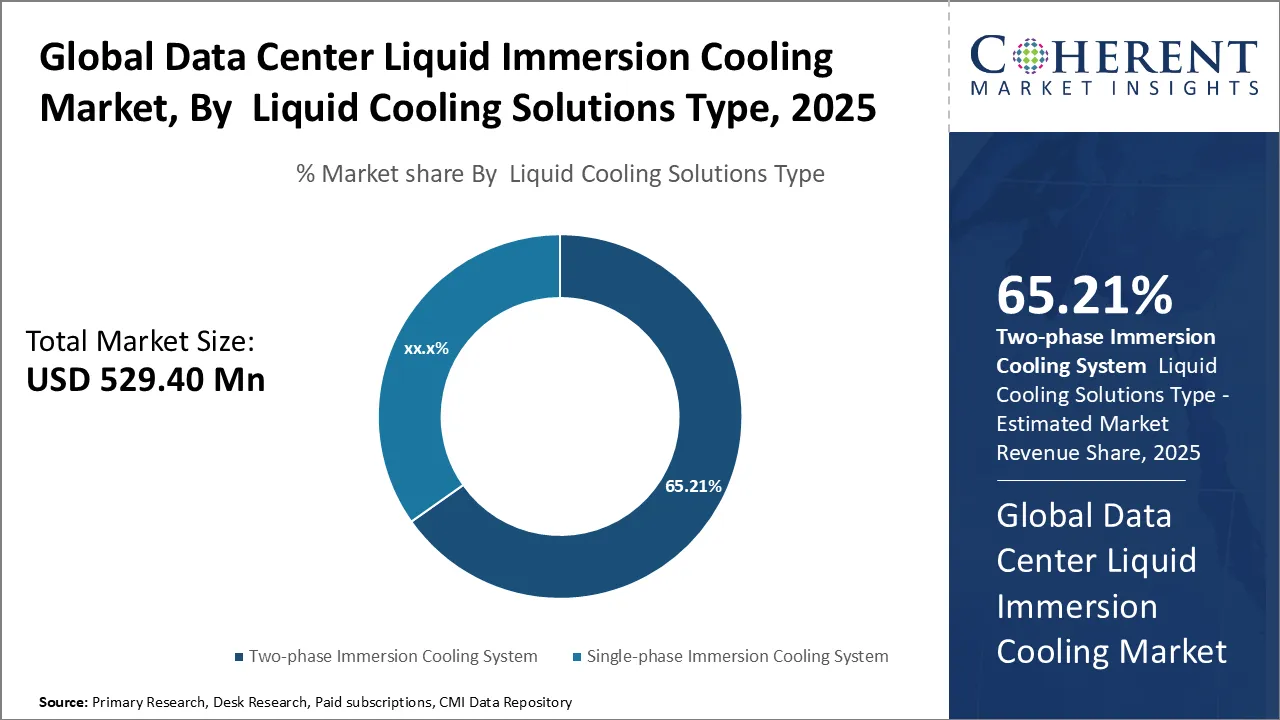
In terms of liquid cooling solution type, the two phase immersion cooling system segment is expected contribute the highest share of 66.21% in the market in 2026 owing to their superior heat dissipation capabilities and energy efficiency advantages. Two phase cooling system utilize the phase change of dielectric fluid from liquid to vapor to absorb and remove heat from servers. The phase change mechanism allows for efficient heat transfer at lower fluid temperatures. This makes them ideal for high density compute environments like AI training clusters and cryptocurrency mining operations handling extreme thermal loads.
For instance, in June 2025, Global Switch has unveiled a comprehensive suite of liquid cooling technologies developed with leading six digital infrastructure partners. The facility showcases four advanced cooling solutions like direct-to-chip, single-phase immersion, and two-phase immersion systems for AI workloads.
To learn more about this report, Download Free Sample
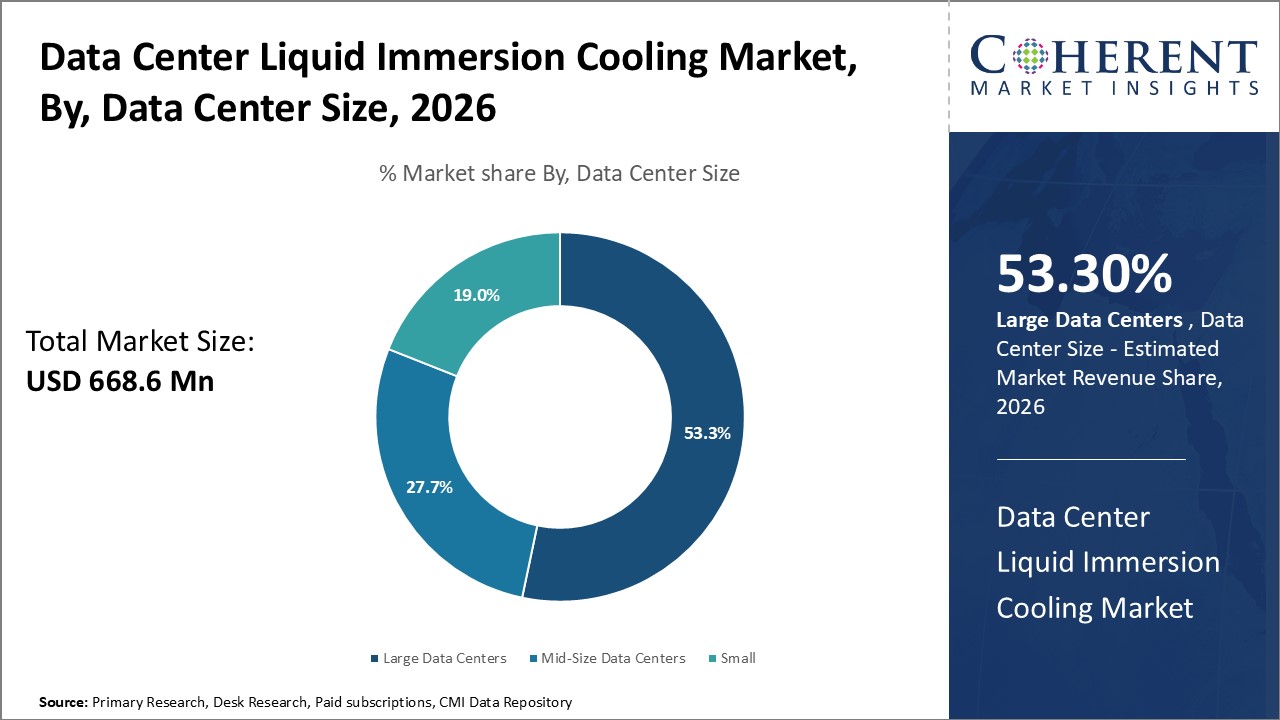
Based on Data Center Size, the Large Data Centers segment is expected to hold the highest share of the market in 2026, owing to massive heat loads and low operational costs.
In terms of data center size, the large data centers segment is expected to lead the data center liquid immersion cooling market with largest share in 2026. Large facilities handle massive computational workloads and require advanced cooling infrastructure to manage high heat densities. They are the best choice for implementing liquid immersion cooling systems. They have the budget and space needed to install these systems across their operations. These data centers save a lot of energy and lower electricity costs compared to traditional air cooling methods. The technology lets them fit more servers into smaller spaces while also lowering their overall carbon footprint.
For instance, In November 2025, Vertiv, released the Vertiv™ CoolCenter Immersion cooling system across Europe, the Middle East for AI and HPC applications. This release broadens Vertiv’s liquid based cooling offerings to handle demanding computing settings that need excellent heat removal and power savings.
In terms of end use industries, the IT and telecom segment is expected to lead the data center liquid immersion cooling market with largest share in 2026. IT and telecom companies have big data centers where servers and networking equipment generate a lot of heat. They require efficient cooling solutions to keep their cloud services and communication networks running smoothly without interruptions. These businesses are spending a lot of money on new technologies to lower energy costs and reach their goals for environmental sustainability. Liquid immersion cooling helps them cool more equipment with less electricity than traditional air conditioning systems.
For instance, in March 2025, SK Telecom worked together with Giga Computing and SK Enmove to create new cooling technologies. The collaboration seeks to improve SK telecom’s ability to design and run power saving cooling equipment that cuts electricity use.
To learn more about this report, Download Free Sample
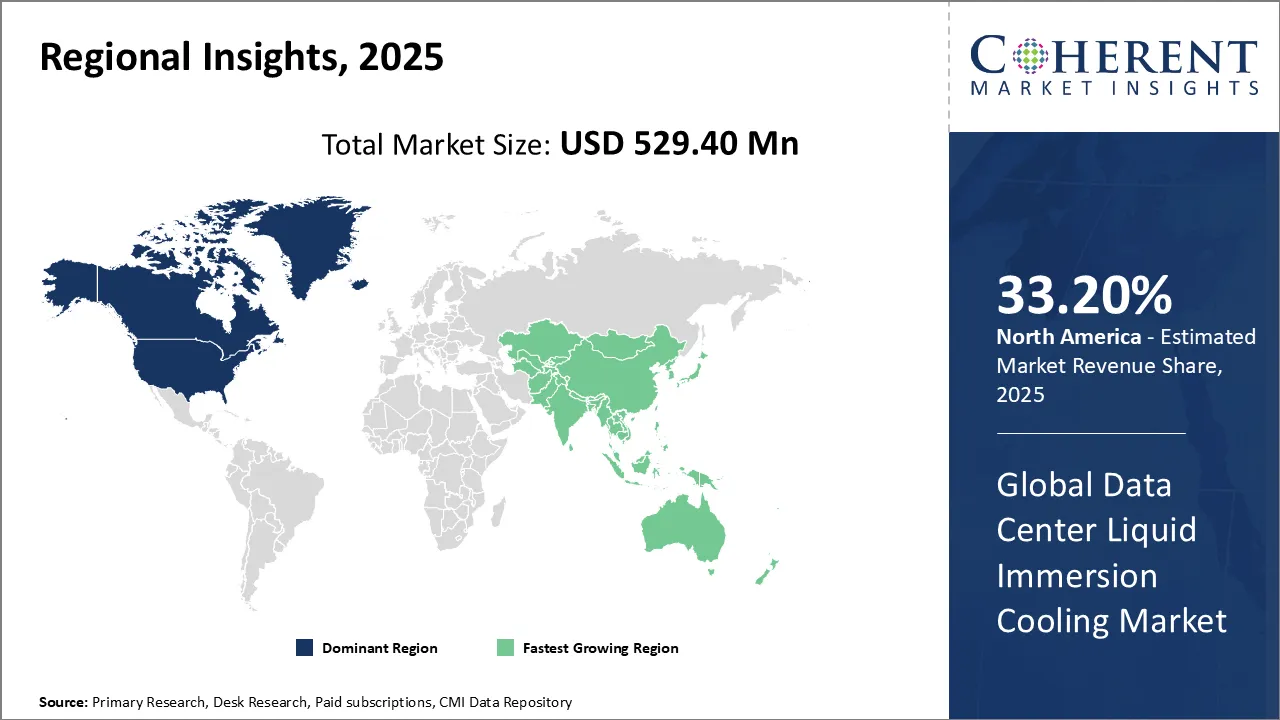
North America has emerged as the dominant region in the Data Center Liquid Immersion Cooling Market owing 33.2% in 2026. The region leads due to its large number of hyperscale data centers and tech companies requiring advanced cooling solutions. The U.S. hosts major cloud service providers and AI companies that generate extremely high heat from their computing operations. Most data centers in the region are adopting liquid immersion cooling to reduce their energy bills and environmental impact. The presence of leading tech firms like Amazon, Google, and Microsoft as well as innovative cooling solution providers has further boosted market adoption across the region.
For instance, in January 2024, Modine purchased TMG Core’s intellectual property and assets to expand its single-phase and two-phase liquid immersion cooling capabilities. This deal helps Modine to better serve cooling options for facilities running intensive computing operations that generate greater heat levels.
Asia Pacific is identified as the fastest growing regional market. The region is seeing rapid growth in internet usage and digital services that require more data centers to handle the traffic. Countries like China, India and Singapore are building many new data centers to cater to the growing demand from businesses and consumers. The hot and humid weather in most Asian countries makes regular air conditioning systems very expensive and inefficient to operate. High electricity prices are forcing data center operators to adopt liquid immersion cooling to reduce their energy bills. More companies are using AI and cloud computing which need powerful servers that generate intense heat requiring advanced solutions.
For instance, in July 2024, NTT FACILITIES started a new facility project using liquid based cooling methods to reach zero emissions by 2030.The firm controls approximately 70% of Japan’s market and builds major facilities throughout Japan, North America and the Asia Pacific region.
In 2026, the market in the China is expected to be strong owing to government support that provides subsidies and creates policies which encourage adoption of advanced cooling technologies. Environmental concerns are pushing data center operators toward cleaner transportation cooling options that reduce energy consumption and carbon emissions. Manufacturing strength lets Chinese companies produce cooling systems at lower costs which makes them accessible to more buyers across various data center scales.
In 2026, the U.S. market is booming with more data center operators choosing environmentally sustainable cooling technologies that helps minimize carbon emissions. Government programs are providing tax breaks and incentives that help offset the initial investments costs for facilities implementing energy efficient cooling infrastructure. The high electricity prices are also pushing operators toward liquid immersion options that reduce cooling energy consumption. Technology upgrades are providing improved dielectric fluids and enhanced heat exchange systems that boost cooling efficiency and support higher data center computing densities.
| Report Coverage | Details | ||
|---|---|---|---|
| Base Year: | 2025 | Market Size in 2026: | USD 668.6 Mn |
| Historical Data for: | 2020 To 2024 | Forecast Period: | 2026 To 2033 |
| Forecast Period 2026 to 2033 CAGR: | 26.3% | 2033 Value Projection: | USD 3,427.8 Mn |
| Geographies covered: |
|
||
| Segments covered: |
|
||
| Companies covered: |
Alfalava, Asetek, CoolIT Systems, Green Data Center LLP, Green Revolution Cooling Inc., Horizon Computing Solutions, IBM Corporation, Midas Green Technologies, LLC, Rittal GmbH & Co. Kg., and Schneider Electric SE. |
||
| Growth Drivers: |
|
||
| Restraints & Challenges: |
|
||
Uncover macros and micros vetted on 75+ parameters: Get instant access to report
The growing use of artificial intelligence, high performance computing and big data is driving up electricity demand like never before. Traditional cooling systems that use air are finding it hard to keep up with the heat produced by today’s data centers. Liquid immersion cooling has become a smart solution to cater to these overheating problems in modern technology facilities across the globe. This new method works by placing computer servers directly into special liquids that do not conduct electricity but absorb heat effectively. This helps companies to cut their energy bills by a significant amount when they switch from old air conditioning to this system. Big tech firms are now using this cooling technology to cater to their growing server needs and save money. The worldwide market for liquid immersion cooling solutions is growing fast as data centers look for better and greener solutions today.
As per a report by the International Energy Agency, the data centers consumed about 415 terawatt hours of electricity in 2024. This represents 1.5% of worldwide power usage. This energy demand has been rising by 12% annually over past five years, thus creating urgent need for more efficient cooling technologies.
Government around the world are introducing stricter environmental regulations that are pushing data centers to reduce their carbon footprint and energy consumptions. These new rules require companies to adopt more sustainable cooling technologies. Liquid immersion cooling systems have emerged as a viable option for businesses who are trying to cater to these demanding environmental standards and compliance requirements. This technology uses significantly less electricity than traditional air conditioning. This helps companies to align with green regulations and sustainable goals. Many countries are now coming up with tax incentives and financial support for data centers that invest in energy efficient solutions. These regulatory mandates are opening up growth prospects for liquid immersions cooling providers.
The data center liquid immersion cooling market is gaining strong traction as computing infrastructure transitions toward higher power densities and performance-intensive workloads. Industry data indicate that modern AI and high-performance computing racks increasingly exceed 50–100 kW, levels at which conventional air-based cooling becomes inefficient and space intensive. Liquid immersion cooling systems address this challenge by submerging IT hardware in dielectric fluids, enabling direct heat removal at the source.
Operational data from pilot and commercial deployments show that immersion cooling can reduce overall data center energy consumption by roughly 20–30% through lower fan usage and reduced reliance on mechanical chillers. Temperature reductions of 30–40°C at the server level have been documented, improving hardware reliability and extending equipment lifespan. Additionally, immersion-cooled facilities typically achieve power usage effectiveness values well below those of traditional air-cooled data centers.
Adoption has accelerated across hyperscale and colocation facilities in North America, while Asia Pacific has emerged as a fast-growing deployment region due to dense urban data centers and expanding AI infrastructure. Two-phase immersion systems are gaining attention for their ability to handle extreme heat flux, although single-phase systems currently account for a larger installed base due to simpler design and maintenance.
Overall, the market is transitioning from early adoption to scaled implementation. Growing investment in AI, cloud computing, and sustainable data center design continues to reinforce immersion cooling as a viable long-term thermal management solution.
Definition: The Data Center Liquid Immersion Cooling Market provides solutions that minimize energy consumption and heat management challenges during heavy computing operations. These liquid immersion cooling systems use either single-phase or two-phase cooling technology to remove heat from servers while preventing overheating and equipment failure in demanding environments. They are commonly used in hyperscale data centers and AI computing when running intensive workloads and power-hungry applications to improve operational efficiency and sustainability.
Share
Share
Suraj Bhanudas Jagtap is a seasoned Senior Management Consultant with over 7 years of experience. He has served Fortune 500 companies and startups, helping clients with cross broader expansion and market entry access strategies. He has played significant role in offering strategic viewpoints and actionable insights for various client’s projects including demand analysis, and competitive analysis, identifying right channel partner among others.
Joining thousands of companies around the world committed to making the Excellent Business Solutions.
View All Our Clients