

Dental Bone Graft and Substitutes Market Size and Share Analysis- Growth Trends and Forecasts (2026-2033)
The Dental Bone Graft and Substitutes Market size is anticipated to grow at a CAGR of 7.2% with USD 1,500 Mn in 2026 and is expected to reach USD 2,440 Mn in 2033. The primary drivers are defined by rising demand for implant dentistry, periodontal reconstruction, ridge augmentation, and socket preservation across dental clinics, hospitals, and ambulatory surgical centers. Some of the other factors include increasing tooth loss, cosmetic dentistry adoption, biomaterial innovation, and preference for synthetic and xenograft substitutes. The WHO reported in March 2025 that the oral diseases affect nearly 3.7 billion people globally, thereby supporting the demand for dental grafting solutions.
Key Takeaways
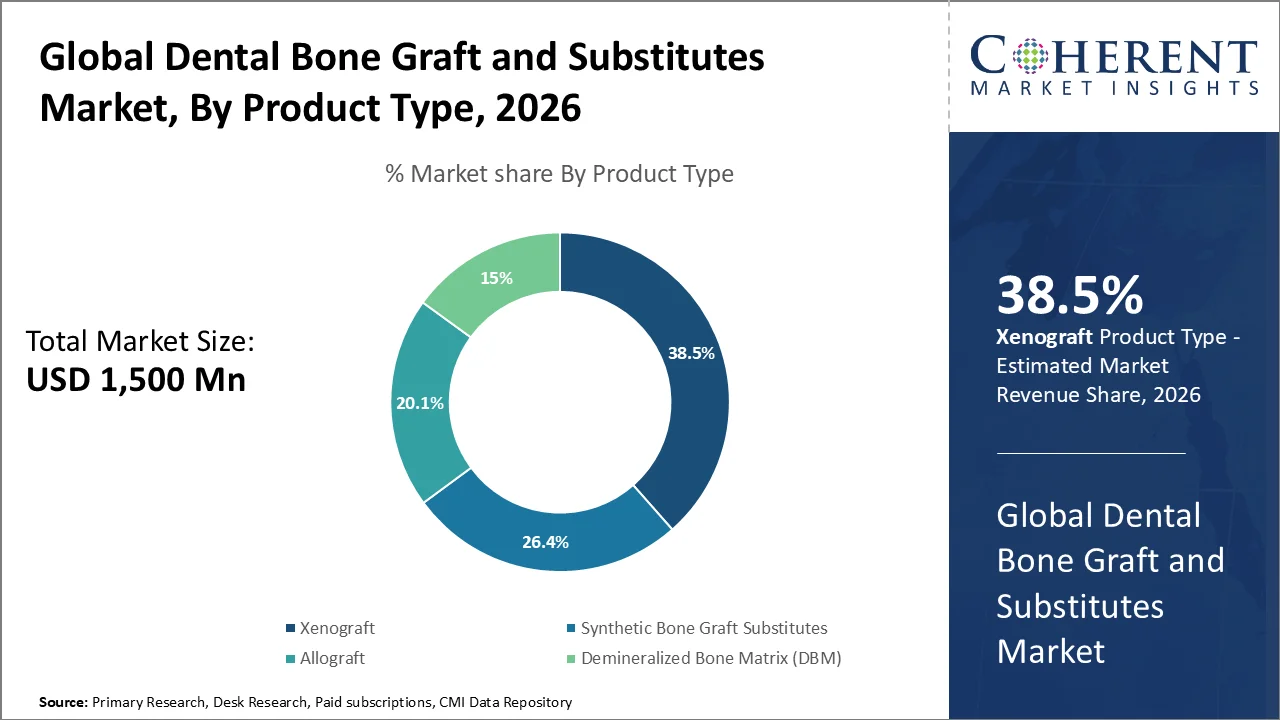
- The xenograft segment is likely to dominate the market with 38.5% in 2026. The segment’s growth is owing to its wider use in socket preservation, sinus lift, ridge augmentation, and periodontal defect repair, as xenografts offer osteoconductive scaffolding, volume stability, and reduced need for autologous bone harvesting. According to MDPI, an estimated 90% of all bone grafting procedures performed worldwide use a natural bone graft or substitute material.
- The animal source segment is set to lead with 42.1% in 2026. The segment’s growth is owing to the strong clinical adoption of bovine and porcine-derived bone matrices, which provide natural mineral structure, porous architecture, and predictable handling for dental implantology and maxillofacial bone regeneration procedures.
- The hospitals segment is set to lead with 45.6% in 2026. The segment’s growth is owing to the increasing number of complex implant surgeries, trauma cases, oral reconstruction procedures, and availability of advanced imaging, sterilization, and multidisciplinary surgical support in hospital-based dental and maxillofacial departments. AHA reported 6,100 U.S. hospitals in 2026.
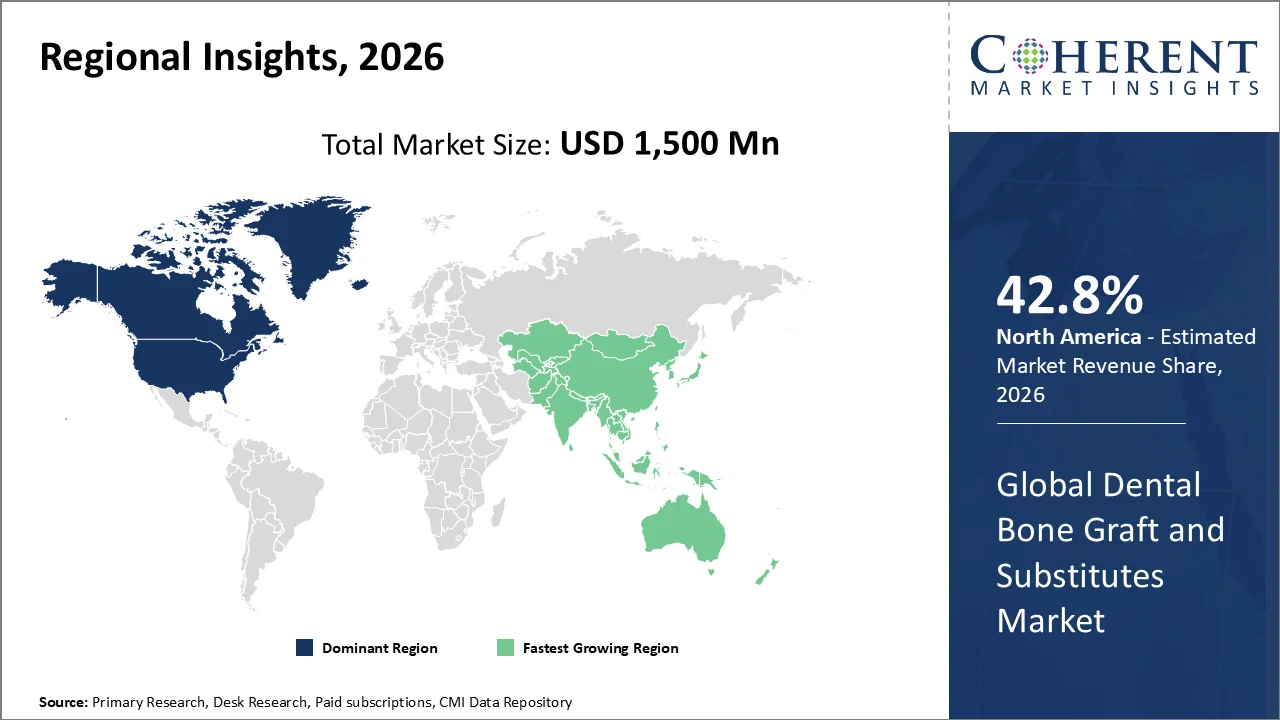
- North America is expected to acquire the prominent share of 42.80% in 2026. The region’s growth is owing to the high dental procedure spending, advanced implant adoption, favorable regulatory clarity, and strong prevalence of periodontal disease. ADA reported U.S. dental expenditure of USD 189 billion in 2024.
Segmental Insights
Why is Xenograft Acquiring the Largest Share?
On the basis of product type, the xenograft segment is projected to account for the largest Dental Bone Graft and Substitutes Market share of 38.5% in 2026. The segment’s growth is owing to their extensive clinical evaluation and established osteoconductive performance.
Multiple ongoing and completed clinical studies registered on ClinicalTrials.gov are actively assessing bovine‑derived and porcine‑derived xenografts for alveolar ridge preservation, sinus augmentation, and socket preservation, indicating sustained research investment in this material class.
According to WHO oral health data, 350, creating significant indications for bone graft intervention prior to implant placement.
A notable clinical development in 2026 includes completion of enrollment in the Phase I/II RESTORE study (Theradaptive’s OsteoAdapt DE) comparing novel regenerative approaches against standard xenograft bone grafts in alveolar ridge augmentation, underscoring xenografts as the control standard in cutting
- Current Industry Events of 2026
- Market Size Estimation
- Regional Breakdown
- Competitive Landscape
- Customer Intelligence
- Segmental Analysis
- Pricing Analysis
- Key Market Drivers, Challenges & Future Trends
- Customized Insights Section
Animal Source hold the Largest Market Share
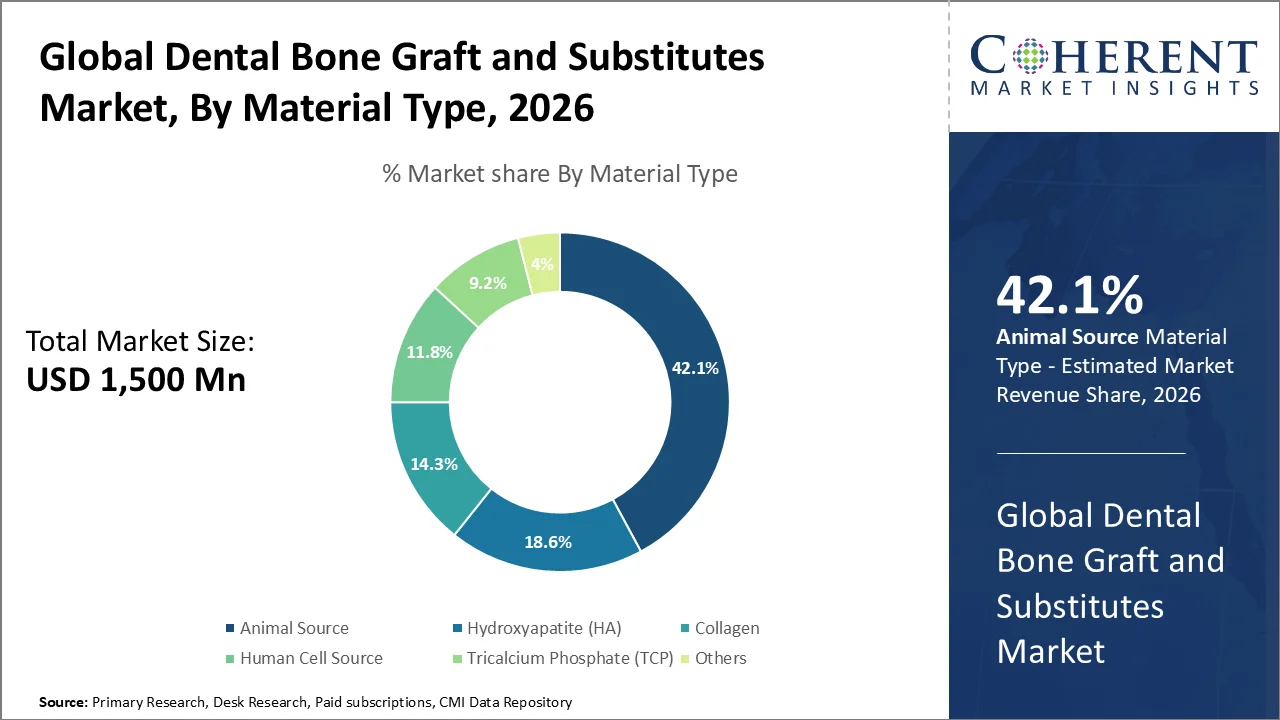
On the basis of basis of material type, the animal source segment lead with a major 42.1% share in 2026. The growth is owing to the broad clinical use of xenografts, mainly bovine- and porcine-derived graft materials, in periodontal defect repair, alveolar ridge preservation, sinus augmentation, and implant-site development.
The demand is increasing with the rising volume of dental implant procedures, as the FDA notes that up to 50% of dental implant procedures may require bone graft support. The animal-derived grafts are extensively preferred because they offer an osteoconductive scaffold which supports the bone regeneration before or during implant placement. The bovine-derived Bio-Oss is among the commonly used dental bone graft materials.
The regulatory clarity is also improved with the FDA’s August 2025 finalized guidance on animal studies for dental bone grafting material 510(k) submissions, thereby strengthening the consistent review of animal-derived devices. The clinical activity also continues through the U.S.-registered trials comparing collagen-enriched bovine xenografts with allografts.
Market Drivers
Rising Adoption of Dental Implants and Periodontal Treatments is Transforming the Dental Bone Graft and Substitutes Market in the US
In the United States, the dental bone graft and substitutes segment is growing at a rapid pace. This is because the dental implants and periodontal treatments are becoming more widely adopted. These grafting materials are used to fill and reconstruct periodontal and alveolar defects before implant placement, in accordance with the 21 CFR § 872.3930 requirements.
The growth is also owing to the regulatory clarity. The updated FDA guidance finalized in August 2025 clarifies animal The expansion in clinical research also reflects the rising demand. The active trials on ClinicalTrials.gov are investigating autogenous tooth bone grafts for ridge preservation and are also comparing allografts versus xenografts for alveolar augmentation.
In January 2026, Alphatec Holdings, a leader in spine surgery solutions, teamed up with Theradaptive, a clinical-stage regenerative medicine firm. Under the agreement, Alphatec secures exclusive U.S. rights to Theradaptive’s OsteoAdapt osteoinductive bone graft.
3D-Printed Synthetics: A Major Breakthrough in the Dental Bone Graft and Substitutes Market
The 3D‑printed synthetics segment of the dental bone graft and substitutes market is expanding rapidly due to technological innovation and regulatory progress.
In Nov 2023, CMFlex, a customizable 3D‑printed synthetic graft developed by Dimension Inx and manufactured on Desktop Health’s 3D‑Bioplotter, received FDA clearance and has been applied in dental socket preservation and jaw defect cases, demonstrating the clinical feasibility of patient-specific synthetic grafts.
Further, in February 2026, Biomendex Oy secured FDA 510(k) clearance for Adaptos Fuse. This allows for its U.S. market launch for dental and craniofacial bone reconstruction, thereby expanding the availability of the off-the-shelf synthetic alternatives.
The government health data indicates the increasing dental implant procedures, rising from 1% in 2009 to 2% in 2023 among adults, thereby propelling the higher adoption of synthetic grafts. These technological innovations, regulatory approvals, as well as the rising procedural demand are fueling strong growth for 3D‑printed synthetics in dental bone grafting.
Current Events and Their Impact
Current Event | Description and its Impact |
WHO Guidance on Biocompatible Bone Graft Materials |
|
U.S. FDA Clearance for Bone Graft Substitutes |
|
Dental Bone Graft and Substitutes Market Trends
- The rising adoption of minimally invasive guided bone regeneration and micro-grafting techniques is improving the procedural safety, reduces recovery times, and enhances patient comfort during implant and reconstructive surgeries.
- The personalized dental graft procedures using autologous, allogeneic, and synthetic bone substitutes optimize bone regeneration and implant stability, thereby improving clinical outcomes and patient satisfaction globally.
- The advanced growth factor-enhanced and bioactive scaffolds are gaining traction, thereby offering precise control over resorption rates and accelerated tissue regeneration.
- The aging populations and increasing prevalence of tooth loss, periodontal disease, and jawbone resorption are propelling the demand for dental bone grafts. According to the CDC, in 2026, about 11% of adults aged 65–74 and nearly 20% of adults aged 75+ have lost all natural teeth, thereby highlighting the need for bone regeneration prior to implants.
- The supportive public health programs and insurance coverage are broadening the patient access to grafting procedures. For example, Medicare Part B in the U.S. covers medically necessary dental procedures associated with reconstructive surgery, thereby increasing the uptake among older adults.
Regional Insights
North America Dominates Owing to the High Prevalence of Periodontitis and Supportive Regulatory Environment
The North America region accounts for 42.8% of the market share in 2026. The region’s growth is owing to a large treated population base for periodontal bone loss, tooth extraction, ridge preservation, and implant-preparation procedures.
In the U.S., NIDCR reports that 42.2% of adults aged 30 years and above had total periodontitis, including 7.8% with severe disease, creating sustained need for regenerative NIDCR also reports that 17.3% of seniors aged 65 years and older have no remaining teeth, supporting demand for implant-supported rehabilitation where bone grafting is often required to rebuild or preserve jawbone volume.
Regulatory activity has further supported the availability of products in the bone graft and substitutes market. In February 2025, the U.S. FDA granted 510(k) clearance (K241186) for a Synthetic Bone Graft Particulate, which is specifically intended to augment alveolar bone in tooth extraction sites and facilitate subsequent implant or restorative procedures.
Asia Pacific Dental Bone Graft and Substitutes Market Trends
Asia Pacific is expected to witness strong growth in Dental Bone Graft and Substitutes Market over the forecast period. The region’s growth is owing to the prevalence of dental conditions requiring bone regeneration rises across the region. Oral diseases such as tooth caries and periodontal bone loss are key drivers of demand for graft and substitute products.
According to the World Health Organization (WHO), in the SouthIn the broader Asia region, research based on the Global Burden of Disease 2021 database reported that there were approximately 684.7 million people with periodontal diseases, a leading indication for bone grafts and alveolar augmentation procedures.
The growing implant‑based rehabilitation efforts and governmental emphasis on integrating oral health into universal health coverage are also supporting the demand for bone graft and substitute products. A recent clinical development is ClinicalTrials.gov ID NCT07362394, a study initiated in 2026 by the National University of Malaysia comparing autologous dentin graft versus xenograft in periodontal bone defect repair, thereby indicating active research and adoption of novel graft technologies.
Tooth Loss and Periodontal Damage is Accelerating the Dental Bone Graft and Substitutes Market in United States
The U.S. market is expanding as tooth loss, periodontal bone damage, and implant-based rehabilitation propel demand for alveolar ridge preservation and grafting.
According to the CDC 2024 Oral Health Surveillance Report, the adults aged 65 and older have an average 6.4 missing teeth due to disease, thereby emphasizing the demand for ridge preservation and regenerative treatments.
In February 2025, the FDA cleared Synthetic Bone Graft Particulate, a 45S5 bioactive-glass absorbable graft from and thereby strengthening the growth and adoption in American dental surgeries.
China Dental Bone Graft and Substitutes Market Trends
In China, the rising demand for dental implants and periodontal treatments is propelling the growth in the dental bone graft and substitutes market. This is supported by government incentives for innovative regenerative devices.
The dental bone graft substitutes in China are regulated as medical devices under the National Medical Products Administration (NMPA), thus requiring Class II/III registration with clinical evidence. In June 2023, the NMPA received 466 applications under innovation and priority review procedures, thereby reflecting a growing focus on advanced graft materials.
A notable development includes Regenity receiving NMPA approval for MatrixOss porcine bone mineral in March 2024 for GTR/GBR, thereby broadening treatment options and encouraging the market expansion.
Who are the Major Companies in Dental Bone Graft and Substitutes Industry
Some of the major key players in Dental Bone Graft and Substitutes Market are Institut Straumann AG, Geistlich, DENTSPLY International, Zimmer Biomet, Medtronic Plc., BioHorizons IPH, Inc., ACE Surgical Supply Company, Inc., RTI Surgical, Inc., LifeNet Health, and Citagenix.
Key News
- In November 2024, Korean med-tech company Innosys Co. Ltd. introduced two injectable spine bone graft substitutes, Velofuse Gel and Velofuse Putty.
- In April 2023, ZimVie launched two new dental bone graft products, expanding its portfolio. The RegenerOss CC Allograft particulate blends cortical and cancellous bone for bony voids, while the RegenerOss bone graft plug simplifies filling extraction sockets and periodontal defects. Both are available in North America.
Market Report Scope
Dental Bone Graft and Substitutes Market Report Coverage
| Report Coverage | Details | ||
|---|---|---|---|
| Base Year: | 2025 | Market Size in 2026: | USD 1,500 Mn |
| Historical Data for: | 2020 To 2024 | Forecast Period: | 2026 To 2033 |
| Forecast Period 2026 to 2033 CAGR: | 7.2% | 2033 Value Projection: | USD 2,440 Mn |
| Geographies covered: |
| ||
| Segments covered: |
| ||
| Companies covered: | Institut Straumann AG, Geistlich, DENTSPLY International, Zimmer Biomet, Medtronic Plc., BioHorizons IPH, Inc., ACE Surgical Supply Company, Inc., RTI Surgical, Inc., LifeNet Health, and Citagenix | ||
| Growth Drivers: |
| ||
| Restraints & Challenges: |
| ||
Analyst Opinion
- Dental Bone Graft and Substitutes is driven by broad ingredient utility, not only by herbal The dental bone graft market is primarily driven by the increasing prevalence of oral diseases and tooth loss. According to the World Health Organization (WHO), approximately 3.5 billion people worldwide suffer from oral diseases, and nearly 350 million people have experienced complete tooth loss. This creates a substantial population requiring restorative procedures such as bone grafting, independent of emerging market trends.
- Dental clinics remain the primary care setting for these procedures. U.S. data from the American Dental Association (ADA, Q1 2026) indicate that 45% of adults received dental care in the previous year, with consumer spending on dental services reaching US$189 billion by 2024. The availability of digital imaging, guided workflows, and specialist-led implant programs is increasing treatment efficiency and expanding the candidate pool for bone graft procedures.
- Technological innovations and regulatory support are reinforcing market growth. Mercury-free, biocompatible materials such as xenografts and allografts are increasingly preferred, supported by WHO guidance and the EU ban on dental amalgam (effective January 1, 2025). Clinical studies show high graft success rates, driving broader adoption of advanced graft materials in hospitals and dental clinics across North America and Europe.
Speak to the analyst
Want personalized insights?
Take the findings above to one of our principal consultants, or have the report rebuilt around the segments, geographies and competitors you actually track.
Market Segmentation
- By Product Type (Revenue, USD Mn, 2021-2033)
- Demineralized Bone Matrix (DBM)
- Allograft
- Xenograft
- Synthetic Bone Graft Substitutes
- By Material Type (Revenue, USD Mn, 2021-2033)
- Collagen
- Human Cell Source
- Animal Source
- Hydroxyapatite (HA)
- Tricalcium Phosphate (TCP)
- Others
- By End User (Revenue, USD Mn, 2021-2033)
- Hospitals
- Clinics
- Ambulatory Surgery Centers
- Global Dental Bone Graft and Substitutes Market, By Region (Revenue, USD Mn, 2021-2033)
- North America
- U.S.
- Canada
- Latin America
- Brazil
- Mexico
- Argentina
- Rest of Latin America
- Europe
- Germany
- U.K.
- France
- Italy
- Spain
- Russia
- Rest of Europe
- Asia Pacific
- China
- India
- Japan
- Australia
- South Korea
- ASEAN
- Rest of Asia Pacific
- Middle East
- GCC
- Israel
- Rest of Middle East
- Africa
- South Africa
- Central Africa
- North Africa
- North America
- Key Players
- Institut Straumann AG
- Geistlich
- DENTSPLY International
- Zimmer Biomet
- Medtronic Plc.
- BioHorizons IPH, Inc.
- ACE Surgical Supply Company, Inc.
- RTI Surgical, Inc.
- LifeNet Health
- Citagenix
Sources
Primary Research Interviews
- Dental Bone Graft Manufacturers
- Dental Implant Manufacturers
- Oral & Maxillofacial Surgeons
- Periodontists and Implantologists
- Dental Clinics and Hospital Procurement Heads
- Dental Biomaterials Distributors
- Regenerative Dentistry Consultants
- Others
Databases
- Bloomberg Terminal
- Thomson Reuters Eikon
- PubMed
- FDA Medical Devices Database
- Others
Magazines
- Dental Tribune International
- Dentistry Today
- Dental Economics
- Inside Dentistry
- Oral Health Group
- Medical Device Network
- Others
Journals
- Journal of Periodontology
- Clinical Oral Implants Research
- Journal of Oral and Maxillofacial Surgery
- International Journal of Oral & Maxillofacial Implants
- Journal of Dental Research
- Materials Science and Engineering: C
- Others
Newspapers
- Financial Times
- The Wall Street Journal
- Reuters
- Bloomberg News
- Business Standard
- The Economic Times
- Others
Associations
- American Dental Association (ADA)
- American Academy of Periodontology (AAP)
- Academy of Osseointegration (AO)
- European Federation of Periodontology (EFP)
- International Team for Implantology (ITI)
- International Association for Dental Research (IADR)
- Others
Public Domain Sources
- U.S. Food and Drug Administration (FDA) – Medical Devices
- Centers for Disease Control and Prevention (CDC) – Oral Health Data
- World Health Organization (WHO) – Oral Health
- National Institutes of Health (NIH)
- U.S. National Library of Medicine – PubMed
- European Medicines Agency (EMA)
- Eurostat
- World Bank Open Data
- Others
Proprietary Elements
- CMI Data Analytics Tool
- Proprietary CMI Existing Repository of Information for the Last 10 Years
Get access to 250+ pages report
Every segment, forecast, competitor profile and data table behind the analysis above — available for instant download.
- ESOMAR Member
- ISO 9001:2015 Certified
- D-U-N-S Registered
- GDPR & CCPA Compliant
Missing comfort of reading report in your local language? Find your preferred language:
Transform your Strategy with Exclusive Trending Reports
Frequently Asked Questions
The Dental Bone Graft and Substitutes Market is expected to reach USD 2,440 Million in 2033.
The high cost of implant procedures, inadequate insurance reimbursements, and risks of graft failure are the key factors hampering growth of the market.
The rising demand for dental implants, a rapidly aging global population prone to tooth loss, and a growing emphasis on aesthetic dentistry is boosting the demand for Dental Bone Graft and Substitutes.
The Dental Bone Graft and Substitutes Market is anticipated to grow at a CAGR of 7.2% between 2026 and 2033.
Among regions, North America is expected to account for a largest market share in the global Dental Bone Graft and Substitutes Market over the forecast period.
Dental implants often require sufficient jawbone density, so patients with bone loss frequently undergo grafting before or during implant placement to improve implant stability and treatment outcomes.
The Dental Bone Graft and Substitutes Market includes products used to rebuild or regenerate jawbone structure for dental implants, tooth extraction sites, periodontal defects, and maxillofacial reconstruction.