

Digital Signage Market Size and Trends Forecast - 2026 to 2033
The global digital signage market is estimated to be valued at USD 33.20 Bn in 2026 and is expected to reach USD 56.90 Bn by 2033, growing at a compound annual growth rate (CAGR) of 8.0% from 2026 to 2033.
Key Takeaways
- By Type, Video Walls is projected to dominate the market share with approximately 27% owing to the continuous demand for immersive large-format displays in retail, corporate, and entertainment applications in 2026.
- Component-based, the Hardware segment is expected to have the highest share of approximately 58.3% in 2026 because displays, media players, and installation equipment are priced quite high, and these components hold a vital position while installing digital signage.
- Technology, the LCD/LED segment is likely to have a share of about 46% in 2026, supported by wide-scale adoption, increased brightness, and low prices of the panels.
- The retail sector, based on application, should continue to dominate the market by attaining around a 25% market share in 2026, as retailers increasingly deploy digital displays for advertising, promotion in stores, and customer engagement.
- By Location, in-Store (Indoor), the segment is expected to account for about 63% share in 2026, driven by large-scale indoor deployments across retail spaces, corporate offices, hospitals, and educational facilities.
- By Region, North America will dominate the global digital signage market with 34.60% share in 2026. Whereas, Asia Pacific is expected to be the fastest growing region.
Market Overview
The key factor contributing to the growth of the digital signage market is the growing adoption of dynamic and visually appealing communication solutions across industries. Apart from offering real-time updates of content, high customer engagement, and high brand visibility, digital signage is increasingly being preferred over traditional static signage. Emerging display technologies, including LED, LCD, and transparent displays, are facilitating higher brightness and energy efficiency, thereby acting as a catalyst for market growth.
Current Events and Its Impact on the Digital Signage Market
Current Events | Description and its impact |
Global Supply Chain Disruptions and Semiconductor Shortages |
|
China-Taiwan Geopolitical Tensions and Display Manufacturing |
|
Smart Technologies in the Digital Signage Market
In 2025, smart technologies are transforming the digital signage market by adding interactivity, data intelligence, and automation to deliver better, more effective communication experiences. The term "smart signage" in the context of digital signage would refer to displays and systems whose feature set includes sensors, AI-driven analytics, IoT connectivity, camera-based audience recognition, and cloud-enabled content management designed to boost engagement, refine targeting, and further optimize performance.
The rapid growth of smart cities and increasing demand for connected public communication will accelerate the adoption of smart digital signage. Cloud-based platforms now allow for central remote monitoring and updating of content across thousands of screens, both reducing operational costs while improving the agility of campaigns.
Another emerging segment in the field of digital signage technology is sustainability. Energy-efficient LED and e-paper displays, solar-powered outdoor units, and advanced power-management systems also contribute to lesser environmental impacts and operating costs. Besides these, manufacturers are now coming up with recyclable display materials and modular components extending device life to support the principles of the circular economy.
For instance, in October 2025, Nanolumens launched the “NanoPanel 55”, a 55-inch direct-view LED (dvLED) display combining dvLED benefits (long life, high brightness, energy efficiency) with a conventional flat-panel form factor.
- Current Industry Events of 2026
- Market Size Estimation
- Regional Breakdown
- Competitive Landscape
- Customer Intelligence
- Segmental Analysis
- Pricing Analysis
- Key Market Drivers, Challenges & Future Trends
- Customized Insights Section
Segmental Insights
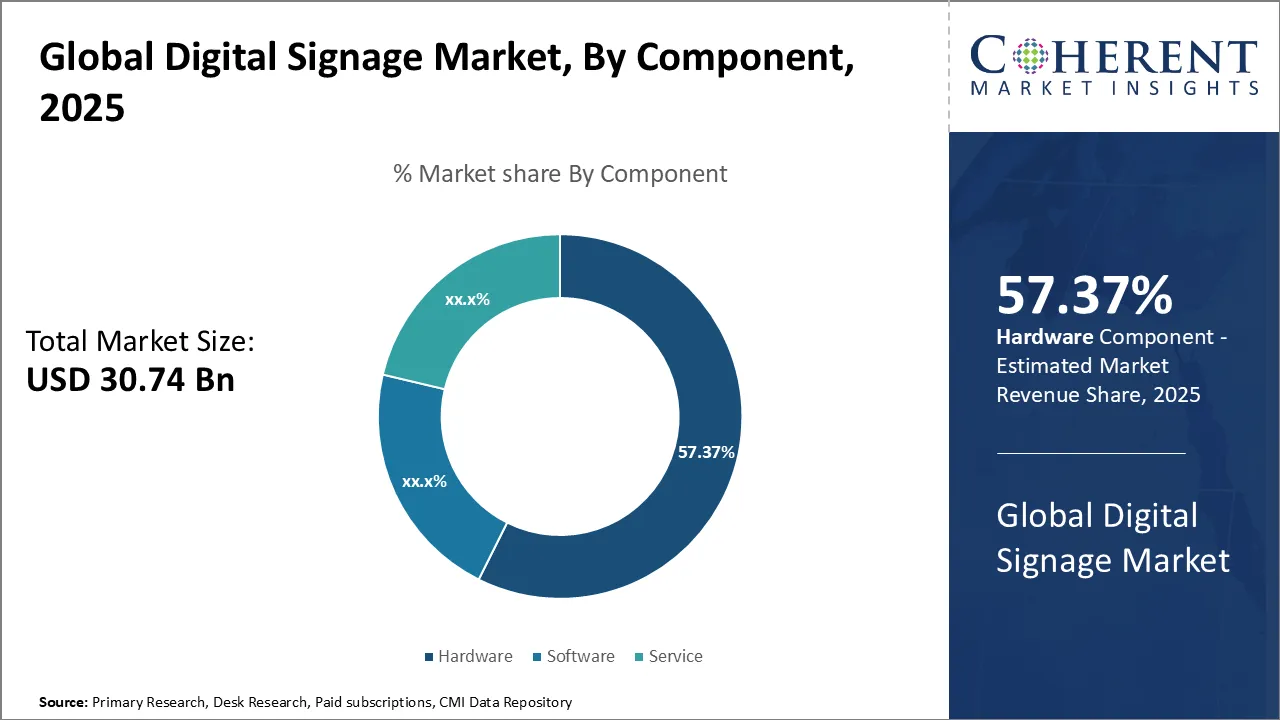
Digital Signage Market Insights, By Component: Hardware Dominates Due to Its Essential Role in Display Infrastructure and High Capital Investment
By component, Hardware has the largest market share, amounting to 58.3% in 2026, due to the very fact that displays, media players, mounting structures, and connectivity systems are integral parts of any digital signage deployment. Hardware remains the most costly constituent, as high-performance screens, processors, and interactive interfaces are indispensable components of digital signage.
It includes LED/LCD panels, projectors, touchscreens, kiosks, transparent displays, and outdoor weatherproof units, all engineered for long operating hours of high brightness and reliable performance. Advanced hardware with integrated sensors, AI processors, and improved energy efficiency are also in rapid demand as more organizations start moving in to adopt smart signage solutions.
For instance, in June 2025, Samsung launched its new Color E-Paper signage line, an energy-efficient display solution consuming far less power than LED/LCD units.
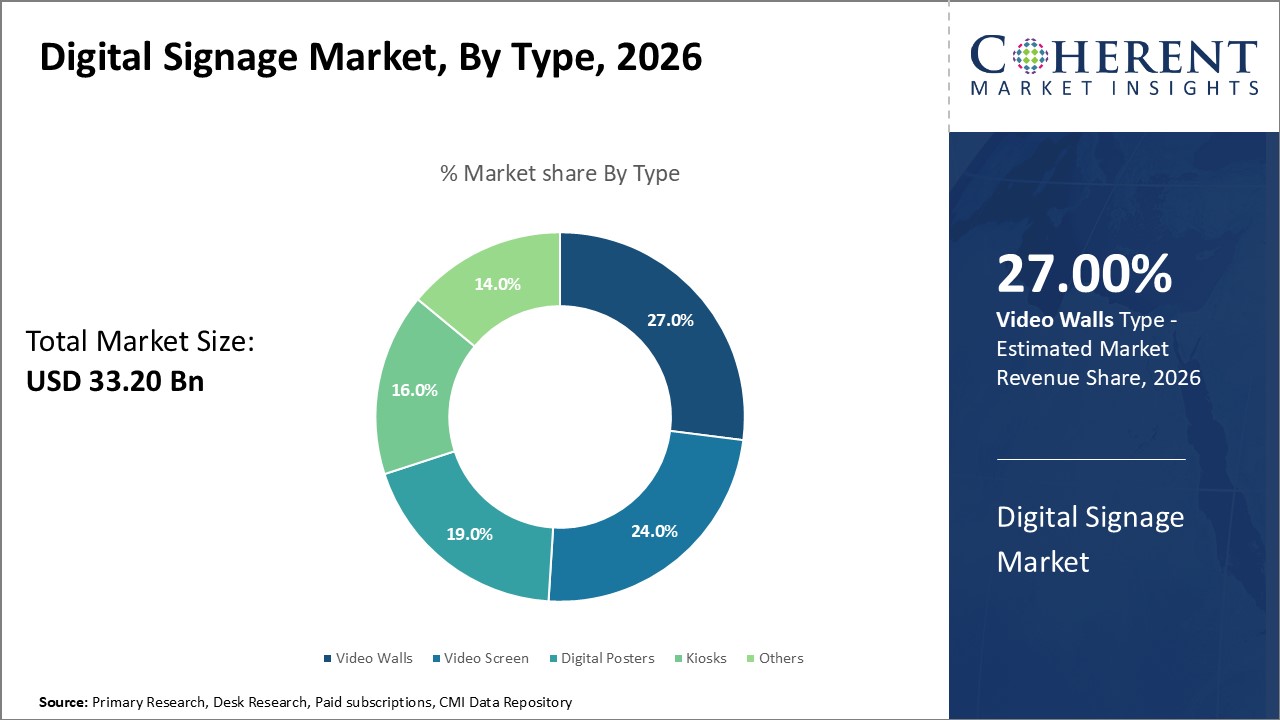
Digital Signage Market Insights, By Type: Video Walls Lead Due to Their Immersive Visual Impact and Expanding Cross-Industry Adoption
By type, the contribution of the market share by Video Walls is 27% in 2026, driven by its capability to provide high-impact and large-format visual experiences to various industries. Video walls provide seamless, high-resolution displays using tiled LED or LCD panels and hence are ideal for those environments where large audiences need to view content simultaneously.
Retailers create immersive brand zones, promotional backdrops, and dynamic story-telling environments with video walls to enhance customer engagement and increase dwell time. Video walls in corporate offices and control rooms are also being used to visualize data, monitor real-time information, and make collaborative decisions. Entertainment venues, stadiums, and public attractions use video walls to enhance the viewing experience with crisp, life-like graphics that surpass conventional messaging formats.
For instance, in June 2025, LG Electronics unveiled its next-generation Kinetic LED video wall series at ISE 2025, featuring AI-driven image adaptation and dynamic motion effects.
Digital Signage Market Insights, By Technology: LCD/LED Leads Due to High Brightness, Durability, and Market Affordability
In terms of technology, the LCD/LED segment accounts for around 46% of the market share in 2026, driven by the increasingly widespread adoption of these display types for their brightness, energy efficiency, cost advantages, and regular manufacturing improvements. LCD still dominates indoor signage on account of its affordability, wide availability, and the excellent visual performance it offers for menus, directories, and retail displays. Meanwhile, LED is expanding quickly in both indoor and outdoor settings due to its seamless modularity and superior luminance.
Some of the key reasons for this growth include improved pixel density, color accuracy, and lower prices of LCD/LED solutions. Companies are increasingly favoring these displays for their reliability in providing long-term performance that is easy to maintain, offering enhanced visual impact in dynamic content campaigns.
For instance, in October 2025, Nanolumens introduced its NanoPanel 55 dvLED display, bringing direct-view LED technology to a flat-panel format with improved energy efficiency and high-definition performance.
Digital Signage Market Insights, By Application: Retail Leads Due to Rising Demand for Dynamic Promotions and In-Store Engagement
Based on application, the Retail segment contributes about 25% of the market share in 2026, driven by retailers’ growing reliance on digital displays for in-store promotions, product advertising, brand storytelling, and customer navigation. Digital signage is fast replacing static ones because it holds attention much better, allowing retailers to update promotions in real time, thus increasing sales conversions and operational efficiency.
Retailers leverage digital screens for product highlights, interactive catalogs, wayfinding, window displays, and digital shelf-edge communication. As consumer expectations for more personalized shopping experiences continue to rise, retailers integrate analytics, AI, and sensors into signage, driving personalization of content according to the time of the day, shopper demographics, or behaviors.
For instance, in May 2025, Albertsons Companies launched a new AI-powered in-store digital display network across its retail chains, enhancing real-time promotional messaging and customer engagement.
Digital Signage Market Insights, By Location: In-Store (Indoor) Leads Due to High Deployment Across Commercial, Institutional, and Corporate Environments
In terms of location, the In-Store (Indoor) segment commands roughly 63% of the market share in 2026, reflecting the extensive use of digital signage within enclosed environments such as retail outlets, corporate offices, hospitals, restaurants, and educational campuses. Indoor settings require consistent engagement and frequent communication updates, making digital signage a preferred medium for delivering real-time information.
Indoor signage offers several advantages: greater visibility of content, less environmental challenge, easier maintenance, and integration with interactive technologies such as touchscreens, gesture control, and camera-based analytics. Advertisements, internal communications, customer assistance, menu boards, and wayfinding applications comprise some of the major indoor applications of digital displays.
For instance, in June 2025, BrightSign expanded its AI-enabled indoor signage solutions with new edge-AI media players, capable of autonomously adapting content based on audience interaction and environmental data. This advancement is accelerating the adoption of smart indoor digital signage across commercial sectors.
Regional Insights
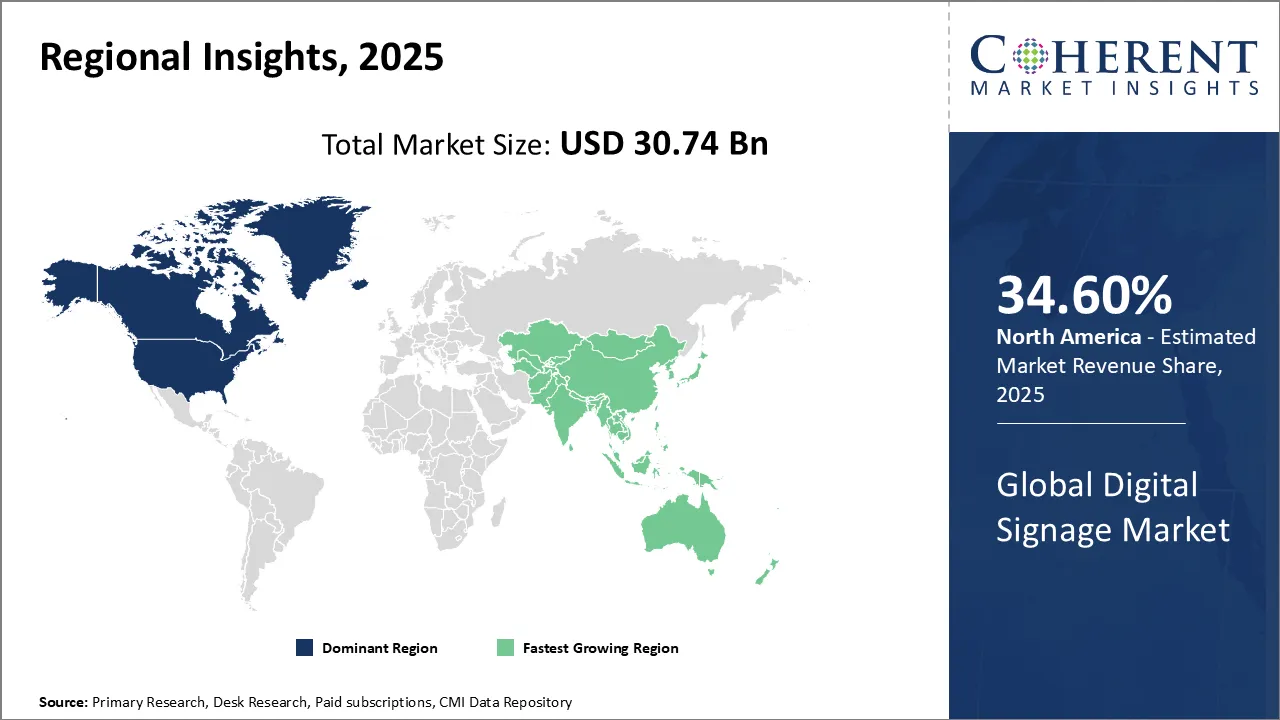
North America Digital Signage Market Analysis & Trends
North America dominated the global digital signage market by accounting for 34.60% of the share in 2026, on account of strong adoption across retail, corporate, transportation, and hospitality verticals. The U.S. has a well-established digital signage ecosystem due to the presence of key manufacturers, fabrication of developed hardware, and easy access to advanced AI-powered content management technologies. The increasing demand for interactive, high-definition displays, and video walls in retail outlets, airports, hospitals, and corporate offices is considered one of the main factors influencing the digital signage market growth.
For instance, in June 2026, BrightSign expanded its AI-enabled indoor signage solutions with new edge-AI media players, enabling real-time content adaptation based on audience behavior and environmental conditions.
Asia Pacific Digital Signage Market Analysis & Trends
The fastest-growing regional market in 2026 for digital signage is expected to be the Asia Pacific, which would also be driven by rapid urbanization, growing retail chains, and increasing investment in the infrastructure for smart cities across countries such as China, India, Japan, and Southeast Asian countries. With rising disposable incomes and a growing middle-class population, demand has increased to engage with customers inside stores through interactive kiosks, displays, and video walls. Local manufacturers increase capacity and integrate LED, LCD, and AI-based signage to meet this rising regional demand. Increased cross-border trade and the surge of imports in hardware also lead to the expansion of the market.
For instance, in September 2026, LG Electronics launched its next-generation Kinetic LED video wall series at ISE 2026 in Asia, featuring AI-driven image adaptation and dynamic motion effects.
Digital Signage Market Outlook Country-Wise
U.S. Digital Signage Market Trends
The U.S. digital signage market is booming in 2026 due to rising demands for immersive retail experiences, interactive corporate displays, and smart city infrastructures. Some of the key technological innovations that have triggered such market growth include AI-enabled content management, edge-AI media players, and advanced LED/LCD video walls. There will be greater penetrations of indoor digital signage devices across retail, healthcare, education, and transportation hubs. Energy efficiency and sustainability will be additional factors driving market growth.
For instance, In January 2026, LG and BrightSign announced a collaboration to ship new LG UHD
China Digital Signage Market Trends
China’s digital signage market is experiencing rapid growth in 2026, driven by urbanization, expanding retail chains, smart city initiatives, and the growing demand for interactive public communication systems. Growing investments in the development of transport hubs, shopping malls, hospitality, and corporate environments drive a high demand for large-format video walls, LCD/LED displays, kiosks, and AI-powered signage solutions. This trend is boosted by government initiatives that encourage digital infrastructure and energy-efficient technologies.
For instance, in April 2026, Christie Digital showcased a wide range of advanced display and AV solutions, including LED video‑walls, projectors and integrated signage solutions, at InfoComm China 2026 in Beijing, aiming at immersive display and signage markets across China
Market Report Scope
Digital Signage Market Report Coverage
| Report Coverage | Details | ||
|---|---|---|---|
| Base Year: | 2025 | Market Size in 2026: | USD 33.20 Bn |
| Historical Data for: | 2020 To 2024 | Forecast Period: | 2026 To 2033 |
| Forecast Period 2026 to 2033 CAGR: | 8.0% | 2033 Value Projection: | USD 56.90 Bn |
| Geographies covered: |
| ||
| Segments covered: |
| ||
| Companies covered: | Samsung Electronics, Daktronics, Exceptional 3D, LG Electronics, Panasonic Corporation, Sony Corporation, Leyard Optoelectronic Co., Ltd., Scala, E Ink Holdings Inc., Deepsky Corporation Ltd., Intel Corporation, and Microsoft Corporation | ||
| Growth Drivers: |
| ||
| Restraints & Challenges: |
| ||
Digital Signage Market Drivers
Increasing Demand for Customized Digital Signage Solutions from Different Sectors
Digital signage provides digital contents, design collaterals, creative advertising, and several other services that leads to adoption of digital signage technology in various applications in sectors such as hospitality, healthcare, education, corporate, banking, transportation, retail, and entertainment. Healthcare sector is one of the prominent end-use industries of digital signage solutions with the growing technological penetration. Moreover, considering the demand for interactive digital advertising, the digital signage is progressing rapidly and witnessing growth which is expected to boost the market.
Increasing Demand for 4k Digital Signage
Rising consumers income leads to increasing purchasing power, and this is expecetd to drive the market growth. The 4K displays are increasingly adopted by the public-display and professional-monitor owing to the improved image features. Moreover, sub-pixel rendering technology is another factor responsible for growing demand for 4K display technology. The sub-pixel rendering technology is used in commercial production of LCDs and active-matrix organic light- emitting diode (AMOLED).
Digital Signage Market Opportunities
Advancement in the Digital Signage Technology Solution
Benefits offered by digital signage solutions such as effective content, collateral design, and impactful marketing & advertisement leads to increased adoption of digital signage. Growing demand for digital signage across various application verticals such as government, healthcare, hospitality, retail, and transportation is expected to drive the market growth. Digital signage is expected to comprise various features such as interactive media, augmented reality (AR), artificial intelligence, and data analysis in the near future.
Analyst Opinion (Expert Opinion)
The digital signage market is undergoing a strategic transformation driven by the convergence of AI, edge computing, and data-driven content optimization. Conventional static displays or centrally managed ones will be quickly displaced by intelligent systems driven by audience demographics, engagement metrics, and environmental cues in real time.
Those retailers and quick-service restaurants that have not deployed AI-powered adaptive signage risk losing measurable sales uplift. Research studies show that interactive or personalized digital signage can raise dwell time by up to 30% and drive purchase conversion by 12–15% compared with static displays, yet less than 25% of retailers in the United States have fully harnessed AI-driven content personalization as of mid-2025. The competitive differentiation is no longer in hardware resolution or size alone; it is in the ability to integrate dynamic analytics, predictive scheduling, and automated content triggers that react to real-world conditions.
Besides this, digital signage leadership is less a function of screen size or pixel density, but rather an ability to deploy intelligent, sustainable, and contextually adaptive solutions that drive measurable engagement and operational efficiency.
Speak to the analyst
Want personalized insights?
Take the findings above to one of our principal consultants, or have the report rebuilt around the segments, geographies and competitors you actually track.
Digital Signage Industry News
- In February 2025, Samsung unveiled a new range of digital‑signage products: notably the Samsung Color E‑Paper (EMDX) displays and AI‑enabled signage solutions under SmartThings Pro and “Interactive Display.”
- In April 2025, E Ink introduced a weather‑resistant, full‑color ePaper display, E Ink Marquee, targeted at outdoor digital signage and DOOH applications, offering low power consumption and wide operating temperature range.
- In October 2025, E Ink announced a partnership with StellarLink in Japan to deliver next‑gen ePaper signage solutions (e.g. the “J-Poster” and “aecoPost”), expanding deployment of ultra‑low‑power, full‑color ePaper signage for commercial / public use.
Market Segmentation
- Type Insights (Revenue, USD Bn & KT, 2026 - 2033)
- Video Walls
- Video Screens (Transparent LED Screens)
- Digital Poster
- Kiosks
- Others
- Component Insights (Revenue, USD Bn & KT, 2026 - 2033)
- Hardware
- Software
- Service
- Technology Insights (Revenue, USD Bn & KT, 2026 - 2033)
- LCD
- LED
- Projection
- Application Insights (Revenue, USD Bn & KT, 2026 - 2033)
- Retail
- Hospitality
- Entertainment (Stadiums & Playgrounds)
- Corporate
- Banking
- Healthcare
- Education
- Transportation
- Location Insights (Revenue, USD Bn & KT, 2026 - 2033)
- In-Store
- Out-Store
- Content Category Insights (Revenue, USD Bn & KT, 2026 - 2033)
- Broadcast
- News
- Weather
- Sports
- Others
- Non-broadcast
- Size Insights (Revenue, USD Bn & KT, 2026 - 2033)
- Below 32 Inches
- 3252 Inches
- Above 52 Inches
- Regional Insights (Revenue, USD Bn & KT, 2026 - 2033)
- North America
- U.S.
- Canada
- Latin America
- Brazil
- Argentina
- Mexico
- Rest of Latin America
- Europe
- Germany
- U.K.
- Spain
- France
- Italy
- Russia
- Rest of Europe
- Asia Pacific
- China
- India
- Japan
- Australia
- South Korea
- ASEAN
- Rest of Asia Pacific
- Middle East & Africa
- GCC Countries
- Israel
- Rest of Middle East & Africa
- North America
- Key Players Insights (Revenue, USD Bn, 2021 - 2033)
- Samsung Electronics
- Daktronics
- Exceptional 3D
- LG Electronics
- Panasonic Corporation
- Sony Corporation
- Leyard Optoelectronic Co., Ltd.
- Scala
- E Ink Holdings Inc.
- Deepsky Corporation Ltd.
- Intel Corporation
- Microsoft Corporation
Sources
Primary Research Interviews from the following stakeholders
Stakeholders
- Interviews with display manufacturers, digital signage software developers, system integrators, IoT and AI solution providers, retail and corporate digital transformation heads, and sustainability officers across major regional markets.
Specific stakeholders
- Product and R&D heads at leading display and signage companies
- Technology and operations managers at digital signage content management and software firms
- Procurement and deployment managers at retail chains, quick-service restaurants, airports, and transportation hubs implementing digital signage networks
- Sustainability and energy-efficiency leads at display and signage associations and alliances
- Installation engineers and service specialists at AV integrators and display solution providers
- IT and digital infrastructure managers at corporate offices and smart city projects using networked digital signage
- Marketing and brand engagement officers utilizing digital signage for interactive and experiential campaigns
Databases
- United Nations Comtrade Database
- World Trade Organization (WTO) Trade Statistics
- Eurostat – Electrical & Electronic Equipment Statistics
- U.S. Census Bureau – Electronic Components & Display Product Data
- China Customs Statistics
- Directorate General of Commercial Intelligence and Statistics (DGCIS), India
- Japan External Trade Organization (JETRO)
- Korea Customs Service Data Portal
- Federal Communications Commission (FCC) – Display and Digital Signage Equipment Standards
- Indian Ministry of Commerce & Industry – Electronics & Display Sector Data
- Energy Star / U.S. Environmental Protection Agency (EPA) – Energy-Efficient Displays Database
Magazines
- Digital Signage Today
- InAVate
- AV Magazine
- Display Daily
- Commercial Integrator
- LED Professional
- Sign & Digital UK
- Electronics World
- AVNetwork
- Smart Cities Dive (Signage & Display Section)
Journals
- Journal of Display Technology (IEEE)
- Displays (Elsevier)
- Journal of Electronic Imaging (SPIE)
- International Journal of Digital Content Technology & its applications
- Journal of Ambient Intelligence and Smart Environments
- Journal of Cleaner Production (Digital Signage Sustainability Section)
- Resources, Conservation & Recycling (Energy Efficient Display Section)
- IEEE Access (IoT & AI in Digital Signage)
Newspapers
- The Wall Street Journal – Technology & Retail Displays
- The Economic Times – Electronics & Signage Industry
- Business Standard – AV & Digital Signage
- Financial Times – Smart Retail & Digital Advertising
- Nikkei Asia – Electronics & Digital Display Value Chain
- The Hindu Business Line – AV and Commercial Display Sector
- South China Morning Post – Electronics & Digital Signage Developments
- The Guardian – Sustainable Electronics & Green Tech
Associations
- Digital Signage Federation (DSF)
- Smart Display & Signage Alliance
- Consumer Technology Association (CTA) – Display Division
- European Digital Signage Association (EDSA)
- Smart Cities Council – Digital Infrastructure Committee
- AVIXA (formerly InfoComm) – Display and Signage Standards
- Asian Digital Signage Association (ADSA)
- Green Electronics Council (GEC) – Energy Efficient Displays
- China Video Industry Association (CVIA) – Digital Signage & LED Displays
- International Electrotechnical Commission (IEC) – Display Standards
Public Domain Sources
- Ministry of Industry and Information Technology (MIIT), China – Display & Digital Signage Policy
- U.S. Environmental Protection Agency (EPA) – Energy Star Reports for Displays
- European Environment Agency (EEA) – Electronic Display Waste & Recycling Statistics
- Ministry of Economy, Trade and Industry (METI), Japan – Display & Electronic Equipment Reports
- Organisation for Economic Co-operation and Development (OECD) – Sustainable Electronics & Display Reports
- Central Pollution Control Board (CPCB), India – E-Waste and Display Electronics
- European Commission – Ecodesign & Energy Efficiency Directives
- United Nations Environment Programme (UNEP) – Sustainable Electronics & E-Waste Reports
- Reserve Bank of India (RBI) – Industrial Output & Electronics Sector
- Department for Promotion of Industry and Internal Trade (DPIIT), India – Digital Display and Electronics Initiatives
Proprietary Elements
- CMI Data Analytics Tool
- Proprietary CMI Existing Repository of information for last 8 years
*Definition: The Digital Signage market refers to the industry involved in the production, distribution, and management of digital display systems that are used for advertising, information dissemination, and communication purposes.
Get access to 250+ pages report
Every segment, forecast, competitor profile and data table behind the analysis above — available for instant download.
- ESOMAR Member
- ISO 9001:2015 Certified
- D-U-N-S Registered
- GDPR & CCPA Compliant
Missing comfort of reading report in your local language? Find your preferred language:
Transform your Strategy with Exclusive Trending Reports
Frequently Asked Questions
The Digital Signage Market is estimated to be valued at USD 33.20 Bn in 2026, and is expected to reach USD 56.90 Bn by 2033.
The CAGR of the Digital Signage Market is projected to be 8.0% from 2026 to 2033.
Increasing demand for customized digital signage solutions from different sectors is expected to drive the market growth.
Hardware segment is the leading component segment in the market.
High initial investment is expected to hamper the market growth.
Samsung Electronics, Daktronics, Exceptional 3D, LG Electronics, Panasonic Corporation, Sony Corporation, Leyard Optoelectronic Co., Ltd., Scala, E Ink Holdings Inc., Deepsky Corporation Ltd., Intel Corporation, and Microsoft Corporation.