

Disposable Incontinence Products Market Analysis & Forecast: 2026-2033
Disposable Incontinence Products Market is estimated to be valued at USD 13.14 Bn in 2026 and is expected to reach USD 18.00 Bn in 2033, exhibiting a compound annual growth rate (CAGR) of 4.6% from 2026 to 2033.
Key Takeaways
- According to Product Type, The Protective Incontinence Garments Category is anticipated to account for the largest share of 47.7% for the Disposable Incontinence Products market in 2026.
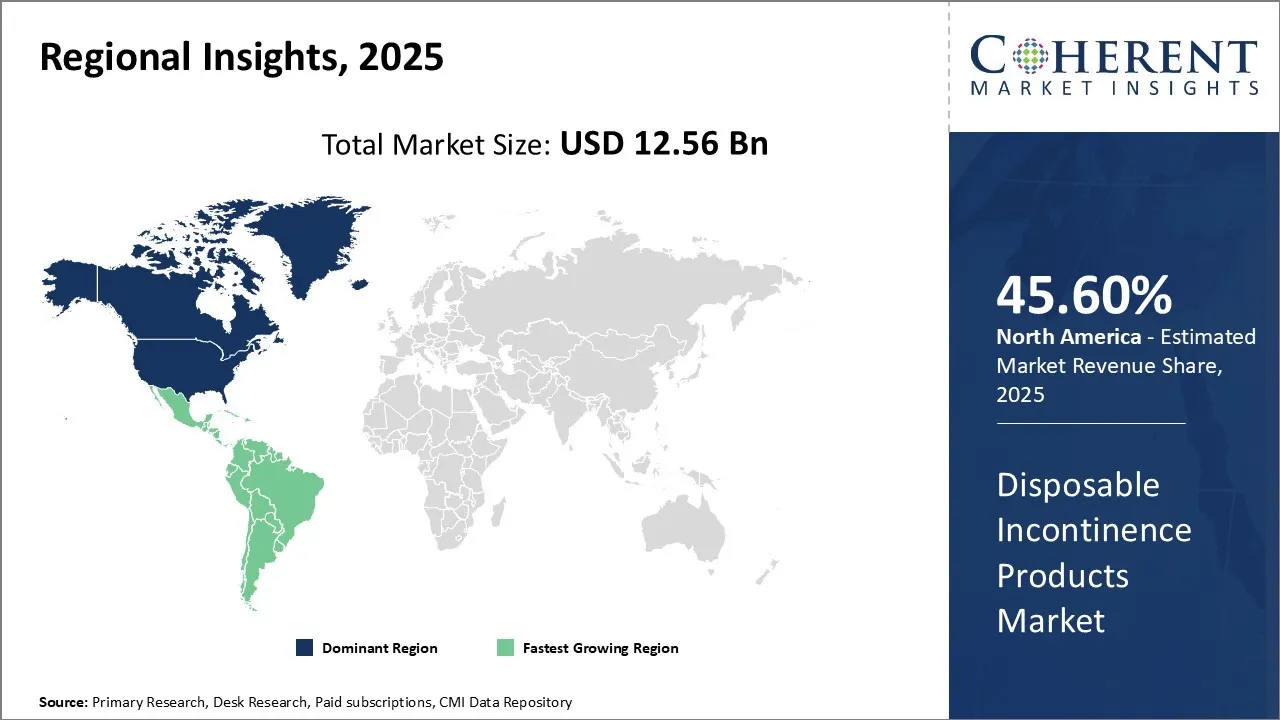
- According to Region, North America holds 45.6% market share for Disposable Incontinence Products market growth by 2026.
Market Overview
The Disposable Incontinence Products Market Size is fueled by shifting customer awareness, product innovation, and demographic developments. The aging population, increased rates of fecal and urine incontinence, and growing awareness of personal care products and incontinence care are the main factors driving the market for disposable incontinence products worldwide. Adult diapers, pads, liners, underpads, and disposable protective undergarments are important product categories that are frequently used in medical facilities, at home, by the elderly, and by patients with long-term illnesses.
For instance, in February 2026, Premium baby care brand Rascal + Friends unveiled a brand refresh last year alongside a new shortened name. Rascals, a short, fun, and distinctive moniker already used by the brand's parents, became the new name for the company.
Current Events and Its Impact
Event | Description and Impact |
Aging Population Surge |
|
Expansion of E-commerce and Online Retail |
|
Pipeline Analysis
The pipeline for disposable incontinence products is characterized by ongoing innovation, with manufacturers focusing on developing new products that offer enhanced absorbency, comfort, and discretion.
Recent advancements include the integration of smart technologies, such as moisture sensors and odor control features, as well as the introduction of gender-specific and eco-friendly materials. These pipeline developments are aimed at addressing the evolving needs of a diverse user base, including elderly populations and individuals with chronic health conditions, and are expected to further drive market growth as they reach commercialization.
- Current Industry Events of 2026
- Market Size Estimation
- Regional Breakdown
- Competitive Landscape
- Customer Intelligence
- Segmental Analysis
- Pricing Analysis
- Key Market Drivers, Challenges & Future Trends
- Customized Insights Section
Patent Landscape
The patent landscape in the disposable incontinence products market is competitive, with leading companies actively protecting innovations related to absorbent materials, ergonomic designs, and smart functionalities.
Patents are being filed for biodegradable and skin-friendly materials, as well as for technologies that improve product fit and minimize leakage. This robust intellectual property activity supports differentiation among brands and helps secure market share, while also encouraging continuous R&D investment to stay ahead in a rapidly evolving market.
Reimbursement Scenario
Reimbursement policies for disposable incontinence products vary significantly across regions, but there is a general trend toward improved coverage, especially in developed markets. Government initiatives and elder care assistance programs are expanding, making these products more affordable and accessible to patients through subsidies and insurance coverage.
Enhanced reimbursement scenarios are contributing to increased adoption of disposable incontinence products, particularly in healthcare facilities and long-term care settings, thus supporting overall market expansion.
Prescribers’ Preference
Prescribers, including physicians and healthcare professionals, are increasingly recommending disposable incontinence products due to their superior hygiene, convenience, and patient comfort. The preference for disposable options over reusable alternatives is reinforced by innovations that offer better absorbency, reduced skin irritation, and improved discretion.
As awareness of incontinence management grows and stigma declines, prescribers are more likely to suggest advanced disposable products, further boosting their uptake in both clinical and home care environments.
Segmental Insights

Disposable Incontinence Products Market Insights, by Product Type
Based on Product Type, the global disposable incontinence products market is segmented into protective incontinence garments, urine bags, and urinary catheter. Out of which, protective incontinence garments segment is expected to dominate the market due rising usage of single-use products like disposable adult diapers.
Disposable Incontinence Products Market Insights, by Material
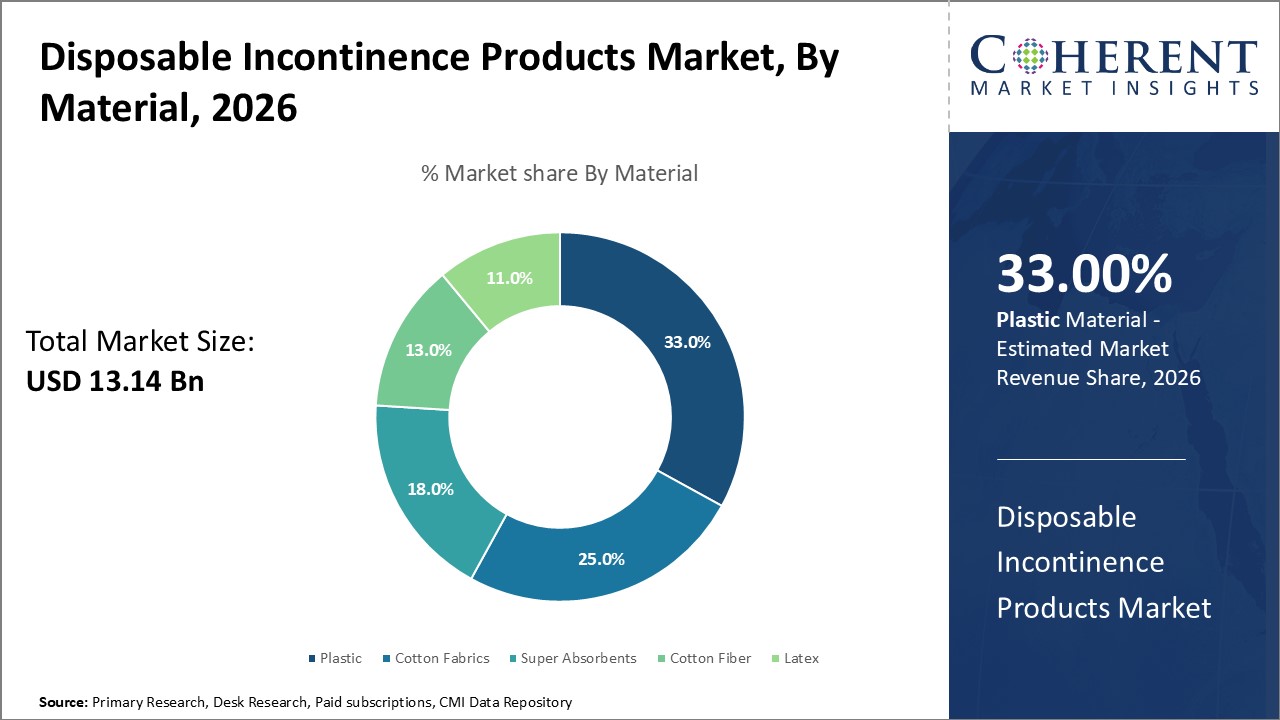
Based on Material, the global disposable incontinence products market is segmented into plastic, cotton, fabrics, super absorbents, cotton fiber, and latex. The plastic segment is expected to dominate the market over the forecast period, as polypropylene non-woven, the most popular plastic, is used as a raw material for disposable diapers.
Disposable Incontinence Products Market Insights, by Distribution Channel
Based on Distribution Channel, the global disposable incontinence products market is segmented into institutional sales and retail sales. The retail segment is expected to dominate the market over the forecast period, owing to ease of access it provide to customers. Many retail stores also conduct health and hygiene awareness programmes for their underprivileged customers.
Regional Insights
North America Disposable Incontinence Products Market
The leadership is driven by several factors, including the region’s aging population, high healthcare expenditure, and strong awareness regarding incontinence management. North America’s advanced healthcare infrastructure supports widespread adoption of premium products such as adult diapers, pads, and underpads.
The market is experiencing robust growth, propelled by rising cases of urinary incontinence, increasing demand for high-performance and discreet products, and ongoing innovations in absorbent technologies particularly the use of superabsorbent polymers that offer superior comfort and leakage protection.
Asia Pacific Disposable Incontinence Products Market
A growing aging population, rising awareness of incontinence care, and technological improvements are all contributing to the market for disposable incontinence products in Asia Pacific. Due to their sizable senior populations and escalating healthcare costs, nations like China, Japan, and India are driving demand for disposable incontinence products, making Asia Pacific the largest and fastest-growing region in the global market in 2024.
Disposable Incontinence Products Market In Europe
The growing aging population of the region, the rising incidence of incontinence-related diseases like diabetes and obesity, and increased knowledge of incontinence treatment are the main factors driving the market for disposable incontinence products in Europe.
Disposable Incontinence Products Market Dominating Countries
U.S Disposable Incontinence Products Market
Due to its huge aging population, high prevalence of chronic diseases including diabetes and obesity, and robust healthcare system, the U.S. dominates the market for disposable incontinence products.
India Disposable Incontinence Products Market
The market for disposable incontinence products in India is expanding quickly because to factors such rising healthcare awareness, an aging population, and an increase in the prevalence of lifestyle-related illnesses. Market expansion has historically been hampered by societal stigma and low awareness, but in recent years, this has changed as a result of educational programs and easier access to healthcare.
Disposable Incontinence Products Market In China
Due to its rapidly aging population and rising incidence of incontinence-related disorders, China is one of the markets with the quickest rate of growth for disposable incontinence products. Growing disposable incomes, more health consciousness, and a move toward Western medical procedures all help the industry.
Market Report Scope
Disposable Incontinence Products Market Report Coverage
| Report Coverage | Details | ||
|---|---|---|---|
| Base Year: | 2025 | Market Size in 2026: | USD 13.14 Bn |
| Historical Data for: | 2020 To 2024 | Forecast Period: | 2026 To 2033 |
| Forecast Period 2026 to 2033 CAGR: | 4.6% | 2033 Value Projection: | USD 18.00 Bn |
| Geographies covered: |
| ||
| Segments covered: |
| ||
| Companies covered: | Unicharm Corporation, Paul Hartmann AG, KCWW (Kimberly-Clark Corporation), B. Braun SE, Medtronic PLC, ConvaTec Inc., Thermo Fisher Scientific Inc., Theos Medical Systems Inc., Abena Group, SCA Hygiene Products AB., Medline Industries, Ontex International N.V., C. R. Bard, Inc. (Becton, Dickinson and Company), Mega Soft (Fujian) Hygiene Products Co., Ltd, Fujian Yifa Healthcare Products Co.Ltd., and Hengan International Group Company Ltd. | ||
| Growth Drivers: |
| ||
| Restraints & Challenges: |
| ||
Disposable Incontinence Products Market: Growth Drivers
- Increasing Investments in Disposable Incontinence Products
Funding provided to self-care companies around the world helps to meet the high demand for disposable incontinence products enabling more manufacturing, production of r&d. For instance, in October 2022, Daye Limited, a U.K.-based gynaecological health start-up, announced the completion of US$ 12 Mn funding round provided by Hambro Perks, an international investment firm, to help increase the production of their vaginal health microbiome tampons.
- Increasing Awareness About Sustainable Sanitary Products and Menstrual Health
Several health programmes are conducted all around the world to increase knowledge and awareness about several aspects of the normal and vital functioning of a woman’s life. For instance, in October 2022, a team of eight women from Pune, India, received a Guinness World Record by making a mosaic image by using 4,560 biodegradable sanitary pads to create awareness regarding menstrual health and sustainable period products. The team shared that all the sanitary pads used in the event will be distributed for free among economically challenged women.
Disposable Incontinence Products Market: Trends
Increasing product launches by neutraceutical companies and their expansion into personalized hygiene products provides new opportunities to key market players to grow their business. For instance, in September 2022, Dabur, an India-based multinational consumer goods company, announced its plant to enter the feminine care market under the ‘Fem’ brand. The company launched the product initially through the e-commerce platform Flipkart before rolling out at other channels to counter the problem of low usage of sanitary napkins in India
Moreover, key players in the market are focused on increasing their investments for expanding their business. For instance, in September 2022, Hayat Kimya Vietnam Company Limited, a Vietnam-based manufacturer of household products, received US$20 billion loan by The Asian Development Bank, a regional development bank based in the Phillipines, to refine its manufacturing and purchase equipment. Hayat Kimya Vietnam Company Limited manufactures disposable baby diapers, sanitary napkins, and baby wipes.
Disposable Incontinence Products Market: Opportunities
The disposable incontinence products market is poised for significant opportunities in the coming years, driven by several converging trends and evolving consumer needs. One of the most promising opportunities lies in the development and adoption of sustainable and biodegradable products.
As environmental concerns and government regulations intensify, manufacturers investing in eco-friendly materials, plant-based fibers, and recyclable packaging are well-positioned to capture a growing segment of environmentally conscious consumers. This shift not only meets regulatory and consumer demands but also offers a competitive edge in a market increasingly focused on sustainability.
Disposable Incontinence Products Market: Key Developments
- May 2025, Cottonsie launched a new diapering solution for parents who prioritize sustainability and natural ingredients in their baby care products. With its revolutionary, patent-pending technology, Cottonsie has delivered a plant-based diaper that is comparable to reusable cloth diapers in terms of natural fibers and breathability, but with the convenience and performance of disposable diapers.
- September 2024, Soft N Dry Diapers Corp., a manufacturer tree-free disposable baby diapers, has launched ecoLite Core, its advanced diaper core technology. Designed to replace the company's first-generation ecoFlex line, the new ecoLiite Core offers superior performance and sustainability for OEMs and retailer-owned brands, with a focus on compliance and reporting with the new EU Deforestation-Free Regulation (EUDR).
- September 2022, Attindas Hygiene Partners is proud to announce its innovative new adult disposable incontinence underwear product in North America. Invisible under clothing while providing up to 100% leak-free protection, the new product leverages Maxi Comfort ultrasonic bonding technology for more elastic material that conforms to a range of body shapes.
Analyst Opinion
- The effects of premiumization trends and gender-specific solutions, especially in developed economies where consumers are looking for more comfortable and discrete items.
- Product innovation and market reach are being accelerated by funding and investment in companies in the self-care and healthcare sectors. Additionally, it is anticipated that rising government assistance and reimbursement programs, as well as the rising incidence of urological problems and chronic illnesses, will further propel market growth.
- Increasing number of bladder control problems is expected to drive the global disposable incontinence products market.
- For instance, according to the report published by Columbia University, a private Ivy League research university in New York City, U.S., on April 14, 2023, people who spent a lot of time working from home have become conditioned to urinate more often. When people regularly urinate more often than necessary, this can disrupt the brain-bladder connection, making it more difficult to sense when the bladder is full or empty.
Speak to the analyst
Want personalized insights?
Take the findings above to one of our principal consultants, or have the report rebuilt around the segments, geographies and competitors you actually track.
Market Segmentation
- Global Disposable Incontinence Products Market, By Product Type (Revenue, USD Bn, 2021 - 2033)
- Protective Incontinence Garments
- Cloth Adult Diaper
- Disposable Adult Diapers
- Disposable Protective Underwear
- Disposable Pads and Liners
- Bladder Control Pads
- Male Guards
- Incontinence Liners
- Belted and Beltless Under Garments
- Disposable Underpads/Sheet
- Urine Bags
- Leg Urine Bags
- Bedside Urine Bags
- Urinary Catheter
- Foley Catheter
- Intermittent Catheter
- External Catheter
- Protective Incontinence Garments
- Global Disposable Incontinence Products Market, By Material (Revenue, USD Bn, 2021 - 2033)
- Plastic
- Cotton Fabrics
- Super Absorbents
- Cotton Fiber
- Latex
- Global Disposable Incontinence Products Market, By Distribution Channel (Revenue, USD Bn, 2021 - 2033)
- Institutional Sales
- Hospitals
- Long Term Care Centers
- Nursing Facilities
- Retail Sales
- Pharmacy & Drug Stores
- Home care
- Online & E-commerce
- Institutional Sales
- Global Disposable Incontinence Products Market, By Region (Revenue, USD Bn, 2021 - 2033)
- North America
- U.S.
- Canada
- Latin America
- Brazil
- Argentina
- Mexico
- Rest of Latin America
- Europe
- Germany
- U.K.
- Spain
- France
- Italy
- Russia
- Rest of Europe
- Asia Pacific
- China
- India
- Japan
- Australia
- South Korea
- ASEAN
- Rest of Asia Pacific
- Middle East
- GCC Countries
- Israel
- Rest of Middle East
- Africa
- South Africa
- North Africa
- Central Africa
- North America
- Company Profiles
- Unicharm Corporation
- Paul Hartmann AG
- KCWW (Kimberly-Clark Corporation)
- B. Braun SE, Medtronic PLC
- ConvaTec Inc.
- Thermo Fisher Scientific Inc.
- Theos Medical Systems Inc.
- Abena Group
- SCA Hygiene Products AB.
- Medline Industries
- Ontex International N.V.
- C. R. Bard, Inc. (Becton, Dickinson and Company)
- Mega Soft (Fujian) Hygiene Products Co., Ltd
- Fujian Yifa Healthcare Products Co.Ltd.
- Hengan International Group Company Ltd.
Sources
Primary Research interviews
- Product managers at Kimberly-Clark, Essity, Unicharm, Procter & Gamble
- R&D heads at adult diaper or incontinence pad manufacturers
- Supply chain heads at hospitals and elderly care homes
- Category managers at retail chains (e.g., Walgreens, CVS, Tesco)
- Procurement managers at healthcare product distributors
Databases
- WHO Global Health Observatory
- World Bank Health Data
- UN Population Division Statistics
- OECD Health Statistics
- IndiaStat
- National Health and Nutrition Examination Survey (NHANES)
- Medicare and Medicaid Statistics
Magazines
- Nonwovens Industry
- Hygiene World
- Global Cosmetic Industry
- Medical Design Briefs
- HealthCare Business News
- Modern Healthcare
- Packaging World (for hygiene product packaging trends)
- Retail World
Journals
- Journal of Wound, Ostomy and Continence Nursing
- BMC Geriatrics
- International Urogynecology Journal
- The Journal of Urology
- Aging & Health Research
- Journal of Tissue Viability
- Journal of Advanced Nursing
- Geriatric Nursing
Newspapers
- The Wall Street Journal – Health Section
- The Guardian – Society and Health
- The Times of India – Health & Wellness
- The New York Times – Aging and Health
- The Economic Times – Healthcare
- The Hindu – Health
- USA Today – Health
- Financial Times – Pharmaceuticals & Healthcare
Associations
- International Continence Society (ICS)
- National Association for Continence (NAFC)
- European Association of Urology Nurses (EAUN)
- World Health Organization (WHO) – Aging and Health
- International Federation on Ageing (IFA)
- Global Aging Network
- Association for the Advancement of Medical Instrumentation (AAMI)
Proprietary Elements
- CMI Data Analytics Tool, Proprietary CMI Existing Repository of information for last 8 years
*Definition: Disposable incontinence products are single-use absorbent items, such as pads, underwear, or briefs, specifically designed to contain and manage involuntary loss of urine or feces in individuals who are unable to control bladder or bowel function. These products are made from nonwoven fabric or superabsorbent polymers and are available in various shapes and sizes to suit different levels of incontinence and user needs.
Get access to 250+ pages report
Every segment, forecast, competitor profile and data table behind the analysis above — available for instant download.
- ESOMAR Member
- ISO 9001:2015 Certified
- D-U-N-S Registered
- GDPR & CCPA Compliant
Missing comfort of reading report in your local language? Find your preferred language:
Transform your Strategy with Exclusive Trending Reports
Frequently Asked Questions
The Disposable Incontinence Products Market size is estimated to be valued at USD 13.14 Bn in 2026, and is expected to reach USD 18.00 Bn by 2033.
The CAGR of the global Market is projected to be 4.6% from 2026 to 2033.
Increasing investments in disposable incontinence products and increasing awareness about sustainable sanitary products and menstrual health are the major factors driving the market.
Protective incontinence garments is the leading product type in the market.
Psychological barriers associated with incontinence and lack of access to incontinence products is expected to hinder the market over the forecast period.
Unicharm Corporation, Paul Hartmann AG, KCWW (Kimberly-Clark Corporation), B. Braun SE, Medtronic PLC, ConvaTec Inc., Thermo Fisher Scientific Inc., Theos Medical Systems Inc., Abena Group, SCA Hygiene Products AB., Medline Industries, Ontex International N.V., C. R. Bard, Inc. (Becton, Dickinson and Company), Mega Soft (Fujian) Hygiene Products Co., Ltd, Fujian Yifa Healthcare Products Co.Ltd., and Hengan International Group Company Ltd.