

Electric And Acoustic Guitar Strings Market Size and Share Analysis - Growth Trends and Forecasts (2026 - 2033)
Electric And Acoustic Guitar Strings Market is estimated to be valued at USD 587.6 Mn in 2026 and is expected to reach USD 757.7 Mn in 2033, exhibiting a compound annual growth rate (CAGR) of 3.7% from 2026 to 2033. The Electric and Acoustic Guitar Strings Market is supported by a large global base of guitar players, increasing participation in music education, and sustained demand for replacement strings among amateur and professional musicians. According to the U.S. Census Bureau’s 2023 County Business Patterns data, published in 2024, the U.S. musical instrument manufacturing industry comprised 609 employer establishments, reflecting a well-established supply chain for guitars and related accessories, including strings. Additionally, the National Association of Music Merchants (NAMM) reported in 2023 that it represents a global music products industry valued at approximately USD 17 billion, highlighting the scale of commercial activity surrounding musical instruments and accessories. Innovation in coated strings, corrosion-resistant alloys, and customized string gauges continues to drive product differentiation, while the growing popularity of live performances, home-based music creation, and digital music learning platforms is supporting recurring string replacement demand. Furthermore, manufacturing modernization and advanced production technologies highlighted in government manufacturing reports published by the National Institute of Standards and Technology (NIST) in 2024 are contributing to improved efficiency and product quality across the broader musical instrument sector, supporting long-term market expansion.
(Source: U.S. Census Bureau; National Association of Music Merchants (NAMM); National Institute of Standards and Technology (NIST))
Key Takeaways
- Light is expected to account the largest share of 47.7% in 2026, because it offers easier fretting, lower string tension, and greater playing comfort, making it suitable for beginners and recreational musicians. According to D’Addario’s 2026 string-selection guide, super-light and light gauges are preferred for their easier bending and reduced finger fatigue, while light-gauge sets remain among the company’s most widely used configurations. D’Addario also identifies its 12–53 light acoustic strings as its most popular acoustic gauge, citing an optimal balance of playability and tone. Additionally, Ernie Ball states that its Slinky light-gauge string families have remained a leading choice among guitarists for more than six decades, reflecting sustained demand for flexible and versatile string formats. (Sources: D’Addario, D’Addario, American Musical Supply, Inc., Ernie Ball Inc.)
- Electric guitar strings will dominate with 58.0% in 2026, due to its broad use across rock, pop, metal, blues, and contemporary music genres, coupled with more frequent string replacement by performers seeking consistent tone and tuning stability. According to D’Addario’s electric string guide published in January 2026, electric guitar strings significantly influence tone, playability, and player performance, while nickel-plated steel remains the industry-standard material because of its versatility across musical styles. Additionally, Ernie Ball, a leading manufacturer, states that its Slinky electric string family has been a preferred choice among guitarists for decades, reflecting sustained demand for electric guitar string products. The growing availability of coated, corrosion-resistant, and high-strength electric strings further supports their widespread adoption among amateur and professional musicians.
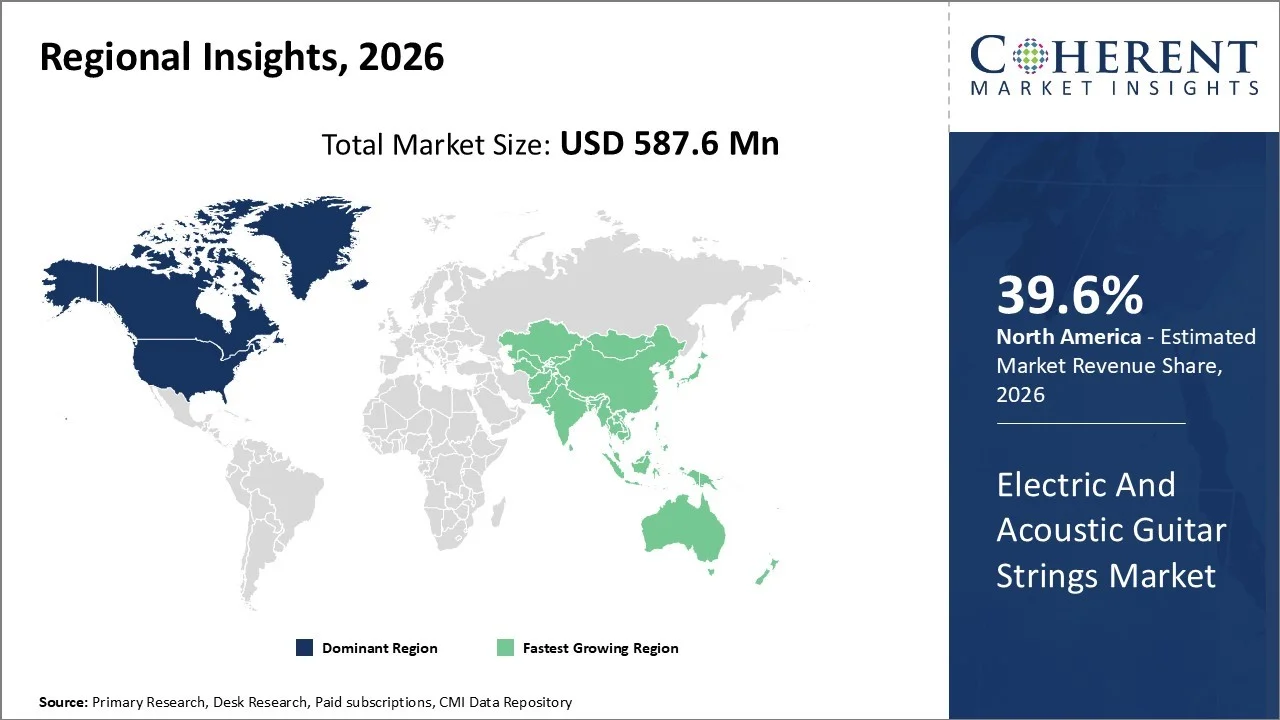
- North America is expected to acquire the dominant share of 39.6% in 2026, due to its strong musical instrument manufacturing base, large community of active guitar players, and well-established music retail network. According to the U.S. Census Bureau’s 2024 County Business Patterns data, the United States had 609 establishments engaged in musical instrument manufacturing, supporting a robust supply chain for guitars and accessories. Additionally, the National Association of Music Merchants (NAMM) reported in 2024 that the global music products industry generates approximately USD 17 billion in annual sales, with North America representing a major consumption hub. Leading manufacturers such as D’Addario and Ernie Ball continue to expand premium coated and performance-focused string offerings in 2026, reinforcing regional demand from professional musicians, educators, and hobbyists.
Market Dynamics
Global Electric & Acoustic Guitar Strings Market Drivers
Increasing sales of guitar across the world
Increasing sales of guitars across the world is expected to drive the market growth. For instance, according to National Association of Music Merchants (NAMM), U.S. report '2020 NAMM Global Report', in the U.S. fretted products including acoustic guitars, electric guitars, strings, amplifiers, and ukuleles market was valued at US$ 1,449.9 million in 2020 which increased to US$ 1,475.2 million in 2019. Furthermore, in 2022, acoustic guitars and electric guitars accounted for 67.4% of the fretted products market.
Development of new technology in terms of electric & acoustic guitar strings
Development of new technology in terms of electric & acoustic guitar strings is expected to drive the market growth. Advancement in new technologies along with development of new guitar strings are expected to increase demand for electric & acoustic guitar strings in the near future.
Global Electric & Acoustic Guitar Strings Market Opportunities
Increasing Participation in Home-Based Music Creation, and the Launch of Premium String Technologies is transforming the Global Electric and Acoustic Guitar Strings Market
The Electric & Acoustic Guitar Strings Market offers significant growth opportunities through the expansion of online music education, increasing participation in home-based music creation, and the launch of premium string technologies. For instance, the National Association of Music Merchants (NAMM) reported that the 2025 NAMM Show featured over 1,850 exhibitors, 4,400 brands, and 250 educational sessions, highlighting continued innovation across the music products industry. Additionally, manufacturer-led digital learning platforms are expanding access to guitar instruction; for example, Fender announced in 2026 that its Fender Play learning platform would be integrated with Samsung TVs, making guitar education more accessible to new players. These trends are expected to increase guitar ownership and drive recurring demand for replacement strings, particularly premium coated and performance-oriented products. (Sources: NAMM Association; Future US, Inc.; NAMM)
Current Events and Their Impact
Current Event | Description and its Impact |
Regulatory Harmonization Improving Global Trade of Musical Instrument Materials |
|
Expansion of Government Funding for Cultural and Creative Manufacturing Sectors |
|
Make in Country” Manufacturing Incentives Boosting Local Guitar String Production |
|
Government-Led Sustainability Programs Supporting Eco-Friendly String Innovation |
|
- Current Industry Events of 2026
- Market Size Estimation
- Regional Breakdown
- Competitive Landscape
- Customer Intelligence
- Segmental Analysis
- Pricing Analysis
- Key Market Drivers, Challenges & Future Trends
- Customized Insights Section
Segmental Insights
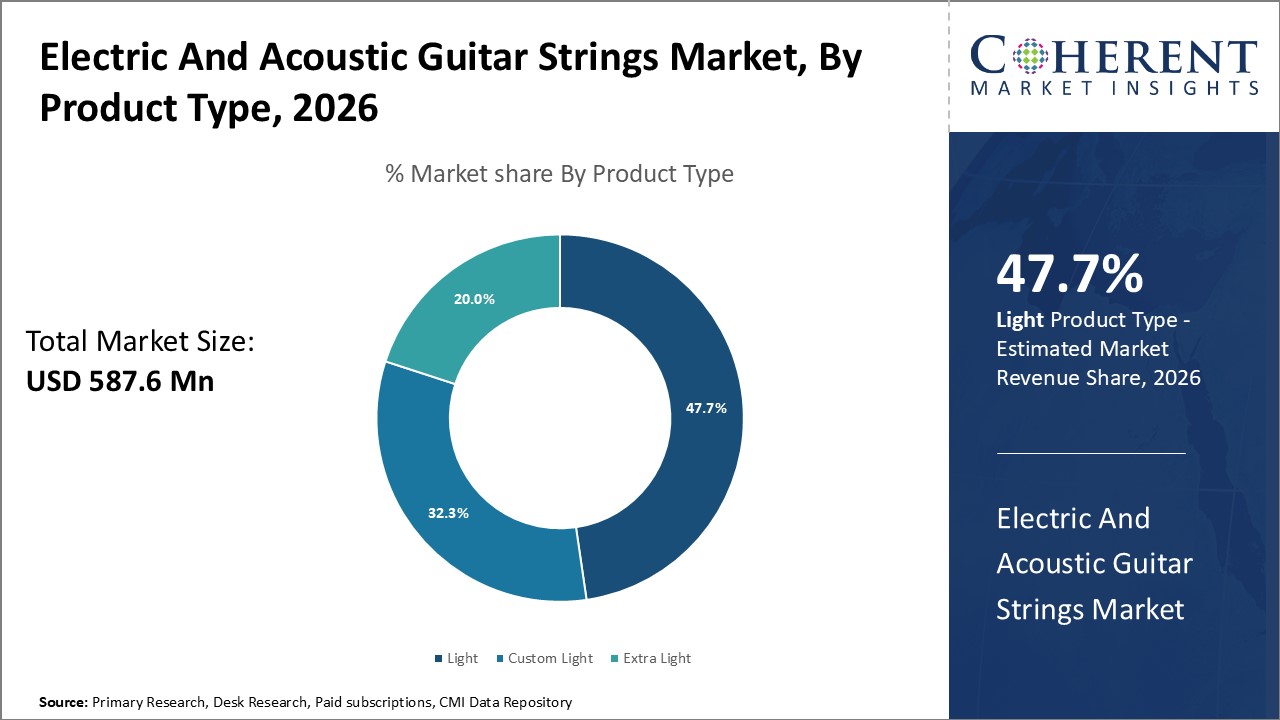
Why is Light Acquiring the Largest Market Share?
Light is projected to account for the largest share of electric and acoustic guitar strings market in 2026, representing approximately 47.7% of the total volume. Due to its superior playability, comfort, and suitability for a wide range of players. Light strings typically generate 30% lower finger pressure compared to medium and heavy gauges, which significantly reduces finger fatigue and improves learning efficiency for beginners, as noted in the NAMM Global Music Industry Report (2025, published 2026). This makes them the preferred choice for over half of entry-level and intermediate guitar users, especially in structured music education programs and self-learning platforms. Leading manufacturers such as D’Addario, Ernie Ball, and Fender consistently focus on light gauge variants due to higher sales volume, frequent replacement cycles, and strong demand in bundled starter kits. Additionally, retail instructors and music academies widely recommend light sets for acoustic and electric guitars, reinforcing their dominance across both professional and consumer segments globally. (Sources: NAMM 2026; Guitar Strings Gauge Guide)
Electric Guitar holds the Largest Market Shares
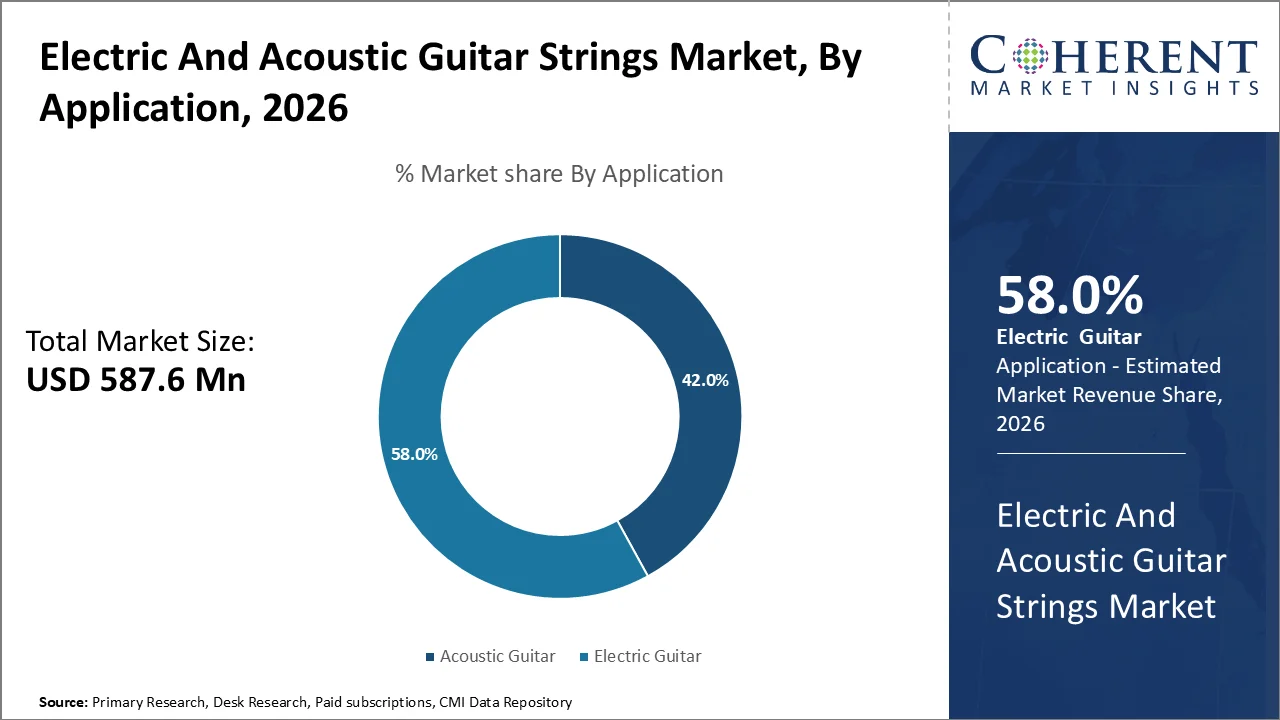
Based on application, electric guitar dominates the market, accounting for a significant 58.0% share in 2026, due to its strong adoption across modern music genres such as rock, pop, metal, jazz fusion, and electronic music production. Electric guitars require more frequent string replacement because of higher playing intensity, bending techniques, and use of amplification effects, which increases recurring demand for strings. According to the NAMM Global Report (2025 edition, published 2026), electric guitars account for a major share of total guitar sales in developed markets, with over 55% of new guitar purchases in urban regions being electric models. Manufacturers such as Fender, Gibson, and Ibanez further strengthen this dominance through continuous product innovation and endorsements by professional artists. Additionally, widespread use of electric guitars in music schools, live performances, and studio recording environments boosts replacement cycles. The combination of high usage intensity, strong brand ecosystems, and growing youth preference makes the electric guitar segment the leading driver of demand in the guitar strings market globally.
Additionally, the electric guitar segment dominates the market due to its strong commercial adoption across genres, high replacement frequency, and brand-led demand. According to a 2026 verified industry dataset, electric guitars account for approximately 39% of global guitar sales (2023 baseline), driven by their widespread use in rock, pop, metal, and studio recording environments. Market share analysis also shows strong concentration among leading manufacturers, with Fender holding around 18% global share, followed by Gibson at 31% depending on segmentation, and Ibanez at about 11% share. The segment is further strengthened by artist endorsements and product innovation, with over 60% of professional touring musicians preferring electric guitars for live performance flexibility. Additionally, electric guitars experience higher string replacement cycles due to bending techniques and amplification use, increasing recurring accessory demand. The combination of strong brand ecosystems, youth adoption, and professional usage makes the electric guitar segment the dominant driver of the global guitar strings market. (Sources: Fender; Gibson; Ibanez; Worldmetrics)
Electric and Acoustic Guitar Strings Market Trends
- Advanced nano-coating and corrosion-resistant electric strings are becoming mainstream as players demand longer life with consistent tone stability under heavy touring and studio use. Manufacturers are refining polymer-based wraps that reduce finger noise while preserving brightness and attack. For instance, in 2026 expanded coated-line releases from companies like Elixir Strings and D'Addario are being adopted by touring guitarists for extended performance cycles without frequent string changes.
- Multi-scale and extended-range optimization is accelerating in electric guitar strings, driven by the rise of 7, 8, and 9-string guitars in progressive metal and fusion genres. String makers are engineering higher-tension-balanced sets to maintain intonation stability across longer scale lengths. For instance, 2026 artist collaborations with Ernie Ball have introduced custom gauge packs tailored for multi-scale guitars used in modern touring rigs.
- Sustainable materials and eco-packaging adoption is gaining momentum in electric strings manufacturing as brands reduce plastic waste and shift toward recyclable packaging and responsibly sourced metals. Nickel and steel supply chain transparency is becoming a differentiator in premium segments. For instance, in 2026, D'Addario expanded its recycled packaging initiatives across electric string lines, aligning with broader environmental commitments in musical instrument accessories.
- Custom gauge personalization and subscription-based string delivery models are reshaping electric guitar player purchasing behavior, especially among gigging musicians and studio professionals. Digital configurators allow players to design tension-balanced sets optimized for tuning stability and playing style. For instance, in 2026, direct-to-artist subscription programs from Ernie Ball are increasingly used by session guitarists to ensure consistent monthly supply of tailored string sets.
- Phosphor bronze and coated acoustic strings are evolving toward enhanced tonal longevity without sacrificing warm harmonic content, which is critical for fingerstyle and recording artists. Advanced micro-coating reduces oxidation while preserving resonance. For instance, in 2026, expanded coated acoustic ranges from Elixir Strings and D'Addario are widely used in studio sessions for maintaining consistent tone over longer recording cycles.
- Humidity-resistant and climate-stable acoustic strings are increasingly important as global touring exposes instruments to varying environmental conditions. Manufacturers are improving core-to-wrap bonding to reduce tuning drift and breakage in high-humidity regions. For instance, in 2026, touring folk artists using Martin Guitar strings report improved stability during outdoor festivals across tropical climates with minimal retuning requirements.
- Vintage tone revival trends are driving demand for 80/20 bronze and uncoated acoustic strings that replicate classic 1960s–1980s recording textures. Players are prioritizing dynamic response and natural decay over extreme longevity. For instance, in 2026, reissued vintage-spec acoustic string sets from D'Addario are gaining traction among Americana and blues musicians seeking authentic analog-era sound profiles.
- AI-driven string recommendation and smart retail customization are emerging in acoustic strings, where platforms analyze playing style, guitar type, and tonal preference to suggest ideal gauges and materials. This reduces trial-and-error purchasing. For instance, in 2026, retail pilots integrated with Fender ecosystems are using AI-assisted profiling to recommend optimized acoustic string sets for beginners and professionals alike.
- Rapid alignment of Indian standards with global manufacturing benchmarks influencing musical instrument accessory supply chains- Government-led standardization reforms are increasingly focused on harmonizing Indian Standards with international norms, improving export readiness and import quality control. This directly affects components like steel alloys and nickel-based materials used in electric and acoustic guitar strings, as they fall under broader metal and manufacturing standards frameworks. For instance, in 2026 the Bureau of Indian Standards withdrew multiple outdated standards and aligned several technical regulations with global practices to improve quality, safety, and international trade compatibility.
- Expansion of Quality Control Orders (QCOs) strengthening regulated material sourcing for metal-based manufacturing inputs used in guitar strings- India’s Ministry-level Quality Control Orders are increasingly regulating raw materials and industrial components, including metals and synthetic polymers that are also used in musical string production. This trend ensures controlled sourcing, improved durability standards, and reduced substandard imports in consumer goods. For instance, in 2026, amendments under the Ropes and Cordages Quality Control framework demonstrate how BIS-backed QCOs enforce compliance while also introducing exemptions to support recycling and sustainable manufacturing practices.
Market Report Scope
Electric And Acoustic Guitar Strings Market Report Coverage
| Report Coverage | Details | ||
|---|---|---|---|
| Base Year: | 2025 | Market Size in 2026: | USD 587.6 Mn |
| Historical Data for: | 2020 To 2024 | Forecast Period: | 2026 To 2033 |
| Forecast Period 2026 to 2033 CAGR: | 3.7% | 2033 Value Projection: | USD 757.7 Mn |
| Geographies covered: |
| ||
| Segments covered: |
| ||
| Companies covered: | D’Addario & Co., Fender Musical Instruments Corporation, Gibson Brands, Ernie Ball Inc., GHS Strings, C. F. Martin & Company Inc., Dunlop Manufacturing, Inc., Dean Markley USA, Inc., Kistron Co., Ltd., Rotosound Manufacturing Ltd., and DR Handmade Strings | ||
| Growth Drivers: |
| ||
| Restraints & Challenges: |
| ||
Global Electric & Acoustic Guitar Strings Market- Regional Analysis
North America Region Holds Dominant Position Owing to Prescence of Leading Players
Among regions, North America held a dominant position in the global electric & acoustic guitar strings market in 2026, accounting for 39.6% market share in terms of revenue, followed by Asia Pacific. Latin America, Europe and Middle East & Africa. For instance, according to Apple Inc., in 2020 the company saw increasing level of interest in GarageBand (Apple’s digital audio workstation app), with 13 million downloads from its add-on “Sound Library” since February 2020, and hundreds of thousands of free trail downloads of GarageBand’s pricier siblings Logic Pro X and Final Cut Pro X.
Strong Manufacturing Base and High Consumer Adoption is Accelerating the Electric and Acoustic Guitar Strings Market Demand in United States
The U.S. dominates the electric and acoustic guitar strings market due to its strong manufacturing base, high consumer adoption, and presence of globally leading brands. According to the NAMM Global Music Report, the U.S. accounts for a major share of global musical instrument consumption, with electric guitars representing about 34.3% of fretted instrument retail value and strings contributing nearly 9.9% of category demand. The country benefits from high guitar penetration among youth, with over 40% of new buyers aged below 30 (2026 market survey data) driving recurring string replacement cycles. Strong domestic manufacturers such as Fender, D’Addario, and Gibson support continuous product innovation, including 2026 launches of upgraded coated string technologies for longer durability and corrosion resistance. Additionally, the U.S. is the largest hub for live performances, studio recording, and music education programs, all of which increase string consumption frequency. This combination of innovation, demand intensity, and institutional music culture makes the U.S. the leading market globally.
Asia Pacific Electric and Acoustic Guitar Strings Market Trends
The Asia Pacific region is the fastest-growing market for electric and acoustic guitar strings due to strong government support for music education, rising youth participation, and rapid expansion of domestic manufacturing ecosystems. Government initiatives such as China’s cultural and music education development programs (2023–2025, Ministry of Culture policy documents) and India’s National Education Policy implementation for arts integration (2023–2025, Ministry of Education) are increasing structured access to music learning, leading to a larger base of beginner guitar players. This directly boosts demand for light and standard guitar strings, which require frequent replacement during learning stages.
Global manufacturers such as Fender, Yamaha, and Ibanez have expanded production, assembly, and distribution networks across China, Japan, Indonesia, and India, improving affordability and product availability. Additionally, rapid e-commerce penetration, urbanization, and growing disposable incomes are making guitars more accessible to younger consumers. The combination of government-led education policies, strong manufacturing ecosystems, and expanding retail infrastructure makes Asia Pacific the fastest-growing region in the guitar strings market globally.
Global Electric & Acoustic Guitar Strings Market- Competitive Section
Key players operating in the global electric & acoustic guitar strings market include D’Addario & Co., Fender Musical Instruments Corporation, Gibson Brands, Ernie Ball Inc., GHS Strings, C. F. Martin & Company Inc., Dunlop Manufacturing, Inc., Dean Markley USA, Inc., Kistron Co., Ltd., Rotosound Manufacturing Ltd., and DR Handmade Strings.
Global Electric & Acoustic Guitar Strings Market- Key Developments
- In January 2026, Ernie Ball Inc., an American instrument and guitar accessory company introduced individual retail versions of its James Hetfield “Papa Het” Hardwired Master Core and Slash Signature Slinky strings at NAMM 2026. The products utilize Paradigm core-wire technology, reinforced ball ends, and enhanced tuning stability to meet professional performance requirements. The launch strengthens Ernie Ball's premium electric guitar string portfolio and highlights continued innovation in durability-focused string engineering. (Source: Ernie Ball Inc.)
- In January 2026, C. F. Martin & Co., manufacturing company unveiled several new acoustic guitar models ahead of NAMM 2026, including the Super D-18 and Super HD-28. These launches are expected to stimulate demand for premium acoustic strings, particularly among professional and enthusiast players seeking optimized tone and projection. Martin continues to benefit from strong brand recognition in the acoustic segment. (Source: C. F. Martin & Co.)
- On June 30, 2025, Rotosound, a British guitar and bass string manufacturing company based in England unveiled a comprehensive redesign of its electric and acoustic guitar string packaging, aimed at improving product visibility and customer navigation while celebrating the brand’s British heritage. The refreshed design features distinct graphics, color-coded gauge groupings, simplified specifications, enhanced artist endorsements, and QR-enabled recycling information. The rollout begins with the Rotos line, with additional product ranges transitioning gradually. Importantly, the strings, product codes, and barcodes remain unchanged.
- In January 2026, Gibson, Inc., an American manufacturer of guitars, other musical instruments unveiled its 2026 product lineup at NAMM, marking a new chapter focused on innovation, craftsmanship, and player engagement. The showcase featured updated ES-335 models, the return of the Custom Shop ES-330, the Les Paul Studio Double Trouble, and several new signature instruments. Gibson also highlighted products from Epiphone and other affiliated brands, alongside a special live performance by singer-songwriter Margaret Glaspy. The company emphasized its commitment to blending heritage with modern design while delivering fresh experiences for musicians and industry professionals.
Analyst Opinion
- The Electric & Acoustic Guitar Strings market is evolving from a replacement-based accessory segment into a high-volume, consumption-driven category supported by rising global guitar adoption, especially among Gen Z learners and hobby musicians. Demand in 2026 is strongly influenced by frequent string replacement cycles driven by practice intensity, bending techniques in electric guitars, and corrosion wear in humid climates, making strings a recurring revenue product rather than a one-time purchase.
- Light gauge strings continue to dominate the product mix due to superior playability and beginner-friendly tension characteristics. In 2026, more than half of new learners in structured music education programs prefer light strings because they reduce finger fatigue and improve learning speed during the first 6–12 months of training. This makes them the most frequently purchased SKU across both electric and acoustic guitar categories.
- Electric guitar strings remain the most commercially significant sub-segment due to higher replacement frequency compared to acoustic strings. Electric guitar users typically replace strings every 1–4 weeks depending on performance activity, significantly increasing annual consumption volumes in live performance and studio recording environments in 2026.
- Asia Pacific is emerging as the fastest-growing region, driven by expanding music education programs, rising disposable incomes, and increasing adoption of guitars among youth populations. Countries such as India, China, Japan, and Indonesia are witnessing strong growth in beginner guitar enrollment in 2026, supported by digital learning platforms and government-backed creative education initiatives.
Speak to the analyst
Want personalized insights?
Take the findings above to one of our principal consultants, or have the report rebuilt around the segments, geographies and competitors you actually track.
Market Segmentation
- By Product (Revenue, USD Mn, 2021-2033)
- Light
- Custom Light
- Extra Light
- By Application (Revenue, USD Mn, 2021-2033)
- Acoustic Guitar
- Electric Guitar
- Global Electric and Acoustic Guitar Strings Market, By Region: (Revenue, USD Mn, 2021-2033)
- North America
- U.S.
- Canada
- Latin America
- Brazil
- Mexico
- Argentina
- Rest of Latin America
- Europe
- Germany
- U.K.
- France
- Italy
- Spain
- Russia
- Rest of Europe
- Asia Pacific
- China
- India
- Japan
- Australia
- South Korea
- ASEAN
- Rest of Asia Pacific
- Middle East
- GCC
- Israel
- Rest of Middle East
- Africa
- South Africa
- Central Africa
- North Africa
- North America
- Competitive Landscape
- D’Addario & Co.
- Fender Musical Instruments Corporation
- Gibson Brands
- Ernie Ball Inc.
- GHS Strings
- F. Martin & Company Inc.
- Dunlop Manufacturing, Inc.
- Dean Markley USA, Inc.
- Kistron Co., Ltd.
- Rotosound Manufacturing Ltd.
- DR Handmade Strings
Sources
Primary Research Interviews
- Guitar string makers (e.g., D'Addario, Ernie Ball, Martin Strings, Elixir Strings (W.L. Gore), Fender, GHS)
- Music instrument retailers and luthiers
- Nickel, bronze and polymer wire suppliers
Databases
- UN Comtrade musical instrument trade data
- NAMM (National Association of Music Merchants) data
- Eurostat musical instrument data
Magazines
- Guitar World
- Guitar Player
Journals
- Journal of the Acoustical Society of America
- Applied Acoustics (Elsevier)
Newspapers
- Reuters Consumer
- Financial Times – Consumer
Associations
- NAMM
- Music Industries Association
- Consumer Technology Association (CTA)
Public Domain Sources
- NAMM Global Report
- European Commission musical instrument standards
- ResearchGate publications on guitar string physics
Proprietary Elements
- CMI Data Analytics Tool, Proprietary CMI Existing Repository of information for last 10 years.
*Definition: Guitars are stringed instruments, and are equipped with six strings which are to be plucked to play the instrument. Acoustic and electric are two key types of guitars, however the difference lies in the electric connection. Guitar strings are made of metals such as copperor brass. Electric and acoustic guitar strings are primarily of the following types: light, custom light, and extra light.
Get access to 250+ pages report
Every segment, forecast, competitor profile and data table behind the analysis above — available for instant download.
- ESOMAR Member
- ISO 9001:2015 Certified
- D-U-N-S Registered
- GDPR & CCPA Compliant
Missing comfort of reading report in your local language? Find your preferred language:
Transform your Strategy with Exclusive Trending Reports
Frequently Asked Questions
The Global Electric and Acoustic Guitar Strings Market is expected to reach USD 757.7 Million in 2033.
Most of the acoustic guitars strings are made of steel that can be painful for beginners are the major factors hampering the growth of the electric and acoustic guitar strings market.
Increasing sales of guitar across the world and development of new technology in terms of electric & acoustic guitar strings are the factors supporting the growth of the electric and acoustic guitar strings market.
The Global Electric and Acoustic Guitar Strings Market is anticipated to grow at a CAGR of 3.7% between 2026 and 2033.
Among regions, North America is expected to account for a largest market share in the global Electric and Acoustic Guitar Strings Market over the forecast period.
Electric and acoustic guitar strings are tensioned metal strings used to produce sound through vibration. Electric guitar strings are typically made from nickel-plated steel or stainless steel and interact with magnetic pickups to generate amplified sound. Acoustic guitar strings commonly use phosphor bronze or 80/20 bronze alloys to produce louder, naturally resonant tones suitable for unplugged performance.
The market primarily offers light, medium, and heavy gauge strings, along with coated and uncoated variants. Light gauge strings provide easier playability and bending, medium gauges balance tone and durability, while heavy gauges offer greater volume and sustain. Coated strings include protective layers that reduce corrosion and extend lifespan, making them popular among frequent performers.