

Flagship Smartphone Market Size and Forecast – 2026 to 2033
The Flagship Smartphone Market is anticipated to grow at a CAGR of 6.2% with USD 13.6 Bn share in 2026 and is expected to reach USD 18.7 Bn in 2033. Consumers are driving the Flagship Smartphone Market by demanding advanced cameras, AI-powered features, 5G connectivity, premium designs, and high-performance processors. By the end of 2025, global 5G connections exceeded 2.7 Bn.
Key Takeaways
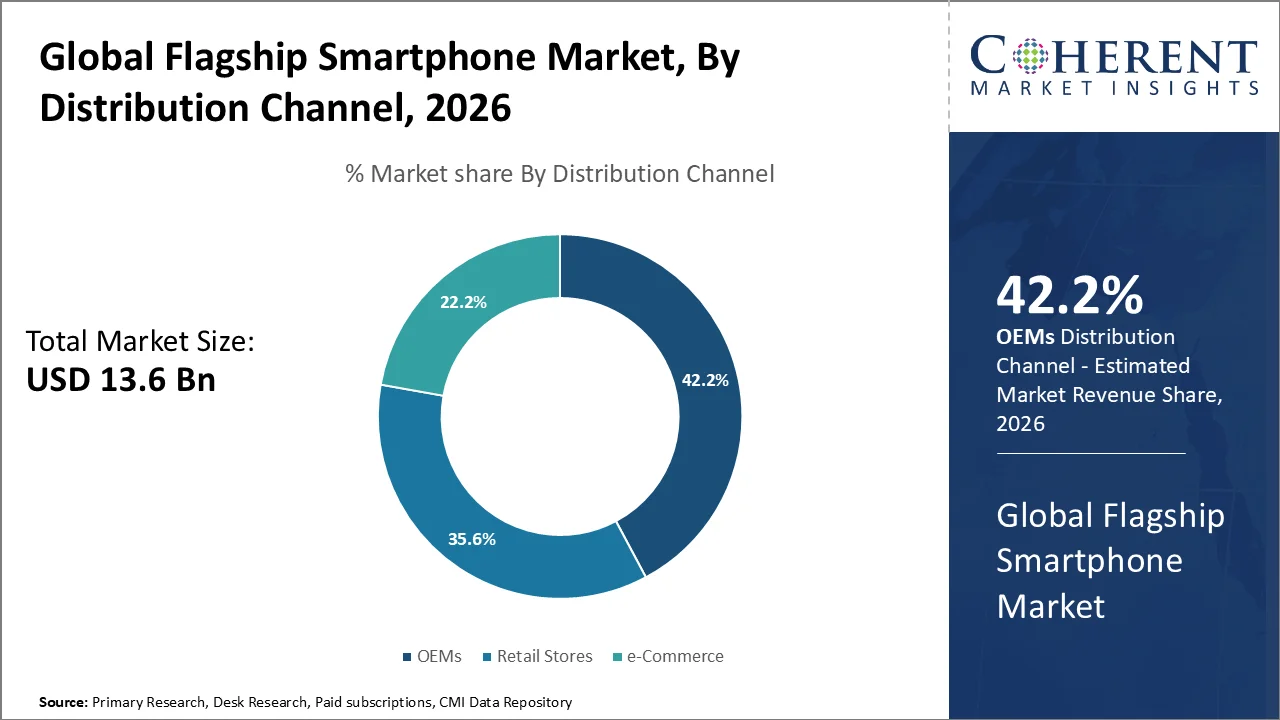
- OEMs hold the largest market share of 42.2% in 2026 owing to the premiumization & ASP growth.
- Android expected to hold largest market share of 38.4% in 2026 owing to its hardware innovation. Android leads the global smartphone market with a 72.77% share.
- Inbuilt storage acquired the prominent market share of 52.3% in 2026 owing to the high-resolution photography.
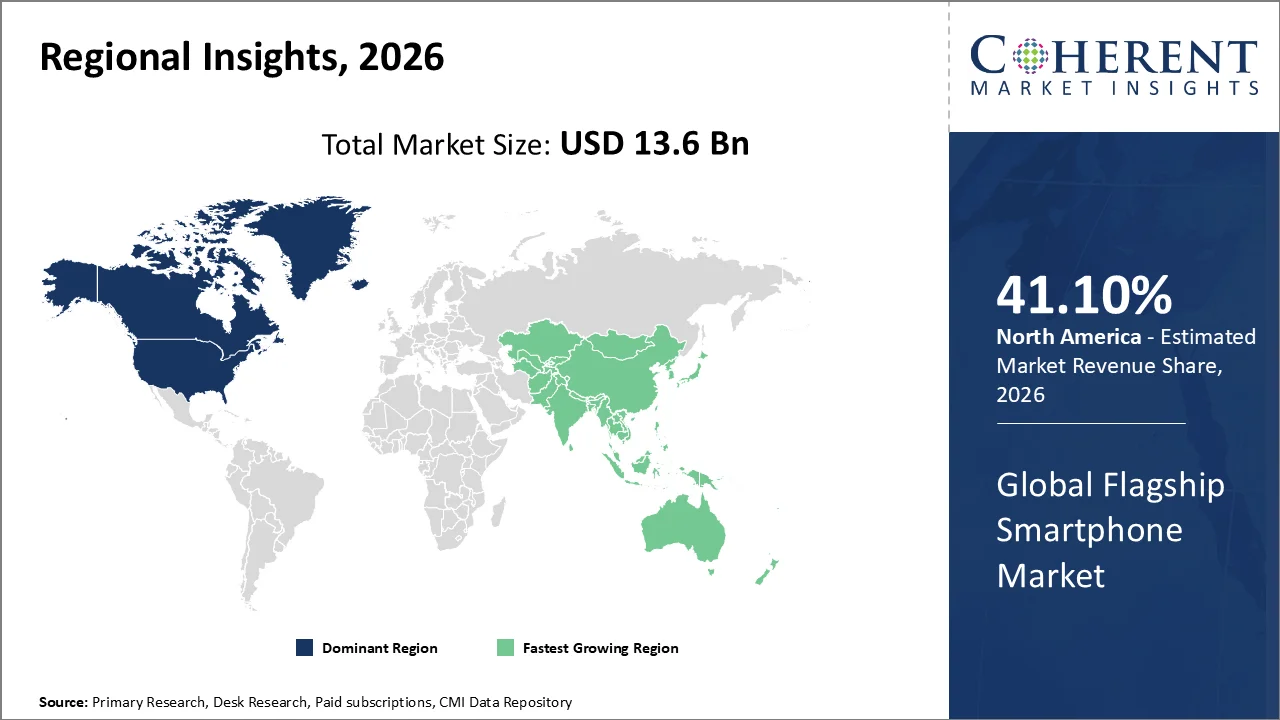
- North America is expected to acquire the dominant share of 41.1% in 2026 owing to its strong premium consumer base. More than 91% of U.S. adults own a smartphone, reflecting near-universal mobile adoption.
Current Events and Their Impact on the Flagship Smartphone Market
Current Event | Description and its Impact |
U.S. Semiconductor Export Controls on China |
|
EU Ecodesign and Energy-Labelling Rules for Smartphones |
|
Segmental Insights
- Current Industry Events of 2026
- Market Size Estimation
- Regional Breakdown
- Competitive Landscape
- Customer Intelligence
- Segmental Analysis
- Pricing Analysis
- Key Market Drivers, Challenges & Future Trends
- Customized Insights Section
Why is OEMs Acquiring the Largest Market Share?
OEMs hold the largest market share of 42.2% in 2026. OEMs in the flagship smartphone market drive growth through premiumization, technological innovation, AI-enabled experiences, advanced cameras and displays, ecosystem integration, and strong brand differentiation. Manufacturers use flagship devices to strengthen their brands, increase average selling prices, and build customer loyalty. They differentiate their products through on-device AI, high-performance processors, advanced imaging, extended software support, premium designs, and foldable form factors. OEMs also leverage financing options, trade-in programs, and efficient supply chains to expand premium adoption and improve profitability. MediaTek that Oppo India and Poco India will be among the first OEMs to launch smartphones powered by its flagship Dimensity 9500s and Dimensity 8500 chipsets.
Android expected to hold largest market share
Android expected to hold largest market share of 38.4% in 2026 owing to its foldables & new form factors. Android drives growth in the flagship smartphone market through rapid hardware innovation, on-device AI, advanced cameras, high-performance processors, foldable designs, fast charging, and extensive customization. Its broad OEM ecosystem allows manufacturers to differentiate products based on design, performance, and pricing. Android also strengthens its position through seamless integration with Google services, wearables, tablets, and other connected devices. Longer software support and enhanced security build consumer confidence, while growing demand for intelligent and personalized experiences further strengthens Android’s competitiveness in the premium segment. For instance, in February 2026, Samsung launched the Galaxy S26 at Galaxy Unpacked, featuring a compact 120Hz AMOLED display, 4,300mAh battery, 50MP OIS camera, and seven major OS updates.
Which Memory Storage Type dominates the market?
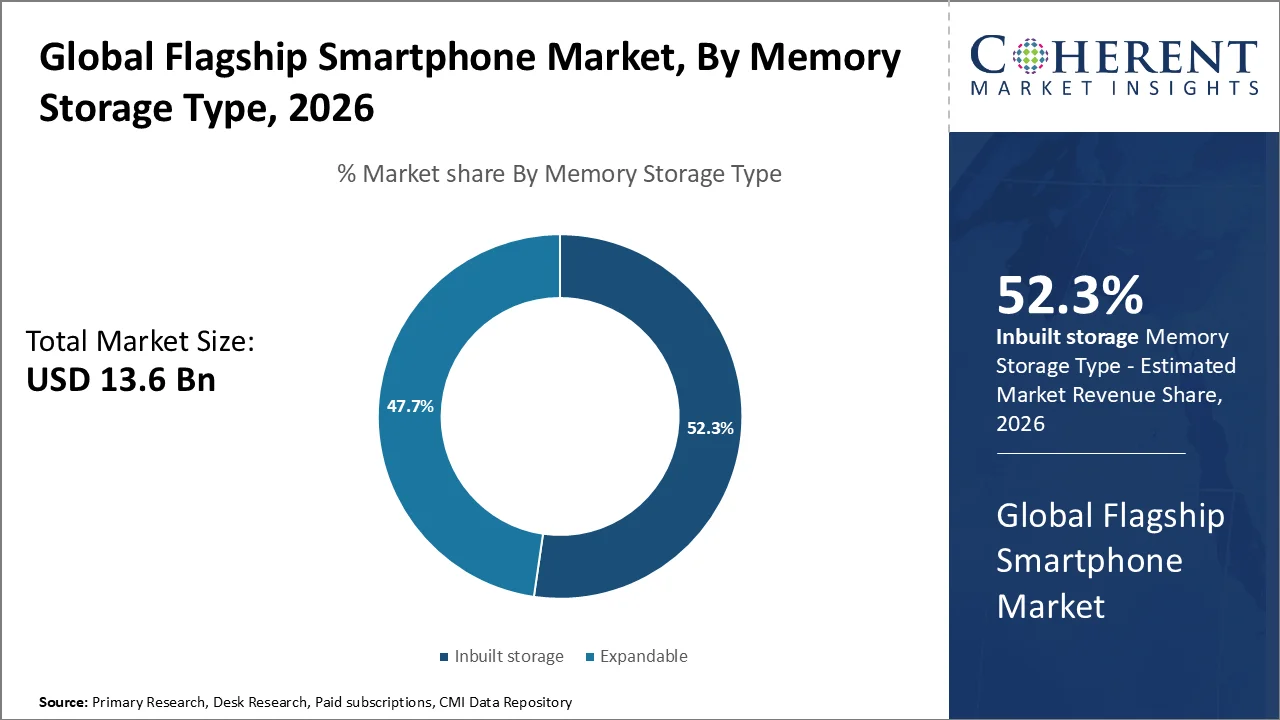
Inbuilt storage acquired the prominent market share of 52.3% in 2026. Consumers drive demand for inbuilt storage in the flagship smartphone market through greater use of on-device AI, high-resolution photography and video, advanced gaming, and storage-intensive apps and operating systems. They also seek higher capacities as they keep devices longer and use smartphones for content creation, entertainment, and productivity. The declining availability of expandable storage further pushes consumers toward larger capacities. OEMs use higher storage options to differentiate premium models, while advances in NAND technology enable greater capacity and support demanding AI applications.
Flagship Smartphone Market Trends
- Rising demand for premium smartphones with advanced AI capabilities, high-performance processors, superior cameras, and enhanced displays is encouraging OEMs to strengthen their flagship portfolios. Globally, smartphones priced at $600 or above accounted for 25% of the smartphone market in 2024, up from 15% in 2020, while the premium segment grew 8% year over year in 2024.
- Increasing adoption of generative AI smartphones is making AI a key differentiator in the flagship segment, supporting features such as personalized assistants, photography enhancements, productivity tools, and on-device AI experiences. In July 2026, China approved a new batch of on-device generative AI services for smartphones, including Apple Intelligence, supporting the expansion of consumer AI applications under the country’s regulatory framework.
- Growing adoption of foldable and innovative form factors is expanding differentiation within the premium smartphone market. Global foldable smartphone shipments are projected to increase 10% year over year to 20.6 million units in 2025.
Regional Insights
North America dominates owing to ecosystem integration
North America is expected to acquire the dominant share of 41.10% in 2026. High consumer purchasing power, demand for premium devices, and strong loyalty to leading OEMs drive North America’s flagship smartphone market. Carriers use financing plans, trade-in programs, and promotional offers to make high-end smartphones more affordable and encourage consumers to upgrade. Advanced AI features, premium cameras, powerful processors, and integrated ecosystems further attract buyers. Robust 5G infrastructure, frequent upgrades, and extended software support strengthen premium adoption, while competition among leading OEMs accelerates technological innovation and enhances product differentiation. The U.S. recorded 341 million 5G connections in Q3 2025,
Asia Pacific Flagship Smartphone Market Trends
Consumers are driving the Asia Pacific flagship smartphone market by demanding premium devices with advanced cameras, powerful processors, longer battery life, and high-quality displays. Rapid 5G adoption and increasingly digital lifestyles encourage consumers to upgrade to high-end smartphones. Smartphone manufacturers are using on-device artificial intelligence as a key differentiator, while foldable designs and integrated device ecosystems attract premium buyers. Rising purchasing power across emerging economies, strong brand loyalty, and premiumization strategies from leading manufacturers continue to accelerate market growth. For instance, in November 2025, OnePlus launched the OnePlus 15 in China by bringing its flagship smartphone to global markets.
United States Flagship Smartphone Market Trends
Consumers in the United States drive the flagship smartphone market through their strong preference for premium devices, advanced cameras, powerful processors, artificial intelligence capabilities, and high-quality displays. Apple and Samsung benefit from strong brand loyalty, well-established ecosystems, and extensive carrier partnerships. Trade-in programs, installment plans, and carrier promotions encourage consumers to upgrade their devices more frequently. Consumers also seek premium experiences, extended software support, enhanced security, and innovative designs, including foldable smartphones, further supporting market growth
Japan Flagship Smartphone Market Trends
Japan’s flagship smartphone market benefits from consumers’ strong preference for premium brands, advanced cameras, powerful processors, long battery life, and high-quality displays. Apple maintains a strong position through its ecosystem and loyal customer base, while Sony, Google, and Chinese brands intensify competition with innovative features and premium devices. Consumers increasingly demand on-device AI, seamless connectivity with wearables and other devices, 5G capabilities, and attractive carrier upgrade programs, which continue to drive growth in the market. In May 2026, Sony unveiled Xperia 1 VIII, featuring improved cameras and an AI assistant that recommends lenses and colors.
Who are the Major Companies in Flagship Smartphone Industry
Some of the major key players in Flagship Smartphone are Samsung Electronics Co. Ltd., Apple Inc., Oppo, OnePlus and Mobitech Creations, Xiaomi, Huawei Technologies Co. Ltd., LG Electronics Inc., Lenovo Group Limited, ZTE Corporation, TCL Communication Technology Holdings Limited, and Vivo Communication Technology Co. Ltd.
Key News
- In August 2026, Honor unveiled its next flagship Magic 9 series.
- In March 2026, Samsung launched Galaxy Forever in India, introducing a new ownership model aimed at making its flagship smartphones more accessible to consumers.
Market Report Scope
Flagship Smartphone Market Report Coverage
| Report Coverage | Details | ||
|---|---|---|---|
| Base Year: | 2025 | Market Size in 2026: | USD 13.6 Bn |
| Historical Data for: | 2020 To 2024 | Forecast Period: | 2026 To 2033 |
| Forecast Period 2026 to 2033 CAGR: | 6.2% | 2033 Value Projection: | USD 18.7 Bn |
| Geographies covered: |
| ||
| Segments covered: |
| ||
| Companies covered: | Samsung Electronics Co. Ltd., Apple Inc., Oppo, OnePlus and Mobitech Creations, Xiaomi, Huawei Technologies Co. Ltd., LG Electronics Inc., Lenovo Group Limited, ZTE Corporation, TCL Communication Technology Holdings Limited, and Vivo Communication Technology Co. Ltd. | ||
Analyst Opinion
- The flagship smartphone market is no longer a volume game — it is a value-capture game. Premium smartphones priced at $600 and above accounted for 25% of global smartphone sales in 2024, up from 15% in 2020, while the $1,000+ ultra-premium segment alone represented more than 40% of premium sales. In my view, this is the clearest evidence that consumers are increasingly willing to concentrate spending on fewer, substantially better devices rather than continuously trading up across the broader smartphone portfolio.
- Apple has effectively turned the flagship category into an ecosystem-led business rather than a hardware contest. Apple captured 67% of the global premium smartphone segment in 2024, compared with 18% for Samsung. More importantly, Apple and Samsung together accounted for 44% of the global active smartphone installed base in 2025, with Apple alone representing nearly one in four active smartphones. This creates a structural advantage: flagship buyers are not simply purchasing a phone; they are buying into an ecosystem that makes switching increasingly expensive in terms of convenience, services and device integration.
- Consumers are rewarding flagship longevity, making annual hardware innovation less important than sustained device value. Counterpoint notes that replacement cycles have extended to nearly four years, while premium devices benefit from durable construction, longer software support and stronger resale values. I believe this fundamentally changes the competitive equation: a flagship that remains desirable and performant for four years can outperform a technically superior phone that fails to establish resale value, ecosystem stickiness or long-term software credibility.
- Samsung remains the only credible global Android counterweight to Apple at the flagship end, but its position is much more fragile than its overall smartphone scale suggests. The Galaxy S25 Ultra's appearance in the global top-10 best-selling models demonstrates that Samsung can still create a genuine flagship hero product, yet no other premium Android model entered that list. In my assessment, this leaves Samsung defending a two-player premium structure while brands such as Xiaomi, Huawei, HONOR, vivo and OPPO increasingly compete for the remaining premium demand.
- India is becoming particularly important for flagship vendors because premiumization is moving beyond a niche affluent audience. Counterpoint reported that more than one in every five smartphones shipped in India was premium in 2025, while Apple reached its highest-ever value share in the country. This suggests that flagship adoption in India is increasingly being driven by consumers trading up, financing availability, aspirational purchasing and stronger brand perception — not merely by traditional high-income buyers.
- Overall, the flagship smartphone market to remain highly concentrated, with Apple continuing to set the benchmark for monetization and Samsung remaining the strongest Android challenger. The evidence increasingly points toward a market where brand equity, ecosystem lock-in, resale value, software longevity and differentiated user experiences matter more than raw specifications. The next phase of competition will therefore not be about who can build the most powerful smartphone; it will be about who can convince consumers that one particular flagship is worth keeping, using and paying a premium for over several years.
Speak to the analyst
Want personalized insights?
Take the findings above to one of our principal consultants, or have the report rebuilt around the segments, geographies and competitors you actually track.
Market Segmentation
- By Distribution Channel (Revenue, USD Bn, 2021-2033)
- OEMs
- Retail Stores
- e-Commerce
- By Operating Systems (Revenue, USD Bn, 2021-2033)
- Android
- iOS
- Microsoft
- RIM Blackberry
- Others
- By Memory Storage Type (Revenue, USD Bn, 2021-2033)
- Inbuilt storage
- Expandable
- By Region (Revenue, USD Bn, 2021-2033)
- North America
- U.S.
- Canada
- Latin America
- Brazil
- Mexico
- Argentina
- Rest of Latin America
- Europe
- Germany
- U.K.
- France
- Italy
- Spain
- Russia
- Rest of Europe
- Asia Pacific
- China
- India
- Japan
- Australia
- South Korea
- ASEAN
- Rest of Asia Pacific
- Middle East
- GCC
- Israel
- Rest of Middle East
- Africa
- South Africa
- Central Africa
- North Africa
- North America
Sources
Primary Research interviews
- Smartphone OEM executives and product-management professionals
- Smartphone brand country heads and regional sales managers
- Mobile network operators and telecom executives
- Smartphone distributors, wholesalers and authorized retailers
- E-commerce marketplace executives and category managers
- Premium smartphone retail-store managers and channel partners
- Semiconductor, chipset and component-industry executives
- Display, camera, memory, battery and connectivity-component specialists
- Mobile application and operating-system ecosystem professionals
- Technology journalists and industry analysts
- Enterprise IT procurement professionals
- Consumer focus groups and smartphone users across key income segments
- Interviews with former industry executives and independent technology experts
Databases
- International Telecommunication Union (ITU) DataHub and ICT statistics
- GSMA mobile-industry databases and Mobile Economy datasets
- World Bank World Development Indicators
- United Nations Data and population databases
- National statistical-office databases
- National telecom-regulator databases and subscriber statistics
- Government customs and trade databases for smartphones and electronic components
- OECD digital-economy and ICT datasets
- Eurostat ICT statistics
- U.S. International Trade Commission trade database
- UN Comtrade database
- World Intellectual Property Organization (WIPO) patent database
- Google Trends and publicly available search-interest data
- StatCounter publicly available device and operating-system usage statistics
- Public company financial statements, annual reports and investor presentations
- Smartphone product specifications, launch records and historical pricing databases
Magazines
- IEEE Spectrum
- MIT Technology Review
- WIRED
- TIME
- Fortune
- Forbes
- The Economist
- PCMag
- TechRadar
- Computerworld
- Mobile World Live
- Electronics Weekly
- EE Times
- Android Authority
- Tom's Guide
Journals
- IEEE Transactions on Mobile Computing
- IEEE Transactions on Consumer Electronics
- IEEE Access
- Journal of Industrial Economics
- International Journal of Industrial Organization
- Information Systems Research
- Management Science
- Journal of Marketing Research
- Technological Forecasting and Social Change
- Telecommunications Policy
- Electronic Commerce Research and Applications
- Research Policy
- Journal of Retailing
- Journal of Business Research
- Economics of Innovation and New Technology
Newspapers
- Reuters
- Financial Times
- The Wall Street Journal
- The New York Times
- The Guardian
- The Washington Post
- The Economic Times
- Business Standard
- Mint
- The Hindu
- The Times of India
- Nikkei Asia
- South China Morning Post
Associations
- GSMA
- International Telecommunication Union (ITU)
- IEEE
- Consumer Technology Association (CTA)
- Mobile & Wireless Forum
- Semiconductor Industry Association (SIA)
- JEDEC Solid State Technology Association
- Bluetooth SIG
- Wi-Fi Alliance
- SD Association
- USB Implementers Forum
- Open Mobile Alliance
- European Telecommunications Standards Institute (ETSI)
- 3GPP
- Telecommunications Industry Association (TIA)
Public Domain sources
- ITU DataHub and ICT Facts and Figures
- World Bank Open Data
- United Nations Data
- UN Comtrade
- WIPO PATENTSCOPE
- National government statistics portals
- National telecom-regulator publications and filings
- U.S. Federal Communications Commission (FCC) equipment authorization database
- European Commission and Eurostat databases
- U.S. Census Bureau international trade data
- U.S. International Trade Commission data
- Government customs/import-export statistics
- Public company annual reports and regulatory filings
- Investor presentations and earnings-call transcripts
- Public smartphone product-launch announcements and technical specifications
- Public patent filings and standards documents
- Google Trends
- StatCounter
- Academic repositories including arXiv, SSRN and institutional repositories
- Public university research datasets and technology studies
Proprietary Elements
- CMI Data Analytics Tool
- Proprietary CMI Existing Repository of information for last 10 years
Get access to 250+ pages report
Every segment, forecast, competitor profile and data table behind the analysis above — available for instant download.
- ESOMAR Member
- ISO 9001:2015 Certified
- D-U-N-S Registered
- GDPR & CCPA Compliant
Missing comfort of reading report in your local language? Find your preferred language:
Transform your Strategy with Exclusive Trending Reports
Frequently Asked Questions
The Flagship Smartphone Market is anticipated to grow at a CAGR of 6.2% with USD 13.6 Bn share in 2026 and is expected to reach USD 18.7 Bn in 2033.
Flagship demand is increasingly driven by premiumization and longer replacement cycles, rather than basic smartphone adoption.
Yes — and the gap is structural, not merely cyclical. Apple accounted for roughly one in four active smartphones globally in 2025, while Apple added more net-new active devices than the next seven leading OEMs combined.
Samsung remains the strongest global Android challenger, but matching Apple's flagship economics is a different challenge from matching its technology.
Absolutely. The $1,000+ segment represented 10% of global smartphone shipments in 2025, making it the largest price band outside smartphones priced below $200.
AI will matter, but I strongly doubt that AI branding alone will determine flagship winners.