

Foodservice Disposable Distribution System Market Size and Share Analysis - 2026 To 2033
The global foodservice disposable distribution system market is estimated to be valued at around USD 22 Bn in 2026 and is projected to grow at a compound annual growth rate (CAGR) of 5% during the forecast period (2026-2033), reaching USD 31 Bn by 2033. This growth can be attributed to rising demand for convenient and hygienic food packaging solutions across quick-service restaurants (QSRs), cloud kitchens, and takeaway services.
Key Takeaways from the Foodservice Disposable Distribution System Market Report
- Tableware disposables are expected to lead the market with a share of 42% in 2026 due to high usage in quick-service restaurants, growth in food delivery platforms, and bulk procurement by caterers. According to our research, approximately 60–70% of U.S. consumers eat quick-service food at least weekly, and more than 40% cite convenience as their main reason.
- Restaurants segment is slated to account for the largest market revenue share of 38% in 2026 as a result of high transaction volume and rising disposable packaging needs. For example, the global fast-food/QSR sector generates hundreds of Bns of transactions annually, with McDonald’s alone serving 70 million customers daily worldwide.
- North America is projected to retain its dominance over the global foodservice disposable distribution system industry with a share of 40% in 2026, driven by strong QSR presence, high food delivery demand, and established distribution networks. For example, according to the National Restaurant Association, almost 3 out of 4 restaurant orders are taken to go.
- Asia Pacific, capturing a share of 26% in 2026, is anticipated to emerge as the fastest-growing market for foodservice disposable distribution systems, thanks to rapid urbanization, expanding food delivery services, and rising demand for convenient dining solutions.
Segmental Insights
Which Product Type Leads the Foodservice Disposable Distribution System Market?
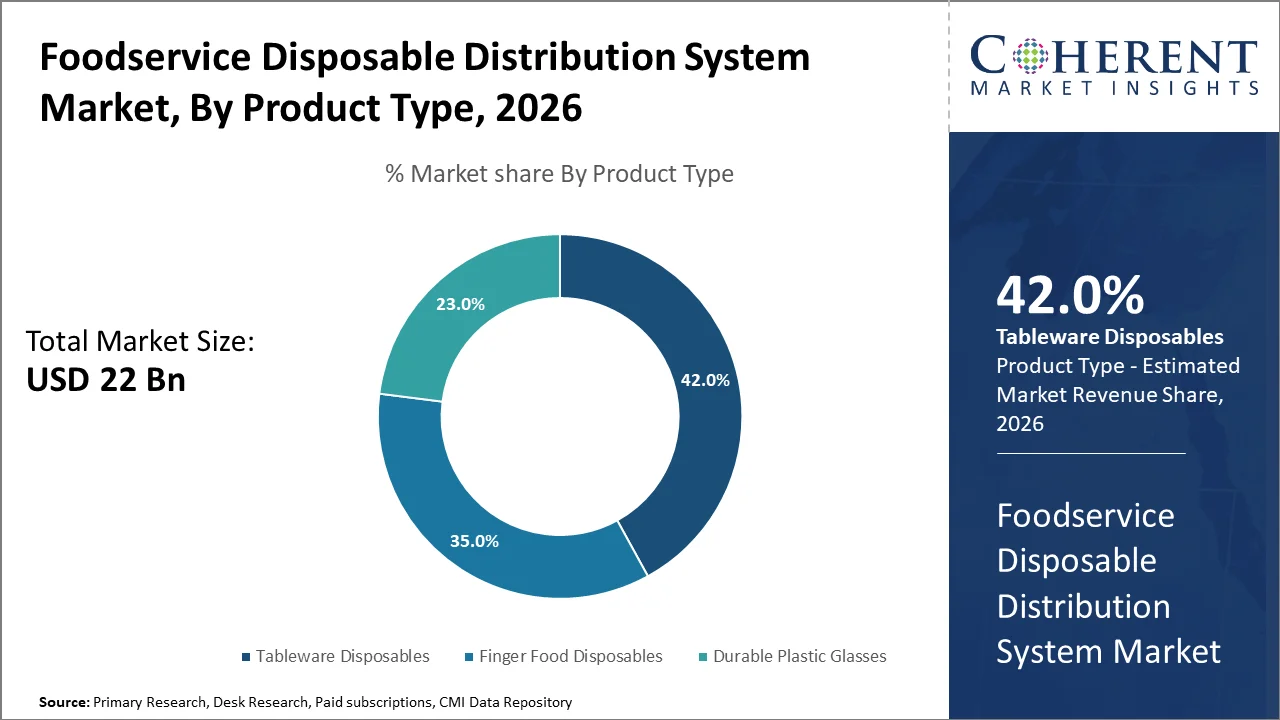
Tableware Disposables Lead the Market with Over Two-Fifths Share in 2026
By product type, tableware disposables segment is projected to lead the market with a share of 42% in 2026. This dominance is attributed to its widespread use of tableware disposables across restaurants, quick-service outlets, catering services, and institutional foodservice operations. Items such as plates, bowls, cups, and cutlery are essential for both dine-in and takeaway services, making them a constant high-volume requirement in daily operations.
The segment also benefits from rising demand for convenience foods, growing shift toward off-premises dining, and the rapid expansion of food delivery platforms. Rising popularity of single-use tableware items is also boosting the target segment. Foodservice operators are increasingly adopting single-use tableware to maintain hygiene standards, improve service speed, and enhance operational efficiency.
- Current Industry Events of 2026
- Market Size Estimation
- Regional Breakdown
- Competitive Landscape
- Customer Intelligence
- Segmental Analysis
- Pricing Analysis
- Key Market Drivers, Challenges & Future Trends
- Customized Insights Section
Which Application Segment Dominates the Foodservice Disposable Industry?
Restaurants Remain the Key Revenue-Generating Segment
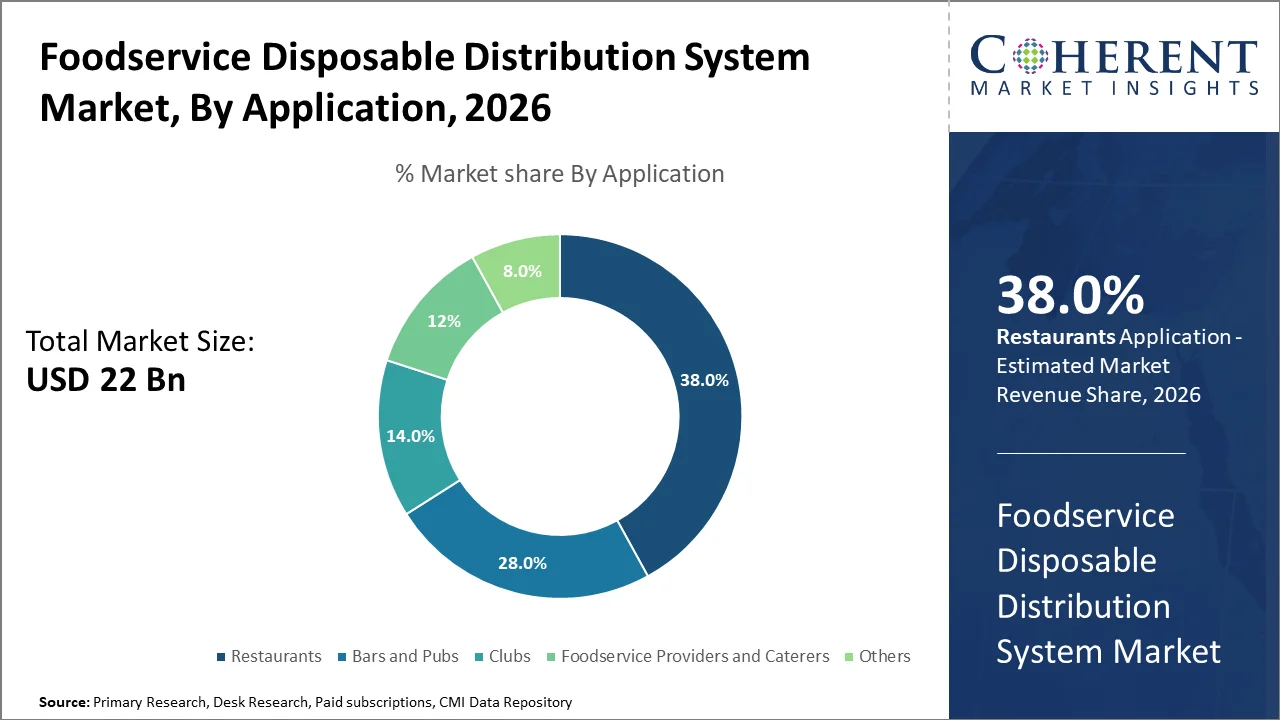
Restaurants segment is set to account for the largest revenue share of 38% in 2026. This is mostly due to high volume of daily customer traffic, rapid expansion of quick-service restaurants, and growing demand for convenient takeout and delivery services.
Restaurants heavily rely on disposable packaging such as cups, containers, cutlery, and wraps to ensure fast service, maintain hygiene standards, and support efficient food delivery operations. In addition, the rising popularity of food delivery platforms and on-the-go eating habits is further strengthening the use of disposable products in this segment.
Foodservice Disposable Distribution System Market Overview
The global foodservice disposable distribution system market is expected to register steady growth over the forecast period. This is due to rapid expansion of the global food delivery and takeaway ecosystem, driven by rising penetration of online food ordering platforms and mobile apps. Increasing number of quick service restaurants (QSRs), cloud kitchens, and franchise-based food outlets are also fueling demand for foodservice disposable distribution systems.
Rising demand for fast food is providing a strong impetus for the growth of the food service disposable distribution system market. Similarly, expansion of online food delivery ecosystem, supported by platforms like Uber Eats and DoorDash-style services, is increasing the consumption of disposable foodservice packaging globally.
Growing environmental concerns are pushing the industry towards sustainable, biodegradable, and compostable disposable products. They are encouraging manufacturers to innovate with eco-friendly materials such as paper-based, plant-based plastics, and reusable hybrid packaging solutions.
Rising urbanization and busy lifestyles are positively influencing sales of foodservice disposable distribution systems. Urban growth, dual-income households, and fast-paced work culture are increasing demand for on-the-go and ready-to-eat food, directly boosting disposable distribution system usage.
Integration of apps and digital ordering systems is making food delivery mainstream. This, in turn, is creating a strong need for efficient distribution networks for disposable food packaging. Thus, rising adoption of digital food ordering platforms is expected to boost the foodservice disposable distribution system market value in the coming year.
Foodservice Disposable Distribution System Market Growth Drivers
Rapid Growth of Food Delivery and Takeout Services: Rise of online food delivery platforms and takeaway culture is providing a strong impetus for the growth of foodservice disposable distribution system market. Consumers in the contemporary world increasingly prefer ordering food for home, office, or travel consumption, which heavily depends on disposable packaging and distribution systems for hygiene and convenience.
Foodservice Disposable Distribution System Market Opportunities
Expansion of Quick-service Restaurants (QSRs and Fast Food Chains: The fast-food and QSR industry is expanding globally, especially in emerging market like China and India. These outlets rely heavily on standardized disposable items (cups, containers, cutlery), increasing demand for efficient distribution systems. Thus, expanding QSRs and fast food chain is expected to create lucrative growth opportunities for the foodservice disposable distribution system market in the coming years.
Foodservice Disposable Distribution System Market Trends
Shift Towards Sustainable and Eco-friendly Materials: Rising preference for sustainable and eco-friendly materials is an emerging trend in the foodservice disposable distribution system market. There is a gradual shift from conventional plastics toward biodegradable, compostable, and paper-based disposables in the industry. Regulations and increasing consumer awareness are pushing companies to redesign supply chains and product offerings.
For instance, Dispo International expanded its compostable bagasse lid range in 2026. The company also introduced a limited range of non-SUP marked paper cups in February 2026. Additionally, Kraft Deli Bowls were added to its product portfolio in 2025. Such innovations are expected to bode well for the foodservice disposable distribution system market in the coming years.
Current Events and Their Impact on the Foodservice Disposable Distribution System Market
Current Event | Description and its Impact |
India bans select single-use plastic items (policy enforcement phase continues) |
|
EU Packaging and Packaging Waste Regulation (PPWR) tightening compliance rules |
|
Regional Insights
Rising On-the-Go Food Consumption Driving Growth in North America
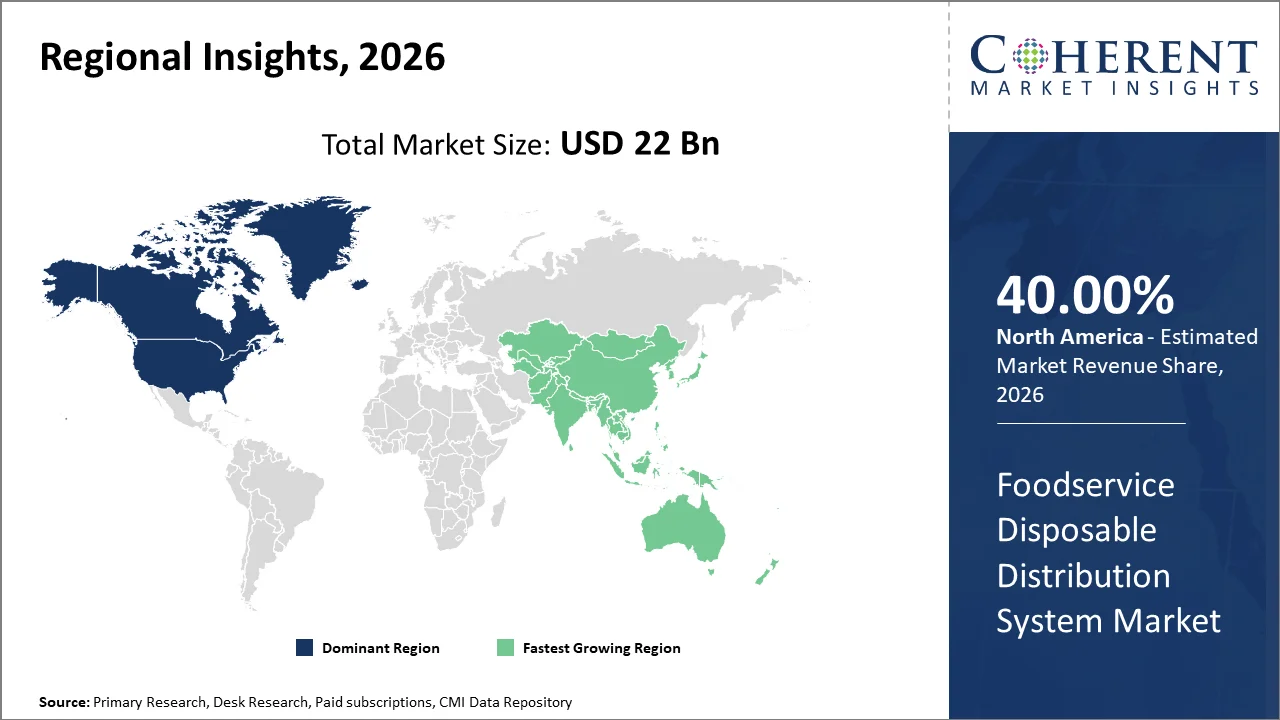
North America is expected to dominate the global foodservice disposable distribution system market with a 40% share in 2026. This can be attributed to rising demand for ready-to-eat food products and the expansion of quick-service restaurants (QSRs). Increasing adoption of online food ordering platforms is also fostering growth in the North America foodservice disposable distribution system market.
Busy urban lifestyles and dual-income households are pushing consumers toward ready-to-eat meals. This, in turn, is increasing demand for single-use foodservice disposables that are easy to handle and dispose of. There is also rising interest in single-use disposables amid growing food safety and hygiene concerns.
According to the This increasing popularity of on-the-go food consumption is creating a need for standardized disposable distribution systems that ensure fast, hygienic, and large-scale supply of packaging materials to restaurants, ghost kitchens, and QSR chains across the region.
Asian Pacific Becoming a Hotbed for Foodservice Disposable Distribution System Companies
Asia Pacific is forecast to emerge as a hotbed for manufacturers of foodservice disposable distribution systems during the forecast period, capturing a global market share of 26% in 2026. This is mainly due to rapid urbanization, rising disposable incomes, and expanding presence of fast-food chains and online food delivery platforms across the region.
The surge in food delivery through digital applications, coupled with increasingly busy urban lifestyles, is significantly boosting demand. Countries such as China and India are witnessing rapid expansion in online food delivery and takeaway services. For instance, in China, the dominance of app-based delivery platforms has increased the use of disposable packaging in quick-service restaurants (QSRs) and cloud kitchens, thereby strengthening the need for efficient distribution systems to manage large-scale packaging and supply requirements across the region.
Foodservice Disposable Distribution System Market Outlook – Country-wise
U.S. Foodservice Disposable Distribution System Market Trends
The United States is likely to remain one of the leading markets for foodservice disposable distribution systems during the forecast period. This is mostly due to rising demand from quick-service restaurants (QSRs), rapid growth in online food delivery, and the need for efficient and hygienic packaging supply chains.
Consumers across the U.S. increasingly prefer convenient, ready-to-eat meals delivered at home or work. This, in turn, boosts demand for disposable packaging and distribution systems. Similarly, growth of ghost kitchens and cloud kitchens in the nation is fueling foodservice disposable distribution system sales.
China Foodservice Disposable Distribution System Market Forecast
China’s foodservice disposable distribution system market is poised to exhibit strong growth during the assessment period. This can be attributed to rising urbanization, growth of QSR chains, and massive adoption of online food delivery platforms.
There is a rapid increase in the number of QSRs, café chains, and fast-food outlets in China. This, in turn, is creating large-scale, standardized demand for disposable packaging systems that ensure efficiency, hygiene, and cost control. In addition, technological improvements in packaging materials are supporting market expansion in the nation.
Who are the Major Companies in the Foodservice Disposable Distribution System Market?
Some of the major players in Foodservice Disposable Distribution System Market are Dispo International, EFG Foodservice, First Pack, Go-Pak Group, MBS Wholesale Ltd, and others.
Key Strategies Adopted by Industry Players
Leading companies operating in the foodservice disposable distribution systems market are adopting various organic and inorganic strategies to strengthen their market position as well as expand their customer base. These include launching eco-friendly and sustainable disposable products, forming partnerships with foodservice providers, and expanding distribution networks to reach more end users.
Many players are also investing in product innovation such as biodegradable packaging and smart dispensing systems to improve efficiency and reduce waste. In addition, companies are emphasizing cost-effective solutions, strengthening supply chain efficiency, and entering emerging markets to capture new growth opportunities.
- In 2025, Go-Pak Group launched Festive Double Wall Aqueous Lined Paper Hot Cups in 8oz, 12oz, and 16oz sizes in 2025. These cups use a water-based lining and are designed to be suitable for home composting under certified conditions.
- In June 2025, Dispo International announced the availability of new biodegradable paper soufflé pots. These new products are designed with tightly rolled rims and box pleats to keep them in best condition when in use.
Market Report Scope
Foodservice Disposable Distribution System Market Report Coverage
| Report Coverage | Details | ||
|---|---|---|---|
| Base Year: | 2025 | Market Size in 2026: | USD 22 Bn |
| Historical Data for: | 2020 To 2024 | Forecast Period: | 2026 To 2033 |
| Forecast Period 2026 to 2033 CAGR: | 5% | 2033 Value Projection: | USD 31 Bn |
| Geographies covered: |
| ||
| Segments covered: |
| ||
| Companies covered: | Dispo International, EFG Foodservice, First Pack, Go-Pak Group, and MBS Wholesale Ltd. | ||
| Growth Drivers: |
| ||
| Restraints & Challenges: |
| ||
Analyst Opinion (Expert Opinion)
- Demand is driven by high food takeaway and delivery consumption. The rise of QSRs, cloud kitchens, and food delivery apps has significantly increased the need for disposable packaging and distribution systems that ensure hygiene and quick service.
- Single-use food packaging dominates daily foodservice operations. Restaurants, cafeterias, and catering services rely heavily on disposable cups, containers, cutlery, and trays because they reduce cleaning time and improve operational speed.
- Supply chains are shifting toward faster and more localized distribution. Distributors are focusing on regional warehouses and shorter delivery cycles to meet the high-frequency, small-order needs of foodservice businesses.
- Sustainability pressure is changing product selection. Growing restrictions on plastic and rising demand for eco-friendly materials (paper-based, compostable, and biodegradable products) are forcing distributors to adjust their product portfolios.
Speak to the analyst
Want personalized insights?
Take the findings above to one of our principal consultants, or have the report rebuilt around the segments, geographies and competitors you actually track.
Market Segmentation
- By Product Type Insights ( Revenue, US$ Bn, 2021 - 2033)
- Tableware Disposables
- Finger Food Disposables
- Durable Plastic Glasses
- By Application Insights ( Revenue, US$ Bn, 2021 - 2033)
- Restaurants
- Bars and Pubs
- Clubs
- Foodservice Providers and Caterers
- Others
- By Distribution Channel Insights ( Revenue, US$ Bn, 2021 - 2033)
- Wholesale
- Retail
- By Region Insights ( Revenue, US$ Bn, 2021 - 2033)
- North America
- U.S.
- Canada
- Latin America
- Brazil
- Argentina
- Mexico
- Rest of Latin America
- Europe
- Germany
- U.K.
- Spain
- France
- Italy
- Russia
- Rest of Europe
- Asia Pacific
- China
- India
- Japan
- Australia
- South Korea
- ASEAN
- Rest of Asia Pacific
- Middle East & Africa
- GCC Countries
- Israel
- Rest of Middle East & Africa
- North America
Sources
Primary Research interviews
- Interviews with foodservice distributors, restaurant operators, packaging manufacturers, retail procurement managers, and supply chain executives involved in disposable products
Databases
- Government trade databases
- Import-export data portals
- Food packaging material databases
- International trade statistics repositories
Magazines
- Foodservice industry magazines
- Packaging and sustainability-focused trade magazines
- Hospitality and restaurant business publications
Journals
- Peer-reviewed journals related to food packaging technology, supply chain management, sustainable materials, and hospitality operations
Newspapers
- Business newspapers
- National dailies
- Financial press covering foodservice trends, packaging innovations, and distribution developments
Associations
- Foodservice industry associations
- Packaging industry bodies
- Hospitality federations
- Restaurant associations
- Supply chain and logistics associations
Public Domain sources
- Government publications
- Regulatory authority reports
- Environmental guidelines on packaging
- Open-access industry statistics
- Publicly available trade reports
Proprietary Elements
- CMI Data Analytics Tool
- Proprietary CMI Existing Repository of information for last 8 years
Get access to 250+ pages report
Every segment, forecast, competitor profile and data table behind the analysis above — available for instant download.
- ESOMAR Member
- ISO 9001:2015 Certified
- D-U-N-S Registered
- GDPR & CCPA Compliant
Missing comfort of reading report in your local language? Find your preferred language:
Transform your Strategy with Exclusive Trending Reports
Frequently Asked Questions
The global Foodservice Disposable Distribution System Market is estimated to be valued at USD 22 Bn in 2026.
The global Foodservice Disposable Distribution System Market value is expected to reach USD 31 Bn by 2033.
The global market is poised to exhibit a CAGR of 5% from 2026 to 2033.
Major growth factors include expansion of quick-service restaurants (QSRs) and increasing preferences for ready-to-eat food.
Tableware disposables segment is expected to lead the market with a share of 42% in 2026.
Some major companies in the Foodservice Disposable Distribution System Market include Dispo International, EFG Foodservice, First Pack, Go-Pak Group, and MBS Wholesale Ltd., among others.
North America, with 40% share in 2026, is expected to lead the market during the forecast period.