

Global Foodservice Disposables Market Size and Share Analysis – Growth Trends and Forecasts (2026-2033)
Foodservice Disposables Market is estimated to be valued at USD 35.71 Bn in 2026 and is expected to reach USD 55.90 Bn in 2033, exhibiting a compound annual growth rate (CAGR) of 6.6% from 2026 to 2033.
Key Takeaways
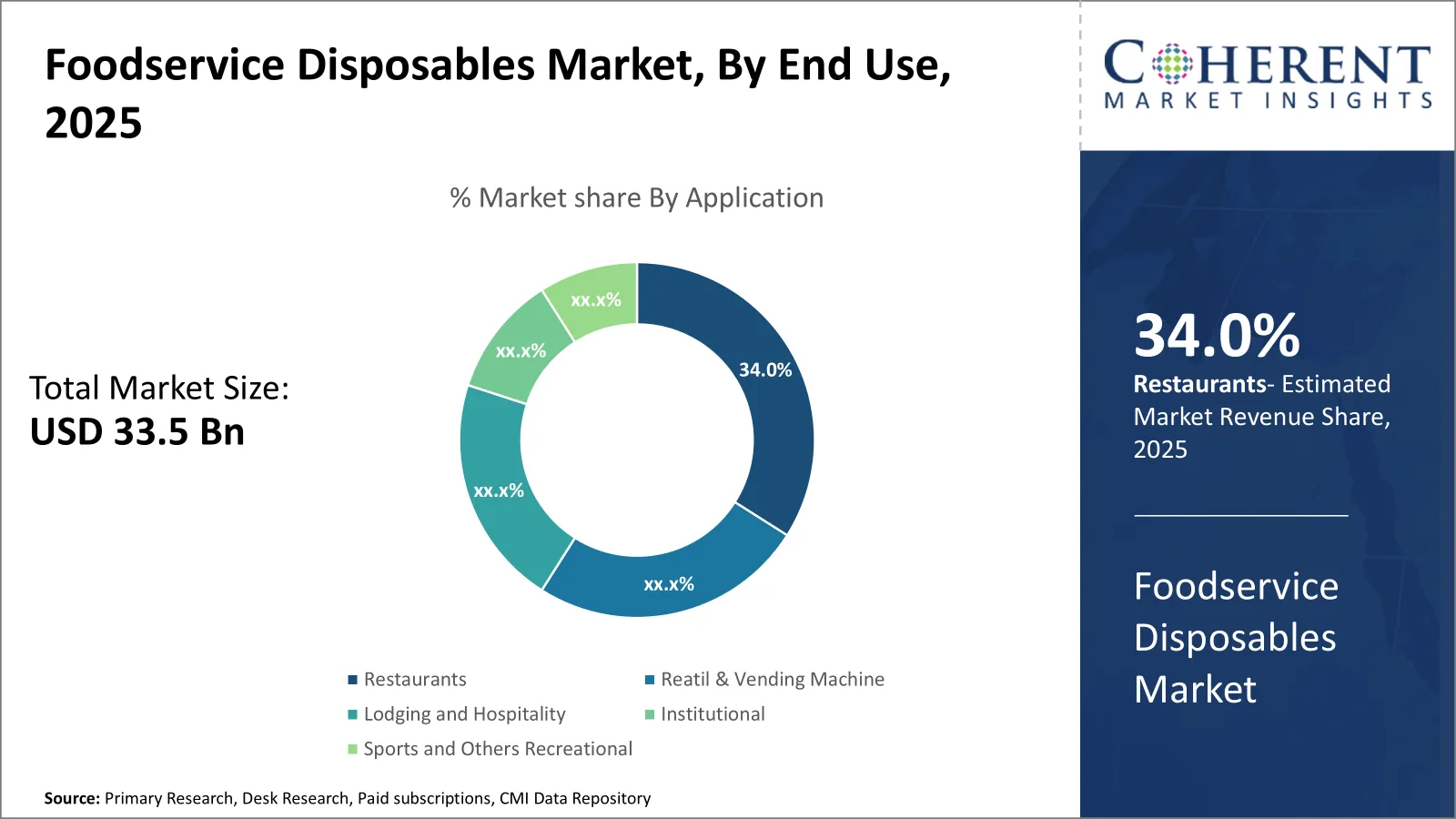
- On the basis of End Use, Restaurants Segment leads the Foodservice Disposables Market with a 35% share. This is attributed to the fact that they carry huge amounts of disposable items for dine-in, takeout, and delivery segments.
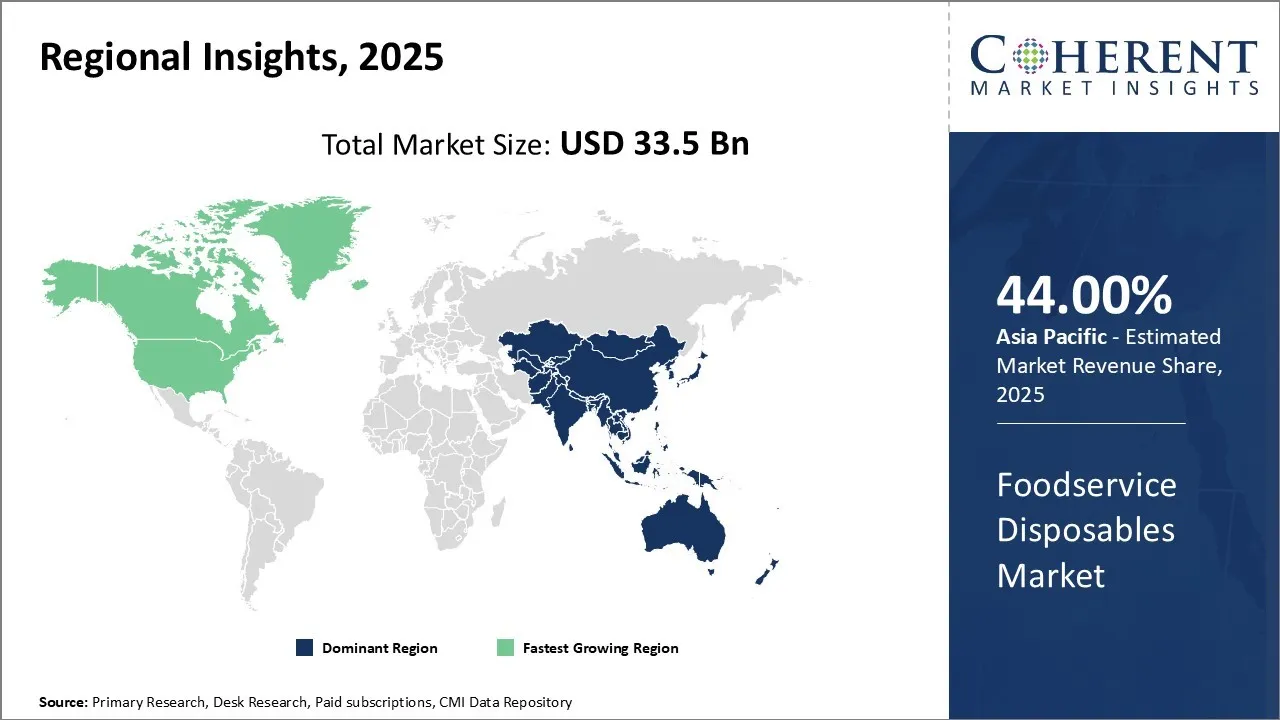
- Asia Pacific dominated the global foodservice disposables market in 2026 with a 44% share. This is attributed to its huge and fast-growing population, urbanization, and growing foodservice market.
- North America is expected to be the second largest region with 30% shares in 2026.
Market Overview
The foodservice disposables market has shown consistent and robust growth over the past decade. This growth is primarily due to the rapid expansion of the global foodservice industry, as well as the rising level of urbanization and increasing demand for on-the-go meals and takeaway food services. In the coming years, the market can expect steady growth, driven by a shift toward hygienic, single-use solutions and eco-friendly alternatives against environmental concerns. Demand is especially strong in markets such as Asia Pacific and North America, where speedy lifestyles, increasing disposable incomes, and the proliferation of quick-service restaurants (QSRs) are spurring consumption.
Current Events and Its Impact on Foodservice Disposables Market
Current Events | Description and its impact |
Shift Toward Compostable & Eco-Friendly Foodservice Disposables |
|
Automation & AI Integration in Packaging Production |
|
Pricing Analysis – Foodservice Disposables Market
The pricing of the foodservice disposables market is governed by a combination of raw material prices, supply situations, regulatory factors, and end-user prices. Dominant materials like plastic, paper, bagasse, aluminum, and bioplastics play a major role in defining the overall pricing policy. Periodic price fluctuations in crude oil (impacting plastics) and pulp (impacting paper-based by foodservice disposables) result in periodic cost revisions. Additionally, the rising price of environmentally friendly materials like PLA (polylactic acid) and molded fiber has raised the mean unit price of environmentally friendly disposables.
Through 2024–2025, worldwide demand—and price—for biodegradable and compostable substitutes has exploded due to the many countries' movement towards becoming green and eliminating single-use plastics within the EU, Canada, and much of the U.S. They customarily hold a 20–40% higher price tag than plastic products, but prices will continue to normalize as production evolves on a broader scale and competition increases.
Moreover, prices vary significantly across end-user segments. Institutional caterers and volume QSRs obtain low per-unit costs due to bulk buys and long-term contracts. Compared to those, unit prices of small cafes and food vendors are usually higher because they have little leverage in buying and not much storage.
Geographically, prices are higher in the developed economies with more energy, labor, and regulatory expenses and where the producers in the emerging countries such as Vietnam or India provide competitively priced goods with export incentives. Overall, the market has a distinctive segmentation between cost-based traditional disposables and high-priced sustainable ones, the latter catching up despite price problems.
- Current Industry Events of 2026
- Market Size Estimation
- Regional Breakdown
- Competitive Landscape
- Customer Intelligence
- Segmental Analysis
- Pricing Analysis
- Key Market Drivers, Challenges & Future Trends
- Customized Insights Section
Role of Technologies such as AI in the Foodservice Disposables Market
Artificial Intelligence (AI) is increasingly playing a revolutionary role in the foodservice disposables market through enhancing the efficiency of operations, optimizing supply chains, and promoting sustainable manufacturing. With the growing demand for eco-friendly and cost-effective disposable items, suppliers and manufacturers are leveraging AI to remain competitive and compliant.
In production, AI-driven automation solutions are streamlining the manufacture of disposables by increasing precision, reducing waste, and enhancing quality inspection. Machine learning algorithms review real-time manufacturing data to find defects, predict equipment breakdowns, and optimize machine runs—reducing downtime and maximizing throughput.
AI is also revolutionizing demand forecasting and inventory. Based on historical sales, patterns of seasonality, and external factors like weather or food ordering habits, AI programs enable suppliers to more accurately predict demand. This minimizes overstocking and stockout, enabling organizations to manage costs while responding to evolving customer needs.
Additionally, AI plays a critical role in packaging innovation. AI-facilitated simulations help develop new biodegradable materials by simulating their performance and environmental footprint prior to actual production. This speeds up R&D and minimizes product development time for compostable or recyclable disposables.
In the supply chain, AI powers logistics by streamlining delivery routes, cutting carbon footprints, and shortening delivery timelines. Others leverage AI to monitor the life cycle of disposables, providing transparency in sustainability statements and conforming to ESG objectives. AI is making the foodservice disposables industry smarter, greener, and more attuned to consumer and regulatory requirements—setting it up for sustainable development.
Demand for Sustainable and Eco-Friendly Solutions within the Foodservice Disposables Market
The market demand for environmentally friendly and sustainable foodservice disposables has seen rapid growth in recent years, as consumers become more environmentally conscious, insist on green products, and governments tighten regulations on the use of single-use plastics. Foodservice companies—such as restaurants, cafes, takeaway food businesses, and catering firms for events—are facing mounting pressure to switch to green solutions like compostable plates, bioplastics cutlery, paper straws, and plant-based packaging.
This transition is driven by increasing consumer demand for environmentally friendly practices. A Nielsen survey in 2024 reported that more than 70% of consumers across the world would rather purchase from brands that show a concern for sustainability, even in the packaging and disposables. Foodservice providers are therefore abandoning the conventional plastic and Styrofoam products for alternatives such as bagasse (sugarcane fiber), PLA (corn-based bioplastic), bamboo, and recycled paperboard.
Regulations have accelerated the trend as well. Plastic disposable bans and taxes in places like the European Union, Canada, India, and a few U.S. states have compelled foodservice companies to invest in compliant, more sustainable alternatives. While such sustainable items tend to be more expensive—usually 20–40% more than traditional items—most companies regard this as an unavoidable expense to meet changing market expectation and brand image.
Manufacturers are escalating innovation in sustainable sourcing and compostable materials, while material innovation and economies of scale are slowly decreasing costs. Overall, demand for green foodservice disposables is not only a trend, but a structural market change driving the future of the industry.
Foodservice Disposables Market: Growth Drivers
- Rising demand of food delivery services using various online platforms
Food delivery services through various online and offline platforms emerged as one of the fast-growing services in the e-commerce space. The presence of different online apps and tools bestowed a new platform for food industry. Availability of cash on delivery option as well as multitude of payment options such as net banking, digital wallets all have increased the consumer attraction.
In 2025, Zomato’s quick commerce unit Blinkit recorded a 127% year-over-year surge in Net Order Value, reaching ₹9,203 crore—surpassing Zomato’s main food delivery segment for the first time. This milestone underscores how consumers increasingly gravitate toward ultra-fast, on-demand delivery services, driven by urban convenience and the proliferation of online payment options.
Rapid exposure of consumers to western lifestyle is aiding the spectacular growth of food delivery segments globally. Adding to this scenario the digital food industries are widely offers many services such as, on-demand delivery, cloud-kitchen, thin layer, full stack, restaurant and food discovery, concierge, market place, and home cooked food models.
- Growing travel and tourism industry increases the usage of disposable items
The travel and tourism industry worldwide has been become a huge social, economic, and cultural activity in both residential and commercial sectors. Travel and tourism promote and increases the understanding among people and also expands economic, cultural and social cooperation.
The increasing demand of tour and travel industry will also boost the market growth of entire food service disposables as these products are the sophisticated way to carry food without any problem. Most of the travelers prefer to have ready to eat food as they are light and do not cause any inconvenience during the time of long travelling. In residential sectors and during family outings and picnics consumers carry their own homely food but there also they use disposable.
Segmental Insights
Foodservice Disposables Market Insights, By End Use
Restaurants dominate the Foodservice Disposables Market with a 35.0% share because they require large volumes of disposable products for dine-in, takeout, and delivery services. The rise of food delivery and takeaway trends has further increased demand for convenient, single-use packaging. Restaurants also prioritize hygiene and convenience, driving the use of disposable cutlery, containers, and cups. Additionally, diverse menu offerings necessitate a wide variety of disposables. This combination of high usage and varied needs makes restaurants the leading end users in the market.
Regional Insights
Asia Pacific Foodservice Disposables Market
Asia Pacific dominated the global foodservice disposables market in 2026 with a 44.00% revenue share due to its large and rapidly growing population, urbanization, and expanding foodservice industry. Rising disposable incomes and changing lifestyles have boosted demand for convenient dining options like takeout and delivery. The presence of numerous small and medium-sized food businesses also contributes to high consumption. These factors collectively position Asia Pacific as the largest market in this sector.
Foodservice Disposables Market Dominating countries
United States Foodservice Disposables Market Analysis and Trend
The U.S. dominates the international foodservice disposables market by virtue of its vast fast food, restaurant, and food delivery markets. Strong consumer demand for convenience, in conjunction with stringent food safety standards, fuels ongoing use of disposable packaging. Ongoing trends toward sustainable options have further stimulated innovation and product diversity.
China Foodservice Disposables Market Analysis and Trend
China is a top producer and consumer of foodservice disposables, owing to its huge population, urbanization, and thriving food delivery market. The nation boasts a huge manufacturing base supporting both local demand and international exports. Environmental policies are also driving the usage of bioplastics and other biodegradable materials, driving local innovation.
India Foodservice Disposables Market Analysis and Trend
India is developing into a rapidly expanding foodservice disposables market through the QSR sector, urbanization, and food delivery applications. Government restrictions on single-use plastics are fueling the demand for sustainable disposables such as areca leaf and bagasse products, which are being produced locally in larger volumes.
Germany Foodservice Disposables Market Analysis and Trend
Germany dominates the European market for sustainable foodservice disposables. With robust environmental regulations and consumer choice favoring biodegradable and compostable products, demand continues to be high. Germany also has a significant role in determining EU-wide packaging policy and green innovation within disposable materials.
Market Report Scope
Foodservice Disposables Market Report Coverage
| Report Coverage | Details | ||
|---|---|---|---|
| Base Year: | 2025 | Market Size in 2026: | USD 35.71 Bn |
| Historical Data for: | 2020 To 2024 | Forecast Period: | 2026 To 2033 |
| Forecast Period 2026 to 2033 CAGR: | 6.6% | 2033 Value Projection: | USD 55.90 Bn |
| Geographies covered: |
| ||
| Segments covered: |
| ||
| Companies covered: | Dart Container Corporation, Georgia-Pacific LLC, Anchor Packaging Inc., D&W Fine Pack LLC, Gold Plast SpA, Berry Plastics Group, Inc., DOpla S.p.A., Huhtamäki Oyj, New WinCup Holdings, Inc., andPactiv LLC | ||
| Growth Drivers: |
| ||
| Restraints & Challenges: |
| ||
Foodservice Disposables Market: Recent Developments
- In 2024, Dart Container collaborated with PulPac to create Dry Molded Fiber technology, which saves 80% CO₂ emissions and facilitates quicker production cycles. The innovation addresses high-volume SKUs with a green alternative to conventional plastic disposables. The technology aids the transition of the industry towards sustainable and efficient production processes.
- In 2024, Novolex's Eco-Products brand extended its GreenStripe® line to feature a range of compostable paper bags, sandwich wraps, and other products. The action reflects the increasing need for environmentally friendly and sustainable packaging solutions within the foodservice sector. The new product extension will help minimize plastic waste and provide companies with more eco-friendly alternatives.
Analyst View
- The foodservice disposables industry is undergoing dramatic change fueled by changing consumer habits and regulatory forces. The accelerated growth of food delivery platforms and takeout culture, fueled by the on-the-go food options, continues to drive demand for single-use packaging products throughout restaurants, cafeterias, and quick-service restaurants.
- Accelerating urbanization and hectic lifestyles are driving the growth of convenient food packaging solutions. The increasing demand for on-the-go eating and meal-delivery services has generated consistent demand for disposable cups, containers, and utensils. Besides, improved hygiene awareness among consumers has strengthened the demand for single-use products at food service outlets. Additionally, the growing adoption of kraft packaging in foodservice disposables—valued for its recyclability, durability, and eco-friendly appeal—is further supporting sustainable packaging trends in the industry.
- Environmental issues are the biggest challenge, as governments across the globe introduce stringent legislations against single-use plastics. Volatile raw material prices, especially for petroleum products, are putting pressure on pricing by manufacturers. Growing consumer awareness about plastic pollution is slowly changing preferences toward alternatives that are reusable.
- The creation of biodegradable and compostable materials offers huge innovation opportunities for innovation-driven companies. Intelligent packaging technologies with temperature indicators and freshness sensors provide differentiation opportunities. The growing organized foodservice market in developing economies opens up new market opportunities.
Market Segmentation
- Global Foodservice disposables Market, By Raw Material (Revenue, USD Bn, 2021 - 2033)
- Paper & Paperboard
- Plastics
- Aluminum
- Global Foodservice disposables Market, By Product Type (Revenue, USD Bn, 2021 - 2033)
- Plates
- Cups & Glasses
- Trays & Containers
- Cutlery
- Bowls & Tubs
- Mugs & Saucers
- Other Products (Napkins & Foil Wraps)
- Global Foodservice disposables Market, By End use (Revenue, USD Bn, 2021 - 2033)
- Restaurants
- Retail & Vending Machines
- Institutions
- Lodging & Hospitality
- Others
- Global Foodservice disposables Market, By Region (Revenue, USD Bn, 2021 - 2033)
- North America
- U.S.
- Canada
- Latin America
- Brazil
- Mexico
- Rest of Latin America
- Europe
- Nordic
- U.K.
- Italy
- Poland
- Russia
- Ukraine
- Rest of Europe
- Asia Pacific
- China
- India
- Japan
- Rest of Asia Pacific
- Middle East & Africa
- GCC
- South Africa
- Rest of Middle East & Africa
- North America
- Company Profiles
- Dart Container Corporation
- Georgia-Pacific LLC
- Anchor Packaging Inc.
- D&W Fine Pack LLC
- Gold Plast SpA
- Berry Plastics Group, Inc.
- DOpla S.p.A.
- Huhtamäki Oyj
- New WinCup Holdings, Inc.
- Pactiv LLC
Sources
Primary Research Interviews
- Online foodservice platform executives and procurement managers
- Disposable packaging manufacturers and suppliers
- Restaurant chain operations directors
- Food delivery service providers
- Others
Databases
- Euromonitor International
- IBISWorld Industry Reports
- Others
Magazines
- Foodservice Equipment & Supplies Magazine
- QSR Magazine (Quick Service Restaurant)
- Nation's Restaurant News
- Packaging World Magazine
- Others
Journals
- Journal of Foodservice Business Research
- Packaging Technology and Science Journal
- Food Quality & Preference Journal
- Others
Newspapers
- Restaurant Business Online
- Food Business Magazine
- Packaging News
- Nation's Restaurant News Daily
- Others
Associations
- National Restaurant Association (NRA)
- Foodservice Packaging Institute (FPI)
- International Foodservice Distributors Association (IFDA)
- Sustainable Packaging Coalition
- Others
Public Domain Sources
- U.S. Environmental Protection Agency (EPA) reports
- Food and Drug Administration (FDA) guidelines
- United Nations Environment Programme publications
- World Health Organization food safety reports
- Others
Proprietary Elements
- CMI Data Analytics Tool
- Proprietary CMI Existing Repository of information for last 8 years
*Definition: Foodservice disposable is used in the packaging of food and beverage products. Foodservice disposable products offer greater ease of packaging food and customer convenience with hygiene and cleanliness. Theses product can be classified into plates, clamshells, trays & containers, cups & bowls, and cutleries.
Get access to 250+ pages report
Every segment, forecast, competitor profile and data table behind the analysis above — available for instant download.
- ESOMAR Member
- ISO 9001:2015 Certified
- D-U-N-S Registered
- GDPR & CCPA Compliant
Missing comfort of reading report in your local language? Find your preferred language:
Transform your Strategy with Exclusive Trending Reports
Frequently Asked Questions
The Foodservice Disposables Market size is estimated to be valued at USD 35.71 Bn in 2026, and is expected to reach USD 55.90 Bn by 2033.
Foodservices Disposable market growth will increase by $45.7 Bn during 2026-2033
The most common materials used in foodservice disposables include plastic, paper, aluminum, foam, and increasingly, biodegradable options like bagasse, PLA, and bamboo.
Foodservice businesses can reduce their environmental footprint by switching to compostable or recyclable materials, minimizing single-use items, and encouraging reuse and proper waste segregation.
While rare, some zero-waste options exist—such as reusable dishware paired with closed-loop composting systems—but full zero-waste implementation is often challenging in large-scale operations.
The CAGR of the global Market is projected to be 6.6% from 2026 to 2033.
Segmented the market by Application and geographic (North America, Europe, APAC, South America, and MEA).