

Free Machining Steel Market Size and Forecast — 2026-2033
The global free machining steel market is estimated to be valued at USD 6.14 Bn in 2026 and is expected to reach USD 8.14 Bn by 2033, exhibiting a compound annual growth rate (CAGR) of 4.1% from 2026 to 2033.
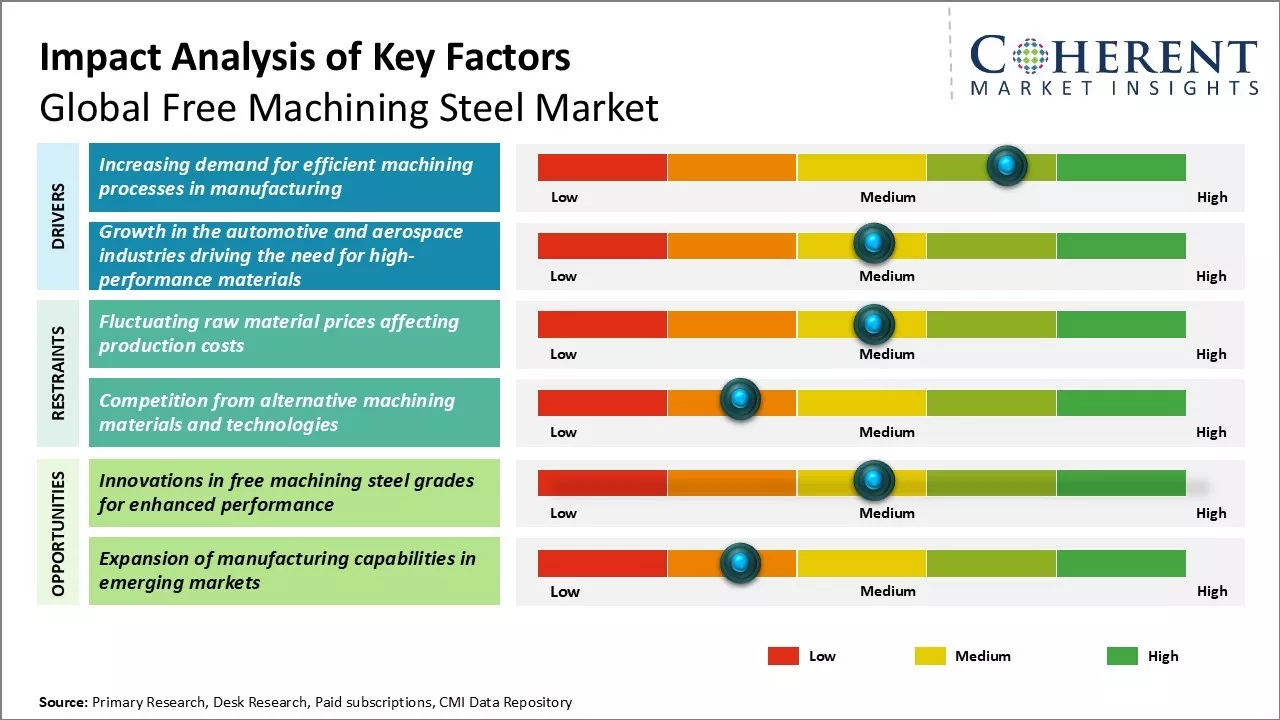
This steady growth can be attributed to rising usage of free machining steel across industries that requires high machinability along with acceptable mechanical properties at moderate costs. Key factors such as growing industrialization and manufacturing activities along with rapid urbanization across developing regions will drive the demand for free machining steel. Additionally, increasing use of free machining steel as a replacement for high-cost tool steel and alloys in various applications will further aid the market expansion from 2026 to 2033.
Insights By Type
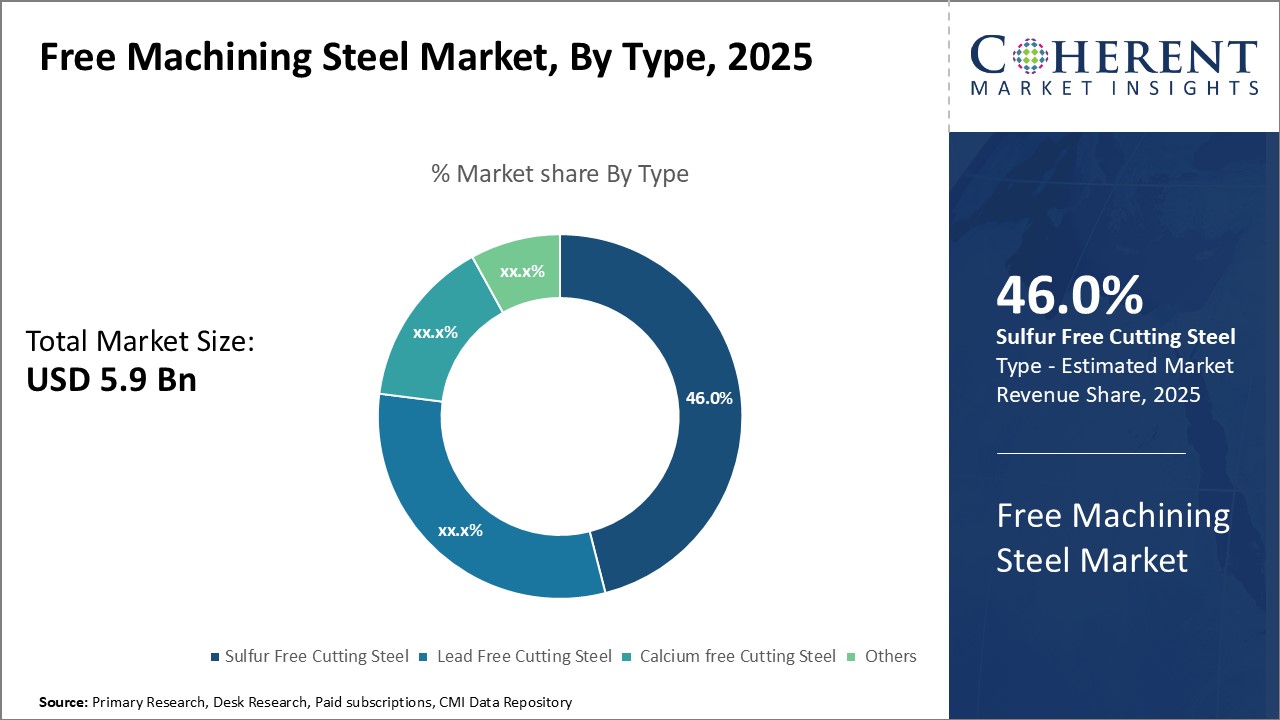
Insights By Type - Superior corrosion and oxidation resistance drive the demand for sulfur free cutting steel
In terms of type, the sulfur free cutting steel segment is expected to contribute 47.0% share of the market in 2026, owing to its superior corrosion and oxidation resistance properties. Its excellent corrosion resistance allows it to maintain dimensional stability and retain mechanical properties for longer periods of usage. This is a highly desirable attribute for applications that require components to perform reliably over extended durations without deterioration. Sulfur free cutting steel also exhibits high resistance to oxidation, retaining its strength at elevated temperatures without forming surface scale.
Insights By Application
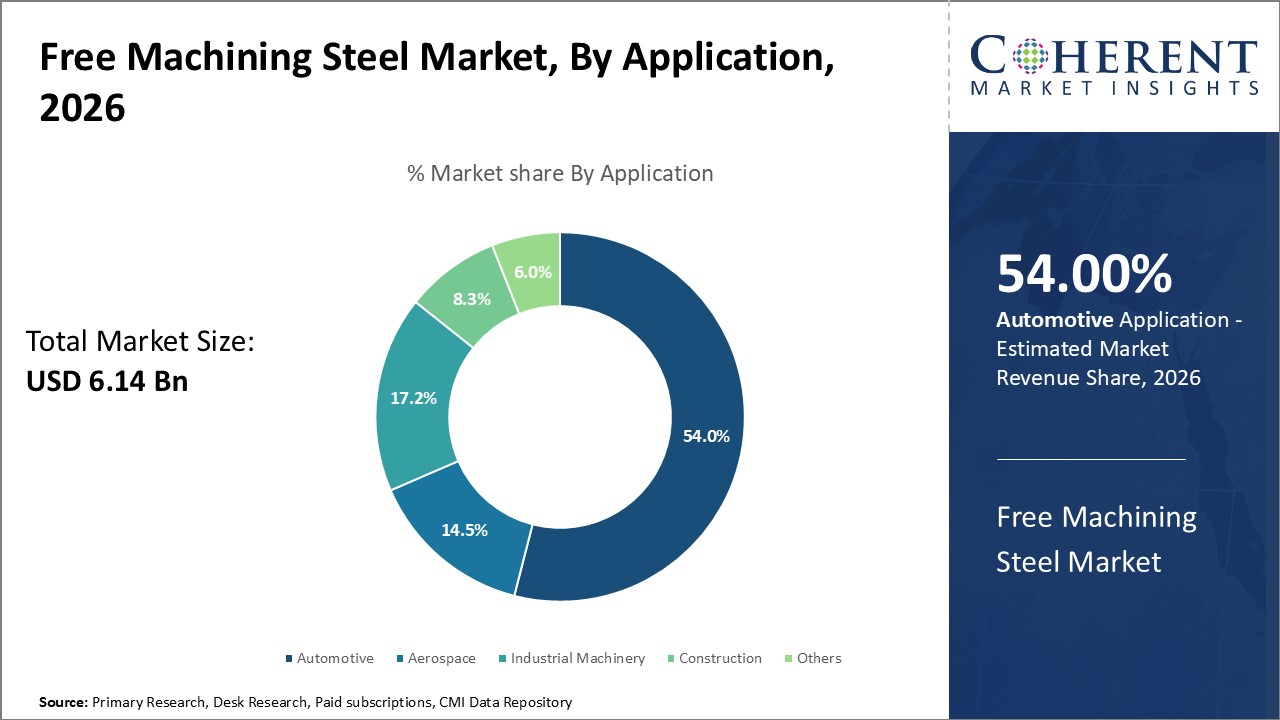
Insights By Application - Reliability and precision requirements in automotive spur the demand for lead free cutting steel
In terms of application, the automotive segment is expected to contribute 54% share of the market in 2026, owing to the stringent reliability and precision requirements imposed in the industry. Lead free cutting steel is extensively utilized in the automotive sector due to its machinability, strength, and dimensional stability. The lead-free composition enables close machining tolerances to be maintained without tool wear issues, fulfilling the automotive industry's demand for high precision components. It exhibits consistency in mechanical properties during forming, machining, and assembly operations.
Insights By Distribution Channel
Insights By Distribution Channel - Ease of procurement and quality assurance drive preference for direct sales among manufacturers
In terms of distribution channel, direct sales (manufacturer to end user) is expected to contribute 48.2% share of the market in 2026, owing to the advantages it provides to manufacturers. The direct sales model facilitates seamless communication between steel manufacturers and OEMs, enabling just-in-time fulfillment of strict material specifications and tight delivery timelines. It eliminates lead times associated with multiple intermediaries in the supply chain. Manufacturers prefer dealing directly with mill sources to ensure sustained supply of high quality, customized products tailored to their requirements.
Regional Insights
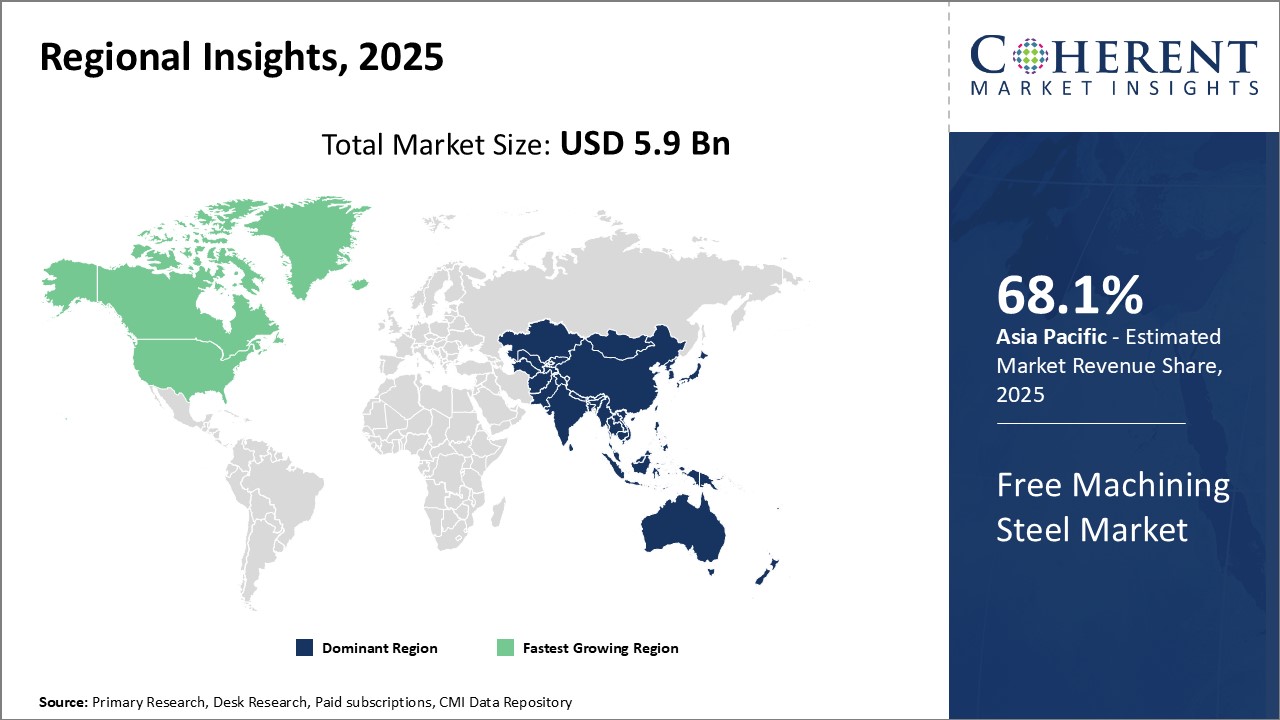
Regional Analysis:
Dominating Region: Asia Pacific
The Asia Pacific region is projected to hold the largest market share, estimated at 68.1% in 2026. The region's dominance in the market can be attributed to the robust presence of key industries such as automotive, aerospace, and machinery. Additionally, government policies such as Tariffs and Trade Measures that encourage domestic manufacturing have further supported the regional market growth.
Fastest-Growing Region: North America
The North America region exhibits the fastest growth and is fast emerging as a global manufacturing hub. Countries such as the U.S. and Canada have witnessed rapid industrialization, driving significant demand from end-use sectors. Regional players such as United States Steel Corporation have enhanced production capacities and leveraged competitive advantages to gain market share.
Free Machining Steel Market Outlook for Key Countries
Strong Demand from the Automotive and Aerospace Sectors Drives the U.S. Free Machining Steel Market Growth
The U.S. free machining steel market is driven by strong demand from the automotive and aerospace industries, which requires high-strength, corrosion-resistant materials. The market has seen significant investment in steel manufacturing, with United States Steel Corporation announcing an expansion of its production facility in October 2023 to meet increasing demand for high-performance steels. This expansion highlights the ongoing trend of rising demand for high-quality steel in these sectors.
Sustainable Manufacturing Initiatives Boost Demand for Free Machining Steels in Germany
The Germany free machining steel market is bolstered by its strong automotive and machinery industries. The country is investing heavily in sustainable manufacturing practices, with a goal to reduce carbon emissions by 55.5% by 2030. This initiative is expected to increase the demand for lead-free and sulfur-free machining steels, aligning with environmental regulations.
Government Initiatives and Automotive Sector Growth Drive Free Machining Steel Demand in Japan
Japan is witnessing significant growth in the free machining steel market, primarily due to its advanced technology and innovation in steel production. The government’s initiative to promote the use of high-strength, lightweight materials in automotive manufacturing is driving demand. In 2023, Japan's automotive sector announced plans to increase the use of advanced materials by 20.5% over the next five years.
"Made in China 2026" Initiative Drives Demand for High-Quality Free Machining Steel in China
The China free machining steel market is expanding rapidly, fueled by urbanization and industrialization. The government’s "Made in China 2026" initiative aims to enhance the manufacturing capabilities of domestic industries, including steel production. This initiative is expected to increase the demand for high-quality machining steels, with a projected market growth rate of 7.5% annually through 2026.
"Make in India" Initiative and Sector Growth Fuel Demand for Free Machining Steel in India
India is emerging as a significant player in the free machining steel market, driven by its growing automotive and aerospace sectors. The government’s push for "Make in India" is fostering local manufacturing, which is expected to increase the demand for free machining steel by 6.5% annually through 2026. Recent investments in infrastructure and manufacturing capabilities are further supporting this growth.
Market Players, Key Development, and Competitive Intelligence
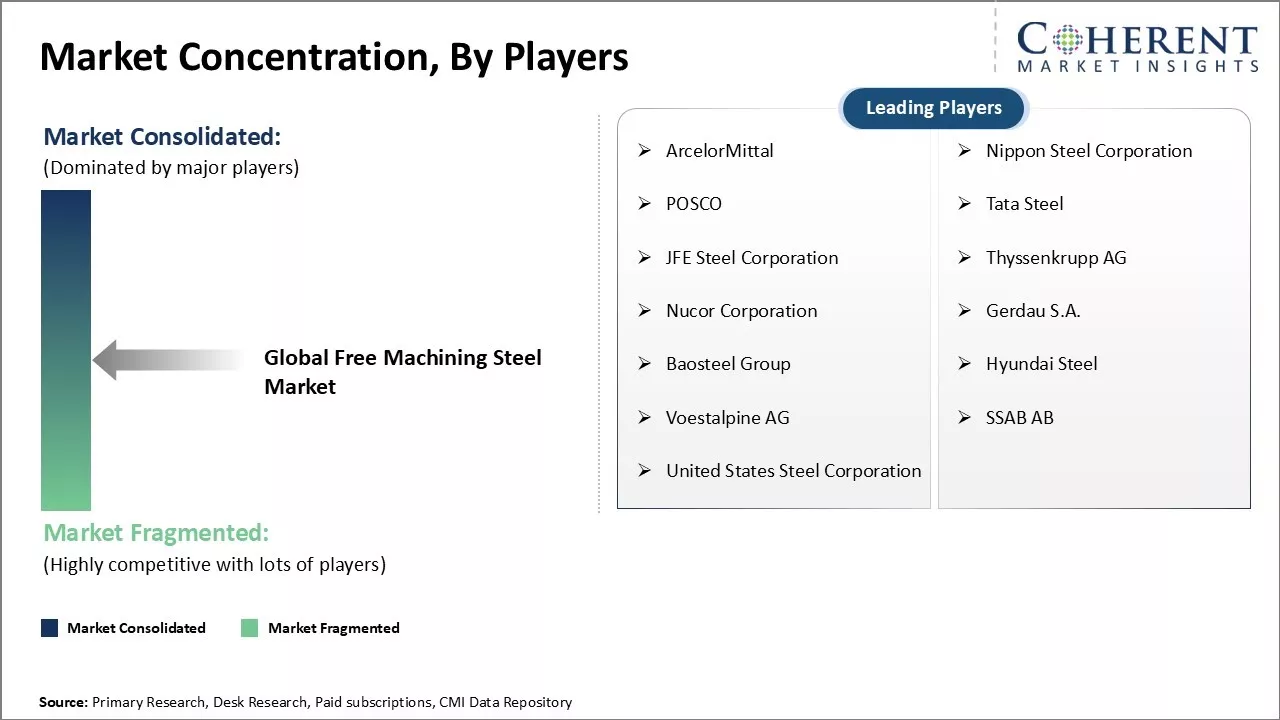
Top Strategies Followed by Global Free Machining Steel Market Players
- Established Players: Leading companies in the market heavily invest in research and development to innovate and launch new high-performance products. For instance, major players like ArcelorMittal, SSAB, and Thyssenkrupp spend over 5% of their annual revenue on R&D activities focused on product design, material enhancement, and manufacturing process improvement. This allows them to introduce advanced steel grades with augmented machinability, sustainability, and mechanical properties to strengthen their position.
- Mid-Level Players: Mid-sized players in the market employ strategies centered around delivering quality and cost-effective solutions. They focus on producing standard and customized steel variants targeting price-conscious industrial segments and individual consumers.
- Small-Scale Players: Small companies often specialize in filling niche demands that major established players overlook. They closely study niche applications and manufacture specialized steel types catering to unique industry needs. For instance, some small brands developed steel grades optimized for 3D printing, micro-machining, and electrical discharge machining.
Emerging Startups in the Global Free Machining Steel Market
Innovative Technologies: Startups are presenting advanced technology-driven solutions. Companies like CIMSTEEL and Metalysis are developing smart sensor-enabled steel that self-adjusts machinability. Arx Metalli uses artificial intelligence for material design and simulations to reduce prototyping cycles. Such innovations could transform machining workflows and drive the market growth.
Sustainable Solutions: Emerging firms offer eco-friendly options. Novati and Staatler are creating steel produced using recycled scrap and industrial waste. This reduces emissions and promotes the circular economy. Steelex and Grafoid develop composites infused with graphene for strength and conductivity. Their sustainable materials can lower environmental impact while meeting performance standards. Startups concentrate on niche segments ignored by big brands. Examples include Metals7 catering to architects with formable steel sheets and Metza focusing on medical device manufacturing needs.
- Current Industry Events of 2026
- Market Size Estimation
- Regional Breakdown
- Competitive Landscape
- Customer Intelligence
- Segmental Analysis
- Pricing Analysis
- Key Market Drivers, Challenges & Future Trends
- Customized Insights Section
Market Report Scope
Free Machining Steel Market Report Coverage
| Report Coverage | Details | ||
|---|---|---|---|
| Base Year: | 2025 | Market Size in 2026: | USD 6.14 Bn |
| Historical Data for: | 2020 To 2024 | Forecast Period: | 2026 To 2033 |
| Forecast Period 2026 to 2033 CAGR: | 4.1% | 2033 Value Projection: | USD 8.14 Bn |
| Geographies covered: |
| ||
| Segments covered: |
| ||
| Companies covered: | ArcelorMittal, Nippon Steel Corporation, POSCO, Tata Steel, JFE Steel Corporation, Thyssenkrupp AG, Nucor Corporation, Gerdau S.A., Baosteel Group, Hyundai Steel, Voestalpine AG, SSAB AB, and United States Steel Corporation | ||
| Growth Drivers: |
| ||
| Restraints & Challenges: |
| ||
Market Dynamics
Market Driver - Increasing demand for efficient machining processes in manufacturing
The global manufacturing industry has been undergoing rapid transformation over the past few years. Manufacturers are constantly seeking ways to improve productivity and reduce manufacturing costs in order to gain a competitive advantage. Increased demand for customized products has necessitated an improvement in machining flexibility and efficiency across industries. Traditional machining methods are often inefficient as they require multiple steps and complex setups to produce complex parts. This has boosted the need for advanced materials that can be easily machined with better surface finish and close dimensional tolerances.
Market Challenge - Fluctuating raw material prices affecting production costs
The market has been facing challenges due to fluctuating raw material prices in the recent past. Raw materials such as chromium, nickel, molybdenum, and vanadium that are used in the production of free machining steel alloys have experienced significant price volatility over the last few years. As these materials constitute a major portion of total input costs for steel makers, unpredictable price swings directly impact the production costs. This makes it difficult for manufacturers to maintain stable product pricing in the market. The fluctuating costs squeeze profit margins and reduce the competitive advantage for players.
Market Opportunity - Innovations in free machining steel grades for enhanced performance
The market is witnessing numerous opportunities for growth driven by ongoing innovations in material development. Steel manufacturers are focusing on new product development through extensive research and testing to expand their portfolio and address evolving applications. Various new grades of free machining steels have been introduced with enhanced machinability, surface finish, and mechanical properties. For instance, some innovative materials offer up to 50% improvement in tool life and chip control compared to conventional grades. Such superior performing varieties satisfy the rigorous specifications of applications in automotive components and industrial machinery.
Analyst Opinion (Expert Opinion)
Key Takeaways from Analyst
This market continues to grow steadily driven by increasing demand from automotive and industrial machinery manufacturing industries. The ease of machining and overall decrease in production costs offered by free machining steel makes it a preferred choice among manufacturers. The Asia Pacific region, led by China, India and Japan, dominates the market and the trend is expected to continue benefiting from growing industrialization and automation.
However, availability of cheaper aluminum and composite substitutes poses a challenge to the market. Volatility in steel prices due to uncertainties over international trade policies can also negatively impact the free machining steel market. Furthermore, stringent environmental regulations around the globe restrict the growth potential to some extent.
On the brighter side, increasing R&D investments by steel manufacturers to develop advanced free machining steel grades provide immense untapped opportunities. Ongoing automation and technological upgrades in end-use sectors will pave the way for new application areas.
Speak to the analyst
Want personalized insights?
Take the findings above to one of our principal consultants, or have the report rebuilt around the segments, geographies and competitors you actually track.
Market Segmentation
- Type Insights (Revenue, USD Bn, 2021 - 2033)
- Sulfur Free Cutting Steel
- Lead Free Cutting Steel
- Calcium free Cutting Steel
- Others
- Application Insights (Revenue, USD Bn, 2021 - 2033)
- Automotive
- Aerospace
- Industrial Machinery
- Construction
- Others
- Distribution Channel Insights (Revenue, USD Bn, 2021 - 2033)
- Direct Sales (Manufacturer to End-User)
- Distributors & Dealers
- Online Platforms (E-commerce)
- Regional Insights (Revenue, USD Bn, 2021 - 2033)
- North America
- U.S.
- Canada
- Latin America
- Brazil
- Argentina
- Mexico
- Rest of Latin America
- Europe
- Germany
- U.K.
- Spain
- France
- Italy
- Russia
- Rest of Europe
- Asia Pacific
- China
- India
- Japan
- Australia
- South Korea
- ASEAN
- Rest of Asia Pacific
- Middle East
- GCC Countries
- Israel
- Rest of Middle East
- Africa
- South Africa
- North Africa
- Central Africa
- North America
- Key Players Insights
- ArcelorMittal
- Nippon Steel Corporation
- POSCO
- Tata Steel
- JFE Steel Corporation
- Thyssenkrupp AG
- Nucor Corporation
- Gerdau S.A.
- Baosteel Group
- Hyundai Steel
- Voestalpine AG
- SSAB AB
- United States Steel Corporation
Get access to 250+ pages report
Every segment, forecast, competitor profile and data table behind the analysis above — available for instant download.
- ESOMAR Member
- ISO 9001:2015 Certified
- D-U-N-S Registered
- GDPR & CCPA Compliant
Missing comfort of reading report in your local language? Find your preferred language:
Transform your Strategy with Exclusive Trending Reports
Frequently Asked Questions
The Free Machining Steel Market is estimated to be valued at USD 6.14 Bn in 2026, and is expected to reach USD 8.14 Bn by 2033.
The CAGR of the Free Machining Steel Market is projected to be 4.1% from 2026 to 2033.
Fluctuating raw material prices affecting production costs and competition from alternative machining materials and technologies are the major factors hampering the growth of the global free machining steel market.
Fluctuating raw material prices affecting production costs and competition from alternative machining materials and technologies are the major factors hampering the growth of the global free machining steel market.
In terms of type, sulfur free cutting steel is estimated to dominate the market revenue share in 2026.
ArcelorMittal, Nippon Steel Corporation, POSCO, Tata Steel, JFE Steel Corporation, Thyssenkrupp AG, Nucor Corporation, Gerdau S.A., Baosteel Group, Hyundai Steel, Voestalpine AG, SSAB AB, and United States Steel Corporation are the major players.
Asia Pacific is expected to lead the global free machining steel market in 2026.