

Geotextile Market Size and Forecast — 2026 - 2033
The Global Geotextile Market size is estimated to be valued at USD 9.5 billion in 2026 and is expected to reach USD 15.8 billion by 2033, exhibiting a compound annual growth rate (CAGR) of 7.4% from 2026 to 2033.
Overview
A geotextile is a permeable synthetic fabric used in civil engineering and construction projects to improve soil stability, drainage, and erosion control. It is commonly made from polypropylene or polyester and is placed between soil layers to separate, filter, reinforce, protect, or drain. Geotextiles are widely used in road construction, railways, retaining walls, landfills, and coastal protection systems. They help prevent soil mixing, enhance load distribution, and allow water to pass through while retaining soil particles. Available in woven, nonwoven, and knitted forms, geotextiles increase the lifespan and strength of infrastructure projects while reducing maintenance costs and environmental impact.
Key Takeaways
Non-woven geotextiles dominate the product type segment, holding 57% market share, driven by versatility and cost-effectiveness.
Roadways and highways application segment leads with a 42% share, reflecting infrastructural investments worldwide.
Asia Pacific is a critical regional market, attributed to rapid infrastructure development and increasing market scope in countries like China and India.
North America remains a mature market with strong government backing for advanced geotextile technologies and sustainable product integration.
Geotextile Market Segmentation Analysis
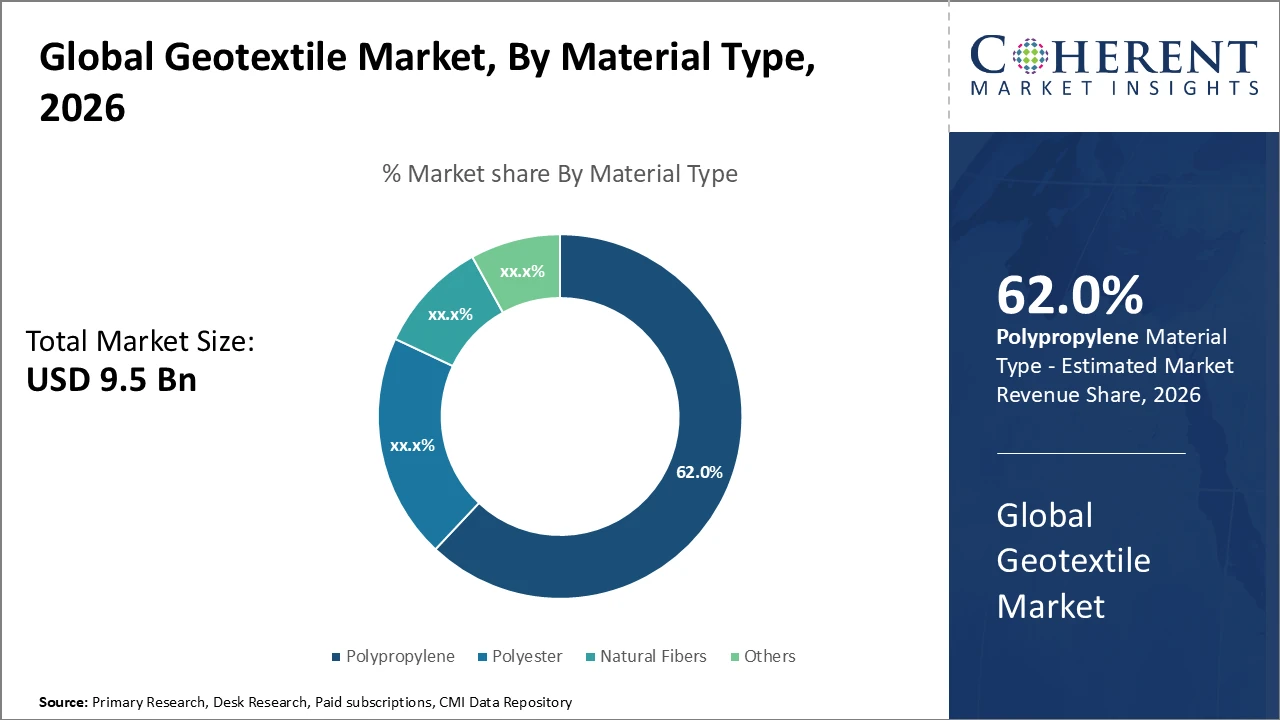
Geotextile Market Insights, By Material Type
Polypropylene holds the dominant market share of 62%, supported by its strong chemical resistance, high tensile strength, and cost-competitive manufacturing, which make it the preferred material for roadways, agriculture, and erosion control applications. The fastest-growing subsegment is natural fibers, propelled by sustainability trends and increasing regulatory pressure to reduce reliance on synthetic polymers. Polyester, appreciated for its thermal stability and durability, continues to maintain demand in niche geotextile products requiring enhanced performance. Other materials, including biodegradable geotextiles, cater to specialized applications but currently account for a comparatively smaller share of the overall market.
Geotextile Market Insights, By Product Type
Non-woven geotextiles dominate the market with a 57% share, driven by their superior permeability, excellent filtration capability, and cost-effectiveness, which support extensive use in road embankments and drainage systems. The fastest-growing subsegment is composite geotextiles, gaining traction as multifunctional solutions that combine woven and non-woven properties to enhance performance in complex construction projects. Woven geotextiles, recognized for their high tensile strength, continue to witness steady demand, particularly in road reinforcement applications. Meanwhile, knitted and other specialty geotextiles serve niche segments such as marine environments and erosion control, though they account for comparatively smaller market shares.
Geotextile Market Insights, By Application
Roadways and highways dominate the market with a 42% share, driven by significant global investments in highway upgradation projects that have accelerated the adoption of geotextiles for soil stabilization and pavement reinforcement. The fastest-growing segment is agriculture, reflecting increasing use of geotextiles for mulch mats, drainage systems, and soil erosion prevention amid rising environmental concerns. Erosion control remains a crucial application, particularly for coastal protection and flood management, supported by expanding climate resilience initiatives. Marine engineering applications, including seawall and harbor construction, are growing steadily, although expansion is somewhat constrained by high project costs and complex implementation requirements.
Geotextile Market Trends
The geotextile market is increasingly shifting toward sustainable and multifunctional materials, enabling broader applications in environmentally sensitive zones.
The growth of biodegradable geotextiles is driven by regulatory frameworks in regions such as Europe and United States aimed at reducing microplastic pollution.
For example, several EU-funded projects in 2025 tested biodegradable geotextiles for coastal erosion mitigation, demonstrating success in lowering ecological footprints.
Smart geotextiles integrated with IoT sensors are gaining traction, supporting real-time infrastructure monitoring and predictive maintenance strategies.
Such advancements have significantly reduced lifecycle costs, particularly in highway management projects across the United States.
Overall, these trends reflect a clear transition from conventional geotextile products toward technologically advanced and environmentally sustainable solutions.
Geotextile Market Insights, By Geography
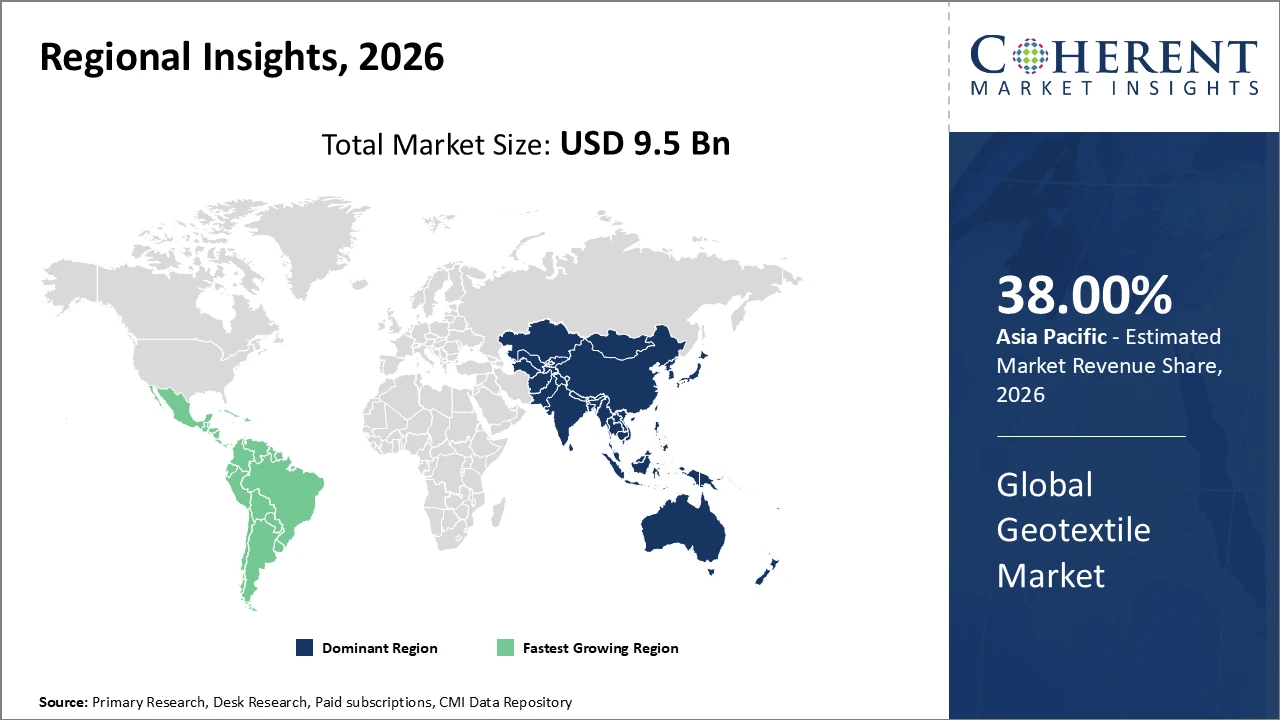
Asia Pacific Geotextile Market Analysis and Trends
In Asia Pacific, dominance in the geotextile market is driven by rapid urbanization, substantial government infrastructure investments, and expanding industrialization, particularly in China and India. The region accounted for over 38% of the market share in 2025, supported by aggressive production capacity expansions and widespread adoption of cost-effective non-woven geotextiles. Favorable trade dynamics and the availability of locally sourced raw materials further strengthen supply chain efficiencies. These advantages have attracted significant investments from leading industry players to meet the region’s extensive and growing infrastructure development needs.
Latin America Geotextile Market Analysis and Trends
Latin America exhibits the fastest growth in the geotextile sector, with a CAGR surpassing 8% from 2026 to 2033. Countries such as Brazil and Mexico are witnessing increased infrastructure modernization and expanding agricultural activities, creating substantial market opportunities. Government-backed highway expansion programs and erosion control initiatives have significantly boosted demand for geotextile products. Additionally, partnerships with international geotextile suppliers are strengthening technological capabilities and distribution networks across the region. These collaborative efforts, combined with supportive public policies, are enhancing overall market dynamics and positioning Latin America as a high-growth regional market.
Geotextile Market Outlook for Key Countries
USA Geotextile Market Analysis and Trends
The U.S. geotextile market remains strong, supported by sustained federal infrastructure initiatives such as the Bipartisan Infrastructure Law (2021), which channels billions of dollars into highway rehabilitation and transit system modernization projects. Leading companies including TenCate, Huesker, and Berry Global have expanded production capacities and intensified R&D efforts to develop advanced geotextile solutions that comply with stringent environmental and performance standards. Furthermore, the adoption of smart geotextiles in public infrastructure projects has accelerated following successful pilot implementations in California and Texas, contributing to higher market revenue and share.
Germany Geotextile Market Analysis and Trends
The Germany geotextile market is characterized by steady growth driven by strong government initiatives in infrastructure modernization, flood protection, and sustainable construction practices. Non-woven geotextiles dominate due to their cost-effectiveness and versatility in road construction, erosion control, and drainage applications. Increasing environmental regulations are boosting demand for biodegradable and eco-friendly geotextiles, while smart geotextiles integrated with sensors are gaining traction in monitoring and maintenance of highways and rail networks. Major players are investing in R&D to enhance product durability and multifunctionality. Robust industrial activity and urban development further support Germany’s position as a key European geotextile market.
Analyst Opinion
Capacity expansions in major production plants across Asia Pacific, particularly in China and India, increased global availability of geotextile products by over 15% in 2024, directly boosting market size. Higher output led to price stabilization, facilitating wider adoption in price-sensitive infrastructure projects.
Growing use of geotextiles in transportation infrastructure accounted for nearly 42% of industry share in 2025, driven by government investments in North America to upgrade highways and bridges. The U.S. Federal Highway Administration funded projects worth USD 1.3 billion, enhancing geosynthetic material utilization.
Innovations such as biodegradable geotextiles and multifunctional composites emerged in 2026, expanding applications in agriculture and erosion control. European trials demonstrated up to 25% improvement in soil stabilization efficiency with these next-generation materials.
Rising environmental regulations globally increased demand for eco-friendly geotextile solutions. Companies invested over USD 200 million in sustainable R&D between 2024 and 2026, boosting green product market share to approximately 18% in 2026.
- Current Industry Events of 2026
- Market Size Estimation
- Regional Breakdown
- Competitive Landscape
- Customer Intelligence
- Segmental Analysis
- Pricing Analysis
- Key Market Drivers, Challenges & Future Trends
- Customized Insights Section
Market Scope
| Report Coverage | Details | ||
|---|---|---|---|
| Base Year: | 2025 | Market Size in 2026: | USD 9.5 billion |
| Historical Data for: | 2020 To 2024 | Forecast Period: | 2026 To 2033 |
| Forecast Period 2026 to 2033 CAGR: | 7.4% | 2033 Value Projection: | USD 15.8 billion |
| Geographies covered: |
| ||
| Segments covered: |
| ||
| Companies covered: | TenCate, NAUE GmbH & Co. KG, Fibertex Nonwovens A/S, Low & Bonar plc, Berry Global, Inc., Juta a.s., GSE Holdings, Inc., Paragon Technical Materials, Hanes Geo Components, Propex Operating Company LLC | ||
| Growth Drivers: |
| ||
Geotextile Market Growth Factors
The demand for durable infrastructure amid rapid urbanization is driving the adoption of geotextiles, as reinforced pavements and retaining structures require enhanced soil stabilization materials. Government spending on road and rail networks in countries such as the United States, China, and India supported a 9% year-over-year revenue growth in 2025. Rising environmental concerns and the promotion of sustainable construction materials have spurred innovations in biodegradable and natural fiber-based geotextiles, broadening market opportunities. Additionally, increasing adoption in agriculture for soil erosion prevention and water retention contributed notably, recording 11% growth in geotextile deployment in 2026.
Geotextile Market Development
In December 2025, Terram, a geosynthetics specialist, introduced a high-performance nonwoven geotextile designed to protect impermeable pond and attenuation tank liners, ensuring long-term durability and system reliability.
Key Players
Leading Companies of the Market
TenCate
NAUE GmbH & Co. KG
Fibertex Nonwovens A/S
Low & Bonar plc
Berry Global Inc.
Juta a.s.
GSE Holdings Inc.
Paragon Technical Materials
Hanes Geo Components
Propex Operating Company LLC
Leading players in the geotextile market have strategically focused on product innovation and capacity expansion to enhance their market presence. For example, TenCate launched eco-friendly biodegradable geotextiles, resulting in a 12% business growth in 2025. Similarly, NAUE expanded its footprint in the Asia Pacific region through the acquisition of a regional manufacturer in India, boosting its distribution network and achieving 18% revenue growth in 2024. These initiatives underscore the industry’s emphasis on sustainable solutions and targeted regional market penetration.
Geotextile Market Future Outlook
The geotextile market is poised for robust growth, driven by increasing infrastructure development, urbanization, and environmental sustainability initiatives globally. Rising adoption of biodegradable and natural fiber-based geotextiles, coupled with smart geotextiles integrated with IoT sensors, is set to transform traditional applications in road construction, erosion control, and agriculture. Emerging markets in Asia Pacific, Latin America, and the Middle East are expected to offer significant growth opportunities due to government-backed infrastructure projects. Additionally, continued investment in R&D by leading players will advance multifunctional and eco-friendly products, supporting long-term market expansion and reinforcing geotextiles’ role in sustainable construction practices worldwide.
Geotextile Market Historical Analysis
The geotextile market has experienced steady growth over the past decade, driven primarily by increasing infrastructure development, urbanization, and the need for soil stabilization in construction projects. Initially dominated by woven geotextiles, the market gradually shifted toward non-woven and composite products due to their versatility, cost-effectiveness, and superior filtration properties. Key applications in roadways, highways, and erosion control spurred widespread adoption, while rising environmental awareness led to early development of biodegradable and natural fiber-based geotextiles. Regional markets such as North America and Europe demonstrated mature demand, whereas Asia Pacific emerged as a high-growth region, laying the foundation for the current market trajectory.
Sources
Primary Research Interviews:
Construction Project Managers
Geosynthetics Manufacturers
Infrastructure Consultants
Environmental and Soil Experts
Civil Engineers
Databases:
World Bank Infrastructure Data
FAO Soil and Land Use Statistics
OECD Environmental and Construction Statistics
GlobalData Geosynthetics & Materials Database
Magazines:
Construction Today
Environmental Design & Construction
Geosynthetics International
Geosynthetics Magazine
Infrastructure Investor
Journals:
Journal of Geotechnical and Geoenvironmental Engineering
Geotextiles and Geomembranes
International Journal of Civil Engineering
Journal of Construction Engineering and Management
Newspapers:
The Financial Times (Infrastructure & Materials)
The Guardian (Environment & Construction)
The Economic Times (Construction & Infrastructure)
Reuters (Sustainable Materials & Construction)
The Hindu Business Line (Infrastructure Development)
Associations:
International Geosynthetics Society (IGS)
American Society of Civil Engineers (ASCE)
European Geosynthetics Institute (EGI)
ASTM International – Geosynthetics Standards Committee
National Geosynthetics Society (NGS)
Get access to 250+ pages report
Every segment, forecast, competitor profile and data table behind the analysis above — available for instant download.
- ESOMAR Member
- ISO 9001:2015 Certified
- D-U-N-S Registered
- GDPR & CCPA Compliant
Missing comfort of reading report in your local language? Find your preferred language:
Transform your Strategy with Exclusive Trending Reports
Frequently Asked Questions
Leading market companies include TenCate, NAUE GmbH & Co. KG, Fibertex Nonwovens A/S, and Low & Bonar plc, which collectively shape the competitive landscape through innovation and regional expansion.
The Geotextile Market size is projected to grow from USD 9.5 billion in 2026 to USD 15.8 billion by 2033, exhibiting a steady CAGR of 7.4%, reflecting robust industry trends.
The roadways and highways segment holds the largest growth opportunity, driven by increasing investment in transportation infrastructure worldwide.
Market development will increasingly focus on sustainable materials such as biodegradable geotextiles and smart geosynthetics integrated with sensors, bolstered by governmental environmental regulations.
The market is highly competitive with players adopting strategies around product innovation and regional diversification. Challenges include raw material price volatility and regulatory compliance.
Key strategies encompass capacity expansion, mergers and acquisitions, and investment in R&D for sustainable products to capture emerging market segments.