

Cable Trays Market Size and Forecast — 2026-2033
The Global Cable Trays Market size is estimated to be valued at USD 3.42 billion in 2026 and is expected to reach USD 5.1 billion by 2033, exhibiting a compound annual growth rate (CAGR) of 6.9% from 2026 to 2033.
Overview
Cable trays are structural support systems used to securely route electrical and communication cables across industrial, commercial, and residential environments. They come in various designs such as ladder trays, perforated trays, wire mesh trays, and channel trays, and are made from materials including steel, aluminum, and fiberglass. Cable trays enable organized cable management, heat dissipation, easy maintenance, and high load-bearing capacity, making them essential for power distribution and data system installations.
Key Takeaways
Ladder-type cable trays dominate the market segment with nearly 36% share, attributed to their versatility in supporting heavy cable loads and easy installation. The Perforated Type subsegment is witnessing faster growth due to enhanced ventilation properties suitable for sensitive electrical environments.
Steel material leads in industry share due to durability, but aluminum and fiberglass are rapidly gaining traction for their corrosion resistance and lightweight characteristics, which align with emerging industry trends.
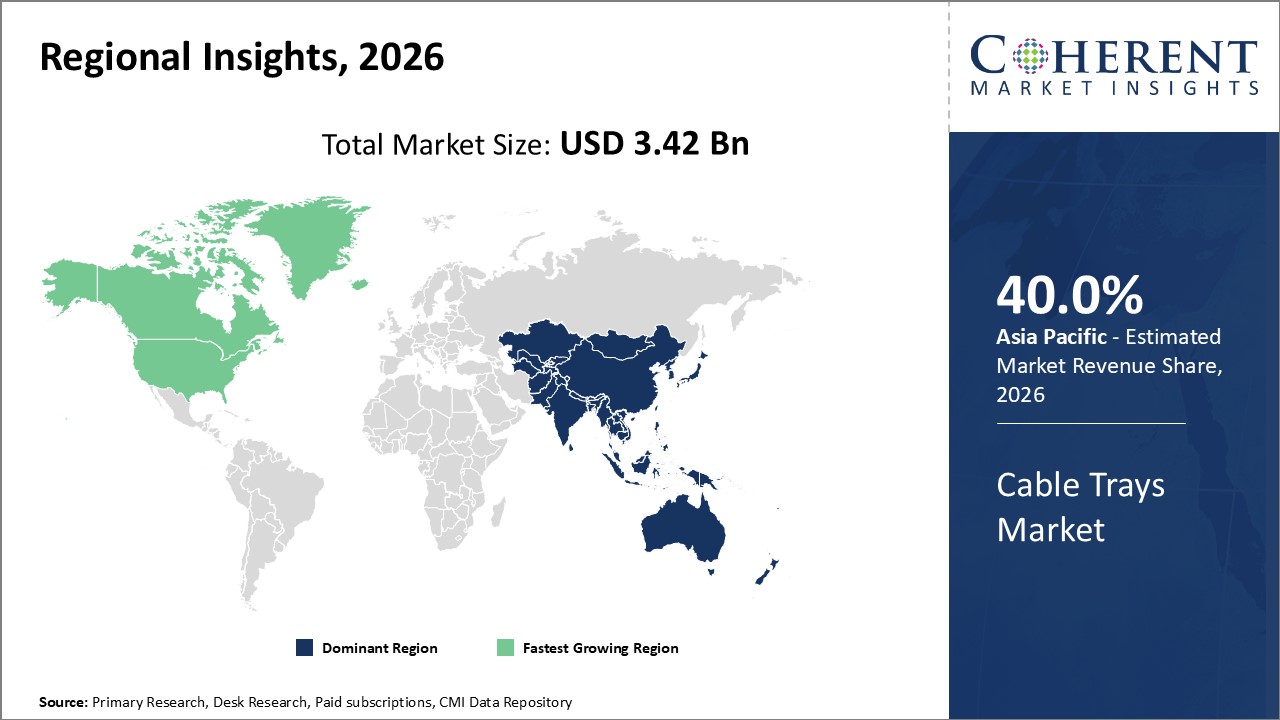
Asia Pacific is the largest regional market, accounting for over 40% of market share, driven by industrialization and large-scale infrastructure projects, particularly in China and India.
North America exhibits the fastest market growth with a CAGR surpassing 7%, attributed to the adoption of advanced cable management systems in data centers and commercial constructions.
Europe’s market growth is steady, supported by strict regulatory frameworks mandating the use of certified cable trays, thus favoring premium product segments.
Cable Trays Market Segmentation Analysis
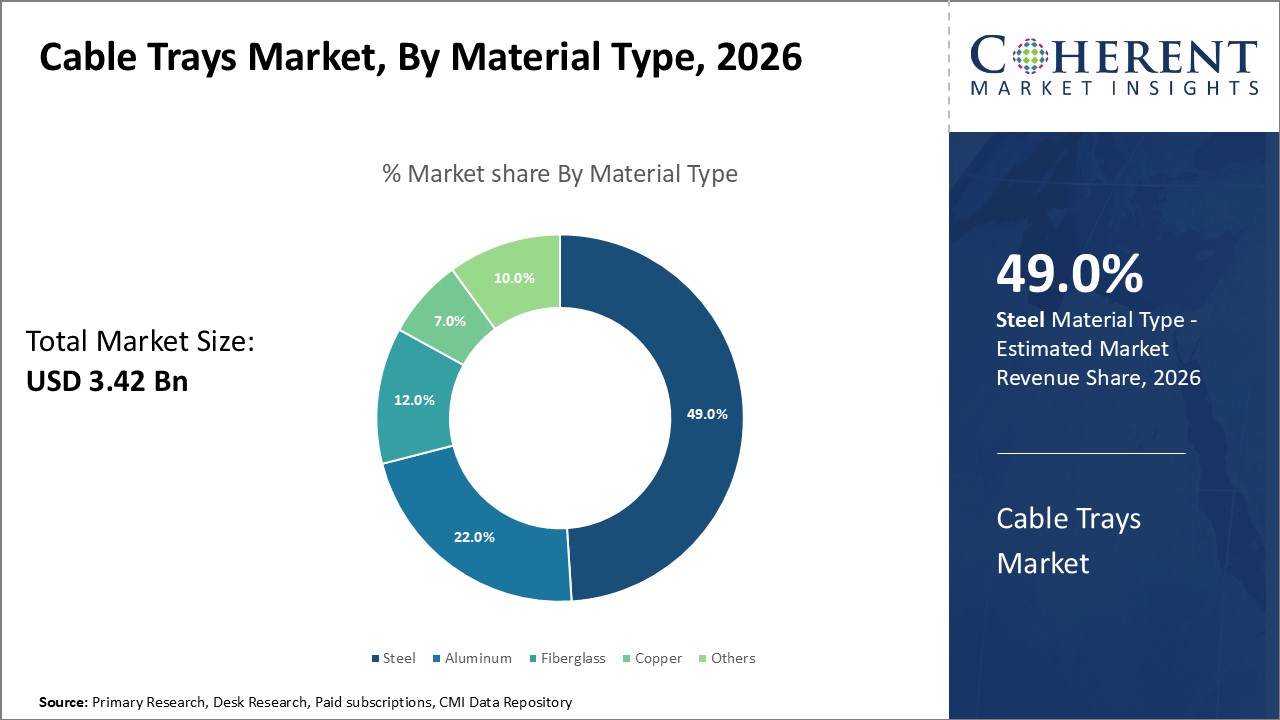
Cable Trays Market Insights, By Material Type
Steel cable trays hold approximately 49% of the market due to their superior strength, load-bearing capacity, and cost-effectiveness. Steel’s high durability under demanding environmental and mechanical stress contributes to its widespread use across commercial and industrial applications. Aluminum emerges as the fastest-growing subsegment, favored for its corrosion resistance, lightweight nature, and ease of installation, which make it ideal for coastal and humidity-prone regions. Fiberglass is gaining traction in highly corrosive chemical plants due to its non-conductive properties, while Copper is used selectively where specialized electrical conductivity is required.
Cable Trays Market Insights, By Type
Ladder Type dominates the market share, constituting nearly 35% because of its versatile design that can accommodate heavy cable loads and ensure effective ventilation, making it suitable for large-scale industrial and commercial installations. Perforated Type trays are the fastest growing subsegment, aligning with market trends favoring enhanced cable cooling and airflow, especially in electrical rooms and data centers. Solid Bottom trays provide superior protection against dust and foreign objects and are commonly used in residential and IT applications. Channel Type trays, though niche, are preferred for lightweight wiring systems requiring easy mounting.
Cable Trays Market Insights, By Application
Commercial Buildings account for the largest share due to surging construction activities and the need for managed electrical frameworks in offices, malls, and hospitals. Industrial applications are the fastest-growing segment, especially in manufacturing and energy sectors, where complex cable routings necessitate specialized tray systems with enhanced durability. The infrastructure subsegment supports extensive utility projects such as airports and transit systems requiring bulk cable management. Residential applications, though smaller in market share, are expanding as smart home technologies integrate more complex electrical wiring.
Cable Trays Market Trends
The market is witnessing accelerated innovation, primarily driven by the demand for lightweight and corrosion-resistant materials like aluminum and fiberglass.
For example, in 2025, the adoption rate of aluminum cable trays increased by 10% across industrialized nations due to their superior longevity and maintenance benefits.
Additionally, the rising need for IoT-based monitoring solutions has unlocked new service segments, improving operational safety and reducing downtime in sectors such as data centers, where 2025 saw a 13% increase in smart cable tray installations.
Market dynamics are further shaped by enhanced regulatory frameworks in Europe that insist on standardized cabling pathways, pushing companies towards high-compliance product development.
Cable Trays Market Insights, By Geography
Asia Pacific Cable Trays Market Analysis and Trends
In the Asia Pacific region, the dominance in the Cable Trays Market is fueled by rapid urbanization, ongoing industrialization, and substantial government infrastructure investments, particularly in China and India. The region holds over 40% of the industry share, supported by prolific construction activities and renewable energy projects. Robust manufacturing capabilities and favorable trade policies have positioned the Asia Pacific as the central hub for cable tray production and consumption.
North America Cable Trays Market Analysis and Trends
Meanwhile, North America exhibits the fastest growth with a CAGR above 7%, reflecting rapid modernization in commercial and data center infrastructure, coupled with stringent regulatory requirements emphasizing electrical safety standards. The U.S. leads this trend with notable market revenue increases due to continuous investments in smart cities and industrial automation.
Cable Trays Market Outlook for Key Countries
USA Cable Trays Market Analysis and Trends
The USA’s Cable Trays Market benefits from strong technology-driven demand in data centers, healthcare, and manufacturing sectors. 2025 data show a 15% increase in cable tray installations in new commercial projects, propelled by federal infrastructure funding and initiatives targeting energy-efficient electrical systems. Major players like Schneider Electric and ABB Ltd. have capitalized on this growth through product innovation and partnerships with construction firms. The market outlook is robust, with consistent demand for modular and IoT-enabled systems predicted to fuel business expansion through 2033.
India Cable Trays Market Analysis and Trends
India’s market is slated for rapid expansion, underpinned by ongoing urbanization and government-led smart city developments. Infrastructure projects in metro cities and industrial corridors have resulted in escalated cable tray demand, with commercial and industrial sectors representing the largest buyers. Local manufacturers are investing in advanced production technologies to cater to quality requirements and cost-sensitive segments. In 2025, India witnessed a remarkable 12% year-on-year increase in cable tray consumption, making it one of the fastest-growing markets globally.
Analyst Opinion
Production Capacity Enhancements: The overall industry shows a notable increase in production capacity across emerging economies, particularly in East Asia and Southeast Asia, where the manufacturing output of cable trays recorded an 9% year-over-year growth in 2025. This expansion is a critical factor bolstering market share, responding directly to surging demand in construction and infrastructure projects globally.
Demand Diversification Across End-Use Sectors: Demand-side indicators highlight the diversification of cable tray applications beyond traditional commercial sectors into industrial automation and data centers. Notably, data centers in North America alone increased cable tray installations by 15% during 2025, reflecting a shift towards higher capacity and safer cable infrastructure.
Pricing Stability Despite Raw Material Volatility: Despite fluctuations in steel and aluminum prices in early 2026, pricing strategies remained stable due to improved supply chain management and operational efficiencies. This stability is crucial in maintaining steady market revenue growth, as manufacturers strategically mitigated cost pressures without passing them entirely to end consumers.
Import-Export Dynamics Influencing Regional Growth: Import statistics show a 12% rise in cable tray imports in Europe in 2025, pointing toward regional supply shortages and increased demand for advanced products featuring corrosion resistance and modular designs. This has led to enhanced regional market penetration for companies focusing on custom solutions tailored to stringent European regulations.
- Current Industry Events of 2026
- Market Size Estimation
- Regional Breakdown
- Competitive Landscape
- Customer Intelligence
- Segmental Analysis
- Pricing Analysis
- Key Market Drivers, Challenges & Future Trends
- Customized Insights Section
Market Scope
| Report Coverage | Details | ||
|---|---|---|---|
| Base Year: | 2025 | Market Size in 2026: | USD 3.42 billion |
| Historical Data for: | 2020 To 2024 | Forecast Period: | 2026 To 2033 |
| Forecast Period 2026 to 2033 CAGR: | 6.9% | 2033 Value Projection: | USD 5.1 billion |
| Geographies covered: |
| ||
| Segments covered: |
| ||
| Companies covered: | Zucchi Group, HB Fuller, Hanil-EH, Anamet Europe Ltd., CBI Electric, Unistrut, Dura-Green, OBO Bettermann, EAE Electric, C2G Industries | ||
| Growth Drivers: |
| ||
Cable Trays Market Growth Factors
The expansion of industrial automation and IT infrastructure upgrades remains the primary driver of the market growth, as evidenced by a 14% uptick in demand within the technology sector in 2025. Furthermore, government initiatives promoting smart city projects in Asia Pacific have led to infrastructure investments worth billions, directly enhancing cable tray market revenue due to extensive wiring requirements. Urbanization in emerging economies also supports rising construction activities, with commercial buildings contributing to over 41% of the market share, driven by increasing demands for efficient cable management solutions. Lastly, rising adoption of renewable energy systems necessitates sophisticated cable management, with solar and wind projects accounting for a significant volume increase in cable tray installations reported in 2025.
Cable Trays Market Development
In 2025, Panduit launched its Wire Basket Cable Tray Routing System, designed to offer flexible, lightweight, and easily configurable cable management for commercial and industrial installations. The system enhanced airflow, simplified on-site customization, and improved support for high-density cabling environments, strengthening Panduit’s position in advanced infrastructure solutions.
In 2025, Remee Wire & Cable introduced its VoltGuard600™ power cable line for building wire applications, engineered to deliver enhanced durability, higher heat resistance, and improved electrical performance. The VoltGuard600™ series targeted modern construction and industrial projects requiring robust, safety-focused wiring solutions, reinforcing Remee’s presence in the premium power cable market.
Key Players
Leading Companies of the Market
Zucchi Group
HB Fuller
Hanil-EH
Anamet Europe Ltd.
CBI Electric
Unistrut
Dura-Green
OBO Bettermann
EAE Electric
C2G Industries
Among these market players, companies like Schneider Electric and ABB Ltd. have adopted aggressive acquisition and product innovation strategies, expanding their product portfolios to cover advanced, modular cable tray systems that meet the growing demand for scalable infrastructure. For instance, Schneider Electric’s recent acquisition of specialized fabrication units has enhanced its capacity to serve complex projects in North America and Europe, thereby increasing its market share by approximately 5% in 2025. Similarly, Essar Steel focused on integrating environmentally sustainable production methods, resulting in a 11% reduction in operational costs and attracting clients with green compliance preferences.
Cable Trays Market Future Outlook
The cable trays market is expected to see steady long-term growth as global construction activity expands and data centers continue multiplying. Digital transformation, electrification initiatives, and the growth of renewable energy installations will significantly increase wiring requirements, benefiting cable tray adoption. Smart buildings and industrial automation will require sophisticated cable routing systems, supporting upgraded and custom-designed trays. Manufacturers will likely invest in new materials—such as fiber-reinforced composites and fire-resistant polymers—to meet safety standards and reduce installation weight. Asia-Pacific and the Middle East will lead growth due to expanding industrialization, infrastructure development, and economic diversification programs.
Cable Trays Market Historical Analysis
Historically, the market grew in parallel with industrial expansion, construction development, and rising investments in power distribution infrastructure. Cable trays became a preferred cable management solution due to their durability, ease of installation, and suitability for large-scale wiring. Over time, industries such as oil & gas, manufacturing, data centers, and commercial buildings increasingly adopted ladder and perforated trays to handle heavy electrical loads and improve maintenance efficiency. The rise of IT infrastructure and telecommunications networks further supported demand. Material innovations, especially in aluminum and corrosion-resistant coatings, strengthened adoption across harsh environments. Regulatory emphasis on electrical safety also played a significant role in boosting the use of structured cable management systems.
Sources
Primary Research Interviews:
Electrical Engineers
Installation Contractors
Cable Tray Manufacturers
Data Center Designers
Maintenance Managers
Databases:
UN Comtrade Cable Systems
BSRIA Electrical Data
Magazines:
Electrical Contractor Magazine
EC&M (Electrical Construction & Maintenance)
Data Center Dynamics
Cabling Installation & Maintenance
Construction Today
Journals:
IEEE Transactions on Industry Applications
Building Services Engineering Research & Technology
Journal of Infrastructure Systems
Materials & Design
Construction and Building Materials
Newspapers:
The Wall Street Journal (Construction)
The Economic Times (Infrastructure)
Financial Times (Industry)
The Guardian (Business)
Reuters Construction News
Associations:
National Electrical Manufacturers Association (NEMA)
International Electrotechnical Commission (IEC)
Institute of Electrical and Electronics Engineers (IEEE)
Building Services Research and Information Association (BSRIA)
NFPA
Get access to 250+ pages report
Every segment, forecast, competitor profile and data table behind the analysis above — available for instant download.
- ESOMAR Member
- ISO 9001:2015 Certified
- D-U-N-S Registered
- GDPR & CCPA Compliant
Missing comfort of reading report in your local language? Find your preferred language:
Transform your Strategy with Exclusive Trending Reports
Frequently Asked Questions
Leading companies include Legrand, Siemens AG, Schneider Electric, ABB Ltd., and Essar Steel, who collectively hold a significant share by leveraging diversified portfolios and strategic expansions.
The market is anticipated to expand from USD 3.42 billion in 2026 to USD 5.1 billion by 2033, growing at a 6.9% CAGR throughout this period.
Commercial buildings hold the largest application share, but industrial automation and IT infrastructure sectors present rapid growth opportunities owing to increased electronic installations.
Emerging trends focus on smart and modular cable tray systems, increasing adoption of corrosion-resistant materials, and integration of IoT technologies for cable management efficiency and safety.
Competition is intense among established market players, with challenges including raw material price fluctuations and evolving regulatory compliance shaping market growth strategies.
Companies are focusing on product innovation, strategic acquisitions, and geographic expansion, alongside sustainability initiatives and customized service offerings to strengthen market presence.