

Industrial Packaging Market Size and Forecast – 2026 to 2033
Industrial Packaging Market is estimated to be valued at USD 80.5 Bn in 2026 and is expected to reach USD 117.1 Bn in 2033, exhibiting a compound annual growth rate (CAGR) of 5.5% from 2026 to 2033. The Industrial Packaging Market is witnessing steady expansion driven by rising global manufacturing output, cross-border trade, and demand for safe bulk material handling. According to Eurostat trade statistics (2026), EU exports of manufactured goods continue to exceed €2.5 trillion annually, strengthening demand for drums, IBCs, and protective packaging systems. The U.S. Census Bureau reports manufacturing shipments surpassing USD 6 trillion, supporting high usage of transport packaging across chemicals, food, and industrial goods. In 2026, industry adoption of recyclable corrugated and reusable bulk containers is increasing, with companies like Greif and Mauser expanding circular reconditioning programs, reflecting growing regulatory pressure for sustainable packaging systems.
Key Takeaways
- Drums hold the largest market share in 2026 owing to its rising demand from chemicals and petrochemicals industry. The drums segment dominates the industrial packaging market due to strong demand for safe bulk transport of chemicals, with global chemical production reaching ~2.3 Bn tonnes in 2026 (UNEP estimates). U.S. manufacturing shipments exceed USD 6.2 trillion in 2026 (U.S. Census Bureau), driving large-scale use of steel and plastic drums. EU industrial trade surpasses €2.5 trillion in 2026 (Eurostat), reinforcing demand for compliant, reusable, and leak-proof drum packaging across global logistics chains.
Source: Eurostat; United Nations Environment Programme (UNEP); OECD; Smithers
- Plastics acquired the prominent share of 58.6% in 2026 as it is lightweight and cost-effective solution. The plastics segment dominates industrial packaging due to lightweight strength, corrosion resistance, and cost efficiency in bulk logistics. As of March 2026, global plastics production exceeds 410 million tonnes annually (OECD estimate). In 2026, U.S. EPA data shows plastics recycling at 8–9%, reinforcing reuse demand.
- Rigid packaging dominates the overall market share in 2026 owing to the demand for versatility in packaging applications. Rigid packaging dominates industrial packaging because drums, pails, crates, and IBCs offer higher stacking strength, puncture resistance, and safer containment for chemicals, lubricants, and food ingredients. In May 2026, U.S. Census reported April durable-goods orders up 7.9% to USD 346.0 Bn, supporting industrial shipments. Eurostat shows EU packaging waste at 79.7 million tonnes. In April 2026, Greif highlighted high-performance containers at Interpack 2026.
Source: Census.gov; ec.europe.eu; grief.com
- Food & Beverage dominates the overall market share in 2026 owing to its rising demand for bulk packaging in food processing. The Food & Beverage segment dominates industrial packaging due to high-volume consumption, strict hygiene standards, and global supply chain expansion. In 2026, FAO reports global food production exceeds 4.0 Bn tonnes annually, driving packaging demand. Eurostat shows EU food exports above €170 Bn in 2026, increasing need for safe transport packaging. FDA FSMA compliance continues enforcing protective packaging standards, while OECD highlights rising processed food trade across industrial and export-oriented markets globally.
- Asia Pacific holds the largest market share of 45.70% in 2026 owing to its rapid industrialization and manufacturing growth. Asia Pacific dominates the industrial packaging market due to strong manufacturing expansion, export-led industries, and rapid industrialization in China, India, and Southeast Asia. In 2026, China’s industrial output accounts for ~30%+ of global manufacturing value added (UNIDO estimates), while India’s manufacturing sector contributes ~17% to GDP (Government of India, 2026). ASEAN trade exceeds USD 3.8 trillion (ASEAN Secretariat), driving high demand for drums, corrugated, and rigid packaging across chemicals, food, and electronics supply chains.
Segmental Insights
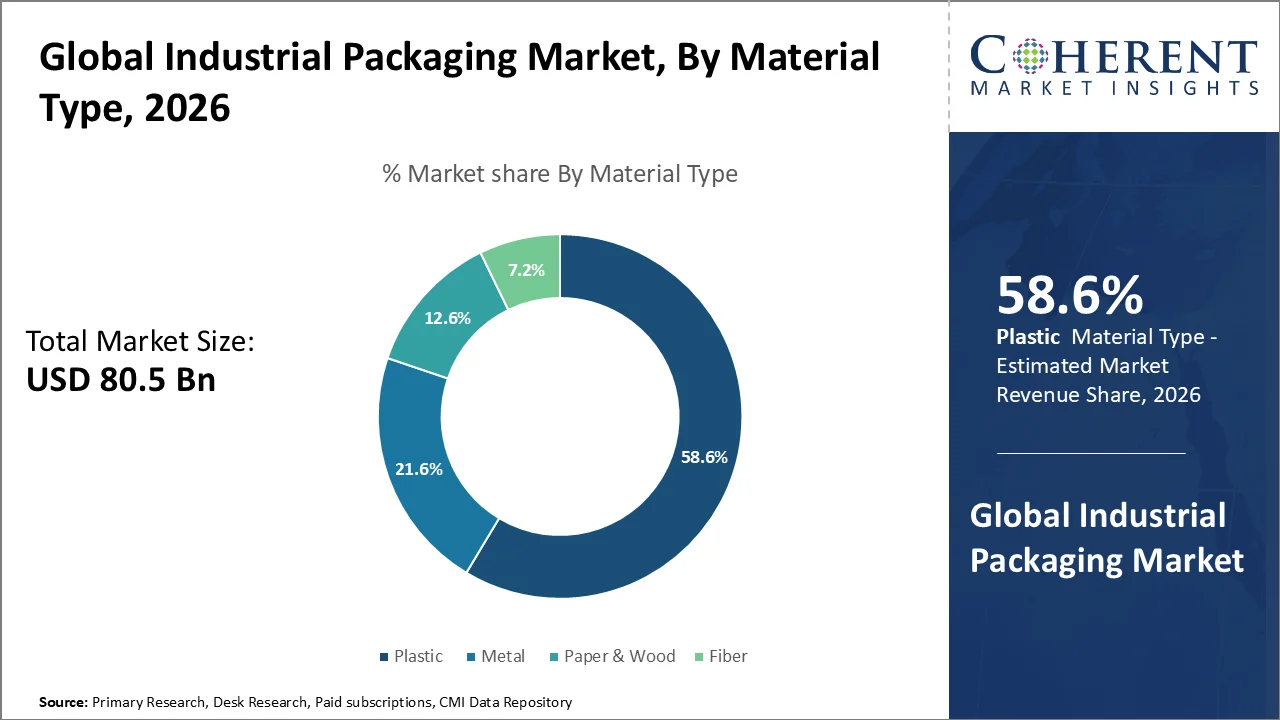
Plastics contribute the highest share of the market owing to its high chemical resistance and durability
Plastics acquired the prominent share of 58.6% in 2026. Plastics continue to drive growth in the industrial packaging market due to their lightweight nature, cost-efficiency, and chemical resistance. Industries such as chemicals, food and beverage, and pharmaceuticals prefer plastic containers, drums, and IBCs for their durability and ease of handling. Advancements in polymer technology have improved the strength and functionality of plastic packaging. Additionally, the push for sustainability has led to increased use of recyclable and reusable plastic solutions, making them a preferred choice across a wide range of industrial applications.
In March 2024, Repsol introduced new lubricant containers made with 60% mechanically recycled post-consumer plastic from its Repsol Reciclex range. These containers, available in five colors, will be used for all 1L, 4L, and 5L lubricant products, including engine and transmission oils for cars, motorcycles, and heavy vehicles. This change reportedly cuts the carbon footprint of the containers by 25% compared to the previous versions.
- Current Industry Events of 2026
- Market Size Estimation
- Regional Breakdown
- Competitive Landscape
- Customer Intelligence
- Segmental Analysis
- Pricing Analysis
- Key Market Drivers, Challenges & Future Trends
- Customized Insights Section
Drums contribute the highest share of the market owing to its shift toward reusable and sustainable packaging
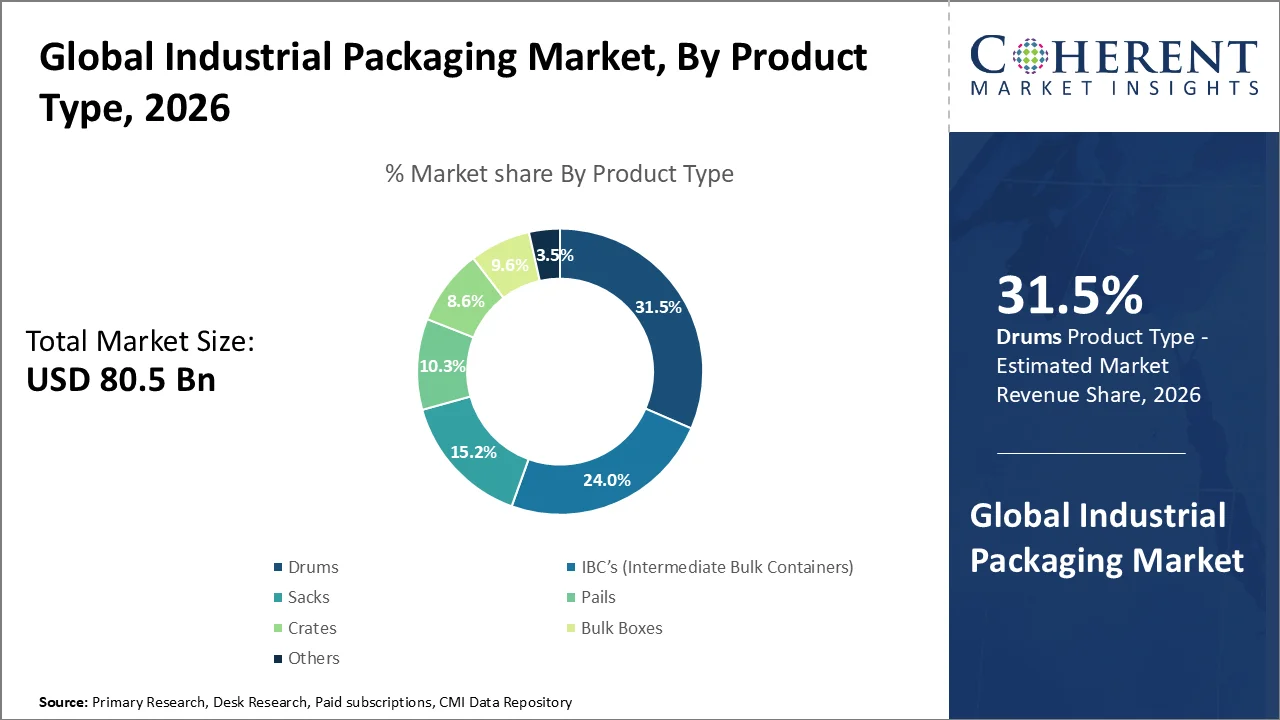
Drums hold a crucial position in the industrial packaging market as industries actively use them for their durability, chemical resistance, and ability to transport bulk liquids and solids. Sectors like chemicals, pharmaceuticals, oil and gas, and food processing depend on drums to ensure safe storage and shipment. Companies are increasingly adopting drums to meet the rising need for secure handling of hazardous materials and to support growing global trade. Many also embrace reconditioned and reusable drums to align with sustainability objectives.
Nexans has introduced the Mobiway MOB drum kit, a smart, compact cable transport and installation system for medium to large building projects. Unlike traditional bulky drums, it offers a safer, easier way to handle and unwind cables—potentially cutting installation time by 50%.
Rigid contribute the highest share of the market owing to its growing preference for flexible packaging in space optimization
The industrial packaging market benefits from the combined strengths of rigid and flexible packaging, which cater to diverse industrial needs. However, Rigid packaging acquires the largest share. Commonly used for heavy machinery, chemicals, and construction materials, rigid packaging offers structural integrity that flexible options cannot match. Materials such metal containers, and corrugated boxes ensure safety and prevent damage, especially in harsh handling environments. Its reusability and stackability also contribute to cost efficiency and sustainability.
In March 2025, LyondellBasell, a chemical company, introduced Pro-fax EP649U, a new polypropylene impact copolymer specifically developed for use in the rigid packaging sector.
Food & Beverages contribute the highest share of the market owing to its growth in export and cold chain logistics.
The food and beverage sector drives demand in the industrial packaging market through its need for bulk handling, hygiene, and safe transportation. Manufacturers rely on containers, and IBCs for storing and moving ingredients like oils, syrups, and grains. Increasing food exports and the rise of processed foods further fuel the demand for robust, compliant packaging. Additionally, stringent food safety regulations push companies to adopt high-quality, food-grade packaging, while growing sustainability goals encourage the use of reusable and recyclable industrial packaging options.
In January 2025, the Food and Beverage Carton Alliance (FBCA)—created through the merger of two well-established organizations—launched a unified platform aimed at promoting beverage cartons as vital, renewable, and circular packaging solutions.
Current Events and Their Impact
Current Events | Description and its impact |
Geopolitical and Regulatory Developments |
|
Economic Trends and Supply Chain Dynamics |
|
Role of Artificial Intelligence (AI) in Industrial Packaging Industry
AI plays a crucial role in the industrial packaging industry by driving innovation, efficiency, and sustainability. It enables the development of advanced packaging materials that offer better protection and environmental benefits through chemical modeling and predictive analysis. AI optimizes manufacturing processes, reducing waste and improving production speed. It enhances quality control by detecting defects in real time, ensuring higher product standards.
In July 2025, Nestlé R&D and IBM scientists launched a collaboration to accelerate the development of packaging solutions that meet rigorous performance, safety, and environmental standards. Their AI tool leverages advanced chemical modeling and generative technology to propose innovative material formulations that protect food and beverages from moisture, oxygen, and temperature changes—major factors in spoilage.
Regional Insights
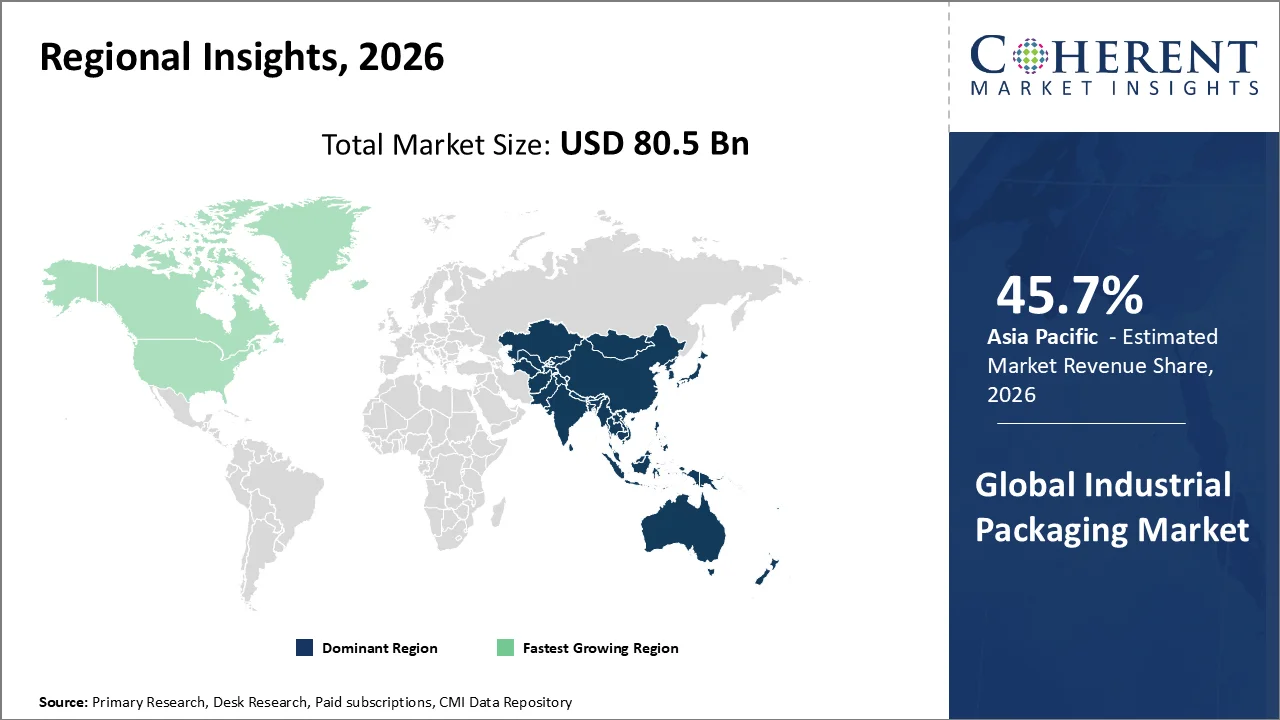
Asia Pacific Industrial Packaging Market Trends
Asia Pacific region acquires the largest share of 45.7%. Strong manufacturing growth and increasing export activities are rapidly expanding the Asia Pacific industrial packaging market. Leading countries like China, India, and Southeast Asian nations drive demand for diverse packaging solutions through their booming chemicals, pharmaceuticals, and food processing industries. Governments actively support manufacturing and logistics infrastructure, further boosting the industrial packaging market revenue. Growing awareness of sustainability prompts companies to adopt recyclable and reusable packaging materials. Additionally, technological advancements in packaging design and materials improve efficiency and product protection across multiple industries in the region.
In August 2026, Sunstream Industries unveiled its new paper poly mailer. This product incorporates Ranpak’s Geami honeycomb protective material, which securely wraps items without requiring adhesive tape or cutting. The launch reflects the partnership’s ongoing adaptation to market needs, providing a solution that combines recyclable materials with shipment protection.
North America Industrial Packaging Market Trends
North America’s industrial packaging market is evolving with increasing demand from chemicals, automotive, and food processing industries. Companies focus on adopting advanced packaging solutions that enhance product safety, durability, and compliance with stringent regulations. The region emphasizes sustainability, driving growth in recyclable and reusable packaging materials. Investments in automation and smart packaging technologies improve efficiency and traceability across supply chains. Strong government support and innovation from key manufacturers further stimulate the market, positioning North America as a leader in industrial packaging advancements.
DS Smith, a leading fiber-based packaging manufacturer, has introduced PackRight 2.0 — a hybrid collaboration platform offering interactive workshops to help FMCG, e-commerce, and other industries improve packaging innovation and sustainability using its Circular Design Metrics.
United States Industrial Packaging Market Trends
The United States industrial packaging market stands out due to its strong focus on innovation and automation. U.S. manufacturers prioritize smart packaging technologies that enhance supply chain visibility and reduce waste. Strict regulatory frameworks compel companies to adopt high-quality, compliant packaging solutions, especially in chemicals and pharmaceuticals. Sustainability remains a key driver, with many businesses investing in eco-friendly materials and circular packaging models. Additionally, the country’s robust logistics network and advanced manufacturing base support the widespread adoption of customized, durable industrial packaging solutions.
In March 2026, Green Lab, Southeast Asia’s top eco-packaging producer and a subsidiary of SGX-listed conglomerate Frasers & Neave Group, officially expanded into the U.S. market, introducing its sustainable packaging solutions to North America.
India Industrial Packaging Market Trends
India’s industrial packaging market is rapidly growing, fueled by expanding manufacturing in sectors like pharmaceuticals, chemicals, and food processing. The government’s “Make in India” initiative boosts local production and demand for efficient packaging solutions. Cost-effectiveness and adaptability drive preference for flexible and lightweight packaging materials. Increasing export activities and improving logistics infrastructure further stimulate growth. Additionally, rising awareness about sustainability encourages the adoption of recyclable and reusable packaging options, while ongoing innovation supports the development of packaging tailored to India’s diverse industrial needs.
In March 2026, Oji India Packaging Pvt Ltd, a global leader in paper products, has opened its fifth manufacturing facility in Sri City, Andhra Pradesh. Spanning 43,000 square meters, it is among the largest corrugated packaging plants in South Asia.
Market Report Scope
Industrial Packaging Market Report Coverage
| Report Coverage | Details | ||
|---|---|---|---|
| Base Year: | 2025 | Market Size in 2026: | USD 80.5 Bn |
| Historical Data for: | 2026 To 2033 | Forecast Period: | 2026 To 2033 |
| Forecast Period 2026 to 2033 CAGR: | 5.5% | 2033 Value Projection: | USD 117.1 Bn |
| Geographies covered: |
| ||
| Segments covered: |
| ||
| Companies covered: | Smurfit Kappa Group, Cascades Inc., Mauser Group B.V., Grief Inc., International Paper, Nefab Group, Schutz, Sonoco, AmeriGlobe, and B.A.G. Corp. | ||
| Growth Drivers: |
| ||
| Restraints & Challenges: |
| ||
Industrial Packaging Market Trend
- Rise of Smart and IoT-Enabled Packaging
Industries increasingly adopt smart packaging integrated with IoT sensors to monitor product condition, temperature, and location in real-time. This technology enhances supply chain transparency and reduces losses caused by damage or spoilage. Automated alerts and data analytics allow proactive decision-making, improving logistics efficiency and customer satisfaction, especially in pharmaceuticals, food, and chemicals sectors.
In January 2025, Giesecke+Devrient (G+D), in partnership with Sensos, launched the G+D Smart Label—an ultra-thin, credit card-sized tracking solution that turns any package into an IoT device. Designed for cost-effective and precise location tracking, it supports applications such as parcel shipping, fleet management, and monitoring high-value goods.
- Shift Toward Circular Economy and Sustainability
The market is moving beyond single-use packaging toward reusable, recyclable, and biodegradable materials. Companies are investing in circular models to minimize waste, reduce carbon footprints, and comply with stringent environmental regulations. This trend drives innovation in material science and packaging design, fostering partnerships across the supply chain to enable sustainable industrial packaging solutions.
In August 2025, Invopak introduced a new range of glass containers, reinforcing its commitment to delivering sustainable packaging solutions to the UK market.
Industrial Packaging Market News
- In August 2025, CMPC, a pulp and paper company based in Santiago, Chile, teamed up with the Massachusetts Institute of Technology (MIT) to launch “The Salmon Packaging Design Competition,” aiming to encourage sustainable packaging solutions for the salmon industry.
- In May 2025, VulCan Packaging launched as North America’s first commercial maker of aTULC aluminum cans. Using clean technology, VulCan is creating more eco-friendly beverage cans.
- In May 2025, AE Global unveiled its new verified plastic-negative and plastic-neutral certifications for product packaging, setting a new standard in sustainable packaging solutions. In collaboration with the world-renowned Plastic Action Platform, rePurpose Global, AE Global is empowering consumers to make environmentally responsible choices with confidence.
- In April 2026, BASF SE, the largest chemical producer will present its next-generation packaging solutions at Interpack 2026, focusing on sustainable, high-performance materials for flexible and rigid packaging applications. The company aims to highlight innovations that improve recyclability, reduce carbon footprint, and enhance product protection across chemical and consumer supply chains. The showcase reflects growing industry demand for circular economy-driven packaging systems and advanced polymer technologies aligned with global sustainability regulations and packaging waste reduction goals in 2026.
- In June 2026, Cosmo Films Ltd, a global leader in specialty films for packaging revealed that the company launched CSP DigiLux MW, a premium-grade film designed for high-end digital printing applications. The new solution enhances print quality, durability, and visual appeal for labels and packaging used in FMCG, personal care, and industrial products. The launch reflects growing demand for advanced packaging films compatible with digital printing technologies, supporting customization, short-run production, and brand differentiation in 2026 across rapidly evolving global packaging and labeling markets.
- In June 2026, IFCO Systems, a company that manufactures reusable packaging solutions has launched TRILLION, a Tracking-as-a-Service solution designed to enhance global asset visibility across reusable packaging pools. The system enables real-time tracking, improved supply chain transparency, and optimized asset utilization for food retail and logistics operators. The innovation supports data-driven decision-making and reduces packaging loss, aligning with circular economy goals and increasing efficiency in global supply chains as demand for smart packaging and digital tracking solutions rises in 2026.
- In May 2026, Atlantic Packaging Products Ltd launched Earth Ventures, an innovation initiative aimed at accelerating advancements in packaging technology and supply chain solutions. The program focuses on sustainable materials, circular economy models, and digital transformation in packaging operations. It seeks to support brands in reducing environmental impact while improving efficiency and resilience across logistics networks. The initiative reflects growing 2026 demand for eco-friendly and tech-enabled packaging systems in global supply chains.
- In January 2026, S.D. Pack Medica, a leading global supplier of sterile packaging solutions and high-performance films for the medical device, pharmaceutical, and diagnostics industries will showcase its next-generation sustainable packaging and streamlined service offerings at Pharmapack Europe 2026. The company plans to highlight eco-friendly materials, improved drug safety packaging formats, and efficiency-driven supply chain solutions for pharma manufacturers. The launch aligns with rising regulatory pressure and industry demand for reduced environmental impact, enhanced patient safety, and innovation in pharmaceutical primary and secondary packaging systems across global healthcare markets in 2026.
- In May 2026, Boxon Group launched new packaging solutions aimed at strengthening global supply chain efficiency and improving product protection during transportation and storage. The solutions focus on durable, sustainable, and cost-efficient packaging formats designed to reduce material waste and optimize logistics performance. The initiative supports increasing demand from manufacturing and e-commerce sectors for resilient packaging systems that enhance handling safety, reduce damage rates, and improve operational efficiency across complex distribution networks in 2026.
Analyst Opinion (Expert Opinion)
- The industrial packaging sector is at a pivotal juncture, driven by complex supply chain demands and heightened sustainability pressures. Recent data from the U.S. Environmental Protection Agency shows industrial packaging waste accounts for over 30% of total packaging waste, underscoring the urgent need for innovation in recyclable and reusable materials. Companies like Greif and Mauser exemplify this shift by pioneering advanced reusable container programs, reducing environmental impact while cutting operational costs.
- Furthermore, automation integration is transforming packaging lines—Coca-Cola’s adoption of automated drum filling systems improved throughput by 25%, highlighting efficiency gains possible with tailored industrial packaging solutions. The rise of Industry 4.0 reinforces this trend, with smart packaging offering real-time tracking and condition monitoring that significantly reduces product loss, especially in sensitive sectors like chemicals and pharmaceuticals.
- However, supply chain disruptions in recent years exposed vulnerabilities in packaging standardization and availability, pushing firms to diversify their packaging sources and innovate modular, flexible designs. For example, BASF’s move toward modular IBCs optimized transport efficiency and minimized damage, setting a precedent for future packaging standards.
- In conclusion, companies investing in sustainability-driven innovation, automation compatibility, and modularity will not only meet evolving regulations but also gain critical competitive advantages. The industrial packaging market’s future hinges on its ability to balance environmental responsibilities with operational excellence.
Speak to the analyst
Want personalized insights?
Take the findings above to one of our principal consultants, or have the report rebuilt around the segments, geographies and competitors you actually track.
Market Segmentation
- By Material Type (Revenue, USD Bn, 2021 - 2033)
- Metal
- Plastic
- Paper & Wood
- Fiber
- By Product Type (Revenue, USD Bn, 2021 - 2033)
- Drums
- IBC’s
- Sacks
- Pails
- Crates
- Bulk Boxes
- Others
- By Category (Revenue, USD Bn, 2021 - 2033)
- Rigid Packaging
- Flexible Packaging
- By Application (Revenue, USD Bn, 2021 - 2033)
- Chemicals & Pharmaceuticals
- Food & Beverage
- Building & Construction
- Automotive
- Plastics & Rubber
- Agriculture and Horticulture
- Oil & Lubricants
- Electronics
- Engineering
- Metal Products
- Tobacco
- Others
- By Region (Revenue, USD Bn, 2021 - 2033)
- North America
- U.S.
- Canada
- Latin America
- Brazil
- Argentina
- Mexico
- Rest of Latin America
- Europe
- Germany
- U.K.
- Spain
- France
- Italy
- Russia
- Rest of Europe
- Asia Pacific
- China
- India
- Japan
- Australia
- South Korea
- ASEAN
- Rest of Asia Pacific
- Middle East
- GCC Countries
- Israel
- Rest of Middle East
- Africa
- South Africa
- North Africa
- Central Africa
- North America
Sources
Primary Research Interviews
- Industry experts from packaging manufacturers
- Supply chain managers from chemicals and food processing companies
- Sustainability officers in manufacturing firms
Databases
- U.S. Environmental Protection Agency (EPA) packaging waste data
- National Institute of Standards and Technology (NIST) materials database
- Trade and customs databases for packaging import/export statistics
Magazines
- Packaging World
- Industrial Packaging Today
- Plastics News
Journals
- Journal of Packaging Technology and Research
- Packaging Technology and Science
- Materials Performance Journal
Newspapers
- The Wall Street Journal (Manufacturing and Supply Chain sections)
- Financial Times (Industry and Sustainability coverage)
- The Economic Times (India-focused industrial packaging news)
Associations
- International Safe Transit Association (ISTA)
- Institute of Packaging Professionals (IoPP)
- The Packaging Federation (UK)
Public Domain Sources
- U.S. Department of Energy reports on packaging sustainability
- World Bank trade and manufacturing reports
- United Nations Environment Programme (UNEP) publications on sustainable packaging
Proprietary Elements
- CMI Data Analytics Tool
- Proprietary CMI Existing Repository of information for last 10 years
Get access to 250+ pages report
Every segment, forecast, competitor profile and data table behind the analysis above — available for instant download.
- ESOMAR Member
- ISO 9001:2015 Certified
- D-U-N-S Registered
- GDPR & CCPA Compliant
Missing comfort of reading report in your local language? Find your preferred language:
Transform your Strategy with Exclusive Trending Reports
Frequently Asked Questions
The Industrial Packaging Market is expected to reach USD 80.5 Bn in 2033.
Major players operating in the global Industrial Packaging Market include Smurfit Kappa Group, Cascades Inc., Mauser Group B.V., Grief Inc., International Paper, Nefab Group, Schutz, Sonoco, AmeriGlobe, and B.A.G. Corp.
Stringent Regulations on usage of certain packaging materials are the major factors hampering the growth of the industrial packaging market.
The Industrial Packaging Market is anticipated to grow at a CAGR of 5.5% between 2026 and 2033.
Demand is driven by rising global manufacturing output, cross-border trade, and growth in chemicals, food, and e-commerce logistics. Increasing need for safe bulk handling and compliance with transport regulations such as ADR and IMDG is boosting adoption of drums, IBCs, and rigid containers. Sustainability mandates and circular packaging initiatives are also accelerating the shift toward reusable and recyclable industrial packaging solutions worldwide.
Plastics, metals, and paper-based materials dominate industrial packaging. Plastics such as HDPE and PP are widely used due to durability and chemical resistance, while steel and aluminum are preferred for hazardous and bulk liquid transport. Corrugated fiberboard is widely used for secondary industrial packaging. Growing focus on recyclability and lightweight packaging is increasing adoption of hybrid and sustainable material solutions globally.
The chemical industry is the largest end user due to high demand for drums, IBCs, and bulk containers for hazardous materials. Food and beverage, pharmaceuticals, automotive, and construction industries also contribute significantly. Growth in global food trade, pharmaceutical distribution, and industrial exports is increasing demand for safe, standardized, and protective packaging systems across global supply chains.