Intraoperative Imaging Market Analysis & Forecast: 2026-2033

The Intraoperative Imaging Market is estimated to be valued at USD 4.78 Bn in 2026 and is expected to reach USD 6.89 Bn by 2033, exhibiting a compound annual growth rate (CAGR) of 7.2% from 2026 to 2033.
Rising demand for real-time visualization in complex surgeries is driving the intraoperative imaging market across neurosurgery, orthopedics, oncology, and cardiovascular care. Advanced imaging technologies, the growth of minimally invasive procedures, hybrid operating rooms, and increased hospital investments are boosting adoption while improving precision, efficiency, and patient safety.
|
Current Events |
Description and its impact |
|
Geopolitical Developments |
|
|
Economic Trends |
|
|
Regulatory and Reimbursement Landscape |
|
Uncover macros and micros vetted on 75+ parameters: Get instant access to report
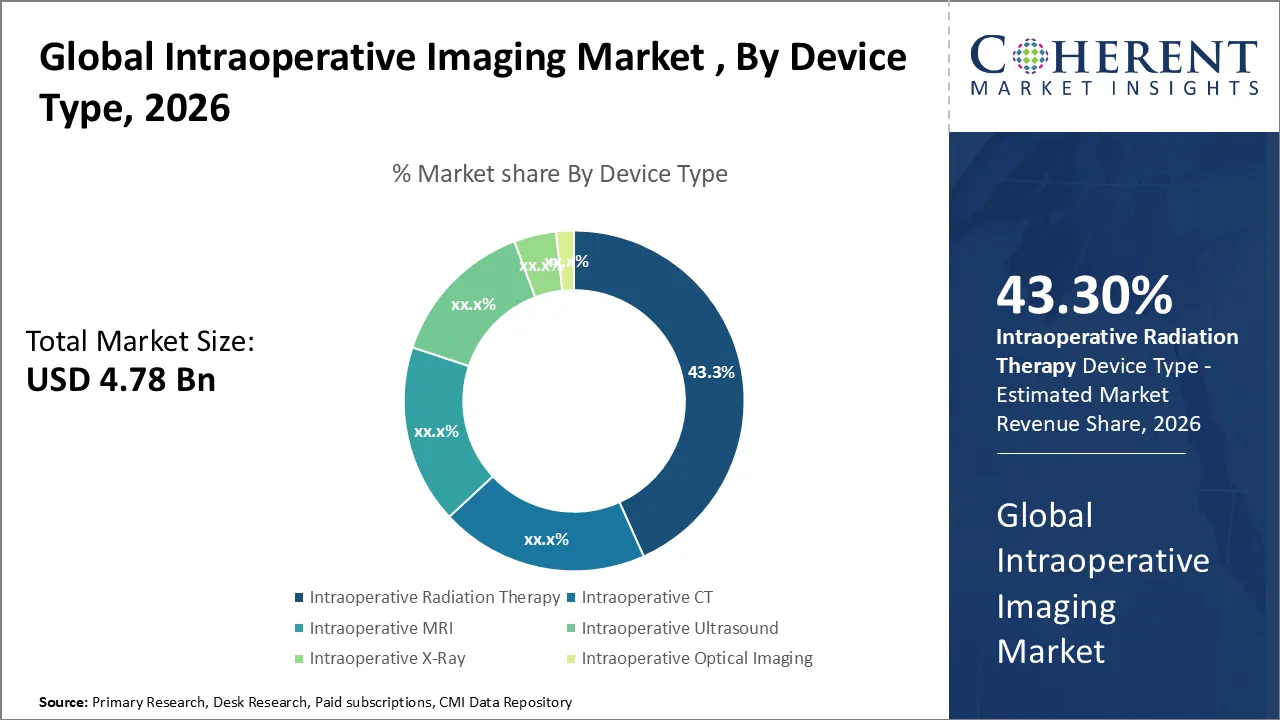
Intraoperative Radiation Therapy hold the largest market share of 43.30% in 2026. The need for precise, localized cancer treatment during surgery drives the intraoperative radiation therapy segment of the intraoperative imaging market. Clinicians use imaging guidance with immediate radiation delivery to directly target residual tumor tissue while protecting surrounding healthy structures. This method shortens overall treatment timelines, reduces the need for postoperative radiation sessions, and improves clinical workflow efficiency. Increasing focus on personalized oncology care, enhanced surgical outcomes, and closer integration of imaging with therapeutic systems continues to support adoption in advanced surgical environments. For instance, Zeiss Medical Technology has launched the INTRABEAM 600 in India, delivering intraoperative radiation therapy (IORT) as a minimally disruptive treatment for patients with early-stage breast
Neurosurgery expected to hold largest market share of 41.1% in 2026. The critical need for real-time, high-precision visualization during brain and spinal procedures drives the neurosurgery segment of the intraoperative imaging market. Surgeons rely on intraoperative imaging to accurately locate lesions, manage brain shift, and safeguard vital neural structures throughout operations. Increasing surgical volumes for neurological disorders, a growing preference for minimally invasive neurosurgical techniques, and wider use of advanced navigation systems boost adoption. Investments in hybrid operating rooms and efforts to minimize repeat surgeries further reinforce demand. For instance, in April 2025, Yashoda Hospitals, Secunderabad, opened India’s most advanced Center of Excellence for Robotic Neurosurgery and Neuro Endoscopy, coinciding with the 2-day “Skull Base Endoscopy” International Summit & Live Workshop 2025, attended by Telangana Health Secretary Dr. Christina Z. Chongthu.
Intraoperative Ultrasonography acquired the prominent market share of 34.4% in 2026. Demand for flexible, real-time imaging that integrates smoothly into surgical workflows drives the intraoperative ultrasonography segment of the intraoperative imaging market. Surgeons rely on intraoperative ultrasound to visualize soft tissues, evaluate blood flow, and guide instruments without exposing patients to ionizing radiation. Its portability, cost efficiency, and suitability for minimally invasive procedures encourage broader adoption. Expanding use in neurosurgery, oncology, and abdominal surgeries, along with continuous improvements in image quality and system design, further fuel demand. For instance, in June 2025, GE HealthCare introduced the bkActiv S series, its next-generation intraoperative ultrasound, expanding the bkPortfolio to provide imaging guidance for urology, colorectal, and pelvic floor procedures.
Hospitals & Clinics captures the largest market share of 44.4% in 2026. Hospitals and clinics drive the intraoperative imaging market as they actively adopt technologies that support complex surgical care and strengthen clinical decision-making. High procedure volumes in neurology, orthopedics, oncology, and trauma increase reliance on real-time imaging during surgery. By using intraoperative imaging, facilities improve surgical accuracy, limit complications, and streamline operating room workflows. Strong investment capabilities, expansion of advanced surgical infrastructure, and a continued focus on better patient outcomes and safety further promote adoption across hospitals and specialty clinics. For instance, in January 2026, Perimeter Medical Imaging AI, Inc. partnered with Intermountain Health to deploy its S-Series OCT advanced imaging technology for tissue visualization in the operating rooms at LDS Hospital in Salt Lake City and American Fork Hospital in Utah.
To learn more about this report, Download Free Sample
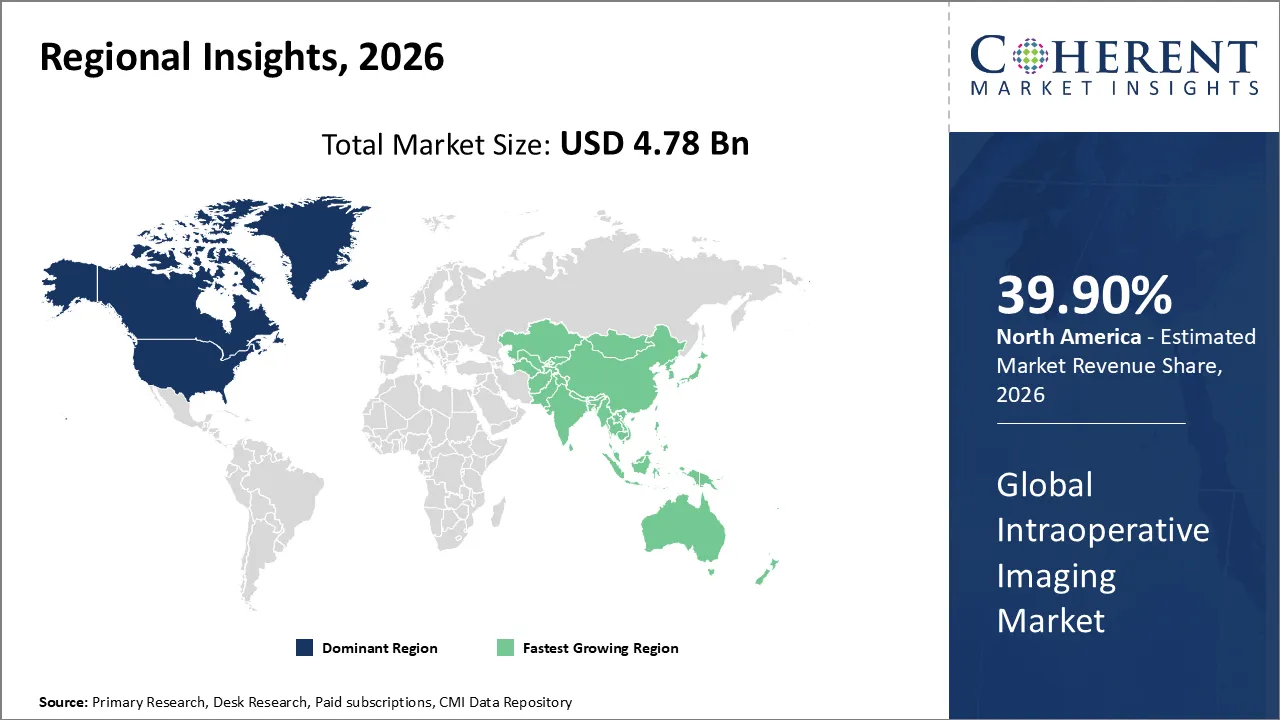
North America dominates the overall market with an estimated share of 39.90% in 2026. In North America, hospitals and surgical centers actively adopt advanced intraoperative imaging systems, supported by robust healthcare infrastructure and high surgical volumes. Providers increasingly integrate AI-enhanced imaging, hybrid operating rooms, and real-time navigation tools, expanding use across neurosurgery, orthopedics, and cardiovascular procedures. The United States drives regional demand through ongoing investments in imaging modernization, favorable reimbursement frameworks, and strong collaboration between medical device manufacturers and clinical institutions. For instance, KUBTEC launched the MOZART iQ 3D Margin Management System, using amorphous selenium and 3D intraoperative tomosynthesis X-ray technology to give breast surgeons a clear view of surgical margins in the OR.
In the Asia Pacific, hospitals and surgical centers actively adopt intraoperative imaging as healthcare systems expand surgical capacity and modernize operating rooms with real-time visualization tools. Providers in China, India, Japan, and South Korea increasingly use mobile C-arms, intraoperative CT, and other imaging systems to guide complex procedures and minimally invasive techniques. Ongoing investments in healthcare infrastructure, growing surgical volumes, and a focus on enhancing clinical precision and patient safety continue to drive wider adoption of intraoperative imaging throughout the region. For instance, in June 2025, Kauvery Hospital has introduced Chennai’s first O-Arm Surgical System with navigation, offering AI-powered 2D and 3D imaging for real-time guidance in complex brain, spine, and orthopedic surgeries.
In the United States, hospitals and surgical centers are actively adopting advanced intraoperative imaging technologies to enhance surgical precision and improve clinical outcomes. Providers increasingly use intraoperative CT, MRI, ultrasound, and mobile C‑arms to achieve real-time visualization during complex procedures such as neurosurgery, orthopedics, and cardiovascular operations. Rising demand for minimally invasive techniques, a growing aging population, and ongoing investments in hybrid operating rooms and AI-enabled imaging solutions continue to drive market expansion. For instance, in August 2025, Samsung India, with its subsidiary NeuroLogica, has launched a new mobile CT scanner portfolio to enhance patient-centric imaging and strengthen hospital infrastructure across urban and regional centers.
In India, hospitals and surgical centers are actively modernizing operations by adopting advanced intraoperative imaging systems such as mobile C‑arms, intraoperative CT, and ultrasound to enhance procedural accuracy and patient safety. Healthcare facilities are expanding infrastructure, particularly in urban and tier‑2 cities, supported by government initiatives to strengthen surgical capabilities. Increasing awareness of image-guided surgeries, higher surgical volumes for complex cases, and rising investments in minimally invasive techniques continue to drive wider adoption of intraoperative imaging across the country.
The market is increasingly driven by the growing adoption of minimally invasive procedures that demand high-precision imaging. Surgeons rely on intraoperative imaging to navigate complex anatomy with minimal tissue disruption, enhancing surgical accuracy and patient recovery. As hospitals prioritize less invasive interventions across neurosurgery, orthopedics, oncology, and cardiovascular procedures, real-time imaging becomes essential for reducing complications, guiding instruments, and confirming outcomes during operations, reinforcing its critical role in modern surgical workflows.
Healthcare facilities are investing in hybrid operating rooms equipped with intraoperative imaging systems, combining surgical and diagnostic technologies in a single environment. This integration allows real-time visualization during complex procedures, improving decision-making and operational efficiency. Hospitals use hybrid ORs to perform advanced surgeries such as neurosurgical tumor resections, cardiovascular interventions, and orthopedic implantations, enabling simultaneous imaging, monitoring, and navigation, which enhances procedural accuracy, reduces revision surgeries, and increases overall patient safety.
Hybrid operating rooms integrating imaging, navigation, and surgical systems offer a substantial growth opportunity. Facilities can perform complex procedures with real-time visualization, improving precision and workflow efficiency. Providers can capitalize on the demand for multifunctional ORs in advanced hospitals and specialty centers, particularly for neurosurgical tumor resections, cardiovascular interventions, and orthopedic implant placements. As hospitals invest in modern surgical infrastructure, intraoperative imaging adoption rises, enabling better patient outcomes and reinforcing the role of advanced imaging technologies in high-end surgical care.
| Report Coverage | Details | ||
|---|---|---|---|
| Base Year: | 2025 | Market Size in 2026: | USD 4.78 Bn |
| Historical Data for: | 2020 To 2024 | Forecast Period: | 2026 To 2033 |
| Forecast Period 2026 to 2033 CAGR: | 7.2% | 2033 Value Projection: | USD 6.89 Bn |
| Geographies covered: |
|
||
| Segments covered: |
|
||
| Companies covered: |
Siemens Healthcare Private Limited, Medtronic, General Electric, IMRIS, SAMSUNG, Ziehm Imaging GmbH, Brainlab AG, Carl Zeiss Meditec AG, Koninklijke Philips N.V., Stryker, FUJIFILM Holdings Corporation, Shenzhen Anke High-tech Co., ESAOTE SPA, Allengers, Analogic Corporation, Shimadzu Corporation, and Activ Surgical |
||
| Growth Drivers: |
|
||
| Restraints & Challenges: |
|
||
Uncover macros and micros vetted on 75+ parameters: Get instant access to report
Share
Share
About Author
Komal Dighe is a Management Consultant with over 8 years of experience in market research and consulting. She excels in managing and delivering high-quality insights and solutions in Health-tech Consulting reports. Her expertise encompasses conducting both primary and secondary research, effectively addressing client requirements, and excelling in market estimation and forecast. Her comprehensive approach ensures that clients receive thorough and accurate analyses, enabling them to make informed decisions and capitalize on market opportunities.
Missing comfort of reading report in your local language? Find your preferred language :
Transform your Strategy with Exclusive Trending Reports :
Frequently Asked Questions
Joining thousands of companies around the world committed to making the Excellent Business Solutions.
View All Our Clients
 Schedule a meeting with report Author