

Light Diffusion Film Market Size and Share Analysis: (2026 - 2033)
The global light diffusion film market size is expected to reach approximately USD 880 Mn in 2026 and is projected to grow at a CAGR of 3.6% during the forecast period (2026-2033), surpassing USD 1,130 Mn by 2033.
Key Takeaways from the Light Diffusion Film Market Report
- Polycarbonate is expected to remain the most widely used material for light diffusion film production, accounting for a market share of over 42% in 2026, thanks to its high impact resistance and optical performance.
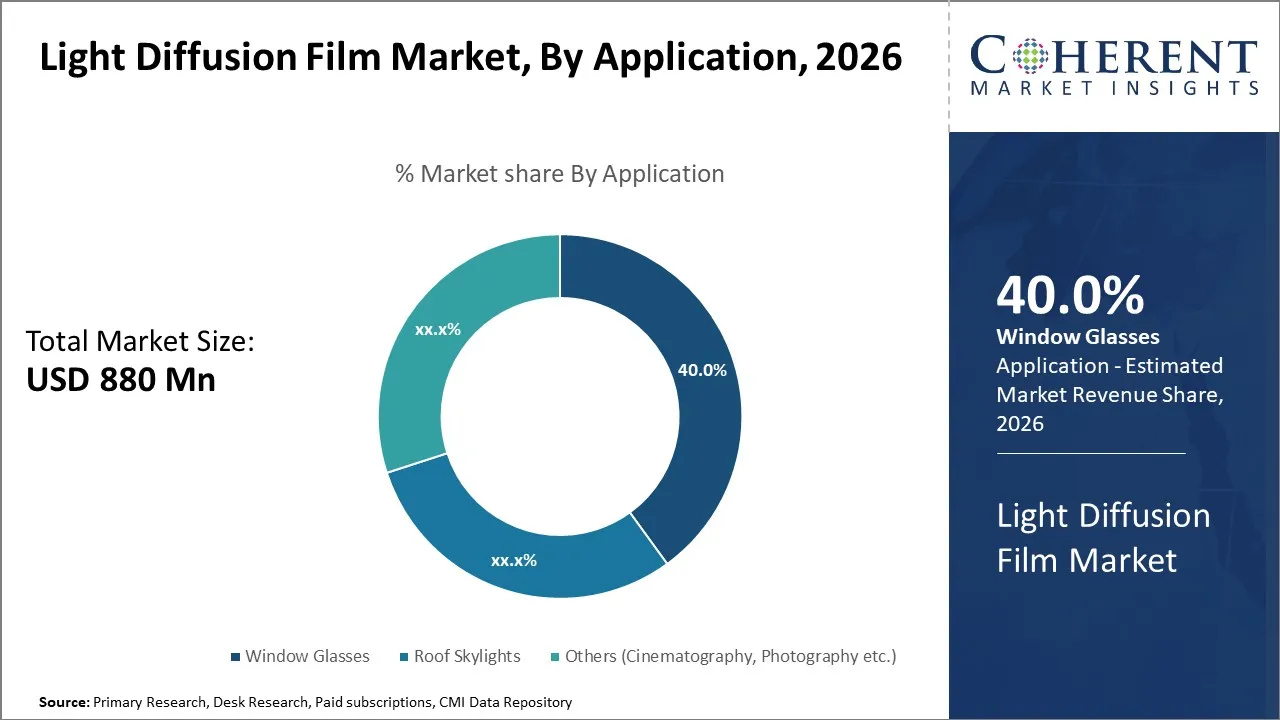
- Based on application, window glasses segment is slated to account for nearly 40% in 2026, owing to rising construction and architectural needs.
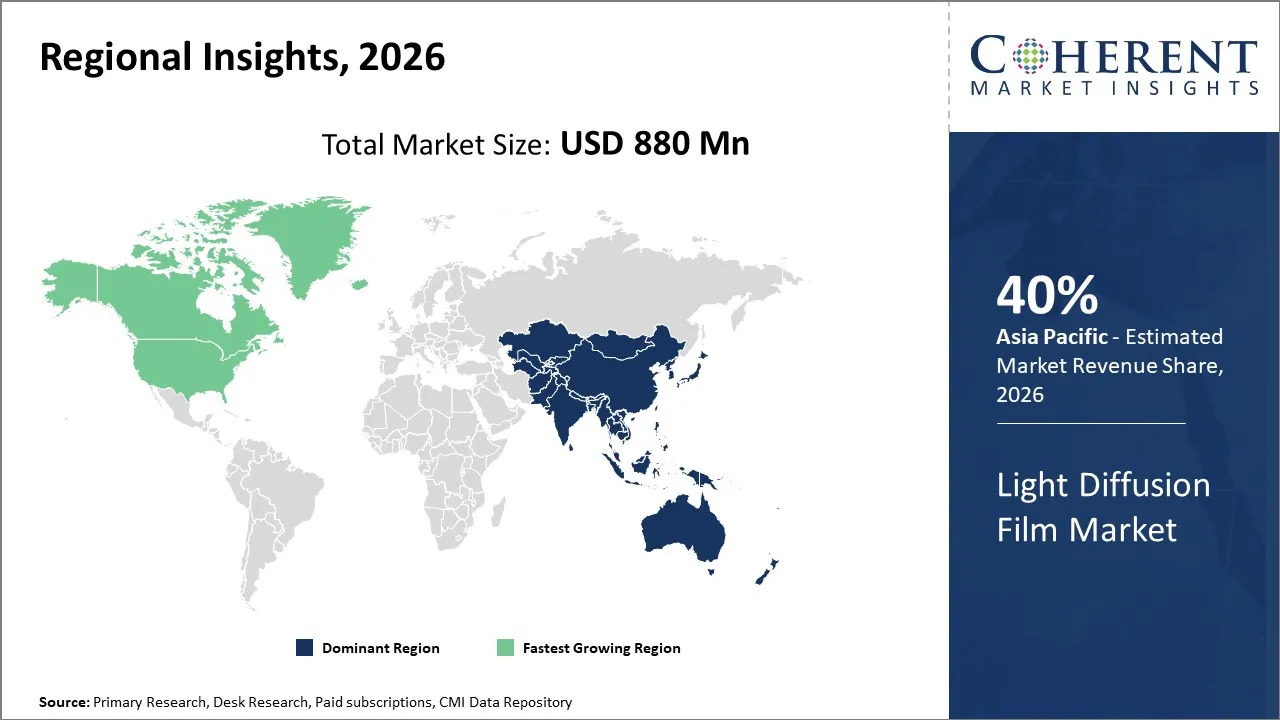
- Asia Pacific is projected to dominate the global light diffusion film industry, capturing a share of about 40% in 2026, because of surging electronics and construction demand.
- North America, with a share of over 28% in 2026, is poised to create lucrative growth opportunities for light diffusion film manufacturers during the assessment period.
Light Diffusion Film Market Overview
The global light diffusion film market is projected to grow steadily during the forecast period. This is mostly due to rising demand for energy-efficient lighting solutions, increasing adoption of LED technology across residential and commercial sectors, and growing applications in electronics, display panels, and automotive lighting.
Light diffusion films are increasingly used across industries such as display panels, electronics, automotive lighting, and professional photography. This is because of their ability to evenly distribute light and enhance visual quality. They are also used in professional lighting setups, including photography, cinematography, and stage productions, to provide uniform illumination and reduce glare. Rising adoption across these industries is boosting light diffusion film market growth.
Demand is rising, especially in countries like India and China, because of growing construction and electronics sectors. As per the latest FICCI EY joint report, India’s Media & Entertainment (M&E) industry reached around ₹2.5 trillion (USD ≈ 29.4 billion) in 2024. This shows strong market opportunities for light diffusion films in professional and commercial lighting applications.
The use of light diffuser films on windows to control sunlight and glare is a growing trend in the global light diffuser film market. As more skyscrapers are constructed around the world, maintaining interior temperatures efficiently has become a major concern. Factors such as population growth, rapid urbanization, industrialization, and rising living standards have boosted the global building and construction sector. Windows coated with light diffuser films offer improved performance over standard glass by reducing glare and distributing light more evenly, which has become an increasingly important application in modern architecture.
Current Events and Their Impact on the Light Diffusion Film Market
Current Event | Description and its Impact |
Global Energy Transition and LED Lighting Adoption |
|
Technological Advancement in Optical Materials |
|
Segmental Insights
- Current Industry Events of 2026
- Market Size Estimation
- Regional Breakdown
- Competitive Landscape
- Customer Intelligence
- Segmental Analysis
- Pricing Analysis
- Key Market Drivers, Challenges & Future Trends
- Customized Insights Section
Light Diffusion Film Market Insights, By Application - Window Glasses to Remain the Most Remunerative Application
Based on application, window glasses segment is expected to account for a market revenue share of 40% in 2026. This is attributable to growing demand for energy-efficient buildings and vehicles, where light diffusion films enhance natural lighting while reducing glare and heat. In addition, increasing consumer preference for comfort and visual clarity in residential, commercial, and automotive spaces is driving the adoption of these films.
Light Diffusion Film Market Insights, By Material Type - Polycarbonate Reigns in Light Diffusion Films
Based on material type, polycarbonate segment is projected to lead the market, accounting for a market share of more than 42% in 2026. This is mostly due to its excellent optical clarity, high impact resistance, and lightweight nature, making it ideal for applications in LED lighting panels, display devices, and automotive lighting.
The increasing use of energy-efficient lighting and higher demand for durable, long-lasting materials in the electronics and automotive sectors are boosting the preference for polycarbonate over materials like acrylic and PET. Other materials like acrylic and PET are expected to witness steady growth owing to their cost-effectiveness and ease of processing, but polycarbonate is likely to maintain its dominance in the global light diffusion film market.
Regional Insights
Asia Pacific Leads the Surge in Light Diffusion Film Demand
Asia Pacific is expected to dominate the global light diffusion film market, accounting for a share of 40% in 2026. This is attributable to rising adoption of LED lighting, display technologies, and energy-efficient solutions in nations like China, Japan, and India. Increasing investments in smart homes, commercial buildings, and automotive lighting systems are driving demand for high-performance light diffusion films.
In addition, growing consumer awareness of energy efficiency and sustainable lighting solutions is encouraging manufacturers to use advanced films that enhance light uniformity and reduce glare in LED panels and displays. New technologies, like ultra-thin diffusion films and multi-layered optical designs, are also widening applications in smart TVs, smartphones, and automotive interiors, further supporting regional market growth.
North America Becoming a Hotbed for Light Diffusion Film Manufacturers
North America is projected to hold over 28% of the global light diffusion film market in 2026. This growth is mostly due to integration of energy-efficient lighting systems in commercial and residential projects, increased adoption of OLED and LED displays in consumer electronics, and rising investments in smart lighting solutions and IoT-enabled building automation systems.
Government initiatives promoting green building certifications, energy conservation, and smart city projects are fueling demand for advanced light diffusion films that enhance lighting efficiency as well as visual comfort. Furthermore, the region is witnessing rising adoption of customized optical films in automotive and electronics sectors, particularly in the U.S. and Canada, where manufacturers focus on improving display brightness, uniformity, and glare reduction.
Light Diffusion Film Market Outlook – Country-wise
China Light Diffusion Film Market Trends
China is one of the largest markets for light diffusion films. This is mostly due to rapid adoption of LED lighting, display devices, and energy-efficient technologies. Expanding smart home infrastructure, commercial construction, and automotive electronics sectors is also fostering market growth in the nation. Government incentives supporting energy-efficient lighting and green building initiatives are encouraging manufacturers to integrate advanced diffusion films in LED panels, displays, and automotive interiors.
Rising demand for ultra-thin, multi-layered optical films that enhance light uniformity as well as reduce glare is also propelling the market. Similarly, expanding applications across diverse industries are expected to boost light diffusion film sales during the forecast period.
Diffusion films are also finding uses in emerging or niche applications such as consumer electronics, medical devices, signage, advertising, greenhouse lighting, wearables, VR/AR, and IoT devices. For example, in greenhouse lighting, they can help improve crop yields by diffusing sunlight, while in electronics and wearables, ultra-thin, custom-designed films enhance device performance.
United States Light Diffusion Film Market Forecast
The U.S. light diffusion film market is expected to grow steadily during the forecast period. This is due to increasing LED and OLED adoption in consumer electronics, commercial lighting, and automotive sectors. Growth is supported by government regulations promoting energy-efficient lighting solutions and green building certifications. Manufacturers are introducing customized diffusion films for improved display brightness, uniformity, and glare reduction.
Rising emphasis on energy efficiency is a key growth-shaping trend in the U.S. light diffusion film industry. Increasing emphasis on energy saving and sustainability is pushing manufacturers to adopt diffusion solutions that enhance light output while reducing consumption. The market is also seeing a trend toward eco friendly and recyclable materials (e.g., PET, bio based polymers) to meet regulatory and consumer sustainability demands.
Light Diffusion Film Industry News
- In February 2026, Kimoto showcased a wide range of solutions at the LOPEC in Munich. These include diffusion films, hard coated and formable polycarbonate films, adhesive films, and structure carrier and transfer films.
- In March 2026, Avery Dennison published its first Environmental Product Declaration (EPD) for solar control interior window films. The EPD report provides data on the carbon footprint of these films based on a life cycle assessment per square meter of product.
- In July 2025, Lintec launched BR‑50UH RECYCLE 100, a new solar control window film made with 100% recycled PET resin. This film helps reduce heat and UV light from entering through windows.
Market Report Scope
Light Diffusion Film Market Report Coverage
| Report Coverage | Details | ||
|---|---|---|---|
| Base Year: | 2025 | Market Size in 2026: | USD 880 Mn |
| Historical Data for: | 2020 To 2024 | Forecast Period: | 2026 To 2033 |
| Forecast Period 2026 to 2033 CAGR: | 3.6% | 2033 Value Projection: | USD 1,130 Mn |
| Geographies covered: |
| ||
| Segments covered: |
| ||
| Companies covered: | 3M, SKC, Kimoto Ltd, Exciton, Xin Guang Laser, Shinhwa, Keiwa Plc, Tsujiden Co, Yongtek, Lintec, TTV GmbH, Fusion Optix, Hayashi Felt, Avery Dennisen corporation, and Whiteoptix, LLC. | ||
| Growth Drivers: |
| ||
| Restraints & Challenges: |
| ||
Light Diffusion Film Market Drivers
Rapid Growth in the Construction Industry
The worldwide construction sector is expanding strongly, supported by urbanization, infrastructure development, and modernization of commercial and residential buildings. As cities grow, demand for new housing, offices, retail spaces, and institutional buildings increases sharply, requiring extensive use of window glass and glazing systems where light diffusion films are applied.
Light diffusion films (LDFs) are commonly used in window glass applications. These films are designed to scatter and diffuse incoming light, reducing glare while allowing natural daylight to pass through. This makes them particularly useful in commercial and residential buildings, skylights, atriums, and office spaces. Thus, expansion of construction and architectural sectors is expected to boost sales of light diffusion films during the forecast period.
Light Diffusion Film Market Drivers
Rising Demand for Advanced Display Technologies
Growing demand for display technologies is a key driver of the light diffusion film market. Light diffusion films are essential for ensuring uniform brightness, accurate color representation, and reduced eye strain in LCD, OLED, micro-LED, and other advanced screens used in smartphones, tablets, TVs, laptops, and digital signage. With increasing consumer preference for larger, high-resolution displays and thinner bezels, diffusion films help optimize visual performance and panel efficiency.
Light Diffusion Film Market Trends
Customization Trend Gaining Traction in the Market
There is a growing trend toward customized light diffusion films in the global market. Manufacturers are increasingly developing bespoke films tailored to specific applications, such as varying shapes, thicknesses, and diffusion angles. These customized solutions help meet the diverse performance needs of end‑users across industries like displays, lighting, and automotive. As a result, the demand for application‑specific diffusion films is rising, creating new opportunities and supporting overall market growth.
Technological Advancements in Materials Supporting Market Expansion
Innovations such as nanotechnology, microreplication and multi layer film architectures improve light transmission efficiency, mechanical performance, and thin film capabilities. These advancements enable films with higher performance in demanding applications like foldable displays and automotive environments.
Light Diffusion Film Market Opportunities
Rising Adoption of Energy-Efficient LED and OLED Lighting Driving Demand
There is a shift toward energy-efficient LED and OLED lighting today. This is increasing demand for diffusion films, which enhance light uniformity, reduce glare, and help lower power consumption. As a result, the growing use of LED installations in residential, commercial, and industrial spaces is expected to drive demand for light diffusion films during the assessment period.
Advancements in Automotive Lighting and Displays Fueling Sales
Modern vehicles are using more advanced lighting systems, like LED headlamps and ambient interior lights, along with integrated displays. Light diffusion films improve aesthetics, safety, readability, and lighting uniformity in these systems. The rise of electric and autonomous vehicles is also boosting demand for high-performance optical films in automotive lighting and dashboards.
Analyst Opinion (Expert Opinion)
- Performance customization is now driving client adoption rather than price. In Japan, OLED display manufacturers using multi-layer diffusion films with tailored haze and light uniformity reported up to 18% better panel brightness consistency compared with generic films. Engineers now treat diffusion film specification as a primary design parameter, not a supplier afterthought.
- Integration with mini-LED backlighting is changing film selection. Chinese TV makers who switched from standard PMMA films to micro-prismatic diffusion films saw local dimming efficiency rise by about 12% and haloing effects decrease. This shows that film microstructure directly impacts perceived image quality, making material choice an important competitive factor.
- Durability under thermal cycling is becoming non-negotiable. South Korean smartphone OEMs adopting high-temperature-resistant PET-based diffusion films noted a 22% reduction in display delamination incidents during accelerated heat/humidity testing. Manufacturers increasingly prioritize thermal stability metrics over simple cost-per-sheet in procurement discussions.
Speak to the analyst
Want personalized insights?
Take the findings above to one of our principal consultants, or have the report rebuilt around the segments, geographies and competitors you actually track.
Light Diffusion Film Market Segmentation
- By Material Type Insights ( Revenue, USD Mn, 2020 - 2033)
- Polycarbonate Sheets
- Acrylic Sheets
- Polypropylene
- Others
- By Type Insights ( Revenue, USD Mn, 2020 - 2033)
- 0.215 mm
- 0.23 mm
- By Application Insights ( Revenue, USD Mn, 2020 - 2033)
- Window Glasses
- Roof Skylights
- Others (Cinematography, Photography etc.)
- By Region Insights ( Revenue, USD Mn, 2020 - 2033)
- North America
- U.S.
- Canada
- Latin America
- Brazil
- Argentina
- Mexico
- Rest of Latin America
- Europe
- Germany
- U.K.
- Spain
- France
- Italy
- Russia
- Rest of Europe
- Asia Pacific
- China
- India
- Japan
- Australia
- South Korea
- ASEAN
- Rest of Asia Pacific
- Middle East & Africa
- GCC Countries
- Israel
- Rest of Middle East & Africa
- North America
- Key Players
- 3M
- SKC
- Kimoto Ltd
- Exciton
- Xin Guang Laser
- Shinhwa
- Keiwa Plc
- Tsujiden Co
- Yongtek
- Lintec
- TTV GmbH
- Fusion Optix
- Hayashi Felt
- Avery Dennisen Corporation
- Whiteoptix, LLC.
Sources
Primary Research interviews
- Interviews with product development heads of light diffusion film manufacturers
- Discussions with procurement and purchasing managers from major display panel producers
- Insights from R&D engineers specializing in optical materials
- Interviews with OEM representatives in consumer electronics and automotive display segments
Databases
- World Intellectual Property Organization (WIPO) patent database
- United States Patent and Trademark Office (USPTO) patent database
- Global trade and customs data portals
- International Trade Centre (ITC) Trademap
- United Nations Comtrade database
Magazines
- Display World Magazine
- Optical Engineering Magazine
- Plastics Today
- Electronics Manufacturing Magazine
- Polymer Technology Magazine
Journals
- Journal of Optical Materials
- Journal of Applied Polymer Science
- Displays (Elsevier)
- Optical Materials Express
- Journal of the Society for Information Display
Newspapers
- The Economic Times
- The Wall Street Journal
- Financial Times
- The Hindu Business Line
- Nikkei Asia
Associations
- Society for Information Display (SID)
- Optical Society of America (OSA)
- International Display Manufacturing Conference (IDMC)
- Polymer Processing Society (PPS)
- Consumer Technology Association (CTA)
Public Domain sources
- Government publications and industry statistics from national ministries (e.g., Ministry of Commerce)
- Annual reports filed with securities regulators (for publicly traded clients/producers)
- Technical whitepapers available through academic and professional institutions
- Public market filings and disclosures
- Regulatory filings and environmental compliance reports
Proprietary Elements
- CMI Data Analytics Tool
- Proprietary CMI Existing Repository of information for last 8 years
Get access to 250+ pages report
Every segment, forecast, competitor profile and data table behind the analysis above — available for instant download.
- ESOMAR Member
- ISO 9001:2015 Certified
- D-U-N-S Registered
- GDPR & CCPA Compliant
Missing comfort of reading report in your local language? Find your preferred language:
Transform your Strategy with Exclusive Trending Reports
Frequently Asked Questions
The global market is estimated to be valued at USD 880 Mn in 2026.
The global Light Diffusion Film Market value is expected to reach USD 1,130 Mn by 2033.
The global market is poised to exhibit a CAGR of 3.6% from 2026 to 2033.
Major growth factors include growth of construction industry and technological advancement in the production of light diffuser films.
Stringent government regulations regarding the use of plastic.
Some major companies in the Light Diffusion Film Market include 3M, SKC, Kimoto Ltd, Exciton, Xin Guang Laser, Shinhwa, Keiwa Plc, Tsujiden Co, Yongtek, Lintec, TTV GmbH, Fusion Optix, Hayashi Felt, Avery Dennisen corporation, and Whiteoptix, LLC.
Asia Pacific, with 40% share in 2026, is expected to lead the market during the forecast period.