Logging Trailers Market Analysis & Forecast: 2026-2033

The global logging trailers market size is expected to reach approximately USD 590.1 Mn in 2026 and USD 765.3 Mn by 2033, growing at a CAGR of 4.5% throughout the forecast period (2026-2033).
Logging trailers are typically designed for rough forest terrain, heavy loads, and easy loading and unloading of long logs. Logging trailers are specialized trailers utilized in forestry operations to transport cut trees, logs, or timber from the harvesting site to storage yards, sawmills, or processing facilities. Logging trailers often have strong frames, adjustable stakes, and sometimes hydraulic loading systems. The logging trailer market focuses on these specialized trailers, which are used in the forestry industry to transport cut trees and lumber from forests to processing facilities. Hence, the market is becoming increasingly significant, driven by the growing need for timber and wood products, the expansion of forestry operations, infrastructure projects, and the rising use of advanced, high-capacity, and durable transport solutions.
|
Current Event |
Description and its Impact |
|
Rising adoption of advanced and high-capacity logging trailers |
|
|
Product improvements focused at lowering haul cycles and increasing load efficiency
|
|
Uncover macros and micros vetted on 75+ parameters: Get instant access to report
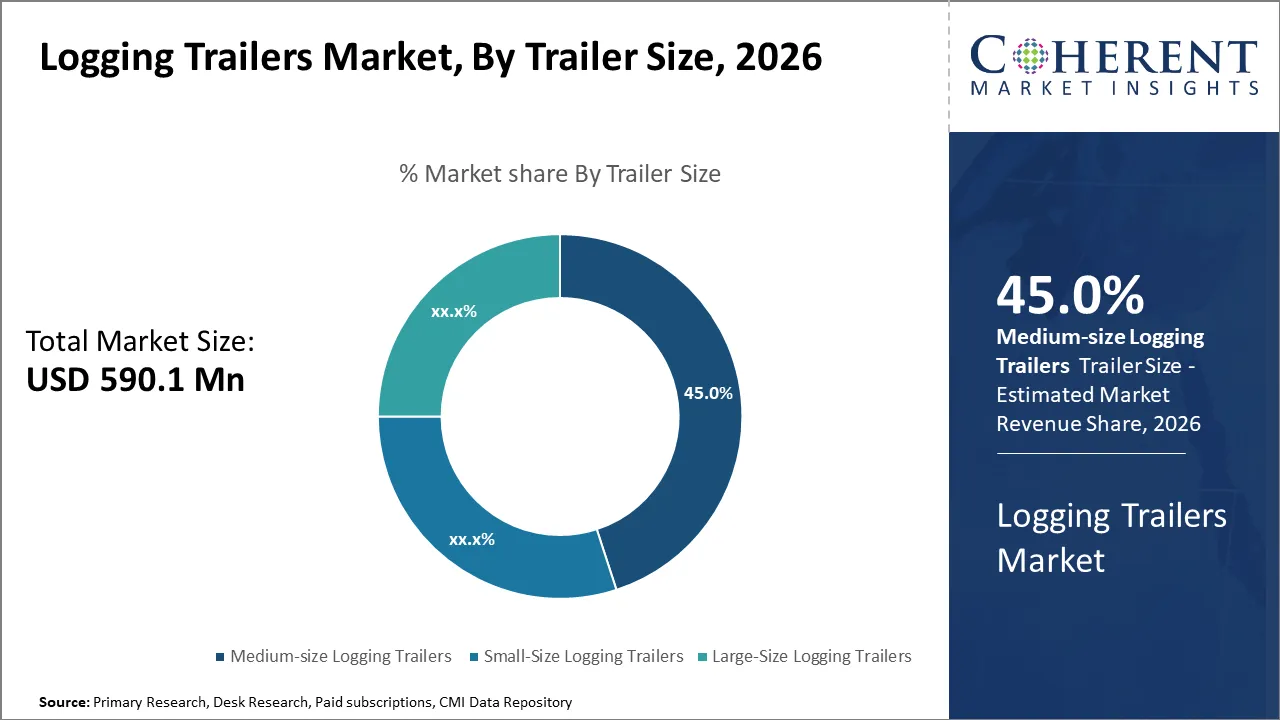
Based on trailer size, medium-size trailers are expected to lead the market, accounting for a revenue share of 45% in 2026. The adoption of medium-sized logging trailers has increased, mainly because they are easier to use in rough areas, are cost-effective, and can be used for different tasks. These trailers require a smaller initial investment and are cheaper to maintain than large-size logging trailers. Also, medium-sized logging trailers can easily connect to common trucks and tractors, which reduces the need for special equipment.
By application, the off-road segment is slated to account for a prominent market share of 60% in 2026. Off-road trailers possess a greater capacity for transporting larger and heavier loads when compared to their on-road counterparts. Off-road logging trailers are built to thrive in the demanding, often unpredictable world of the forest. They're tough, with heavy wheels that make them perfect for getting the job done in remote areas where timber is harvested. These trailers are designed to handle mud, rocks, and steep slopes, which is essential. The ability to move a lot of timber in one go is a big deal in logging. It cuts down on the number of trips needed, which makes everything work more smoothly. Furthermore, the components that make up these trailers are built to last, designed to withstand significant wear and tear. This durability translates to a reduced likelihood of mechanical failures.
To learn more about this report, Request Free Sample
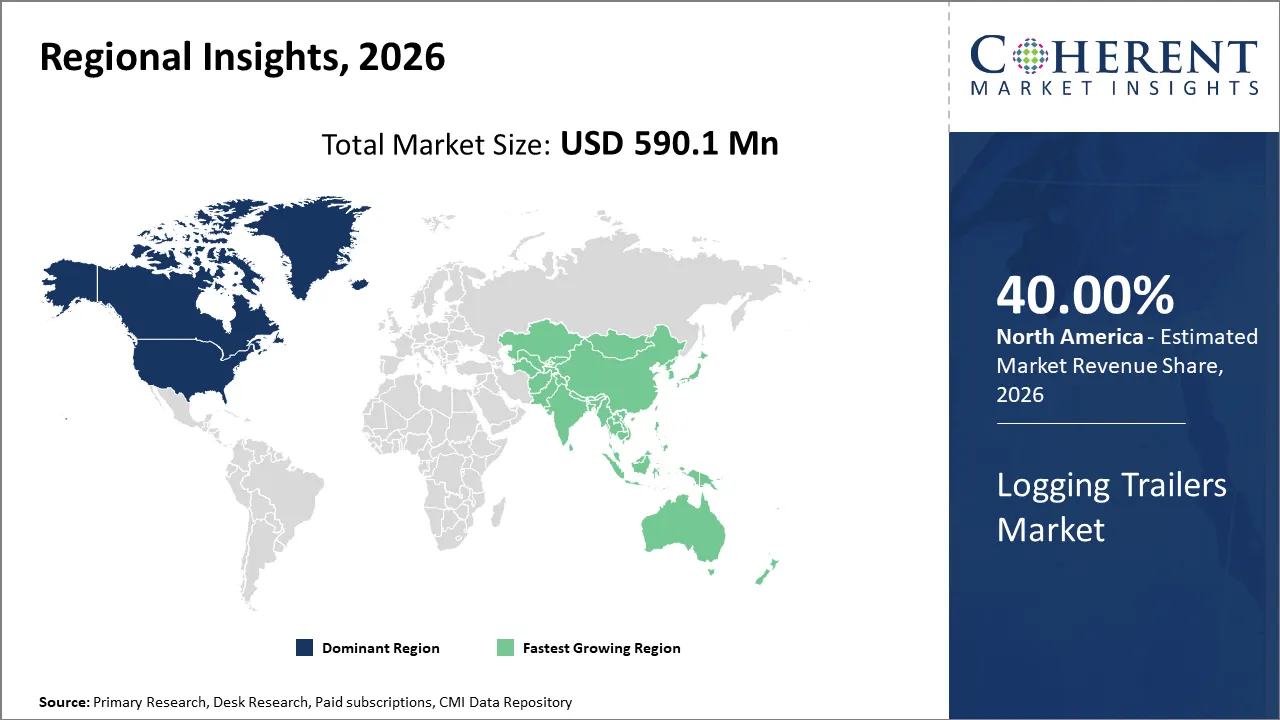
North America is expected to dominate the global logging trailers market, accounting for a share of 40% in 2026. North America holds a dominant position in the market, thanks to its robust infrastructure for forestry and a growing emphasis on sustainable logging practices. This has spurred demand for sophisticated off-road logging trailers. The U.S. and Canada, with their extensive forest resources, see considerable activity in logging, which naturally translates to a strong need for trailers. With its high level of technological advancement, the North American forestry industry relies on latest version machinery and equipment, thereby increasing the demand for efficient logging trailers. Moreover, the logging trailers industry within this geographical area is governed by a variety of environmental and safety mandates. Therefore, off-road logging trailers are made to meet these strict requirements, giving environmental impact reduction a priority when using them in delicate forest ecosystems. A highly competitive market environment is a result of this emphasis on sustainability.
Asia Pacific is expected to grow at the fastest CAGR in the logging trailers market during the forecast period. Asia Pacific witness huge forest area and expanding timber industries, has increased the demand for the logging equipment, which driven the growth of market over the forecast period. Due to rapid infrastructure development in many Asia Pacific region demand for timber and the need for efficient logging logistics has increased over the period of time. Economies such as China, India, and Southeast Asian countries are seeing rising consumption of wood products for packaging, paper, furniture, and construction. Higher timber demand translates into increased logging activity and a greater need for logging trailers. Asia Pacific region is experiencing significant growth due to expanding forestry activities, entry of local and global manufacturers, government initiatives and policies, and expanding forestry activities.
The U.S. country holds the dominant revenue share in the North America logging trailers market. The U.S. country has very large working-forest base and bigger timber base directly increases the need for log extraction and transport equipment, including logging trailers. U.S. leadership attributes due to its large forestry industry, developed infrastructure, and advances in technology. The U.S. is experiencing significant revenue share in the North America logging trailers market owing to its high construction-linked wood demand, advanced logging infrastructure, and continued government support for timber production and wood-market expansion.
The China country holds the dominant revenue share in the Asia Pacific logging trailers market due to massive forest areas, particularly in regions like Inner Mongolia, Heilongjiang, and Yunnan, driving the demand for efficient transportation equipment, such as logging trailers, to move timber from remote areas to processing units. Furthermore, due to the rapid expansion of e-commerce and the packaging industry in China, the demand for timber has been boosted, especially in the production of packaging materials. Moreover, supportive government policies, technological advancements in logging equipment, rural development, and increased logging activities in remote areas make China grow at a significant rate in the Asia Pacific logging trailers market.
| Report Coverage | Details | ||
|---|---|---|---|
| Base Year: | 2025 | Market Size in 2026: | USD 590.1 Mn |
| Historical Data for: | 2020 To 2024 | Forecast Period: | 2026 To 2033 |
| Forecast Period 2026 to 2033 CAGR: | 4.5% | 2033 Value Projection: | USD 765.3 Mn |
| Geographies covered: |
|
||
| Segments covered: |
|
||
| Companies covered: |
Anser Manufacturing Ltd, Arctic Trailers Inc., Big John Trailers, Binderberger, BMF Production, BWS MANUFACTURING, Deloupe, Doepker Industries Limited, FÉRICAR INC., Kesla, and RABAUD |
||
| Growth Drivers: |
|
||
| Restraints & Challenges: |
|
||
Uncover macros and micros vetted on 75+ parameters: Get instant access to report
Growing concentration on mobility solutions for timber log transportation has significantly driven the growth of the logging trailers market. Increasing launch of new log transportation for mobility of timber solution has estimated to drive the growth of the market over the forecast period. For instance, in January 2026, HORSCH Maschinen GmbH, a company focused on manufacturing innovative agricultural technology and modern solutions for soil cultivation, revealed the expansion of the forestry sector. With a new venture and a cutting-edge timber trailer that increases adaptability, maneuverability, and range of uses, HORSCH company is entering the forestry industry.
The logging trailers has capacity to handle heavier loads and is known for for their ability to handle heavier payloads and maintain stability on rugged terrains, making them ideal for transporting timber. Due to increased efficiency in timber transportation and capability to handle heavier loads, there is a rise in demand for rigid & high-capacity trailers, which is estimated to drive the growth of the logging trailers market in the near future. Trailers that can transport heavier loads and maneuver across difficult terrain are becoming essential as forestry operations spread to distant and difficult areas.
The integration of the smart and telematics technologies such as sensors, IoT, AI, cloud platform, etc. has positive impact of log transport because it transforms traditional trailers into connected, intelligent assets. Integration of smart technology helps to higher operational efficiency and increased asset reliability. Expansion of connected trailers with IoT sensors, telematics, load management, and GPS tracking. Real-time data, fleet tracking, and diagnostics are being used by logging firms more and more to increase safety, lower theft risk, and improve operating efficiency. For logging fleets, telematics enhances maintenance scheduling and route planning. For instance, in March 2026, Phillips Connect, software company based in California U.S., unveiled a number of platform improvements at the Technology & Maintenance Council Annual Meeting. The goal of new developments in its Smart Trailer technology is to increase the amount of data that fleets can collect and utilize from connected trailers. Several trailer systems are covered by the modifications. These include liftgate operations, brake performance, roadside safety, and cargo monitoring. They are all intended to advance fleets from basic GPS trailer tracking to more sophisticated operational intelligence.
Heavy-duty logging trailers are engineered to carry larger payloads and oversized structures. High-capacity trailers support remote and industrial workforce accommodation and hence play important role in mining, oil & gas, ad infrastructure mobility, where transporting heavy equipment is routine. Heavy duty trailers enable scalable and modular housing solutions. Larger, heavier loads must be transported each trip in order to increase efficiency and lower transportation costs, and logging operations are expanding. This increases the need for heavy-duty, multi-axle logging trailers that can operate toughly in challenging forestry environments.
Increase in the demand for the wood and timber has estimated to create significant growth opportunity for the growth of the logging trailers market. Globally, logging activity is increasing due to the growing demand for timber in the construction, furniture, paper, and packaging industries. Logging trailers become more necessary as harvesting increases because more logs must be carried from forests to mills.
Share
Share
Ramprasad Bhute is a Senior Research Consultant with over 6 years of experience in market research and business consulting. He manages consulting and market research projects centered on go-to-market strategy, opportunity analysis, competitive landscape, and market size estimation and forecasting. He also advises clients on identifying and targeting absolute opportunities to penetrate untapped markets.
Joining thousands of companies around the world committed to making the Excellent Business Solutions.
View All Our Clients