

Magnesium Metal Market Analysis & Forecast
Magnesium Metal Market is estimated to be valued at USD 6.85 Bn in 2026 and is expected to reach USD 13.33 Bn in 2033, exhibiting a compound annual growth rate (CAGR) of 10.0% from 2026 to 2033.
Key Takeaways
- By Application, The Die-Casting Segment is projected to lead the magnesium metal market with a dominant 37% share in 2026, driven by rising demand from the automotive and electronics industries for lightweight, high-strength components.
- By Region, Asia Pacific is expected to account for the largest revenue share of over 36% in 2026, supported by strong manufacturing growth in China and India, and increasing adoption of magnesium in automotive and aerospace applications.
- North America is anticipated to hold the second-largest share at 22%, owing to robust demand in defense and transportation sectors.
- Europe is projected to maintain a moderate share of 20% in 2026, fueled by environmental regulations encouraging the use of lightweight metals for fuel efficiency.
Market Overview
The rising product demand from die casting and aluminum alloy applications in different end use industries is expected to fuel the market growth. Due to its excellent electromagnetic screening property and heat conductivity, magnesium is perfect for these applications. Aluminum, which is frequently used in these applications, gains strength as a result. Additionally, it is anticipated that over the course of the forecast period, the market will grow in response to the rising demand for lightweight components, particularly in the automotive and aerospace industries.
Current Events and Its Impact on the Magnesium Metal Market
Event | Description and Impact |
China's Environmental Regulations and Production Policies |
|
Electric Vehicle Industry Expansion |
|
US-China Trade Relations and Critical Materials Strategy |
|
Pricing Analysis
The global solar micro inverter market is gaining traction due to growing adoption of renewable energy. It reveals a unique yet competitive price distribution influenced by the level of technology used, power output metrics, and brand placement in the market. In 2025, residential micro inverters are projected to cost between $150-$400 while commercial-grade models can even go upto $600 due to higher outputs and smart grid compatibility. Sponsoring brands such as Enphase Energy charge additional fees because their products feature more than 96% efficiency, integrated monitoring, and 25-year warranties which advances reverse demand.
As for retail prices, Enphase’s IQ8 series sells at $220-$285 while older versions IQ7 series range from $180-$225. APsystems and Darfon as mid-tier competitors have micro inverters that fit reliably priced from $140-$240 providing both value and performance quadratic benefit.
Looking lower end NEP sell basic tier micro inverters with prices starting off at $120-150 for meeting essential needs among homeowners. The most notable factors affecting price are power capability (250W–500W+), smart features like installation type plus compliance with local regulations, and regionally executed laws on electrical code requirements along with supply chain maturity. Advanced economies such as US Europe experience higher installation pricing alongside increased warranty costs which leads to overall elevated prices incurred on developed regions.
- Current Industry Events of 2026
- Market Size Estimation
- Regional Breakdown
- Competitive Landscape
- Customer Intelligence
- Segmental Analysis
- Pricing Analysis
- Key Market Drivers, Challenges & Future Trends
- Customized Insights Section
Patent Landscape
Renewable Innovations has tracked steady growth in micro solar inverter patents pertaining to power electronics and energy efficiency over the last five years. Enphase Energy, SolarEdge Technologies, and Chilicon Power are industry leaders for patents concerning real-time monitoring, rapid shutdown compliance, multi-module control, and grid forming capabilities. The industry is moving towards intelligent and autonomous systems as evidenced by the increasing focus on MLPEs, AI-enabled fault detection patents.
Other recent filings relate to bi-directional energy flow and battery-ready micro inverter architectures which would enable use in hybrid or off-grid scenarios. As usual, China and the US are the leading regions for patent applications with an edge in innovation quality going to the US. Companies are increasingly using price competition sensitive markets as a way to secure competitive advantage through imitation prevention strategies. Many new entrants have begun filing patents for cheap thermal management circuitry resulting in broader participation.
Role of Advanced Technologies
Magnesium metal continues to advance due to enhancements in technology, marking a change in its global market as the efficiency of development processes improves. Optimization of the Pidgeon process is achieved through advanced furnace materials and AI controls which minimize energy consumption and emissions. At the same time, electrolytic production has received improvements from low-temperature electrolyte cell design systems that boost current efficiency and operational life.
Direct reduction plasma-assisted methods are also paving the way for cleaner alternatives to carbon-intensive hydrogen processes. Membrane separation and nanofiltration progress in seawater extraction has reduced energy usage while increasing yield. Flux-free melting with environmentally friendly protective gases during recycling ensures minimal environmental impact while maintaining high recovery rates, making it less harmful to nature. Separation of alloys is becoming more efficient with laser-induced spectroscopy.
The electronics sector along with hydrogen storage and battery applications will benefit from the ultra-high purity nanostructured magnesium products. Expansion of aerospace and automotive usage due to alloy innovations with rare-earth free compositions have increased corrosion resistance which deepened adaptability in these fields. Longterm tech-based growth in the magnesium industry is attainable as productivity, predictive maintenance, and operational transparency improves from IoT employing digital twins alongside automated quality control.
Segmental Insights
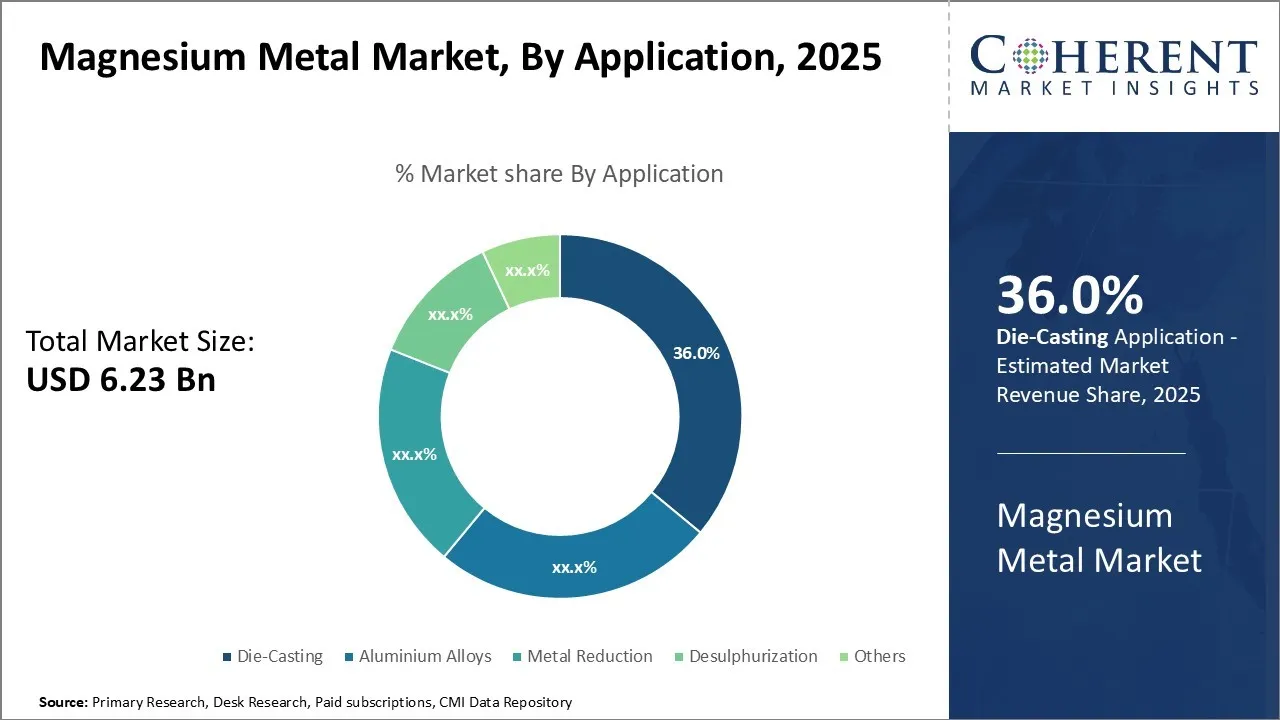
Magnesium Market Insights, By Application
In terms of application, the die-casting segment is projected to dominate the magnesium market with a leading share of 37.0% in 2026, primarily due to its extensive use in the automotive and electronics industries. Magnesium’s superior strength-to-weight ratio and excellent machinability make it ideal for manufacturing lightweight, high-performance die-cast components that contribute to fuel efficiency and product miniaturization.
Aluminum alloys represent the second-largest segment, accounting for 25% of the market. Magnesium is a key alloying element in aluminum processing, improving strength, corrosion resistance, and ductility. These alloys are widely employed in aerospace, construction, and packaging industries due to their enhanced mechanical properties.
The metal reduction segment holds a notable 20% market share. Magnesium’s role as a reductant in the production of titanium and other metals positions it as a critical material in metallurgy, especially in high-performance and specialty metal manufacturing.
Desulphurization applications, making up 12% of the market, rely on magnesium’s ability to remove sulfur impurities from molten iron in steelmaking processes, thus enhancing steel quality and reducing brittleness. This segment is supported by consistent demand from the global construction and infrastructure sectors.
The others category, including niche applications like pyrotechnics and chemical synthesis, contributes 7% to the overall market. While relatively smaller, this segment is witnessing innovation-driven growth, particularly in defense and specialty chemical domains.
As sustainability and lightweighting trends continue across industries, the magnesium market is expected to witness increased demand across these diverse application segments. Strategic sourcing, improved recycling technologies, and innovations in magnesium processing will further bolster growth in key areas such as die-casting and aluminum alloy production.
Regional Insights
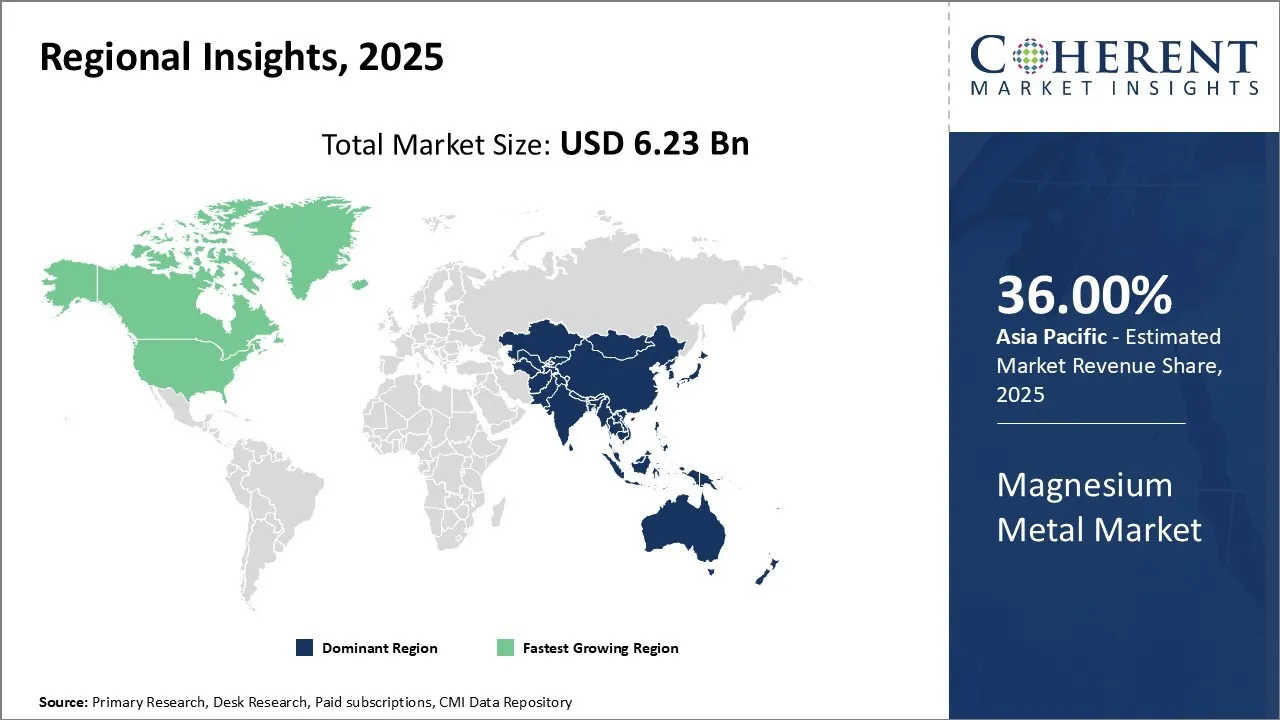
Asia Pacific Magnesium Market Analysis and Trends
Asia Pacific is projected to lead the global magnesium market with a dominant revenue share of over 36.00% in 2026, and is expected to register the fastest CAGR from 2026 to 2032. This regional growth is primarily driven by the surge in aluminum and steel consumption across key end-use industries such as electric vehicles (EVs), construction, and infrastructure.
China and India are emerging as pivotal markets due to their expanding automotive and aerospace sectors, alongside substantial investments in metal production and processing technologies.Furthermore, the steel industry in India and Japan plays a significant role in fueling magnesium demand for desulfurization applications and alloy production. Government initiatives supporting electric mobility and industrial development are further catalyzing magnesium usage in lightweight structural components, particularly in transportation and construction.
North America Magnesium Market Analysis and Trends
North America held the second-largest revenue share of 22% of the global magnesium market in 2026 and is poised for steady growth throughout the forecast period. The region benefits from increasing demand for aluminum and titanium alloys, especially in the automotive, aerospace, and defense sectors.
Magnesium's role in alloying and structural light-weighting makes it an essential material in these high-performance applications.The U.S. and Canada are witnessing a resurgence in aerospace manufacturing and EV adoption, which is accelerating the use of magnesium in casting and alloy development. Strategic investments in recycling technologies and advanced materials R&D are also contributing to the long-term sustainability and competitiveness of the regional market.
Europe Magnesium Market Analysis and Trends
Europe is expected to witness moderate of 20% share in 2026 in the magnesium market, underpinned by rising demand from the aerospace, transportation, and electrical & electronics industries. Notably, the region has seen a 137% increase in EV sales between 2022 and 2030, signaling robust demand for lightweight materials like magnesium in vehicle structures and battery enclosures.Countries such as Germany, Italy, and Russia are ramping up defense budgets, leading to increased magnesium usage in aircraft, missiles, and military components. The region’s focus on energy efficiency and reduced emissions is also encouraging manufacturers to adopt magnesium alloys across automotive and industrial manufacturing.
Dominating Countries in the Magnesium Market
China Magnesium Market Analysis and Trends
China dominates the Asia Pacific magnesium market owing to its strong foothold in magnesium production and export, along with its vast automotive and electronics manufacturing base. With rising investments in EV infrastructure and high-performance materials, China continues to be the global hub for magnesium consumption and innovation.
United States Magnesium Market Analysis and Trends
The United States leads the North American market due to its advanced aerospace and defense sectors, along with growing investments in lightweight vehicle production. U.S.-based manufacturers are heavily investing in magnesium alloy R&D and recycling technologies to support sustainability goals and enhance material performance.
India Magnesium Market Analysis and Trends
India is emerging as a fast-growing magnesium market within Asia Pacific, supported by increasing demand from its steel, construction, and mobility sectors. Government initiatives such as “Make in India” and infrastructure modernization are expected to further stimulate domestic magnesium consumption, especially in structural and desulfurization applications.
Market Report Scope
Magnesium Metal Market Report Coverage
| Report Coverage | Details | ||
|---|---|---|---|
| Base Year: | 2025 | Market Size in 2026: | USD 6.85 Bn |
| Historical Data for: | 2020 To 2024 | Forecast Period: | 2026 To 2033 |
| Forecast Period 2026 to 2033 CAGR: | 10.0% | 2033 Value Projection: | USD 13.33 Bn |
| Geographies covered: |
| ||
| Segments covered: |
| ||
| Companies covered: | Key players operating in the global magnesium metal market are US Magnesium LLC., Dead Sea Magnesium Ltd., POSCO, RIMA Group, Solikamsk Magnesium Works OAO, Wenxi YinGuang Magnesium Industry (Group) Co., Ltd., Shanxi Wenxi Hongfu Magnesium Co., Ltd., Shanxi Wenxi Zhenxin Magnesium Co., Ltd., and Taiyuan Tongxiang Magnesium Co., Ltd. | ||
| Growth Drivers: |
| ||
| Restraints & Challenges: |
| ||
Global Magnesium Metal Market: Growth Drivers
Increasing Use in the Production of Aluminum Alloys
Magnesium enhances the moderate and high strength properties of metals, particularly aluminum alloys, without sacrificing ductility. Commercially available plates and sheets of aluminum alloys with magnesium added are listed in the 5000 series. Manufacturing of aerospace parts, auto parts, industrial parts, tools and machinery, among other uses, are among the major applications of aluminum alloys. The manufacturing of automobiles is evolving as more people opt for electric vehicles.
For instance, The Organization International des Constructeurs d' Automobiles (OICA) estimates that in 2022, new car sales and registrations will total close to 69 million units across all OICA member nations. The market demand for aluminum alloys would therefore increase as the number of vehicles produced or sold increased. Additionally, 50 million passenger cars were produced globally in the first three quarters of 2022, up almost 9% from the same period in 2021.
The market for electric vehicles, however, may likely drive up demand for aluminum alloys. It is anticipated that the market will be driven by the rising demand for lightweight components across numerous applications. For instance, The World Economic Forum (WEF) estimates that in the first half of 2022, nearly 4.3 million new battery-powered electric vehicles (BEVs) and plug-in hybrid electric vehicles (PHEVs) were sold worldwide. Aluminum alloys are also used in aircraft because they are strong and light. Because a lighter plane requires less lift force and thrust to fly, it is a good way to save energy and reduce fuel consumption.
Manufacturing has been triggered by the increasing demand for commercial aircraft due to an increase in air passengers and air transport for trade operations. It includes high-strength and lightweight aircraft capable of carrying heavy loads while maintaining efficient performance.
According to Boeing's commercial outlook for 2025-2032 the North American region will account for approximately 22% of the global fleet by the end of the forecast period (2030). It is also expected that over the next two decades, a total of 9,310 fleet deliveries will be made, with single-aisle accounting for nearly 70% of total deliveries in the region. Boeing is the world's largest aerospace company and leading manufacturer of commercial jetliners and defense, space and security systems. Owing to all of these factors, the global market for metal magnesium is expected to grow during the forecast period.
Rising New Aircraft Production will Drive Market Growth
Metal has long been used in civil and military aircraft. Reduce the weight of air and spacecraft, as well as projectiles, to help reduce emissions and increase fuel efficiency. Due to the limited ongoing improvements in aluminum weight reduction, the high cost of fiber metal laminates or carbon fiber composites, and the poor impact and damage properties of low-density plastics when exposed to extreme temperatures, magnesium is an ideal material for use in these applications.
Thrust reversers for the Boeing 737, 747, 757, and 767, as well as jet engine fan frames and aircraft and helicopter transmission casings, are made of magnesium. Furthermore, rising demand for fuel-efficient and lightweight aircraft for military and commercial applications is expected to drive magnesium demand. From 2021 to 2040, large aircraft manufacturers such as Boeing, headquartered in the U.S., will deliver approximately 43,610 new commercial aircraft worldwide, with 9,160 delivered in North America, 17,645 in Asia Pacific, 8,705 in Europe, 3,000 in the Middle East, 2,530 in Latin America, 1,540 in Russia and Central Asia, and 1,030 in Africa. Furthermore, Airbus stated that there is a demand for approximately 29,700 small aircraft, such as the A220 and A320 families, and approximately 5,300 medium aircraft, such as the A321XLR and the A330neo. 4,000 deliveries in the large segment, which the A350 serves, are expected by 2040.
In addition, the Federal Aviation Administration (FAA) projects that the number of aircraft in the U.S. commercial fleet will increase from 5,882 in 2020 to 8,756 in 2041, a 2% annual growth rate, after declining by 22.9% (1,746 aircraft) in 2020. As a result, it is anticipated that the demand for magnesium for aircraft production will rise along with the rising production of new aircraft, which will further fuel the expansion of the global magnesium metal market size during the forecasted period.
Analyst Viewpoint: Global Magnesium Metal Market
- Magnesium’s high strength-to-weight ratio continues to drive demand from automotive and aerospace sectors focused on lightweighting and emission reduction.
- The metal is increasingly used in electric vehicle battery housings and structural components as OEMs prioritize fuel efficiency.
- Die-casting applications in consumer electronics and industrial machinery are expanding, reinforcing magnesium’s industrial relevance.
- High production costs and energy-intensive extraction processes remain major barriers to broader market adoption.
- Environmental concerns linked to traditional production methods are pushing the need for cleaner, sustainable alternatives.
- The market faces supply chain risks due to heavy dependence on specific geographies, especially China, for primary production.
- Price volatility of raw materials and the complexity of magnesium recycling challenge consistent supply and cost-efficiency.
- Opportunities are emerging in renewable energy infrastructure, particularly for use in solar panel frames and wind turbine components.
- The medical device sector offers untapped potential, with magnesium’s biocompatibility enabling innovative implant development.
- Asia-Pacific dominates global supply and demand, supported by China's industrial base and competitive production costs.
- North America is the fastest-growing region due to rising EV production and aerospace investments.
- Europe shows stable growth, driven by strict emission regulations and advancements in precision manufacturing.
Global Magnesium Metal Market: Recent Developments
- In February 2023, Western Magnesium Corporation announced plans to build a new magnesium metal production facility in Nevada, U.S. with an initial annual capacity of 25,000 metric tons, as well as a new research and development center. Through this expansion, the company hopes to serve automotive, aerospace, airline, eco-friendly technology companies, and defense contractors with the help of this new production facility.
- In July 2022, Chongqing Boao Magnesium-Aluminum Metal Manufacturing Co. Ltd (a wholly owned subsidiary of RSM Group/Nanjing Yunhai Special Metals Co. Ltd) has completed a high-performance magnesium-aluminum alloy and deep processing project (Phase II project) in Chongqing City. The new manufacturing facilities may include a magnesium particle production workshop with a capacity of 7,200 tons per year.
- In October 2021, General Magnesium Corporation and International Cobalt Corp. are pleased to announce that Laurentian Bank Securities Inc. has served as the firms' Financial Advisor. International Cobalt disclosed the terms of a definitive agreement in a press release issued on August 11, 2021."Business Combination Agreement" with GMC and 2857695 Ontario Inc., International Cobalt's recently integrated, wholly-owned subsidiary. According to the terms of the agreement, International Cobalt will acquire all of GMC's issued and outstanding shares.
Market Segmentation
- Global Magnesium Metal Market, By Application (Revenue, USD Bn, 2021 - 2033)
- Die-casting
- Aluminum Alloys
- Metal Reduction
- Desulphurization
- Others
- Global Magnesium Metal Market, By Region (Revenue, USD Bn, 2021 - 2033)
- North America
- U.S.
- Canada
- Latin America
- Brazil
- Argentina
- Mexico
- Rest of Latin America
- Europe
- France
- Germany
- Italy
- Spain
- U.K.
- Nordic
- Benelux
- Russia
- Poland
- Rest of Europe
- Asia Pacific
- China
- India
- Japan
- ASEAN
- Australia & New Zealand
- Rest of Asia Pacific
- Middle East
- GCC Countries
- Israel
- Rest of Middle East
- Africa
- South Africa
- North Africa
- Central Africa
- North America
- Company Profiles
- US Magnesium LLC
- Dead Sea Magnesium Ltd.
- POSCO
- RIMA Group
- Solikamsk Magnesium Works OAO
- Wenxi YinGuang Magnesium Industry (Group) Co., Ltd.
- Shanxi Wenxi Hongfu Magnesium Co., Ltd.
- Shanxi Wenxi Zhenxin Magnesium Co., Ltd.
- Taiyuan Tongxiang Magnesium Co., Ltd.
Sources
Primary Research Interviews
- Magnesium metal producers and manufacturers
- Raw material suppliers and distributors
- End-use industry representatives (automotive, aerospace, electronics)
- Industry consultants and technical experts
- Others
Databases
- Bloomberg Terminal
- S&P Capital IQ
- Euromonitor International
- Others
Magazines
- Metal Bulletin Magazine
- Industrial Minerals Magazine
- Light Metal Age
- Materials Today Magazine
- Others
Journals
- Journal of Magnesium and Alloys
- Materials Science and Engineering
- Metallurgical and Materials Transactions
- Others
Newspapers
- Financial Times
- The Wall Street Journal
- Reuters Business News
- Metal Bulletin Daily
- Others
Associations
- International Magnesium Association (IMA)
- American Foundry Society (AFS)
- European Aluminium Association
- China Nonferrous Metals Industry Association
- Others
Public Domain Sources
- U.S. Geological Survey (USGS) Mineral Commodity Summaries
- World Trade Organization (WTO) Trade Statistics
- International Trade Centre (ITC) Market Analysis
- Government statistical offices and trade departments
- Others
Proprietary Elements
- CMI Data Analytics Tool
- Proprietary CMI Existing Repository of information for last 8 years
*Definition: Magnesium metal is one of the lightest metal which can be used for structural applications. It is a silvery-white metal and can be extracted from seawater or brines. One of the major application areas of magnesium metal is the production of aluminum where it is used to improved physical properties and process ability of metal. They are mostly used to make lighter components and also used in iron and steel desulphurization applications. Furthermore, it is also used as a reluctant in the manufacturing of metals such as hafnium, titanium, uranium, and zirconium. Some of the end user of magnesium metal are automotive, electronics, aerospace, packaging and printing. Additionally, they are also used in the petroleum industry in the production of crude oil production.
Get access to 250+ pages report
Every segment, forecast, competitor profile and data table behind the analysis above — available for instant download.
- ESOMAR Member
- ISO 9001:2015 Certified
- D-U-N-S Registered
- GDPR & CCPA Compliant
Missing comfort of reading report in your local language? Find your preferred language:
Transform your Strategy with Exclusive Trending Reports
Frequently Asked Questions
The Magnesium Metal Market size is estimated to be valued at USD 6.85 Bn in 2026, and is expected to reach USD 13.33 Bn by 2033.
Global magnesium metal market is estimated to reach USD 13.33 Bn by 2033.
Key players operating in the market are US Magnesium LLC., Dead Sea Magnesium Ltd., POSCO, RIMA Group, Solikamsk Magnesium Works OAO, Wenxi YinGuang Magnesium Industry (Group) Co., Ltd., Shanxi Wenxi Hongfu Magnesium Co., Ltd., Shanxi Wenxi Zhenxin Magnesium Co., Ltd., and Taiyuan Tongxiang Magnesium Co., Ltd.
Strict rules and regulations is expected to hamper the growth of the market during the forecast period.
Increasing use in the production of aluminum alloys and rising new aircraft production will drive market growth is fuelling the growth of the market in the region.
The CAGR of the Magnesium Metal industry is projected to be 10.0% from 2026 to 2033.
Among region, Asia Pacific is expected to hold a dominant position in the market over the forecast period.