

Meat Glue Market Size and Forecast — 2026 - 2033
The Global Meat Glue Market size is estimated to be valued at USD 328.5 million in 2026 and is expected to reach USD 587.3 million by 2033, exhibiting a compound annual growth rate (CAGR) of 8.6% from 2026 to 2033.
Overview
The Meat Glue Market is driven by rising demand for processed, restructured, and value-added meat products across foodservice and packaged food industries. Transglutaminase helps bind small meat pieces into uniform cuts, reducing wastage and improving product yield for meat processors. Growing consumption of ready-to-cook foods, sausages, nuggets, steaks, seafood products, and premium convenience meals is further supporting adoption. The enzyme also improves texture, appearance, and slicing stability, making it useful in both meat and seafood applications. In addition, increasing focus on cost optimization, protein innovation, and efficient utilization of meat trimmings is encouraging manufacturers to use meat glue in commercial processing.
Key Takeaways
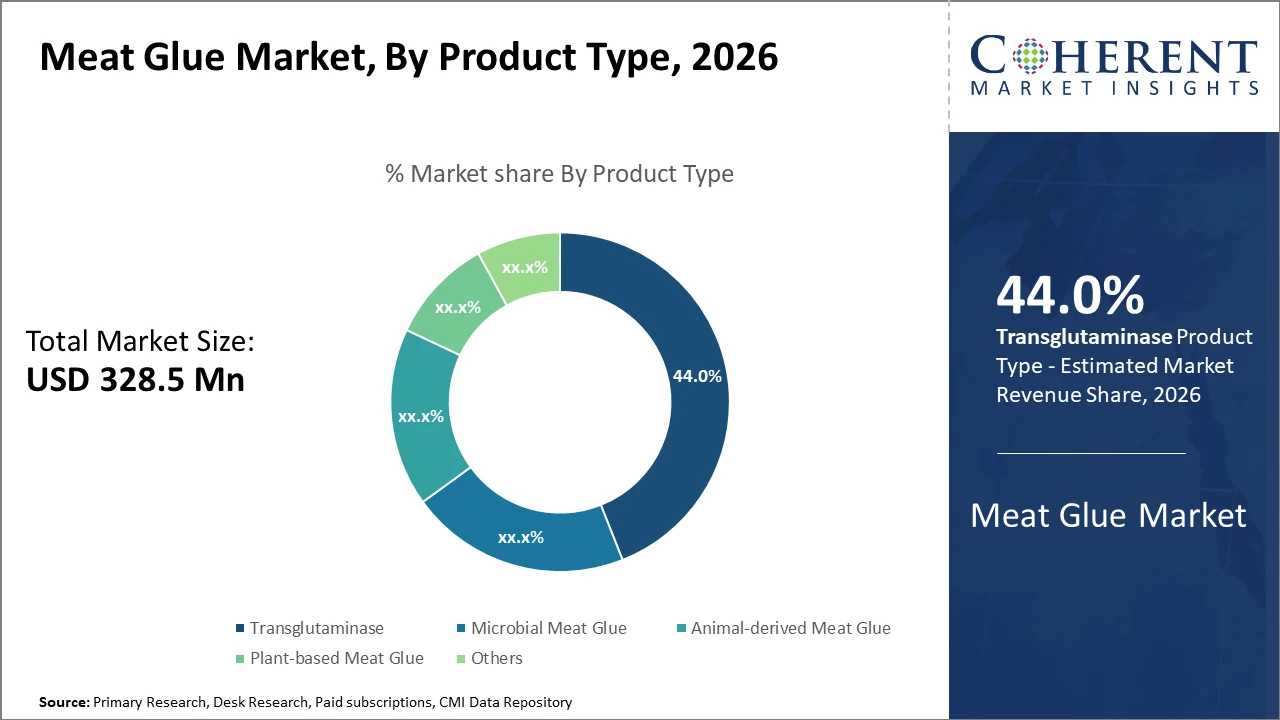
Transglutaminase dominates the Meat Glue Market with a share of 44% due to its superior protein-binding efficiency, wide industrial usage, and strong demand across processed meat and food manufacturing applications.
Microbial meat glue is the fastest-growing product segment because of its clean-label positioning, scalability advantages, and increasing adoption in sustainable food processing operations.
Meat processing remains the leading application segment with extensive use in restructured meat products, while seafood processing is emerging rapidly due to rising demand for texture enhancement and product consistency.
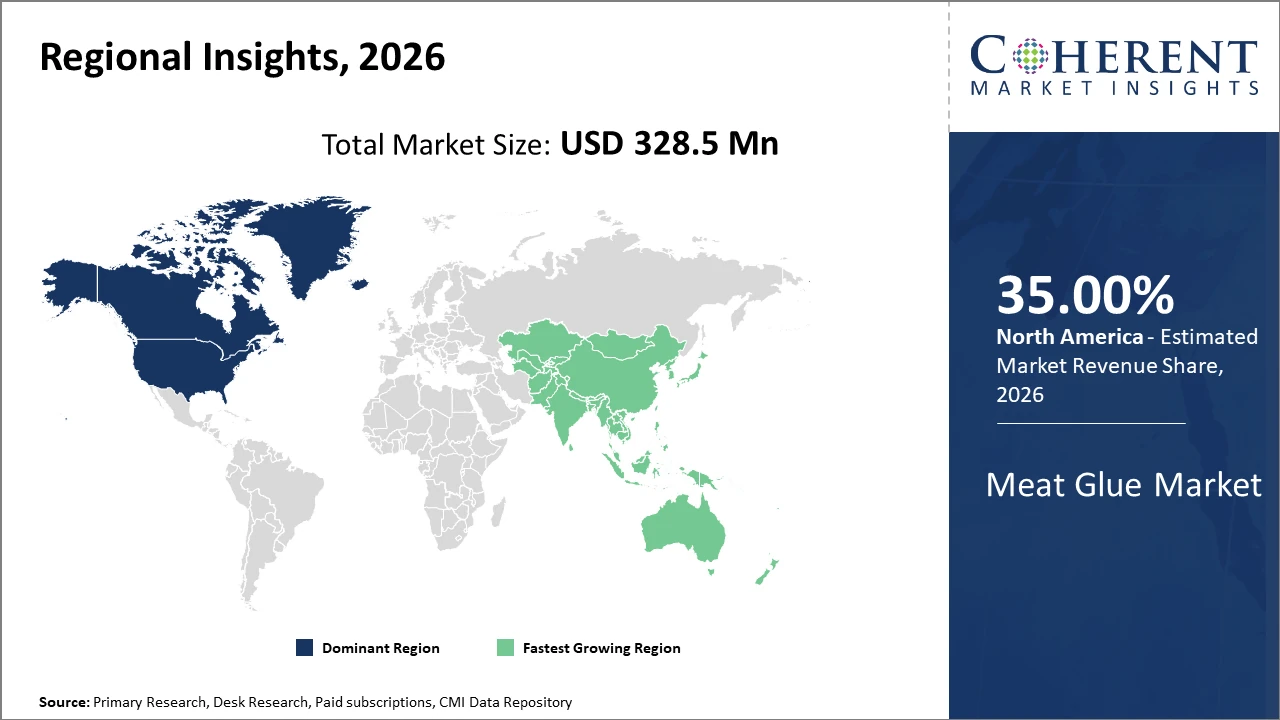
North America holds the largest market share supported by advanced meat processing infrastructure and high processed food consumption, whereas Asia Pacific is the fastest-growing regional market driven by urbanization and expanding food processing industries in China and India.
Meat Glue Market Segmentation Analysis
Meat Glue Market Insights, By Product Type
Transglutaminase dominates the Meat Glue Market with a share of 44% due to its excellent protein-binding properties, broad industrial applicability, and well-established supply chains within global meat processing industries. The enzyme supports cost-efficient production of uniform and high-quality restructured meat products while maintaining texture and structural integrity during processing and packaging. Microbial meat glue represents the fastest-growing segment because of rising consumer preference for clean-label and naturally derived food ingredients, alongside its scalable and environmentally efficient production methods. Animal-derived meat glue continues serving specialized traditional meat applications, while plant-based meat glue is gradually gaining traction with the expansion of alternative protein and vegan food markets. Additional enzyme blends support niche and customized food processing requirements.
Meat Glue Market Insights, By Application
The meat processing industry dominates the Meat Glue Market due to extensive utilization of transglutaminase in restructured meat products, sausages, deli meats, and processed protein foods requiring improved texture, binding strength, and sliceability. Strong consumer demand for convenient and ready-to-eat meat products across retail and food service sectors continues supporting segment growth. Seafood processing is the fastest-growing application area, driven by increasing innovations in surimi, fish paste, and texture-enhanced seafood products using enzyme-based binding technologies. Bakery and confectionery applications remain niche, mainly supporting protein-enriched products and specialty formulations. Dairy applications are limited to cheese analogs and specialty foods, while emerging gluten-free and low-fat products create additional market opportunities.
Meat Glue Market Insights, By End User Industry
Food service dominates the Meat Glue Market due to widespread use of transglutaminase in large-scale food preparation, quick-service restaurants, catering operations, and commercial kitchens requiring consistent restructured meat products and efficient bulk production. The segment benefits from strong demand for standardized texture, portion control, and improved product presentation. Retail meat packaging is the fastest-growing subsegment as consumers increasingly prefer value-added and conveniently packaged meat products supported by advanced food processing technologies. Institutional catering services, including hospitals and educational facilities, are steadily adopting enzymatic meat binding to improve nutritional efficiency and reduce food waste. Household consumers represent a smaller market segment, primarily through indirect consumption of processed meat products.
Meat Glue Market Trends
Innovation in multifunctional enzyme technologies is transforming the Meat Glue Market, with advanced formulations improving binding performance, texture enhancement, and shelf-life extension for processed meat and ready-to-eat food products.
Asia Pacific is emerging as a major growth hub due to increasing collaborations between regional enzyme manufacturers and international meat processing companies aiming to meet rising processed food demand.
Sustainability and transparency trends are gaining momentum through adoption of digital traceability systems and enzyme solutions that optimize meat utilization, reduce processing waste, and improve consumer confidence in food production practices.
Meat Glue Market Insights, By Geography
North America Meat Glue Market Analysis and Trends
North America dominates the Meat Glue Market due to the strong presence of established meat processing companies, advanced food manufacturing infrastructure, and strict food safety and quality regulations. The region accounted for more than 35% of global market share in 2026, supported by increasing investments in enzyme technology innovation and modernization of meat processing facilities. Growing demand for processed, ready-to-eat, and value-added meat products continues strengthening regional market expansion. Leading companies such as Ajinomoto and DSM have significantly contributed to market growth through development of high-efficiency, regulation-compliant enzyme solutions tailored for U.S. and Canadian food processing industries.
Asia Pacific Meat Glue Market Analysis and Trends
Asia Pacific is the fastest-growing region in the Meat Glue Market, recording a CAGR exceeding 10% due to rapid urbanization, expanding middle-class populations, and changing dietary preferences favoring processed and convenience meat products. Government initiatives supporting industrial food processing, export-oriented manufacturing, and modernization of food supply chains are strengthening regional market dynamics. Countries such as China, India, and Australia are witnessing rising adoption of advanced enzyme-based meat binding technologies across commercial food processing industries. Leading regional companies like Dongtai Jinxin Biotechnology, along with collaborations involving multinational food ingredient manufacturers, are accelerating production capacity expansion and encouraging innovation in clean-label and high-efficiency meat glue formulations throughout the Asia Pacific market.
Meat Glue Market Outlook for Key Countries
USA Meat Glue Market Analysis and Trends
The United States Meat Glue Market is characterized by strong demand from processed meat manufacturers and continuous innovation in enzyme-based food processing technologies. Growing consumer preference for consistent, high-quality restructured meat products has encouraged wider adoption of transglutaminase solutions across commercial meat processing facilities and food service operations. In recent years, regional meat processors significantly increased enzyme utilization to improve texture, yield, and production efficiency. Major companies such as Ajinomoto and DuPont have expanded manufacturing and distribution capabilities while focusing on FDA-compliant enzyme formulations with enhanced safety and performance characteristics, reinforcing the country’s major contribution to global market revenue growth.
Germany Meat Glue Market Analysis and Trends
Germany’s Meat Glue Market is witnessing steady growth driven by the country’s strong processed meat industry, advanced food manufacturing sector, and increasing demand for cost-efficient meat processing technologies. Food processors and commercial kitchens are increasingly utilizing transglutaminase-based products to improve meat texture, product consistency, and portion standardization while reducing raw material waste. Rising consumption of convenience foods and ready-to-cook meat products further supports market expansion. Regulatory emphasis on food safety and transparent ingredient labeling is influencing manufacturers to develop high-quality and compliant enzyme formulations. Additionally, growing innovation in protein processing, seafood applications, and plant-based meat alternatives is creating new opportunities within Germany’s evolving food processing industry.
Analyst Opinion
Expansion of transglutaminase production capacities in major meat processing regions is strengthening supply chains and supporting rising industrial demand for enzyme-based meat binding solutions.
Growing use of meat glue in ready-to-eat foods, high-protein snacks, and plant-based meat alternatives is broadening application scope and increasing demand across global foodservice industries.
Automation in meat restructuring operations is improving processing efficiency, reducing labor costs, and accelerating adoption of enzymatic bonding technologies within commercial food manufacturing facilities.
Stricter international food safety and certification standards are encouraging development of high-purity, regulation-compliant meat glue products, enhancing consumer trust and supporting long-term market growth.
- Current Industry Events of 2026
- Market Size Estimation
- Regional Breakdown
- Competitive Landscape
- Customer Intelligence
- Segmental Analysis
- Pricing Analysis
- Key Market Drivers, Challenges & Future Trends
- Customized Insights Section
Market Scope
| Report Coverage | Details | ||
|---|---|---|---|
| Base Year: | 2025 | Market Size in 2026: | USD 328.5 million |
| Historical Data for: | 2020 To 2024 | Forecast Period: | 2026 To 2033 |
| Forecast Period 2026 to 2033 CAGR: | 8.6% | 2033 Value Projection: | USD 587.3 million |
| Geographies covered: |
| ||
| Segments covered: |
| ||
| Companies covered: | Ajinomoto Co. Ltd., DSM Nutritional Products AG, DuPont de Nemours Inc., Kerry Group Plc, Novozymes A/S, Puratos Group, Creative Enzymes, Amano Enzyme Inc. | ||
| Growth Drivers: |
| ||
Meat Glue Market Growth Factors
The Meat Glue Market is driven by rising demand for processed and restructured meat products, particularly in emerging economies such as China and India where increasing protein consumption supports higher adoption of enzyme-based meat binding solutions. Advancements in enzyme engineering have improved binding efficiency, product texture, and production speed while lowering manufacturing costs for food processors. Strict food safety regulations and growing traceability requirements are further encouraging adoption of high-purity, internationally compliant meat glue formulations across commercial food industries. Additionally, sustainability trends promoting efficient utilization of meat trimmings and by-products are expanding the use of transglutaminase technologies, supporting waste reduction and enhancing overall market growth opportunities globally.
Meat Glue Market Development
In October 2023, Novozymes launched Vertera ProBite, a natural enzyme that improves the texture of plant-based meat by converting plant proteins into fibrous structures that mimic the bite and mouthfeel of animal meat.
Key Players
Leading Companies of the Market
Ajinomoto Co. Ltd.
DSM Nutritional Products AG
DuPont de Nemours Inc.
Kerry Group Plc
Novozymes A/S
Puratos Group
Creative Enzymes
Amano Enzyme Inc.
Competitive strategies in the Meat Glue Market are increasingly focused on mergers, acquisitions, and strategic partnerships aimed at expanding enzyme production capabilities and strengthening global market presence. Ajinomoto enhanced its transglutaminase manufacturing capacity through acquisition activities that strengthened its position within the European food ingredient sector and improved regional market penetration. At the same time, DSM expanded collaborative initiatives centered on sustainable and clean-label enzyme development, enabling broader entry into Asia Pacific food processing markets. These strategic efforts are supporting innovation, improving supply chain efficiency, and reinforcing competitive positioning among leading companies operating within the global meat glue industry.
Meat Glue Market Future Outlook
The Meat Glue Market is expected to witness stable growth driven by increasing demand for processed meat products, food waste reduction solutions, and efficient protein processing technologies. Rising adoption of transglutaminase enzymes in meat, seafood, dairy, and ready-to-eat food applications will continue supporting market expansion. Food manufacturers are increasingly focusing on improving product texture, portion consistency, and production efficiency, boosting demand for advanced enzyme-based binding solutions. Growing interest in clean-label ingredients and sustainable food processing practices is also encouraging innovation in allergen-free and natural enzyme formulations. Asia Pacific and Europe are expected to remain major markets, while emerging economies will offer new growth opportunities for food processing applications.
Meat Glue Market Historical Analysis
The Meat Glue Market evolved with advancements in food processing technologies and increasing demand for efficient protein utilization in the meat industry. Initially adopted by commercial meat processors and high-end culinary establishments, transglutaminase enzymes gained popularity for their ability to bind smaller meat pieces into uniform products while improving texture and reducing waste. During the early 2000s, growth accelerated as processed and convenience food consumption increased globally. Regulatory scrutiny and consumer concerns regarding food transparency later encouraged manufacturers to improve labeling practices and develop cleaner formulations. Over time, applications expanded beyond meat into seafood, dairy, and plant-based proteins, supporting broader adoption across the global food processing industry.
Sources
Primary Research Interviews:
Market analysts, R&D directors, regulatory consultants, and food scientists involved in enzyme technology innovation, protein processing research, clean-label food development, and food safety compliance standards.
Enzyme manufacturers, food ingredient suppliers, supply chain executives, and procurement specialists responsible for sourcing transglutaminase enzymes, protein binders, stabilizers, and food processing additives.
Magazines:
Food Processing – Insights into meat processing technologies, enzyme applications, and food manufacturing innovations.
Meat+Poultry – Coverage of meat industry trends, protein processing advancements, and food ingredient developments.
Prepared Foods – Updates on processed food technologies, ingredient innovations, and commercial food production trends.
Journals:
Journal of Food Science – Research on enzyme applications, protein binding technologies, and processed food quality improvement.
Meat Science – Studies focused on meat texture enhancement, transglutaminase functionality, and protein processing innovations.
Food Hydrocolloids – Research on food stabilizers, enzyme interactions, and texture optimization in processed foods.
Newspapers:
Financial Times – Coverage of food industry investments, processed food market developments, and biotechnology innovations.
Reuters – Reporting on food ingredient product launches, regulatory developments, and global food processing trends.
Bloomberg – Insights into mergers, acquisitions, R&D investments, and strategic developments among food ingredient and enzyme manufacturing companies.
Associations:
American Meat Science Association – Research updates, meat processing standards, and advancements in protein processing technologies.
Institute of Food Technologists – Innovations, regulatory guidance, and developments in food ingredients and enzyme technologies.
North American Meat Institute – Industry standards, food safety guidelines, and best practices in meat processing and packaged food production.
Get access to 250+ pages report
Every segment, forecast, competitor profile and data table behind the analysis above — available for instant download.
- ESOMAR Member
- ISO 9001:2015 Certified
- D-U-N-S Registered
- GDPR & CCPA Compliant
Missing comfort of reading report in your local language? Find your preferred language:
Transform your Strategy with Exclusive Trending Reports
Frequently Asked Questions
Major companies operating in the Meat Glue Market include Ajinomoto, DSM, DuPont, and Kerry Group, which maintain strong market positions through extensive production capabilities, innovation, and global distribution networks.
The Meat Glue Market is projected to grow from USD 328.5 million in 2026 to USD 587.3 million by 2033, registering a CAGR of 8.6% driven by rising processed food demand and expanding enzyme applications.
The meat processing industry remains the largest end-user segment due to extensive use of meat glue in restructured meat products, while seafood processing and plant-based protein applications offer strong future growth potential.
Future trends will emphasize sustainability, clean-label enzyme formulations, improved plant-based protein binding technologies, and digital traceability systems across global food processing supply chains.
The market is highly competitive and innovation-driven, with companies pursuing strategic partnerships, acquisitions, and product development while facing challenges related to food safety regulations and raw material price volatility.
Key strategies include regional expansion partnerships, product diversification focused on clean-label solutions, investment in enzyme research and development, and strengthening distribution networks to improve market penetration and customer reach.