

Medical Device Outsourcing Market Size and Trends - 2026 to 2033
Medical device outsourcing market is estimated to be valued at USD 101.9 Bn in 2026 and is expected to reach USD 231.1 Bn by 2033, exhibiting a compound annual growth rate (CAGR) of 12.4% from 2026 to 2033.
Key Takeaways
- Based on Product, the Finished Goods segment is expected to lead the Global Medical Devices Outsourcing Market with 52% share in 2026.
- Based on Device Type, the Class II Devices segment is expected to dominate with 50% share in 2026.
- Based on Application, the Cardiovascular segment is expected to lead with 23% share in 2026, driven by rising incidence of heart diseases and increasing device innovation.
- Based on Services, the Finished Device Manufacturing segment is expected to dominate with 35% share in 2026.
- Based on Region, North America is set to lead the medical device outsourcing market with 42% share in 2026. While, Asia Pacific is anticipated to be the fastest growing region.
Market Overview
The rising trend of employing outsourcing strategies by medical device manufacturing companies is another major driver of the growth of the Global Medical Devices Outsourcing Market. The need to reduce production costs and the emphasis on meeting stringent guidelines are prompting companies, including the original equipment manufacturing companies, to adopt the outsourcing strategy. By employing the strategy of outsourcing, companies are able to concentrate on their core activities such as research, innovation, and marketing, instead of worrying about the manufacturing, assembly, testing, and regulation of their products.
Current Events and Its Impacts on the Medical Device Outsourcing Market
Current Events | Description and its Impact |
US-China Technology Trade Relations |
|
FDA and Global Regulatory Harmonization Efforts |
|
How is innovation driving growth in the medical devices outsourcing market?
- Integrated Design to Commercialization Solutions: The tendency towards contract manufacturers providing end-to-end services to OEMs, whereby the services offered range from design conceptualization to commercialization, helps many OEMs in simplifying vendor relationships.
- Advanced Manufacturing Technologies: Advances in technology to perform automation, adopt robotic technology, utilize accurate CNC machining technology, and adopt 3-D printing in the creation of complex geometries to reduce costs in the manufacture of small numbers of high-value devices.
- Miniaturization & Microelectronics Expertise: Increasing demand for minimally invasive and wearable technologies in the medical industry needs to be met with an outsourcing partner’s acquisition of mini-molding and mini-assembly techniques along with microelectronic.
- Current Industry Events of 2026
- Market Size Estimation
- Regional Breakdown
- Competitive Landscape
- Customer Intelligence
- Segmental Analysis
- Pricing Analysis
- Key Market Drivers, Challenges & Future Trends
- Customized Insights Section
Segmental Insights
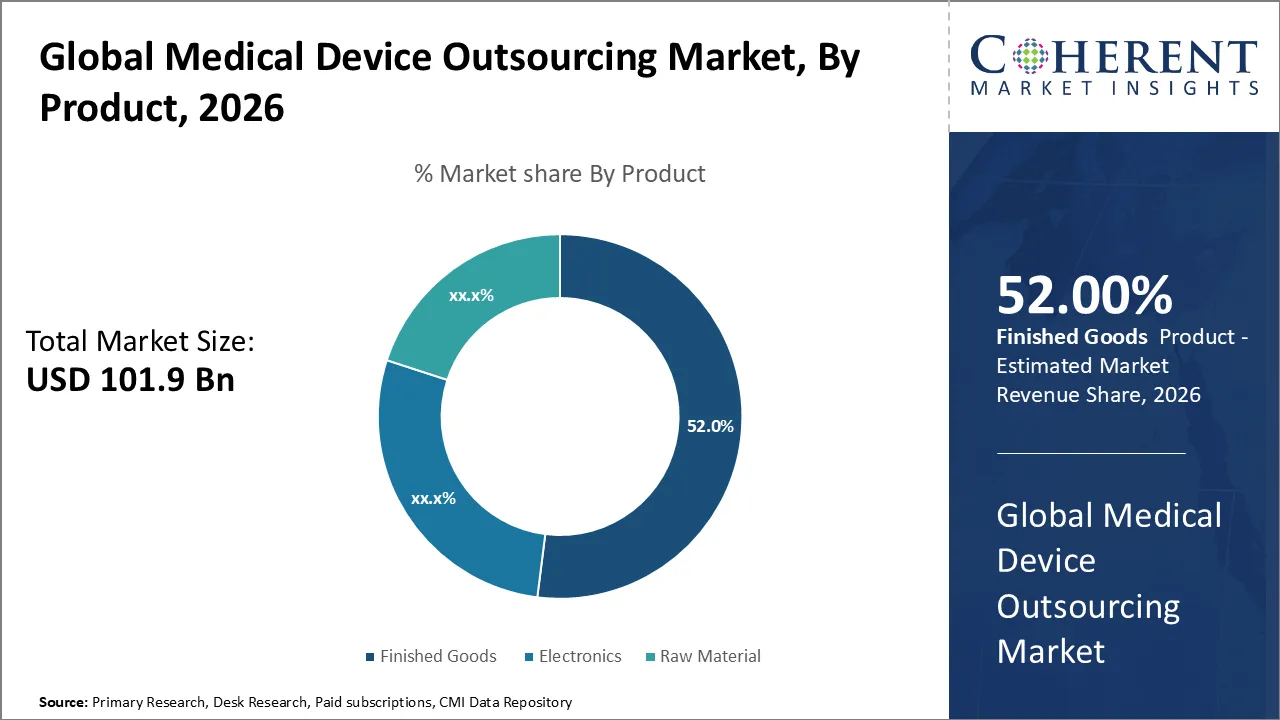
Medical Devices Outsourcing Market Insights, By Product – Finished Goods dominates due to rising end-to-end manufacturing demand
Based on product, the finished goods segment is estimated to contribute the highest market share of 52% in 2026 due to the increasing tendency of OEMs to outsource the complete device manufacturing rather than components. The outsourcing of finished goods benefits medical device companies in terms of lower operational cost, scale benefits, and improved speed-to-market.
For instance, in July 2025, Jabil Healthcare launched turnkey manufacturing solutions for medical devices, covering assembly, testing, and regulatory support services, to better serve OEM clients and accelerate commercialization.
Medical Devices Outsourcing Market Insights, By Device Type – Class II Devices dominate due to high production volume and moderate regulatory requirements
By device type, the Class II devices segment is estimated to generate the highest market share, around 50%, in 2026. Class II devices include infusion pumps, surgical drapes, diagnostic imaging devices, and many other devices that incorporate a significant market share in the total medical device production worldwide. Moderate regulatory control is required for Class II devices, making these devices ideal for outsourcing.
For instance, in July 2025, Elevaris Medical Devices, which acts as a contract development and manufacturing organization (CDMO), introduced live prototyping for the development of medical devices, especially those classified under Class II.
Medical Devices Outsourcing Market Insights, By Application – Cardiovascular leads due to rising heart disease prevalence and innovation
Based on application, the cardiovascular segment is expected to hold a maximum share of 23% in 2026 due to rising global disease burdens and rapid advancements within cardiac device technologies. Increasing demand for stents, pacemakers, defibrillators, and catheter-based systems significantly boosts outsourced needs.
For instance, in January 2026, Boston Scientific announced a definitive agreement to acquire Penumbra, Inc. in a transaction valued at approximately $14.5 billion, after which its cardiovascular device portfolio was significantly enhanced, its products targeting conditions such as pulmonary embolism, stroke, deep vein thrombosis, heart attack, and aneurysms.
Medical Devices Outsourcing Market Insights, By Services – Finished Device Manufacturing dominates due to OEM focus on core competencies
By services, the finished device manufacturing segment is estimated to contribute the highest market share of 35% in 2026. Medical device companies are increasingly outsourcing full-scale production with the objective of optimizing operational efficiency and concentrating resources on R&D and commercialization strategies. Contract manufacturers provide advanced production technologies, automated assembly lines, and global supply chain networks that ensure high-quality output with cost efficiency.
For instance, in May 2025, Quasar Medical announced the acquisition of Nordson’s contract manufacturing operations in Galway (Ireland) and Tecate (Mexico), significantly enhancing its global manufacturing footprint and production capabilities for complex medical devices.
Regional Insights
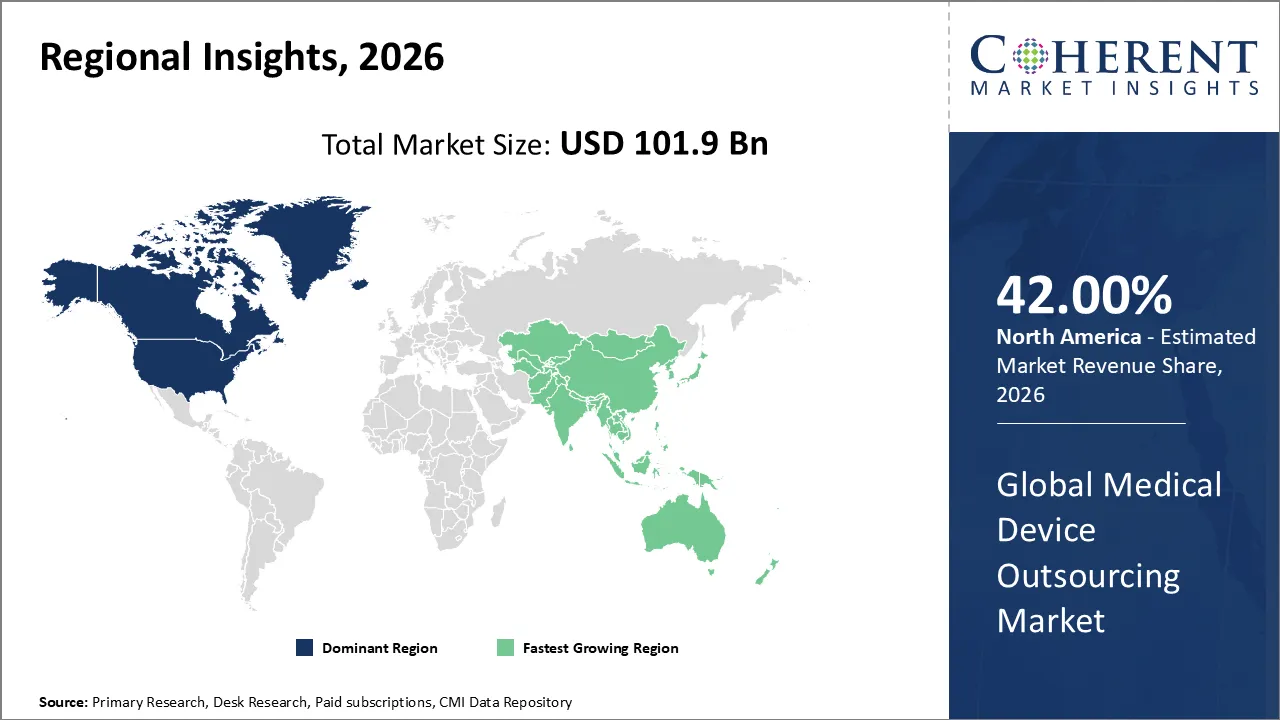
North America Medical Devices Outsourcing Market Analysis & Trends
North America is likely to continue leading the medical devices outsourcing market and account for the maximum share of 42% by 2026. The factors contributing to its leading position in the market include a well-established healthcare infrastructure, high investment of medical device firms in R&D, strong expertise in regulatory compliance, and wide adoption of outsourcing strategies by OEMs to gain operational efficiencies.
For instance, in March 2025, Medline Industries expanded its contract manufacturing and finished device services in the U.S., including new assembly lines for Class II cardiovascular and diagnostic devices.
Asia Pacific Medical Devices Outsourcing Market Analysis & Trends
The Asia Pacific market is expected to be the fastest-growing market for medical device outsourcing in 2026. The drivers of growth in this market include cost-effective production, availability of skilled labor, growth in healthcare infrastructure, and supportive government initiatives for medical device development in countries such as China, India, and Japan.
For instance, in November 2025, Jabil Healthcare announced the expansion of its manufacturing facility in Suzhou, China, adding advanced assembly and testing lines for Class II and Class III devices.
Medical Devices Outsourcing Market Outlook for Key Countries & Regions
Is the U.S. medical devices outsourcing market expanding due to strong OEM presence and advanced healthcare innovation?
The U.S. medical devices outsourcing market is expanding at a rapid rate, considering the presence of key OEMs, high healthcare expenditure, and demands for advanced manufacturing technologies. With outsourcing, local manufacturers are focusing more on core product development activities and utilizing CMOs for other finishing activities.
For instance, in August 2025, Flex Ltd. expanded its medical device outsourcing for U.S. customers by adding more value to the service offerings in design, prototyping, and full-scale finished goods manufacturing to offer better support to OEMs in bringing complex devices to the market.
Is China’s manufacturing prowess fueling its rise in outsourced device production?
China’s medical devices outsourcing market is rapidly gaining ground as domestic and international OEMs seek cost‑effective manufacturing solutions with advanced capacity. Supportive industrial policies and a large skilled workforce, along with growing domestic demand for medical technologies, are driving investment in contract manufacturing facilities.
For instance, in November 2025, China’s National Medical Products Administration (NMPA) officially released a revised Good Manufacturing Practice (GMP) for Medical Devices, representing the first comprehensive update since 2014.
Market Report Scope
Medical Device Outsourcing Market Report Coverage
| Report Coverage | Details | ||
|---|---|---|---|
| Base Year: | 2025 | Market Size in 2026: | USD 101.9 Bn |
| Historical Data for: | 2020 To 2024 | Forecast Period: | 2026 To 2033 |
| Forecast Period 2026 to 2033 CAGR: | 12.4% | 2033 Value Projection: | USD 231.1 Bn |
| Geographies covered: |
| ||
| Segments covered: |
| ||
| Companies covered: | SGS SA, Intertek Group PLC, Wuxi Apptec, TüvSüd AG, Toxikon, INC., American Preclinical Services, Eurofins Scientific, Sterigenics International LLC, Pace Analytical Services LLC., Charles River Laboratories International, Inc., North American Science Associates, Inc., IQVIA, Accellent Inc., Celestica Inc., Benchmark Electronic Inc., Cadence Inc., Providien LLC, Thermo Fischer Scientific Inc., and West Pharmaceuticals Services Inc. | ||
| Growth Drivers: |
| ||
| Restraints & Challenges: |
| ||
Market Dynamics
Medical Devices Outsourcing Market Driver
Rising demand for cost-effective manufacturing and regulatory compliance support
The rising complexities associated with medical devices and enhanced regulatory requirements across various countries have prompted medical device OEMs to outsource various factors, including production, assembly, and other regulatory requirements. This is likely to help companies lower their operational costs and thereby enhance product development. The requirements hold greater significance for Class II and Class III devices that require moderate to high levels of technical skill and quality assurance.
Medical Devices Outsourcing Market Opportunity
Expansion of advanced manufacturing technologies and integrated services
The market offers scope for significant growth opportunities through the development of advanced manufacturing technology for sophisticated devices. Design, development, scale manufacturing, assembly, and/or packaging solutions for contract manufacturers can help them form partnerships. In addition, the development of advanced services for emerging markets or growing segments like cardiovascular, orthopedic, and diagnostics can increase revenue opportunities.
Analyst Opinion (Expert Opinion)
The medical devices outsourcing market is undergoing a fundamental transformation, driven by expertise, compliance, and innovation capacity. Outsourcing is increasingly viewed as a strategic extension of R&D and commercialization rather than a simple operational tool. OEMs are now relying on contract manufacturers not only for production but also for regulatory support, quality assurance, and complex assembly processes.
End-to-end manufacturing solutions are becoming the norm. Leading outsourcing partners provide integrated services including prototyping, full-scale production, assembly, testing, and regulatory documentation. Such capabilities allow OEMs to streamline development cycles and reduce time-to-market, particularly for sophisticated cardiovascular, orthopedic, and diagnostic devices. Regional hubs, especially in Asia Pacific, are emerging as centers of technical expertise and regulatory compliance, challenging the traditional perception of these regions as purely low-cost manufacturing destinations.
Regulatory developments, such as updates to China’s GMP and evolving FDA and EU MDR standards, are reshaping outsourcing dynamics. Manufacturers increasingly seek partners who can navigate these frameworks efficiently while maintaining production quality and scalability. This trend underscores that success in outsourcing now hinges on technical competency, regulatory insight, and the ability to deliver integrated solutions, rather than cost alone.
Speak to the analyst
Want personalized insights?
Take the findings above to one of our principal consultants, or have the report rebuilt around the segments, geographies and competitors you actually track.
Top Strategies Followed by Medical Devices Outsourcing Market Players
- Established players focus on technology, regulatory compliance, and integrated services. Leading contract manufacturers like Jabil Healthcare, Flex Ltd., and Celestica are investing in advanced manufacturing technologies, quality systems, and regulatory expertise. They offer integrated solutions that include prototyping, assembly, testing, sterilization, and packaging to streamline efficiency and ensure regulatory conformity across sophisticated Class II and Class III devices.
- Mid-level players compete on operational efficiency and specialized services. These companies employ cost-efficient production patterns, geography-based networks, and service provision practices to remain competitive in the market. Their usual scope includes serving therapeutic segments such as cardiovascular, orthopedic, and diagnostic devices.
- Small-scale firms specialize in niche segments or emerging device types. These companies serve underserved markets or emerging product categories such as wearable monitoring devices, minimally invasive implants, and lab-on-a-chip diagnostics. They use new manufacturing technologies, digital quality management systems, and local partnerships to reach additional patients and markets, even with limited scale and budget.
Emerging Startups in the Medical Devices Outsourcing Market
- Innovation-driven startup organizations are developing pioneering technologies. Organizations are creating smart devices, connected devices, and devices that are to be implanted in the body, therefore requiring high-end outsourcing. For instance, innovation-driven startup organizations are collaborating with Contract Manufacturers to integrate electronics, sensors, and microfluidics into Class II and III devices.
- Sustainability and Eco-Conscious Manufacturing: There seems to be increased emphasis on sustainability and eco-conscious manufacturing contracts. There are startups and smaller OEMs looking for contract manufacturers that can help them achieve sustainable manufacturing processes.
- Niche and specialized offerings create growth opportunities. Some startups focus on adaptive or personalized devices, such as wearable diagnostics or patient-specific implants, while others form strategic partnerships with universities or technology providers to accelerate development. These collaborations highlight the market’s move toward high-tech, flexible, and innovation-driven outsourcing solutions.
Medical Device Outsourcing Industry News
- In December 2025, Intertek announced the acquisition of an additional 29,000 sq ft facility adjacent to its Melbourn site to expand GMP pharmaceutical services, including analytical testing and clinical material production capabilities.
- In May 2025, Quasar Medical announced the acquisition of Nordson’s contract manufacturing operations in Galway (Ireland) and Tecate (Mexico), strengthening its capability in highly specialized medical device manufacturing such as balloon and catheter design, expanding its outsourcing service portfolio and global production capacity.
- In March 2025, Flex Ltd. opened a new Product Introduction (NPI) center near Boston, USA, aimed at supporting healthcare customers with end‑to‑end support from prototyping to production transfer.
Market Segmentation
- Product Insights (Revenue, USD Bn, 2026 - 2033)
- Finished Goods
- Electronics
- Raw Material
- Device Type Insights (Revenue, USD Bn, 2026 - 2033)
- Class I Devices
- Class II Devices
- Class III Devices
- Application Insights (Revenue, USD Bn, 2026 - 2033)
- Orthopedics and Spine
- Cardiovascular
- Radiology
- General Medical Devices
- Others
- Services Insights (Revenue, USD Bn, 2026 - 2033)
- Prototype Development
- Finished Device Manufacturing
- Assembly & Packaging
- Testing & Regulatory Support Services
- Regional Insights (Revenue, USD Bn, 2026 - 2033)
- North America
- U.S.
- Canada
- Latin America
- Brazil
- Argentina
- Mexico
- Rest of Latin America
- Europe
- Germany
- U.K.
- Spain
- France
- Italy
- Russia
- Rest of Europe
- Asia Pacific
- China
- India
- Japan
- Australia
- South Korea
- ASEAN
- Rest of Asia Pacific
- Middle East
- GCC Countries
- Israel
- Rest of Middle East
- Africa
- South Africa
- North Africa
- Central Africa
- North America
- Key Players Insights
- SGS SA
- Intertek Group PLC
- Wuxi Apptec
- TuvSud AG
- Toxikon, INC.
- American Preclinical Services
- Eurofins Scientific
- Sterigenics International LLC
- Pace Analytical Services LLC.
- Charles River Laboratories International, Inc.
- North American Science Associates, Inc.
- IQVIA
- Accellent Inc.
- Celestica Inc.
- Benchmark Electronic Inc.
- Cadence Inc.
- Providien LLC
- Thermo Fischer Scientific Inc.
- West Pharmaceuticals Services Inc.
Sources
Primary Research Interviews
- Medical Device Manufacturers & Brand Managers
- Contract Manufacturing Organizations (CMOs)
- Product Development & R&D Heads
- Regulatory Affairs & Quality Assurance Managers
- Hospital Procurement Officers & Healthcare Providers
- E-commerce & Distribution Platform Managers
- Clinical Researchers & Consultants
- Others
Databases
- PubMed
- FDA Device Database
- ClinicalTrials.gov
- WHO Global Health Observatory
- U.S. National Library of Medicine (NLM)
- Others
Magazines
- Medical Device & Diagnostic Industry (MD+DI)
- MedTech Dive
- Medical Design & Outsourcing Magazine
- Healthcare Technology Magazine
- MassDevice
- Others
Journals
- Journal of Medical Devices
- International Journal of Medical Robotics and Computer Assisted Surgery
- Journal of Biomedical Materials Research
- Medical Device and Diagnostic Industry Journal
- Others
Newspapers
- The New York Times (Health & Science Section)
- The Wall Street Journal (Healthcare Section)
- The Guardian (Health & Science)
- Reuters Health
- Bloomberg News – Healthcare
- Others
Associations
- Advanced Medical Technology Association (AdvaMed)
- Medical Device Manufacturers Association (MDMA)
- International Federation of Medical and Biological Engineering (IFMBE)
- Regulatory Affairs Professionals Society (RAPS)
- Others
Public Domain Sources
- FDA – Device Approvals & Recalls Reports
- U.S. Census Bureau – Healthcare Industry Data
- Centers for Medicare & Medicaid Services (CMS) – Healthcare Expenditure Data
- World Health Organization (WHO) – Medical Device Reports
- National Institutes of Health (NIH) Publications
- Others
Proprietary Elements
- CMI Data Analytics Tool
- Proprietary CMI Existing Repository of Information for the Last 8 Years
Get access to 250+ pages report
Every segment, forecast, competitor profile and data table behind the analysis above — available for instant download.
- ESOMAR Member
- ISO 9001:2015 Certified
- D-U-N-S Registered
- GDPR & CCPA Compliant
Missing comfort of reading report in your local language? Find your preferred language:
Transform your Strategy with Exclusive Trending Reports
Frequently Asked Questions
The Medical Device Outsourcing Market is estimated to be valued at USD 101.9 Bn in 2026, and is expected to reach USD 231.1 Bn by 2033.
The CAGR of the Medical Device Outsourcing Market is projected to be 12.4% from 2026 to 2033.
Rising demand for advanced medical devices, increasing regulatory pressures, cost optimization strategies by device manufacturers, and the need for specialized manufacturing capabilities are major factors driving market growth.
Stringent regulatory compliance, data security concerns, and dependency on third-party manufacturers are key factors hampering growth.
In terms of device type, class II devices segment is estimated to dominate the market in 2026.
SGS SA, Intertek Group PLC, Wuxi Apptec, TüvSüd AG, Toxikon, INC., American Preclinical Services, Eurofins Scientific, Sterigenics International LLC, Pace Analytical Services LLC., Charles River Laboratories International, Inc., North American Science Associates, Inc., IQVIA, Accellent Inc., Celestica Inc., Benchmark Electronic Inc., Cadence Inc., Providien LLC, Thermo Fischer Scientific Inc., and West Pharmaceuticals Services Inc. are the major players.
North America is expected to lead the medical device outsourcing market in 2026 due to advanced healthcare infrastructure and a high concentration of device manufacturers.