

Medical Imaging Analysis Software Market Size and Share Analysis - Growth Trends and Forecasts (2026 - 2033)
The medical imaging analysis software market was valued at USD 2.9 Bn in 2026 and is forecast to reach a value of USD 4.68 Bn by 2033 at a CAGR of 7.57% between 2026 and 2033.
Key Takeaways
- Based on image type, the 3D image segment is expected to hold 48.9% share of the market in 2026.
- Based on modality, the tomography segment is projected to account for 40% share of the market in 2026.
- Based on software type, the standalone software segment is expected to lead the market with 66.4% share in 2026.
- Based on end user, the hospital segment is projected to capture 54% share in 2026.
- Based on Region, North America is set to lead the medical imaging analysis software market with 55% share in 2026. While, Asia Pacific is anticipated to have the fastest growing region.
Market Overview
The global medical imaging analysis software market is experiencing strong growth owing to the increasing prevalence of chronic diseases across the globe and technological advancements in the field of medical imaging. Over the years, medical imaging has evolved from relatively primitive 2D scans into high-resolution sources of valuable information. The use of 3D imaging (even 4D imaging) technologies in medical imaging has the ability to create better images, as well as powerful results. Moreover, increasing prevalence of chronic disease worldwide is expected to aid in the growth of the market.
Current Events and their Impacts
Current Event | Description and its Impact |
Advances in AI and Autonomous Imaging Technologies |
|
Expansion of 3D and Advanced Imaging Modalities |
|
Role of AI (Artificial Intelligence) in Medical Imaging Analysis Software Industry
Artificial Intelligence (AI) is transforming medical imaging analysis by enhancing accuracy, efficiency, and diagnostic capabilities. AI algorithms, particularly deep learning models, can automatically detect, segment, and classify abnormalities in images such as X-rays, MRIs, and CT scans. This reduces human error, accelerates diagnosis, and assists radiologists in prioritizing critical cases. AI-driven imaging software also enables predictive analytics, tracking disease progression, and personalized treatment planning.
In March 2026, ADLINK Technology Inc., a global edge AI computing leader, announced it will exhibit at NVIDIA GTC 2026, booth 141, March 16–19, highlighting its Edge AI platforms for scalable humanoid robotics, medical image analytics, and high-performance embedded graphics.
- Current Industry Events of 2026
- Market Size Estimation
- Regional Breakdown
- Competitive Landscape
- Customer Intelligence
- Segmental Analysis
- Pricing Analysis
- Key Market Drivers, Challenges & Future Trends
- Customized Insights Section
Segmental Insights
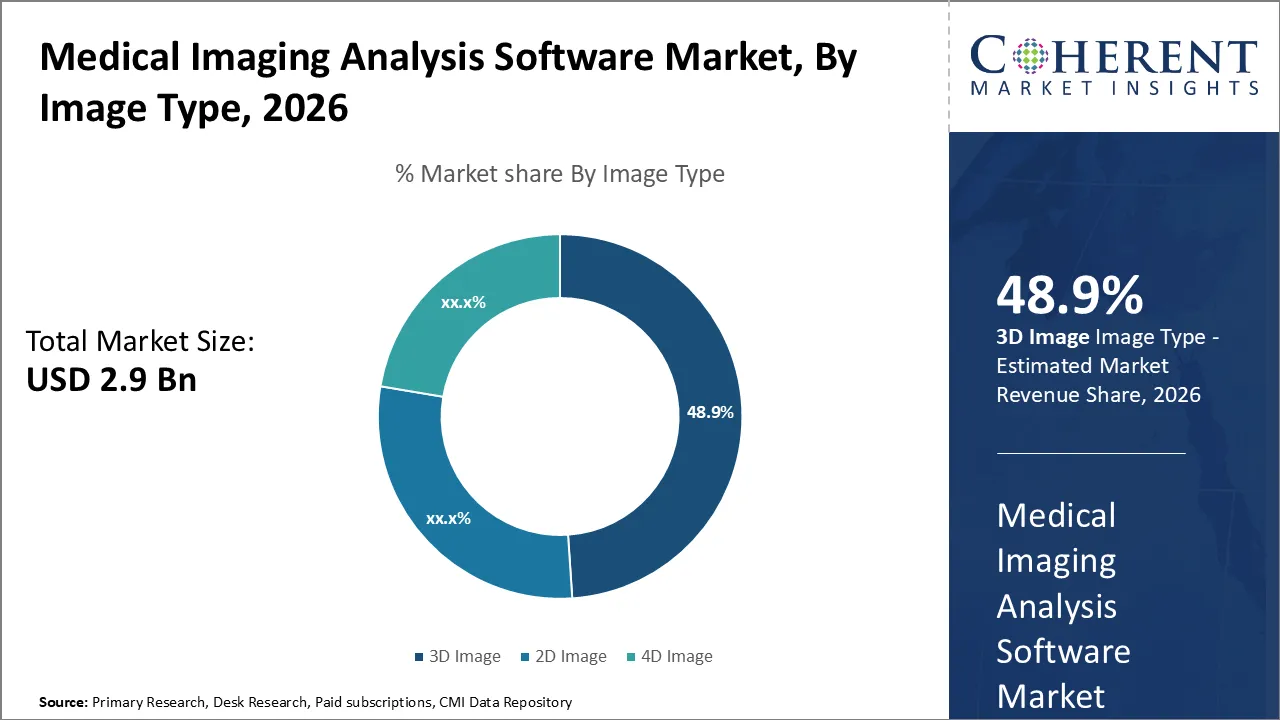
Medical Imaging Analysis Software Market Insights, By Image Type - 3D Image represent the largest market share, because 3D images provide more detailed as well as accurate information than 2D images
In terms of image type, the 3D Image segment is expected to lead the market with 48.9% share in 2026, due to its extensive use in clinical diagnostics, surgical planning, and therapeutic monitoring. The dominance of 3D imaging technologies stems from their ability to bring volumetric views of anatomical structures, providing clinicians a more complete and detailed understanding compared to conventional 2D images.
For instance, in December 2025, Nikon launched AI Reconstruction, new 3D CT scan software that utilizes artificial intelligence to make images faster without compromising quality, highlighting the ongoing innovation as well as use of 3D imaging solutions in the market.
Medical Imaging Analysis Software Market Insights, By Modality - Tomography dominate the market share because it provides highly detailed 3D images that are essential for accurate diagnosis, treatment planning, and monitoring
In terms of modality, the tomography segment is expected to hold 40% share of the market in 2026. owing to its advanced imaging capabilities, widespread application in diagnostics, and integration with cutting-edge software solutions that enhance the precision and speed of medical interpretations. Tomography, particularly in the form of Computed Tomography (CT) scans, has become indispensable in a broad spectrum of clinical applications, including oncology, cardiology, neurology, and emergency medicine.
For instance, in November 2025, Nanox, a medical imaging technology company, announced that it will show its Nanox.ARC X tomosynthesis system and new AI software at the RSNA 2025 Annual Meeting from November 30 to December 4 in Chicago.
Medical Imaging Analysis Software Market Insights, By Software Type - Standalone Software leads because it can work with many different imaging machines, is easier to install, and is more flexible for hospitals and diagnostic centers compared to integrated software
In terms of software type, the standalone software segment is projected to account for 66.4% share of the market in 2026. Owing to several intrinsic advantages and well-established foothold within healthcare and diagnostic environments. Standalone software solutions have historically been the primary tools deployed in radiology as well as medical imaging departments due to their specific, focused functionalities that are usually optimized for certain imaging modalities such as MRI, CT, ultrasound, or X-ray.
For instance, many hospitals and diagnostic centers have long relied on specialized platforms like AnalyzeDirect and OsiriX, which are designed to operate independently of larger hospital IT infrastructures. This specificity allows standalone solutions to offer a high degree of customization, flexibility, and specialized image processing capabilities which are essential for radiologists, clinicians, and researchers who require reliable as well as performance-efficient systems tailored to their needs.
Medical Imaging Analysis Software Market Insights, By End User - Hospital dominate as they handle the largest number of patients and perform the most imaging tests, making them the biggest users of medical imaging analysis software
In terms of end user, the hospital segment is projected to capture 54% share in 2026, hospitals contribute the highest share in the market, primarily owing to their broad infrastructure, diverse patient base, as well as multifaceted diagnostic and treatment requirements. Hospitals, especially large tertiary-care institutions as well as academic medical centers, integrate multiple imaging modalities such as MRI, CT scans, X-rays, and ultrasound, necessitating advanced imaging analysis software to enhance diagnostic accuracy and operational efficiency.
For instance, prominent healthcare institutions like the Mayo Clinic and Cleveland Clinic extensively employ sophisticated imaging analysis tools to support complex clinical workflows as well as multidisciplinary case management. These tools facilitate automated image processing, three-dimensional reconstructions, and AI-driven predictive diagnostics, which are critical in managing a broad spectrum of diseases including oncology, neurology, and cardiology.
Regional Insights
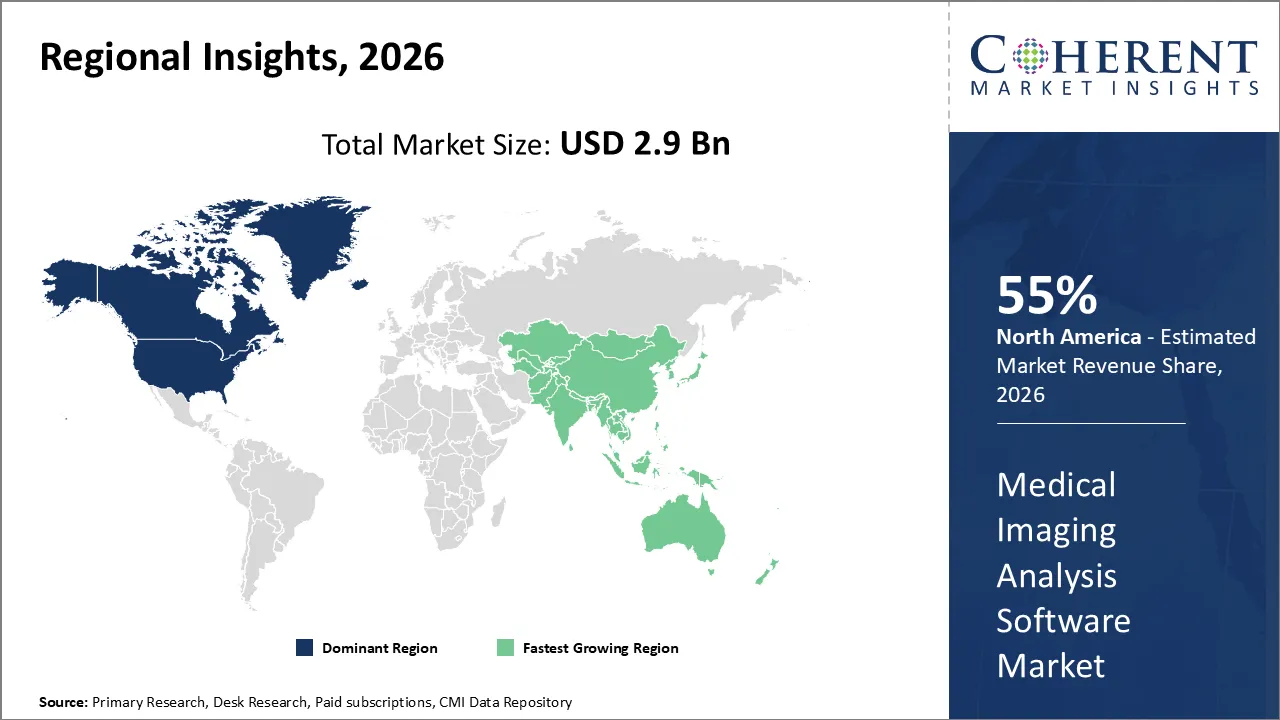
North America Medical Imaging Analysis Software Market Analysis & Trends
North America is expected to dominate the medical imaging analysis software market with 55% share in 2026, owing to several critical factors that include robust healthcare infrastructure, extensive adoption of advanced technologies, and a concentrated presence of leading market players.
For instance, in March 2026, announced the U.S. launch of the VISERA ELITE III surgical imaging system. It is designed to help surgeons see better, work more efficiently, and use it in many types of surgeries. This is the third major product made by SONY Olympus Medical (SOMED), a joint venture started in 2013.
Asia Pacific Medical Imaging Analysis Software Market Analysis & Trends
Asia Pacific is expected to exhibit the fastest growth, the surge in digital transformation initiatives and burgeoning healthcare spending have been critical drivers that elevate Asia-Pacific’s dominance in the Medical Imaging Analysis Software Market. The region’s governments actively promote the utilization of digital health solutions across urban as well as rural healthcare facilitiegs, catering to the gaps in diagnostic capacities through advance imaging tools.
For instance, in December 2025, At RSNA 2025, Canon Medical Systems showed its latest CT technologies, including 320-row Area Detector CT, Ultra-High-Resolution CT, as well as AI-based image reconstruction software. These innovations advances image quality, speed, and analysis, showcasing Canon’s consistant leadership in CT imaging as well as supporting advanced medical imaging software applications.
Medical Imaging Analysis Software Market Outlook Country-Wise
The U.S. Medical Imaging Analysis Software Market Trends
The U.S. contributes the highest share in the Medical Imaging Analysis Software Market owing to its highly advanced healthcare infrastructure, robust adoption of cutting-edge medical technologies, as well as substantial investments in research and development. The U.S. healthcare ecosystem focus the integration of artificial intelligence (AI) and machine learning (ML) into clinical workflows, majorly propelling the demand for sophisticated imaging analysis software.
For instance, institutions such as the National Institutes of Health (NIH) have highly promoted initiatives to integrate AI-driven imaging platforms across radiology departments to enhance diagnostic accuracy as well as patient outcomes. Major academic medical centers like the Mayo Clinic and Johns Hopkins have pioneered the deployment of AI-enabled imaging analysis tools to detect early-stage pathologies such as cancer, cardiovascular anomalies, neurological disorders, etc.
China Medical Imaging Analysis Software Market Trends
China contributes the highest share in the Medical Imaging Analysis Software Market within the region owing to its high technological advancements, strategic government initiatives, as well as a robust healthcare infrastructure that supports digital transformation. The country has been undergoing substantial modernization of its medical facilities, primarily bolstered by state-backed policies such as the "Healthy China 2030" plan, which emphasizes the integration of digital health technologies, including AI-driven medical imaging solutions, to improve patient outcomes as well as optimize healthcare workflows.
For instance, China’s Ministry of Health has promoted the high adoption of AI-enabled diagnostic tools, especially in medical imaging fields such as radiology and oncology, to address the high burden of chronic diseases such as cancer and cardiovascular conditions.
Market Report Scope
Medical Imaging Analysis Software Market Report Coverage
| Report Coverage | Details | ||
|---|---|---|---|
| Base Year: | 2025 | Market Size in 2026: | USD 2.9 Bn |
| Historical Data for: | 2020 To 2024 | Forecast Period: | 2026 To 2033 |
| Forecast Period 2026 to 2033 CAGR: | 7.57% | 2033 Value Projection: | USD 4.68 Bn |
| Geographies covered: |
| ||
| Segments covered: |
| ||
| Companies covered: | Xinapse Systems Ltd., Siemens Healthcare GmbH, ScienceSoft USA Corporation, Koninklijke Philips NV, Carestream Health, AQUILAB SAS, Agfa-Gevaert Group, General Electric Company (GE Healthcare), Canon Inc. (Canon Medical Systems, United States), and International Business Machines Corporation (IBM), among others. | ||
| Growth Drivers: |
| ||
| Restraints & Challenges: |
| ||
Market Dynamics
Medical Imaging Analysis Software Market Driver
Increasing prevalence of chronic diseases
The increasing prevalence of chronic diseases such as cancer, cardiovascular diseases, diabetes, and neurological disorders is significantly driving the demand for advanced medical imaging analysis software. Chronic diseases usually require detailed and frequent imaging examinations to monitor disease progression, guide treatment plans, and assess therapeutic outcomes.
Rising investments in healthcare infrastructure
The increasing investments in healthcare infrastructure across both developed and emerging economies are significantly propelling the demand for medical imaging analysis software, thereby fostering the overall expansion of this market. Governments and international organizations have been channeling substantial funds to upgrade medical facilities, driven by a growing emphasis on early diagnosis, precision medicine, and improving patient outcomes.
Medical Imaging Analysis Software Market Opportunity
Integration of AI with medical imaging for automated analysis
The integration of artificial intelligence (AI) with medical imaging for automated analysis presents a transformative opportunity within the Medical Imaging Analysis Software Market. These fusion leverages AI’s capabilities, such as machine learning and deep learning algorithms, to enhance diagnostic accuracy, reduce interpretation times, and minimize human error. For instance, AI-powered software can rapidly analyze complex imaging data from modalities like MRI, CT scans, and X-rays, highlighting anomalies such as tumors or fractures that may be missed by the human eye. A notable example is the use of AI in detecting early signs of diseases like cancer and neurological disorders, where early and accurate detection is crucial for effective treatment.
Analyst Opinion (Expert Opinion)
The Medical Imaging Analysis Software Market is experiencing significant transformation, driven primarily by the high utilization of advanced imaging technologies in healthcare. The rising occurrence of chronic diseases such as cancer, cardiovascular ailments, as well as neurological disorders is fueling demand for precise diagnostic tools, positioning imaging analysis software as a critical component in enhancing diagnostic accuracy and treatment planning.
Technological advancements, including AI and machine learning integration, are further enabling automated, faster, as well as more accurate image interpretation, thereby advancing clinical decision-making processes.
However, the market growth is somewhat restrained by the high costs associated with advanced imaging software as well as the complexity of integrating these solutions within existing healthcare infrastructure. Data privacy concerns as well as regulatory challenges, particularly regarding patient data management and software validation, also pose barriers to widespread adoption.
Emerging economies present substantial opportunities owing to expanding healthcare infrastructure, increased government initiatives, and rising awareness about the benefits of early diagnosis. North America remains the dominant region due to well-established healthcare systems, extensive research activities, as well as significant investments in medical technology.
Meanwhile, the Asia-Pacific region is emerging as the fastest-growing market, driven by advancing medical facilities, rising geriatric population, as well as escalating demand for cost-effective diagnostic solutions.
Overall, the Medical Imaging Analysis Software Market is poised for continued innovation, with high emphasis on cloud-based solutions, interoperability, as well as real-time analytics, which are expected to reshape diagnostic workflows and contribute to better patient outcomes globally.
Speak to the analyst
Want personalized insights?
Take the findings above to one of our principal consultants, or have the report rebuilt around the segments, geographies and competitors you actually track.
Global Medical Imaging Analysis Software Market: Key Developments
- In March 2025, GE HealthCare announced a partnership with NVIDIA at GTC 2025. They will work together on new AI-based imaging technology, starting with autonomous X-ray and ultrasound applications.
- In March 2026, Subtle Medical, a company that makes AI medical imaging software, announced it will take part in the European Congress of Radiology (ECR) 2026 from March 4–8 in Vienna, Austria. At the event, the company will show 14 presentations about AI improvements for MRI and PET images and early research on using AI for CT scans.
Market Segmentation
- By Image Type
- 2D Image
- 3D Image
- 4D Image
- By Modality
- Tomography
- Ultrasound Imaging
- Radiographic Imaging
- X-ray Imaging
- MRI
- Other Modalities
- By Software Type
- Integrated Software
- Standalone Software
- By End User
- Hospital
- Diagnostic Center
- Research Center
- By Region
- North America
- U.S.
- Canada
- Latin America
- Brazil
- Argentina
- Mexico
- Rest of Latin America
- Europe
- Germany
- U.K.
- Spain
- France
- Italy
- Russia
- Rest of Europe
- Asia Pacific
- China
- India
- Japan
- Australia
- South Korea
- ASEAN
- Rest of Asia Pacific
- Middle East & Africa
- GCC Countries
- Israel
- Rest of Middle East & Africa
- North America
- Key Players
- Xinapse Systems Ltd.
- Siemens Healthcare GmbH
- ScienceSoft USA Corporation
- Koninklijke Philips NV
- Carestream Health
- AQUILAB SAS
- Agfa-Gevaert Group
- General Electric Company (GE Healthcare)
- Canon Inc. (Canon Medical Systems, United States)
- International Business Machines Corporation (IBM)
Sources
Primary Research Interviews
- Radiologists
- Medical Imaging Software Developers
- Hospital Procurement Managers
- Healthcare IT Consultants
- Others
Databases
- Thomson Reuters Eikon
- IQVIA (sales, prescription, and treatment trend datasets)
- ClinicalTrials.gov database
- WHO Global Health Observatory
- OECD Health Statistics
- Others
Magazines
- Medical Imaging Technology
- Diagnostic Imaging Magazine
- Healthcare IT News
- Others
Journals
- Journal of Medical Imaging
- European Journal of Radiology
- IEEE Transactions on Medical Imaging
- Others
Newspapers
- The New York Times – Health Section
- The Guardian – Healthcare
- The Wall Street Journal – Health & Technology
- Others
Associations
- Radiological Society of North America (RSNA)
- American College of Radiology (ACR)
- Society for Imaging Informatics in Medicine (SIIM)
- Others
Public Domain Sources
- World Health Organization (WHO) Reports
- U.S. Food & Drug Administration (FDA)
- Centers for Medicare & Medicaid Services (CMS)
- Others
Proprietary Elements
- CMI Data Analytics Tool
- Proprietary CMI Existing Repository of Information for the Last 8 Years
Get access to 250+ pages report
Every segment, forecast, competitor profile and data table behind the analysis above — available for instant download.
- ESOMAR Member
- ISO 9001:2015 Certified
- D-U-N-S Registered
- GDPR & CCPA Compliant
Missing comfort of reading report in your local language? Find your preferred language:
Transform your Strategy with Exclusive Trending Reports
Frequently Asked Questions
The global medical imaging analysis software market size was valued at USD 2.90 million in 2026 and is expected to reach USD 4.68 million in 2033.
Major players operating in the market include Xinapse Systems Ltd., Siemens Healthcare GmbH, ScienceSoft USA Corporation, Koninklijke Philips NV, Carestream Health, AQUILAB SAS, Agfa-Gevaert Group, General Electric Company (GE Healthcare), Canon Inc. (Canon Medical Systems, United States), and International Business Machines Corporation (IBM), among others.
Among image type, the 3D image segment estimated significant revenue in 2026.
Increasing usage of imaging equipment due to rising prevalence of chronic diseases and rise in demand for diagnostic imaging software in various medical fields are fueling the growth of the market.
The market is estimated to exhibit a CAGR of 7.57% till 2033.
Among region, North America is expected to witness significant growth over the forecast period.