

E-Prescribing Market Size and Trends - 2026 to 2033
The E-Prescribing Market is estimated to be valued at USD 5.2 Bn in 2026 and is expected to reach USD 20.0 Bn by 2033, growing at a compound annual growth rate (CAGR) of 18.6% from 2026 to 2033.
Key Takeaways
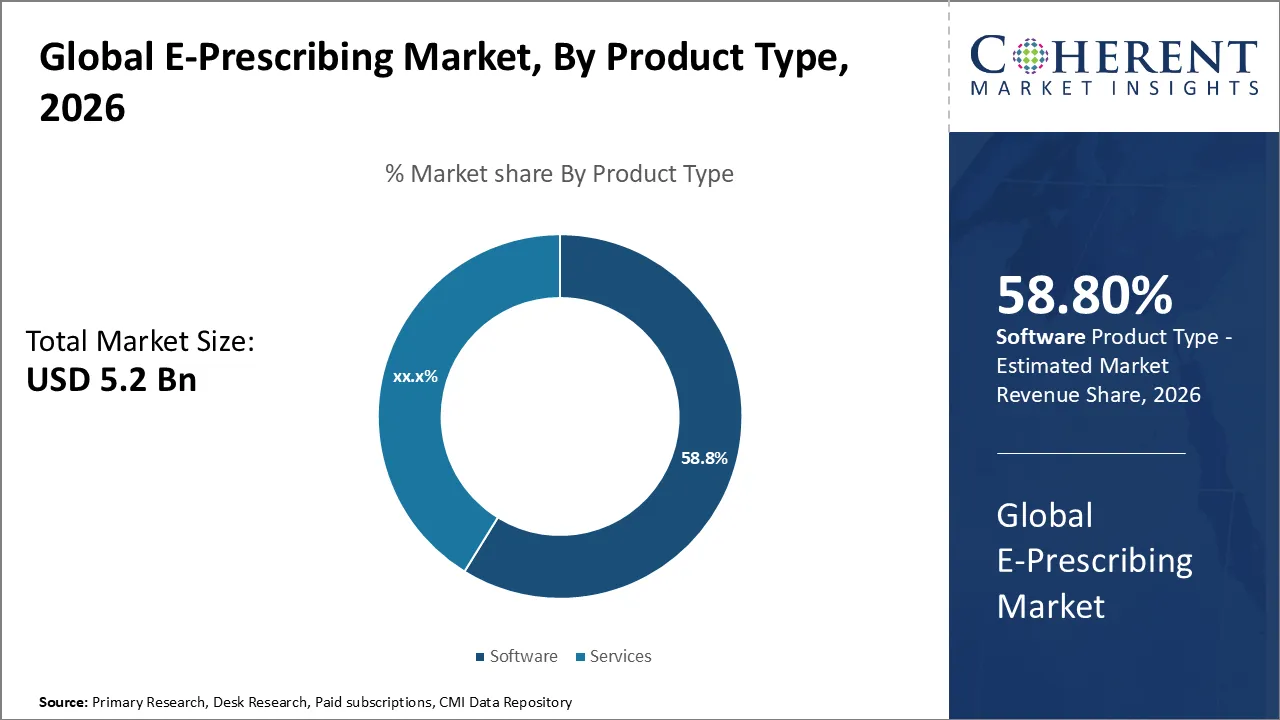
- Based on Product Type, the Software segment is expected to lead the market with 58.80% share in 2026, owing to high adoption of e‑prescribing platforms and EHR integration.
- Based on Deployment, the Web & Cloud-based segment is expected to lead the market with 68.10% share in 2026, due to scalability as well as remote access advantages.
- Based on End User, the Hospital segment is expected to lead the market with 47.40% share in 2026, due to high prescription volumes.
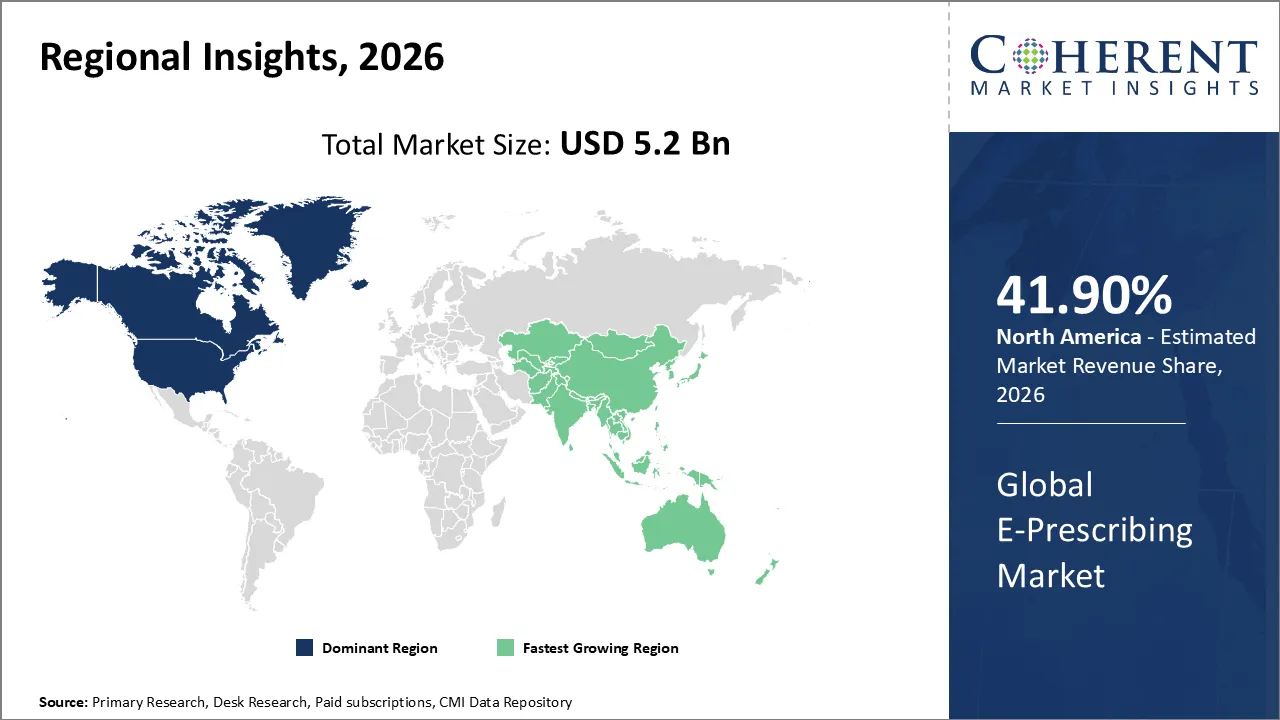
- Based on Region, North America is set to lead the market with 41.90% share in 2026. While, Asia Pacific is anticipated to be the fastest growing region.
Market Overview
The E-Prescribing Market is growing rapidly, driven by the wider use of digital health solutions and a stronger focus on patient safety and simpler, smoother healthcare workflows. The expanding government mandates for the Electronic Prescribing of Controlled Substances (EPCS) and the increasing use of telehealth services are expected to support market growth over the forecast period.
E-Prescribing acts as the digital backbone of modern medication management, replacing traditional paper-based methods with fast, secure electronic transmission of prescriptions directly from the point of care to pharmacies. These platforms are used for the easy and accurate sharing of patient medication data and clinical decision support, helping reduce adverse drug events and improve overall health outcomes.
The e-prescribing industry is entering a strong growth phase driven by key technological advances like cloud-based delivery models, the use of artificial intelligence for quick drug interaction alerts, and the growing need for easy data exchange within Electronic Health Records (EHR). These advances have expanded the capabilities of e-prescribing software and improved its efficiency, security, and automation, leading to a clear shift in the market. As healthcare systems around the world move toward paperless operations, these platforms are becoming essential for managing complex treatment plans in chronic disease care and specialty medicine.
Current Events and their Impacts on the E-Prescribing Market
Current Event | Description and the Impact |
Technological Advancements and Integration |
|
Regulatory and Policy Changes in Key Regions
|
|
Market Consolidation and Partnerships |
|
Segmental Insights
- Current Industry Events of 2026
- Market Size Estimation
- Regional Breakdown
- Competitive Landscape
- Customer Intelligence
- Segmental Analysis
- Pricing Analysis
- Key Market Drivers, Challenges & Future Trends
- Customized Insights Section
E-Prescribing Market Insights, By Product Type – Software Leads Due to High Adoption of E ‑ Prescribing Platforms
In terms of product type, the software segment contributes the highest share of 58.80% in 2026 of the market. The growth is because it provides the core functions needed for digital scripts. These applications integrate smoothly with electronic health records to provide clinicians with real-time alerts regarding drug interactions and patient allergies. Regulatory mandates across many regions now require healthcare providers to use certified software for prescribing controlled substances to ensure transparency. As medical practices move away from paper-based systems, the demand for advanced software that offers clinical decision support continues to grow. This segment remains the most significant revenue generator because software requires ongoing subscription fees and regular updates to stay compliant with changing medical regulations and security standards.
For instance, in November 2025, Vagaro, a leading software solution for businesses in the beauty, wellness, and fitness industries, has introduced E-Prescribe. This new integration aims to modernize and simplify the management of prescriptions for medspas and other providers.
E-Prescribing Market Insights, By Deployment – Web & Cloud-based Leads Due to Scalability and Remote Access Advantages
In terms of deployment, the web & cloud-based devices segment contributes the highest share of 68.10% in 2026 of the market. This growth is due to its better access and lower cost for healthcare providers. The deployment model enables doctors to create and transmit prescriptions from any location using an internet connection and mobile device. The cloud dilutions do not require costly hardware installations or dedicated IT staff to maintain local servers. Numerous clinics prefer this model because it offers automatic data backups and high levels of encryption to protect sensitive patient information. The scalability of cloud platforms makes them ideal for both small independent practices and large medical groups. This felicity has made web-based delivery the standard choice for modern healthcare organizations seeking efficient data management.
E-Prescribing Market Insights, By End User – Hospitals Leads Due to Prescription Volumes
In terms of end user, the hospitals segment contributes the highest share of 47.40% in 2026 of the market. This growth is because these institutions process the largest number of daily prescriptions. The hospitals rely on e-prescribing to manage complex patient care in many departments, like emergency rooms and surgical units. The integration of these systems helps hospital staff reduce the risk of prescription mistakes and ensures that pharmacy orders are correct. Furthermore, large hospital networks often have the financial resources and infrastructure needed to adopt full digital health systems. Government initiatives often provide financial incentives for hospitals to use electronic systems, further strengthening this leadership. The hospitals can speed up patient discharge and improve long-term medication adherence by centralizing the prescription process.
For instance, in January 2026, Worcestershire Acute Hospitals NHS Trust has implemented Altera Digital Health’s Sunrise electronic prescribing and medicines administration (ePMA) system. This system has been deployed in 56 inpatient wards and urgent care areas throughout the trust’s 3 hospital sites.
Regional Insights
North America E-Prescribing Market Analysis & Trends
North America has remained the dominant region with 41.90% in 2026 of the global E-Prescribing Market over the past decade. The growth is driven by a well-developed healthcare infrastructure and early clear regulatory actions. The region’s dominance is due to federal mandates that supported the adoption of electronic health records and reduced the continued use of paper-based systems. One of the major factors in this market is the strict requirement for the electronic prescription for controlled substances, which serves as a key tool in dealing with the opioid crisis. The presence of major industry players and a strong network connecting prescribers, pharmacies, and insurance payers ensures easy interoperability. In addition, an ongoing cultural shift emphasizing patient safety and the mitigation of human error has facilitated the integration of these digital solutions into routine clinical practice. This mature ecosystem continues its evolution via the ongoing integration of real-time benefit tools and telehealth platforms.
For instance, in August 2025, Blue Shield of California launched an innovative service featuring mobile push notifications that alert members when their doctor initiates an e-prescription order. This feature encourages patients to check drug prices and explore alternatives, including more affordable options.
Asia Pacific E-Prescribing Market Analysis & Trends
The Asia Pacific region is experiencing the fastest growth in the e-prescribing market, fueled by large digital transformation efforts across emerging economies. The governments are placing a greater emphasis on the modernization of healthcare systems to manage aging populations and the increasing prevalence of chronic diseases.
Countries like Japan, China, and India are implementing national digital health systems that connect patient identities with medical records and pharmacy services. This growth is also supported by the widespread use of smartphones and the rise in internet connectivity, which has made telemedicine and e-pharmacy services reachable even in rural areas. Strong investments in cloud-based infrastructure allow for low-cost scaling compared to traditional on-premise systems. As healthcare providers move away from disconnected paper records, the region is quickly becoming a major hub for technological innovation and large-scale digital precision activity.
For instance, in May 2025, the Rajendra Institute of Medical Sciences (RIMS) has begun a trial of e-prescription services within its psychiatry department to support its initiative aimed at advancing digital transformation in healthcare.
E-Prescribing Market Outlook Country-Wise
The US E-Prescribing Market Trends
The US e-prescribing market has reached a phase of almost full adoption, with most prescribers now using electronic systems. The growth is mainly driven by rules for the electronic prescribing of controlled substances and integration with prescription drug monitoring programs to help control the opioid crisis. The market is moving from simple transaction tools to AI based clinical decision support systems that spot drug interactions in real time. The major industry firms are focusing on specialized medication workflows and improving patient medication adherence across the nation’s well-developed healthcare IT infrastructure. This ensures higher levels of patient safety and pharmacy efficiency across all states.
For instance, in April 2025, Photon Health announced a partnership with Amazon Pharmacy, a digital-first, full-service online pharmacy that makes prices clearer and makes medications easier for patients to get while also delivering them quickly.
China E-Prescribing Market Trends
China’s e-prescribing market is at a major turning point in the first year of its latest five-year plan. The market is expanding beyond top-tier urban hospitals into regional and rural healthcare networks driven by national health initiatives. A main driver is the rapid rise of online healthcare platforms and internet hospitals, which have made digital prescriptions common for chronic disease management. China is among the fastest-growing regions due to fast EHR integration and government-led efforts to standardize digital medical data. The focus is shifting toward local system development and ensuring smooth data exchange between fragmented provincial systems to support its aging population and modernize medical delivery nationwide.
Market Report Scope
E-Prescribing Market Report Coverage
| Report Coverage | Details | ||
|---|---|---|---|
| Base Year: | 2025 | Market Size in 2026: | USD 5.2 Bn |
| Historical Data for: | 2020 To 2024 | Forecast Period: | 2026 To 2033 |
| Forecast Period 2026 to 2033 CAGR: | 18.6% | 2033 Value Projection: | USD 20.0 Bn |
| Geographies covered: |
| ||
| Segments covered: |
| ||
| Companies covered: | Allscripts Healthcare Solutions, Inc., Athenahealth, Inc., Change Healthcare Holdings, Inc., Cerner Corporation, Computer Programs and Systems Inc., DrFirst, Inc., eClinicalworks, Epic Systems Corporation, GE Healthcare, Henry Schein, Inc., Medical Information Technology, Inc., Practice Fusion, Inc., Quality Systems, Inc., RelayHealth Corporation, and Surescripts-RxHub, LLC. | ||
| Growth Drivers: |
| ||
| Restraints & Challenges: |
| ||
E-Prescribing Market Drivers
Increasing launch of new technologies in service platform
The increasing launch of new technologies in service platforms is expected to drive the growth of the global e-prescribing market over the forecast period. For instance, on March 15, 2022, FDB (First Databank, Inc.), a provider of drug knowledge that aids healthcare professionals in making precise decisions, announced the launch of FDB Vela. This new, cloud-native electronic prescribing (ePrescribing) network facilitates the seamless flow of critical medication prescription information, benefits verification, and clinical decision support among prescribers, payers, pharmacies, and other stakeholders. With the introduction of FDB Vela, participants including electronic health record (EHR) developers, other technology partners, payers, pharmacy benefit managers (PBMs), and pharmacies gain access to a new option that offers enhanced accessibility, straightforward onboarding, and the ability to utilize advanced functionalities to streamline the prescribing and fulfillment process.
Increasing inorganic growth strategies
The increasing collaboration among key market players in the service platform is anticipated to drive the growth of the global e-prescribing market throughout the forecast period. For example, Veradigm, a provider of data and technology solutions and a business unit of Allscripts Healthcare Solutions, announced a collaboration agreement with Lash Group, a patient support services business and part of AmerisourceBergen, a wholesale company. This partnership will allow specialty medications, supported by Lash Group, to be managed within the Veradigm AccelRx platform. This platform streamlines the specialty enrollment process for users of Veradigm, Allscripts, and other electronic health record (EHR) software vendors, leading to increased efficiency and a faster speed-to-therapy.
Analyst Opinion (Expert Opinion)
The E-Prescribing Market demonstrates strong expansion, driven by measurable adoption and increased integration into healthcare workflows. Multiple industry data sources indicate significant market valuation and broadening applications across hospitals, clinics, pharmacies, and telehealth platforms. North America leads in market maturity and adoption, supported by widespread EHR integration and favorable digital health policies. Europe and Asia-Pacific are also witnessing notable uptake, propelled by national healthcare IT initiatives and growing technology budgets.
Technology penetration reflects a preference for integrated systems: a majority of deployments connect e-prescribing with electronic health records and clinical decision support platforms. Cloud-based solutions account for more than half of implementations, enabling scalability across multi-site healthcare networks. Usage surveys reveal measurable operational impacts, including enhanced prescription accuracy, reduced manual errors, and improved workflow efficiency.
Segment-wise, hospitals dominate due to prescription volumes, while telehealth providers are among the fastest-growing adopters. Advanced features—such as drug interaction checks, automated refill alerts, and mobile prescribing—further strengthen adoption metrics. However, smaller practices report integration challenges with existing EHRs, and interoperability gaps persist across networks.
Overall, quantitative data portray the E-Prescribing Market as a core element of digital healthcare, demonstrating sustained adoption, operational efficiency gains, and regional growth patterns, while technical and integration challenges remain areas of focus for stakeholders.
Speak to the analyst
Want personalized insights?
Take the findings above to one of our principal consultants, or have the report rebuilt around the segments, geographies and competitors you actually track.
E-Prescribing Industry News
- In August 2025, the ASTP/ONC has completed the HTI-4 rule to improve electronic prescribing, real-time prescription benefits, and prior authorizations better by using FHIR standards in EHR systems. This rule requires updates to be implemented by 2028 to automate workflows, lower administrative costs, and make it easier for patients to get their medications.
- In April 2025, the American Medical Association (AMA) proposed several important recommendations that the Department of Health and Human Services (HHS) has since adopted as new electronic prescribing (eRx) standards. This modernization aims to improve patient safety, simplify administrative processes, and facilitate doctors in performing their duties.
- In February 2025, iPrescribe by DrFirst has released Connect, the first built-in dialer that is meant to let prescribers make private and secure calls to patients and other contacts.
- In February 2025, DoseSpot, a provider of top-tier e-prescribing, insurance verification, and revenue cycle management solutions for healthcare providers, has introduced DoseSpot Connect. This new suite of tools aims to eliminate surprise costs at the pharmacy and enhance medication adherence.
- In September 2022, OptimizeRx Corp. announced the renewal of its exclusive collaboration with Therapy Brands. This collaboration utilizes their NewCrop solution, a prominent electronic prescribing service that is trusted by numerous EHRs across the country.
Market Segmentation
- Product Type Insights (Revenue, USD Bn, 2026 - 2033)
- Software
- Services
- Deployment Insights (Revenue, USD Bn, 2026 - 2033)
- Web & Cloud-based
- On-premise
- End User Insights (Revenue, USD Bn, 2026 - 2033)
- Hospital
- Clinics
- Pharmacies
- Regional Insights (Revenue, USD Bn, 2026 - 2033)
- North America
- U.S.
- Canada
- Latin America
- Brazil
- Argentina
- Mexico
- Rest of Latin America
- Europe
- Germany
- U.K.
- France
- Italy
- Russia
- Rest of Europe
- Asia Pacific
- China
- India
- Japan
- Australia
- South Korea
- ASEAN
- Rest of Asia Pacific
- Middle East
- GCC
- Israel
- Rest of Middle East
- Africa
- North Africa
- Central Africa
- South Africa
- Key Players Insights
- Allscripts Healthcare Solutions, Inc
- Athenahealth, Inc.
- Change Healthcare Holdings, Inc.
- Cerner Corporation
- Computer Programs and Systems Inc.
- DrFirst, Inc.
- eClinicalWorks
- Epic Systems Corporation
- GE Healthcare
- Henry Schein, Inc.
- Medical Information Technology, Inc.
- Practice Fusion, Inc.
- Quality Systems, Inc.
- RelayHealth Corporation
- Surescripts-RxHub, LLC
Sources
Primary Research Interviews
- E-Prescribing Software Providers
- EHR/EMR Platform Vendors
- Pharmacy Benefit Managers (PBMs)
- Retail & Hospital Pharmacists
- Healthcare IT Integration Specialists
- Healthcare Compliance & Interoperability Consultants
- Others
Databases
- Bloomberg Terminal
- Thomson Reuters Eikon
- Definitive Healthcare Database
- Others
Magazines
- Healthcare IT News
- Pharmacy Times
- Modern Healthcare
- HealthTech Magazine
- Becker’s Hospital Review
- Others
Journals
- Journal of Medical Internet Research
- Journal of the American Medical Informatics Association
- International Journal of Medical Informatics
- BMC Health Services Research
- Telemedicine and e-Health Journal
- Others
Newspapers
- Financial Times
- The Wall Street Journal
- Reuters
- Bloomberg News
- The Economic Times
- Others
Associations
- Healthcare Information and Management Systems Society (HIMSS)
- American Medical Association (AMA)
- National Association of Boards of Pharmacy (NABP)
- Office of the National Coordinator for Health Information Technology (ONC)
- Centers for Medicare & Medicaid Services (CMS)
- Others
Public Domain Sources
- U.S. Department of Health and Human Services (HHS)
- Centers for Disease Control and Prevention (CDC)
- World Health Organization (WHO)
- World Bank
- Organisation for Economic Co-operation and Development (OECD)
- Others
Proprietary Elements
- CMI Data Analytics Tool
- Proprietary CMI Existing Repository of Information for the Last 8 Years
Definition: The E-Prescribing Market refers to the specialized healthcare technology sector that provides the infrastructure, software, and services necessary for the electronic generation and transmission of medical prescriptions. This market functions as a digital bridge between healthcare practitioners and pharmacies, replacing traditional handwritten and faxed orders with secure, real-time data exchange. These systems are integrated into Electronic Health Records (EHR) to give clinicians real-time access to a patient’s medication history, confirm insurance eligibility, and detect potential drug-to-drug or drug-to-allergy interactions at the point of care. The automation of these workflows improves patient safety by eliminating illegible handwriting and reducing manual entry errors. The industry is shaped by government regulations and the growing use of telehealth, both of which highlight the need for a transparent and efficient pharmaceutical supply chain.
Get access to 250+ pages report
Every segment, forecast, competitor profile and data table behind the analysis above — available for instant download.
- ESOMAR Member
- ISO 9001:2015 Certified
- D-U-N-S Registered
- GDPR & CCPA Compliant
Missing comfort of reading report in your local language? Find your preferred language:
Transform your Strategy with Exclusive Trending Reports
Frequently Asked Questions
The E-Prescribing Market is estimated to be valued at USD 5.2 Bn in 2026, and is expected to reach USD 20.0 Bn by 2033.
The CAGR of the E-Prescribing Market is projected to be 18.6% from 2026 to 2033.
Increasing launch of new technologies in service platform is the major factor driving the growth of the E-Prescribing Market.
Increasing medication errors caused due to wrong interpretation and pronunciation of drugs are the major factors hampering the growth of the E-Prescribing Market.
In terms of product type, the software segment is estimated to dominate the market revenue share in 2026.
Allscripts Healthcare Solutions, Inc., Athenahealth, Inc., Change Healthcare Holdings, Inc., Cerner Corporation, Computer Programs and Systems Inc., DrFirst, Inc., eClinicalworks, Epic Systems Corporation, GE Healthcare, Henry Schein, Inc., Medical Information Technology, Inc., Practice Fusion, Inc., Quality Systems, Inc., RelayHealth Corporation, and Surescripts-RxHub, LLC. are the major players.
North America is expected to lead the E-Prescribing Market in 2026.