

Home Healthcare Software Market Size and Forecast — 2026 - 2033
The Global Home Healthcare Software Market size is estimated to be valued at USD 2.8 billion in 2026 and is expected to reach USD 6.1 billion by 2033, exhibiting a compound annual growth rate (CAGR) of 11.9% from 2026 to 2033.
Overview
Home healthcare software products are digital platforms designed to support the delivery and management of healthcare services in home-based settings. These solutions include patient monitoring applications, caregiver scheduling tools, electronic documentation systems, billing and compliance software, and telehealth interfaces. The software helps clinicians and care providers track patient health status, manage care plans, coordinate visits, and communicate with patients and families. It is widely used by home healthcare agencies, nurses, therapists, and remote care providers to ensure continuity, accuracy, and efficiency of in-home medical services.
Key Takeaways
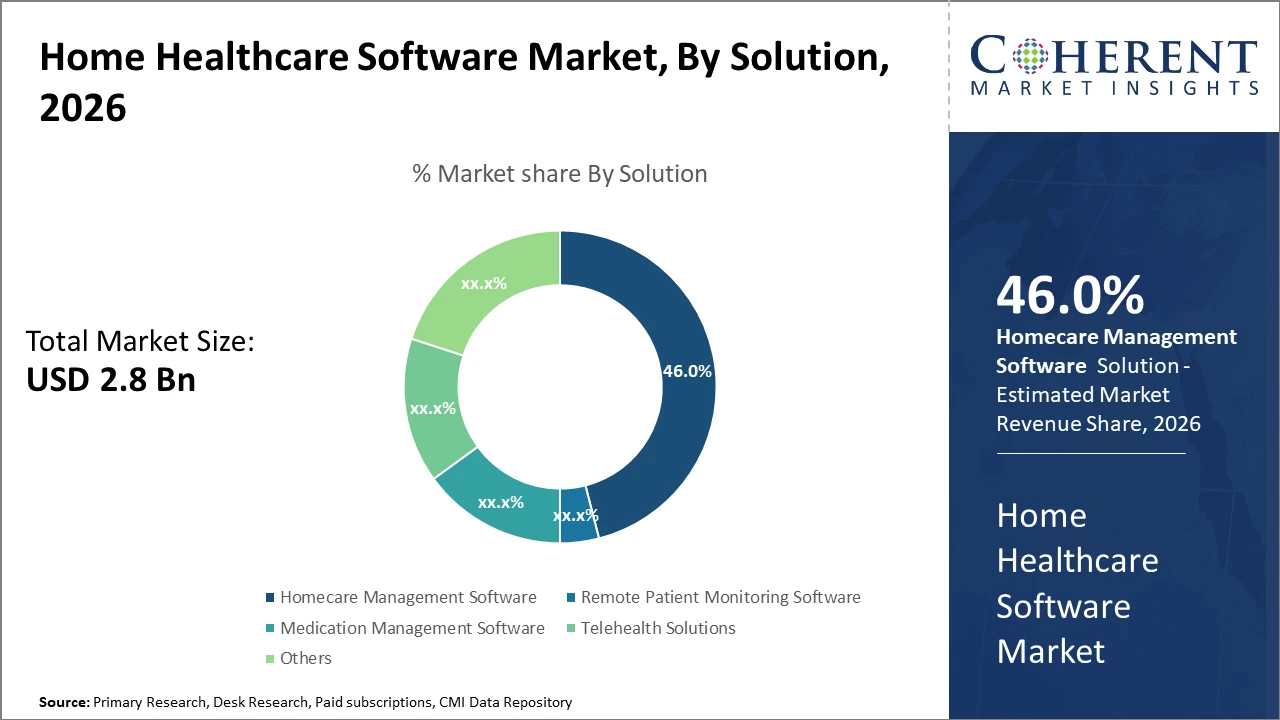
Homecare Management Software commands the largest market share, driven by increasing demand for comprehensive patient data management solutions. The medication management subsegment is emerging rapidly, contributing to adherence improvement initiatives.
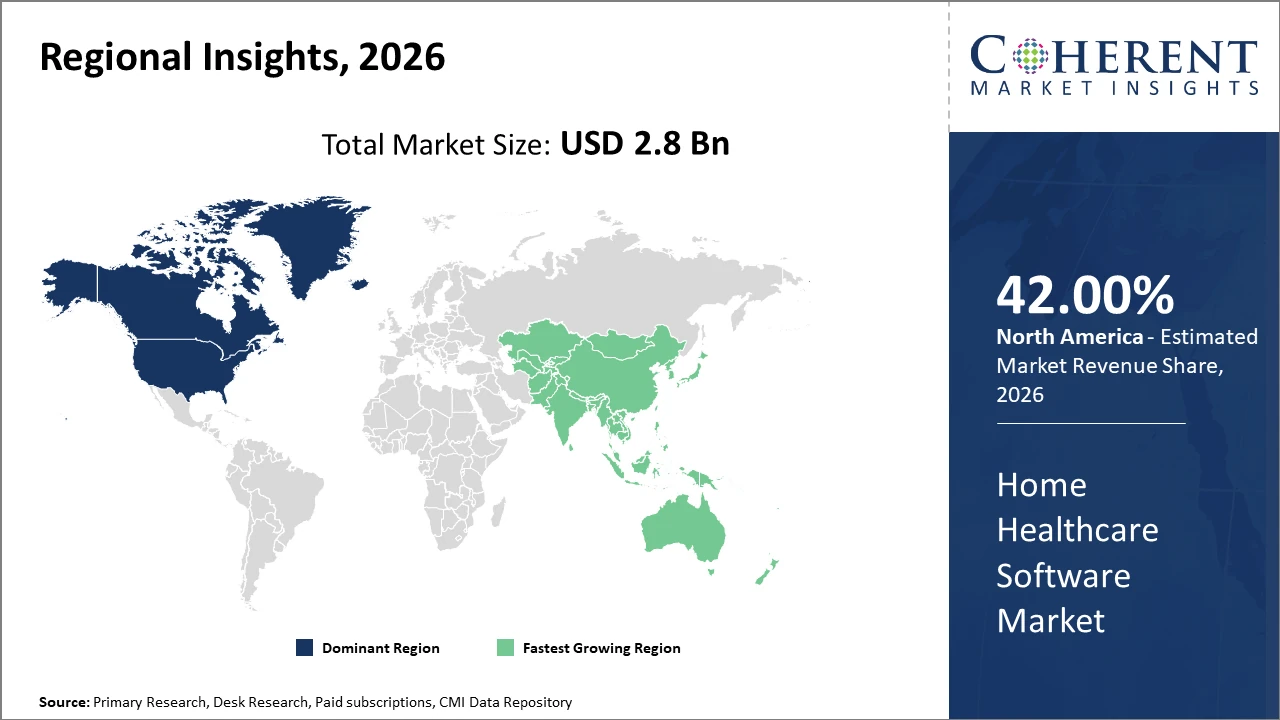
North America leads the market share mainly because of its advanced healthcare infrastructure and supportive government policies promoting digital health adoption.
Asia Pacific exhibits the fastest market growth rate, fueled by strong telehealth penetration and a rising geriatric population demanding home-based care.
Home Healthcare Software Market Segmentation Analysis
Home Healthcare Software Market Insights, By Solution Type
Homecare Management Software leads due to its comprehensive functionalities, including patient record management, scheduling, and care coordination, essential for optimizing home health agencies' workflows. The subsegment's software platforms have integrated AI-driven predictive analytics in 2025, enhancing patient outcome forecasts and reducing hospital readmissions. Remote Patient Monitoring Software is the fastest-growing subsegment, fueled by the increasing adoption of IoT devices and wearable health technology, which has expanded use cases across chronic disease management and elderly care, resulting in significant market expansion.
Home Healthcare Software Market Insights, By Component
Software's growth is driven by continuous upgrades and new functionalities, including AI, cloud computing, and enhanced security protocols. Services represent the fastest-growing subsegment, particularly in support, maintenance, and customization, as healthcare providers demand tailored implementations and ongoing technical assistance to maximize software utility under evolving healthcare regulations. Support and Maintenance enable seamless operation and ensure compliance with data privacy laws.
Home Healthcare Software Market Insights, By End-User
Home Health Agencies lead as primary service providers requiring integrated software to efficiently manage widespread patient bases and regulatory reporting obligations. Increasing government incentives to promote home care fuel this segment’s steady revenue. Individual Healthcare Providers represent the fastest-growing subsegment, propelled by telehealth expansion and mobile software solutions allowing independent nurses and therapists to offer personalized care remotely. Hospital-based Home Care Programs utilize software for post-discharge patient monitoring to reduce readmissions, while Assisted Living Facilities focus on resident health management through specialized platforms.
Home Healthcare Software Market Trends
Market trends in the home healthcare software sector showcase a decisive move toward AI-driven solutions and cloud-native platforms, which have significantly enhanced real-time patient monitoring and care coordination.
For example, in 2024, a 28% rise in AI-driven software adoption was recorded across Western Europe, optimizing workflow efficiency and reducing healthcare costs.
Simultaneously, telehealth integration within home care platforms facilitated a 35% increase in remote chronic disease management globally.
Home Healthcare Software Market Insights, By Geography
North America Home Healthcare Software Market Analysis and Trends
In North America, the dominance in the market is propelled by a mature healthcare infrastructure and government initiatives such as Medicare’s expansion of telehealth reimbursement policies. This region captures nearly 42% of the market share, supported by widespread adoption of RPM technologies and robust vendor presence. Leading companies like Cerner and Philips have significantly contributed to growth through continuous innovation and targeted acquisitions.
Asia Pacific Home Healthcare Software Market Analysis and Trends
Meanwhile, the Asia Pacific region exhibits the fastest growth with a CAGR exceeding 14%, driven by rising healthcare digitization, increasing internet penetration, and a burgeoning elderly population. Countries like India and China are rapidly adopting cloud-based home healthcare software, expanding market reach. Companies focused on cost-effective, scalable solutions have leveraged this region’s growth potential by tailoring offerings to local healthcare ecosystems.
Home Healthcare Software Market Outlook for Key Countries
USA Home Healthcare Software Market Analysis and Trends
The USA is a pivotal contributor to the overall market revenue due to extensive deployment of remote care technologies and reimbursement frameworks favoring home healthcare. The country’s aging population and high prevalence of chronic diseases underpin steady demand. Market leaders such as Medtronic and GE Healthcare have solidified positions through partnerships with home health agencies and continuous R&D in AI-enabled platforms, directly influencing market revenue and share growth.
India Home Healthcare Software Market Analysis and Trends
India’s market scenario is shaped by rapid telehealth adoption and government-supported digital health initiatives such as the National Digital Health Mission. The expanding middle-class population demanding affordable healthcare solutions is augmenting the market. Domestic companies and multinational entrants alike focus on mobile-based software to tap into rural and semi-urban segments, thereby fueling ongoing market expansion and diversifying the user base.
Analyst Opinion
Enhanced Interoperability as a Market Catalyst: The proliferation of interoperable home healthcare software systems is a significant quantitative driver propelling market revenue. Recent integrations using HL7 FHIR standards have increased system compatibility by over 25% in 2024, enabling better data exchange between patients, providers, and payers, thereby boosting market growth.
Surge in Remote Patient Monitoring Demand: Market insights reveal that the demand for remote patient monitoring (RPM) tools embedded within home healthcare software has surged by 28% in North America, reflecting a growing patient preference for decentralized care. RPM’s adoption has directly contributed to a 16% increase in market share for software modules supporting chronic disease management.
Pricing Strategies Reinforcing Market Dynamics: Pricing models evolved with subscription-based and SaaS frameworks dominating the market revenue streams. For instance, the SaaS model saw uptake grow by 33% in 2024 across Europe due to reduced upfront costs, propelling the market forecast upward in terms of overall business growth.
Expanding User Base in Geriatric Care: The market analysis indicates a 20% uptick in software adoption specifically targeted at geriatric care in Asia Pacific in 2025, driven by both demographic shifts and increased smartphone penetration. This micro-indicator underscores the segment’s high growth potential within the market.
- Current Industry Events of 2026
- Market Size Estimation
- Regional Breakdown
- Competitive Landscape
- Customer Intelligence
- Segmental Analysis
- Pricing Analysis
- Key Market Drivers, Challenges & Future Trends
- Customized Insights Section
Market Scope
| Report Coverage | Details | ||
|---|---|---|---|
| Base Year: | 2025 | Market Size in 2026: | USD 2.8 billion |
| Historical Data for: | 2020 To 2024 | Forecast Period: | 2026 To 2033 |
| Forecast Period 2026 to 2033 CAGR: | 11.9% | 2033 Value Projection: | USD 6.1 billion |
| Geographies covered: |
| ||
| Segments covered: |
| ||
| Companies covered: | Koninklijke Philips N.V., IBM Watson Health, GE Healthcare, Honeywell International Inc., Cisco Systems, Inc., McKesson Corporation, DRChrono Inc., CareCloud Corporation, PointClickCare Technologies Inc., Teladoc Health | ||
| Growth Drivers: |
| ||
Home Healthcare Software Market Growth Factors
Significant government initiatives aimed at reducing hospital readmissions have accelerated the adoption of home healthcare software, notably in regions like North America and Europe, where policies mandate patient-centered care models. Additionally, the expansion of broadband infrastructure in developing countries has facilitated remote patient monitoring uptake, unlocking new markets in the Asia Pacific and Latin America. Another critical driver is the rise of chronic diseases, such as diabetes and cardiovascular conditions, compelling healthcare providers to deploy advanced software to enhance disease management and patient engagement. Furthermore, the growing elderly population worldwide has amplified demand for personalized care solutions, pushing market companies to innovate continuously in telehealth and medication management modules.
Home Healthcare Software Market Development
In late 2025, Homecare Homebase (HCHB) expanded its digital portfolio with the launch of the HCHB AI Suite, introducing multiple AI-driven tools to improve home health and hospice operations. Key solutions include Curate: Medications, which uses artificial intelligence to pre-populate patient medication records and significantly reduce clinician documentation time, and Predict: Hospitalization Risk, a machine learning–based model that delivers real-time risk insights to help providers proactively intervene and prevent avoidable hospital readmissions.
In May 2025, Iodine Software launched AwarePre-Bill, an AI-powered post-discharge auditing solution designed to identify and close clinical documentation gaps before billing. By improving coding accuracy and compliance, the platform helps hospitals reduce claim denials and revenue leakage, with projections indicating substantial monthly cost savings and improved revenue cycle performance.
In May 2025, Apollo Home Healthcare introduced its 90-Minute Doctor-on-Call service in Bangalore, leveraging an integrated digital and logistics platform to ensure a physician reaches a patient’s home within 90 minutes of booking. The service enhances access to urgent home-based medical care, supporting timely clinical intervention, reduced emergency room dependence, and improved patient convenience within urban healthcare ecosystems.
Key Players
Leading Companies of the Market
Koninklijke Philips N.V.
IBM Watson Health
GE Healthcare
Honeywell International Inc.
Cisco Systems, Inc.
McKesson Corporation
DRChrono Inc.
CareCloud Corporation
PointClickCare Technologies Inc.
Teladoc Health
Among these, Philips Healthcare successfully expanded its homecare management software portfolio through strategic AI integration in 2024, resulting in a 12% growth in market share. Meanwhile, Cerner implemented advanced analytics-based solutions in 2025 to enhance remote patient monitoring capabilities, contributing to improved client retention rates by 18%. ResMed focused on acquiring niche firms specializing in medication adherence technologies, which assisted in diversifying service offerings and increasing annual revenue by 14%.
Home Healthcare Software Market Future Outlook
The future of the home healthcare software market is expected to be shaped by the continued expansion of value-based care, integration with wearable and IoT devices, and advanced analytics. Software platforms will increasingly embed artificial intelligence to predict risk, personalize care plans, and automate administrative tasks. Remote patient monitoring systems will work in tandem with clinical workflows to deliver real-time alerts and support chronic condition management. Interoperability standards will evolve to bridge home care data with enterprise health records, enhancing continuity of care. Care coordination tools that span family caregivers, home health professionals, and specialists will become essential. The market will also see growth in consumer-oriented health applications that empower patients and informal caregivers to participate actively in care management.
Home Healthcare Software Market Historical Analysis
The home healthcare software market emerged as healthcare delivery models began to shift from institutional to community and home-based care in the late 20th century. Early software solutions were simple scheduling and billing tools used by home health agencies to manage patient visits. As the demand for home-based care grew—driven by aging populations, chronic disease management, and cost containment—software capabilities expanded to include clinical documentation, care planning, remote monitoring, and regulatory compliance. Interoperability with electronic health records became increasingly important as clinicians needed seamless access to patient data regardless of care setting. Mobile applications enabled caregivers to access and update patient information at the point of care, while telehealth capabilities enhanced remote clinical interactions.
Sources
Primary Research Interviews:
Home healthcare agency owners
Nurses
Software developers
Care coordinators
Databases:
CMS Home Health Data
OECD Long-Term Care Data
AHRQ Reports
WHO Digital Health
Magazines:
Home Health Care News
HealthTech Magazine
Healthcare IT Today
Aging Media Network
Medical Economics
Journals:
Journal of Home Health Care Management
Journal of Medical Internet Research
BMC Health Services Research
Telemedicine Journal
Digital Health
Newspapers:
The New York Times (Health)
Reuters Healthcare
Financial Times (Healthcare)
The Guardian (Social Care)
Bloomberg Health
Associations:
National Association for Home Care & Hospice
Home Care Association of America
HIMSS
American Nurses Association
Digital Health Society
Get access to 250+ pages report
Every segment, forecast, competitor profile and data table behind the analysis above — available for instant download.
- ESOMAR Member
- ISO 9001:2015 Certified
- D-U-N-S Registered
- GDPR & CCPA Compliant
Missing comfort of reading report in your local language? Find your preferred language:
Transform your Strategy with Exclusive Trending Reports
Frequently Asked Questions
Dominance in the home healthcare software market is primarily held by companies such as Philips Healthcare, Cerner Corporation, and ResMed Inc., which lead through innovation in remote patient monitoring and AI integration.
The market size is projected to expand from USD 2.8 billion in 2026 to approximately USD 6.1 billion by 2033, driven by continuous advancements in telehealth capabilities and increased chronic disease management at home.
Home Health Agencies represent the largest end-user segment, attributing to their growing adoption of integrated healthcare software solutions to enhance patient outcomes and operational efficiency.
Market development trends will emphasize AI-enabled predictive analytics, cloud-based service models, and enhanced patient engagement features, with a shift towards comprehensive care ecosystems.
The landscape is competitive with players focusing on strategic partnerships and technological innovation, while challenges include data security, interoperability complexities, and regulatory compliance requirements.
Key strategies include acquisitions to broaden technology portfolios, subscription-based pricing models to increase accessibility, and partnerships with healthcare providers to tailor software capabilities for specialized needs.