

Men’s Grooming Products Market Analysis & Forecast: 2026-2033
The men's grooming products market is estimated to be valued at USD 278.22 Bn in 2026 and is expected to reach USD 492.48 Bn by 2033, exhibiting a compound annual growth rate (CAGR) of 8.5% from 2026 to 2033.
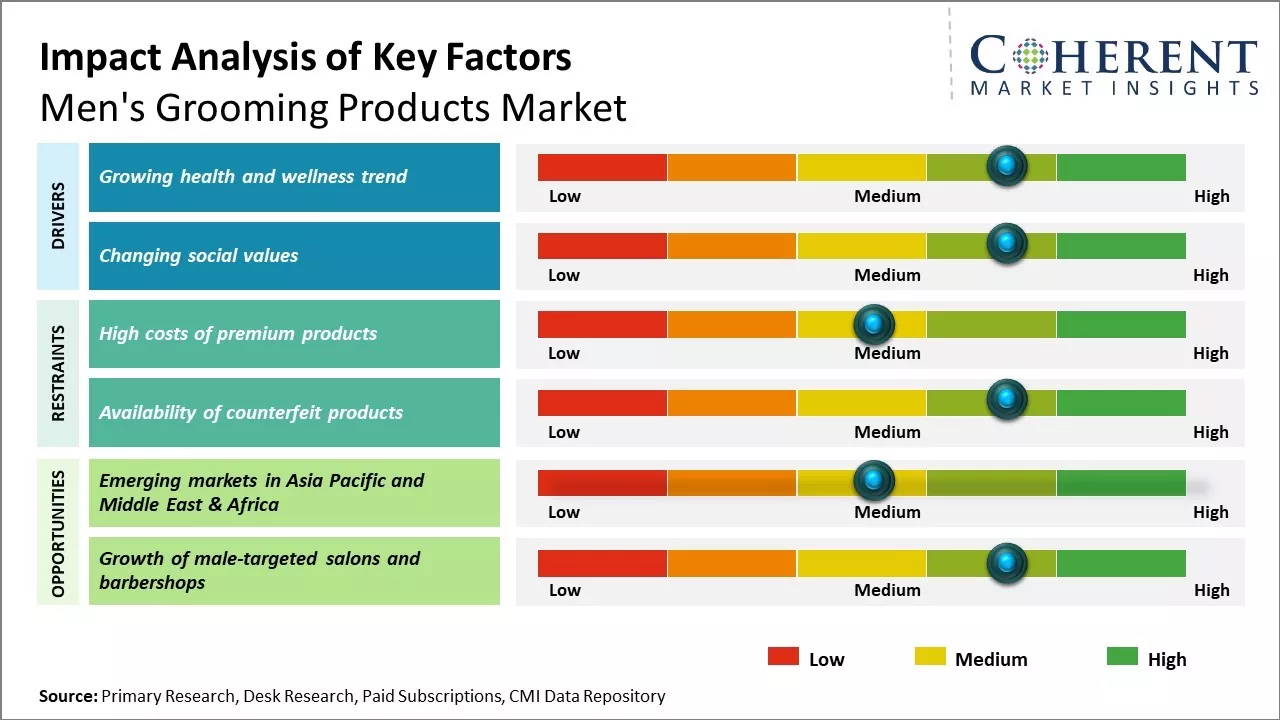
Key Takeaways
- By Type, the Skin Care segment is projected to hold approximately 45.3% share of the global men's grooming products market in 2026.
- By Price Range, the Mass segment is expected to dominate with a 76.1% share in 2026.
- By Distribution Channel, Supermarkets & Hypermarkets are anticipated to contribute 37.1% of market share in 2026.
- By Region, North America is forecasted to lead the global men’s grooming products market with 35.0% share in 2026.
Market Overview
The Men's Grooming Products Market is experiencing a profound shift in trends. An increasing demand for natural and organic personal care products is seen. Products featuring ingredients like argan oil, coconut oil, and aloe vera are gaining popularity. Furthermore, the visibility of men's grooming on social media through influencer marketing has made these products more accessible and encouraged experimentation with different items.
For instance, the rapid growth of brands like Beardbrand and Harry’s, which have capitalized on natural ingredient formulations and strong social media presence. Beardbrand, for example, emphasizes organic oils such as argan and coconut oil in its beard care products, appealing to health-conscious consumers.
Current Events and Its Impact on the Men's Grooming Products Market
Event | Description and Impact |
Rising Inflation and Economic Recession Pressures (Macro-Economic) |
|
AI and Personalization Technology Integration (Nano-Technological) |
|
Sustainable Beauty and Clean Ingredient Movement (Macro-Environmental) |
|
Role of Artificial Intelligence (AI)
Artificial Intelligence (AI) is rapidly rewriting the playbook for the $55 billion global men’s grooming segment, powering ultra-personalized care and smarter product creation. Major players like Unilever now harness AI to mine consumer data, anticipate emerging preferences, and cut product development cycles by as much as 30%, which noticeably boosts success rates once items hit shelves.
Personalized skincare stands out as AI’s most telling contribution. L’Oréal, fresh from its ModiFace acquisition, employs AI-driven skin analysis in its apps to recommend bespoke products generated from user selfies. This tactic has sparked a 40% lift in engagement for its men’s lines, including Kiehl’s and Biotherm Homme.
On the hardware front, Philips has dressed its Series 9000 Prestige shaver in SenseIQ technology, which learns during the shave and fine-tunes power according to beard thickness and skin sensitivity. Clinical data reveal the system delivers 20% fewer strokes and achieves 85% satisfaction from testers.
AI is doing much more than polishing the customer experience; it is re-engineering R&D, rethinking marketing, and sharpening customer loyalty tactics. As the technology keeps advancing, the men’s grooming category is set to become ever more intuitive, efficient, and personalized, fitting seamlessly into the rhythm of individual lifestyles and preferences.
- Current Industry Events of 2026
- Market Size Estimation
- Regional Breakdown
- Competitive Landscape
- Customer Intelligence
- Segmental Analysis
- Pricing Analysis
- Key Market Drivers, Challenges & Future Trends
- Customized Insights Section
Pricing Analysis
The Men’s Grooming Products Market continues to diversify across pricing tiers as demand rises for targeted solutions such as itchy scalp, sun-damaged skin, hyperpigmentation, razor burns, eye puffiness, pore minimizing, and frizz control. Products addressing these specific concerns are increasingly available in premium, mid-range, and mass-market categories, reflecting both consumer need and income diversity.
Luxury products like La Mer’s Concentrate ($285) and Clinique’s Anti-Age Eye Cream ($52) continue to attract buyers addressing razor burn, eye puffiness, and sun damage, driven by a desire for proven, high-performance formulas. For hyperpigmentation and pore refinement, Kiehl’s and Tom Ford provide precisely formulated serums and moisturizers priced between $35 and $95.
Brands such as Jack Black and Baxter of California carve out a mid-range segment ($8–$35) with specialized grooming items, including frizz-dispensing beard oils and reparative moisturizers for sun-damaged and razor-irritated skin.
At the mass-market level, Nivea Men and L’Oréal Men Expert serve up effective, accessible solutions for itchy scalps, shaving sensitivities, and daily facial care priced from $4 to $15. Together, these layered pricing tiers and an increasingly segmented consumer base are redefining the men’s grooming landscape, delivering precisely calibrated products at every spend level.
Emergence of New Technology
The market for men’s grooming products is evolving at fast pace, with breakthroughs in smart devices, artificial intelligence, and bespoke skincare technology leading the charge. Today’s smart razors and electric shavers incorporate pressure sensors, adaptive motors, and Internet-of-Things connectivity, adjusting in real-time to variations in beard thickness and skin sensitivity. These devices link to companion apps that log every shave, providing detailed insights that further tighten the fit of personalized routines.
Hair styling tools have similarly upped the game: precision-engineered clippers equipped with titanium and ceramic blades, laser-guided alignment, and long-lasting, cordless lithium-ion power deliver salon-standard finishes in the home. LED therapy units and sonic facial brushes, designed specifically for male skin, tackle common issues like razor burn and acne.
Formulations leverage microencapsulation and nanotech to transport active compounds into the skin with exceptional efficiency, catering to the demand for lightweight, high-efficacy products. AI-driven platforms analyze facial features via smartphone cameras and generate tailored skincare and grooming regimes, while augmented reality try-on solutions support smarter styling choices. At the same time, refillable razors and compostable packaging signal a new commitment to environmental sustainability.
Combined, these advancements are repositioning grooming as a sophisticated, technology-rich segment of self-care, empowering brands to pursue premium pricing and lifestyle-oriented strategies alike.
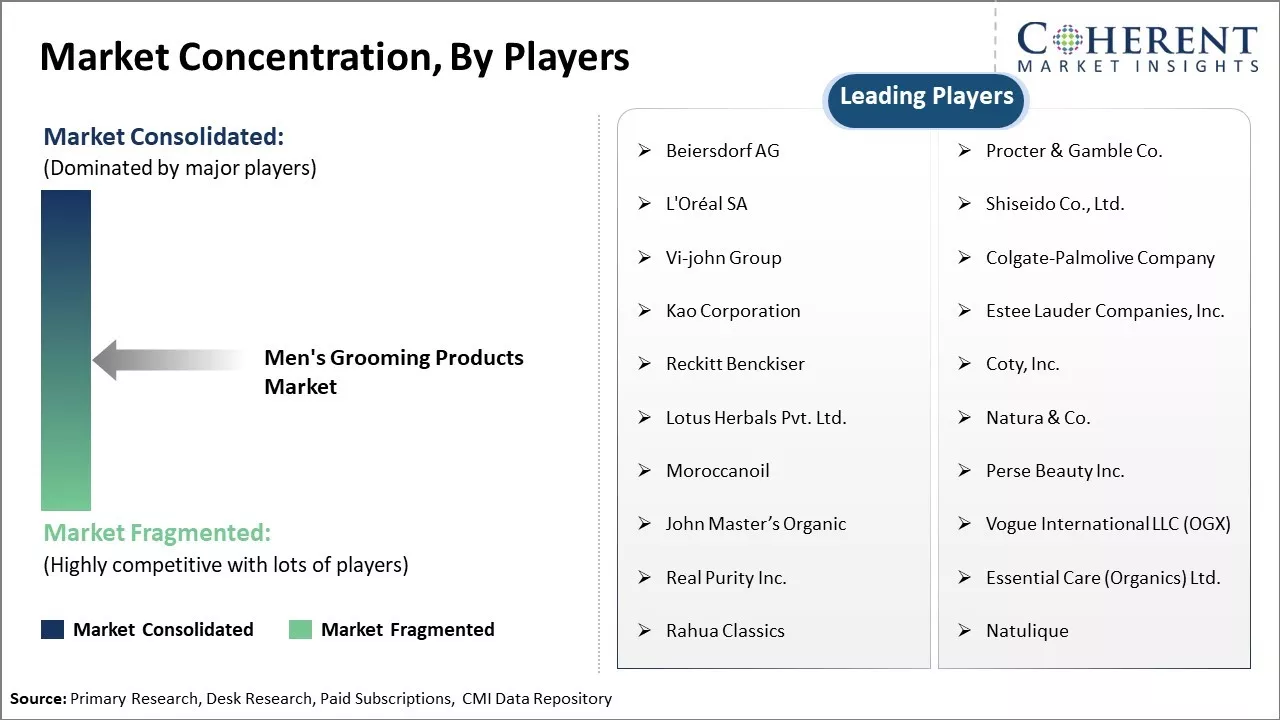
Market Concentration and Competitive Landscape
Changing social values
Societal values around masculinity are evolving with growing acceptance of diversity and alternative definitions of attractiveness. There is less stigma attached to putting effort into personal appearance and displaying natural beauty, which was earlier discouraged as vain behavior.
Younger generations especially are challenging old stereotypes and feel empowered to define their grooming needs on their own terms. With normalization of social media documentation of daily lives, putting one's best foot forward has become an integral part of self-expression for many.
Visible traits like hair, facial hair, fit bodies, etc. get as much attention as personality traits in shaping perceptions. In this backdrop, grooming has cemented its place as an emblem of confidence and social currency for those who engage in it seriously. Whether it be a date, job interview, or public gathering, men want to put their best self forward by looking polished and groomed.
Growing health and wellness trend
There is a noticeable shift in attitude among men towards taking better care of their personal hygiene and grooming. With increasing health awareness, many men are making conscious choices to improve their self-care routines. They are paying more attention to diet, fitness, skincare, and overall wellness.
The focus on incorporating efficacious natural ingredients and sustainable products also contributes to this change. Taking care of one's appearance is no longer seen as feminine. Rather it is recognized as responsible self-care that enhances confidence and overall quality of life.
Male grooming and skincare products have evolved considerably to cater to this growing need. The availability of multipurpose natural products that cleanse, nourish and protect the skin without harsh chemicals appeals to health-conscious consumers.
Moreover, easy access to product information through digital and social media has made grooming more approachable for men. Busy lifestyles are another factor driving better routine maintenance. Men seek quick fix solutions that fit into their daily schedules without compromising on results.
Lightweight, multi-tasking formulations address all the key steps of grooming - from face wash to moisturizer to beard oil - in one simple step. The promise of rejuvenated, healthier looking skin motivates many to incorporate grooming essentials as part of their self-care regimen alongside diet and exercise.
Market Challenges: High costs of premium products
The high costs of premium men's grooming products are significantly restraining the growth of the global men's grooming market. Many male consumers, especially in developing regions, find the premium products to be too expensive for regular purchase and use. This price sensitivity is causing them to either avoid or decrease spending on such higher-priced grooming items.
Unlike women's grooming market where cosmetic products are considered more of a necessity, men generally perceive costly grooming items as luxuries. They are reluctant to spend significant amounts frequently on shaving creams, deodorants, hair serums, and facial cleansers. Even among men with higher disposable incomes, there is a perception that premium brands offer marginal benefits over regular mass-market products. This makes them less inclined to pay premium prices.
Market Opportunities: Emerging markets in Asia Pacific and Middle East & Africa
The emerging markets in Asia Pacific and Middle East & Africa regions hold huge potential for growth in the global men's grooming products industry. These regions are expected to see substantial rise in disposable incomes and spending power of the consumers in the coming years. More number of consumers in the urban areas will be adopting western lifestyles and will become aware of personal grooming products.
The youth population in countries like India, Vietnam, Indonesia, Nigeria, Saudi Arabia etc is rising rapidly which is a big opportunity for men's grooming brands. Evolving social and cultural norms are driving greater acceptance of male grooming behaviors in these regions. Taking care of skin, hair, face and overall appearance is no more considered a vain act.
Rising aspirations to look handsome, presentable and confident are prompting more males to use products like face cleansers, moisturizers, stylers, trimmers etc on a regular basis. Even the small towns are opening up to premium men's grooming offerings driven by increasing exposure through social media and e-commerce platforms. Sports and entertainment celebrities are also playing a crucial role in changing mindsets about personal care routines among young men in these developing nations.
Segmental Insights

Global Men’s Grooming Products Market Insights, By Type
In terms of type, skin care is expected to contribute 45.3% share of the market in 2026, owing to evolving consumer preferences toward self-care and beauty. Today's men are increasingly conscious about their appearance and see skin care as an important part of their daily routine just like women.
As more men engage in self-care rituals like face cleansing, moisturizing, and using anti-aging products, the skin care segment continues to experience robust growth. Products targeted toward common skin concerns such as acne, dark spots, and aging signs have become widely popular.
Rising awareness about skin health benefits has also encouraged men to incorporate facial SPF protection and exfoliants into their grooming regimen. The growing availability of natural, organic and clean-label skin care products designed specifically for men's skin further attracts health-conscious consumers.
Additionally, celebrities and social media influencers openly discussing their grooming habits have made it socially acceptable for men to indulge in skin treatments like facials on a regular basis. Consumers are readily experimenting with new skin care tools and devices promising anti-aging benefits at home as well. With continuing urbanization and increasing disposable incomes, men see skincare as an integral part of their lifestyle and wellness regime, spurring further developments in this market segment.
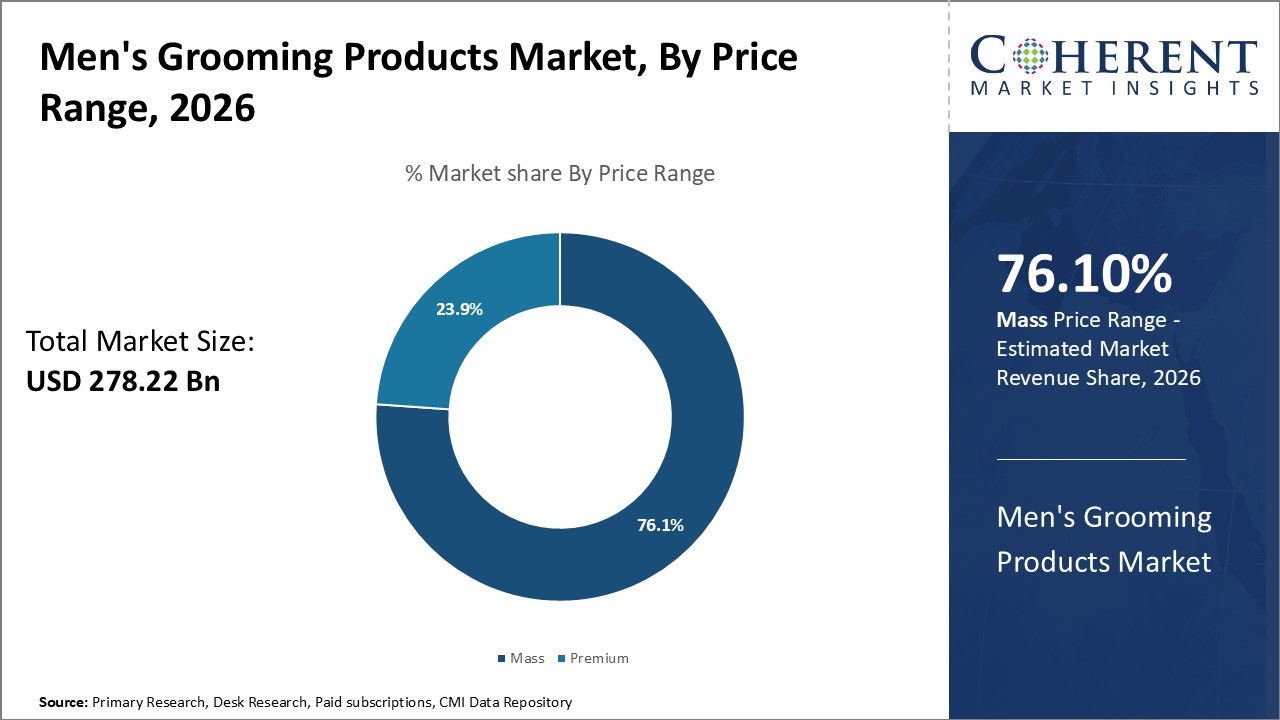
Global Men’s Grooming Products Market Insights, By Price Range
In terms of price range, mass is expected to contribute 76.1% share of the market in 2026, owing to affordability and accessibility factors. Mass grooming products cater to the everyday needs of average male consumers seeking hassle-free solutions at affordable price points. This segment thrives on offering quality basics and multipurpose items like 2-in-1 shampoo-conditioners that simplify grooming routines on a budget.
Being more pocket-friendly allows mass brands to attract younger consumers just stepping into the world of personal care. Their wide product ranges also give customers flexibility to experiment with different variants without burning a hole in their wallet.
Mass products are highly accessible through all major retail channels including drug stores, supermarkets, and online shopping sites. This extensive distribution reach efficiently brings trusted brands within easy reach of customers across locations. Strong supply chain networks stock mass grooming essentials on shelves round the year for regular replenishment shopping.
Additionally, mass brands extensively use digital and social media promotions to engage price-conscious consumers and drive repeat purchases. With a focus on affordability, access and everyday practicality, the mass segment dominates the price-defined marketplace.
Global Men’s Grooming Products Market Insights, By Distribution Channel
In terms of distribution channel, supermarkets & hypermarkets is expected to contribute 37.1% share of the market in 2026, owing to the unparalleled shopping convenience offered by them. As one-stop shopping destinations, hypermarkets make it extremely hassle-free for hurried customers to pick up all their monthly grooming essentials alongside regular household supplies.
With massive store spaces, they service all grooming categories under a single roof without consumers having to visit multiple specialized outlets. Customers also benefit from bulk-buying deals and loyalty rewards programs at these stores.
Hypermarkets expertly organize grooming products by brands, types, and price points for efficient aisle navigation. Extensive shelves stocks thousands of SKUs allowing customers to compare options freely before making selections. Their periodic promotional campaigns on different categories throughout the year attract bargain-hunting audiences.
Moreover, premium hypermarket loyalty programs offer additional savings and rewards for regular spending customers. With their unmatched convenience of centralized shopping, hypermarkets skillfully dominate the offline distribution segment.
Global Men’s Grooming Products Market - Regional Insights
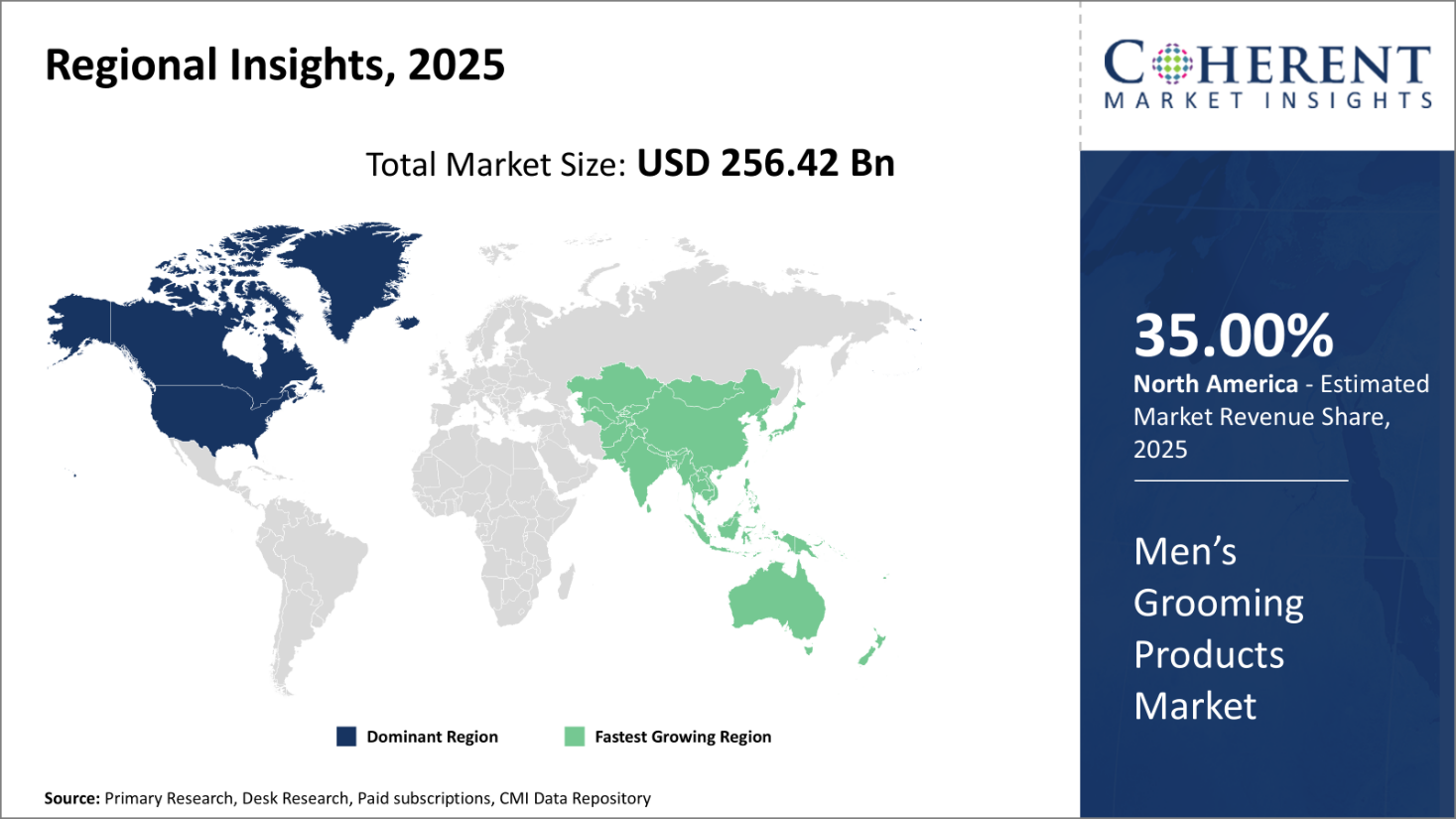
North America Men's Grooming Products Market Analysis and Trends
North America has established itself as the largest and most dominant region in the global men’s grooming products market and is projected to hold approximately 35.00% of the total market share by 2026. This leadership is supported by the strong presence of globally recognized grooming brands offering a wide range of products—from shaving creams and razors to skincare, hair care, and deodorants. These companies invest heavily in marketing, digital campaigns, and celebrity endorsements to drive consumer engagement and brand loyalty.
The modern North American male is increasingly embracing self-care routines, with a growing willingness to invest in premium grooming products. Easy access to grooming items through supermarkets, pharmacies, e-commerce platforms, and dedicated beauty stores further boosts market penetration. While the U.S. leads the region with higher per capita consumption, Canada contributes moderately with a slower but steady growth trajectory.
Asia Pacific Men's Grooming Products Market Analysis and Trends
The Asia Pacific region has emerged as the fastest-growing market for men’s grooming products, driven by surging disposable incomes and rapid urbanization in key economies like India and China. Increasing exposure to Western grooming standards and social media influencers has significantly impacted grooming habits among men in the region. A growing working population, both male and female, is fostering demand for well-groomed and professional appearances.
Local companies in Japan and South Korea have gained strong market traction by offering affordable, high-quality grooming products tailored to regional preferences. International brands are also strengthening their footprint by partnering with local retailers, influencers, and e-commerce platforms. The region’s cultural shift toward personal grooming and appearance enhancement signals high long-term potential for continued growth.
Dominating Countries in the Men’s Grooming Products Market
United States Men’s Grooming Market Analysis and Trends
The United States is the largest contributor to the North American men’s grooming market, with strong brand penetration and a mature consumer base. American men are more open than ever to investing in grooming, skincare, and styling products, supported by a vibrant retail ecosystem and targeted marketing campaigns.
China Men’s Grooming Market Analysis and Trends
China is leading growth in the Asia Pacific market, fueled by rising incomes, urban lifestyles, and digital engagement. The younger demographic, particularly in tier 1 and 2 cities, is highly influenced by KOLs (Key Opinion Leaders) and celebrity endorsements, spurring rapid adoption of grooming routines.
South Korea Men’s Grooming Market Analysis and Trends
South Korea continues to be a grooming trendsetter in Asia, known for its innovation in men’s skincare and cosmetics. The local market is sophisticated, with high consumer expectations and a culture that embraces male beauty standards. Domestic and global brands thrive through constant product innovation and aesthetic appeal.
Market Report Scope
Men's Grooming Products Market Report Coverage
| Report Coverage | Details | ||
|---|---|---|---|
| Base Year: | 2025 | Market Size in 2026: | USD 278.22 Bn |
| Historical Data for: | 2020 To 2024 | Forecast Period: | 2026 To 2033 |
| Forecast Period 2026 to 2033 CAGR: | 8.5% | 2033 Value Projection: | USD 492.48 Bn |
| Geographies covered: |
| ||
| Segments covered: |
| ||
| Companies covered: | Beiersdorf AG, Procter & Gamble Co., L'Oréal SA, Shiseido Co., Ltd., Vi-john Group, Colgate-Palmolive Company, Kao Corporation, Estee Lauder Companies, Inc., Reckitt Benckiser, Coty, Inc., Lotus Herbals Pvt. Ltd., Natura & Co., Moroccanoil, Perse Beauty Inc., John Master’s Organic, Vogue International LLC (OGX), Real Purity Inc., Essential Care (Organics) Ltd., Rahua Classics, and Natulique | ||
| Growth Drivers: |
| ||
| Restraints & Challenges: |
| ||
Men’s Grooming Products Market Key Developments
- In April 2024, Piramal Pharma Limited launches Bohem, forays into men’s grooming market in India
- In 2023, Bravado, Men’s Grooming Makes a Launch in India
- In May 2020, Gillette, a subsidiary of Procter and Gamble, a personal care brand, launched King C. Gillette, a complete range of grooming and beard care products for men. The range was categorized into three sections, such as shave and edge, trim, and care.
Analyst Viewpoint
- Men’s grooming keeps expanding, driven by the embrace of self-care as a key part of a contemporary masculine identity. Personal upkeep is now viewed as a wellness practice, a show of confidence, and a professionalism cue, far removed from old notions of vanity.
- In emerging markets, increasing disposable income is widening the customer pool. Meanwhile, social media and influencers are bridging age and cultural gaps, making grooming routines more relatable and aspirational.
- More men are reaching for premium products, opting for precise, high-quality formulations that align with their specific needs. This shift toward premium offerings opens robust avenues for brands that prioritize innovation and proven performance.
- Consumers increasingly prefer natural, organic, and eco-friendly grooming products, prompting brands to reformulate and adopt greener practices to satisfy these new norms.
- E-commerce and DTC models have redefined how grooming items are found and bought. Digital-first players are winning market share through convenience, customized experiences, and compelling storytelling.
- Yet cultural barriers persist in conservative areas where male grooming still carries stigma, and in price-sensitive markets, premium products struggle to reach larger audiences.
- The Asia-Pacific region is the fastest-growing area, propelled by urbanization, Western influence, and a rising middle class. China, India, and South Korea are key trendsetters that shape spending habits.
- North America remains solid, buoyed by ongoing product innovation and a mix of mass and premium brands that target diverse consumer needs.
- Influencer campaigns and celebrity collaborations are rewriting brand playbooks and driving choices, with high-profile partnerships enhancing credibility and consumer connection.
- Collectively, the mainstream acceptance of male grooming worldwide suggests durable market growth. The sector is likely to keep expanding as grooming routines increasingly become everyday practices.
Market Segmentation
- Type Insights (Revenue, USD Bn, 2021 - 2033)
- Skin Care
- Hair Styling
- Shave/Beard Care
- Color Cosmetics
- Others
- Price Range Insights (Revenue, USD Bn, 2021 - 2033)
- Mass
- Premium
- Distribution Channel Insights (Revenue, USD Bn, 2021 - 2033)
- Supermarkets & Hypermarkets
- Online
- Others
- Regional Insights (Revenue, USD Bn, 2021 - 2033)
- North America
- U.S.
- Canada
- Latin America
- Brazil
- Argentina
- Mexico
- Rest of Latin America
- Europe
- Germany
- U.K.
- Spain
- France
- Italy
- Russia
- Rest of Europe
- Asia Pacific
- China
- India
- Japan
- Australia
- South Korea
- ASEAN
- Rest of Asia Pacific
- Middle East & Africa
- GCC Countries
- Israel
- Rest of Middle East & Africa
- Key Players Insights
- Beiersdorf AG
- Procter & Gamble Co.
- L'Oréal SA
- Shiseido Co., Ltd.
- Vi-john Group
- Colgate-Palmolive Company
- Kao Corporation
- Estee Lauder Companies, Inc.
- Reckitt Benckiser
- Coty, Inc.
- Lotus Herbals Pvt. Ltd.
- Natura & Co.
- Moroccanoil
- Perse Beauty Inc.
- John Master’s Organic
- Vogue International LLC (OGX)
- Real Purity Inc.
- Essential Care (Organics) Ltd.
- Rahua Classics
- Natulique
Sources
Primary Research Interviews
- Online Men's Grooming Product Manufacturers
- E-commerce Platform Executives
- Digital Marketing Managers in Men's Grooming Sector
- Men's Grooming Brand Retailers
- Others
Databases
- Euromonitor International
- IBISWorld
- Others
Magazines
- Men's Health Magazine
- GQ Magazine
- Allure Magazine
- Beauty Independent Magazine
- Others
Journals
- International Journal of Cosmetic Science
- Journal of Consumer Marketing
- Global Journal of Business Research
- Others
Newspapers
- The Wall Street Journal
- Financial Times
- Business Insider
- Forbes
- Others
Associations
- Personal Care Products Council
- National Association of Men's Grooming Professionals
- E-commerce Association
- International Beauty and Personal Care Association
- Others
Public Domain Sources
- U.S. Census Bureau
- Federal Trade Commission (FTC)
- European Commission Trade Statistics
- World Trade Organization (WTO)
- Others
Proprietary Elements
- CMI Data Analytics Tool
- Proprietary CMI Existing Repository of information for last 8 years
*Definition: The men's grooming products market consists of various personal care products targeted towards male consumers such as hair care products, skin care products, fragrances, deodorants, shaving supplies, and other grooming accessories. These range from daily essentials like shampoo, conditioner, and soap to specialized items for hair styling, skin hydration, shaving, and stubble care. The market has witnessed significant growth in recent years due to rising male grooming and personal care awareness along with growing demand for natural and organic men's grooming lines.
Get access to 250+ pages report
Every segment, forecast, competitor profile and data table behind the analysis above — available for instant download.
- ESOMAR Member
- ISO 9001:2015 Certified
- D-U-N-S Registered
- GDPR & CCPA Compliant
Missing comfort of reading report in your local language? Find your preferred language:
Transform your Strategy with Exclusive Trending Reports
Frequently Asked Questions
The Men’s Grooming Products Market size is estimated to be valued at USD 278.22 Bn in 2026, and is expected to reach USD 492.48 Bn by 2033.
The CAGR of the global Market is projected to be 8.5% from 2026 to 2033.
Growing health and wellness trend and changing social values are the major factors driving the growth of the men's grooming products market.
High costs of premium products and availability of counterfeit products are the major factors hampering the growth of the global market.
In terms of type, skin care is estimated to dominate the market revenue share in 2026.
Beiersdorf AG, Procter & Gamble Co., L'Oréal SA, Shiseido Co., Ltd., Vi-john Group, Colgate-Palmolive Company, Kao Corporation, Estee Lauder Companies, Inc., Reckitt Benckiser, Coty, Inc., Lotus Herbals Pvt. Ltd., Natura & Co., Moroccanoil, Perse Beauty Inc., John Master’s Organic, Vogue International LLC (OGX), Real Purity Inc., Essential Care (Organics) Ltd., Rahua Classics, and Natulique are the major players.
North America is expected to lead the men's grooming products market.