

Mesh Nozzle Plates Market Size and Share Analysis - 2026 To 2033
The mesh nozzle plates market is anticipated to grow at a CAGR of 7.68% with USD 12.38 Mn in 2026 and is expected to reach USD 20.79 Mn in 2033. Increasing number of clinical trials (In 2025, the Western Pacific region registered 31,097 clinical trials, which was more than 30 times higher than Africa's 822 trials) for mesh nebulizers is expected to aid in the growth of the global mesh nozzle plates market over the forecast period. Moreover, rise in the advancement of technologies for ventilators is expected to bolster the growth of global mesh nozzle plates market.
Key Takeaways
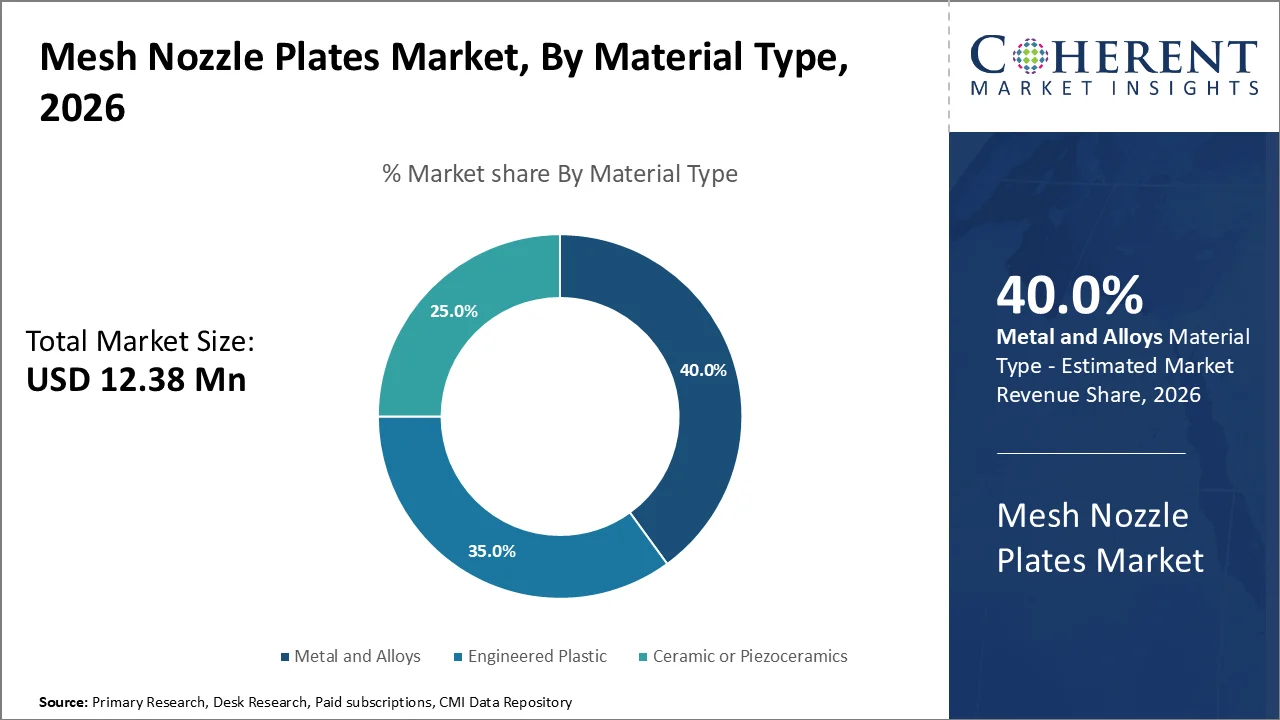
- Metal and alloys is expected to account the largest share of 40% in 2026, because metals and alloys combine high strength, durability, corrosion resistance, and good manufacturability at a lower cost than ceramics while performing better than plastics in harsh industrial conditions. Stainless steel contains at least 10.5% chromium, which forms a protective oxide layer that improves corrosion resistance, and 316L stainless steel is widely used in medical devices due to its strength, durability, ease of cleaning, and cost-effectiveness.
- Medical will dominate with 45% in 2026, medical dominates because mesh nozzle plates are essential for precise drug delivery and respiratory devices, which have large and continuously growing healthcare demand. The rise in global healthcare access and coverage (UHC index increasing from 54 in 2000 to 71 in 2023) indicates growing healthcare utilization, which indirectly supports higher demand for medical devices such as drug delivery and respiratory systems that use mesh nozzle plates.
- Hospitals will dominate with 35% in 2026, hospitals dominate because they are the main point of patient care and use large volumes of mesh-based respiratory and drug delivery devices every day, creating the highest and most consistent demand. The total number of hospitals globally is projected to reach approximately 215,977 by 2026.
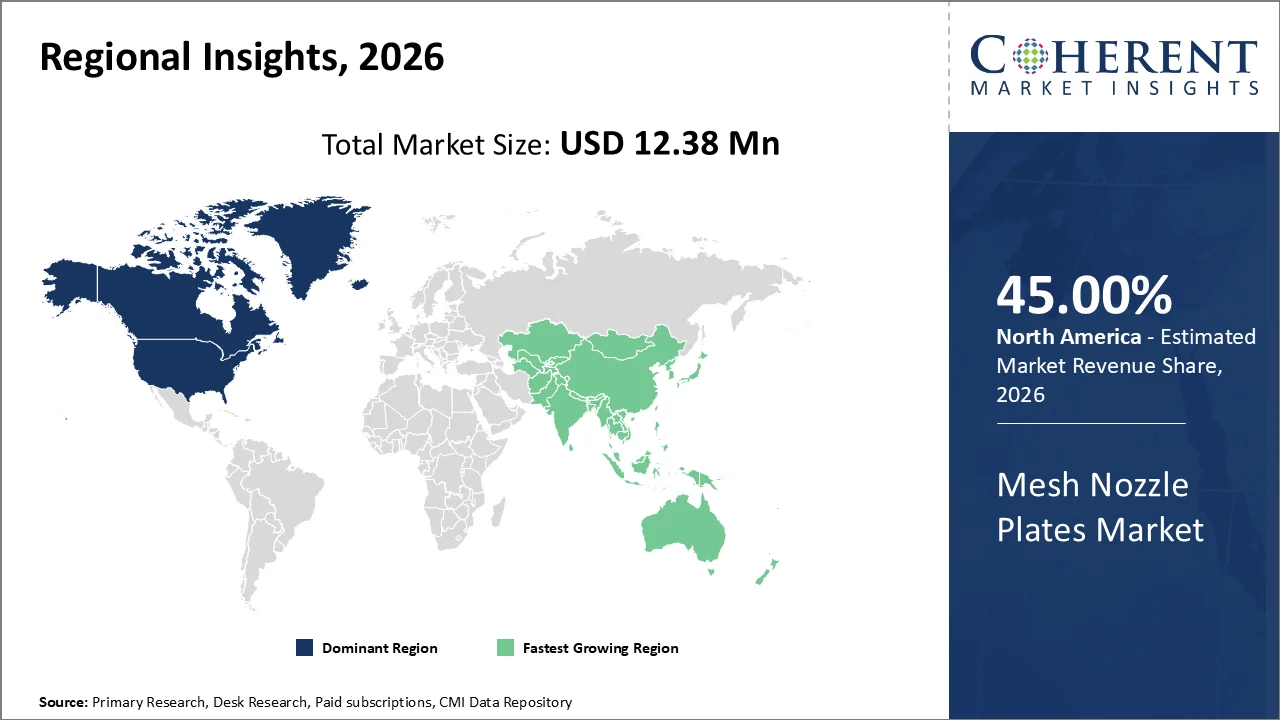
- North America is expected to acquire the dominant share of 45% in 2026, due to its strong medical device industry, advanced manufacturing capabilities, and strict quality-driven regulations that increase demand for high-precision mesh nozzle plates.
Segmental Insights
Why is Metal and Alloys Acquiring the Largest Market Share?
Metal and Alloys is projected to account for the largest share of material type in 2026, representing approximately 40% of the total volume. Owing to their unmatched combination of mechanical strength, thermal resistance, corrosion resilience, and long-term operational reliability across a diverse spectrum of industrial applications. According to the WorldSteel Association, Global steel demand in 2025 is expected to stay almost the same as 2024 at about 1,749 million tonnes, with a small growth of 1.3% in 2026.
The inherent physical properties of metals along with their engineered alloy counterparts make them the ideal material for manufacturers who need consistent performance under demanding conditions including high-pressure fluid dynamics, elevated temperature environments, chemically aggressive media, etc.
Stainless steel, titanium alloys, nickel-based superalloys, copper-beryllium, etc., their compositions are among the most frequently used materials in this category, each providing distinct performance advantages that align with specific end-use requirements in sectors including aerospace, automotive fuel systems, industrial inkjet printing, pharmaceutical spray drying, precision agricultural spraying systems, etc.
- Current Industry Events of 2026
- Market Size Estimation
- Regional Breakdown
- Competitive Landscape
- Customer Intelligence
- Segmental Analysis
- Pricing Analysis
- Key Market Drivers, Challenges & Future Trends
- Customized Insights Section
Medical holds the Largest Market Share
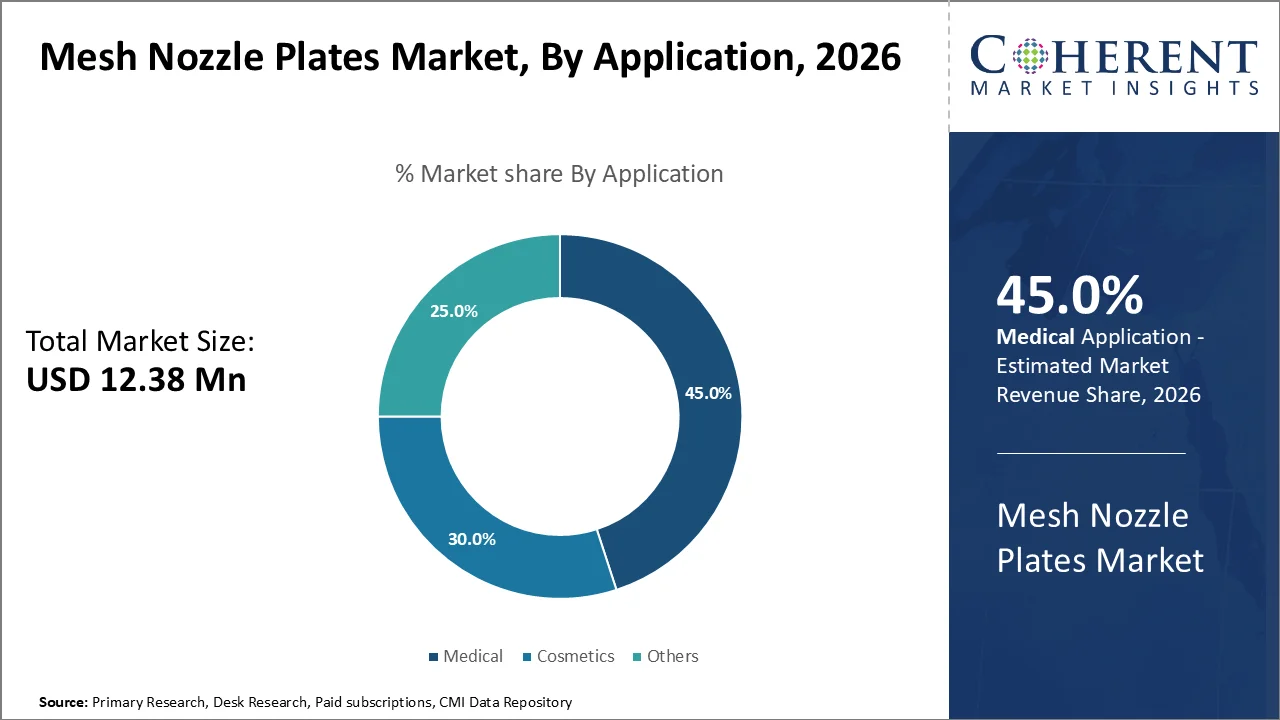
Based on application, medical dominates the market, accounting for a significant 45% share in 2026. The application of these plates in various medical devices and applications, including nebulizers, spray devices for wound care, drug delivery systems, diagnostic equipment, etc., where they ensure controlled as well as consistent fluid atomization or spray patterns is fueling the market growth.
The focus on patient safety, infection control, as well as regulatory adherence in the healthcare industry demands components like mesh nozzle plates to cater to stringent quality standards, which builds the demand within this segment. For example, the World Health Organization (WHO) shows the high need for improved drug delivery methods in respiratory care, particularly in addressing chronic conditions including asthma and chronic obstructive pulmonary disease (COPD).
These devices depend heavily on efficient mesh nozzle plates to generate fine mist droplets that make sure precise dosage as well as deep lung penetration, minimizing drug wastage as well as its side effects. The escalating aging population globally as well as the rising prevalence of respiratory diseases further amplify demand within the medical segment. Asthma is a widespread chronic condition affecting about 262 million people worldwide and leading to over 461,000 deaths annually.
Hospitals holds the Largest Market Share
Based on end user, hospitals dominates the market, accounting for a significant 35% share in 2026, the extensive application of mesh nozzle plates in critical medical procedures as well as equipment utilized within healthcare facilities worldwide is one of the factors propelling the market growth. 11%–30% of the global disease burden requires surgical or anaesthesia care, showing that surgery-related medical devices are widely needed worldwide.
Mesh nozzle plates serve as essential components in various medical instruments, including surgical devices and diagnostic apparatus, which are prevalently used in hospital settings.
The rapidly aging global population as well as the increasing incidence of chronic diseases, which drive demand for advanced medical procedures and sophisticated healthcare services are further augmenting the market growth. This trend has led to a surge in hospital admissions as well as surgical interventions, where high-precision components including mesh nozzle plates play a crucial role in making patient safety as well as procedural efficacy.
Market Drivers
Electroforming Technology is transforming the Mesh Nozzle Plates Industry
Electroforming is a process where metal (like nickel) is built up using electricity and deposited onto a shaped base called a mandrel. This helps copy the exact shape of the base with very high accuracy and creates a smooth metal structure. After the metal is formed, it is removed from the base.
This method can create very tiny and precise holes (as small as 1–5 microns) with thousands of holes in a single plate. It also keeps all holes very uniform, controls thickness very tightly, and can produce complex shapes like tapered or conical openings.
Micro-Electro-Mechanical Systems (MEMS) Fabrication: A major breakthrough in Mesh Nozzle Plates
Micro-Electro-Mechanical Systems (MEMS) fabrication is a method used to make very small parts using semiconductor techniques like photolithography, etching, and material deposition on a silicon base. It allows engineers to build tiny mechanical structures and circuits together on the same chip with very high precision.
It is used in inkjet printer nozzle plates (for example by HP and Canon) to create many tiny nozzles that control ink droplets very accurately. This improves print quality, reduces clogging, and increases the lifetime of the nozzle plates.
Current Events and Their Impact on the Mesh Nozzle Plates Market
Current Event | Description and its Impact |
Rising adoption of MEMS and electroforming technologies in precision manufacturing |
|
Escalating demand for respiratory drug delivery devices owing to rising chronic diseases |
|
Mesh Nozzle Plates Market Trends
- Strongly boosts demand from the medical sector, making it the leading application segment in the market. In 2023, healthcare spending in the European Union was €1,720 billion, which is equal to 10% of the EU’s total GDP. This means that one-tenth of the economy was spent on healthcare services.
- Increasing preference for corrosion-resistant and wear-resistant materials is shaping product innovation.
- Integration of smart manufacturing and IoT-enabled monitoring for nozzle performance enhancement is an emerging trend. For instance, Meteor Inkjet Ltd, a leading supplier of industrial inkjet printhead driving solutions, today announced the launch of its Nozzle Health Technology the first commercially available system to provide real-time health monitoring of every nozzle in an inkjet printhead.
Regional Insights
North America dominates owing to owing to its advanced manufacturing infrastructure
North America account 45% market share in 2026, owing to its advanced manufacturing infrastructure, extensive R&D capabilities, and strong automotive and aerospace sectors. In 2025, the U.S. light vehicle market reached about 16.3 million units, growing by 2.3% compared to 2024.
The United States and Canada, in particular, dominate this market due to their long-established industrial bases as well as ongoing innovation in precision engineering, which mesh nozzle plates heavily rely on. These plates are critical components in filtration systems broadly used in chemical processing, water treatment, as well as oil & gas exploration industries historically well-developed in North America.
For example, the U.S. Department of Energy (DOE) has been actively funding projects focused at advancing filtration technologies for emissions control as well as renewable energy applications. Such initiatives by government authorities have propelled demand for highly durable as well as precision-engineered components like mesh nozzle plates.
Moreover, many leading original equipment manufacturers (OEMs) and suppliers in the United States have embraced Industry 4.0 technologies, optimizing manufacturing processes with digital twins as well as advanced robotics, which considerably enhance the production quality and customization of mesh nozzle plates.
Asia Pacific Mesh Nozzle Plates Market Trends
The Asia Pacific region is poised to be the fastest-growing region through 2026-2033, expanding at a CAGR of approximately 6.8%. Rapid urbanization in emerging economies is one of the factors stimulating the growth. By 2050, the urban population is expected to grow by about 50%, meaning many more people will live in cities and towns. This will require better planning as well as development to support growing cities.
Countries including China, India, Japan, South Korea, Australia, etc., are investing heavily in sectors such as electronics, oil refining, wastewater treatment, and chemical manufacturing each of which demands sophisticated mesh nozzle plates for filtration and process optimization.
China, in particular is a major driver, with government-led initiatives emphasizing industrial upgrading and clean energy transitions. Based on announcements from the Ministry of Industry and Information Technology (MIIT) of China, there has been increased funding for high-tech manufacturing clusters focusing on refining equipment and advanced filtration technologies that utilize mesh nozzle plates extensively.
Industrial Manufacturing Base is Accelerating the Mesh Nozzle Plates Market Demand in United States
The United States has long been the backbone of high-precision component manufacturing, with industries including aerospace, medical device fabrication, automotive fuel systems, industrial inkjet printing, etc., driving substantial demand for mesh nozzle plates.
The U.S. Department of Defense's is consistently investment in next-generation propulsion systems and precision spray technologies has made consistent procurement pipelines for mesh nozzle plate manufacturers operating domestically.
China Mesh Nozzle Plates Market Trends
China is expected to lead the Asia-Pacific mesh nozzle plates market because it has a large manufacturing industry, a strong electronics sector, and continuous government support for new technologies and industrial development.
China's dominance in precision atomization and nebulization technologies is strongly reinforced by its position as the world's largest manufacturer of consumer electronics, medical devices, and industrial aerosol systems, all of which critically depend on high-performance mesh nozzle plates.
According to the Ministry of Industry and Information Technology (MIIT) of China, the country's electronics and semiconductor manufacturing output has consistently expanded, directly driving demand for precision-engineered micro-perforation components including mesh nozzle plates used in ultrasonic nebulizers and inkjet printing heads.
Who are the Major Companies in Mesh Nozzle Plates Industry
Some of the major key players in Mesh Nozzle Plates market include, Veco B.V., Aerogen Ltd., Temicon GmbH, Hamilton Medical, Belkin International, Getinge (Electrolux AB), Omron Corporation, TEKCELEO, APC International, Ltd., and Maidencreek Manufacturing Sales LLC
Key News
- In 2026, Veco Precision reports that micro nozzle plates are used for very precise control of liquids and gases. These plates are widely used in medical nebulizers, flow control systems, and fuel injection systems. They are made to be extremely accurate, even at sub-micron level, so that they can control very small amounts of liquid or gas in a smooth and stable way. This high precision helps improve performance in medical devices, industrial systems, and other advanced applications.
Market Report Scope
Mesh Nozzle Plates Market Report Coverage
| Report Coverage | Details | ||
|---|---|---|---|
| Base Year: | 2025 | Market Size in 2026: | USD 12.38 Mn |
| Historical Data for: | 2020 To 2024 | Forecast Period: | 2026 To 2033 |
| Forecast Period 2026 to 2033 CAGR: | 7.68% | 2033 Value Projection: | USD 20.79 Mn |
| Geographies covered: |
| ||
| Segments covered: |
| ||
| Companies covered: | Veco B.V., Aerogen Ltd., Temicon GmbH, Hamilton Medical, Belkin International, Getinge (Electrolux AB), Omron Corporation, TEKCELEO, APC International, Ltd., and Maidencreek Manufacturing Sales LLC | ||
| Growth Drivers: |
| ||
| Restraints & Challenges: |
| ||
Analyst Opinion
- The mesh nozzle plates market is witnessing a compelling evolution driven by rising demand across industrial spray systems, pharmaceutical nebulizers, and inkjet printing technologies. It is estimated that nebulizers, are expected to reach USD 38 billion by 2026.
- The growing emphasis on precision fluid atomization across multiple end-use industries remains a fundamental catalyst propelling market advancement.
- Manufacturers are highly investing in advanced materials including stainless steel, titanium, nickel alloys, etc., for better durability and corrosion resistance, directly improving product performance longevity. Global stainless-steel manufacturing surged by 2.5% in the first quarter of 2026, reaching 15.8 million tons.
- The pharmaceutical and medical device sector has evolved as a significant driver, given the critical role mesh nozzle plates play in efficient drug delivery systems as well as respiratory care devices.
Speak to the analyst
Want personalized insights?
Take the findings above to one of our principal consultants, or have the report rebuilt around the segments, geographies and competitors you actually track.
Market Segmentation
- By Material Type (Revenue, USD Mn, 2021-2033)
- Metal and Alloys
- Engineered Plastic
- Ceramic or Piezoceramics
- By Application (Revenue, USD Mn, 2021-2033)
- Medical
- Cosmetics
- Others
- By End User (Revenue, USD Mn, 2021-2033)
- Hospitals
- Medical Device Industries
- Others
- By Region (Revenue, USD Mn, 2021-2033)
- North America
- U.S.
- Canada
- Latin America
- Brazil
- Mexico
- Argentina
- Rest of Latin America
- Europe
- Germany
- U.K.
- France
- Italy
- Spain
- Russia
- Rest of Europe
- Asia Pacific
- China
- India
- Japan
- Australia
- South Korea
- ASEAN
- Rest of Asia Pacific
- Middle East
- GCC
- Israel
- Rest of Middle East
- Africa
- South Africa
- Central Africa
- North Africa
- North America
Sources
Primary Research Interviews
- Mesh Nozzle Plate Manufacturers & OEMs
- Industrial Spray System Integrators
- Aerospace & Automotive Component Suppliers
- Medical Device & Pharmaceutical Equipment Providers
- Others
Databases
- GlobalSpec Industrial Database
- Dun & Bradstreet Business Database
- Thomas Net Industrial Database
- Others
Magazines
- Spray Technology & Marketing Magazine
- Industrial Equipment News (IEN)
- Manufacturing Engineering Magazine
- Precision Manufacturing Journal Magazine
- Others
Journals
- Journal of Aerosol Science
- Journal of Manufacturing Processes
- International Journal of Precision Engineering and Manufacturing
- Others
Newspapers
- The Wall Street Journal (Industrial & Manufacturing Segment)
- Financial Times (Manufacturing & Technology Section)
- The Economic Times (Industry & Trade Section)
- Others
Associations
- Spray Nozzle Industry Association (SNIA)
- American Society of Mechanical Engineers (ASME)
- Society of Manufacturing Engineers (SME)
- International Federation of Robotics (IFR)
- Others
Public Domain Sources
- U.S. Patent and Trademark Office (USPTO) – Patent filings related to Mesh Nozzle Plates
- European Commission – Industrial Manufacturing Policy Reports
- U.S. Department of Commerce – Manufacturing Industry Data
- World Trade Organization (WTO) – Trade Data for Industrial Components
- Others
Proprietary Elements
- CMI Data Analytics Tool
- Proprietary CMI Existing Repository of information for last 10 years
Get access to 250+ pages report
Every segment, forecast, competitor profile and data table behind the analysis above — available for instant download.
- ESOMAR Member
- ISO 9001:2015 Certified
- D-U-N-S Registered
- GDPR & CCPA Compliant
Missing comfort of reading report in your local language? Find your preferred language:
Transform your Strategy with Exclusive Trending Reports
Frequently Asked Questions
The mesh nozzle plates market is expected to reach USD 20.79 Mn in 2033.
Major players operating in the global mesh nozzle plates market include Veco B.V., Aerogen Ltd., Temicon GmbH, Hamilton Medical, Belkin International, Getinge (Electrolux AB), Omron Corporation, TEKCELEO, APC International, Ltd., and Maidencreek Manufacturing Sales LLC.
High manufacturing costs associated with precision engineering and specialized materials is one of the major factors that is expected to hamper growth of the market over the forecast period.
Rising demand for precision drug delivery systems in pharmaceutical and medical industries are driving growth of the global Mesh Nozzle Plates market.
The mesh nozzle plates market is anticipated to grow at a CAGR of 7.68% between 2026 and 2033.
Among regions, North America is expected to account for a largest market share in the global mesh nozzle plates market over the forecast period.
In fluid dynamics and engineering, the two primary types of nozzles are converging and converging-diverging (Laval) nozzles.