

Pharmaceutical Robots Market Size and Share Analysis- 2026 To 2033
The Pharmaceutical Robots Market size is anticipated to grow at a CAGR of 9.1% with USD 250 Mn in 2026 and is expected to reach USD 460 Mn in 2033. The primary drivers are defined by the increasing sterile-drug production, expansion of biologics and cell therapies, stricter contamination-control requirements, pharmaceutical reshoring, and rising demand for accurate and traceable manufacturing processes. Pharmaceuticals accounted for 29.1% of the European Union’s €414 billion high-tech sold production in 2024, equivalent to approximately €120.5 billion. This large production base is strengthening demand for hygienic articulated robots, autonomous mobile robots, machine-vision systems, and automated laboratory platforms across pharmaceutical manufacturing facilities worldwide.
Key Takeaways
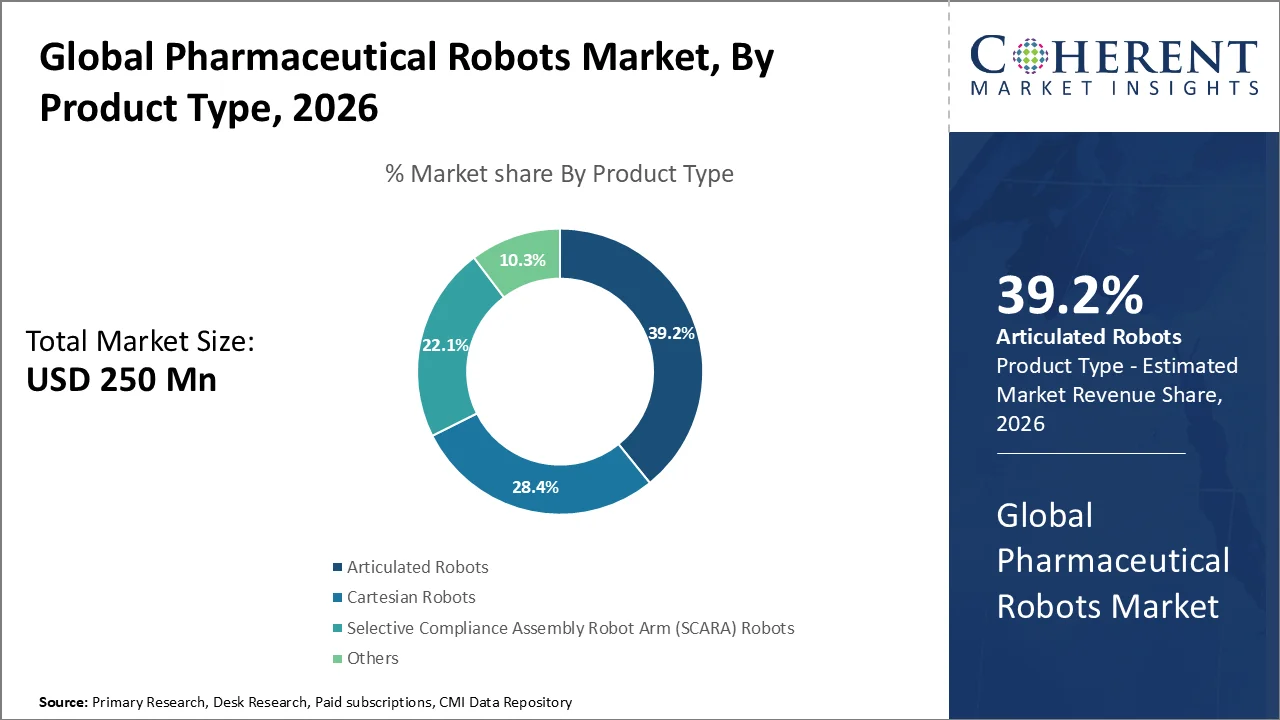
- The articulated robots segment is likely to dominate the market with 39.2% in 2026. The segment’s growth is owing to the multi-axis flexibility, high payload capacity, and ability to perform complex pharmaceutical manufacturing, material-handling, packaging, and laboratory automation operations. The Indian pharmaceutical industry ranks third globally by production volume and eleventh by value, comprising more than 3,000 companies and over 10,500 manufacturing facilities.
- The picking and packaging segment is set to lead with 45.4% in 2026. The segment’s growth is owing to the increasing demand for high-speed, precise, and contamination-free handling of medicines. Pharmaceutical robots improve packaging consistency, reduce human errors, and support large-scale production.
- The pharmaceutical companies segment are expected to dominate the market with a share of 68.1% in 2026. The segment’s growth is owing to the growing investments in automated production lines, stringent quality-control requirements, increasing medicine output, and focus on improving operational efficiency.
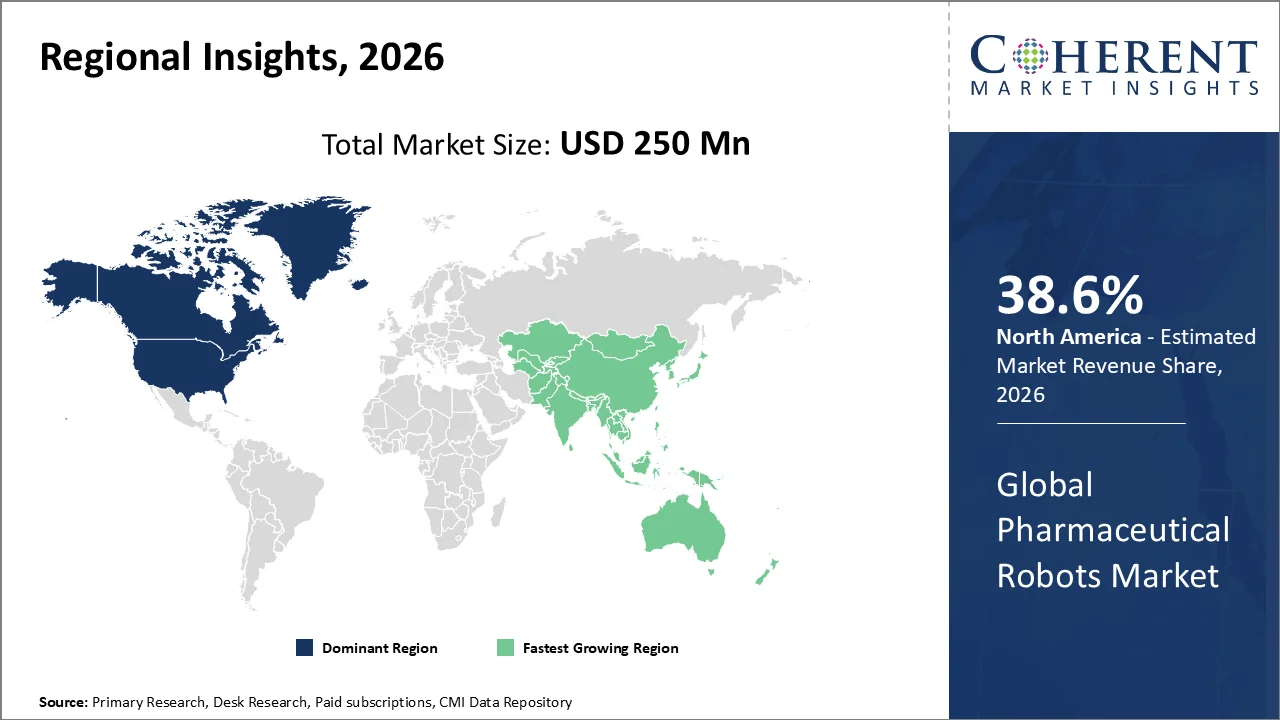
- North America is expected to acquire the prominent share of 38.6% in 2026. The region’s growth is owing to the strong presence of pharmaceutical manufacturers, advanced automation infrastructure, high research and development expenditure, stringent drug-quality standards, and early adoption of robotic technologies.
Segmental Insights
Why is Articulated Robots Segment Acquiring the Largest Share?
On the basis of product type, the articulated robots segment is projected to account for the largest Pharmaceutical Robots Market share of 39.2% in 2026. The segment’s growth is owing to the six-axis flexibility, high positioning accuracy, and the ability to automate dispensing, vial handling, packaging, palletizing, inspection, and cleanroom material transfer within one integrated production line.
The U.S. FDA reported 5,953 drug-manufacturing sites in its global Site Catalog at the end of FY2025, highlighting the production base requiring standardized, traceable automation. The agency also conducted around 1,248 drug-quality-assurance inspections during FY2025, thereby reinforcing manufacturers’ need for repeatable processes, contamination control, and electronically documented operations.
In June 2025, KUKA introduced the KMR iisy CR, an autonomous mobile manipulator certified for ISO Class 3 cleanrooms. The robot performs pick-and-place, material transport, and palletizing tasks using a six-axis arm and AI-based fleet management.
- Current Industry Events of 2026
- Market Size Estimation
- Regional Breakdown
- Competitive Landscape
- Customer Intelligence
- Segmental Analysis
- Pricing Analysis
- Key Market Drivers, Challenges & Future Trends
- Customized Insights Section
Picking and Packaging hold the Largest Market Share
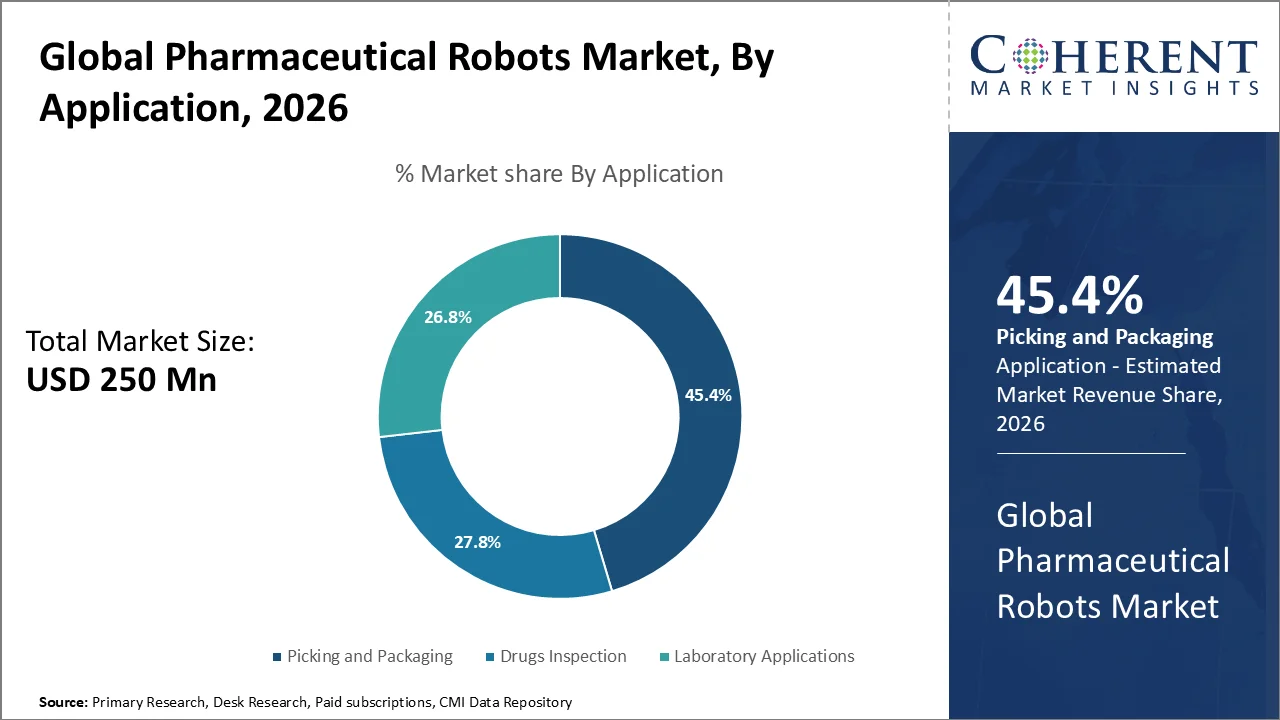
On the basis of application, the picking and packaging segment lead with a major 45.4% share in 2026. The growth is owing to the need to handle rising medicine volumes, multiple dosage formats, serialized packs, and contamination-sensitive products with consistent speed and traceability.
The FDA approved 46 novel drugs in 2025, expanding products requiring validated filling, inspection, labeling, cartoning, and end-of-line handling. The CDC data show that 88.6% of U.S. adults aged 65 years and older took prescription medication, thereby indicating the sustained demand for packaged medicines and efficient production throughput.
In May 2025, Syntegon introduced SynTiso, a fully automated, Annex 1-compliant filling line for liquid pharmaceuticals. It processes up to 600 syringes, vials, or cartridges per minute, uses contactless suspended transport, reduces contamination risk, and shortens batch changeovers by 50%.
Market Drivers
Rising Innovations in Hygienic Robotic Handling Are Transforming the Pharmaceutical Robots Market in Japan
Japan is an important pharmaceutical robotics innovation center because of its established industrial-robot manufacturers, advanced manufacturing capabilities, ageing workforce, and concentration of pharmaceutical and life science companies. Japanese robot suppliers are developing systems with smoother exterior surfaces, stronger ingress protection, cleanroom classifications, chemical-resistant coatings, specialized seals, and food- or pharmaceutical-compatible lubricants. These features allow robots to perform container handling, laboratory preparation, chemical transport, inspection, packaging, and machine tending in controlled environments.
The demand is also being supported by demographic pressure. WHO reports that approximately 30% of Japan’s population is already aged 60 years or above, creating greater medicine demand while reducing the availability of working-age employees.
In June 2026, Yaskawa Electric Corporation launched the MOTOMAN-HD7 and MOTOMAN-HD8 robots for life-science and pharmaceutical environments. The HD7 provides a seven-kilogram payload and 927-millimeter maximum reach, while the HD8 provides an eight-kilogram payload and 727-millimeter reach. Yaskawa designed the robots for chemical and small-container transportation in areas requiring advanced hygiene management.
Cleanroom-Compatible Mobile Robots: A Major Breakthrough in the Pharmaceutical Robots Market
Cleanroom-compatible autonomous mobile robots represent an important breakthrough because they extend pharmaceutical automation beyond stationary work cells. Mobile pharmaceutical robots can transport components, samples, vials, syringes, caps, tools, environmental-monitoring devices, and partially completed products between production stations.
In September 2025, Staubli announced that it would showcase Sterimove at CPHI Frankfurt in October 2025. Stäubli described Sterimove as the first mobile pharmaceutical robot compatible with GMP cleanroom Grades A, B, C, and D. The platform was developed for cleanroom transport and can be combined with Staubli’s Stericlean+ robotic arms for automated tub, vial, syringe, and freeze-dryer handling.
Current Events and Their Impact on the Pharmaceutical Robots Market
Current Event | Description and its Impact |
FDA Advanced Manufacturing Technologies Designation Program in the U.S.
|
|
EU Data Act Requirements for Connected Pharmaceutical Robots |
|
Pharmaceutical Robots Market Trends
- Rising adoption of collaborative robots in drug manufacturing, packaging, labeling, and palletizing improves throughput, workplace safety, and production consistency.
- AI-enabled robotic systems with machine vision support precise inspection, defect detection, sample handling, and real-time quality control across pharmaceutical facilities.
- Growing demand for personalized medicines and small-batch biologics encourages flexible robotic platforms capable of rapid changeovers and contamination-controlled production.
- Expansion of automated laboratories accelerates drug discovery, diagnostic testing, and high-throughput screening while reducing repetitive manual work. As of 2026, the International Federation of Robotics reported that global sales of robots used for diagnostics and medical laboratory analysis increased by 610% in 2024, while total medical-robot sales rose 91% to around 16,700 units.
- Supportive regulatory initiatives for advanced pharmaceutical manufacturing strengthen adoption of robotics, continuous processing, and digitally controlled production. In December 2025, the U.S. FDA finalized guidance for its Advanced Manufacturing Technologies Designation Program, which facilitates development of drugs produced using qualifying advanced manufacturing technologies. FDA’s 2026 FRAME initiative also supports faster automation adoption while maintaining product quality, process control, and regulatory compliance.
Regional Insights
North America Dominates Owing to the Large Pharmaceutical Manufacturing and Automation Base
The North America region accounts for 38.6% of the market share in 2026. The region’s growth is owing to the large drug-manufacturing base, strict quality standards, and adoption of automated laboratories and production lines.
The U.S. Census Bureau data show that pharmaceutical and medicine manufacturers recorded USD 122.4 billion in shipments during January–May 2026, up 9.6% from the same period in 2025, thereby strengthening the demand for robotic handling, inspection, packaging, and material transfer. Statistics Canada reported that 230 pharmaceutical R&D enterprises spent C$1.8 billion on in-house R&D, thereby supporting high-throughput automation as well as robotic sample processing.
In April 2026, Canada highlighted the Korea Pharmaceutical and Bio-Pharma Manufacturers Association’s Self-Driving Laboratory using Vancouver-based Telescope Innovations’ technology for AI-driven pharmaceutical R&D automation.
Asia Pacific Pharmaceutical Robots Market Trends
Asia Pacific is expected to witness strong growth in market over the forecast period. The region’s growth is owing to the factory automation, expanding biologics production, and contamination-control requirements across China, Japan, South Korea, India, and Southeast Asia.
The International Federation of Robotics’ World Robotics 2025 survey reported that Asia accounted for 74% of new industrial robot deployments in 2024, confirming the region’s dominant automation base. China alone installed 295,000 industrial robots, creating a large supplier, integrator, and engineering ecosystem that pharmaceutical manufacturers can leverage for sterile filling, inspection, packaging, palletizing, and laboratory handling.
In June 2025, Japan-based Seiko Epson announced the development of its first collaborative robot for life-sciences and pharmaceutical laboratories, with initial commercialization planned in Japan and Europe. The robot offers a 6 kg payload, 900 mm reach, ISO 14644-1 Class 5 cleanroom-compatible design, and integration with autonomous mobile robots.
Expanding Pharmaceutical Manufacturing and FDA-Backed Advanced Automation is Accelerating the Pharmaceutical Robots Market in United States
The U.S. is the largest individual pharmaceutical robots market owing to its extensive drug-manufacturing base, stringent quality requirements, and rapid adoption of automated sterile processing, inspection, packaging, and laboratory systems. In June 2026, the U.S. Bureau of Labor Statistics reported that pharmaceutical and medicine manufacturing employed 357,500 workers in 2025, thereby highlighting the scale of production requiring productivity and contamination-control solutions.
In December 2025, Astellas received U.S. FDA Advanced Manufacturing Technology designation for its Maholo robotic cell-culture automation system. The dual-arm, AI-enabled platform improves precision, reproducibility, scalability, and consistency while accelerating cell-therapy process development and supporting reliable GMP manufacturing.
China Pharmaceutical Robots Market Trends
China’s pharmaceutical robots market is gaining momentum. The drug manufacturers and pharmacies are adopting automation for precise handling, packaging, inspection, dispensing, and laboratory workflows. According to the State Council Information Office, China produced a record 602,700 industrial robots from January to October 2025, representing 28.8% year-on-year growth and strengthening domestic availability of automation systems adaptable to pharmaceutical facilities.
In a notable investment-led development, Beijing-based Galbot had raised RMB 2.4 billion by July 2025 and deployed humanoid robots in more than 10 Beijing pharmacies, where they autonomously retrieve medicines and deliver orders. These capabilities support robotic adoption across China’s pharmaceutical supply chain.
Who are the Major Companies in Pharmaceutical Robots Industry
Some of the major key players in Pharmaceutical Robots Market are Kawasaki Heavy Industries, Ltd., FANUC Corporation, Mitsubishi Electric Corporation, ABB Ltd., Seiko Epson Corporation, Universal Robots A/S, Yaskawa Electric Corporation, Marchesini Group S.p.A., and Midea Group Co.
Key News
- In February 2026, Opentrons partnered with NVIDIA to integrate Isaac and Cosmos software across its network of more than 10,000 laboratory robots. The collaboration aims to generate real-world training data, connect AI-designed experiments with automated execution, and accelerate drug discovery.
- In July 2025, Kawasaki launched the six-axis MC006V medical and pharmaceutical robot, offering a 6 kg payload, 610 mm reach, and faster operation. It supports Grade A/B cleanrooms, IP67-rated protection, and vaporized hydrogen peroxide resistance for aseptic filling, sterilization, handling, and packaging.
Market Report Scope
Pharmaceutical Robots Market Report Coverage
| Report Coverage | Details | ||
|---|---|---|---|
| Base Year: | 2025 | Market Size in 2026: | USD 250 Mn |
| Historical Data for: | 2020 To 2024 | Forecast Period: | 2026 To 2033 |
| Forecast Period 2026 to 2033 CAGR: | 9.1% | 2033 Value Projection: | USD 460 Mn |
| Geographies covered: |
| ||
| Segments covered: |
| ||
| Companies covered: | Kawasaki Heavy Industries, Ltd., FANUC Corporation, Mitsubishi Electric Corporation, ABB Ltd., Seiko Epson Corporation, Universal Robots A/S, Yaskawa Electric Corporation, Marchesini Group S.p.A., and Midea Group Co. | ||
| Growth Drivers: |
| ||
| Restraints & Challenges: |
| ||
Analyst Opinion
- Pharmaceutical robots are increasingly driven by supply-chain localization and manufacturing resilience. In 2025, the FDA reported that 53% of branded drugs and 69% of generics supplied in the U.S. were manufactured overseas, thereby strengthening investment in automated domestic production capacity and quality.
- Industrial robot adoption is speeding up worldwide. IFR estimated 575,000 new factory installations in 2025, up 6%, thereby providing a strong technology base for pharmaceutical automation across regulated production environments.
- Robotic systems are gaining traction across sterile filling, packaging, inspection, laboratory handling, and hazardous-drug preparation. U.S. industrial robot installations reached 38,000 units in 2025, increasing 11% year over year. Combined with FDA support for continuous manufacturing, advanced process control, and smart manufacturing, this momentum is expected to expand pharmaceutical robot deployment, improve consistency, reduce contamination risks, and strengthen production scalability across global pharmaceutical facilities.
Speak to the analyst
Want personalized insights?
Take the findings above to one of our principal consultants, or have the report rebuilt around the segments, geographies and competitors you actually track.
Market Segmentation
- By Product Type (Revenue, USD Mn, 2021-2033)
- Cartesian Robots
- Selective Compliance Assembly Robot Arm (SCARA) Robots
- Articulated Robots
- Others
- By Application (Revenue, USD Mn, 2021-2033)
- Picking and packaging
- Drugs inspection
- Laboratory applications
- By End User (Revenue, USD Mn, 2021-2033)
- Pharmaceutical companies
- Research laboratories
- By Region (Revenue, USD Mn, 2021-2033)
- North America
- U.S.
- Canada
- Latin America
- Brazil
- Mexico
- Argentina
- Rest of Latin America
- Europe
- Germany
- U.K.
- France
- Italy
- Spain
- Russia
- Rest of Europe
- Asia Pacific
- China
- India
- Japan
- Australia
- South Korea
- ASEAN
- Rest of Asia Pacific
- Middle East
- GCC
- Israel
- Rest of Middle East
- Africa
- South Africa
- Central Africa
- North Africa
- North America
Sources
Primary Research Interviews
- Pharmaceutical manufacturing executives
- Automation and robotics engineers
- Production and plant managers
- Quality assurance and quality control professionals
- Laboratory managers and researchers
- Hospital and retail pharmacy administrators
- Pharmaceutical robot manufacturers and system integrators
- Pharmaceutical equipment distributors
- Regulatory and compliance specialists
- Key opinion leaders (KOLs) in pharmaceutical automation
Databases
- World Health Organization (WHO)
- U.S. Food and Drug Administration (FDA)
- European Medicines Agency (EMA)
- National Institutes of Health (NIH)
- Organisation for Economic Co-operation and Development (OECD)
- International Federation of Robotics (IFR)
- United Nations Industrial Development Organization (UNIDO)
- Eurostat
Magazines
- Pharmaceutical Technology
- Pharmaceutical Manufacturing
- European Pharmaceutical Review
- Pharma Manufacturing
- Robotics & Automation Magazine
- The Medicine Maker
Journals
- International Journal of Pharmaceutics
- Journal of Pharmaceutical Innovation
- PDA Journal of Pharmaceutical Science and Technology
- Robotics and Computer-Integrated Manufacturing
- IEEE Transactions on Automation Science and Engineering
- International Journal of Advanced Robotic Systems
Newspapers
- The New York Times
- The Guardian
- The Wall Street Journal
- Financial Times
- Nikkei Asia
Associations
- International Federation of Robotics (IFR)
- International Society for Pharmaceutical Engineering (ISPE)
- Parenteral Drug Association (PDA)
- Association for Advancing Automation (A3)
- Pharmaceutical Research and Manufacturers of America (PhRMA)
- European Federation of Pharmaceutical Industries and Associations (EFPIA)
Public Domain Sources
- Company Annual Reports and Investor Presentations
- Government Health and Pharmaceutical Regulatory Publications
- FDA and EMA Manufacturing and Good Manufacturing Practice Guidelines
- Patent Databases such as WIPO PATENTSCOPE, Google Patents, and Espacenet
- Government Industrial Automation and Manufacturing Statistics
- Company Press Releases, Product Launch Announcements, and Technical White Papers
- Public Procurement and Pharmaceutical Facility Expansion Databases
Proprietary Elements
- CMI Data Analytics Tool
- Proprietary CMI Existing Repository of Information for Last 10 Years
Get access to 250+ pages report
Every segment, forecast, competitor profile and data table behind the analysis above — available for instant download.
- ESOMAR Member
- ISO 9001:2015 Certified
- D-U-N-S Registered
- GDPR & CCPA Compliant
Missing comfort of reading report in your local language? Find your preferred language:
Transform your Strategy with Exclusive Trending Reports
Frequently Asked Questions
The Pharmaceutical Robots Market is expected to reach USD 460 Mn in 2033.
Major players operating in the global Pharmaceutical Robots Market include Kawasaki Heavy Industries, Ltd., FANUC Corporation, Mitsubishi Electric Corporation, ABB Ltd., Seiko Epson Corporation, Universal Robots A/S, Yaskawa Electric Corporation, Marchesini Group S.p.A., and Midea Group Co.
The high initial capital investments, strict validation and integration complexities, and a shortage of skilled operators the key factors hampering growth of the market.
The strict contamination control needs, labor shortages, and rising production volumes is boosting the demand for Pharmaceutical Robots.
The Pharmaceutical Robots Market is anticipated to grow at a CAGR of 9.1% between 2026 and 2033.
Among regions, North America is expected to account for a largest market share in the global Pharmaceutical Robots Market over the forecast period.
The global Pharmaceutical Robots Market is on a steady upward trajectory owing to the rising automation, sterile manufacturing needs, and precision requirements