

Uveitis Treatment Market Size and Share Analysis: (2026 - 2033)
The global uveitis treatment market size is estimated to total approximately USD 906 Mn in 2026 and is projected to grow at a compound annual growth rate (CAGR) of 6.3% during the forecast period (2026-2033), reaching USD 1,389 Mn by 2033. This growth is attributable to increasing prevalence of uveitis and growing adoption of advanced treatment options, including biologics and corticosteroid therapies.
Key Takeaways from the Uveitis Treatment Market Report
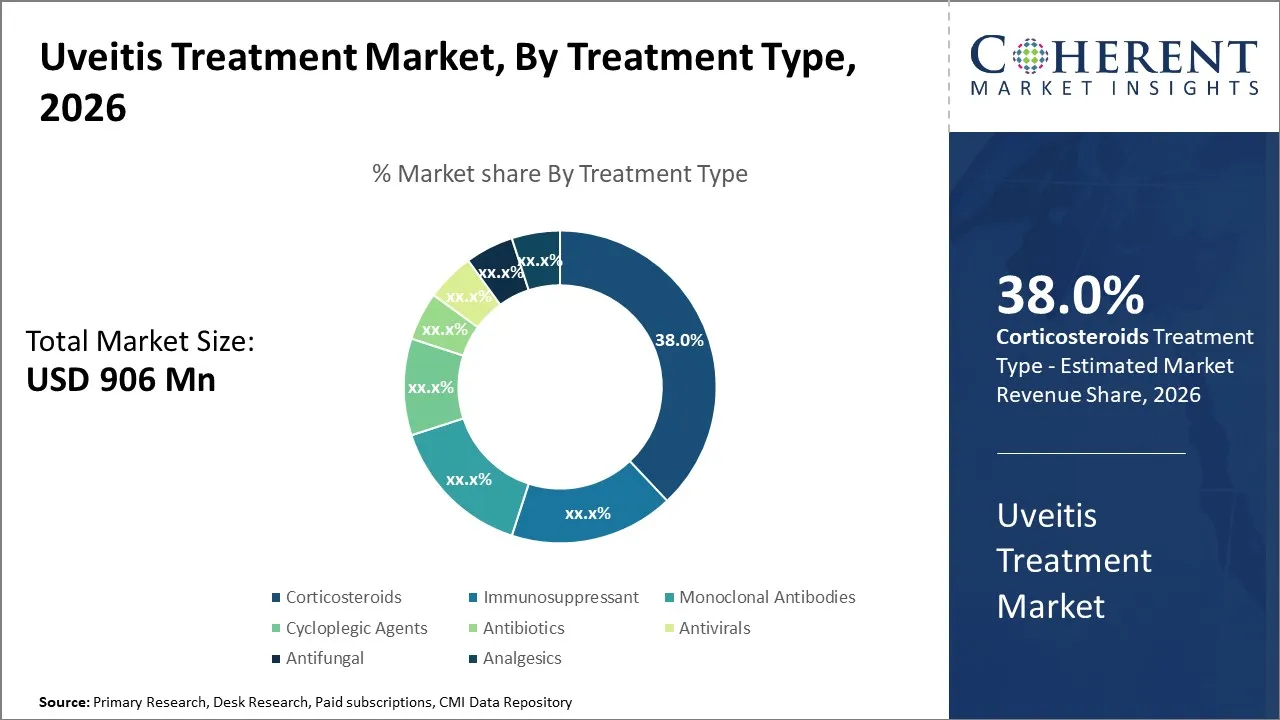
- Corticosteroids are expected to remain the most popular treatment type for uveitis management, holding a revenue share of 38% in 2026 because of their first-line use and strong clinical effectiveness.
- Anterior uveitis segment is anticipated to lead the market with a share of 36% in 2026 because of high prevalence and easier diagnosis.
- Based on distribution channel, retail pharmacies segment is slated to account for 40% of the global uveitis treatment market share in 2026, owing to its wider accessibility.
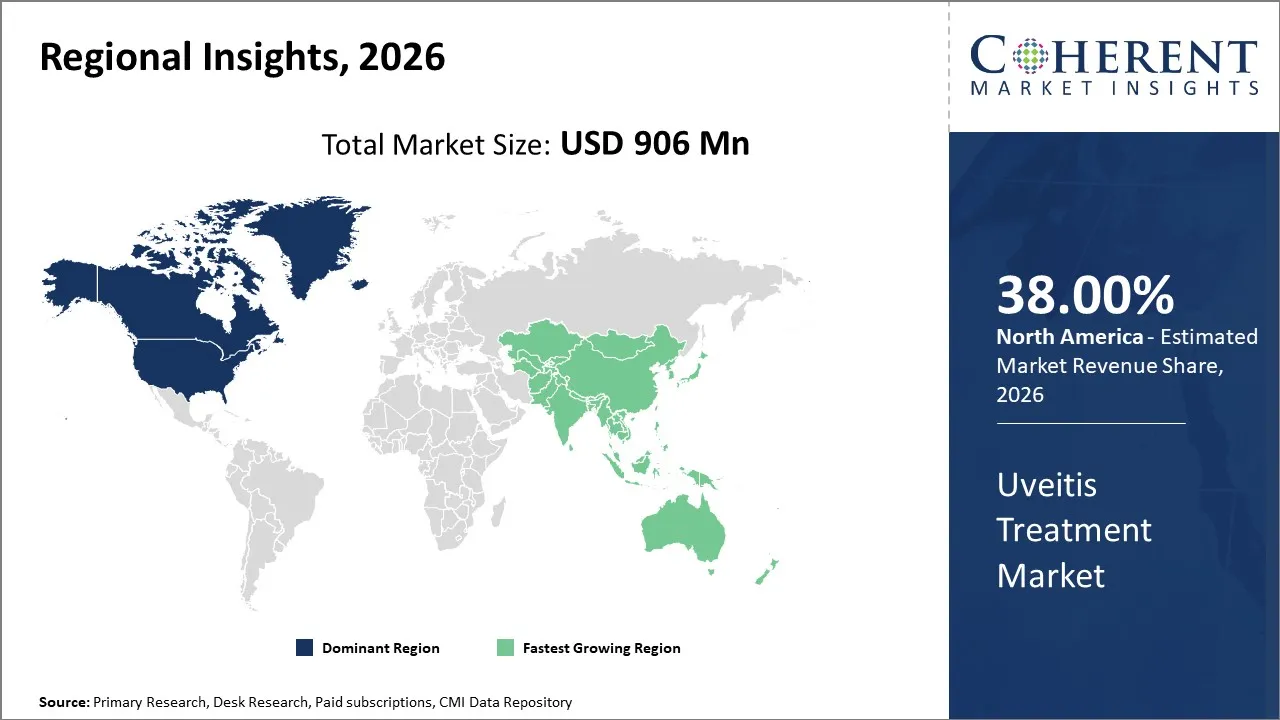
- North America is expected to dominate the global uveitis treatment industry, capturing a share of 38% in 2026 as a result of robust healthcare infrastructure and increased disease detection.
- Asia Pacific, with a share of 22% in 2026, is anticipated to emerge as the most lucrative pocket for uveitis treatment drug manufacturers during the forecast period, thanks to a large patient pool, improving healthcare infrastructure, and rising awareness regarding eye disorders.
Uveitis Treatment Market Overview
The global uveitis treatment market is expected to grow steadily during the forecast period. This is mostly due to increasing prevalence of autoimmune and inflammatory eye disorders, along with rising awareness regarding early diagnosis and treatment. In addition, advancements in biologics and targeted therapies are also supporting market expansion.
Uveitis is an inflammation of the uvea, the middle layer of the eye, which consists of the iris, ciliary body, and choroid. Based on the location of inflammation, uveitis is classified into anterior uveitis, intermediate uveitis, posterior uveitis, and panuveitis (diffuse involvement of all layers). Anterior uveitis (iritis), which involves inflammation of the iris, is the most common form. Symptoms may include eye redness, pain, light sensitivity, blurred vision, and, in some cases, floaters.
Rising incidence of uveitis is providing a strong impetus for the growth of uveitis treatment market. Similarly, rising adoption of advancements therapies is fostering revenue growth. There is a rising shift towards targeted therapies for the management of uveitis. Patients and physicians are increasingly preferring precision therapies like biologics and targeted immunosuppressants over traditional corticosteroids. This trend is expected to boost the uveitis treatment market growth during the assessment period.
Current Events and Their Impact on the Uveitis Treatment Market
Current Event | Description and its Impact |
Advances in Gene Therapy and Precision Medicine |
|
Digital Health Integration and AI Development |
|
Segmental Insights
- Current Industry Events of 2026
- Market Size Estimation
- Regional Breakdown
- Competitive Landscape
- Customer Intelligence
- Segmental Analysis
- Pricing Analysis
- Key Market Drivers, Challenges & Future Trends
- Customized Insights Section
Which is the Commonly Used Treatment Type for Uveitis?
Corticosteroids Remain the Most Widely Used Treatment Type
Corticosteroids are the most commonly used treatment for uveitis due to their potent anti-inflammatory effects, rapid symptom relief, and applicability across various uveitis types. According to Coherent Market Insights’ latest uveitis treatment market analysis, corticosteroids segment will likely generate a market share of 38% in 2026.
Corticosteroids are preferred for uveitis treatment because of their versatility and proven effectiveness. They can be administered in multiple forms, such as eye drops, oral tablets, or injections, allowing doctors to tailor treatment to each patient’s condition and severity. In addition, ongoing research and clinical studies support their safety and efficacy, reinforcing their role as the preferred choice in managing both acute and chronic uveitis cases.
Which Disease Type Leads the Uveitis Treatment Market?
Anterior Uveitis Segment Holds the Largest Market Share
Based on disease type, anterior uveitis segment is anticipated to dominate the market with a share of 36% in 2026. This is mostly due to its higher prevalence and relatively easier diagnosis compared with posterior or intermediate forms. Anterior uveitis accounts for approximately 50% to 60% of all uveitis cases and is often associated with conditions like HLA-B27–related autoimmune disorders, infections, or trauma.
Symptoms such as eye redness, pain, and photophobia are more noticeable, enabling timely medical attention. Rising adoption of medications like corticosteroids, immunosuppressants, monoclonal antibodies, and antibiotics for anterior uveitis management is set to boost segment growth. In addition, treatment options for anterior uveitis, including corticosteroid eye drops and immunomodulatory therapies, are well-established and widely accessible, further supporting market growth for this segment.
Regional Insights
North America Remains at the Epicenter of Uveitis Treatment Market Growth
North America is expected to lead the global uveitis treatment market during the forecast period, commanding a share of 38% in 2026. This is mostly due to rising prevalence of autoimmune and inflammatory eye diseases, increasing healthcare expenditure, and presence of advanced ophthalmology infrastructure.
The high prevalence of autoimmune and inflammatory disorders in the United States and Canada is a major driver for uveitis treatment adoption. Patients with these conditions require regular monitoring and advanced therapies, including corticosteroids, immunosuppressants, and biologics. Presence of well-established healthcare systems and easy access to specialized ophthalmologists further support timely diagnosis and treatment, boosting overall market growth.
Asia Pacific Becoming a Central Hub for Industry Players
Asia Pacific is anticipated to emerge as the fastest growing market for uveitis treatments during the forecast period. This is because of increasing awareness of eye health, expanding healthcare infrastructure, and rising incidence of ocular infections and chronic diseases in countries like India, China, and Japan. The region is slated to hold around 22% of the global market by 2026.
Rising incidence of ocular infections and chronic systemic diseases, such as diabetes and autoimmune disorders, is playing a key role in boosting sales of uveitis treatment drugs in the region. These conditions increase the risk of developing uveitis, leading to higher demand for effective treatment options.
Uveitis Treatment Market Outlook – Country-wise
U.S. Uveitis Treatment Market Trends
The U.S. remains the market leader in uveitis treatments as a result of the increasing prevalence of autoimmune and inflammatory eye disorders, growing awareness of eye health, and advanced healthcare infrastructure. Patients suffering from conditions like rheumatoid arthritis or sarcoidosis are more prone to developing uveitis, which increases demand for corticosteroids, immunosuppressants, and biologic therapies.
A shift toward novel therapies like biologics and advanced immunosuppressants is a key trend in the U.S. uveitis therapy market. Biologics target specific inflammatory pathways and provide more effective and safer treatment for patients with chronic or severe uveitis. Growing clinical use, along with expanded insurance coverage, is helping patients access these advanced treatments, which is boosting overall market growth.
China Uveitis Treatment Market Forecast
The uveitis treatment market in China poised to witness rapid growth during the forecast period. This is mostly due to rising awareness of eye health, increasing prevalence of ocular infections and chronic systemic diseases, and expanding healthcare infrastructure. In addition, improving healthcare facilities, government initiatives for eye care, and increased patient education are helping expand access to advanced therapies across both urban and semi-urban regions.
Rising incidence of ocular complications related to diabetes and infectious diseases is creating lucrative growth opportunities for uveitis treatment industry in China. As more patients require effective and timely uveitis management, demand for corticosteroids and immunomodulatory therapies is increasing. Government initiatives promoting eye care, coupled with growing patient education and awareness campaigns, are further accelerating adoption of modern uveitis treatments across the country.
Uveitis Treatment Industry News
- In January 2026, the U.S. Food and Drug Administration (FDA) cleared Novaliq’s Investigational New Drug (IND) application for NOV05. This clearance allows the initiation of the EYETAC Phase II clinical trial in patients with non-infectious anterior uveitis (NIAU).
- In July 2025, Clearside Biomedical announced that XIPERE was approved in Canada to treat uveitic macular edema. The drug is given as an injection into the space around the eye called the suprachoroidal space.
- In November 2024, Santen and Arctic Vision signed a commercial agreement for ARVN001, a therapy for uveitic macular edema. The treatment is administered via a suprachoroidal injection, targeting the space around the eye.
- In February 2024, Bausch + Lomb Corporation presented a study on XIPERE at the Macular Society annual meeting. The study looked at how long the treatment lasts and how it is used for uveitic macular edema in clinical practice.
Market Report Scope
Uveitis Treatment Market Report Coverage
| Report Coverage | Details | ||
|---|---|---|---|
| Base Year: | 2025 | Market Size in 2026: | USD 906 Mn |
| Historical Data for: | 2020 To 2024 | Forecast Period: | 2026 To 2033 |
| Forecast Period 2026 to 2033 CAGR: | 6.3% | 2033 Value Projection: | USD 1,389 Mn |
| Geographies covered: |
| ||
| Segments covered: |
| ||
| Companies covered: | AbbVie, Novartis AG, Bausch Health Companies Inc., Galapagos NV, EyePoint Pharmaceuticals, Inc., Clearside Biomedical, Tarsier Pharma Ltd, Santen Pharmaceutical Co., Ltd., Bausch & Lomb Incorporated, Sanofi, Regeneron Pharmaceuticals, and Inc., and Alimera Sciences | ||
| Growth Drivers: |
| ||
| Restraints & Challenges: |
| ||
Uveitis Treatment Market Drivers
Rising Prevalence of Uveitis and Related Diseases: The high prevalence of uveitis, especially in countries like India, the U.S., and France, is driving growth in the uveitis drugs market. According to Retina International, uveitis affects about 730 people per 100,000 in India and around 200 per 100,000 in the U.S. This large disease burden is expected to boost demand for effective uveitis treatments during the forecast period. Similarly, growth in autoimmune and inflammatory conditions like rheumatoid arthritis, lupus, and Crohn’s disease, which can lead to non-infectious uveitis, is significantly increasing treatment demand.
Uveitis Treatment Market Trends
Biologics and Immunotherapy Taking Center Stage: There is a rising shift in the uveitis treatment landscape toward biologic drugs and immunomodulatory therapies. These targeted treatments are increasingly being used, especially in non‑infectious uveitis and chronic or refractory cases, because they modulate specific immune pathways and often offer better safety/tolerability profiles than long‑term corticosteroids.
Uveitis Treatment Market Opportunities
Early Diagnosis and Rising Awareness: Healthcare professionals and patients in the contemporary world are increasingly becoming more aware of eye disorders like uveitis. This awareness leads to earlier diagnosis and intervention, boosting the uptake of uveitis treatments. In addition, advancements in diagnostic technologies, such as optical coherence tomography (OCT) and wide-field imaging systems, support timely and accurate disease detection. These factors will collectively create growth opportunities for the uveitis treatment market during the forthcoming period.
Advancements in Therapeutic Options: Biologics and immunomodulatory therapies, including TNF inhibitors and IL-6 inhibitors, are increasingly being adopted for more targeted control of ocular inflammation, with the potential to reduce systemic side effects. In addition, the development of sustained-release drug delivery systems and novel formulations is enhancing treatment efficacy and improving patient adherence.
Analyst Opinion (Expert Opinion)
- Biologics are rapidly becoming the de‑facto pivot in moderate‑to‑severe management because steroids alone fail to deliver durable control. Real‑world cohorts show that agents like adalimumab allow ~76% of refractory non‑infectious uveitis patients to discontinue corticosteroids long‑term, with visual acuity stabilizing or improving in most treated eyes — and relapse rates remain comparatively low (~17.4% over ~4.5 years). Steroid dependency is not merely inconvenient; chronic use drives cataract glaucoma risks, which in turn spur switching to targeted immunotherapy.
- Despite abundant conventional therapies, a substantial share of patients require escalation. In a cohort of 356 patients with non‑infectious uveitis, ~18.5% needed systemic immunosuppressive/biologic treatment and ~48% required biologics at some point, indicating that first–line agents alone often fail to maintain quiescence. Nearly 53% had to switch drugs due to inadequate response, underscoring a core unmet need in durable control.
- The real measure of competitive differentiation is relapse suppression over time, not just initial response. Meta‑analysis data highlight that even with optimized regimens (e.g., adalimumab + corticosteroids), overall treatment failure by 6 months remains ~37.6%, and serious adverse events ~10.1%, meaning nearly 4 in 10 patients still relapse within a short period despite best‑of‑class therapy. This frames an urgency for next‑generation modalities (e.g., novel targets, localized delivery) that can materially extend relapse‑free intervals beyond this benchmark.
Speak to the analyst
Want personalized insights?
Take the findings above to one of our principal consultants, or have the report rebuilt around the segments, geographies and competitors you actually track.
Uveitis Treatment Market Segmentation
- By Treatment Type Insights ( Revenue, USD Mn, 2021 - 2033)
- Corticosteroids
- Immunosuppressant
- Monoclonal Antibodies
- Cycloplegic Agents
- Antibiotics
- Antivirals
- Antifungal
- Analgesics
- By Disease Type Insights ( Revenue, USD Mn, 2021 - 2033)
- Anterior Uveitis
- Posterior Uveitis
- Intermediate Uveitis
- Pan uveitis
- By Distribution Channel ( Revenue, USD Mn, 2021 - 2033)
- Hospital Pharmacies
- Retail Pharmacies
- Online Pharmacies
- Drug Stores
- By Region Insights ( Revenue, USD Mn, 2021 - 2033)
- North America
- U.S.
- Canada
- Latin America
- Brazil
- Argentina
- Mexico
- Rest of Latin America
- Europe
- Germany
- U.K.
- Spain
- France
- Italy
- Russia
- Rest of Europe
- Asia Pacific
- China
- India
- Japan
- Australia
- South Korea
- ASEAN
- Rest of Asia Pacific
- Middle East & Africa
- GCC Countries
- Israel
- Rest of Middle East & Africa
- North America
- Key Players in the Uveitis Treatment Market
- AbbVie
- Novartis AG
- Bausch Health Companies Inc.
- Galapagos NV
- EyePoint Pharmaceuticals, Inc.
- Clearside Biomedical
- Tarsier Pharma Ltd
- Santen Pharmaceutical Co., Ltd.
- Bausch & Lomb Incorporated
- Sanofi
- Regeneron Pharmaceuticals
- Alimera Sciences
Sources
Primary Research interviews
- Ophthalmologists and Retina Specialists
- Immunologists with focus on ocular diseases
- Key opinion leaders from tertiary eye care hospitals
- Clinical researchers involved in uveitis clinical trials
- Pharmacists specializing in ophthalmic therapeutics
- Hospital formulary committee members
- Regulatory experts in ophthalmic drug approvals
Databases
- PubMed/MEDLINE clinical and biomedical database
- ClinicalTrials.gov – registry of clinical studies
- WHO ICTRP – international clinical trials platform
- U.S. FDA Drugs@FDA database
- EMA European Public Assessment Reports (EPAR)
- National pharmaceutical drug databases (e.g., CDSCO India)
- ICD-10 and MeSH classification indexing
Magazines
- Ocular Surgery News
- Optometric Management
- Pharmaceutical Technology
- Drug Delivery Business News
- Pharma Focus Asia
Journals
- Ophthalmology (American Academy of Ophthalmology)
- Investigative Ophthalmology & Visual Science (IOVS)
- Journal of Ophthalmic Inflammation and Infection
- British Journal of Ophthalmology
- American Journal of Ophthalmology
- Clinical Ophthalmology
- Expert Opinion on Biological Therapy
- Journal of Autoimmunity
Newspapers
- The New York Times – Health/Science Section
- The Guardian – Science/Health
- The Times of India – Health/Medical research focus
- The Hindu – Health updates
Associations
- International Uveitis Study Group (IUSG)
- American Uveitis Society (AUS)
- Association for Research in Vision and Ophthalmology (ARVO)
- European Society of Retina Specialists (EURETINA)
- American Academy of Ophthalmology (AAO)
- All India Ophthalmological Society (AIOS)
Public Domain sources
- World Health Organization (WHO) reports on eye diseases
- Global Health Data Exchange (GHDx)
- National health ministry publications (e.g., Indian Ministry of Health)
- CDC (Centers for Disease Control and Prevention) epidemiology data
- Government healthcare expenditure databases
- Open access clinical guidelines (e.g., National Eye Institute)
Proprietary Elements
- CMI Data Analytics Tool
- Proprietary CMI Existing Repository of information for last 8 years
Get access to 250+ pages report
Every segment, forecast, competitor profile and data table behind the analysis above — available for instant download.
- ESOMAR Member
- ISO 9001:2015 Certified
- D-U-N-S Registered
- GDPR & CCPA Compliant
Missing comfort of reading report in your local language? Find your preferred language:
Transform your Strategy with Exclusive Trending Reports
Frequently Asked Questions
The global market is estimated to be valued at USD 906 Mn in 2026.
The global Uveitis Treatment Market value is expected to reach USD 1,389 Mn by 2033.
The global market is poised to exhibit a CAGR of 6.3% from 2026 to 2033.
Major growth factors include high prevalence of uveitis and increasing incidence of autoimmune disorders.
Challenging manufacturing process might slow down market growth.
Some major companies in the Uveitis Treatment Market include AbbVie, Novartis AG, Bausch Health Companies Inc., Galapagos NV, EyePoint Pharmaceuticals, Inc., Clearside Biomedical, Tarsier Pharma Ltd, Santen Pharmaceutical Co., Ltd., Bausch & Lomb Incorporated, Sanofi, Regeneron Pharmaceuticals, and Alimera Sciences.
North America, with 38% share in 2026, is expected to lead the market during the forecast period.