

Global Microspheres Market Size and Share Analysis – 2026 to 2033
The microspheres market is estimated to be valued at USD 9.49 Bn in 2026 and is expected to reach USD 17.92 Bn by 2033, growing at a compound annual growth rate (CAGR) of 9.5% from 2026 to 2033.
Key Takeaways
- In terms of Type, Hollow Microspheres Segment is expected to contribute 72.4% share of the market. This is due to their extensive use in construction composites in 2026.
- In terms application, Healthcare and biotechnology segment is expected to gain 37.2% of the market share in 2026. This is due to intensive research in these areas.
- In terms of Raw Material, Glass Segment is expected to hold 39% of the market share in 2026. This is due to its inherent advantages over other types.
- North America is dominant region in the global microspheres market and is expected to account for 36.2% of the market share in 2026. This is due to the presence of leading manufacturers and established end-use industries such as paints & coatings, healthcare & personal care, automotive, and oil & gas.
Market Overview
The microspheres market has been registering steady growth in recent years, driven by growing applications in pharmaceuticals, construction, aerospace, cosmetics, and medical devices. These spherical particles, ranging from hollow ones to solid ones consisting of such material as glass, ceramic, polymer, and biodegradable materials, are valued for their lightness, for the delivery of drugs under controlled conditions, and as performance-oriented functions in composites. Increasing use in high-end drug delivery, tissue engineering, and high-performance coatings is propelling demand even higher, particularly in life sciences and biotechnology.
Current Events and Its Impact on Microspheres Market
Current Events | Description and its impact |
Advanced Bio-Based and Functional Microspheres Development |
|
Integration of Smart Microspheres with Sensor and Diagnostic Functions |
|
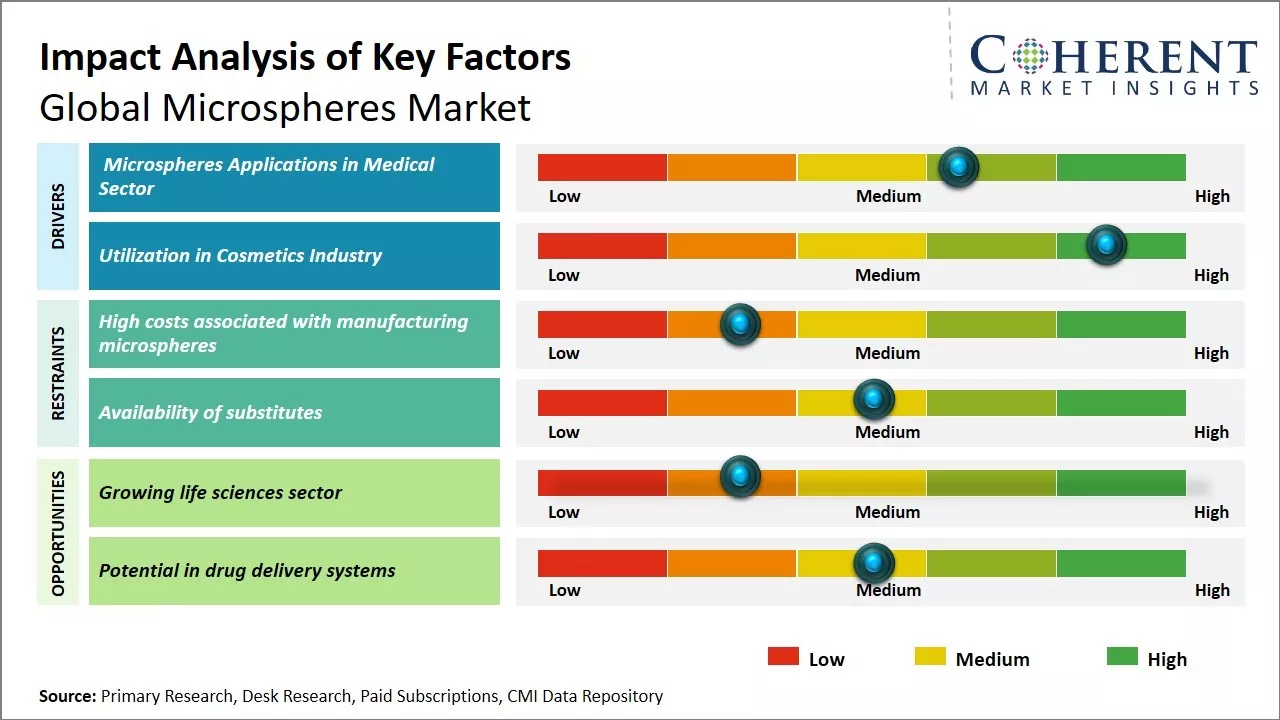
Microspheres Market Driver
- Microspheres Applications in Medical Sector
The extensive use of microspheres in medical applications such as drug delivery, cell therapy, medical imaging, regenerative medicines, etc. is expected to boost the demand. Microspheres are increasingly replacing traditional drug delivery methods owing to their controlled release mechanism. Various biodegradable polymers are being used to develop microspheres which can encapsulate a wide range of drugs and deliver them precisely at the target site in a sustained manner. This ensures maximum drug utilization and minimum side effects.
In cell therapy, microspheres act as ideal carriers to administer stem cells for treating complex diseases like cardiovascular illnesses. The three-dimensional scaffold created by microspheres mimic the native extracellular matrix and provide conducive environment for cell proliferation. Researchers are also exploring the potential of magnetic microspheres loaded with drugs/cells which can be guided to target location inside the body using external magnetic field. This capability is poised to revolutionize the precision of medical treatments in future.
In 2024, PolyMicrospheres Inc. announced the commercial launch of their biodegradable microsphere platform designed for targeted drug delivery in oncology, enabling sustained release of chemotherapy agents with reduced side effects, marking a significant advancement in precision medicine.
- Utilization in Cosmetics Industry
The unique properties of microspheres make them extensively utilized as delivery systems and additives in cosmetic formulations such as creams, lotions, gels, etc. Microencapsulation allows controlled release of active ingredients, protects them from degradation and improves chemical stability of end products. Oil-based microspheres loaded with vitamins, antioxidants, or anti-ageing agents deliver nutrients beneath skin surface in a sustained manner.
Color cosmetics greatly leverage microsphere technology for long lasting pigments which disperse uniformly. Microspheres are also gaining prominence as texturizing agents to provide rich feel and improve spread-ability of cosmetic formulations. With rising health and aesthetic consciousness, demand for cosmetic products with high performance and novelty is growing rapidly worldwide.
Microspheres enable development of such advanced formulations. They help brands to launch new generation of skin care and color cosmetic products with superior benefits. Innovation is further fueled by ongoing R&D to produce biodegradable polymeric microspheres from natural polymers. The dual drivers of industry expansion and continual technology advancement will foster healthy demand for microspheres from cosmetic manufacturers globally in the coming years.
Microspheres Market Opportunities: Growing life sciences sector
The growing life sciences sector is increasing the demand for tailored microspheres in drug delivery, vaccines, and medical imaging applications. As renewable energy technologies progress, microspheres offer potential solutions aiding concentration and insulation. Furthermore, advancement of 3D printing techniques relies on reliable microsphere inputs. Developing innovative production methods and partnering across industries can help producers capitalize on these expanding opportunities.
- Current Industry Events of 2026
- Market Size Estimation
- Regional Breakdown
- Competitive Landscape
- Customer Intelligence
- Segmental Analysis
- Pricing Analysis
- Key Market Drivers, Challenges & Future Trends
- Customized Insights Section
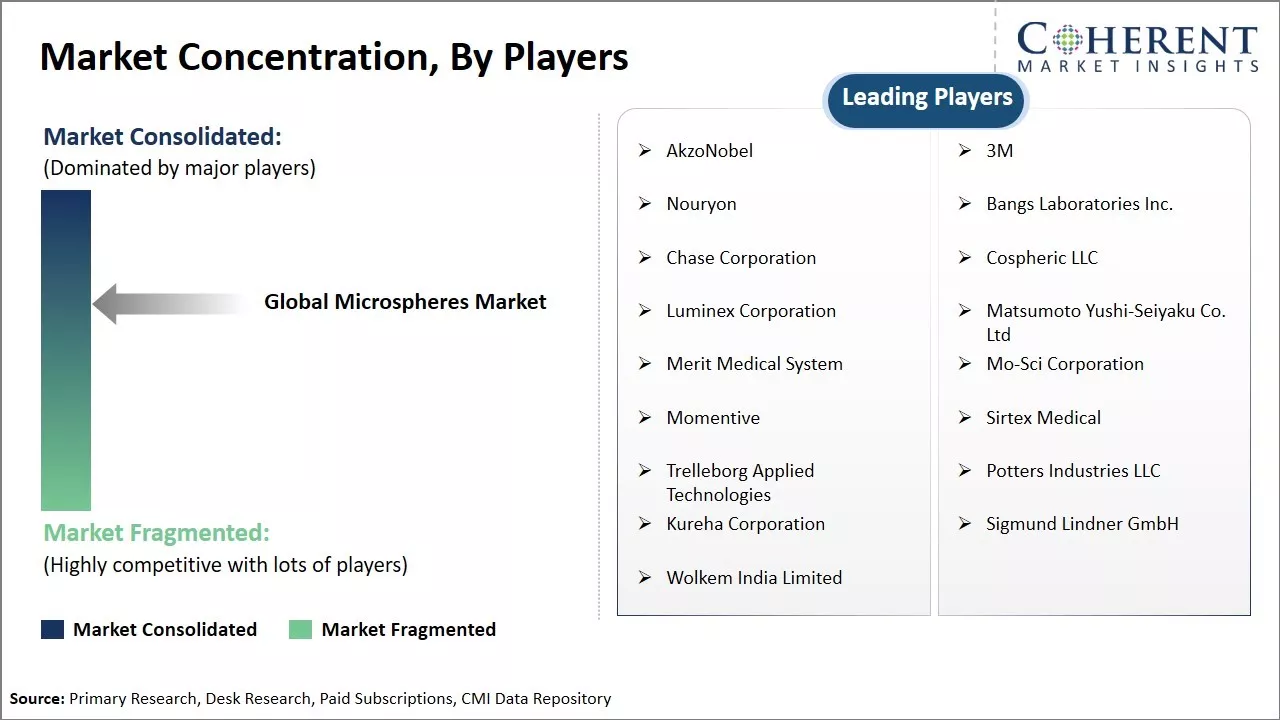
Market Concentration and Competitive Landscape
Segmental Insights
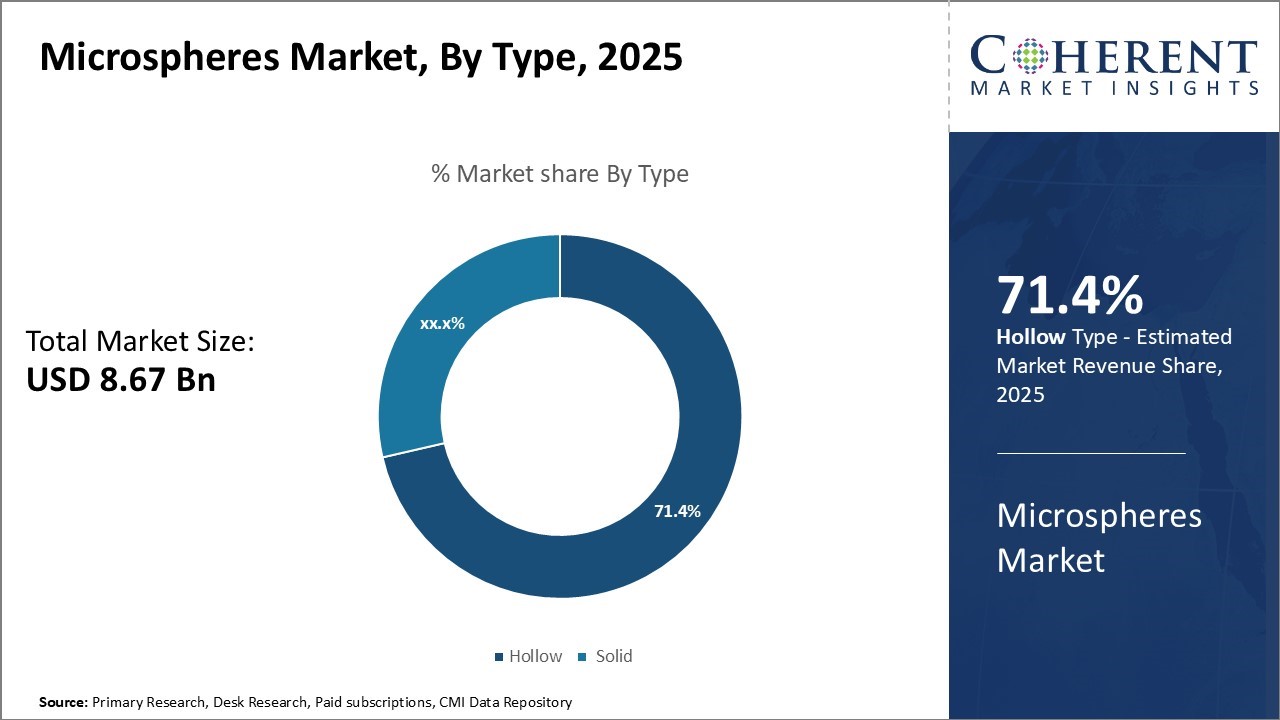
Microspheres Market Insights, By Type
In terms of type, hollow microspheres are expected to contribute 72.4% share of the market owing to their extensive use in construction composites in 2026. Hollow microspheres are used as lightweight fillers in various construction materials such as cement, concrete, plasters, and others to reduce the overall weight without compromising on strength.
The hollow internal structure makes them many times lighter than conventional filler materials. Their use helps optimize the strength-to-weight ratio of composites. The ever-growing construction industry, particularly in developing economies, relies heavily on lightweight and high-strength building materials for commercial and residential construction.
Hollow microspheres address this need efficiently. Their increasing adoption allows for constructing taller yet sturdier structures using lesser raw materials. This supports sustainability goals as well. Various infrastructure development projects also employ composites containing hollow microspheres. The hollow structure provides insulation and protects against cracks.
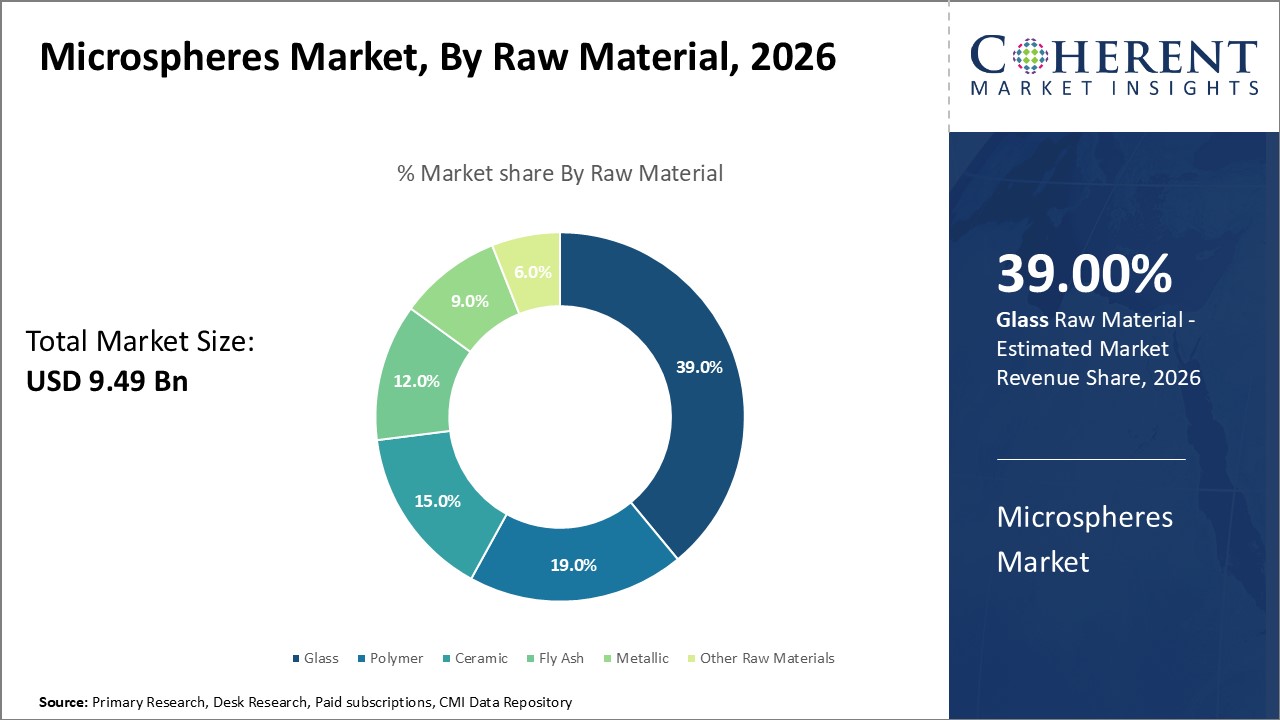
Microspheres Market Insights, By Raw Material
In terms of raw material, glass dominates the market share due to its inherent advantages over other types, which is expected 39% of the market share in 2026. Glass microspheres can be manufactured to precise sizes and morphologies. They exhibit high sphericity and narrow particle size distribution. This makes them extremely useful as reinforcement fillers.
Glass does not degrade or corrode when used in composites. It withstands high temperatures and pressure very well. Since glass is inert and does not react chemically, it does not interfere with polymerization or curing reactions involved in composite synthesis. This facilitates uniform dispersion of glass microspheres into matrices without compromising the final product performance.
Their chemical resistance allows for end-use in demanding applications exposed to chemicals and solvents. Glass microspheres are also non-toxic and biocompatible. These properties have led to preferred adoption of glass over other raw materials in high-growth application segments.
Microspheres Market Insights, By Application
Among application, healthcare and biotechnology capture the highest share due to intensive research in these areas, which is expected to 37.2% of the market share in 2026. Microspheres find widespread application as carriers for drug and gene delivery, tissue engineering, cell therapy, and other medical solutions. Their miniature, spherical shape with narrow size distribution allows for efficient encapsulation of active therapeutic molecules.
Functionalized microspheres can be targeted to specific body parts or cells. They help optimize dosage and maintain steady concentration of entrapped drugs. This improves efficacy and reduces side effects. Microspheres are being explored for developing advanced treatments for cancer, cardiovascular diseases, ophthalmic disorders, and more. Rising healthcare expenditure to address growing disease burden will further drive their demand from the biotechnology segment.
Regional Insights
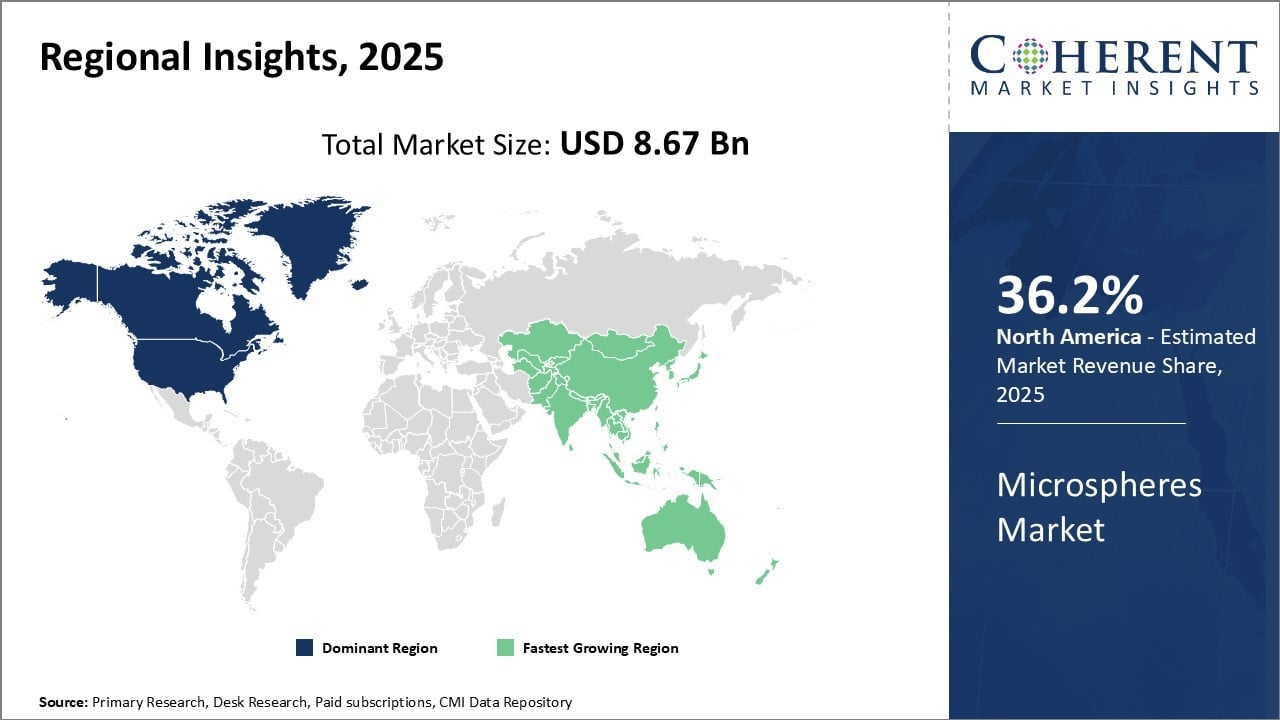
North America Microspheres Market Analysis and Trends
North America has established itself as the dominant region in the global microspheres market with and is expected to account for 36.2% of the market share in 2026. The presence of leading manufacturers and established end-use industries such as paints & coatings, healthcare & personal care, automotive, and oil & gas has propelled the market growth.
Major players like 3M, Trelleborg, and Luminex Corporation have their headquarters in the U.S., conferring it with an advantage in terms of production and technological capabilities. The demand for lightweight and specialty products from automotive and aviation industries has risen exponentially over the past decade. This has spurred the adoption of microsphere fillers and additives in North America.
Impressive growth in the application of microspheres within the personal care and medical sectors has further augmented the regional market size. The easy availability of raw materials and growth opportunities across industries will continue to drive North America's leadership.
North America Microspheres Market Analysis and Trends
Asia Pacific has emerged as the fastest expanding regional market for microspheres. Countries like China, India, Japan, and South Korea are influencing global manufacturing processes with their substantial industrial growth rates. Asia Pacific nations are rapidly industrializing and witnessing rising disposable incomes. This has increased the usage of various end-use materials incorporating microspheres in the region.
The strong international presence of domestic manufacturers has enabled Asia Pacific to become a prominent exporter of microsphere-based products. In addition, the regional emphasis on developing specialized and customized products has led to extensive research collaborations between industry players and academia. Such initiatives are helping new application areas and innovative production techniques to emerge, satisfying the evolving needs of global customers.
Microspheres Market Dominating Countries
United States Microspheres Market Analysis and Trend
The U.S. dominates the world microspheres market because of its robust pharmaceutical, aerospace, and medical device sectors. Heavy investment in R&D and early embracement of complex drug delivery systems fuel demand for polymer and biodegradable microspheres. Support from regulations and existence of prominent players such as 3M and Thermo Fisher enhance its dominance.
Germany Microspheres Market Analysis and Trend
Germany dominates the European microspheres market through innovation in automotive components, coatings, and biomedical engineering. Emphasis is placed on sustainable and lightweight materials in the nation, fostering expansion in hollow glass and ceramic microspheres. Strong manufacturing platform and academic partnerships also support market penetration.
Japan Microspheres Market Analysis and Trend
Japan dominates in the production of high-purity ceramic and polymer microspheres for electronics, cosmetics, and precision coatings. Japan's leadership in miniaturized medical devices and semiconductors fuels demand for microspheres with enhanced narrow size distribution and surface control. Domestic companies focus on innovation and export-oriented production.
China Microspheres Market Analysis and Trend
China is spearheading a strong penetration into the microspheres market, supported by capacity-intensive manufacturing equipment and rising domestic demand in pharmaceuticals, building construction, and coatings. Competitive pricing and government support for biotechnology and advanced materials are stimulating its growth. However, quality control and coordination of regulations are huge problems.
India Microspheres Market Analysis and Trend
India's market for microspheres is continuously growing, especially in pharmaceutical and diagnostic applications. Cheaper production and an extensive base for generic drug production underpin its growth as a major supplier of polymer microspheres. Increasing foreign investment and government-backed expansion in the healthcare sector drives long-term market expansion.
Market Report Scope
Microspheres Market Report Coverage
| Report Coverage | Details | ||
|---|---|---|---|
| Base Year: | 2025 | Market Size in 2026: | USD 9.49 Bn |
| Historical Data for: | 2020 To 2024 | Forecast Period: | 2026 To 2033 |
| Forecast Period 2026 to 2033 CAGR: | 9.5% | 2033 Value Projection: | USD 17.92 Bn |
| Geographies covered: |
| ||
| Segments covered: |
| ||
| Companies covered: | AkzoNobel , 3M, Nouryon, Bangs Laboratories Inc., Chase Corporation, Cospheric LLC, Luminex Corporation, Matsumoto Yushi-Seiyaku Co. Ltd, Merit Medical System, Mo-Sci Corporation, Momentive, Sirtex Medical, Trelleborg Applied Technologies, Potters Industries LLC, Kureha Corporation, Sigmund Lindner GmbH, and Wolkem India Limited | ||
| Growth Drivers: |
| ||
| Restraints & Challenges: |
| ||
Microspheres Industry News
- In 2024, at Foam Expo Europe in Stuttgart, Nouryon launched its Expancel® BIO—a partially bio‑based expandable microsphere that has the ability to substitute fossil-based materials with up to 55 % biogenic content. Target markets are coatings, construction materials, adhesives, automotive parts, and porous ceramics.
- In 2024, Evonik Industries AG launched a new series of biodegradable polymer microspheres for use in optimizing drug delivery systems. These microspheres are intended to deliver active pharmaceutical ingredients in a controlled release manner for enhanced therapeutic efficacy.
Analyst View
- The market for microspheres shows strong momentum fueled by growing applications in pharmaceutical, automotive, and construction sectors. The increased demand for targeted drug delivery systems highly contributes to market adoption as microspheres facilitate controlled release mechanisms and improved therapeutic efficacy.
- The automotive industry increasingly employs lightweight microspheres for fuel efficiency, whereas construction applications take advantage of their insulating and weight reduction capabilities. Microspheres in food encapsulation market protect flavors, nutrients, and bioactives, enabling controlled release, improved stability, and better sensory profiles in functional food products.
- Increasing healthcare costs and emerging biotechnology research create significant opportunities for specialty microsphere development. Furthermore, increased focus on sustainable materials propels development in biodegradable and sustainable microsphere solutions. The aerospace sector offers emerging opportunities through a need for next-generation composite materials with microspheres.
- As part of the microspheres market risk assessment, strict regulatory environments, especially for pharmaceutical uses are nonetheless major impediments to expansion within the market. Production costs that are too high and processes that are too complicated reduce market entry by smaller competitors. Issues of quality control and the need for technical skills further inhibit large-scale takeover.
- North America leads the microspheres market, backed by strong pharmaceutical research infrastructure and high healthcare investments. The region is aided by established biotech firms and supportive regulatory policies for new drug delivery systems. The Asia-Pacific region leads in terms of growth, spurred by augmented pharmaceutical manufacturing capacity, rising healthcare awareness, and growing disposable income. China and India are especially significant contributors to regional growth through government-led healthcare initiatives and increasing generic drug production.
Speak to the analyst
Want personalized insights?
Take the findings above to one of our principal consultants, or have the report rebuilt around the segments, geographies and competitors you actually track.
Market Segmentation
- Type Insights (Revenue, USD Bn, 2021 - 2033)
- Hollow
- Solid
- Raw Materials Insights (Revenue, USD Bn, 2021 - 2033)
- Glass
- Polymer
- Ceramic
- Fly Ash
- Metallic
- Other Raw Materials
- Application Insights (Revenue, USD Bn, 2021 - 2033)
- Construction Composites
- Healthcare and Biotechnology
- Paints & Coatings
- Cosmetics & Personal Care
- Oil & Gas
- Automotive
- Others
- Regional Insights (Revenue, USD Bn, 2021 - 2033)
- North America
- U.S.
- Canada
- Latin America
- Brazil
- Argentina
- Mexico
- Rest of Latin America
- Europe
- Germany
- U.K.
- Spain
- France
- Italy
- Russia
- Rest of Europe
- Asia Pacific
- China
- India
- Japan
- Australia
- South Korea
- ASEAN
- Rest of Asia Pacific
- Middle East & Africa
- GCC Countries
- Israel
- Rest of Middle East & Africa
- Key Players Insights
- AkzoNobel
- 3M
- Nouryon
- Bangs Laboratories Inc.
- Chase Corporation
- Cospheric LLC
- Luminex Corporation
- Matsumoto Yushi-Seiyaku Co. Ltd
- Merit Medical System
- Mo-Sci Corporation
- Momentive
- Sirtex Medical
- Trelleborg Applied Technologies
- Potters Industries LLC
- Kureha Corporation
- Sigmund Lindner GmbH
- Wolkem India Limited
Sources
Primary Research Interviews
- Medical Device Manufacturers
- Pharmaceutical Companies
- Research Laboratory Directors
- Healthcare Technology Providers
- Others
Databases
- Euromonitor International
- Others
Magazines
- Medical Device & Diagnostic Industry (MD+DI)
- Pharmaceutical Technology Magazine
- Drug Discovery & Development
- BioWorld Intelligence Database
- Others
Journals
- Journal of Controlled Release
- International Journal of Pharmaceutics
- Biomaterials Journal
- Others
Newspapers
- Financial Times
- The Wall Street Journal
- Reuters Health News
- Bloomberg Healthcare
- Others
Associations
- Advanced Medical Technology Association (AdvaMed)
- International Pharmaceutical Federation (FIP)
- Society for Biomaterials
- American Association of Pharmaceutical Scientists (AAPS)
- Others
Public Domain Sources
- FDA (Food and Drug Administration) Publications
- WHO (World Health Organization) Reports
- National Institutes of Health (NIH) Database
- European Medicines Agency (EMA) Guidelines
- Others
Proprietary Elements
- CMI Data Analytics Tool
- Proprietary CMI Existing Repository of information for last 8 years
*Definition: The microspheres market includes the manufacturing and sales of microspheres. Microspheres are tiny spheres made from ceramic, polymer, glass, or other materials with diameters ranging from less than 1 micrometer to 1 millimeter. They are used as additives, fillers, or thickening agents in various industries such as construction, life sciences & biotechnology, automotive, and paints & coatings.
Get access to 250+ pages report
Every segment, forecast, competitor profile and data table behind the analysis above — available for instant download.
- ESOMAR Member
- ISO 9001:2015 Certified
- D-U-N-S Registered
- GDPR & CCPA Compliant
Missing comfort of reading report in your local language? Find your preferred language:
Transform your Strategy with Exclusive Trending Reports
Frequently Asked Questions
The Microspheres Market size is estimated to be valued at USD 9.49 Bn in 2026, and is expected to reach USD 17.92 Bn by 2033.
The CAGR of the global Market is projected to be 9.5% from 2026 to 2033.
Microspheres applications in medical sector and utilization in cosmetics industry are the major factors driving the growth of the global microspheres market.
Yes, microspheres can deliver agrochemicals efficiently by enabling controlled release and targeted application, reducing chemical waste and environmental impact.
Yes, food-grade microspheres made from GRAS (Generally Recognized As Safe) materials are considered safe for encapsulating flavors, nutrients, and additives in food applications.
UV-curable microspheres are used in high-performance coatings for electronics, automotive finishes, and protective films where fast curing, durability, and surface texture control are required.
High costs associated with manufacturing microspheres and availability of substitutes are the major factors hampering the growth of the global market.