

Nanoceramic Powder Market Size and Forecast — 2026-2033
The Global Nanoceramic Powder Market size is estimated to be valued at USD 1.39 billion in 2026 and is expected to reach USD 2.35 billion by 2033, exhibiting a compound annual growth rate (CAGR) of 9.5% from 2026 to 2033.
Overview
Nanoceramic powders consist of ultrafine ceramic particles—typically under 100 nanometers—engineered for superior mechanical, thermal, optical, and electrical properties. These powders exhibit exceptional hardness, high-temperature stability, chemical inertness, and improved sinterability compared to conventional ceramics. They are used in advanced electronics, aerospace components, cutting tools, biomedical implants, energy storage systems, and protective coatings. Common compositions include alumina, zirconia, titania, silicon carbide, and nitrides. Their nanoscale structure enables enhanced durability, lightweighting, and improved performance in high-stress environments, making them essential in next-generation materials technology.
Key Takeaways
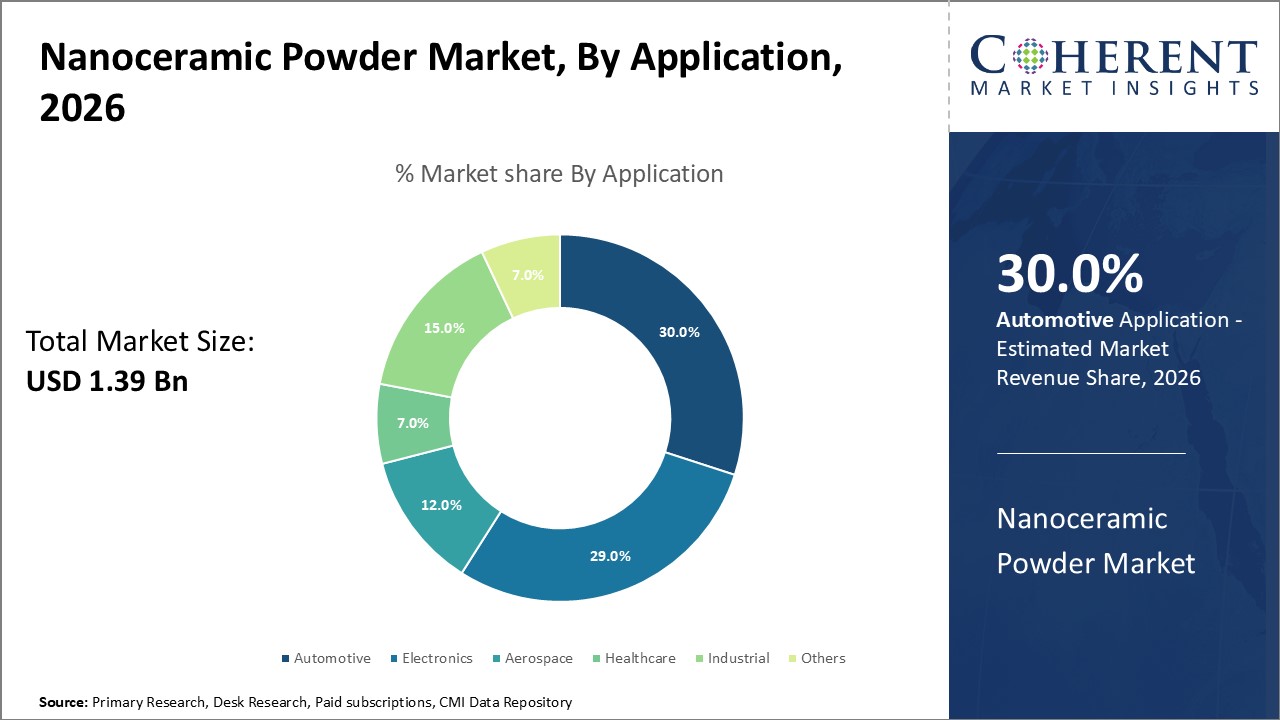
Automotive application dominates the Nanoceramic Powder market segments with approximately 30% market share in 2026, primarily driven by industry demands for lighter and more efficient vehicle parts.
Silicon Nitride type powder exhibits the fastest growth rate due to superior mechanical and thermal properties that suit cutting-edge electronics and aerospace applications.
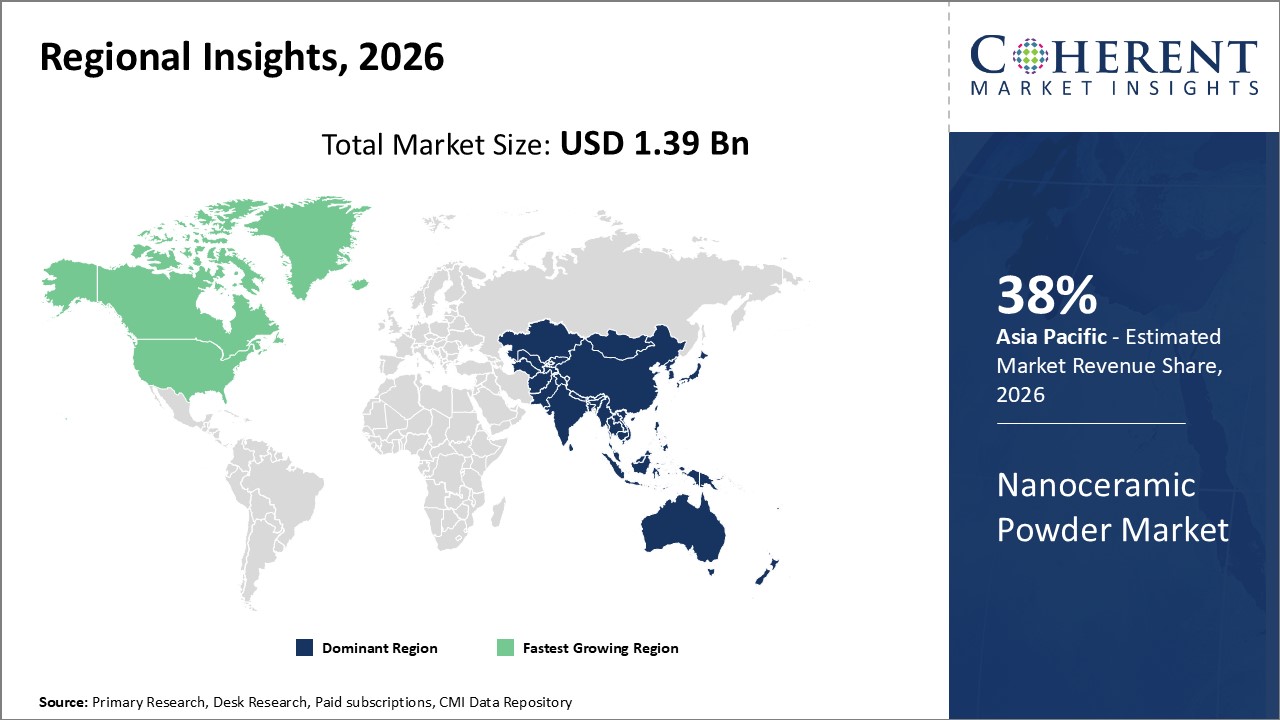
Asia Pacific holds a commanding position in the Nanoceramic Powder market, accounting for nearly 38% of market revenue, fueled by government initiatives and manufacturing ecosystems in China and India.
North America remains a significant market with elevated R&D investments and high-end application adoption, contributing to steady market growth despite increasing market restraints such as raw material costs.
Nanoceramic Powder Market Segmentation Analysis
Nanoceramic Powder Market Insights, By Application
The automotive segment leads due to the increasing integration of nanoceramic powders in lightweight engine and transmission components that reduce vehicle emissions and improve fuel efficiency. Demand is primarily driven by stringent emission regulations and cost-efficiency targets, with manufacturers achieving substantial fuel savings using ceramic composites. The fastest growing subsegment is Electronics, driven by miniaturization trends requiring materials with superior thermal and electrical conductivity. Other segments include Aerospace, known for high-performance materials in engine parts; Healthcare, focusing on biocompatible powders for implants; Industrial, applying powders in wear-resistant tools, with Others covering niche uses in consumer goods.
Nanoceramic Powder Market Insights, By Type
Aluminum oxide powders dominate owing to their excellent hardness, chemical stability, and cost-effectiveness, making them the preferred choice for a wide range of industrial and automotive applications. Silicon Nitride is the fastest growing subsegment due to its outstanding mechanical strength and thermal shock resistance, crucial for electronics and aerospace applications demanding high durability. Zirconium Oxide is notable for its superior fracture toughness and is widely used in medical implants and cutting tools. Titanium Carbide sees moderate demand in industrial tooling, while Others encapsulate specialty ceramics with specific functionalities.
Nanoceramic Powder Market Insights, By End-Use Industry
Consumer Electronics commands the largest market share. This dominance is attributed to the surging demand for effective thermal management solutions and enhanced durability of devices such as smartphones, laptops, and wearable tech. Transportation is witnessing the fastest growth spurred by automotive OEMs incorporating nanoceramic powders into various powertrain and structural components for better performance and compliance with environmental standards. Medical Devices remain critical due to the increasing use of biocompatible nanoceramic powders for implants and surgical tools. Industrial Machinery benefits from wear-resistant powders, prolonging machinery life, with Others covering various specialty sectors.
Nanoceramic Powder Market Trends
Recent market trends in nanoceramic powders underscore the transition toward sustainability and performance enhancement.
For example, in 2026, prominent manufacturers reported adopting eco-friendly powder synthesis techniques, which cut down waste by up to 8%, aligning with global sustainability targets.
Another dominant trend is the broad incorporation of nanoceramic powders in additive manufacturing, which facilitated the production of complex, lightweight aerospace components in record time, as highlighted by collaborations between aerospace titans and ceramic powder suppliers.
Additionally, hybrid composite development combining aluminum oxide and zirconium oxide powders has strengthened product versatility, allowing multifunctional applications in electronics and industrial machinery.
Nanoceramic Powder Market Insights, By Geography
Asia Pacific Nanoceramic Powder Market Analysis and Trends
Asia Pacific leads the nanoceramic powder market, accounting for nearly 38% of global market revenue due to its robust manufacturing base, government incentives in countries like China and India, and a vast consumer electronics ecosystem. The presence of significant market companies and continuous capacity expansions reinforces this region's dominance.
North America Nanoceramic Powder Market Analysis and Trends
North America exhibits the fastest growth with a CAGR surpassing 10%, bolstered by high R&D expenditure, particularly in the U.S., and rapid adoption of nanoceramics in aerospace and healthcare sectors. Supportive government policies promoting innovation further fuel this growth.
Nanoceramic Powder Market Outlook for Key Countries
USA Nanoceramic Powder Market Analysis and Trends
The U.S. market is a key contributor to the nanoceramic powder industry, driven by massive R&D investments from private and government sectors, amounting to over USD 200 million in 2026. Major companies like 3M Company and CoorsTek Inc. lead the innovation front with breakthroughs in silicon nitride and zirconium oxide powders, catering to the aerospace and electronics sectors. Moreover, strategic alliances between industry players and federal aerospace agencies support advanced materials deployment, enhancing market share and competitive dynamics.
China Nanoceramic Powder Market Analysis and Trends
China's market benefits from aggressive industrial policies aimed at boosting advanced materials production. Companies such as Tosoh Corporation (joint ventures) and local manufacturers have scaled production capacity by over 15% in 2025, catering largely to burgeoning automotive and electronics manufacturing hubs. The nation's focus on self-reliance in material technology, coupled with expanding export volumes, positions it as a formidable force shaping global market revenue and business growth opportunities.
Analyst Opinion
Production capacity expansion has been a significant supply-side indicator influencing the market growth. In 2025, leading manufacturers enhanced their production lines, contributing to a 13% increase in global output, which stabilized pricing structures while meeting rising demand from the automotive and electronics industries.
On the demand side, the electronics sector's adoption of nanoceramic powders surged by 16% in 2026 due to increased integration of ceramic-based components in devices focusing on heat dissipation and durability, reflecting the segment’s pivotal role in market growth.
Import trends in Asia Pacific have revealed a sharp increase in nanoceramic powder imports totaling over USD 320 million in 2025, driven by rapid industrialization and government incentives promoting advanced materials manufacturing in countries like China, South Korea, and India.
Market micro-indicators highlight the rise of niche applications within the healthcare sector, where nanoceramic powders used in biocompatible implants showed a 21% revenue increase in 2026, underscoring a critical new avenue contributing to overall industry size expansion.
- Current Industry Events of 2026
- Market Size Estimation
- Regional Breakdown
- Competitive Landscape
- Customer Intelligence
- Segmental Analysis
- Pricing Analysis
- Key Market Drivers, Challenges & Future Trends
- Customized Insights Section
Market Scope
| Report Coverage | Details | ||
|---|---|---|---|
| Base Year: | 2025 | Market Size in 2026: | USD 1.39 billion |
| Historical Data for: | 2020 To 2024 | Forecast Period: | 2026 To 2033 |
| Forecast Period 2026 to 2033 CAGR: | 9.5% | 2033 Value Projection: | USD 2.35 billion |
| Geographies covered: |
| ||
| Segments covered: |
| ||
| Companies covered: | CeramTec AG, Tosoh Corporation, Saint-Gobain Ceramics & Plastics, Kyocera Corporation, 3M Company, Sumitomo Electric Industries, Plasma Chem GmbH, CoorsTek Inc., H.C. Starck Ceramics GmbH, SCHOTT AG | ||
| Growth Drivers: |
| ||
Nanoceramic Powder Market Growth Factors
The escalating demand for lightweight, high-performance materials in the automotive industry remains a primary growth driver, with vehicle manufacturers focusing on reducing emissions by integrating nanoceramic powders in engine components. In 2025 alone, this application segment contributed a 11% increase in market revenue. Another critical driver is the miniaturization trend in consumer electronics, which pushes for enhanced thermal and electrical properties that only nanoceramic powders can deliver, bolstering the electronics subsegment. Government grants and industrial policies in the Asia Pacific, encouraging advanced materials innovation, have accelerated production capacity, which positively influences market growth trajectories. Additionally, the rise of biocompatible nanoceramics for medical implants and devices is expanding opportunities in healthcare segments, where market players report double-digit growth rates.
Nanoceramic Powder Market Development
In May 2025, 3M Company launched a new series of nanoceramic powders, engineered to deliver superior high-temperature resistance and advanced wear protection. The product line is tailored for demanding aerospace and electronics applications, enabling improved component durability, thermal stability, and long-term performance under extreme operating conditions.
In 2025, Nitto Denko Corporation and aceRNA Technologies Co., Ltd. initiated joint development of Switch mRNA therapy incorporating nanoceramic materials, aiming to enhance mRNA stability, targeted delivery, and controlled activation. This collaboration leverages nanoceramic-enabled delivery platforms to advance next-generation precision therapeutics across a range of immune and genetic disease targets.
Key Players
Leading Companies of the Market
CeramTec AG
Tosoh Corporation
Saint-Gobain Ceramics & Plastics
3M Company
Sumitomo Electric Industries
Plasma Chem GmbH
CoorsTek Inc.
H.C. Starck Ceramics GmbH
SCHOTT AG
Recently, CeramicTech expanded its global footprint through a successful acquisition of a niche nanoceramic powder manufacturer, resulting in a 18% increase in market revenue in North America. Similarly, Tosoh Corporation implemented an advanced R&D-driven strategy focusing on silicon nitride powders, propelling technological differentiation and boosting their market share within electronics applications.
Nanoceramic Powder Market Future Outlook
Future market growth will be driven by rapid advancements in electronics miniaturization, high-performance coatings, and energy storage technologies. Demand for nanoceramics in EV batteries, fuel cells, and thermal barrier coatings is expected to rise substantially. The biomedical sector will also continue adopting nano-enhanced ceramics for implants, prosthetics, and dental applications. As industries prioritize lightweight, high-strength, and heat-resistant materials, nanoceramic powders will play a central role in enabling next-generation manufacturing. Increasing commercialization of nano-additive technologies and improved production scalability are likely to lower costs and expand market accessibility.
Nanoceramic Powder Market Historical Analysis
The Nanoceramic Powder market has historically grown due to advancements in materials science, which enabled the precise engineering of nanoscale ceramic particles with exceptional mechanical, thermal, and electrical properties. Early adoption occurred in electronics, where nanoceramics improved dielectric strength and heat resistance in semiconductor components. Over time, applications expanded into catalysts, aerospace materials, high-strength coatings, and bioceramics for implants. Increased R&D investment, government-funded nanotechnology programs, and the expansion of advanced manufacturing created steady market momentum. Nanoceramic powders gained traction for their superior hardness, corrosion resistance, and enhanced surface reactivity compared to conventional ceramic materials.
Sources
Primary Research Interviews:
Materials Scientists
Electronics Component Engineers
Aerospace Material Designers
Biomedical Implant Manufacturers
Coating Technologists
Databases:
IEEE Nanomaterials Data
UN Comtrade Ceramics Trade
ICIS Advanced Inorganics
Magazines:
Advanced Materials & Processes
Materials World
Ceramic Industry Magazine
Nano Today
Electronics Weekly
Journals:
Journal of Nanomaterials
Advanced Ceramics Journal
Materials Science & Engineering A
Nano Research
Journal of Biomedical Materials Research
Newspapers:
Financial Times (Tech)
The Wall Street Journal (Innovation)
Nikkei Asia (Advanced Manufacturing)
The Economic Times (Industry)
The Guardian (Science)
Associations:
American Ceramic Society (ACerS)
Materials Research Society (MRS)
European Nanotechnology Association
IEEE Nanotechnology Council
International Ceramic Federation
Get access to 250+ pages report
Every segment, forecast, competitor profile and data table behind the analysis above — available for instant download.
- ESOMAR Member
- ISO 9001:2015 Certified
- D-U-N-S Registered
- GDPR & CCPA Compliant
Missing comfort of reading report in your local language? Find your preferred language:
Transform your Strategy with Exclusive Trending Reports
Frequently Asked Questions
The market is led by industry veterans such as CeramTec AG, Tosoh Corporation, and Saint-Gobain Ceramics & Plastics, which collectively hold a significant share through advanced product portfolios and expansive manufacturing capabilities.
The market size is projected to grow from approximately USD 1.39 billion in 2026 to USD 2.35 billion by 2033, reflecting a CAGR of 9.5% driven by adoption across automotive, electronics, and healthcare sectors.
Automotive claims the largest growth opportunity with increasing demand for lightweight components to enhance fuel efficiency and meet stringent emission norms globally.
Trends will focus on sustainability, additive manufacturing integration, and hybrid nanoceramic composites, all transforming product innovation and business growth strategies.
The competitive environment centers on technological innovation and capacity expansion, while challenges include raw material volatility and high production costs that could constrain profit margins.
Leading players prioritize R&D investments, strategic acquisitions, and partnerships with end-user industries to enhance product customization and penetrate emerging regional markets.