

Paraformaldehyde Market Size and Forecast — 2026-2033
The Global Paraformaldehyde Market size is estimated to be valued at USD 1.59 billion in 2026 and is expected to reach USD 2.36 billion by 2033, exhibiting a compound annual growth rate (CAGR) of 7.3% from 2026 to 2033.
Overview
Paraformaldehyde is a polymerized form of formaldehyde, existing as a white, crystalline powder that serves as a versatile source of formaldehyde gas when heated. It is widely used in chemical synthesis as a stabilizer, disinfectant, and fumigant. In the resin industry, paraformaldehyde acts as a key intermediate for the production of urea-formaldehyde, phenol-formaldehyde, and melamine-formaldehyde resins, which are essential in adhesives, coatings, and molded plastics. Its antimicrobial properties make it useful in agriculture for pest control and in laboratories as a fixative for biological specimens. The product is valued for its high formaldehyde content, easy handling, and stability compared to aqueous formaldehyde solutions.
Key Takeaways
The market segment dominated by granules holds a 49% market share, reflecting its versatility and widespread industrial application. The construction chemicals application segment exhibits steady revenue gains driven by infrastructure growth globally.
Pharma end-use industry is the fastest-growing segment, boosted by pharma producers adopting nano-formaldehyde derivatives for controlled drug delivery systems.
North America commands a significant share due to stringent hygiene regulations and technological adoption, while the Asia Pacific exhibits the highest CAGR fueled by expanding chemical manufacturing ecosystems.
Europe’s growth is influenced by stringent environmental policies encouraging green production methods, presenting opportunities for eco-innovative companies.
Paraformaldehyde Market Segmentation Analysis
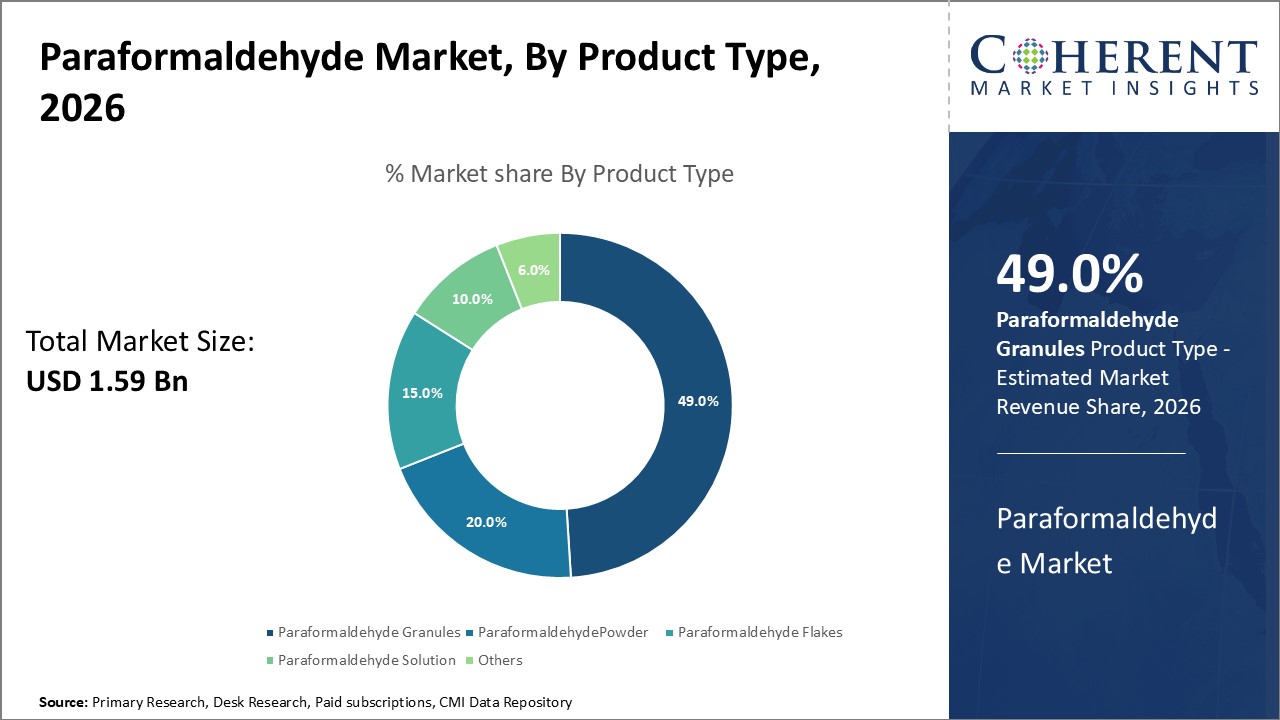
Paraformaldehyde Market Insights, By Product Type
Paraformaldehyde Granules dominate the market share with 49%, owing to their stability, ease of handling, and widespread applicability in resin and chemical manufacturing. This product type benefits from rising demand in construction chemicals and textile industries, where granules serve as a preferred precursor for resins and formulations. The fastest-growing subsegment is Paraformaldehyde Solution, gaining traction due to its suitability for liquid applications in pharmaceutical sterilization and agrochemical production.
Paraformaldehyde Market Insights, By Application
Construction Chemicals dominate, propelled by increased infrastructure development across emerging and developed economies, driving paraformaldehyde-based resin demand. These resins contribute to high-strength adhesives and coatings essential for sustainable construction projects. Meanwhile, Pharmaceuticals represent the fastest-growing application segment as paraformaldehyde’s role in sterilization and drug delivery innovations becomes more prominent. Agriculture's role remains substantial due to fumigation use, but growth is moderated by regulatory scrutiny. The Textile segment continues to rely on paraformaldehyde for finishing agents, although growth is steady rather than exponential.
Paraformaldehyde Market Insights, By End-User Industry
Automotive and Building & Construction sectors jointly dominate market share. The automotive industry leverages paraformaldehyde-based resins to produce lightweight components that reduce emissions, while building & construction demand is fueled by adhesives and formaldehyde resin applications in insulation and composites. Chemicals & Manufacturing maintain significant consumption, driven by raw material requirements for specialty chemicals. Agriculture Equipment and Consumer Goods gradually expand product application scope, influenced by enhanced material qualities.
Paraformaldehyde Market Trends
The market continues to gravitate toward sustainable manufacturing and application methods, amplified by regulatory mandates in developed countries.
In 2025, the implementation of stricter emission norms in Europe resulted in a 22% increase in investments toward cleaner production technologies.
Moreover, the surge in resin demand for automotive lightweighting technologies in North America is driving volume and revenue growth.
Asia Pacific is rapidly adopting paraformaldehyde in agriculture and pharmaceuticals, supported by expanding chemical industry capabilities and government incentives, especially in China and India.
Digital automation trends in processing plants are reducing production costs and improving product quality, marking a significant market shift.
Paraformaldehyde Market Insights, By Geography
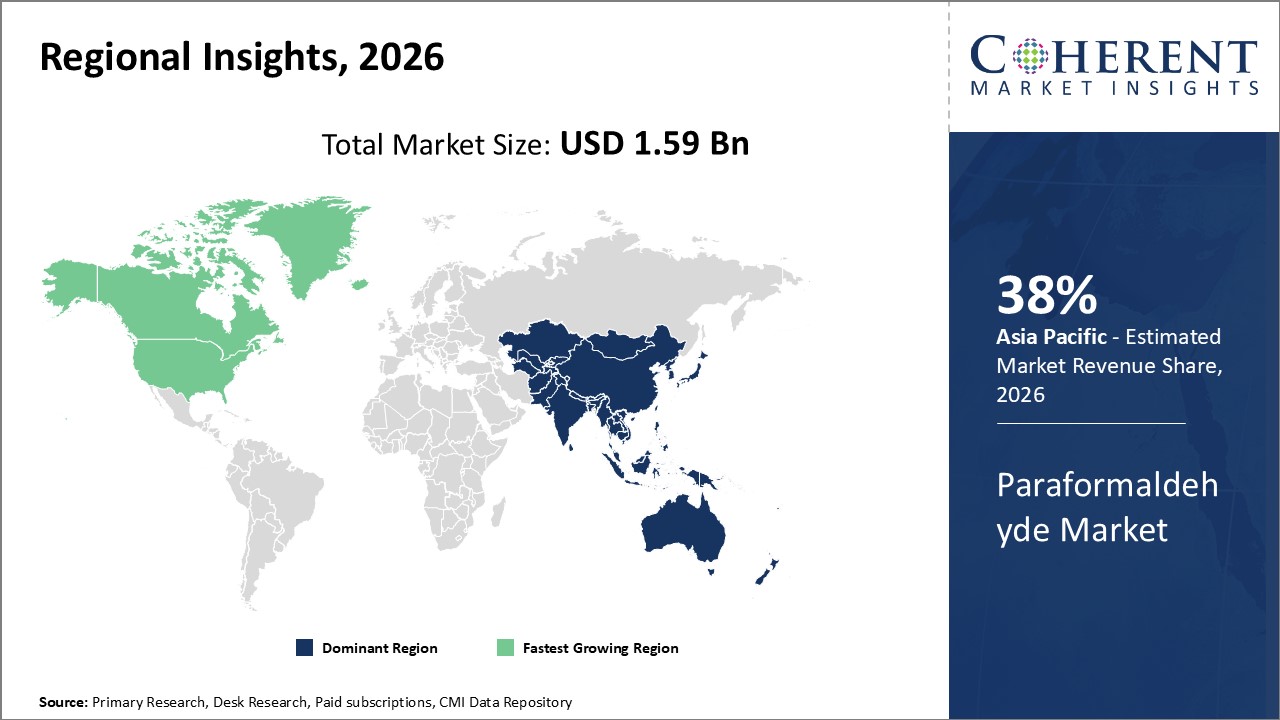
Asia Pacific Paraformaldehyde Market Analysis and Trends
In the Asia Pacific, the dominance in the Paraformaldehyde market is driven by extensive industrial growth, particularly in chemical manufacturing hubs in China and India. These nations collectively account for over 38% of industry share due to high application uptake in agriculture and construction chemicals. The expansion of localized production facilities and increasing exports have reinforced the region’s leading position.
North America Paraformaldehyde Market Analysis and Trends
Meanwhile, North America exhibits the fastest growth with a projected CAGR exceeding 7.5%, attributed to strong government regulations emphasizing hygiene, sterilization, and formaldehyde-based resin applications in the automotive sector. The USA leads this growth, fueled by innovative product development and defense-related chemical demand.
Paraformaldehyde Market Outlook for Key Countries
USA Paraformaldehyde Market Analysis and Trends
The USA's market is predominantly driven by strict environmental norms and increased adoption in healthcare sterilization and resin production. Companies including Huntsman Corporation and BASF SE have expanded their operational capacities to meet surging demand. In 2025, the US market recorded a 9% increase in paraformaldehyde consumption, aligning with rising construction and automotive sector activities. Government incentives supporting green chemistry innovations further enhance the country's business growth potential.
China Paraformaldehyde Market Analysis and Trends
China’s paraformaldehyde market is characterized by its vast chemical manufacturing ecosystem and growing agricultural applications. Key players such as Shandong Bolai Chemical Co., Ltd. have leveraged capacity expansions and export drives to strengthen market share. The country witnessed a 12% year-over-year growth in 2025, supported by government policies promoting sustainable agriculture and industrial chemicals. Ongoing investments in automation and environmental compliance are shaping the market’s future trajectory.
Analyst Opinion
The surge in demand for formaldehyde-based resins in the automotive and construction sectors remains a vital growth driver. For instance, resin production capacity surged by 13% in 2025, with resin manufacturers expanding output to meet construction industry requirements. This uptick reflects increased industrial activities and infrastructure developments worldwide.
Pricing trends in paraformaldehyde have exhibited moderate growth in recent years due to supply chain stabilization post-2023. Export volumes from chemical manufacturing hubs in Asia increased by 9% in H1 2026, reflecting strengthened production efficiency and competitive pricing impacting global market share dynamics.
Various usage domains, particularly agriculture for fumigants and biocides, have witnessed a growing adoption of paraformaldehyde owing to its biodegradability and effective pest control. North American agricultural compound imports of paraformaldehyde-based products rose approximately 10% in 2025, highlighting demand-side expansion.
Micro-quantitative indicators reveal that nano-particle formaldehyde derivatives used in pharmaceuticals now contribute nearly 16% of total market volume, an increase facilitated by innovations in controlled-release formulations. This segment's expanding footprint is expected to influence future market revenue significantly.
- Current Industry Events of 2026
- Market Size Estimation
- Regional Breakdown
- Competitive Landscape
- Customer Intelligence
- Segmental Analysis
- Pricing Analysis
- Key Market Drivers, Challenges & Future Trends
- Customized Insights Section
Market Scope
| Report Coverage | Details | ||
|---|---|---|---|
| Base Year: | 2025 | Market Size in 2026: | USD 1.59 billion |
| Historical Data for: | 2020 To 2024 | Forecast Period: | 2026 To 2033 |
| Forecast Period 2026 to 2033 CAGR: | 7.3% | 2033 Value Projection: | USD 2.36 billion |
| Geographies covered: |
| ||
| Segments covered: |
| ||
| Companies covered: | Solvay SA, Shandong Bolai Chemical Co., Ltd., Zhejiang Xinan Chemical Industrial Group Co., Ltd., SABIC, Evonik Industries, INEOS Group Limited, Mitsui & Co., Ltd., Eastman Chemical Company, Nouryon, Arkema. | ||
| Growth Drivers: |
| ||
Paraformaldehyde Market Growth Factors
The expansion of the market is propelled primarily by the increasing demand for formaldehyde resins in the automotive and construction sectors, which accounted for over 41% of the total market revenue in 2025. The evolving agricultural practices that prefer formaldehyde-based fumigants for their cost-efficiency and biodegradability have also propelled significant demand. Furthermore, growing pharmaceutical segments utilizing nano-formaldehyde derivatives for advanced drug delivery systems underscore rising industrial applications. Finally, government regulations emphasizing hygiene and sterilization in healthcare and food processing industries have led to a notable uptake, especially evident in North America and Europe.
Paraformaldehyde Market Development
In June 2023, Stora Enso introduced NeoLigno®, a fully bio-based alternative to traditional paraformaldehyde, formulated from renewable lignin-derived materials. The product delivers comparable reactivity and binding performance without formaldehyde content, enabling manufacturers in adhesives, resins, and composite applications to transition toward safer, low-emission, and sustainability-aligned chemistries.
In May 2023, Innovative Materials Inc. introduced a next-generation portfolio of PFA-based adhesives and resins, engineered to deliver superior thermal stability, exceptional bonding strength, and enhanced chemical resistance. Designed for high-reliability applications in electronics, aerospace, and industrial assembly, the line expands material options for manufacturers seeking robust performance under extreme operating conditions.
Key Players
Leading Companies of the Market:
Solvay SA
Shandong Bolai Chemical Co., Ltd.
Zhejiang Xinan Chemical Industrial Group Co., Ltd.
SABIC
Evonik Industries
INEOS Group Limited
Mitsui & Co., Ltd.
Eastman Chemical Company
Nouryon
Arkema
Leading market players focus on strategic partnerships and capacity expansions. For instance, BASF SE recently announced a 20% capacity increase in paraformaldehyde production in its European plants, driving enhanced supply to resin manufacturers. Similarly, Huntsman Corporation has invested in green chemical synthesis processes, leading to a 15% reduction in emissions and strengthening sustainability credentials, enhancing competitiveness in major markets.
Paraformaldehyde Market Future Outlook
The future of the paraformaldehyde market is expected to grow moderately as demand for high-performance resins, adhesives, and biocides increases. Emerging economies, particularly in the Asia-Pacific region, are likely to drive growth due to expanding furniture, construction, and chemical manufacturing sectors. Environmental compliance will continue to shape product development, encouraging low-emission, formaldehyde-efficient alternatives. Advances in polymerization and processing technology may further enhance usability, safety, and application efficiency, expanding its use in both industrial and laboratory applications.
Paraformaldehyde Market Historical Analysis
Historically, paraformaldehyde has been widely used as a stable solid source of formaldehyde, particularly in resin manufacturing and as a disinfectant. Its adoption grew with the expansion of the adhesives, coatings, and plastics industries, which increasingly relied on urea-formaldehyde, phenol-formaldehyde, and melamine-formaldehyde resins for wood composites, laminates, and molded products. Its role as a fumigant and biological fixative also contributed to steady demand in agricultural and laboratory applications. The market faced challenges from environmental regulations controlling formaldehyde emissions, prompting manufacturers to develop stabilized and low-emission formulations.
Sources
Primary Research Interviews:
Chemical Process Engineers
Resin Manufacturers
Laboratory Product Suppliers
Databases:
ICIS Chemical Pricing Data
Magazines:
Chemical Week
Industrial & Engineering Chemistry
Adhesives & Sealants Industry Magazine
Journals:
Journal of Applied Polymer Science
Industrial & Engineering Chemistry Research
Polymer Degradation and Stability
Newspapers:
The Wall Street Journal (Chemicals)
Financial Times (Industry)
The Economic Times (Chemicals)
Associations:
American Chemistry Council (ACC)
European Chemical Industry Council (CEFIC)
ASTM International
Get access to 250+ pages report
Every segment, forecast, competitor profile and data table behind the analysis above — available for instant download.
- ESOMAR Member
- ISO 9001:2015 Certified
- D-U-N-S Registered
- GDPR & CCPA Compliant
Missing comfort of reading report in your local language? Find your preferred language:
Transform your Strategy with Exclusive Trending Reports
Frequently Asked Questions
Leading companies such as BASF SE, Huntsman Corporation, and Mitsui Chemicals dominate the market by expanding production capacity and innovating green manufacturing techniques.
The Paraformaldehyde market size is projected to reach USD 2.36 billion by 2033, driven by robust growth in resin applications and agricultural use.
The pharmaceutical segment represents the largest growth opportunity due to increased usage of paraformaldehyde in drug development and sterilization products.
Market trends indicate a strong focus on sustainability with increasing green chemistry adoption and automated manufacturing leading to higher efficiencies.
The competitive landscape is consolidated with major players focusing on capacity expansion and sustainability, while challenges include feedstock price volatility and regulatory compliance costs.
Companies often leverage strategic partnerships, regional expansions, and increased R&D investment to develop innovative, environmentally conscious offerings and achieve business growth.