

Isocyanates Market Size and Forecast — 2026-2033
The Global Isocyanates Market size is estimated to be valued at USD 16.91 billion in 2026 and is expected to reach USD 24.7 billion by 2033, exhibiting a compound annual growth rate (CAGR) of 7.0% from 2026 to 2033.
Overview
Isocyanates are highly reactive organic chemicals characterized by the –NCO functional group, used predominantly in the manufacture of polyurethanes, foams, coatings, adhesives, and elastomers. They react with polyols to form polyurethane networks, providing thermal insulation, flexibility, durability, and chemical resistance in final products. Isocyanates such as methylene diphenyl diisocyanate (MDI) and toluene diisocyanate (TDI) are central to flexible and rigid foam applications, automotive components, and construction materials. Due to their high reactivity and potential health hazards, careful handling, specialized formulations, and strict regulatory compliance are critical during production and application.
Key Takeaways
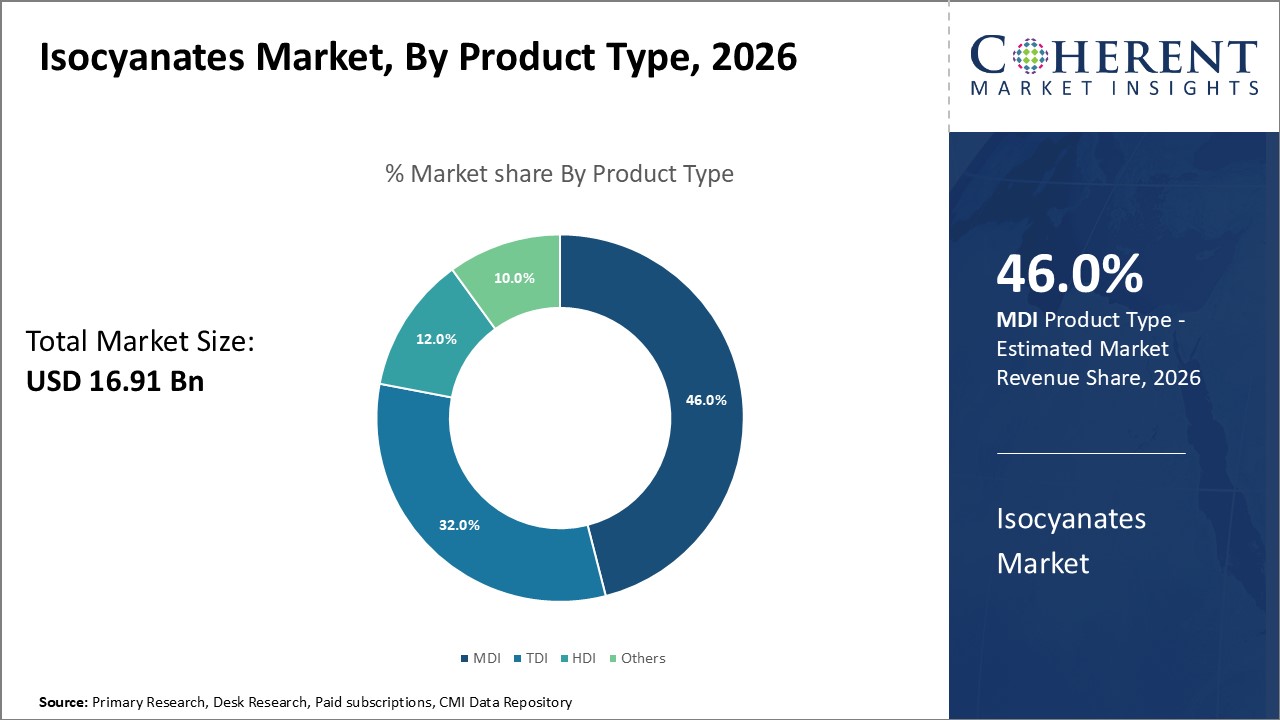
The MDI segment, dominating 46% market share, continues driving segmental revenue growth due to strong application demand in flexible foams.
Rigid foam application is rapidly expanding, driven by regulatory energy-efficiency targets in construction, capturing a sizable revenue share.
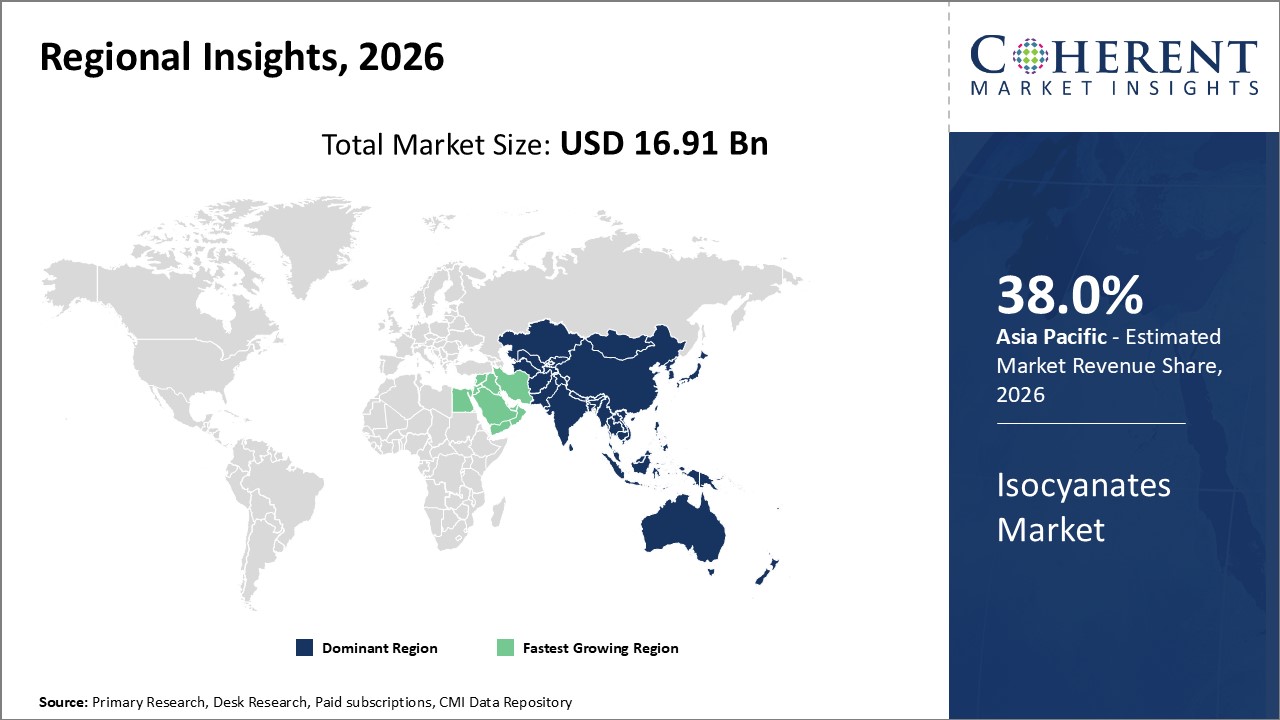
Asia Pacific remains the dominant regional market, accounting for over 38% of the isocyanates industry share, aided by large manufacturing hubs in China and India.
North America exhibits steady market growth with enhanced innovation, facilitating the adoption of eco-friendly isocyanate solutions.
Isocyanates Market Segmentation Analysis
Isocyanates Market Insights, By Product Type
MDI dominates the market share at 46%. MDI’s dominance is fueled by its extensive use in flexible polyurethane foams and rigid insulation applications, benefiting from better mechanical properties and lower emissions in formulations. The segment is boosted by growing automotive seat foam usage and energy-efficient building requirements. The fastest growing subsegment is HDI, which is gaining traction for its superior performance in specialty coatings, particularly in automotive refinishing, due to excellent durability and chemical resistance. TDI, another vital subsegment, finds steady demand in flexible foam but is challenged by stricter regulatory concerns due to toxicity, tempering its growth pace. The Others category covers specialized isocyanates used in limited volume, niche chemical syntheses.
Isocyanates Market Insights, By Application
Flexible foam captures the largest market share. This segment’s substantial share is directly linked to surging demand in the automotive and furniture industries, where comfort, durability, and lightweight materials are paramount. The fastest growing application is Coatings & Adhesives, boosted by rising industrialization and environmental legislation favoring polyurethane coatings with enhanced corrosion resistance and lower VOC emissions. Rigid Foam maintains strong demand in construction for insulation, driven by energy efficiency policies. Elastomers serve specialized sectors like footwear and mechanical parts, experiencing moderate growth.
Isocyanates Market Insights, By End-Use Industry
Construction is holding the dominating share due to heightened demand for insulation materials and energy-efficient buildings. Infrastructure development announcements in Asia Pacific and Europe have escalated isocyanate consumption in this subsegment. The fastest growing industry is Automotive, as increasingly stringent fuel efficiency regulations worldwide propel the use of lighter and more durable polyurethane components. Furniture & Bedding represents a mature but steady segment focused on consumer comfort and flame retardancy standards, while Footwear leverages elastomeric polyurethanes for flexibility and durability.
Isocyanates Market Trends
Over the recent years, the market has seen heightened innovation directed at sustainability.
The commercial introduction of bio-based MDI derivatives in 2025 exemplifies a pivotal shift, meeting growing regulatory demands and consumer environmental awareness.
Another key trend is the digital transformation within production facilities; a significant number of manufacturers incorporated Industry 4.0 technologies, resulting in improved process control and lower emissions.
The expansion into emerging verticals such as electronics with advanced coating applications further diversifies market revenue streams, balancing mature sectors like automotive and construction.
Isocyanates Market Insights, By Geography
Asia Pacific Isocyanates Market Analysis and Trends
In Asia Pacific, the dominance in the market is attributed to the abundance of raw materials, competitive production costs, and an expansive industrial ecosystem. China alone contributed to over 38% of the global industry share in 2025, with India showing rapid infrastructure growth. Government incentives supporting chemical manufacturing and urbanization are crucial drivers, underpinning expansion here.
Middle East & Africa Isocyanates Market Analysis and Trends
Meanwhile, the Middle East & Africa region exhibits the fastest growth, with a CAGR surpassing 8% projected through 2033. Initiatives to diversify economies and invest in petrochemical industries, particularly in Saudi Arabia and the UAE, are catalyzing this trend. Implementation of industrial clusters and export-driven policies furthers market revenue growth.
Isocyanates Market Outlook for Key Countries
USA Isocyanates Market Analysis and Trends
The USA’s isocyanates market is driven by advanced manufacturing and stringent environmental regulations demanding low-emission polyurethane systems. Leading market companies have invested substantially in capacity upgrades, introducing green product lines with reduced VOC content. In 2026, isocyanate consumption surged by over 7% in automotive lightweighting, driven by OEM commitments to fuel efficiency. Import-export dynamics also favor the USA, with an increase in both specialty isocyanate imports and high-value exports contributing to robust industry share growth.
Germany Isocyanates Market Analysis and Trends
Germany’s market benefits from a strong chemical manufacturing base and is a hub for innovative isocyanate applications in automotive and construction. Regulatory frameworks like the EU’s Green Deal have substantially influenced green product development and adoption, leading to a 12% increase in eco-friendly isocyanate sales by 2025. Major companies headquartered here continue to lead R&D investments, fostering a competitive market landscape and sustaining Germany’s prominent role in the European market.
Analyst Opinion
The rising capacity expansion in Asia Pacific, driven particularly by China and India, strongly influences the global isocyanates market share. China alone accounts for over 30% of global isocyanates production capacity as of 2025, with ongoing projects expected to increase output by 12% in the next two years. This supply-side indicator highlights the region's dominance in production and pricing control.
Demand-side indicators reveal the increasing use of MDI (Methylene Diphenyl Diisocyanate) in various end-use sectors such as automotive seating, refrigeration, and footwear industries, boosting market revenue. Industry reports show that MDI use in automotive contributed to nearly 26% of segment demand in 2025, underpinning the robust market growth in these verticals.
Pricing dynamics also play a critical role: fluctuations in raw material costs, particularly aniline and formaldehyde, have influenced isocyanate prices globally. For example, in 2026, pricing volatility in North America and Europe due to supply chain disruptions led to a 6% increase in average market prices, impacting profit margins of market companies.
Micro-indicators, such as the rise of bio-based polyols combined with isocyanates, are creating new business growth avenues. Eco-friendly product variants accounted for 15% of total polyurethane production in Europe in 2025, reflecting a market shift toward sustainability in the isocyanates value chain.
- Current Industry Events of 2026
- Market Size Estimation
- Regional Breakdown
- Competitive Landscape
- Customer Intelligence
- Segmental Analysis
- Pricing Analysis
- Key Market Drivers, Challenges & Future Trends
- Customized Insights Section
Market Scope
| Report Coverage | Details | ||
|---|---|---|---|
| Base Year: | 2025 | Market Size in 2026: | USD 16.91 billion |
| Historical Data for: | 2020 To 2024 | Forecast Period: | 2026 To 2033 |
| Forecast Period 2026 to 2033 CAGR: | 7.0% | 2033 Value Projection: | USD 24.7 billion |
| Geographies covered: |
| ||
| Segments covered: |
| ||
| Companies covered: | Huntsman Corporation, Mitsui Chemicals, Inc., Bayer AG, Tosoh Corporation, Italy’s Versalis, Kumho P&B Chemicals, Inc., Shanghai BASF Polyurethane Co., Ltd., Evonik Industries AG, SABIC, Huntsman Advanced Materials | ||
| Growth Drivers: |
| ||
Isocyanates Market Growth Factors
The growth of the isocyanates market is significantly propelled by the rising demand for lightweight and fuel-efficient vehicles globally, which increase the adoption of polyurethane composites utilizing MDI and TDI. In 2025, automotive manufacturers increased their polyurethane-based components by 19%, thereby escalating isocyanate consumption. Urbanization and infrastructural growth in emerging economies are driving the demand for rigid foam insulation materials, which accounted for nearly 36% of the isocyanate market revenue in 2025.
Policies promoting energy efficiency in building codes across regions like Europe and North America further accelerate this trend. Technological advancements toward bio-based isocyanates and adherence to stringent environmental regulations stimulate innovation-driven market growth. Data show that eco-friendly isocyanate formulations witnessed a CAGR exceeding 10% during 2025–2026, backed by regulatory incentives. Supply chain optimization and increased raw material availability also help stabilize the market, mitigating prior period volatility and supporting steady market growth through the forecast period.
Isocyanates Market Development
In August 2026, Algenesis Labs launched Bio-Iso, the world’s first fully biogenic and plant-derived isocyanate, marking a major breakthrough in polyurethane chemistry. Developed without the use of highly toxic phosgene and completely eliminating fossil-based carbon inputs, Bio-Iso provides a safer, more sustainable alternative for foams, coatings, and adhesives. The innovation significantly reduces environmental toxicity risks while enabling manufacturers to transition to a fully renewable isocyanate supply chain.
In October 2025, Covestro introduced its new line of bio-attributed MDI, offering up to a 100% reduction in CO₂ emissions compared to conventional fossil-based MDI, based on certified mass-balance methodologies. The product line supports large-scale decarbonization across insulation, automotive, and construction applications, enabling downstream users to meet stringent sustainability targets without compromising performance or process compatibility.
In February 2022, BASF launched Lupranat ZERO, an aromatic isocyanate with a cradle-to-gate greenhouse gas emission footprint of zero, achieved through the use of renewable feedstocks, certified green electricity, and verified carbon accounting methods. Designed for use in high-performance polyurethane systems, Lupranat ZERO enables manufacturers to integrate climate-neutral raw materials into rigid foams, coatings, and elastomers while maintaining identical specifications to conventional isocyanates.
Key Players
Leading Companies of the Market
Huntsman Corporation
Mitsui Chemicals, Inc.
Bayer AG
Tosoh Corporation
Italy’s Versalis
Kumho P&B Chemicals, Inc.
Shanghai BASF Polyurethane Co., Ltd.
Evonik Industries AG
SABIC
Huntsman Advanced Materials
Several leading companies adopt aggressive expansion and collaboration strategies. For instance, Wanhua Chemical’s acquisition of BorsodChem in 2025 expanded its European footprint significantly, boosting its market share by approximately 10%. Covestro AG implemented a joint venture with regional partners in Southeast Asia to enhance localized production capacity, resulting in a 16% increase in market penetration in 2026.
Isocyanates Market Future Outlook
Future demand will be driven by the growth of insulation materials, automotive lightweighting, construction, and furniture manufacturing. Technological advancements in low-VOC formulations, bio-based isocyanates, and safer handling solutions are expected to expand applications while maintaining regulatory compliance. Asia-Pacific will continue to dominate production and consumption, supported by industrialization, urbanization, and growing construction and automotive sectors.
Isocyanates Market Historical Analysis
Isocyanates, characterized by the –NCO functional group, have historically been central to polyurethane production for foams, coatings, adhesives, and elastomers. Methylenediphenyl diisocyanate (MDI) and toluene diisocyanate (TDI) enabled flexible and rigid foam applications, widely adopted in construction, automotive, and furniture industries. High reactivity and versatility in polymer formation supported global industrial growth, though safety handling and regulatory compliance were consistent market considerations.
Sources
Primary Research Interviews:
Polyurethane Manufacturers
Automotive Component Engineers
Industrial Coatings Specialists
Databases:
ICIS Chemical Pricing Data
Magazines:
Coatings World
Polyurethanes Technology Magazine
Chemical Week
Journals:
Journal of Applied Polymer Science
Industrial & Engineering Chemistry Research
Polymer Chemistry
Newspapers:
The Wall Street Journal (Chemicals)
Financial Times (Manufacturing)
The Hindu BusinessLine (Industry)
Associations:
American Chemistry Council (ACC)
European Diisocyanate Producers Association (EDIPA)
ASTM International
Get access to 250+ pages report
Every segment, forecast, competitor profile and data table behind the analysis above — available for instant download.
- ESOMAR Member
- ISO 9001:2015 Certified
- D-U-N-S Registered
- GDPR & CCPA Compliant
Missing comfort of reading report in your local language? Find your preferred language:
Transform your Strategy with Exclusive Trending Reports
Frequently Asked Questions
Dominant players include Covestro AG, Wanhua Chemical Group, BASF SE, Dow Chemical Company, and Huntsman Corporation, who collectively command significant global market share through production capacity and innovation.
The Isocyanates market size is projected to grow from USD 16.91 billion in 2026 to approximately USD 24.7 billion by 2033, reflecting sustained demand and emerging end-use applications.
The automotive and construction industries present the largest growth opportunities, with increased usage of MDI and TDI in lightweight composites and insulation materials driven by efficiency regulations.
Emerging trends include rising adoption of bio-based isocyanates, expansion of smart manufacturing technologies, and penetration into non-traditional sectors such as electronics, signaling a market shift toward sustainable and innovative applications.
The market is characterized by high competition among key players with strategies focusing on capacity expansion, backward integration, and eco-friendly product development. Challenges include fluctuating raw material prices and regulatory compliance pressures.
Companies focus on strategic acquisitions, joint ventures for regional penetration, and R&D investment to produce sustainable isocyanate variants, thereby enhancing market share and revenue.