

Parenteral Packaging Market Size and Forecast – 2026 to 2033
The Parenteral Packaging Market is estimated to be valued at USD 27.3 Bn in 2026 and is expected to reach USD 41.8 Bn by 2033, exhibiting a compound annual growth rate (CAGR) of 7.8% from 2026 to 2033.
Key Takeaways
- By Packaging Type, Prefilled Syringes & Cartridges hold the largest market share of 34.4% in 2026 owing to the rising prevalence of chronic diseases.
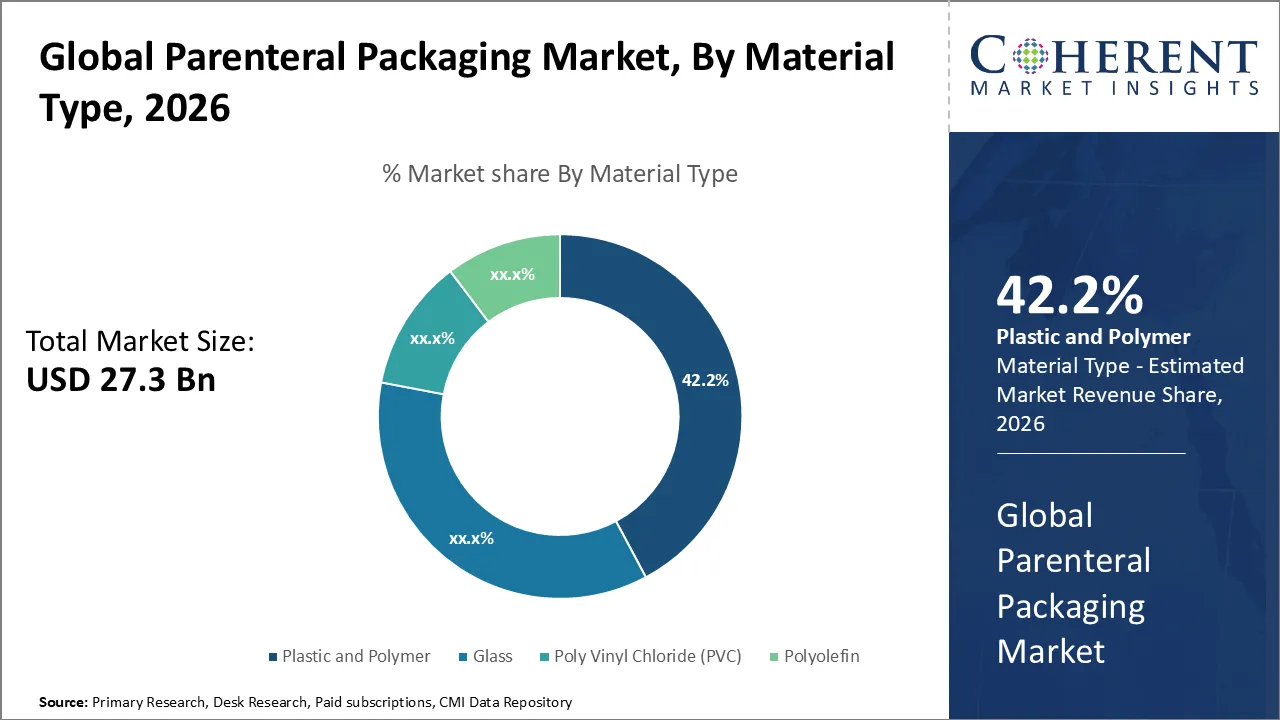
- By Material Type, Plastic and Polymer expected to hold the largest market share of 42.2% in 2026 owing to the growing shift away from glass packaging.
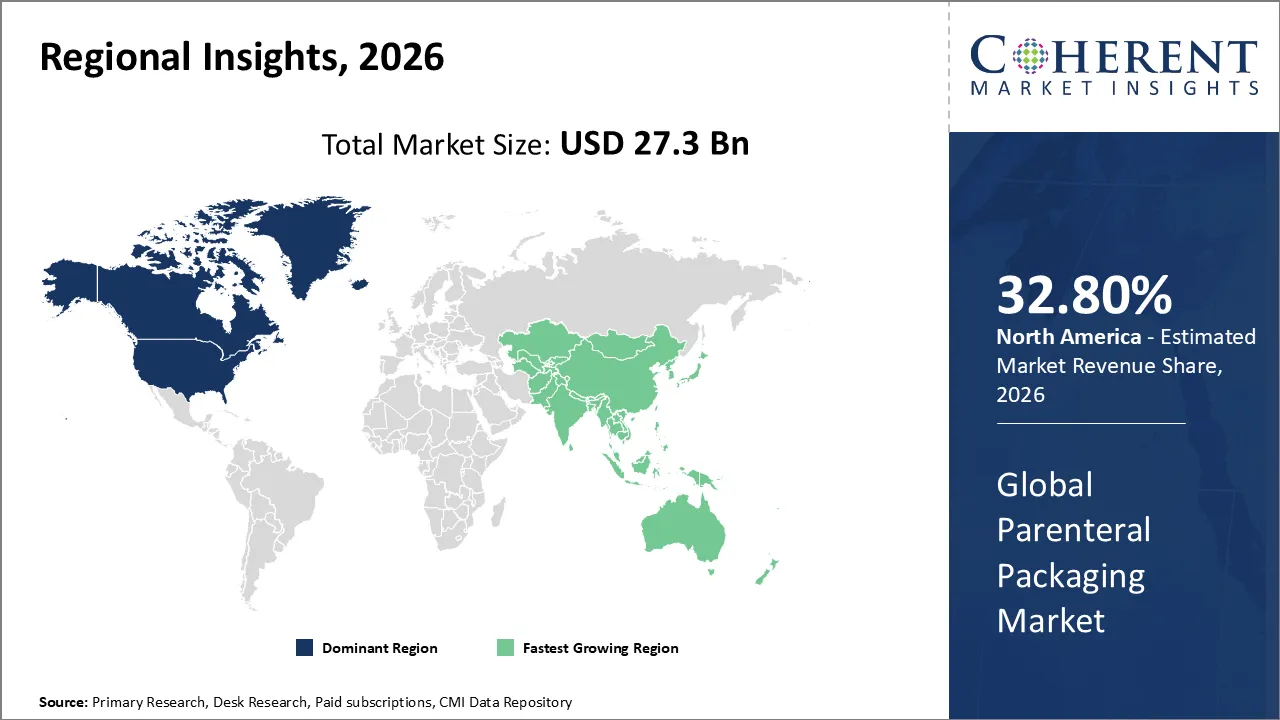
- By Region, North America dominates the overall market with an estimated share of 32.8% in 2026 owing to the strong pharmaceutical & biotechnology industry.
Market Overview
Rising demand for injectable drugs, including biologics, vaccines, and specialty therapies, is driving steady growth in the parenteral packaging market. The increasing prevalence of chronic diseases and a growing shift toward self-administration are boosting the adoption of prefilled syringes, cartridges, and IV containers. Manufacturers are enhancing drug safety and stability by using advanced materials such as polymers and high-quality glass. Additionally, strict regulatory requirements and the need for sterile, contamination-free delivery systems are supporting market expansion across developed and emerging healthcare markets.
Current Events and their Impact on the Parenteral Packaging Market
Current Events | Description and its impact |
Geopolitical and Regulatory Developments |
|
Technological Advancements in Packaging Materials |
|
Economic and Supply Chain Factors |
|
Segmental Insights
- Current Industry Events of 2026
- Market Size Estimation
- Regional Breakdown
- Competitive Landscape
- Customer Intelligence
- Segmental Analysis
- Pricing Analysis
- Key Market Drivers, Challenges & Future Trends
- Customized Insights Section
Parenteral Packaging Market Insights, By Packaging Type: Prefilled Syringes & Cartridges contribute the highest share of the market owing to its increasing demand for self-administration & home healthcare.
Prefilled Syringes & Cartridges hold the largest market share of 34.4% in 2026. The growing use of injectable therapies for chronic and complex conditions is accelerating demand for prefilled syringes and cartridges in parenteral packaging. Healthcare providers and patients prefer these formats because they offer convenience, precise dosing, and lower contamination risk. The expansion of home-based care and self-administration is further driving their adoption. Moreover, pharmaceutical companies are integrating these systems with advanced drug delivery devices, while ongoing improvements in materials and design are enhancing safety, compatibility, and overall treatment efficiency. For instance, in August 2025, SCHOTT, a global leader in specialty glass, expanded its Jambusar, Gujarat facility to produce syringe and cartridge glass tubing, strengthening India’s pharmaceutical packaging and supporting the ‘Make in India’ initiative.
Parenteral Packaging Market Insights, By Material Type: Plastic and Polymer contribute the highest share of the market owing to its increasing adoption of single-use & disposable systems.
Plastic and Polymer expected to hold the largest market share of 42.2% in 2026. The rising preference for lightweight, durable, and cost-efficient solutions is driving the use of plastics and polymers in the parenteral packaging market. Manufacturers are increasingly adopting materials such as polypropylene and cyclic olefin polymers because they provide strong barrier properties and compatibility with sensitive drug formulations. The need for flexible designs and integration with advanced drug delivery systems is further supporting demand. Additionally, the growing focus on infection control and single-use sterile packaging is encouraging wider adoption across healthcare settings.
Regional Insights
North America Parenteral Packaging Market Trends
North America dominates the overall market with an estimated share of 32.8% in 2026. North America’s parenteral packaging market is advancing as healthcare providers and manufacturers adopt advanced drug delivery formats, including prefilled and ready-to-use systems, to improve efficiency and patient safety. Companies are increasingly integrating automation and innovative materials to maintain sterility and ensure product integrity. The rise of biologics and specialty injectables is influencing packaging design, while pharmaceutical firms continue investing in high-performance solutions, supported by strong healthcare infrastructure and ongoing technological innovation across the region. For instance, in July 2025, Nordic Cold Chain Solutions, a top provider of temperature-controlled packaging, launched the Nordic Express Pack, the first cold chain solution specifically designed and tested for shipping GLP-1 medications.
Asia Pacific Parenteral Packaging Market Trends
The Asia Pacific parenteral packaging market is expanding as pharmaceutical manufacturers and healthcare providers in countries like China and India increase production and use of injectable drugs and biologics. Companies are adopting prefilled and ready-to-use formats to enhance patient safety and streamline clinical workflows. Rapid vaccine production and wider access to healthcare services are driving greater demand for advanced sterile packaging solutions, while ongoing investment in innovative materials and technologies is improving product performance and reliability across the region.
United States Parenteral Packaging Market Trends
The United States parenteral packaging market is growing as healthcare providers and manufacturers increase demand for sterile, high-quality solutions, including vials, prefilled syringes, and ready-to-use systems for injectable and biologic therapies. Domestic pharmaceutical and biotech companies are investing in advanced packaging formats and automation to maintain product safety and integrity. Expanding vaccine production and a focus on cold chain management are driving the adoption of innovative packaging, while a strong healthcare system and regulatory oversight continue to shape market trends. For instance, WuXi STA, a subsidiary of WuXi AppTec, has begun operations of a new parenteral formulation manufacturing line at its drug product site in Wuxi, China, marking the company’s second line this year for clinical and commercial parenteral drug production with an annual capacity of 10 million units.
India Parenteral Packaging Market Trends
India’s parenteral packaging market is expanding as pharmaceutical manufacturers and government initiatives increase the production of injectable drugs, biologics, and vaccines. Domestic companies are adopting sterile prefilled and ready-to-use formats and improving quality to meet safety standards and streamline workflows. Broader access to healthcare services and growth in export-oriented drug production are driving investment in advanced packaging solutions. Additionally, firms are implementing digital supply chain tools and innovative materials to enhance performance and ensure compliance with global standards. For instance, SGD Pharma, a global provider of pharmaceutical glass packaging, will showcase an innovative product range and services at CPHI Milan, Italy, from Oct. 8–10, including its internally siliconized molded glass vials that enhance vial functionality.
Parenteral Packaging Market Trend
Rise of Prefilled and Ready-to-Use Systems
Healthcare providers and patients increasingly favor prefilled syringes, cartridges, and ready-to-use vials to reduce preparation time, prevent dosing errors, and enhance sterility. Pharmaceutical companies are expanding these formats to support home-based care, self-administration, and high-volume clinical workflows. Continuous innovation in ergonomic designs, integrated delivery devices, and advanced materials is further driving adoption across hospitals, clinics, and patient-administered therapy segments.
Growth of Biologics and Specialty Injectables
The expansion of biologics, monoclonal antibodies, and high-value specialty drugs is influencing packaging innovation. Sensitive molecules require high-barrier materials, precise dosing, and contamination-free delivery. Manufacturers are adopting advanced polymers, cyclic olefin systems, and glass alternatives to maintain stability. This trend encourages the development of combination drug-device solutions, automated filling lines, and specialized cold chain packaging to meet the safety and efficacy needs of complex therapies.
Parenteral Packaging Market Opportunity
Growth in Home Healthcare and Self-Administration
Increasing patient preference for home-based care opens opportunities for user-friendly parenteral packaging. Prefilled pens, auto-injectors, and ready-to-use syringes can simplify self-administration, improve adherence, and reduce clinical workload. Packaging innovations that focus on ergonomic design, intuitive operation, and safety features such as needle protection can capture this emerging segment while supporting chronic disease management and patient-centric therapy delivery.
Market Report Scope
Parenteral Packaging Market Report Coverage
| Report Coverage | Details | ||
|---|---|---|---|
| Base Year: | 2025 | Market Size in 2026: | USD 27.3 Bn |
| Historical Data for: | 2020 To 2024 | Forecast Period: | 2026 To 2033 |
| Forecast Period 2026 to 2033 CAGR: | 7.8% | 2033 Value Projection: | USD 41.8 Bn |
| Geographies covered: |
| ||
| Segments covered: |
| ||
| Companies covered: | Gerresheimer AG, Schott AG, Unilife Corporation Inc, Becton Dickinson and Company, Ypsomed Holding AG, West Pharmaceutical Services, Inc., SiO2 Medical Products, Terumo Corporation, Ompi Stevanato Group, Berry Plastics Corporation, MeadWestvaco Corporation, Owens-Illinois, RPC Group, and Graphic Packaging Group. | ||
| Growth Drivers: |
| ||
| Restraints & Challenges: |
| ||
Parenteral Packaging Market News
- In June 2025, Nordic Cold Chain Solutions introduced Nordic Express Pack, the first cold chain packaging solution purpose-built and tested for transporting GLP-1 medications.
Analyst Opinion (Expert Opinion)
- In premium pharmaceutical supply chains, the parenteral packaging sector has transitioned from being a cost‑center commodity to a strategic determinant of drug integrity and commercial differentiation. Across industry analyses, over 68 % of demand is directly attributed to injectable biologics and vaccines, underscoring the fact that sterile packaging is now inseparable from product efficacy and regulatory compliance rather than a peripheral afterthought.
- The unequivocal shift toward prefilled systems and patient‑centric formats is not merely a trend but a structural change in how injectable therapies are delivered. Prefilled syringes, cartridges, and ready‑to‑use systems are increasingly prioritized for their ability to reduce dosing errors and contamination risks — critical considerations in home care and self‑administration contexts where traditional vial‑and‑syringe models are increasingly seen as antiquated.
- Material innovation reveals a bifurcation in strategic priorities. While traditional borosilicate glass still dominates segments requiring ultra‑high chemical inertness, polymer technologies such as cyclic olefin copolymers (COC/COP) are gaining traction due to superior break resistance and dimensional stability. This reflects a broader industry judgment: packaging performance now directly impacts biologic stability and supply continuity, not just shelf‑life preservation.
- Regionally, North America’s dominance — accounting for roughly 32.8% of global market share — signals that advanced healthcare infrastructure and regulatory stringency are accelerating adoption of high‑barrier packaging systems. Asia‑Pacific’s accelerating uptake is similarly meaningful; it reflects not just volume growth but a qualitative shift toward compliance with global standards and export‑oriented manufacturing practices.
Speak to the analyst
Want personalized insights?
Take the findings above to one of our principal consultants, or have the report rebuilt around the segments, geographies and competitors you actually track.
Market Segmentation
- By Packaging Type
- Bags and Bottles
- Ampoules
- Vials
- Prefilled Syringes & Cartridges
- Ready-to-mix-Systems
- By Material Type
- Glass
- Plastic and Polymer
- Poly Vinyl Chloride (PVC)
- Polyolefin
- By Regional Insights
- North America
- U.S.
- Canada
- Latin America
- Brazil
- Argentina
- Mexico
- Rest of Latin America
- Europe
- Germany
- U.K.
- Spain
- France
- Italy
- Russia
- Rest of Europe
- Asia Pacific
- China
- India
- Japan
- Australia
- South Korea
- ASEAN
- Rest of Asia Pacific
- Middle East
- GCC Countries
- Israel
- Rest of Middle East
- Africa
- South Africa
- North Africa
- Central Africa
- North America
- Key Players Insights
- Gerresheimer AG
- Schott AG
- Unilife Corporation Inc
- Becton Dickinson and Company
- Ypsomed Holding AG
- West Pharmaceutical Services, Inc.
- SiO2 Medical Products
- Terumo Corporation
- Ompi Stevanato Group
- Berry Plastics Corporation
- MeadWestvaco Corporation
- Owens-Illinois
- RPC Group
- Graphic Packaging Group
Sources
Primary Research interviews
- Interviews with senior R&D professionals from pharmaceutical manufacturing firms
- Discussions with packaging engineers specializing in parenteral formats
- Insights from quality assurance and regulatory compliance experts
- Interviews with procurement and supply chain heads from injectable product manufacturers
- Feedback from packaging operations managers at contract manufacturing organizations (CMOs)
Databases
- World Health Organization (WHO) drug product registries
- U.S. Food & Drug Administration (FDA) drug approvals database
- European Medicines Agency (EMA) medicinal product database
- PubChem chemical and formulation database
- ClinicalTrials.gov injectable device and formulation records
Magazines
- Pharmaceutical Technology
- PharmTech
- Packaging World
- International Pharmaceutical Industry Magazine
- Drug Development & Delivery Magazine
Journals
- Journal of Pharmaceutical Sciences
- International Journal of Pharmaceutics
- European Journal of Pharmaceutics and Biopharmaceutics
- Journal of Medical Devices
- AAPS PharmSciTech
Newspapers
- The Economic Times – Healthcare Section
- The Times of India – Healthcare & Science
- Hindustan Times – Business & Healthcare News
- Business Standard – Pharma & Packaging Updates
- The Financial Express – Industry Insights
Associations
- International Society for Pharmaceutical Engineering (ISPE)
- Parenteral Drug Association (PDA)
- Indian Pharmaceutical Association (IPA)
- International Federation of Pharmaceutical Manufacturers & Associations (IFPMA)
- European Federation of Pharmaceutical Industries and Associations (EFPIA)
Public Domain sources
- World Bank healthcare expenditure data
- United Nations population health statistics
- Government drug pricing and regulatory portals (e.g., CDSCO India, MHRA UK)
- Patent filings from Google Patents / WIPO public database
- National health policy documents and vaccination program reports
Proprietary Elements
- CMI Data Analytics Tool
- Proprietary CMI Existing Repository of information for last 8 years
Get access to 250+ pages report
Every segment, forecast, competitor profile and data table behind the analysis above — available for instant download.
- ESOMAR Member
- ISO 9001:2015 Certified
- D-U-N-S Registered
- GDPR & CCPA Compliant
Missing comfort of reading report in your local language? Find your preferred language:
Transform your Strategy with Exclusive Trending Reports
Frequently Asked Questions
The global parenteral packaging market is estimated to surpass USD 41.8 Bn by 2033.
Major players operating in the global parenteral packaging market include Gerresheimer AG, Schott AG, Unilife Corporation Inc, Becton Dickinson and Company, Ypsomed Holding AG, West Pharmaceutical Services, Inc., SiO2 Medical Products, Terumo Corporation, Ompi Stevanato Group, Berry Plastics Corporation, MeadWestvaco Corporation, Owens-Illinois, RPC Group, and Graphic Packaging Group.
Among packaging type, prefilled syringes & cartridges segment is expected to hold dominant position in the market over the forecast period.
Increasing number of surgical procedures and chronic disease cases such as diabetes and cancer is one of the major factors that is expected to propel growth of the market over the forecast period.
The global parenteral packaging market is estimated to exhibit a CAGR of 7.8% over the forecast period.
Among regions, North America holds dominant position in the global parenteral packaging market.