

Phenylalanine Market Size and Forecast — 2026-2033
The Global Phenylalanine Market size is estimated to be valued at USD 1.85 billion in 2026 and is expected to reach USD 3.09 billion by 2033, exhibiting a compound annual growth rate (CAGR) of 7.6% from 2026 to 2033.
Overview
Phenylalanine products include amino acids in both natural (L-phenylalanine) and synthetic forms used as key intermediates in food, pharmaceutical, and feed industries. L-phenylalanine serves as a building block for proteins and as a precursor for artificial sweeteners such as aspartame. It is produced through fermentation or chemical synthesis, ensuring high purity and consistent quality.
In the pharmaceutical sector, phenylalanine is utilized in formulations targeting depression and neurological disorders due to its role in neurotransmitter synthesis. Product innovations include bio-based fermentation processes and encapsulated forms to improve stability, solubility, and controlled release in food and supplement applications.
Key Takeaways
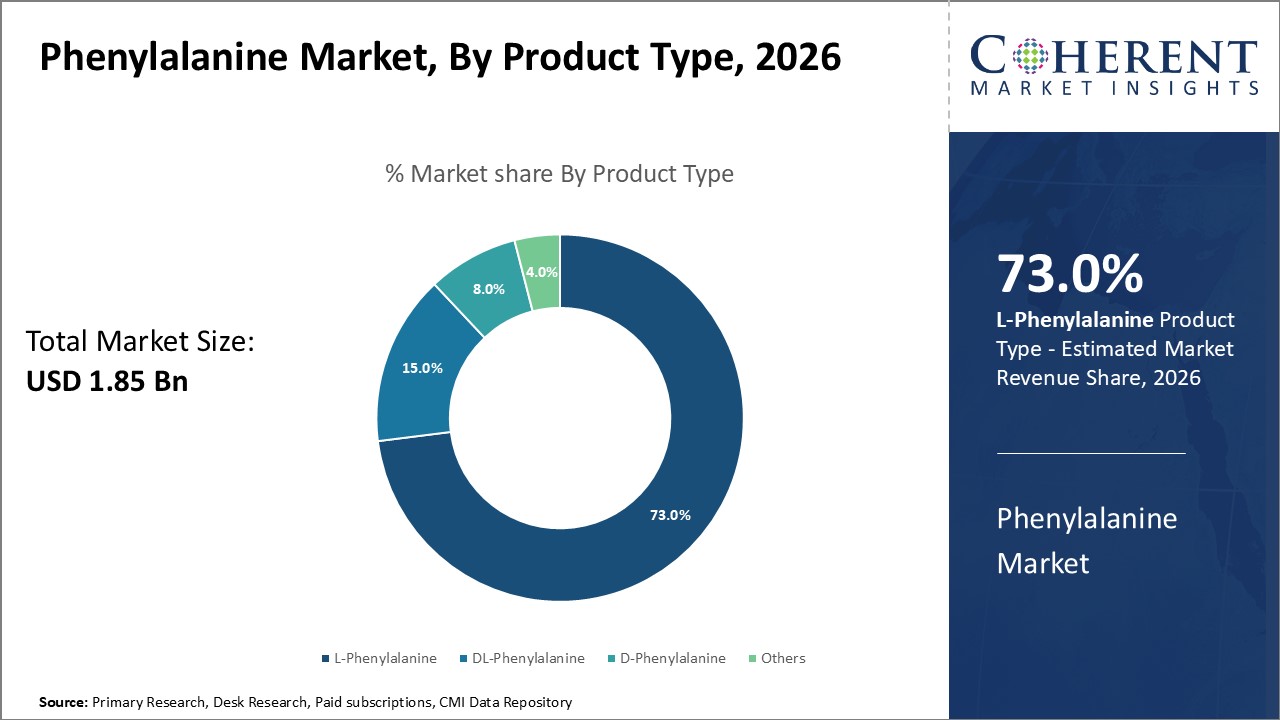
Industry share within the L-Phenylalanine product type remains dominant, controlling approximately 73% of the phenylalanine market, driven by its superior efficacy and application versatility.
Likewise, the food & beverage segment's robust growth (46% market share) is reinforced by escalating global aspartame production volumes.
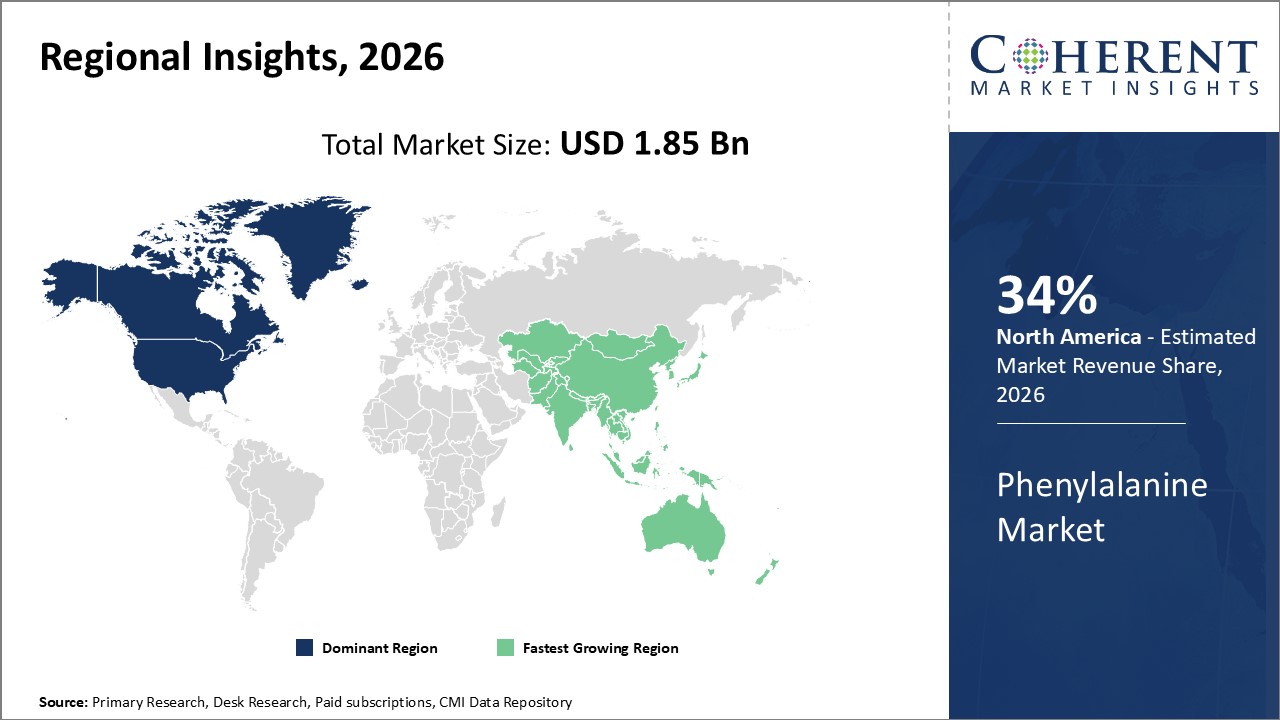
Regionally, North America leads market share at 34%, supported by advanced production infrastructure and regulatory frameworks fostering industry growth.
Meanwhile, the Asia Pacific region registers the fastest CAGR, fueled by expanding production capacity and increasing export volumes from China and India.
Phenylalanine Market Segmentation Analysis
Phenylalanine Market Insights, By Product Type
L-Phenylalanine accounts for the largest proportion of market revenue due to its extensive use in aspartame sweetener manufacturing and pharmaceutical formulations. Its high purity, better bioavailability, and established supply chains have propelled its dominance. DL-Phenylalanine is gaining traction, especially in niche pharmaceutical and nutritional applications, reflecting a steady growth trajectory driven by emerging therapeutic uses. D-Phenylalanine caters to specialized applications in synthesizing chemical intermediates but maintains a modest share due to limited end-user industries.
Phenylalanine Market Insights, By Application
Food & Beverages retains the dominant position, leveraging over 45% market share primarily due to the widespread use of phenylalanine in aspartame production for low-calorie food and beverage products. This segment benefits from increasing consumer health consciousness and regulatory endorsements of alternative sweeteners. Pharmaceuticals are the fastest-growing application segment with expanding roles in therapeutic agents, supplements targeting metabolic conditions, and research-driven neurological treatments—growth here is propelled by escalating prevalence of phenylketonuria and other disorders treatable by phenylalanine derivatives.
Phenylalanine Market Insights, By Production Method
Chemical Synthesis dominates with 58% market share. It remains favored for its scalability and historical prevalence, maintaining industry share through cost-effective mass production suited primarily for food-grade phenylalanine. However, fermentation is the fastest-growing subsegment, driven by growing environmental regulations and consumer demand for sustainable production, leading to increased investments in microbial and biotechnological production processes.
Phenylalanine Market Trends
Phenylalanine market trends point to a significant increase in bio-fermentation production as companies prioritize sustainability and cost reduction.
For instance, 2026 saw over 30% of phenylalanine produced through fermentation techniques, especially in Europe and North America, responding to governmental environmental regulations.
The novel applications of phenylalanine in nutraceuticals and personalized nutrition markets are further accelerating demand.
Additionally, the Asia Pacific has become the epicenter of export-led growth, driven by low-cost production and expanding international trade agreements.
Phenylalanine Market Insights, By Geography
North America Phenylalanine Market Analysis and Trends
In North America, the dominance in the Phenylalanine market is largely due to substantial investments in R&D, advanced manufacturing infrastructures, and a growing demand for pharmaceutical-grade phenylalanine. The U.S., in particular, spearheads the industry share with approximately 30%. Regulatory frameworks encouraging health-focused food and drug development underpin steady market revenue growth annually. Leading market companies such as Ajinomoto and Archer Daniels Midland leverage technological advancements, maintaining competitive resilience.
Asia Pacific Phenylalanine Market Analysis and Trends
Meanwhile, the Asia Pacific exhibits the fastest growth with a CAGR exceeding 9%, stimulated by increased production capacities in countries like China and India, where government incentives promote biochemical industries. The presence of key manufacturers investing in fermentation technology and export-driven business growth strategies drives market expansion. Lower production costs combined with a burgeoning food processing sector contribute substantially to market size and revenue in this region.
Phenylalanine Market Outlook for Key Countries
USA Phenylalanine Market Analysis and Trends
The USA’s phenylalanine market remains robust, driven by escalating demand in pharmaceutical applications and stringent quality standards that favor domestic manufacturing over imports. Leading companies such as Archer Daniels Midland and Ajinomoto have expanded production capabilities in the U.S., enhancing supply chain resilience. Innovations in bio-fermentation and large-scale production plants are expected to bolster market share further. Increasing awareness about low-calorie sweeteners in the food industry has also supported the steady rise in demand, contributing to substantial business growth and market revenue.
China Phenylalanine Market Analysis and Trends
China’s phenylalanine market benefits from government support and low production costs, enhancing its position as both a producer and exporter. Domestic firms like Shandong Hongda Biotechnology and Changmao Biochemical Engineering have invested heavily in fermentation technologies, resulting in improved output efficiency and quality. China's export-oriented approach, coupled with rising internal consumption in the food and pharmaceutical sectors, has amplified the market size significantly. Favorable trade policies and expanding industry infrastructure position China as a critical driver of the phenylalanine market’s rapid regional growth.
Analyst Opinion
The increasing production capacity of phenylalanine worldwide is a key supply-side indicator. In 2025, Asia Pacific production facilities expanded by over 15% in capacity, fostering accessibility to low-cost phenylalanine, thereby reinforcing market share in emerging economies. This expansion reduces import dependencies in regions like India and China, influencing market revenue positively.
Demand-side dynamics reveal a surge in phenylalanine usage beyond aspartame production, notably in active pharmaceutical ingredients (APIs) and dietary supplements. For example, the pharmaceutical industry consumed 23% more phenylalanine in 2026 compared to 2023, driven by growth in treatments for phenylketonuria (PKU) and other metabolic disorders. This diversification is shifting market growth patterns.
Nano-scale market indicators such as innovative microbial fermentation processes are reshaping phenylalanine production economics. Biotechnological advancements introduced in 2025 reduced overall production costs by up to 10%, enhancing competitive pricing structures globally. Increased adoption of fermentation methods in Europe and North America has improved product quality and throughput.
Price stability in phenylalanine, observed during economic uncertainties in 2026, indicates resilience due to consistent end-user demand across food and pharmaceutical sectors. While raw material costs fluctuated, phenylalanine prices maintained a steady range between USD 18-22/kg, supporting steady market revenue and business growth.
- Current Industry Events of 2026
- Market Size Estimation
- Regional Breakdown
- Competitive Landscape
- Customer Intelligence
- Segmental Analysis
- Pricing Analysis
- Key Market Drivers, Challenges & Future Trends
- Customized Insights Section
Market Scope
| Report Coverage | Details | ||
|---|---|---|---|
| Base Year: | 2025 | Market Size in 2026: | USD 1.85 billion |
| Historical Data for: | 2020 To 2024 | Forecast Period: | 2026 To 2033 |
| Forecast Period 2026 to 2033 CAGR: | 7.6% | 2033 Value Projection: | USD 3.09 billion |
| Geographies covered: |
| ||
| Segments covered: |
| ||
| Companies covered: | Ajinomoto Co., Inc., Evonik Industries AG, Archer Daniels Midland Company, CJ CheilJedang Corporation, Shandong Hongda Biotechnology Co., Ltd., Lonza Group AG, Kyowa Hakko Bio Co., Ltd., Changmao Biochemical Engineering Co., Ltd., Solvay S.A., BASF SE. | ||
| Growth Drivers: |
| ||
Phenylalanine Market Growth Factors
Rising demand for Phenylalanine as a precursor in aspartame, with global aspartame production volumes increasing by over 10% in 2026, provides significant revenue growth in food and beverage applications. Pharmaceutical usage expansion is noteworthy, supported by ongoing research into phenylalanine’s role in treating metabolic disorders and neurological diseases, which saw a 15% increase in clinical demand during 2025-2026. Technological innovations, particularly fermentative production processes, have enhanced production efficiency and sustainability, driving down costs by approximately 8% compared to traditional synthetic methods, thus widening market scope. Increasing consumer preference for healthier food additives over sugar is accelerating phenylalanine demand in dietary sectors, particularly in North America and Europe, where low-calorie sweetener consumption rose by around 11% between 2023 and 2026.
Phenylalanine Market Development
In July 2021, Ajinomoto Co., Inc. launched “Nou-Katsu Seven Amino, a dietary supplement formulated with seven amino acids—including phenylalanine—designed to support brain health, focus, and fatigue reduction. Marketed as part of Ajinomoto’s “Nou-Katsu (Brain Activity)” campaign in Japan, the supplement reflects the company’s push into functional nutrition and cognitive-support categories, leveraging its amino-acid expertise for consumer wellness applications.
In November 2023, Ajinomoto Co., Inc. announced the acquisition of Forge Biologics LLC for $620 million, expanding its advanced-therapy and genetic-medicine manufacturing capabilities. Forge Biologics specializes in adeno-associated virus (AAV) gene-therapy development and production, complementing Ajinomoto’s biologics and oligonucleotide contract-development and manufacturing operations. Although not directly linked to phenylalanine, the acquisition underscores Ajinomoto’s broader diversification into high-growth biopharma and precision-medicine markets.
Key Players
Leading Companies of the Market
Evonik Industries AG
Archer Daniels Midland Company
CJ CheilJedang Corporation
Shandong Hongda Biotechnology Co., Ltd.
Kyowa Hakko Bio Co., Ltd.
Changmao Biochemical Engineering Co., Ltd.
Solvay S.A.
BASF SE
In recent years, companies like Ajinomoto and Evonik have focused on strategic partnerships and capacity expansions, resulting in a 13% revenue increase in 2025. Archer Daniels Midland leveraged cost reduction by integrating biotechnological processes, enhancing their competitive edge and expanding market share in North America and Asia Pacific. CJ CheilJedang’s investment in fermentation technology facilities in 2026 resulted in a 10% increase in production output, boosting market growth strategies within the Asia Pacific.
Phenylalanine Market Future Outlook
Future developments in the phenylalanine market will emphasize bio-based production and high-value applications. Fermentation technology using genetically engineered microorganisms will dominate due to sustainability and cost advantages. The ingredient’s use in precision nutrition, sports supplementation, and medical nutrition will expand with advancements in metabolomic research. The growing popularity of clean-label and plant-derived formulations will reinforce phenylalanine’s role as a natural and functional additive in both the food and nutraceutical sectors.
Phenylalanine Market Historical Analysis
The phenylalanine market has developed steadily as a critical ingredient for food, beverage, and pharmaceutical formulations. Initially produced synthetically, the shift toward bio-fermentation in the 2010s improved efficiency and purity standards. Demand for aspartame and other sweeteners fueled large-scale consumption in processed foods and beverages. The amino acid’s role in neurological and metabolic therapies also enhanced its pharmaceutical relevance. Rising health consciousness and regulatory acceptance of amino acid-based supplements further sustained market growth through the 2020s.
Sources
Primary Research Interviews:
Biochemists
Food Technologists
Pharmaceutical Researchers
Nutrition Manufacturers
Databases:
PubChem Chemical Data
FAO Food Additives Database
Magazines:
Food Chemistry News
Nutraceutical World
Chemical & Engineering News
Food Navigator
Journals:
Journal of Food Science
Amino Acids Journal
Food Chemistry
International Journal of Biological Macromolecules
Newspapers:
The New York Times (Science)
The Guardian (Health)
The Hindu (Food Industry)
Financial Express (Chemicals)
Associations:
American Chemical Society (ACS)
FAO
International Food Information Council (IFIC)
EFSA
Get access to 250+ pages report
Every segment, forecast, competitor profile and data table behind the analysis above — available for instant download.
- ESOMAR Member
- ISO 9001:2015 Certified
- D-U-N-S Registered
- GDPR & CCPA Compliant
Missing comfort of reading report in your local language? Find your preferred language:
Transform your Strategy with Exclusive Trending Reports
Frequently Asked Questions
The market is led by industry giants including Ajinomoto Co., Inc., Evonik Industries AG, Archer Daniels Midland Company, and CJ CheilJedang Corporation, whose production and technological advancements significantly shape market dynamics.
The Phenylalanine market size is projected to grow from USD 1.85 billion in 2026 to USD 3.09 billion by 2033, exhibiting a CAGR of 7.6%, reflecting strong market momentum and expanding application scope.
Market trends indicate a shift toward bio-fermentation production methods, higher demand for dietary supplements, and increasing regional trade collaborations, which together are expected to reshape industry standards and growth pathways.
The market is moderately consolidated with a few key players dominating; challenges include raw material price fluctuations and regulatory compliances, balanced by technological innovations enhancing production efficiency.
Competitive strategies include capacity expansion via partnerships and mergers, investment in sustainable production methods, and diversification of product applications to capture emerging markets and address shifting consumer preferences.