

Proteinase K Market Analysis & Forecast: 2026-2033
Proteinase K Market is estimated to be valued at USD 33.5 Bn in 2026 and is expected to reach USD 51.7 Bn in 2033, exhibiting a compound annual growth rate (CAGR) of 6.4% from 2026 to 2033.
Key Takeaways
- According to Application, The Purification Of DNA & RNA Segment is anticipated to hold 43% share of the Proteinase K market in 2026.
- According to region, North America holds the largest market share of 44.3% for Proteinase K market growth by 2026.
Market Overview
The Proteinase K Market Size has grown significantly in recent years due to its crucial significance in biotechnology, diagnostics, and molecular biology. The enzyme's crucial function in molecular diagnostics, particularly in the purification of DNA and RNA that supports next-generation sequencing (NGS) and polymerase chain reaction (PCR) technologies, is the main driver of its increase. The need for precise diagnostic instruments has increased due to the growing incidence of infectious and chronic illnesses, which has further expanded the market.
Current Events and Its Impact
Event | Description and Impact |
Surge in Chronic and Infectious Diseases |
|
Advancements in Next-Generation Sequencing (NGS) Technologies |
|
Pricing Analysis
The pricing landscape for proteinase K is influenced by several key factors, including production costs, purity grades, source (microbial, animal-derived, or recombinant), and the scale of procurement. High production costs, especially for recombinant and high-purity forms, have historically kept prices elevated.
However, increasing competition among major suppliers such as Merck KGaA, QIAGEN, Thermo Fisher Scientific, and others has led to some price moderation and greater availability of various product grades. Market segmentation by form lyophilized powder and liquid also affects pricing, with lyophilized forms generally commanding higher prices due to their stability and longer shelf life.
- Current Industry Events of 2026
- Market Size Estimation
- Regional Breakdown
- Competitive Landscape
- Customer Intelligence
- Segmental Analysis
- Pricing Analysis
- Key Market Drivers, Challenges & Future Trends
- Customized Insights Section
Role of Emerging Technology
Emerging technologies are significantly reshaping the proteinase K market. The adoption of next-generation sequencing (NGS), advanced PCR techniques, and high-throughput genomic workflows has increased the demand for highly pure and stable proteinase K, as these applications require efficient and reliable nucleic acid extraction.
The development of recombinant proteinase K variants engineered for enhanced stability, activity, and regulatory compliance represents a major technological advancement and is now the largest and fastest-growing segment in the market.
Segmental Insights
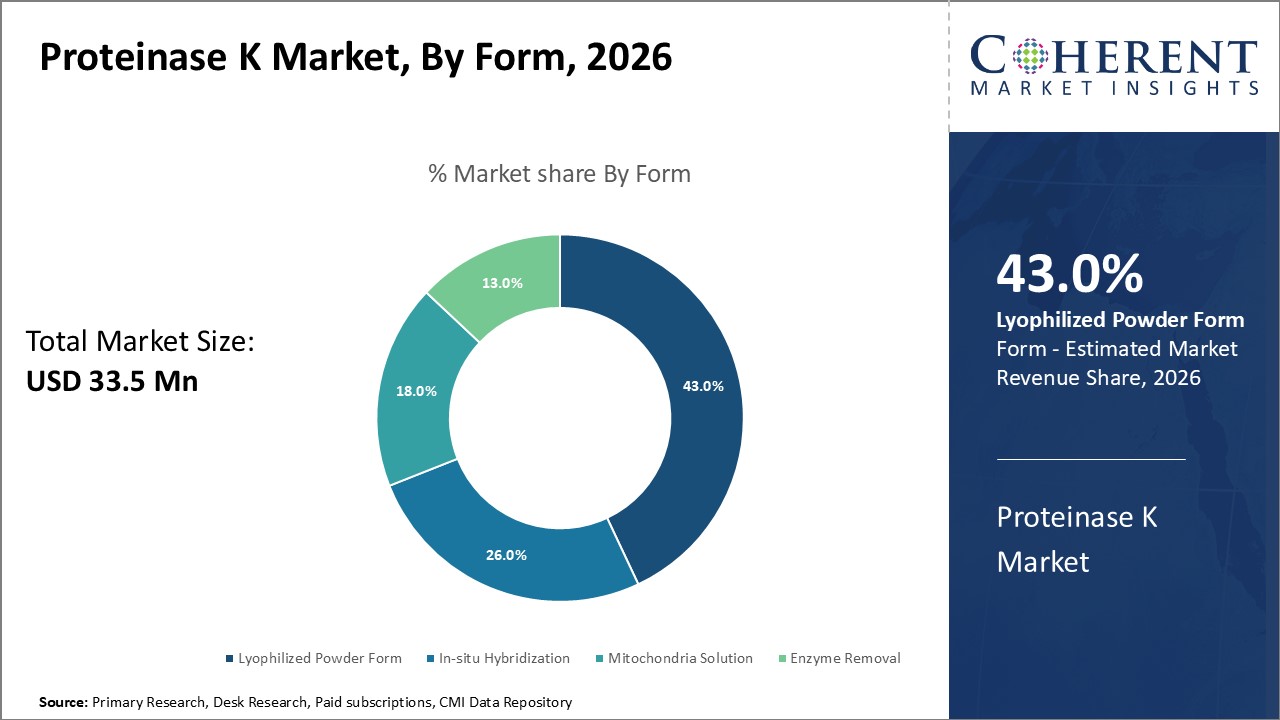
Proteinase K Market Insights, by Form
By Form, the market is segmented into lyophilized powder form and liquid form. Out of which, the lyophilized powder form segment is expected to hold a dominant position in the global Proteinase K market during the forecast period and this is attributed to the advantages imparted due to lyophilization techniques. The powder after lyophilization have high stability, long shelf life and inexpensive shipping. Lyophiliziation also does not reduce the activity of proteinase K.
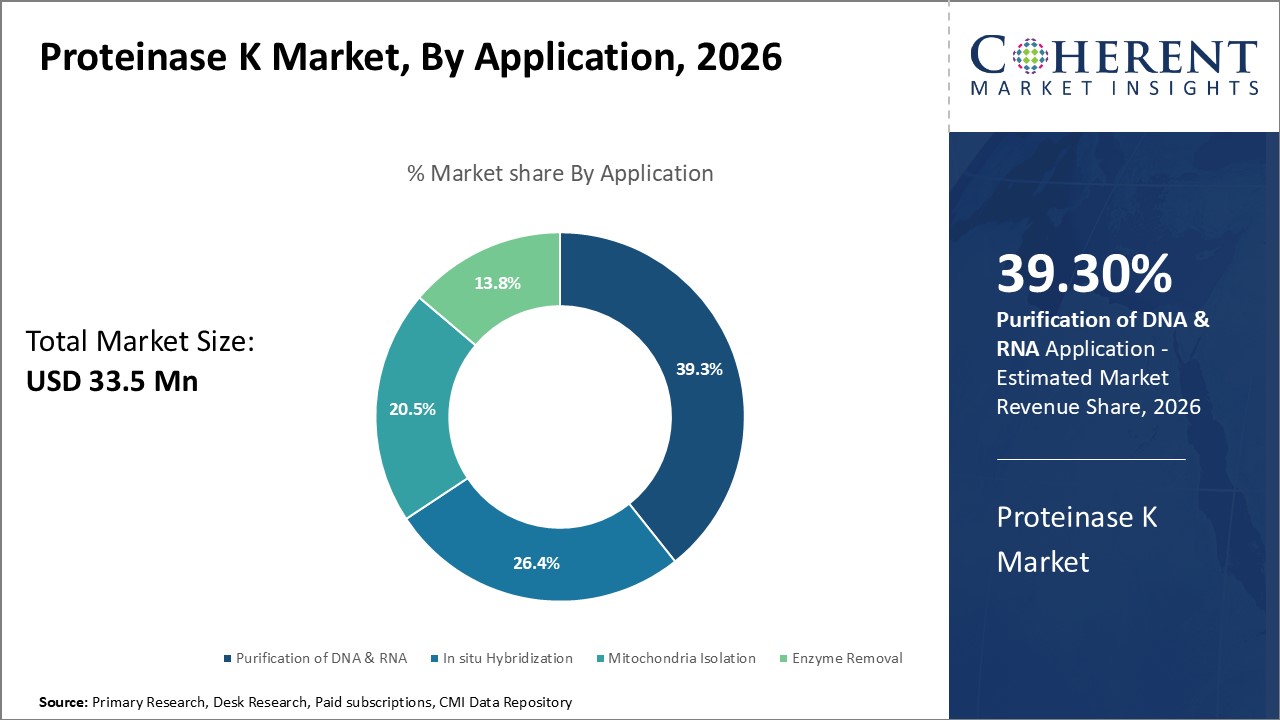
Proteinase K Market Insights, by Application
By Application, the market is segmented into Purification of DNA & RNA, In situ Hybridization, Mitochondria Isolation, and Enzyme Removal. Out of which, the purification of RNA & DNA segment is expected to hold a dominant position in the global proteinase K market during the forecast period and this is attributed to the increasing number of infectious diseases worldwide. This increases the demand for techniques used in diagnosis of infectious diseases like hepatitis, influenza, human immunodeficiency virus.
Proteinase K Market Insights, by End User
By End user, the market is segmented into Contract Research Organization, Academic Institutes, Biotechnology Companies, and Diagnostic Laboratories. Out of which, the contract research organization segment is expected to dominate the market over the forecast period and this is attributed to the increasing research activities in Clinical Research Organizations.
Regional Insights
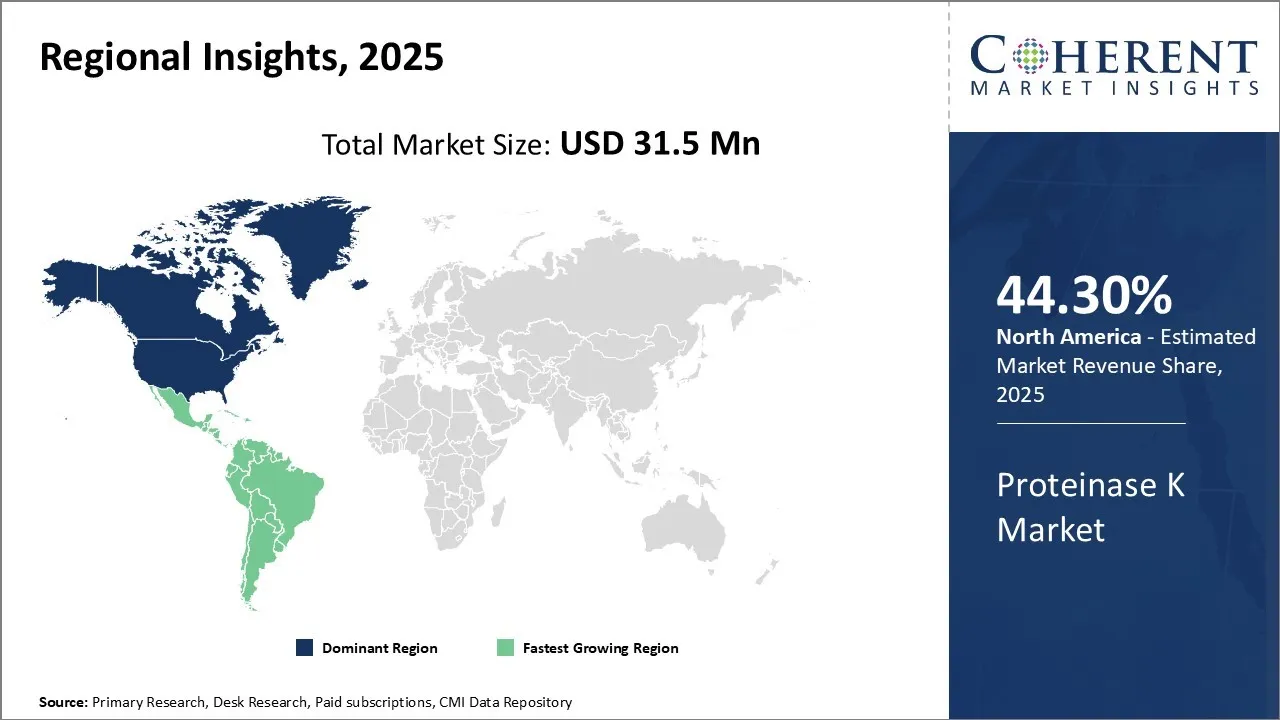
North America Proteinase K Market
North America is estimated to hold a dominant position in global proteinase K market over the forecast period. The growing prevalence of infectious diseases and genetic disorders directly impacts the increased demand for the global proteinase K market.
For instance, as per the report from the World Health Organization in 2021, there was an increase in tuberculosis cases by 4.5% in 2021. The number of cases was 10.1 million which rose to 10.6 million, reversing many years of slow decline. Similarly, the tuberculosis incidence rate (new cases per 100, 000 population per year) is estimated to have increased by 3.6% between 2020 and 2021.
Thus, the rise in infectious cases like tuberculosis, human immunodeficiency viruses, influenza, and hepatitis is anticipated to increase market growth over the forecast period. Globally, 38.4 million [33.9–43.8 million] people were living with human immunodeficiency viruses at the end of 2021. An estimated 0.7% [0.6-0.8%] of adults aged 15–49 years worldwide are living with HIV, although the burden of the epidemic continues to vary considerably between countries and regions.
Asia Pacific Proteinase K Market
Over the course of the next ten years, the Asia Pacific Proteinase K market is expected to grow at the quickest rate in the world. The main drivers of this increase include the region's expanding use of molecular diagnostics, the incidence of infectious and chronic diseases, and rising investments in biotechnology research.
Proteinase K Market In Europe
The increasing incidence of infectious and chronic illnesses, which call for sophisticated diagnostic equipment, is driving the expansion in Europe. Demand is further increased by the enzyme's vital involvement in molecular diagnostics, particularly in the purification of DNA and RNA for PCR and next-generation sequencing (NGS) methods. Furthermore, the enzyme's uses are growing as a result of developments in biopharmaceutical research and customized treatment.
Proteinase K Market Dominating Countries
U.S Proteinase K Market
The U.S. market benefits from a well-established healthcare infrastructure and a robust presence of leading industry players such as Merck KGaA, QIAGEN, Thermo Fisher Scientific, and Roche. The largest segment in the U.S. is the powder form of Proteinase K, but the liquid segment is growing rapidly due to its convenience in automated and high-throughput applications.
India Proteinase K Market
India is emerging as a major growth engine for the Proteinase K market, propelled by rapid advancements in biotechnology research, expanding healthcare infrastructure, and increasing government initiatives to support genomics and molecular diagnostics.
Proteinase K Market In China
China’s large-scale genomic research projects, expanding biopharmaceutical sector, and increasing focus on personalized medicine further drive market growth. The presence of both domestic and multinational companies ensures a competitive landscape, fostering innovation and expanding the application spectrum of Proteinase K in areas such as diagnostics, forensics, and food safety testing.
Market Report Scope
Proteinase K Market Report Coverage
| Report Coverage | Details | ||
|---|---|---|---|
| Base Year: | 2025 | Market Size in 2026: | USD 33.5 Mn |
| Historical Data for: | 2020 To 2024 | Forecast Period: | 2026 To 2033 |
| Forecast Period 2026 to 2033 CAGR: | 6.4% | 2033 Value Projection: | USD 51.7 Mn |
| Geographies covered: |
| ||
| Segments covered: |
| ||
| Companies covered: | Thermo Fisher Scientific Inc., Merck KGaA, Qiagen N.V., F. Hoffmann-La Roche Ltd., New England Biolabs, Worthington Biochemical Corporation, Norgen Biotek Corp., BIORON GmbH, Sisco Research Laboratories Pvt. Ltd., Bioline (Meridian Biosciences Inc.), Promega Corporation | ||
| Growth Drivers: |
| ||
| Restraints & Challenges: |
| ||
Proteinase K Market: Growth Drivers
- Collaborations by key market players to expand product portfolio
In order to carry out the research in an efficient way, key market players are focused on collaborating with other clinical research organizations to expand their product portfolio. For instance, on April 19, 2022, Thermo Fisher Scientific Inc., a U.S.-based reagent supplier, and Matrix Clinical Trials, a U.S.-based clinical service organization, announced a collaboration to bring clinical trials to patients with an innovative decentralized clinical trial (DCT) solution.
Thermo Fisher Scientific is deploying state-of-the-art Matrix mobile research sites and expert clinical staff across the U.S. to help identify, recruit, and retain trial participants while ensuring a positive patient experience. This increase in clinical trials can help in increasing the growth of the global proteinase K market for diagnosis purposes.
- Newer research and development activities in field of proteinase K
Proteinase K is commonly used in extraction and purification of DNA and RNA. Apart from that alternative uses of it are also under study. This can fuel the growth of global proteinase K market.
For instance, according to article published by Journal of Functional Polymers on June, 2022, Proteinase K can be used along with antimicrobials to enhance penetration of antimicrobials across the biofilm. It was found that proteinase K has ability to disperse over the mature biofilm of methicillin resistant staphylococcus aureus and increase entry of antimicrobial agent.
Proteinase K Market: Trends
- Funding for research and development in the biotechnology field
Market players are focused on granting funding to increase research and funding in biotechnology industry, the global proteinase K market is expected to experience considerable expansion in the North American region. For instance, in January 2021, Pfizer Inc., a multinational biotechnology company, announced that as part of its Pfizer Breakthrough Growth Initiative (PBGI), it has invested a total of US$ 120 million in four clinical-stage biotechnology firms.
Pfizer is investing up to US$ 500 million in biotechnology firms through PBGI, offering capital and access to Pfizer's scientific expertise to support the continuation of promising clinical development programs that Pfizer may find strategically valuable in the future.
Proteinase K Market: Opportunities
- Expansion in Molecular Diagnostics and Genomics
The increasing adoption of molecular diagnostic techniques, particularly DNA and RNA purification for next-generation sequencing (NGS) and polymerase chain reaction (PCR), is a primary growth driver. As the prevalence of chronic and infectious diseases rises, there is a greater need for accurate diagnostic tools, which boosts demand for proteinase K. The growing use of gene expression profiling and targeted panels via qPCR in pathology labs further enhances market opportunities.
Proteinase K Market: Key Developments
- January 2023, Selecta Biosciences, Inc., and Astellas Pharma Inc. announced an exclusive licensing and development agreement for IdeXork (Xork). Xork is being studied as a potential next generation immunoglobulin G (IgG) protease that will be developed by Astellas for use with AT845, an investigational, adeno-associated virus (AAV)-based treatment for Late-Onset Pompe disease (LOPD) in adults.
Analyst Opinion
- Increase in exploring newer methods of cell separation by diagnostic labs and research laboratories is one of the key factors contributing to the growth of the market within the forecast period.
- For instance, on April 8, 2022, Researchers from Cornell University, U.S., launched a startup called Inso Biosciences to commercialize nucleic acid extraction and sample preparation technology. Its first application is based on targeting DNA extraction and sample preparation for long-read sequencing. This technology can complete sample processing in 30 to 40 minutes, instead of four to six hours for DNA pieces 40 kb to 50 kb in length or as long as 100 kb.
- Moreover, the firm's method keeps DNA in solution, which results in less damage than chemical binding-based methods. As Proteinase K plays a major role in DNA purification, such techniques can increase the demand of global proteinase K market.
Speak to the analyst
Want personalized insights?
Take the findings above to one of our principal consultants, or have the report rebuilt around the segments, geographies and competitors you actually track.
Market Segmentation
- Global Proteinase K Market, By Form (Revenue, USD Mn, 2021 - 2033)
- Lyophilized Powder Form
- Liquid Form
- Global Proteinase K Market, By Application (Revenue, USD Mn, 2021 - 2033)
- Purificaion of DNA & RNA
- In situ Hybridization
- Mitochondria Isolation
- Enzyme Removal
- Global Proteinase K Market, By End User (Revenue, USD Mn, 2021 - 2033)
- Contract Research Organization
- Academic Institutes
- Biotechnology Companies
- Diagnosis Laboratories
- Global Proteinase K Market, By Region (Revenue, USD Mn, 2021 - 2033)
- North America
- U.S.
- Canada
- Latin America
- Brazil
- Mexico
- Argentina
- Rest of Latin America
- Europe
- Germany
- U.K.
- France
- Italy
- Spain
- Russia
- Rest of Europe
- Asia Pacific
- China
- India
- Japan
- Australia
- South Korea
- ASEAN
- Rest of Asia Pacific
- Middle East
- GCC
- Israel
- Rest of Middle East
- Africa
- South Africa
- Central Africa
- North Africa
- North America
- Company Profiles
- Thermo Fisher Scientific Inc.
- Merck KGaA
- Qiagen N.V.
- F. Hoffmann-La Roche Ltd.
- New England Biolabs
- Worthington Biochemical Corporation
- Norgen Biotek Corp.
- BIORON GmbH
- Sisco Research Laboratories Pvt. Ltd.
- Bioline (Meridian Biosciences Inc.)
- Promega Corporation
Sources
Primary Research interviews
- R&D Heads – Biotech Companies
- Manufacturing Heads – Enzyme Producers
- Procurement Managers – Diagnostic Kit Manufacturers
- Product Managers – Life Sciences Tools Companies
- Academic Researchers – Molecular Biology
- Quality Assurance Heads – Clinical Labs
- Regulatory Affairs Specialists – Pharma & Biotech
- Distributors – Enzyme and Diagnostic Reagents
- Hospital Laboratory Directors
Databases
- Scopus
- EMBASE
- Cortellis
- ClinicalTrials.gov
- GenomeWeb Database
- BioCyc Database Collection
Magazines
- Genetic Engineering & Biotechnology News
- BioSpectrum
- The Scientist
- Biopharma Dive
- Labiotech.eu
- Nature Biotechnology (magazine section)
- Chemistry World
- PharmaTimes
Journals
- Enzyme and Microbial Technology
- Journal of Biotechnology
- Applied and Environmental Microbiology
- Protein Expression and Purification
- Biotechnology Advances
- Analytical Biochemistry
- Molecular Biology Reports
Newspapers
- The Wall Street Journal
- Financial Times
- The Economic Times (Health/Science section)
- The Hindu BusinessLine (Biotech & Pharma)
- The Times of India (Science & Technology)
- Business Standard
Associations
- American Society for Biochemistry and Molecular Biology (ASBMB)
- Enzyme Technical Association (ETA)
- European Federation of Biotechnology (EFB)
- International Union of Biochemistry and Molecular Biology (IUBMB)
- Biotechnology Innovation Organization (BIO)
- Indian Drug Manufacturers’ Association (IDMA)
- All India Biotech Association (AIBA)
- European Enzyme Manufacturers Association (EEM)
Proprietary Elements
- CMI Data Analytics Tool, Proprietary CMI Existing Repository of information for last 8 years
*Definition: Proteinase K is a serine protease produced by the fungus Tritirachium album Limber. It is used as an enzyme or reagent in different chemical reactions. It digests the unwanted nuclease in protein purification and produces a pure sample of high molecular weight DNA & RNA. Proteinase K has various applications such as isolation and purification of nucleic acid, mitochondria isolation, enzyme removal, and PCR purification.
Get access to 250+ pages report
Every segment, forecast, competitor profile and data table behind the analysis above — available for instant download.
- ESOMAR Member
- ISO 9001:2015 Certified
- D-U-N-S Registered
- GDPR & CCPA Compliant
Missing comfort of reading report in your local language? Find your preferred language:
Transform your Strategy with Exclusive Trending Reports
Frequently Asked Questions
The Proteinase K Market size is estimated to be valued at USD 33.5 Mn in 2026, and is expected to reach USD 51.7. Mn by 2033.
The CAGR of the global Market is projected to be 6.4% from 2026 to 2033.
The collaborations by market key players to expand the product portfolio is expected to drive the market growth.
Purification of DNA & RNA is the leading application segment in the Market.
Alternative products for cloning and sequencing is expected to hinder the market over the forecast period.
Major players operating in the Market include Thermo Fisher Scientific Inc., Merck KGaA, Qiagen N.V., F. Hoffmann-La Roche Ltd., New England Biolabs, Worthington Biochemical Corporation, Norgen Biotek Corp., BIORON GmbH, Sisco Research Laboratories Pvt. Ltd., Bioline (Meridian Biosciences Inc.), Promega Corporation.