

Regenerative Artificial Skin Market Size and Trends - 2025 to 2033
Regenerative artificial skin market is estimated to be valued at USD 3,084.9 Mn in 2026 and is expected to reach USD 5,980.0 Mn by 2033, exhibiting a compound annual growth rate (CAGR) of 9.9% from 2026 to 2033.
Key Takeaways
- Based on Material Type, the Biological Materials segment is expected to lead the market with 34% share in 2026, due to superior biocompatibility and clinical adoption.
- Based on Product Type, the Bioengineered Skin segment is expected to hold 31% share of the market in 2026, as it provides enhanced wound healing and functional outcomes.
- Based on Application, the Burn Treatment & Management segment is projected to account for 47% share in 2026, owing to high demand for advanced burn care solutions.
- Based on End-User, Hospitals are set to lead the market with 58% share in 2026.
- Based on Region, North America is set to lead the regenerative artificial skin market with 40% share in 2026. While, Asia Pacific is anticipated to be the fastest growing region.
Market Overview
Rising prevalence of chronic wounds, burn injuries, and surgical trauma globally is driving the demand for regenerative artificial skin solutions. The demand for advanced products for healing wounds, such as bioengineered and cellular skin substitutes, is increasing in hospitals, burns, and specialized clinics because of their ability to promote quick recovery and ensure prevention of any further complications.
Company leaders are working on introducing innovative products for skin construction with greater compatibility and functionality for handling both acute and chronic conditions associated with wounds. Rising investment in the field of regenerative medicine and increased healthcare infrastructure and awareness about advanced technology in the field of wounds are boosting the market.
Current Events and Its Impacts on the Regenerative Artificial Skin Market
Current Events | Description and its impact |
Advanced Bioprinting and Tissue Engineering Breakthroughs |
|
U.S.-China Trade Relations and Biotechnology Competition |
|
How is product innovation driving the growth in the regenerative artificial skin market?
- Advanced Bioengineered Constructs: Developing multi-layered skin substitutes with a natural tissue structure for better outcomes in wound healing and prevention of infection.
- Stem Cell-Enhanced Products: Employing stem cells embedded in scaffolding to facilitate regeneration and grafting in chronic wounds and burning injuries.
- 3D Bioprinting Applications: Utilizing 3D printing technology for the development of skin grafts for patients in a cell arrangement for increased effectiveness in reconstructive surgery.
- Smart Wound Dressings: Includes embedding sensors and bioactive agents into skin substitutes for monitoring the course of wound healing, detecting infection, and delivering therapeutic agents locally and in a controlled manner when needed.
- Sustainable Biomaterials: Research for the development of sustainable and eco-friendly scaffolds that are biodegradable.
- Current Industry Events of 2026
- Market Size Estimation
- Regional Breakdown
- Competitive Landscape
- Customer Intelligence
- Segmental Analysis
- Pricing Analysis
- Key Market Drivers, Challenges & Future Trends
- Customized Insights Section
Segmental Insights
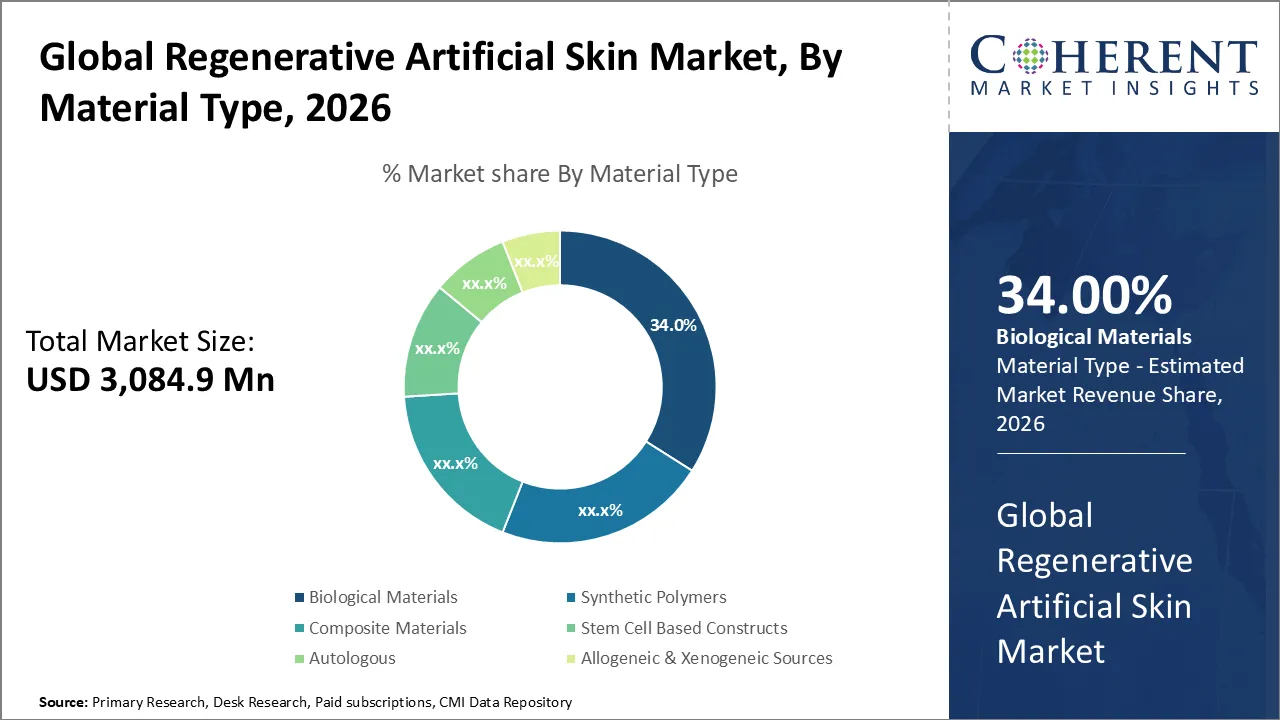
Regenerative Artificial Skin Market Insights, By Material Type – Biological Materials dominate due to superior biocompatibility
By material type, the Biological Materials segment is projected to hold the largest market share of 34% in 2026. This can be attributed to the excellent biocompatibility attribute of Biological Materials. Biological scaffolds such as collagen and fibrin have very similar characteristics to natural human skin; hence, they are easily integrated into the body tissues and are resistant to rejection. Hospitals and specialized centers use these materials to treat both acute burn wounds as well as chronic wounds.
For instance, in October 2025, researchers from the Mayo Clinic announced the development of a fully humanized 3D bioprinted human skin model that uses CollPlant Biotechnologies’ plant‑derived recombinant human collagen (rhCollagen) bioink.
Regenerative Artificial Skin Market Insights, By Product Type – Bioengineered Skin leads due to enhanced wound healing
By product type, the Bioengineered Skin segment is projected to have the largest market share of 31% in 2026. This is due to the enhanced wound healing and functional performance of Bioengineered Skin compared to conventional graft substitutes. Bioengineered products usually incorporate cellular elements along with synthetic or biological scaffolds.
For instance, in April 2025, AVITA Medical introduced Cohealyx, a bioengineered collagen‑based skin matrix designed to reduce preparation time and improve graft integration in complex wound and burn treatments.
Regenerative Artificial Skin Market Insights, By Application – Burn Treatment & Management dominates due to high demand
Based on application, the Burn Treatment & Management segment is estimated to command a share of 47% in 2026 owing to the immense demand for superior burn management solutions. Burn centers and hospitals demand superior artificial skin products capable of handling acute cases of burns effectively.
For instance, In May 2025, CUTISS AG announced progress in its Phase 3 clinical trial of denovoSkin™, a personalized bio‑engineered skin graft designed for severe burn patients, with initial grafts completed at clinical sites in multiple EU countries.
Regenerative Artificial Skin Market Insights, By End-User – Hospitals lead due to volume of acute and specialized cases
Based on the end-user, the Hospitals segment is anticipated to lead the market in 2026, holding a share of 58%, as it is primarily used as the channel through which advanced regenerative artificial skins are adopted because of its specialized infrastructure as well as its qualified medical staff.
For instance, In September 2025, AVITA Medical announced that real‑world clinical data demonstrated its RECELL® System significantly reduced hospital length of stay by an average of 36% for burn patients compared with traditional skin grafting.
Regional Insights
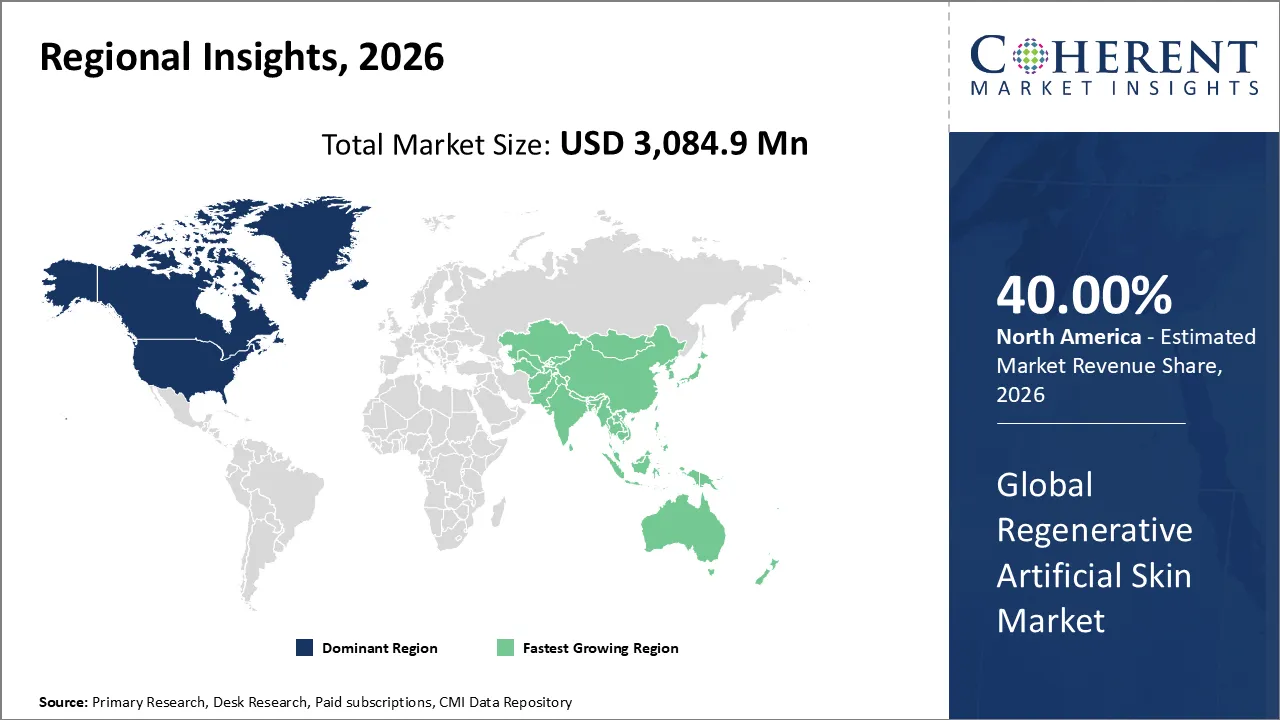
North America Regenerative Artificial Skin Market Analysis & Trends
North America is projected to record the highest market share of 40% in the regenerative skin market by 2026. This is due to factors such as an extensive health care infrastructure, a large adoption rate of advanced wound care technology, and presence of major market influencers who are actively engaging in R&D activities for regenerative medicine.
For instance, in June 2025, AVITA Medical announced that its RECELL® System and RECELL® GO were recognized as the “Best New Technology Solution, Surgical” at the 2025 MedTech Breakthrough Awards, highlighting leadership in regenerative skin care technologies used in hospitals and burn treatment centers across North America.
Asia Pacific Regenerative Artificial Skin Market Analysis & Trends
The Asia Pacific region is expected to be the fastest-growing market due to increasing healthcare investments, growing prevalence of burns and chronic wounds, and a growing awareness about advanced wound management products entering the market. Rising investment in the infrastructure related to hospitals in countries such as China, India, and Japan, and an environment that is conducive to regenerative medicine, is driving the demand for bioengineered skin substitutes in the Asia Pacific region.
For instance, in May 2025, CUTISS AG advanced its denovoSkin™ Phase 3 clinical trial across multiple EU and Asia Pacific clinical sites, including burn centers in India and Japan, demonstrating the region’s growing focus on adopting next-generation bioengineered skin solutions.
Regenerative Artificial Skin Market Outlook for Key Countries
Is the U.S. regenerative artificial skin market expanding through hospital adoption and advanced wound care technologies?
The U.S. regenerative artificial skin market is growing rapidly, driven by high adoption of advanced wound care solutions, well-established healthcare infrastructure, and supportive regulatory frameworks for regenerative medicine. Hospitals and burn units are gradually adopting bio-engineered artificial skins as an adjunct for quicker patient recovery.
For instance, In June 2025, AVITA Medical announced that its RECELL® Platform, including RECELL and RECELL GO, was honored as the “Best New Technology Solution, Surgical” at the 2025 MedTech Breakthrough Awards.
Is China’s increasing healthcare investment boosting regenerative artificial skin adoption?
China’s regenerative artificial skin market is growing steadily, promoted by an increasingly developed healthcare infrastructure, encouraging government initiatives concerning innovative and advanced solutions for wound management, as well as an increasing number of instances related to burns or chronic wounds.
For instance, in October 2025, international dermatology company Galderma introduced four core Alastin® products in the Chinese market designed to support natural skin regeneration around aesthetic treatments, helping peri‑ and post‑procedure recovery.
Market Report Scope
Regenerative Artificial Skin Market Report Coverage
| Report Coverage | Details | ||
|---|---|---|---|
| Base Year: | 2025 | Market Size in 2026: | USD 3,084.9 Mn |
| Historical Data for: | 2020 To 2024 | Forecast Period: | 2026 To 2033 |
| Forecast Period 2026 to 2033 CAGR: | 9.9% | 2033 Value Projection: | USD 5,980.0 Mn |
| Geographies covered: |
| ||
| Segments covered: |
| ||
| Companies covered: | Integra LifeSciences Corporation, Smith & Nephew plc, Organogenesis Inc., MiMedx Group, Inc., Avita Medical, Inc., Stratatech (a Mallinckrodt Company), Vericel Corporation, B. Braun Melsungen AG, Kerecis (Coloplast subsidiary), PolarityTE, Inc., Tissue Regenix Group plc, Celularity. | ||
| Growth Drivers: |
| ||
| Restraints & Challenges: |
| ||
Market Dynamics
Regenerative Artificial Skin Market Driver
Rising demand for advanced wound care and burn treatment solutions
Rising incidence of chronic wounds, burns, and trauma injury cases is triggering the demand for regenerative artificial skin. Hospitals, burn units, and specialty care facilities are increasingly using bio-engineered and artificial skin substitutes. Rising awareness about advanced regenerative medicines among healthcare providers and consumers alike is also resulting in increased market growth.
Regenerative Artificial Skin Market Opportunity
Innovation in bioengineered and stem-cell-based skin products
The market also offers significant opportunities for growth in the development of next-generation bioengineered skin, stem-cell-based constructs, and composite materials. The key strategies for companies could be the formulation of faster-healing, cost-effective, and tunable alternatives for applications ranging from burn care to chronic wound management. Further, expanding into emerging markets and partnering with hospitals and research institutes can accelerate adoption and revenue growth.
Analyst Opinion (Expert Opinion)
The regenerative artificial skin market is revolutionizing the treatment of burns and wound care through the integration of the latest bioengineering, cell therapies, and biomaterials. The acceptance rate in hospitals and burn units is increasing, as they realize the benefits of faster healing achieved through bioengineered and stem cell-based skin substitutes. The use of products like Apligraft, Dermagraft, or RECELL is improving the process of wound healing, while at the same time streamlining operations.
The “functional skin construct” approach to recreating the structure and sensation of the epidermis represents a transition from covering the wound temporarily to a fully regenerative approach. Technologies such as fish skin grafts are gaining recognition as a means of rapid healing and reduced infection rates, reflecting the market trend shifting from purely cosmetic substitutes to something meaningful from a clinical perspective.
Geographically, the adoption is strong in regions with supportive regulatory frameworks and established healthcare infrastructure, while emerging markets are rapidly increasing their uptake through collaborations between international regenerative companies and local hospitals. It indicates a growing awareness among healthcare providers and expanded access to advanced treatments for more patients.
The market’s trajectory is driven by continuous product innovation, growing clinical confidence in regenerative therapies, and increasing integration of regenerative solutions into mainstream medical practice. The firms that work on clinically justified and cost-effective solutions are expected to drive the next wave of growth in this dynamic and revolutionary market.
Speak to the analyst
Want personalized insights?
Take the findings above to one of our principal consultants, or have the report rebuilt around the segments, geographies and competitors you actually track.
Regenerative Artificial Skin Industry News
- In December 2025, Organogenesis announced it submitted initial modules of a Biologics License Application (BLA) under rolling review with the FDA, with final modules expected in first half of 2026, showing advancement toward product regulatory approval.
- In October 2025, MiMedx announced the launch of EPIXPRESS® and its participation in the Advanced Wound Care Fall Symposium, underscoring active product and clinical engagement.
- In July 2024, AVITA Medical expanded its portfolio by securing an exclusive development and distribution agreement for a unique collagen‑based dermal matrix, set to launch pending a 510(k) clearance.
Market Segmentation
- Material Type Insights (Revenue, USD Mn, 2026 - 2033)
- Biological Materials
- Synthetic Polymers
- Composite Materials
- Stem‑Cell Based Constructs
- Autologous
- Allogeneic & Xenogeneic Sources
- Product Type Insights (Revenue, USD Mn, 2026 - 2033)
- Acellular Skin Substitutes
- Cellular Skin Substitutes
- Composite Skin Substitutes
- Bioengineered Skin
- Synthetic Skin
- Hydrogel‑based Skin
- Application Insights (Revenue, USD Mn, 2026 - 2033)
- Burn Treatment & Management
- Chronic Wound Healing
- Trauma & Injury Repair
- Reconstructive & Plastic Surgery
- Dermatology & Cosmetic Uses
- Others
- End User Insights (Revenue, USD Mn, 2026 - 2033)
- Hospitals
- Burn Care Centers
- Clinics
- Ambulatory Surgical Centers (ASCs)
- Regional Insights (Revenue, USD Mn, 2026 - 2033)
- North America
- U.S.
- Canada
- Latin America
- Brazil
- Argentina
- Mexico
- Rest of Latin America
- Europe
- Germany
- U.K.
- Spain
- France
- Italy
- Russia
- Rest of Europe
- Asia Pacific
- China
- India
- Japan
- Australia
- South Korea
- ASEAN
- Rest of Asia Pacific
- Middle East
- GCC Countries
- Israel
- Rest of Middle East
- Africa
- South Africa
- North Africa
- Central Africa
- North America
- Key Players Insights
- Integra LifeSciences Corporation
- Smith & Nephew plc
- Organogenesis Inc.
- MiMedx Group, Inc.
- Avita Medical, Inc.
- Stratatech (a Mallinckrodt Company)
- Vericel Corporation
- Braun Melsungen AG
- Kerecis (Coloplast subsidiary)
- PolarityTE, Inc.
- Tissue Regenix Group plc
- Celularity
Sources
Primary Research Interviews
- Hospital & Burn Care Center Administrators
- Dermatologists & Plastic Surgeons
- Wound Care Specialists & Clinical Researchers
- Regenerative Medicine Scientists & Biotech Experts
- Tissue Engineering Product Developers
- Laboratory & Biomanufacturing Managers
- Academic Researchers in Regenerative Medicine
- Others
Databases
- PubMed
- gov
- Web of Science
- Scopus
- MEDLINE
- ScienceDirect
- Others
Magazines
- BioProcess International
- Genetic Engineering & Biotechnology News (GEN)
- Pharmaceutical Technology
- MedTech Insight
- Regenerative Medicine Today
- Others
Journals
- Journal of Tissue Engineering and Regenerative Medicine
- Burns
- Wound Repair and Regeneration
- Stem Cell Research & Therapy
- Advanced Healthcare Materials
- Others
Newspapers
- The New York Times (Health & Science Section)
- The Guardian – Science & Health
- The Washington Post – Health & Medicine
- Reuters Health
- Bloomberg News – Biotechnology Section
- Others
Associations
- International Society for Burn Injuries (ISBI)
- American Burn Association (ABA)
- Tissue Engineering and Regenerative Medicine International Society (TERMIS)
- American Society for Dermatologic Surgery (ASDS)
- Others
Public Domain Sources
- U.S. Food & Drug Administration (FDA) – Device & Biologics Approvals
- European Medicines Agency (EMA) – Product Approvals & Guidelines
- National Institutes of Health (NIH) Publications
- World Health Organization (WHO) – Wound Care & Regenerative Medicine Reports
- Clinical trial registries & government reports
- Others
Proprietary Elements
- CMI Data Analytics Tool
- Proprietary CMI Existing Repository of Information for the Last 8 Years
Get access to 250+ pages report
Every segment, forecast, competitor profile and data table behind the analysis above — available for instant download.
- ESOMAR Member
- ISO 9001:2015 Certified
- D-U-N-S Registered
- GDPR & CCPA Compliant
Missing comfort of reading report in your local language? Find your preferred language:
Transform your Strategy with Exclusive Trending Reports
Frequently Asked Questions
The Regenerative Artificial Skin Market is estimated to be valued at USD 3,084.9 Mn in 2026 and is expected to reach USD 5,980.0 Mn by 2033.
The CAGR of the Regenerative Artificial Skin Market is projected to be 9.9% from 2025 to 2033.
Increasing demand for advanced wound healing solutions, rising prevalence of burns and chronic wounds, advancements in bioengineered skin technologies, and growing investments in regenerative medicine are the major factors driving market growth.
High production costs, regulatory challenges, and limited awareness of advanced regenerative treatments are the major factors hampering market growth.
In terms of material type, the Biological Materials segment is estimated to dominate the market in 2026 due to superior biocompatibility and clinical adoption.
Integra LifeSciences Corporation, Smith & Nephew plc, Organogenesis Inc., MiMedx Group, Inc., Avita Medical, Inc., Stratatech (a Mallinckrodt Company), Vericel Corporation, B. Braun Melsungen AG, Kerecis (Coloplast subsidiary), PolarityTE, Inc., Tissue Regenix Group plc, Celularity are the major players.
North America is expected to lead the regenerative artificial skin market in 2026 with the largest market share, while Asia Pacific is anticipated to be the fastest-growing region.