

Scar Treatment Market Analysis & Forecast: 2026-2033
Scar Treatment Market size is estimated to be valued at USD 13,736.3 Mn in 2026 and is expected to reach USD 18,919.8 Mn in 2033, exhibiting a compound annual growth rate (CAGR) of 4.7% from 2026 to 2033.
Key Takeaways
- By Product Type, the Topical Scar Products segment is projected to dominate the global scar treatment market with 36.5% shares in 2026, driven by increasing regulatory approvals.
- By Region, North America is expected to lead the global scar treatment market with 37.8% shares in 2026, owing to robust regulatory approvals and high adoption of both topical and device‑based treatment modalities, capturing the largest regional share through the forecast period
Market Overview
The global scar treatment market growth is driven by the rising number of surgical procedures, burns, and trauma cases worldwide. Topical scar products, including gels and creams, dominate the market due to ease of use and regulatory approvals. North America leads the market, while Asia Pacific shows strong growth potential. However, high costs of laser treatments and limited access in low-income regions remain key challenges.
Current Events and Its Impact on the Scar Treatment Market
Event | Description and Impact |
Technological Advancement in Regenerative Medicine |
|
Regulatory Harmonization and Drug Approval Processes |
|
Global Aging Demographics and Healthcare Accessibility |
|
Scar Treatment Market: Pipeline Analysis
The scar treatment pipeline is witnessing robust innovation across topical products, laser devices, and biologics aimed at improving scar appearance and healing outcomes. In late-stage development, FDA-fast-tracked products like TWYNEO (a topical gel combining tretinoin and triamcinolone) exemplify advanced formulations targeting hypertrophic scars and keloids. Other Phase II and III candidates include novel silicone-based sheets and anti-inflammatory injectables designed to minimize scar tissue formation and enhance skin regeneration.
Early-phase pipelines focus on regenerative medicine approaches, including stem cell-derived therapies and CRISPR-based gene editing techniques aimed at cellular-level scar remodeling. Laser and light-based devices with enhanced safety profiles and precision targeting capabilities are also advancing through clinical trials, focusing on reducing treatment time and adverse effects.
In the preclinical stage, companies are exploring biomaterial scaffolds, growth factor formulations, and nanotechnology-enhanced topical agents to promote scarless wound healing and tissue regeneration. Key platforms leverage combination therapies, such as integrating anti-fibrotic agents with laser treatment, to optimize outcomes.
- Current Industry Events of 2026
- Market Size Estimation
- Regional Breakdown
- Competitive Landscape
- Customer Intelligence
- Segmental Analysis
- Pricing Analysis
- Key Market Drivers, Challenges & Future Trends
- Customized Insights Section
Patent Landscape
The scar treatment market features a dynamic patent landscape, with leading players such as Perrigo, Syneron Medical, and Merz Therapeutics holding a majority of active patents related to topical formulations, laser devices, and injectable therapies. Key innovation areas include advanced silicone-based products, combination drug therapies, and energy-based scar reduction technologies.
Recent patent filings emphasize novel drug delivery systems, minimally invasive laser and light therapies, and regenerative medicine approaches including stem cell applications and biomaterial scaffolds. Software-driven personalization of treatment regimens using AI algorithms is an emerging focus in patent activity.
Academic institutions and startups contribute to intellectual property development around gene-editing technologies and nanotechnology-enhanced scar treatments, supporting future therapeutic breakthroughs. Geographically, patent grants are concentrated in the U.S., Europe, and Asia-Pacific, reflecting global R&D investment and competitive positioning. This evolving IP environment is poised to drive innovation, partnerships, and higher entry barriers in the scar treatment industry.
Reimbursement Scenario
The global reimbursement landscape for scar treatment is varied and influenced by regional healthcare policies, coding systems, and payer structures. In the U.S., reimbursement depends on CPT and HCPCS codes covering procedures such as laser therapy and topical drug applications, with Medicare and Medicaid providing partial coverage—often requiring prior authorization for advanced treatments. Commercial insurers like Blue Cross Blue Shield and UnitedHealth frequently reimburse at rates higher than Medicare but impose stringent documentation and approval processes.
In Europe, reimbursement frameworks differ by country, with national health agencies like NICE (UK) and G-BA (Germany) evaluating cost-effectiveness to determine coverage of scar management therapies, including medical devices and pharmaceuticals. Asia-Pacific countries such as Japan and Australia operate under national reimbursement schedules, with growing inclusion of innovative treatments reflecting increasing demand.
Globally, payers are emphasizing evidence-based treatment efficacy, cost containment, and patient outcomes, which shape market access and adoption rates for new scar treatment technologies.
Prescribers’ Preference
Prescribers’ preferences for scar treatment vary depending on scar type, severity, and patient characteristics. Scar treatment for keloid scars often involves the use of topical therapies, with dermatologists and plastic surgeons frequently favoring options like silicone gels and corticosteroid creams due to their ease of application and clinically proven effectiveness. For deeper or contracture scars, laser therapies such as fractional CO₂ and pulsed dye lasers are preferred to improve texture and pigmentation.
Injectable treatments, including corticosteroids and botulinum toxin, are commonly prescribed for raised scars and contractures, often combined with physical therapy for optimal outcomes. In post-surgical and burn cases, combination approaches integrating topical agents with device-based therapies are gaining traction.
Prescribers prioritize treatment safety, minimal invasiveness, and patient adherence, tailoring protocols based on scar age, location, and patient skin type to maximize effectiveness and satisfaction.
Segmental Insights
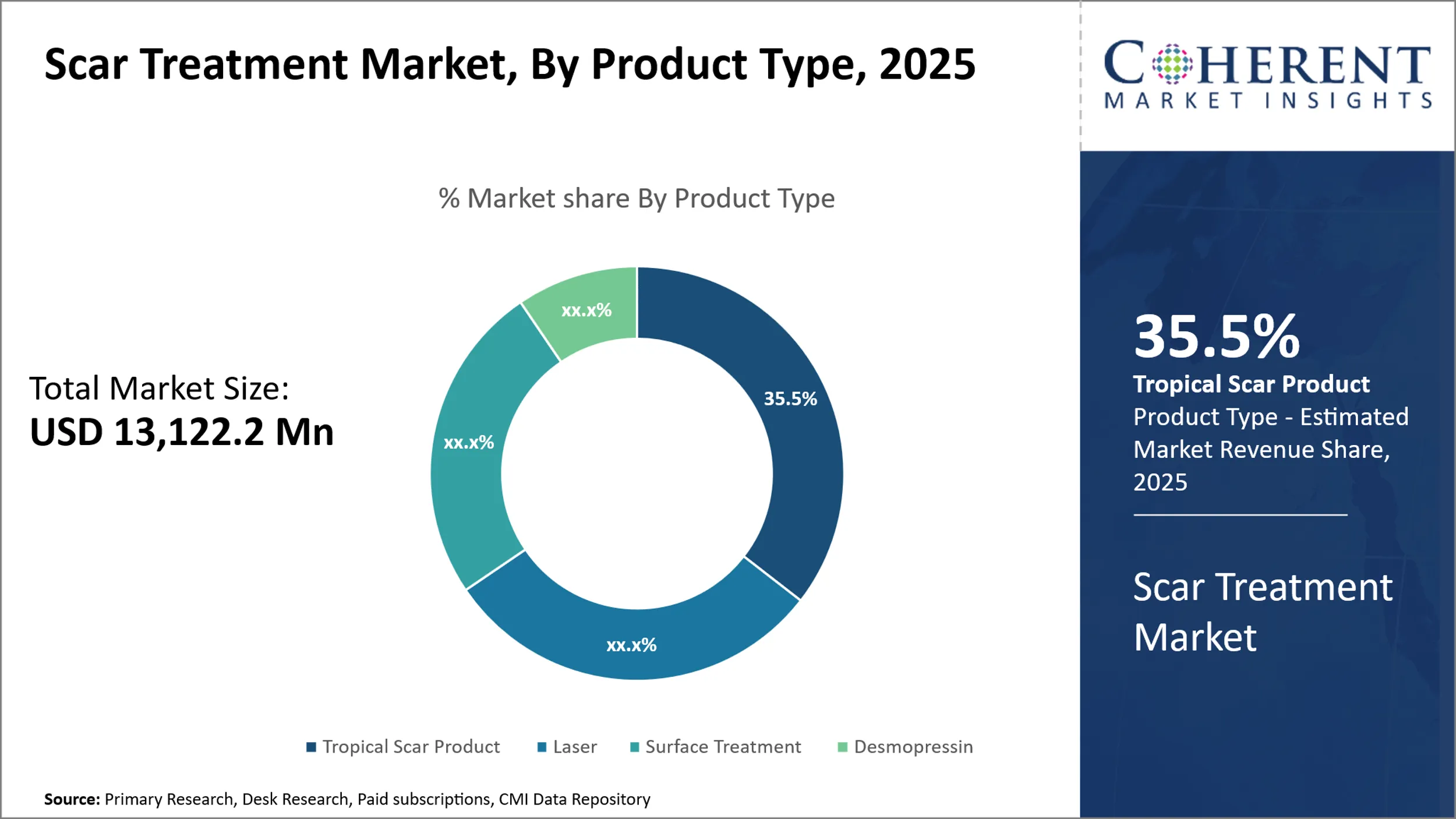
Global Scar Treatment Market Insights, By Product Type
The market is segmented into topical scar product (gels, creams, oils, and sheets), laser (co2 laser, excimer laser, and pulsed dye laser), surface treatment, and injectable. Out of which, topical scar product segment is expected to dominate the global scar treatment market demand during the forecast period and this is attributed to increase in the product launches by key players in the market.
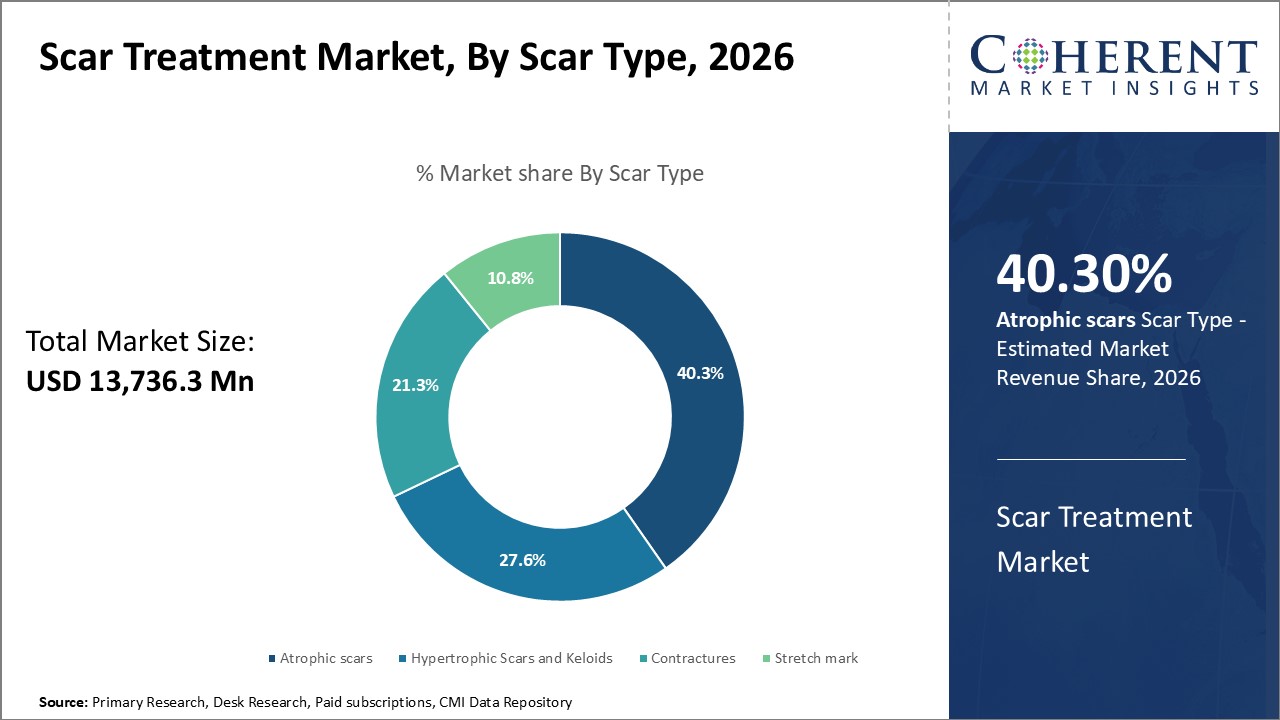
Global Scar Treatment Market Insights, By Scar Type
The global scar treatment market is segmented into atrophic scars (acne, trauma and surgery), hypertrophic scars and keloids, contractures, stretch marks. Atrophic scars segment is expected to dominate the market over the forecast period and this is attributed to the increase incidence of surgical operations.
Global Scar Treatment Market Insights, By End User
The global scar treatment market is segmented into hospitals, clinics, pharmacies and drug stores, e-commerce. Of which, e-commerce segment is expected to dominate the market over the forecast period and this is attributed to the increasing number of scar treatment products available on different E-commerce websites.
Among all segmentation, product type segment has the highest potential due to increasing incidence of scars due to burn injuries. For instance, in November 2022, an article published on UpToDate, Inc., which is a point-of-care medical resource, stated that at an estimate, there are between 7 and 12 million people (up to 33,000 each day) who sustain burn injuries every year.
Regional Insights
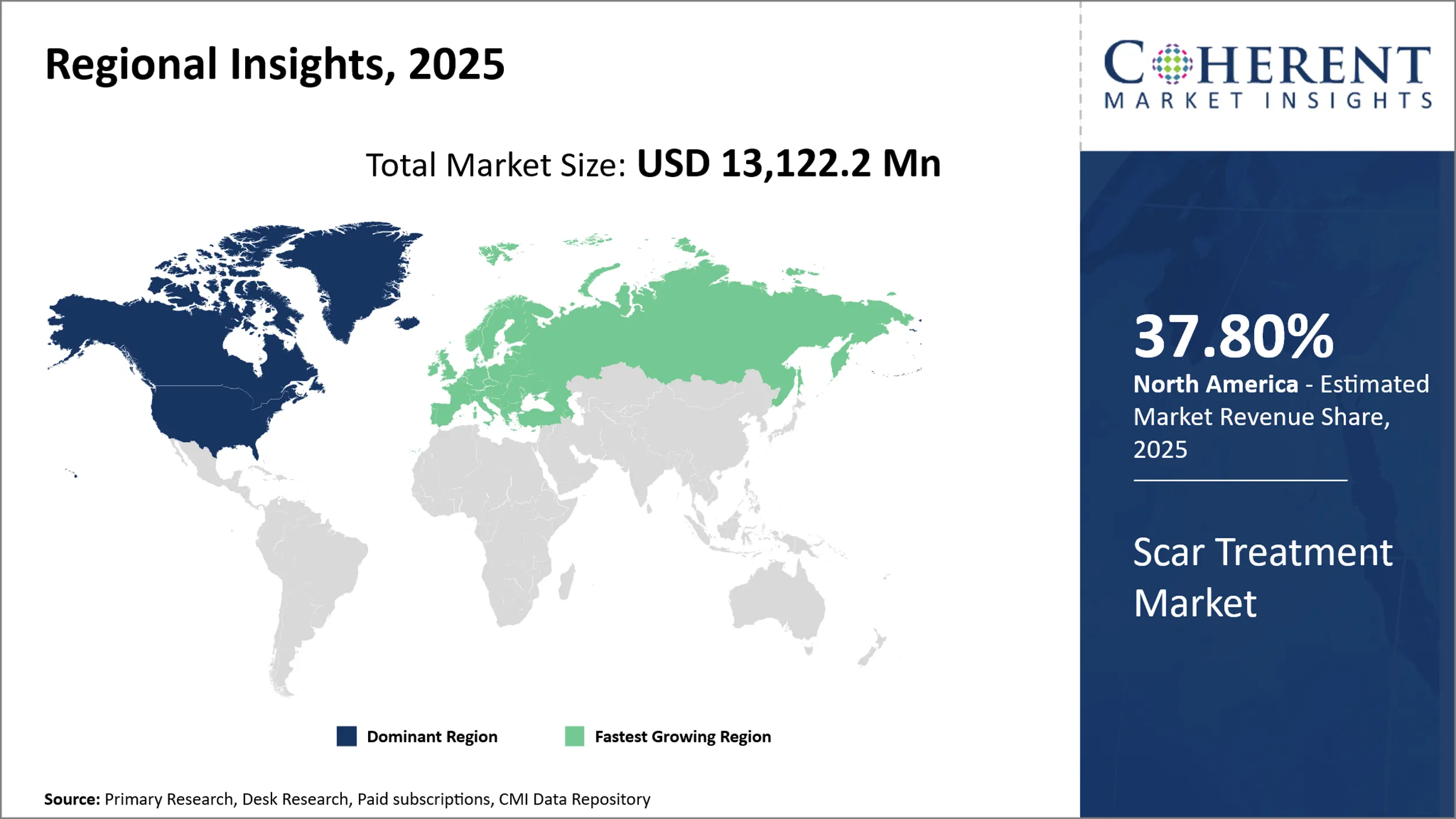
North America Scar Treatment Market Analysis and Trends
North America is expected to dominate the market over the forecast period. This is attributed to increasing adoption of organic growth strategies such as product launches by key players in the region to expand their product portfolio.
For instance, in March 2026, Cocoon Medical, a leading global developer and provider of energy-based aesthetic systems for practitioners, announced the launch of its Primelase diode laser platform. Primelase guarantees a 4.800W maximum power, providing peak performance and highest profitability for the market.
Europe Scar Treatment Market Analysis and Trends
The European region is expected to be the second-largest region in to dominate the market over the forecast period, owing to increasing growth strategies such as product launches by key players in the region expected to drive the market growth over the forecast period.
For instance, in September 2021, SkinCeuticals, a provider of skincare products, announced the launch of their latest innovation, Advanced Scar Control. The new semi-occlusive treatment is designed to protect vulnerable skin to help improve the appearance of new and recent scars.
Treatment Market Dominating Countries
- The U.S. leads globally, with a scar treatment market value worth around USD 7.36 billion in 2023, projected to reach USD 13.47 billion by 2030, growing at a 9% CAGR from 2024 onward. It remains the largest single-country market due to high adoption of advanced treatments and strong aesthetic care demand.
- Germany, the UK, France, and Italy are significant contributors under the European umbrella, with regulatory approvals and biologic introductions—such as nemolizumab in late 2024—supporting sustained growth.
Market Report Scope
Scar Treatment Market Report Coverage
| Report Coverage | Details | ||
|---|---|---|---|
| Base Year: | 2025 | Market Size in 2026: | USD 13,736.3 Mn |
| Historical Data for: | 2020 To 2024 | Forecast Period: | 2026 To 2033 |
| Forecast Period 2026 to 2033 CAGR: | 4.7% | 2033 Value Projection: | USD 18,919.8 Mn |
| Geographies covered: |
| ||
| Segments covered: |
| ||
| Companies covered: | Bausch Health Companies Inc., Candela Medical, Perrigo Company plc, Sonoma Pharmaceuticals Inc., Hologic Inc., Johnson & Johnson Services Inc., Quantum Health, CCA Industries Inc., AVITA Medical, Revitol Corp, Scarguard labs, Smith+Nephew, Lumenis Be Ltd, Merz Therapeutics, Cynosure, HRA Pharma, GC Aesthetics, Sientra Inc., SkinCeuticals, Cimeosil.com, Honeydew Products, 3V Sigma USA Inc., Syneron Medical Ltd. | ||
| Growth Drivers: |
| ||
| Restraints & Challenges: |
| ||
Global Scar Treatment Market Driver
- Increasing incidence of surgeries
The global scar treatment is used in treatment of scars caused due to surgeries. Thus, increasing rate of surgical operations is expected to drive the market growth over the forecast period. For instance, in March 2022, according to a report published by John Wiley & Sons, Inc., a research and education company, it was reported that in a survey conducted on people living in Brazil, China, France, Russia and the U.S., 35% of women and 28% of men indicated that scarring was caused due to general or orthopedic surgery.
- Increasing incidence of burn injuries
Scar treatment is used for the treatment of scars caused due to burn injuries, and thus, the increasing incidence of burn injuries is expected to drive the market growth over the forecast period. For instance, in December 2022, according to an article published in Springer Nature, which is a scientific journal, it was reported that the 67% of the scars were caused due to burn injuries in the U.S.
Global Scar Treatment Market Cross Sectional Analysis
Under the product type segment, topical scar product segment held a dominant position in North America region due to increasing incidence of accidents which require surgical operations and thus result in the development of scars. For instance, on 9 January 2023, according to a report published by Centers for Disease Control and Prevention (CDC), each year, around 1.35 million people are killed on roadways around the world.
In end user segment, E-commerce segment is dominant in Asia Pacific region due to increased availability of different scar products available on E-commerce websites. For instance, Alibaba.com, which is a leading E-commerce website in Asia, has around 3000 different products for scar treatment.
Global Scar Treatment Market: Key Developments
- On June 12 2022, Syneron Medical Ltd, a cosmetic surgery device manufacturer, acquired Candela Corporation, a laser manufacturing company, under the terms of the merger agreement, Candela shareholders will receive 0.2911 ordinary shares of Syneron for each share of Candela common stock they own. Syneron has issued approximately 6.7 million shares to acquire Candela.
- On 28 April 2022, Lumenis Be, Ltd., a global leader in the field of minimally-invasive clinical solutions for the ophthalmology and aesthetic market, announced the launch of triLift, a facial stimulation device targeting three aging elements—structure, contour, and texture—by treating the three tissue layers. The device affects the muscles, the dermal layer, and the epidermal layer.
- On 17 August 2021, Merz Therapeutics, a manufacturer of pharmaceutical products, came into a partnership with VENSICA, a medical device company for the needleless delivery of botox to treat scars.
- On 28 September 2022, Johnson & Johnson Services, a leading healthcare company, announced an independent new consumer health company, Kenvue, which will be a standalone leading global consumer health company in 2023, subject to legal requirements including consultation with works councils and employee representatives, as required.
Analysts’ Views on Global Scar Treatment Market
- The global scar treatment market outlook demonstrates robust momentum driven by increasing awareness of aesthetic concerns and rising demand for minimally invasive cosmetic procedures. Growing prevalence of surgical procedures, accidents, and skin conditions like acne significantly contributes to market expansion.
- Significant opportunities emerge from increasing research and development investments in advanced biomaterials and regenerative medicine technologies. The growing medical tourism industry creates new revenue streams, particularly in cost-effective treatment destinations. Digital health platforms and telemedicine integration present innovative delivery channels for consultation and follow-up care.
- North America dominates the scar treatment landscape, supported by advanced healthcare infrastructure, high disposable income, and strong aesthetic consciousness among consumers.
- Asia-Pacific represents the fastest-growing region, driven by expanding healthcare access, rising middle-class population, and increasing medical tourism activities. The region's growing awareness of advanced treatment options and improving economic conditions position it as a key growth driver for market participants seeking expansion opportunities.
Market Segmentation
- Global Scar Treatment Market, By Product Type (Revenue, USD Mn, 2021 - 2033)
- Topical Scar Product
- Gels
- Creams
- Oils
- Sheets
- Laser
- CO2 Laser
- Excimer Laser
- Pulsed Dye Laser
- Surface Treatment
- Injectable
- Topical Scar Product
- Global Scar Treatment Market, By Scar Type (Revenue, USD Mn, 2021 - 2033)
- Atrophic scars
- Hypertrophic Scars and Keloids
- Contractures
- Stretch mark
- Global Scar Treatment Market By End User (Revenue, USD Mn, 2021 - 2033)
- Hospitals
- Clinics
- Pharmacies and Drug Stores
- E-Commerce
- Global Scar Treatment Market, By Region (Revenue, USD Mn, 2021 - 2033)
- North America
- U.S.
- Canada
- Latin America
- Brazil
- Argentina
- Mexico
- Rest of Latin America
- Europe
- Germany
- U.K.
- Spain
- France
- Italy
- Russia
- Rest of Europe
- Asia Pacific
- China
- India
- Japan
- Australia
- South Korea
- ASEAN
- Rest of Asia Pacific
- Middle East
- GCC Countries
- Israel
- Rest of Middle East
- Africa
- South Africa
- North Africa
- Central Africa
- North America
- Company Profiles
- Bausch Health Companies Inc.
- Candela Medical
- Perrigo Company plc
- Sonoma Pharmaceuticals Inc.
- Hologic Inc.
- Johnson & Johnson Services Inc.
- Quantum Health
- CCA Industries Inc.
- AVITA Medical
- Revitol Corp.
- Scarguard labs
- Smith+Nephew
- Lumenis Be Ltd.
- Merz Therapeutics
- Cynosure
- HRA Pharma
- GC Aesthetics
- Sientra Inc.
- SkinCeuticals
- Cimeosil.com
- Honeydew Products
- 3V Sigma USA Inc.
- Syneron Medical Ltd.
Sources
Primary Research Interviews
- Dermatologists and Plastic Surgeons
- Online Scar Treatment Product Manufacturers
- Digital Health Platform executives
- Telemedicine Service Providers
- Others
Databases
- Global Health Observatory (WHO)
- Medical Device Database (FDA)
- IBISWorld Industry Reports
- Others
Magazines
- Dermatology Times
- Plastic Surgery Practice
- Medical Device & Diagnostic Industry (MD+DI)
- Cosmetics & Toiletries
- Others
Journals
- Journal of Clinical and Aesthetic Dermatology
- Dermatologic Surgery Journal
- Plastic and Reconstructive Surgery Journal
- Others
Newspapers
- Healthcare Finance News
- Medical Device Network
- FierceBiotech
- Healthcare IT News
- Others
Associations
- American Academy of Dermatology (AAD)
- International Society of Aesthetic Plastic Surgery (ISAPS)
- Digital Medicine Society (DiMe)
- American Telemedicine Association (ATA)
- Others
Public Domain Sources
- FDA Medical Device Reports
- Clinical Trials Database (ClinicalTrials.gov)
- Healthcare Cost and Utilization Project (HCUP)
- World Health Organization Reports
- Others
Proprietary Elements
- CMI Data Analytics Tool
- Proprietary CMI Existing Repository of information for last 8 years
*Definition: Scar is a fibrous tissue that forms when normal tissue is destroyed by disease, injury, or surgery. For example, scar tissue forms when a wound heals after a cut, sore, burn, or other skin condition, or when an incision (cut) is made into the skin during surgery.
Get access to 250+ pages report
Every segment, forecast, competitor profile and data table behind the analysis above — available for instant download.
- ESOMAR Member
- ISO 9001:2015 Certified
- D-U-N-S Registered
- GDPR & CCPA Compliant
Missing comfort of reading report in your local language? Find your preferred language:
Transform your Strategy with Exclusive Trending Reports
Frequently Asked Questions
The Scar Treatment Market size is estimated to be valued at USD 13,736.3 Mn in 2026, and is expected to reach USD 18,919.8 Mn by 2033.
The CAGR of the global Market is projected to be 4.7% from 2026 to 2033.
Recent advancements in treating hypertrophic and keloid scars include laser-assisted drug delivery, cryotherapy, RNA-based therapies, and stem cell treatments for improved outcomes and reduced recurrence.
Topical scar product is the leading product type segment in the market.
Major factors that can hamper growth of the market include high cost of laser treatment.
Major players operating in the market include Bausch Health Companies Inc., Candela Medical, Perrigo Company plc, Sonoma Pharmaceuticals, Inc., Hologic, Inc., Johnson & Johnson Services, Inc., Quantum Health, CCA Industries, Inc., AVITA Medical, Revitol Corp, Scarguard labs, Smith+Nephew, Lumenis Be Ltd, Merz Therapeutics, Cynosure, HRA Pharma, GC Aesthetics, Sientra, Inc., SkinCeuticals, Cimeosil.com, Honeydew Products, 3V Sigma USA Inc., Syneron Medical Ltd.
The market potential for scar treatment products in emerging economies is significant, driven by increasing awareness, rising healthcare access, and growing demand for advanced and affordable scar management solutions.