

Silicone Resins Market Size and Forecast — 2026-2033
The Global Silicone Resins Market size is estimated to be valued at USD 2.28 billion in 2026 and is expected to reach USD 3.8 billion by 2033, exhibiting a compound annual growth rate (CAGR) of 8.5% from 2026 to 2033.
Overview
Silicone resins are high-performance polymers composed of siloxane backbones with organic side chains, offering exceptional thermal stability, weather resistance, and dielectric properties. These products are primarily used as binders, coatings, and encapsulants in the electrical, automotive, and construction industries. Their unique hybrid inorganic-organic structure enables superior adhesion, UV resistance, and oxidation stability compared to conventional organic resins. Modern silicone resins are tailored for high-temperature coatings, powder formulations, and water-repellent surface treatments. In electronics, they serve as insulating varnishes for coils and motors, while in coatings, they provide gloss retention and surface durability.
Key Takeaways
The Alkenyl Modified segment dominates the market with a 46% share, owing to its versatile application across coatings and electronics, reflecting its performance advantages such as thermal stability and cross-linking capabilities.
Coatings remain the largest application segment, driven by increasing demand in automotive and industrial sectors, influencing market share and revenue positively.
Asia Pacific leads the regional market share at 42%, attributed to extensive industrial and construction activities, with notable contributions from China and India, supported by strong government infrastructure investments.
North America holds considerable market influence, bolstered by advancements in aerospace, electronics, and environmental compliance standards, driving the adoption of high-performance silicone resins
Silicone Resins Market Segmentation Analysis
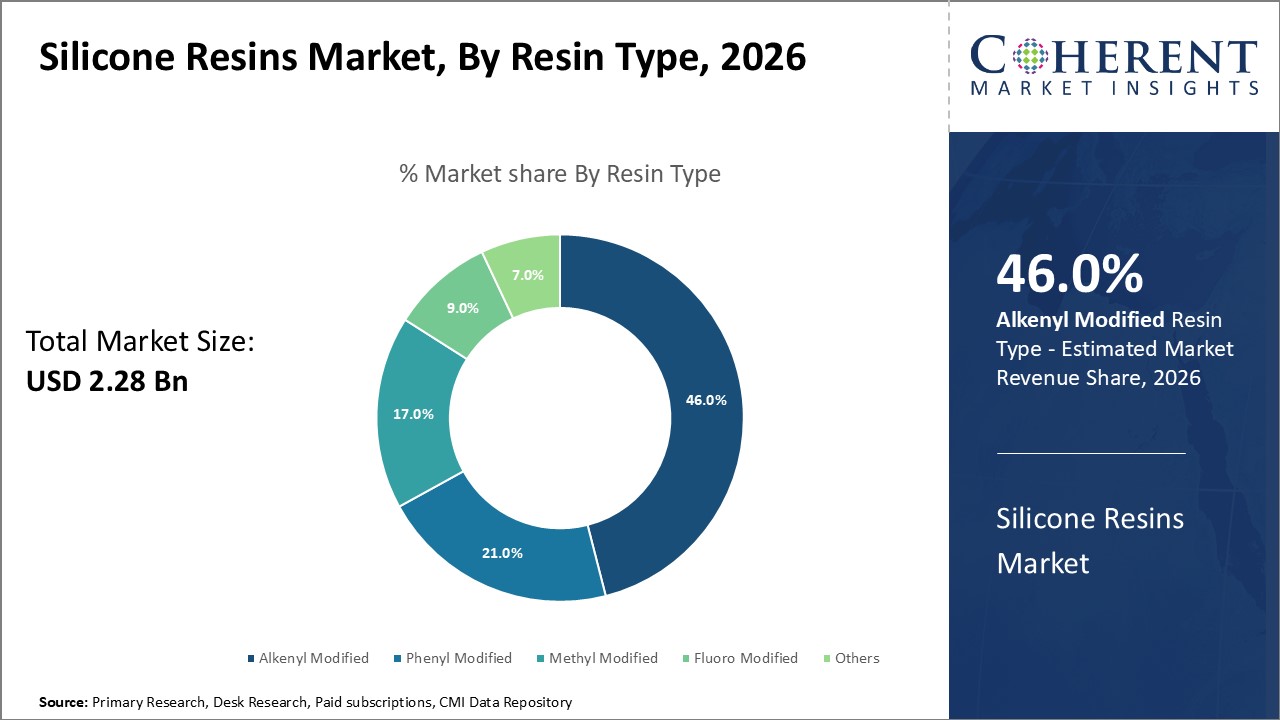
Silicone Resins Market Insights, By Resin Type
Alkenyl-modified silicone resins lead the segment due to their superior cross-linking capabilities and thermal stability, essential for high-durability coatings and electronic insulation applications. This subsegment’s ability to form robust networks under curing conditions enhances resistance to environmental stresses and chemical degradation, making it the preferred choice in automotive and industrial applications. The fastest-growing Propyl Modified and Phenyl Modified resins are increasingly adopted in specialty sectors like aerospace and personal care, attributed to their enhanced heat resistance and UV stability.
Silicone Resins Market Insights, By Application
Coatings are the dominating segment. Coatings command a significant portion of the market revenue due to escalating demand in automotive paint and industrial protection layers. Their high weather resistance and gloss retention make them essential for exterior automotive finishes and heavy-duty industrial applications. The fastest-growing Automotive & Transportation segment benefits from increased electrification and lightweight materials, prompting demand for heat-resistant coatings and dielectric substrates. Electronics continue to grow steadily, driven by miniaturization trends.
Silicone Resins Market Insights, By Form Segment
Liquid form captures the largest market share. Liquid silicone resins dominate due to ease of application in coatings and electronics, offering superior film formation and curing characteristics. Their flexibility across different industries supports extensive revenue opportunities. Powder form is the fastest-growing subsegment, gaining acceptance for advanced industrial and automotive coatings where precise control over particle size influences performance properties. It supports solvent-free and environmentally friendly formulations, aligning with emerging sustainability trends.
Silicone Resins Market Trends
Over recent years, the market has been shaped prominently by sustainability imperatives, technological innovation, and evolving end-use demands.
Environment-focused policies, especially in Europe, have enforced a shift to low-VOC and solvent-free resin variants, reducing ecological footprint while maintaining performance standards.
Coupled with this, nanotechnology integration has generated silicone resins with improved resistance to environmental stressors, enhancing applicability in demanding industrial applications.
Lastly, the electrification trend, notably within the transportation sector, continues to drive demand for thermally stable and electrically insulating resins, with electric vehicle sales growth propelling innovation and market revenue.
Silicone Resins Market Insights, By Geography
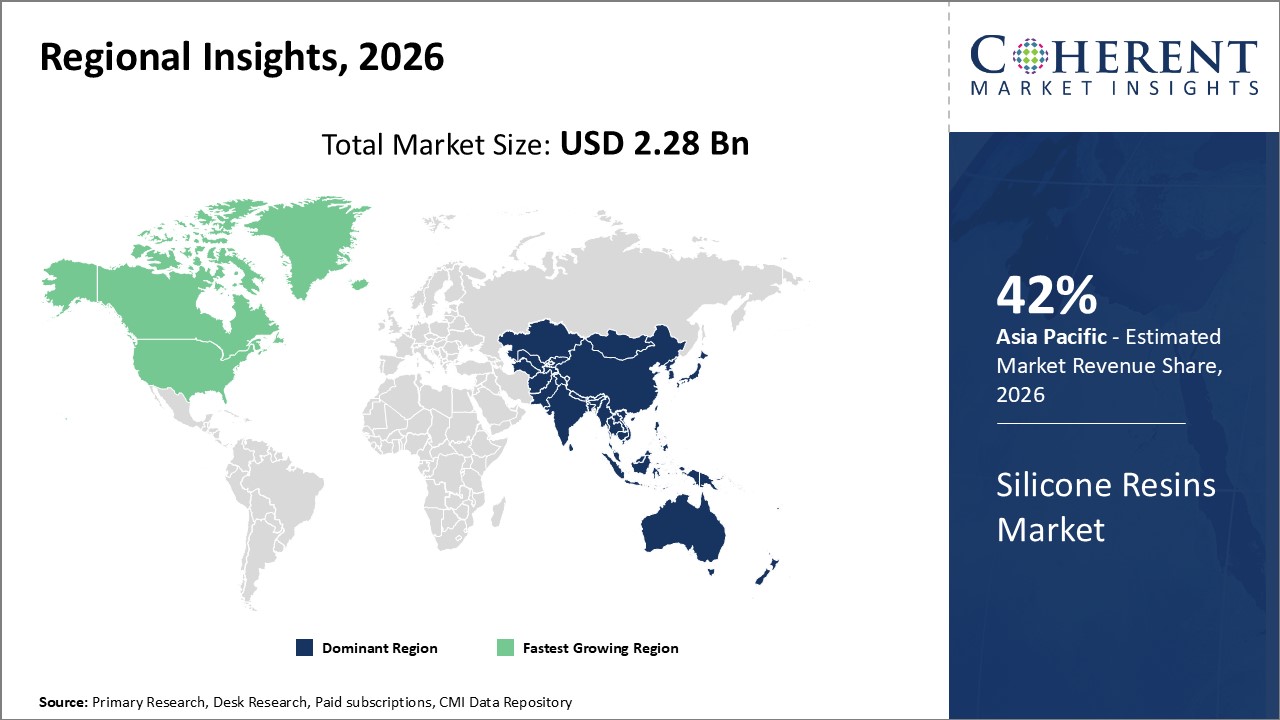
Asia Pacific Silicone Resins Market Analysis and Trends
In the Asia Pacific, the dominance in the Silicone Resins market is strongly backed by rapid industrialization, expanding automotive and electronics sectors, and significant infrastructure developments. Countries like China and India have witnessed an upward trajectory in the use of silicone resins, with China alone contributing to over 38% of the regional industry share. This prominence is bolstered by government initiatives promoting manufacturing growth, enabling robust market dynamics and supply chain integrations.
North America Silicone Resins Market Analysis and Trends
Meanwhile, North America exhibits the fastest growth with a CAGR of 9.1%, driven mainly by the U.S. market’s focus on aerospace innovations, green building mandates, and the increasing use of silicone resins in high-end electronics. Stringent environmental regulations and the adoption of next-generation electric vehicles underpin accelerating demand. The presence of major players and technological advancement hubs further supports this growth trajectory.
Silicone Resins Market Outlook for Key Countries
USA Silicone Resins Market Analysis and Trends
The USA’s market is propelled by intensive R&D investment and growing end-use applications in aerospace, automotive, and electronics. In 2025, US electric vehicle production accounted for over 20% of global volumes, necessitating complex thermal and electrical insulation materials where silicone resins play a vital role. Additionally, sustainability regulations compel builders to adopt silicone-based coatings and sealants, driving business growth. Key players such as Dow Inc. and Momentive Performance Materials maintain a strong market presence backed by established supply chains and innovation leadership.
China Silicone Resins Market Analysis and Trends
China’s market continues to expand rapidly due to massive infrastructure development, booming electronics manufacturing, and rising automotive output. Regulatory frameworks focused on emission reductions have accelerated the uptake of environmentally friendly silicone resins. Local companies such as Zhejiang Jiuzhou Chemical are gaining prominence by scaling production and investing in specialty silicone resin formulations. This country’s market is characterized by significant capacity additions and a strong export-oriented strategy, contributing substantially to regional market share and revenue.
Analyst Opinion
Rising demand in the electronics and automotive industries significantly fuels the silicone resins market share. For instance, the electric vehicle market grew by approximately 41% globally in 2025, amplifying demand for heat-resistant silicone coatings used in battery insulation and circuit protection. This trend validates the increased procurement of specialty silicone resins tailored for such applications.
The production capacity of silicone resins has witnessed a 12% expansion globally in 2025, primarily in the Asia Pacific, driven by increasing industrial output and capacity augmentation projects. This augmentation directly correlates with the rising market revenue and is indicative of robust upstream supply chain confidence.
Price dynamics in 2026 reflect a marginal increase in silicone resin prices by 5%, mainly influenced by higher raw material costs such as siloxanes. This slight uptick has not dampened demand, as end-users prioritize product performance over cost in high-value industries, ensuring steady market growth.
Diverse end-use applications, including construction and personal care, contribute to expanding market segments. For example, the secondary construction coatings segment witnessed a 9% rise in consumption in Europe in 2025, attributed to stricter building codes emphasizing weather resistance and longevity.
- Current Industry Events of 2026
- Market Size Estimation
- Regional Breakdown
- Competitive Landscape
- Customer Intelligence
- Segmental Analysis
- Pricing Analysis
- Key Market Drivers, Challenges & Future Trends
- Customized Insights Section
Market Scope
| Report Coverage | Details | ||
|---|---|---|---|
| Base Year: | 2025 | Market Size in 2026: | USD 2.28 billion |
| Historical Data for: | 2020 To 2024 | Forecast Period: | 2026 To 2033 |
| Forecast Period 2026 to 2033 CAGR: | 8.5% | 2033 Value Projection: | USD 3.8 billion |
| Geographies covered: |
| ||
| Segments covered: |
| ||
| Companies covered: | Evonik Industries AG, Dow Inc., Wacker Chemie AG, Shin-Etsu Chemical Co., Ltd., Bluestar Silicones, Momentive Performance Materials Inc., KCC Corporation, Zhejiang Jiuzhou Chemical Co., Ltd., Jiangsu Xiongfeng Silicon Industry Technology Co., Ltd., Gelest Inc., Sinopec Corp. | ||
| Growth Drivers: |
| ||
Silicone Resins Market Growth Factors
The growing adoption of electric vehicles and expansion of the electronics sector are the foremost market growth strategies conferring momentum in the silicone resins market. High-temperature resistance and electrical insulation properties drive their use in battery packs and electronic components, with global electric vehicle sales surpassing 8 million units in 2025. Additionally, the rising demand for durable and eco-friendly construction coatings adhering to stringent environmental regulations accentuates adoption. The Asia Pacific region’s rapid industrialization and construction boom also stimulates market revenue growth. Furthermore, technological advancements in fluorosilicone and phenyl-modified resins support high-performance requirements in aerospace and personal care sectors, catalyzing market dynamics. Finally, growing awareness about sustainable manufacturing processes fuels research and development in bio-based silicone resins, presenting new growth avenues.
Silicone Resins Market Development
In 2025, Evonik introduced a new low-VOC resin engineered to help coatings manufacturers meet tightening environmental and indoor-air-quality regulations. The resin delivers high performance while significantly reducing solvent emissions, supporting formulators seeking cleaner, more sustainable solutions for architectural and industrial applications.
In 2025, Siltech launched a specialized marine-grade resin designed to withstand prolonged saltwater exposure, UV stress, and harsh environmental conditions. The product enhances durability for boat coatings, offshore structures, and marine equipment, reflecting rising demand for high-performance materials in maritime infrastructure.
Key Players
Leading Companies of the Market
Dow Inc.
Wacker Chemie AG
Shin-Etsu Chemical Co., Ltd.
Bluestar Silicones
Momentive Performance Materials Inc.
KCC Corporation
Zhejiang Jiuzhou Chemical Co., Ltd.
Jiangsu Xiongfeng Silicon Industry Technology Co., Ltd.
Gelest Inc.
Sinopec Corp.
Several leading companies have strategically expanded their product portfolios by investing in eco-friendly and low-VOC silicone resin technologies. For example, Evonik's recent launch of high-solid silicone resins for industrial coatings boosts application efficiency and environmental compliance, elevating its industry share. Meanwhile, Dow Inc. has leveraged partnerships with automotive manufacturers to supply custom-formulated silicone resins aimed at lightweight and thermal management applications, resulting in a 11% sales increase in 2025.
Silicone Resins Market Future Outlook
The silicone resins market is poised for consistent growth as industries transition toward long-lasting, low-maintenance materials. Future development will center on hybrid silicone-organic formulations that combine flexibility with superior thermal and UV performance. Rising adoption of electric vehicles, renewable energy systems, and smart coatings will create new product opportunities. Manufacturers are expected to focus on eco-friendly production technologies, enhanced adhesion properties, and increased crosslink density to meet evolving industry requirements. The global move toward sustainability and extended product lifespan will position silicone resins as key materials in advanced protective and electronic applications.
Silicone Resins Market Historical Analysis
The silicone resins market developed in the mid-20th century, driven by the need for high-performance materials that could withstand extreme temperatures and environmental exposure. Initially used in electrical insulation and coatings, silicone resins gained industrial relevance for their superior thermal stability, oxidation resistance, and hydrophobicity compared to organic polymers. Over the decades, demand grew in automotive coatings, electronics, and construction sectors, supported by continuous chemical innovation in siloxane backbone modification. The introduction of solvent-free, waterborne, and powder resin technologies further expanded application diversity, aligning with environmental compliance and performance enhancement needs.
Sources
Primary Research Interviews:
Polymer Chemists
Coating Engineers
Materials Scientists
Industrial Manufacturers
Databases:
U.S. Patent and Trademark Office (USPTO)
European Chemicals Agency (ECHA)
ChemSpider
Magazines:
Coatings World
Chemical & Engineering News
Paint & Coatings Industry Magazine
Materials Today
Journals:
- Journal of Applied Polymer Science
- Progress in Organic Coatings
ACS Applied Materials & Interfaces
Polymer International
Newspapers:
The Economic Times (Industry)
Nikkei Asia (Materials)
The Guardian (Sustainability)
Financial Express (Chemicals)
Associations:
American Chemical Society (ACS)
European Coatings Association
Society of Chemical Industry (SCI)
ASTM International
Get access to 250+ pages report
Every segment, forecast, competitor profile and data table behind the analysis above — available for instant download.
- ESOMAR Member
- ISO 9001:2015 Certified
- D-U-N-S Registered
- GDPR & CCPA Compliant
Missing comfort of reading report in your local language? Find your preferred language:
Transform your Strategy with Exclusive Trending Reports
Frequently Asked Questions
The market is led by companies such as Evonik Industries AG, Dow Inc., and Wacker Chemie AG, which dominate through advanced product portfolios and strategic partnerships with end-user industries.
The market size is projected to reach USD 3.8 billion by 2033, growing at a CAGR of 8.5% from 2026, driven by expansion in electric vehicles, electronics, and construction sectors.
The coatings application segment, particularly in automotive and industrial coatings, presents the largest growth opportunity due to stringent regulatory norms and demand for high-durability materials.
Market trends will evolve towards sustainable silicone resin formulations, increased nanotechnology integration, and hybrid resins, supporting multifunctional applications, especially in electronics and automotive industries.
The competitive landscape is characterized by innovation-driven companies focusing on product performance enhancements, with challenges including raw material cost volatility and stringent environmental regulations.
Key strategies include product differentiation through advanced formulations, collaboration with automotive/electronics manufacturers, and geographic expansion with localized production facilities to optimize supply chains.