

Software Composition Analysis Market Size and Share Analysis - 2026 To 2033
The global software composition analysis market size is projected to grow from USD 674.4 Mn in 2026 to USD 1,868.8 Mn by 2033, registering a compound annual growth rate (CAGR) of 15.7% during the forecast period (2026-2033). This growth is mostly due to the increasing adoption of open-source software across enterprises, rising concerns regarding software supply chain security, growing regulatory compliance requirements, and increasing demand for vulnerability detection and license risk management solutions across organizations.
Key Takeaways from the Software Composition Analysis Market Report
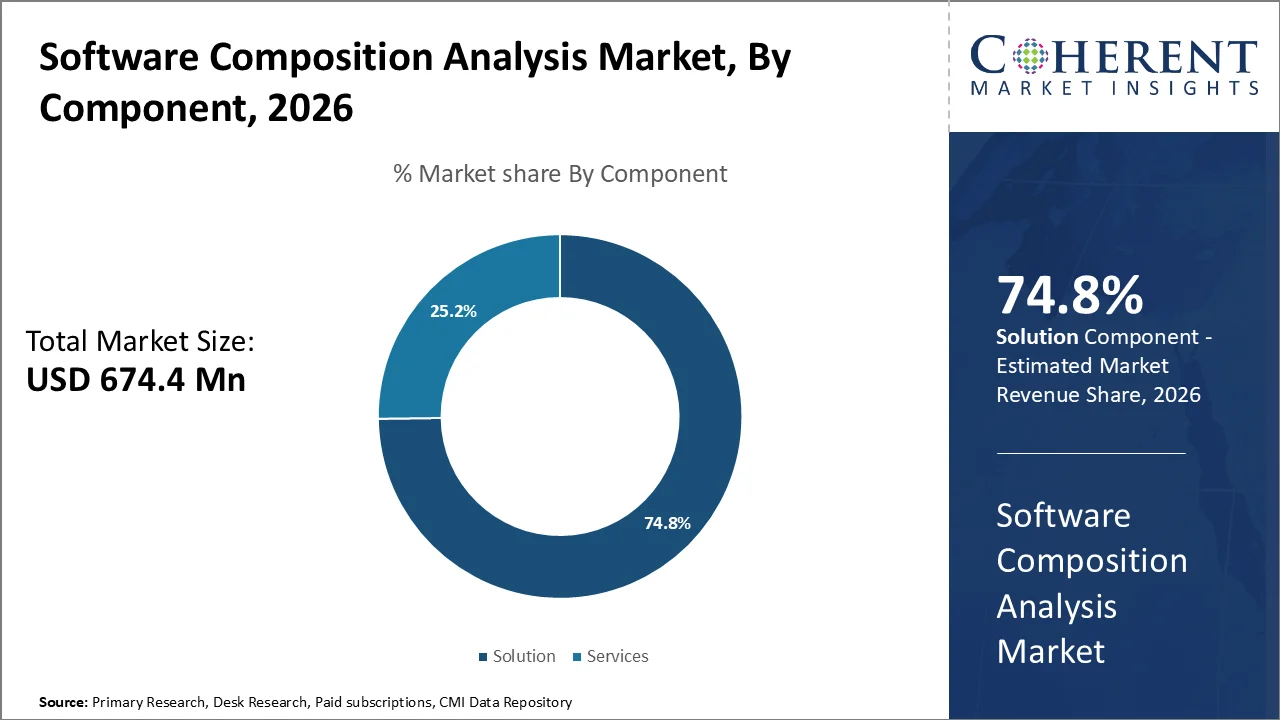
- The solution segment is expected to lead the market with a share of 74.8% in 2026 owing to the growing demand for automated open-source dependency scanning, vulnerability identification, and software license compliance management across enterprises. According to Sonatype’s 2026 State of the Software Supply Chain Report, more than 1.23 million malicious open-source packages were identified across major ecosystems, highlighting the increasing need for advanced software composition analysis solutions.
- The cloud-based segment is expected to dominate the market, accounting for 68.9% of the overall market share in 2026, due to the increasing popularity of cloud-native application development, DevSecOps adoption, and usage of cloud software security tools in the form of software available as a service (SaaS) monitoring, better scalability, and smooth integration with CI/CD systems.
- Large organizations are expected to hold a significant share of 64.5% due to the extensive use of third-party software and open-source components, as well as stricter compliance laws. According to the statistics of the market, nearly 86% of all the software that is commercially available poses open-source risks.
- Banking, financial services, and insurance (BFSI) segment is estimated to have the maximum market share of 24.8% during 2026, owing to increasing cyber security threats, increasing digitization within the banking industry, and stringent data security policies and laws. Financial institutions increasingly use software composition analysis tools to identify vulnerabilities in third-party and open-source code.
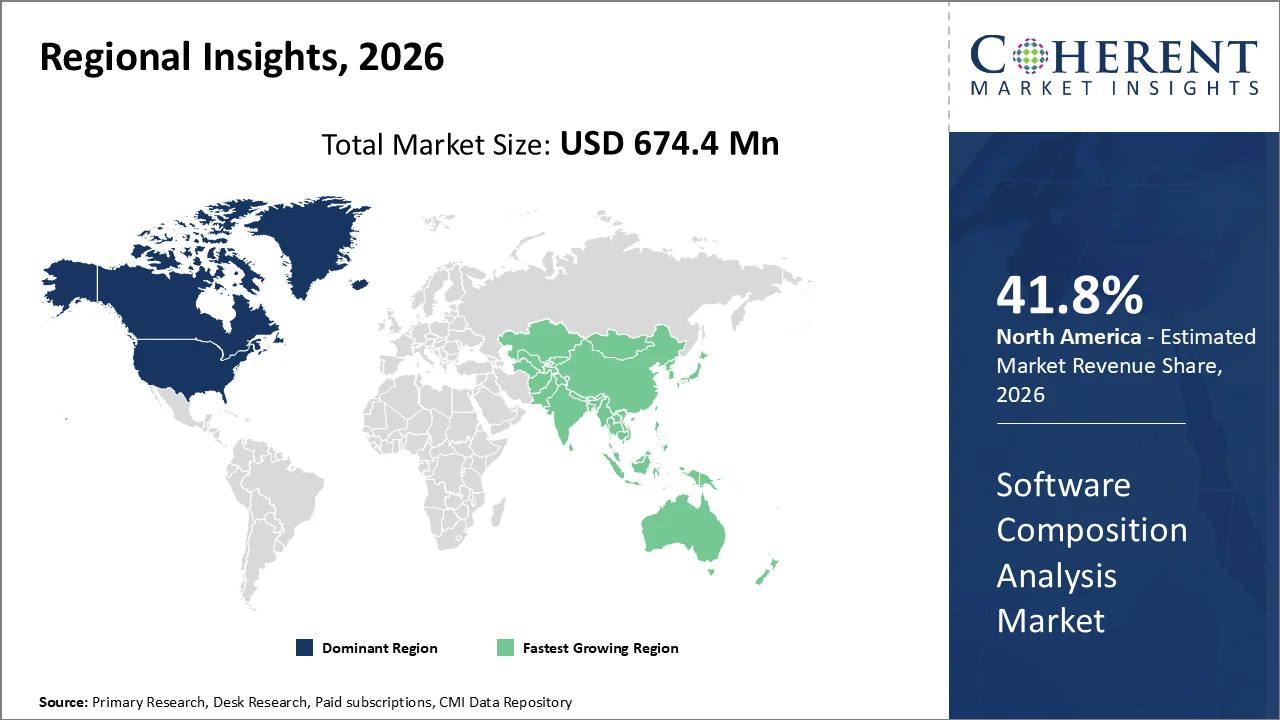
- North America is anticipated to dominate the software composition analysis market, accounting for a 41.8% market share in 2026 owing to the presence of many cybersecurity firms, rapidly growing adoption of DevSecOps, increasing software supply chain attacks, and stringent regulations pertaining to software security and SBOMs. As per the U.S.'s Cybersecurity and Infrastructure Security Agency, the concept of SBOMs is now regarded as a key element in dealing with software supply chain risks due to the rapid adoption of SBOMs in federal agencies and enterprises.
Segmental Insights
Why is the Solution Segment Acquiring the Largest Market Share?
The solution segment is expected to hold the maximum market share in the software composition analysis market in 2026, with around 74.8% of total revenue contributed by it. The increasing preference of organizations for automation for open-source dependency scanning, vulnerabilities analysis, software bill of material (SBOM) production, and license compliance will be the major reasons behind this growth. Companies have been using software composition analysis technology to detect vulnerable open source code in the software supply chain prior to its deployment.
In March 2025, Sonar announced SonarQube Advanced Security, which introduced integrated Software Composition Analysis (SCA) capabilities along with advanced Static Application Security Testing (SAST) features.
- Current Industry Events of 2026
- Market Size Estimation
- Regional Breakdown
- Competitive Landscape
- Customer Intelligence
- Segmental Analysis
- Pricing Analysis
- Key Market Drivers, Challenges & Future Trends
- Customized Insights Section
Why is the Cloud-Based Segment Dominating the Market?
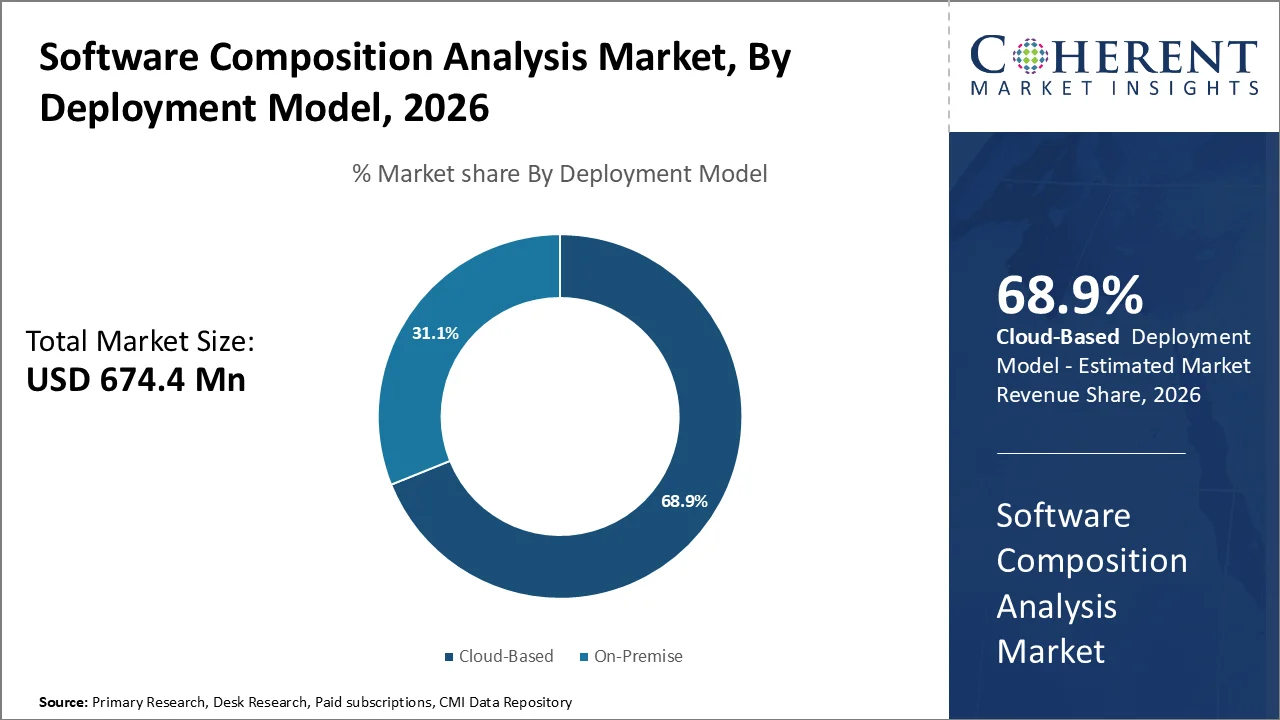
Cloud-based deployment is expected to hold the maximum market share of 68.9% in 2026 owing to growing adoption of cloud-native development, DevSecOps, and SaaS-based software composition analysis tools for application security. Software composition analysis tools based on the cloud offer advantages of real-time vulnerability assessment, centralized dependency management, automated patching, and smooth CI/CD pipeline integration and are thus widely adopted in agile software development.
Red Hat reported that over 70% of enterprises are actively adopting containerized and Kubernetes-based environments, creating strong demand for cloud-native software composition analysis solutions capable of monitoring open-source dependencies across distributed application ecosystems.
Why are Large Organizations Acquiring the Largest Market Share?
Large organizations will account for a dominant market share of 64.5% in 2026 due to their greater reliance on third-party software components and open source code, increased budgets in cybersecurity spending, and higher regulatory compliance requirements. Larger companies usually have a more intricate software ecosystem that entails thousands of dependencies, APIs, and cloud-based applications.
According to IBM’s 2025 Cost of a Data Breach Report, the global average cost of a data breach reached approximately USD 4.88 million, with software and supply chain vulnerabilities emerging as major contributors to enterprise cybersecurity incidents.
Why is BFSI the Leading Vertical in the Software Composition Analysis Market?
The banking, financial services, and insurance (BFSI) segment is forecasted to lead the market share with 24.8% in 2026 owing to growing cybersecurity attacks, increased usage of digital banking services, and tight regulatory policies for ensuring security and data privacy. Banks and financial firms depend immensely on software-based solutions such as digital banking apps, APIs, mobile banking software, and cloud-based software frameworks.
In May 2026, FIS announced a strategic collaboration with Anthropic to launch an AI-powered Financial Crimes AI Agent for the banking and financial services sector.
Market Drivers
Rapid Adoption of DevSecOps and Cloud-Native Development is Driving Market Expansion
The increasing trend towards DevSecOps approaches and cloud native software development is driving huge demand for software composition analysis tools throughout global corporations. Companies are now incorporating security testing right within their software development processes in order to detect flaws early in the process and save on costs.
As per the GitLab State of DevOps Report 2025, 58% of organizations worldwide have already adopted security testing into their CI/CD pipelines, whereas over 67% of developers have used automated security and compliance tools in their DevSecOps environment.
Current Events and Their Impact on the Software Composition Analysis Market
Current Event | Description and its Impact |
U.S. Government Expansion of Software Supply Chain Security Requirements (2025–2026) |
|
Surge in Open-Source Malware and Dependency Attacks |
|
Software Composition Analysis Market Trends
- The rising trend towards DevSecOps and shift left methodologies will result in higher demand for automated software composition analysis systems.
- The rise in software supply chain attacks and malicious open source software will cause more organizations to invest in dependent vulnerability scanners. According to Synopsys, 96% of commercial codebases incorporate open source software.
- The growing use of Kubernetes, containers, and cloud-native apps is driving the growth of cloud-based platforms for software composition analysis.
- The increasing attention by regulators to SBOM and secure software development is aiding the growth of the market in the regulated industry
Regional Insights
North America dominates the Software Composition Analysis Market owing to Rising Software Supply Chain Security Requirements
North America is projected to have a market share of 41.8% by 2026 owing to the significant presence of players dealing in cybersecurity solutions, early adoption of DevSecOps processes, and growing importance of software supply chain security in both enterprises and government bodies. Growing incidences of cyber-attacks on third-party and open source software have propelled the adoption of software composition analysis tools.
In March 2025, SonarSource announced SonarQube Advanced Security, integrating Software Composition Analysis (SCA) capabilities with advanced static application security testing (SAST) to improve open-source dependency monitoring and vulnerability management within enterprise development environments.
Asia Pacific Software Composition Analysis Market Trends
Asia Pacific is expected to emerge as the fastest-growing market from 2026 to 2033, growing at a considerable CAGR on account of accelerating digital transformation initiatives, growth in cloud-native software development, developing fintech eco-systems, and higher investment in cybersecurity measures in countries such as China, India, Japan, and Southeast Asia. There is increased use of DevSecOps, Kubernetes, and containerization techniques, thus, driving demand for SCA platforms.
In September 2025, SAP officially launched SAP Sovereign Cloud in India to support secure and compliant cloud modernization across regulated industries including BFSI, government, and healthcare sectors.
U.S. Software Composition Analysis Market Trends
The software composition analysis market in the U.S. is expected to experience steady growth during the forecast period. This growth is largely influenced by the increase in supply chain attacks on software, the adoption of DevSecOps methodology, an increase in cloud-native application development, and federal government cybersecurity guidelines for safe software development and SBOM compliance.
The U.S. Cybersecurity and Infrastructure Security Agency (CISA) continues promoting SBOM adoption and secure-by-design software development practices to improve software transparency and reduce third-party dependency risks.
China Software Composition Analysis Market Forecast
The China software composition analysis market is predicted to continue as one of the major markets for software composition analysis throughout the forecast period. The factors contributing to its growth include digitization, increasing use of cloud computing, high investment in cybersecurity, open-source software adoption, and government initiative towards modernizing software security. In March 2026, China launched its first dedicated cybersecurity university to strengthen advanced talent development in response to rising cyber threats and rapid AI-driven technological advancements.
Who are the Major Companies in Software Composition Analysis Industry
Some of the major key players in Software Composition Analysis are WhiteSource Software, Sonatype, Inc., Synopsys, Inc., WhiteHat Security, Veracode (CA Technologies), Flexera, NexB, Inc., SourceClear, and Rogue Wave Software.
Industry News
- In October 2025, Mend launched its AI-native application security platform designed to unify Software Composition Analysis (SCA), Static Application Security Testing (SAST), and container security capabilities.
- In September 2025, Synopsys announced expanded generative AI capabilities across its engineering and software development solutions portfolio.
Market Report Scope
Software Composition Analysis Market Report Coverage
| Report Coverage | Details | ||
|---|---|---|---|
| Base Year: | 2025 | Market Size in 2026: | USD 674.4 Mn |
| Historical Data for: | 2020 To 2024 | Forecast Period: | 2026 To 2033 |
| Forecast Period 2026 to 2033 CAGR: | 15.7% | 2033 Value Projection: | USD 1,868.8 Mn |
| Geographies covered: |
| ||
| Segments covered: |
| ||
| Companies covered: | WhiteSource Software, Sonatype, Inc., Synopsys, Inc., WhiteHat Security, Veracode (CA Technologies), Flexera, NexB, Inc., SourceClear, and Rogue Wave Software | ||
| Growth Drivers: |
| ||
| Restraints & Challenges: |
| ||
Analyst Opinion
- Market growth for software composition analysis software is experiencing robust growth due to the sharp increase in software supply chain attacks and reliance on open source software by enterprises.
- Growth in DevSecOps practices and cloud native application development is spurring demand for automated software composition analysis tools that fit well into CI/CD pipelines and Kubernetes.
- The BFSI, healthcare, government, and critical infrastructures industries are anticipated to continue being significant users of the software composition analysis platform owing to increasing regulations related to cybersecurity, third-party software threats, and digital transformations.
- AI-driven remediation, vulnerability prioritization, and real-time dependency tracking have been identified as some of the competitive factors for software composition analysis providers, as businesses require improved software security management systems.
- North America is anticipated to continue leading the market based on robust cybersecurity budgets, increased software security regulation by the government, and early implementation of DevSecOps methodologies, whereas Asia Pacific will be experiencing the highest rate of growth on account of fast digitalization and cloud-native software development initiatives.
Speak to the analyst
Want personalized insights?
Take the findings above to one of our principal consultants, or have the report rebuilt around the segments, geographies and competitors you actually track.
Market Segmentation
- By Component (Revenue, USD Mn, 2021-2033)
- Solution
- Policy management
- Risk Management, Alerting, and Reporting
- Vulnerability Detection
- License Management
- Others
- Services
- Professional Services
- Consulting Services
- Support & Maintenance
- Others
- Managed Services
- Professional Services
- Solution
- By Deployment Model (Revenue, USD Mn, 2021-2033)
- Cloud-Based
- On-Premise
- By Organization Size (Revenue, USD Mn, 2021-2033)
- Small and Mid-sized Organization (SMEs)
- Large Organization
- By Vertical (Revenue, USD Mn, 2021-2033)
- Banking, Financial Services, and Insurance
- Government & Defense
- IT and Telecom
- Healthcare
- Retail & E-Commerce
- Manufacturing
- Others
- By Region (Revenue, USD Mn, 2021-2033)
- North America
- U.S.
- Canada
- Latin America
- Brazil
- Mexico
- Argentina
- Rest of Latin America
- Europe
- Germany
- U.K.
- France
- Italy
- Spain
- Russia
- Rest of Europe
- Asia Pacific
- China
- India
- Japan
- Australia
- South Korea
- ASEAN
- Rest of Asia Pacific
- Middle East
- GCC
- Israel
- Rest of Middle East
- Africa
- South Africa
- Central Africa
- North Africa
- North America
Sources
Primary Research interviews
- Interviews with cybersecurity professionals, DevSecOps engineers, software architects, application security specialists, cloud infrastructure managers, and software supply chain security experts
- Discussions with software composition analysis vendors, open-source governance specialists, enterprise IT administrators, and compliance officers
- Interviews with BFSI, healthcare, government, telecom, and cloud-native platform stakeholders
Databases
- Cybersecurity vulnerability databases
- Open-source software package repositories
- Software vulnerability tracking databases
- Cloud-native and DevOps adoption databases
- Government cybersecurity and compliance databases
Magazines
- Cybersecurity industry magazines
- Application security and DevSecOps publications
- Cloud computing and enterprise software magazines
- Open-source technology magazines
- Software engineering and digital transformation publications
Journals
- Peer-reviewed cybersecurity journals
- Software engineering and application security research journals
- Cloud computing and DevSecOps academic journals
- Open-source software governance and software supply chain security journals
Newspapers
- Leading national and international newspapers covering cybersecurity incidents, software supply chain attacks, enterprise software trends, AI security developments, and digital transformation initiatives
Associations
- Cybersecurity and Infrastructure Security Agency (CISA)
- National Institute of Standards and Technology (NIST)
- Cloud Native Computing Foundation (CNCF)
- Open Source Security Foundation (OpenSSF)
- Linux Foundation
Public Domain sources
- Government cybersecurity reports and software security frameworks
- Publicly available company annual reports and investor presentations
- Open-source security reports and SBOM guidance documents
- Regulatory and compliance publications related to software supply chain security
- Patent databases and publicly available enterprise cybersecurity filings
Proprietary Elements
- CMI Data Analytics Tool
- Proprietary CMI Existing Repository of information for last 10 years
Get access to 250+ pages report
Every segment, forecast, competitor profile and data table behind the analysis above — available for instant download.
- ESOMAR Member
- ISO 9001:2015 Certified
- D-U-N-S Registered
- GDPR & CCPA Compliant
Missing comfort of reading report in your local language? Find your preferred language:
Transform your Strategy with Exclusive Trending Reports
Frequently Asked Questions
The Software Composition Analysis Market is expected to reach USD 1,868.8 Mn by 2033.
Major players operating in the global software composition analysis market include WhiteSource Software, Sonatype, Inc., Synopsys, Inc., WhiteHat Security, Veracode (CA Technologies), Flexera, NexB, Inc., SourceClear, and Rogue Wave Software.
Large volume of false positives, alert fatigue, shortage of skilled cybersecurity professionals, and limited cybersecurity budgets among SMEs are some major factors restraining market growth.
Rising software supply chain attacks, increasing adoption of open-source software, growing DevSecOps implementation, and increasing regulatory focus on Software Bill of Materials (SBOM) and secure software development are driving market growth.
The Software Composition Analysis Market is anticipated to grow at a CAGR of 15.7% between 2026 and 2033.
Among regions, North America is expected to account for the largest market share in the global software composition analysis market over the forecast period.
Enterprises are increasingly adopting software composition analysis solutions to detect open-source vulnerabilities, improve software supply chain security, ensure license compliance, and strengthen DevSecOps workflows within cloud-native development environments.