

Spunbond Nonwoven Market Size and Forecast — 2026 - 2033
The Global Spunbond Nonwoven Market size is estimated to be valued at USD 12.4 billion in 2026 and is expected to reach USD 21.1 billion by 2033, exhibiting a compound annual growth rate (CAGR) of 8.4% from 2026 to 2033.
Overview
The spunbond nonwoven market is driven by rising demand from hygiene and medical sectors, particularly in products such as diapers, sanitary napkins, and surgical gowns. Growing awareness of hygiene and infection control has significantly boosted consumption. Expanding applications in agriculture, including crop covers and mulch mats, also support market growth. The packaging industry increasingly uses spunbond nonwovens due to their durability and cost-effectiveness. Additionally, rapid urbanization, population growth, and rising disposable incomes contribute to higher demand for disposable products. Technological advancements in nonwoven production and increasing focus on sustainable, lightweight, and recyclable materials further accelerate market expansion globally.
Key Takeaways
The polypropylene spunbond segment leads the market with over two-thirds of the share, driven by cost-effectiveness and versatility across applications.
Polyester spunbond is the fastest-growing segment due to its superior mechanical properties, making it suitable for technical uses.
North America holds the largest regional share at 28%, fueled by high-end applications in medical and filtration sectors.
Asia Pacific is the fastest-growing region with a CAGR exceeding 10%, driven by manufacturing expansion and urbanization.
Construction and agriculture segments provide emerging opportunities through the use of spunbond materials in geotextiles and crop protection.
Spunbond Nonwoven Market Segmentation Analysis
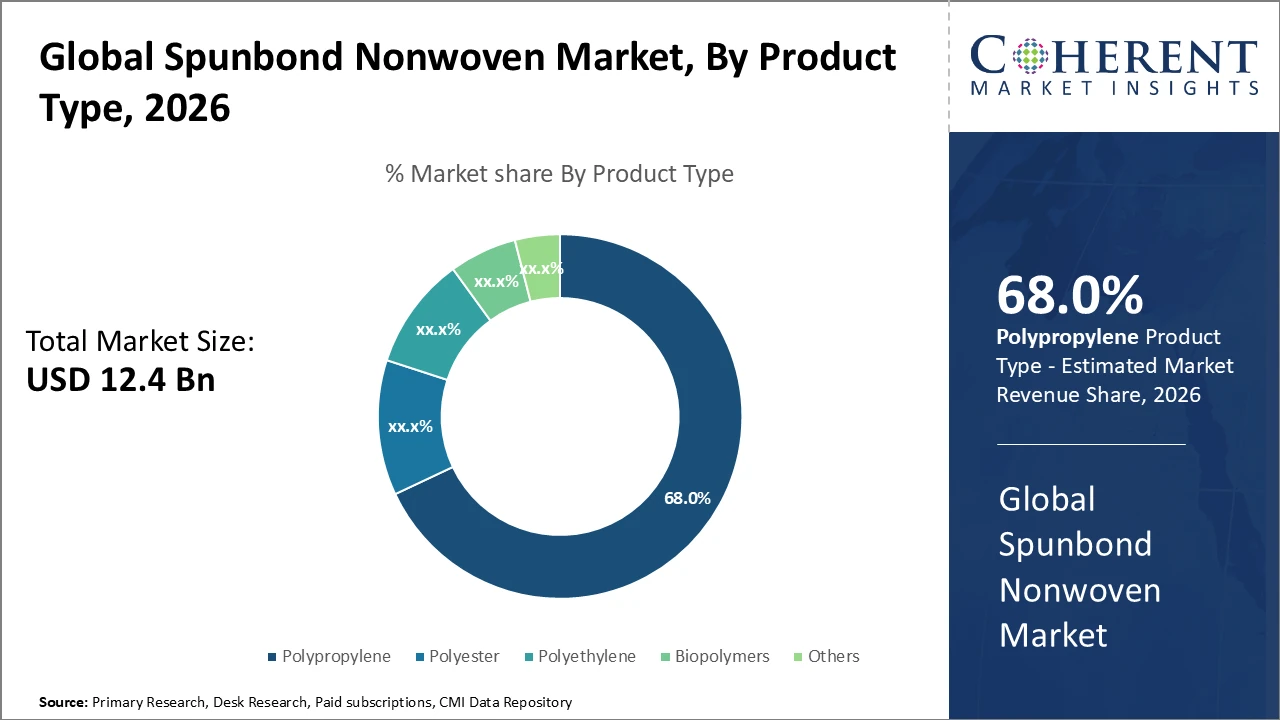
Spunbond Nonwoven Market Insights, By Product Type
Polypropylene dominates the spunbond nonwoven market with a 68% share, driven by cost-effectiveness, chemical resistance, and extensive use in hygiene and medical applications. PP spunbond is widely adopted for disposable hygiene products due to its high strength-to-weight ratio and moisture barrier properties. The fastest-growing subsegment is biopolymers, reflecting increasing demand for sustainable, biodegradable alternatives, with innovations in bio-based resin blends supporting new product launches for eco-conscious industries. Polyester spunbond provides superior durability and thermal stability for technical textiles, while polyethylene serves niche roles in protective apparel and packaging. The ‘Others’ category includes specialty polymer blends for unique industrial applications.
Spunbond Nonwoven Market Insights, By Application
Hygiene and personal care dominate the spunbond nonwoven market, driven by extensive use in disposable diapers, feminine hygiene products, and wipes, with rising consumer focus on hygiene in emerging countries. The fastest-growing application is automotive and transportation, as spunbond materials are increasingly used for lightweight interiors, sound insulation, and filtration media. Advances in resin formulations for enhanced tensile strength and thermal stability have broadened automotive applications. Medical and healthcare use remains strong, with surgical gowns, masks, and medical packaging emphasizing sterility and disposability. Construction, agriculture, and filtration applications also expand globally, leveraging spunbond’s durability and versatility for geotextiles, crop protection, and air/liquid filtration.
Spunbond Nonwoven Market Insights, By End User Industry
The consumer goods segment leads the spunbond nonwoven market, driven primarily by disposable hygiene products that generate stable revenue from recurring demand. The healthcare sector is the fastest-growing end user, fueled by rising requirements for disposable medical textiles, supported by global health safety protocols and aging populations. Industrial applications, including filtration, construction, and protective textiles, show steady growth with innovations in material strength and sustainability. Automotive end users increasingly adopt spunbond for weight reduction, fuel efficiency, and sound insulation. Agricultural applications, such as crop covers and soil stabilization, represent an emerging niche, expanding the market’s scope and versatility.
Spunbond Nonwoven Market Trends
The spunbond nonwoven market is increasingly embracing eco-conscious manufacturing, with over 30% of revenue in 2026 coming from biodegradable polymer-based products, driven by European regulations and rising global consumer demand.
Leading companies, including Ahlstrom-Munksjö, have shifted toward sustainable alternatives, reporting a 20% increase in bio-based spunbond product sales in 2025.
Adoption of digital twins and IoT in manufacturing is improving production accuracy and reducing waste, with North American manufacturers enhancing efficiency by 18% over two years while maintaining product quality.
Diversification into technical textiles, especially for automotive and filtration, is creating higher-value market opportunities, supported by Asia Pacific’s automotive manufacturing growth.
Spunbond Nonwoven Market Insights, By Geography
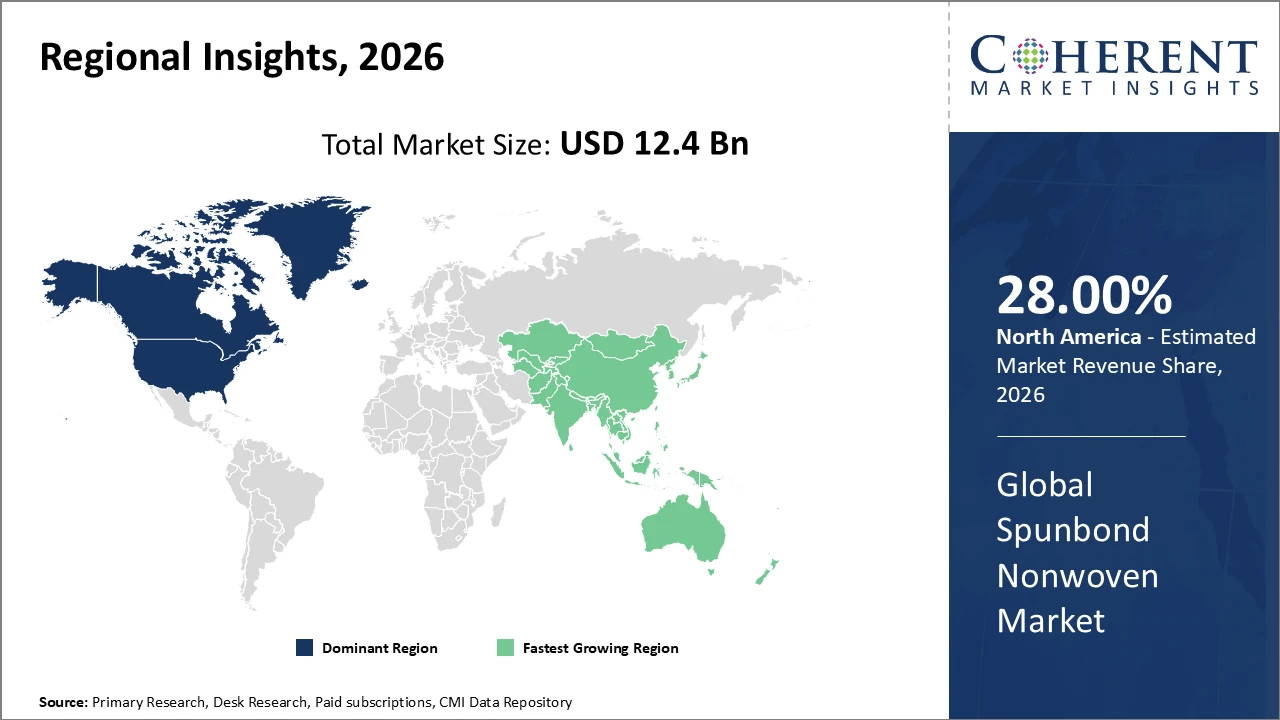
North America Spunbond Nonwoven Market Analysis and Trends
In North America, the spunbond nonwoven market is dominated by established healthcare and hygiene industries, robust regulatory standards, and advanced manufacturing infrastructure. The U.S. accounts for a significant portion of market share, supported by strong domestic production and consistent import demand. Key players such as Berry Global Inc. have expanded production capacities, strengthening their presence in medical, hygiene, and filtration applications. High adoption of disposable hygiene products, medical textiles, and filtration materials further reinforces market leadership. The region benefits from technological advancements, efficient supply chains, and favorable policies, maintaining its position as a critical and mature market in the global spunbond nonwoven industry.
Asia Pacific Spunbond Nonwoven Market Analysis and Trends
Asia Pacific is the fastest-growing region in the spunbond nonwoven market, propelled by rapid urbanization, rising disposable incomes, and expanding end-user industries such as automotive, hygiene, and healthcare. Countries like China and India are experiencing double-digit capacity expansions, supported by substantial investments in manufacturing facilities and favorable government incentives promoting industrial development. The region’s CAGR exceeds 10%, driven by increased demand from construction projects, infrastructure development, and growing healthcare facilities requiring spunbond materials. Strong adoption in consumer goods, medical textiles, and technical applications further reinforces Asia Pacific’s position as a critical growth hub for the global spunbond nonwoven market.
Spunbond Nonwoven Market Outlook for Key Countries
USA Spunbond Nonwoven Market Analysis and Trends
The USA’s spunbond nonwoven market thrives on robust domestic production and import activity, particularly for medical and filtration applications. The COVID-19 pandemic spurred significant demand for personal protective equipment, driving market expansion. Key players, including Berry Global Inc., have strengthened their market leadership through strategic capacity enhancements and product innovations. In 2025, U.S. production capacity grew by 7%, reflecting investments in advanced manufacturing and alignment with evolving regulations emphasizing high-performance and sustainable spunbond materials. Rising adoption in hygiene, healthcare, and industrial applications continues to support market growth, positioning the United States as a leading and influential hub in the global spunbond nonwoven industry.
Germany Spunbond Nonwoven Market Analysis and Trends
Germany’s spunbond nonwoven market is characterized by strong demand across hygiene, medical, and technical textile applications, supported by advanced manufacturing infrastructure and strict quality standards. The country benefits from robust R&D activities, fostering innovations in high-performance and sustainable spunbond materials. Hygiene and medical segments dominate, driven by disposable products and stringent healthcare regulations, while technical textiles for automotive and filtration applications are emerging growth areas. Manufacturers are increasingly adopting eco-friendly polymers and energy-efficient production processes. Germany’s market trends reflect a shift toward biodegradable and recyclable nonwovens, digitalized production lines, and integration of high-strength, multi-layered fabrics, ensuring steady growth in both domestic and export markets.
Analyst Opinion
Supply-side dynamics show expanding production capacities in Asia Pacific, particularly China and India, with a 12% increase in output in 2025 due to investment in modern machinery, enhancing efficiency and lowering costs, which supports higher market revenue.
Capacity growth contributed to a 15% reduction in pricing trends, benefiting downstream manufacturers.
Hygiene segment demand, especially for disposable diapers and sanitary products, remains a key driver, with sanitary products accounting for over 40% of global spunbond consumption in 2026; adoption in India’s personal care market grew 14% in 2024.
North American imports of high-grade spunbond materials for medical and filtration applications exceeded USD 500 million in 2025, reflecting post-pandemic protective equipment demand.
Raw material pricing for polypropylene stabilized after 2024 volatility, improving market pricing stability, forecasting accuracy, and business growth for manufacturers.
- Current Industry Events of 2026
- Market Size Estimation
- Regional Breakdown
- Competitive Landscape
- Customer Intelligence
- Segmental Analysis
- Pricing Analysis
- Key Market Drivers, Challenges & Future Trends
- Customized Insights Section
Market Scope
| Report Coverage | Details | ||
|---|---|---|---|
| Base Year: | 2025 | Market Size in 2026: | USD 12.4 billion |
| Historical Data for: | 2020 To 2024 | Forecast Period: | 2026 To 2033 |
| Forecast Period 2026 to 2033 CAGR: | 8.4% | 2033 Value Projection: | USD 21.1 billion |
| Geographies covered: |
| ||
| Segments covered: |
| ||
| Companies covered: | Berry Global Inc. LG Chem, Low & Bonar, Fiberweb, DuPont, GDM Group, JSP Corporation, Sateri, Glatfelter, Jaya Shree Textiles | ||
| Growth Drivers: |
| ||
Spunbond Nonwoven Market Growth Factors
Expanding hygiene and personal care sectors in emerging markets are driving significant growth in the spunbond nonwoven market, supported by rising disposable incomes and heightened health awareness. In 2025, the U.S. saw a 9% year-over-year increase in demand for disposable diapers. Government initiatives in Europe promoting eco-friendly and biodegradable spunbond products, driven by stricter environmental regulations, led to a 13% rise in product launches in 2024. Technological advancements in polymer extrusion and web bonding have enhanced product quality and lowered costs. Industrial applications, particularly in automotive insulation and filtration, are also growing, with Asia Pacific automotive spunbond consumption increasing by 11% in 2026.
Spunbond Nonwoven Market Development
In March 2026, Turkish nonwovens producer Mogul introduced Metaint, a new advancement in microfilament spunbond technology. Made entirely from PET spunbond, it features ultra-fine filaments of 0.8–0.9 micro denier, delivering exceptional uniformity and surface smoothness that surpass conventional materials and is rarely seen in the global market.
Key Players
Leading Companies of the Market
Berry Global Inc.
LG Chem
Low & Bonar
DuPont
GDM Group
JSP Corporation
Jaya Shree Textiles
Glatfelter
Leading companies in the spunbond nonwoven market continue to pursue strategic mergers and acquisitions to expand their product offerings and strengthen geographic reach. For example, Berry Global’s acquisition of a nonwoven manufacturer in 2024 increased its spunbond production capacity by 10%, enhancing its market share across North America. Similarly, Ahlstrom-Munksjö invested in R&D for biodegradable spunbond materials in 2025, accelerating its entry into sustainable product segments. These strategic initiatives reflect a focus on innovation, sustainability, and market diversification, positioning companies to capitalize on emerging trends in hygiene, healthcare, and technical textile applications.
Spunbond Nonwoven Market Future Outlook
The spunbond nonwoven market is expected to grow steadily, driven by rising demand in hygiene, medical, and technical textile applications. Increasing consumer awareness of personal hygiene, coupled with government initiatives promoting eco-friendly and biodegradable materials, will support sustainable product adoption. Technological advancements in polymer extrusion, web bonding, and multi-layered fabric production are likely to enhance product quality and operational efficiency. Industrial applications, including automotive, filtration, and construction, will continue to expand. Emerging markets in Asia Pacific and Latin America are projected to drive significant growth due to urbanization, rising disposable income, and investments in manufacturing infrastructure.
Spunbond Nonwoven Market Historical Analysis
The spunbond nonwoven market has experienced steady growth over the past decade, driven primarily by the rising demand for disposable hygiene products and medical textiles. Early adoption was concentrated in North America and Europe, where healthcare infrastructure and stringent quality standards fueled consistent consumption. Technological advancements in polymer extrusion, web bonding, and multi-layered fabric production enhanced product performance and broadened applications. Asia Pacific emerged as a key manufacturing hub, benefiting from lower production costs and expanding industrial capacity. The period also saw increasing interest in sustainable and biodegradable spunbond materials, laying the groundwork for environmentally conscious innovations in subsequent years.
Sources
Primary Research Interviews:
Materials scientists, R&D managers, and production engineers from companies manufacturing polypropylene, polyester, polyethylene, and biodegradable polymer spunbond nonwovens.
Project managers and technical specialists from firms producing spunbond nonwoven fabrics for hygiene, medical, automotive, filtration, and construction applications.
Industry experts from equipment providers specializing in polymer extrusion, web bonding, calendering, and automation systems for high-performance spunbond production.
Magazines:
Nonwovens Industry – Market trends, technological innovations, and spunbond applications.
Textile World – Developments in technical textiles, industrial adoption, and sustainability.
Fibre2Fashion – Updates on spunbond manufacturing processes, raw materials, and global market performance.
Journals:
Journal of Engineered Fibers and Fabrics – Research on spunbond production techniques, material properties, and durability.
Journal of Industrial Textiles – Insights on applications, process optimization, and performance evaluation.
Polymer-Plastics Technology and Engineering – Studies on polymer extrusion, web formation, and automation in nonwoven manufacturing.
Newspapers:
The Wall Street Journal – Corporate activities, mergers, and investments in spunbond production.
Financial Times – Market trends, regulatory developments, and industrial growth affecting spunbond nonwovens.
Reuters – Industry news on technology adoption, production volumes, and market performance.
Bloomberg – Company strategies, revenue trends, and global spunbond market growth.
Associations:
INDA – Association of the Nonwoven Fabrics Industry – Standards, research, and global nonwoven data.
EDANA – European Disposables and Nonwovens Association – Updates on European spunbond markets, regulatory compliance, and innovation.
Nonwovens Industry Association – Insights on global trends, events, and technological advancements in spunbond production.
Get access to 250+ pages report
Every segment, forecast, competitor profile and data table behind the analysis above — available for instant download.
- ESOMAR Member
- ISO 9001:2015 Certified
- D-U-N-S Registered
- GDPR & CCPA Compliant
Missing comfort of reading report in your local language? Find your preferred language:
Transform your Strategy with Exclusive Trending Reports
Frequently Asked Questions
The market is largely led by companies such as Berry Global Inc., GDM Group, and JSP Corporation, which have robust production capacities and strong distribution networks globally.
The market size is estimated to reach USD 21.1 billion by 2033, growing at a CAGR of 8.4% from 2026, reflecting steadily expanding market revenue and share.
The hygiene and personal care industry remains the largest growth opportunity, accounting for the highest spunbond consumption and growing demand particularly in emerging markets.
Increasing sustainability initiatives, technological integration in production, and diversification into automotive and filtration sectors will be key market trends shaping future growth.
The competitive landscape is characterized by strategic expansions, innovation focus, and evolving regulatory frameworks, with challenges including raw material price volatility and environmental compliance.
Market players typically pursue capacity expansions, mergers and acquisitions, product portfolio diversification, and investments in sustainable materials to enhance their market share and revenue streams.