

Tankless Water Heater Market Size and Forecast – 2026 to 2033
The global tankless water heater market is estimated to be valued at USD 4.87 Bn in 2026, and is expected to exhibit a compound annual growth rate (CAGR) of 8.9% during the forecast period, reaching USD 8.84 Bn by 2033.
Key Takeaways from the Tankless Water Heater Market Report
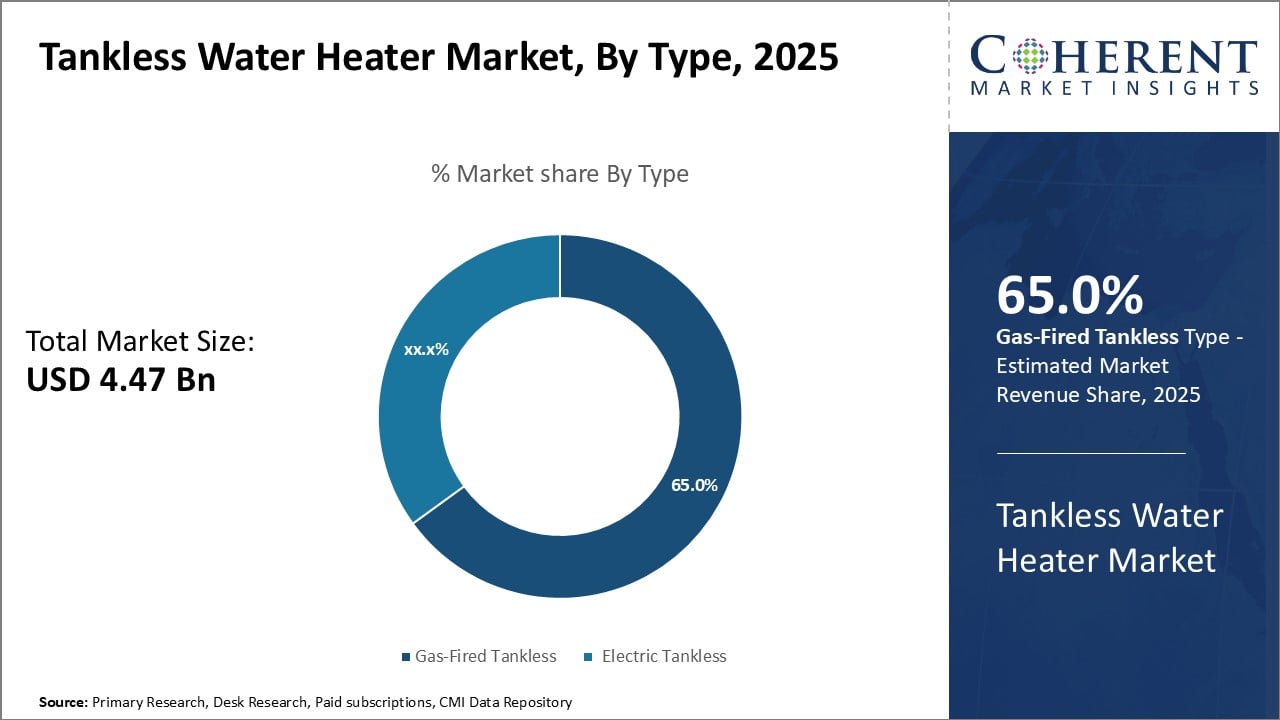
- Gas-fired tankless water heaters are expected to remain the top-selling type, accounting for 66% of the global market share in 2026.
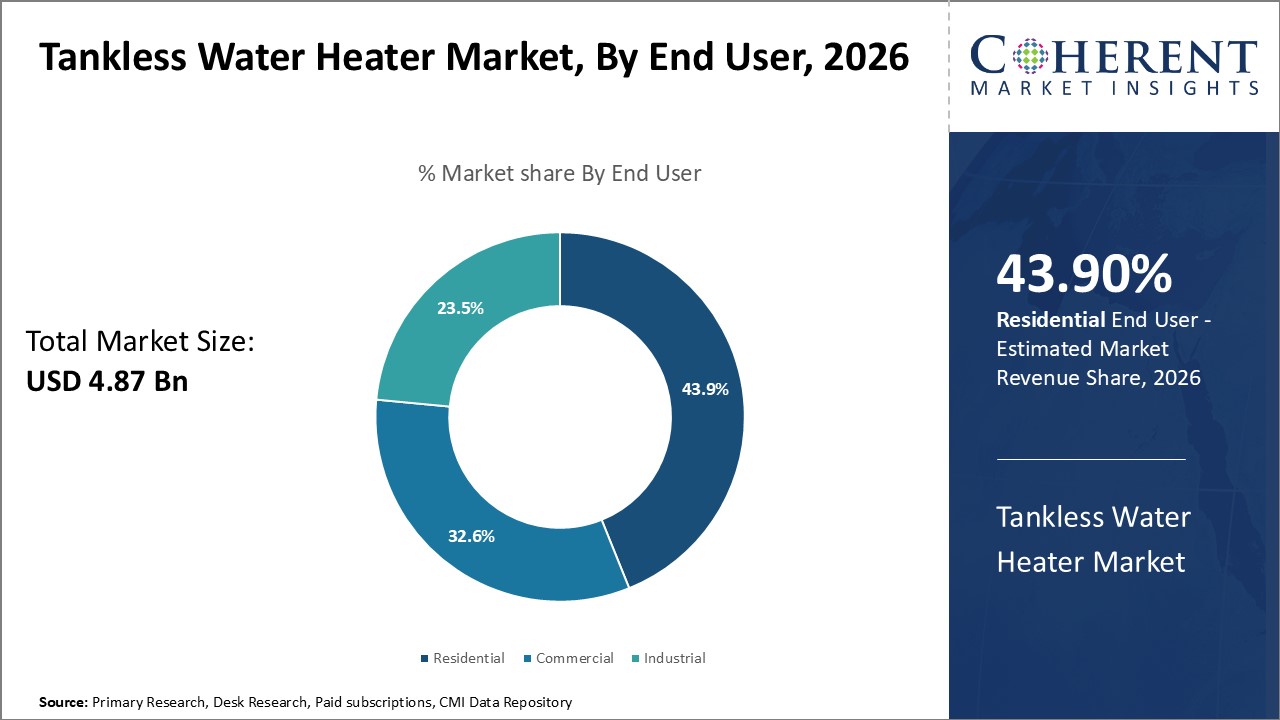
- Tankless water heater adoption remains high in the residential sector, with the target segment capturing 43.9% of the market share in 2026.
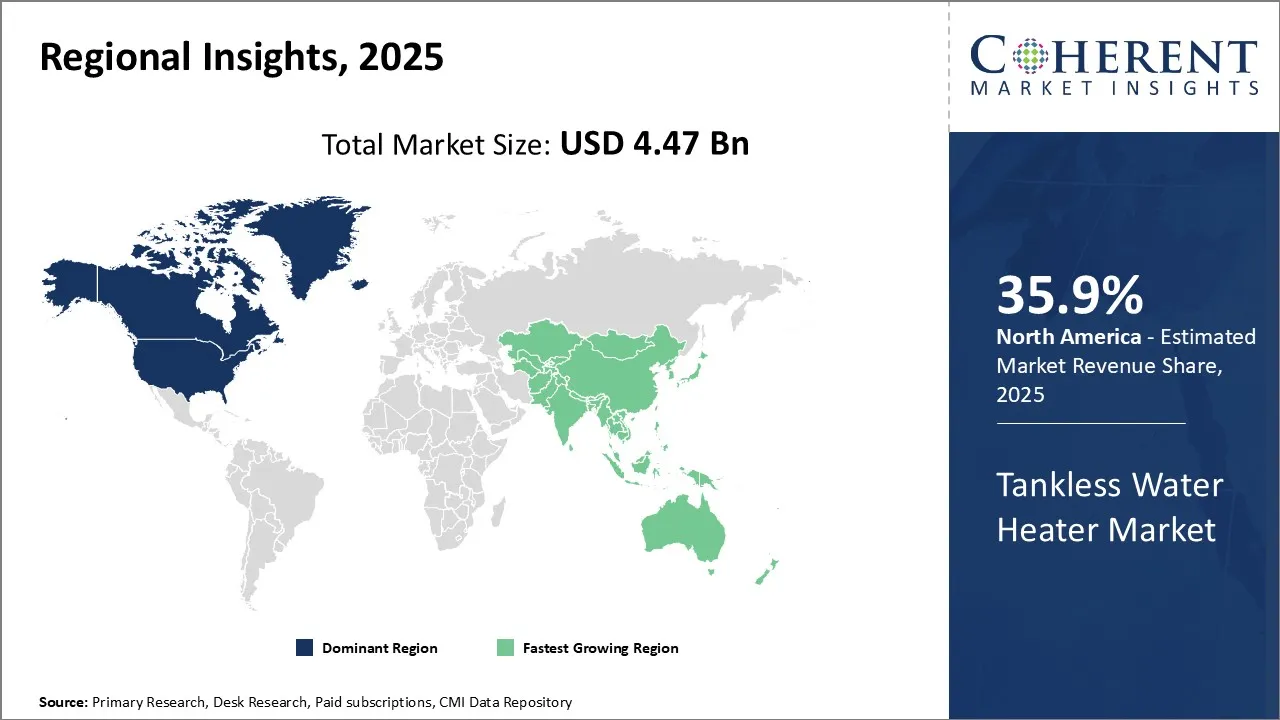
- North America, with an estimated share of 35.9% in 2026, is projected to dominate the global tankless water heater industry.
- Asia Pacific is poised to emerge as the fastest-growing tankless water heater market during the forecast period.
Tankless Water Heater Market Overview
The global tankless water heater market is expected to register robust growth during the forecast period. This can be attributed to increasing adoption of energy efficient appliances and rising construction of green buildings.
Consumers are showing growing preference for compact, energy-saving water heating solutions that provide continuous hot water while minimizing energy consumption. This is putting tankless water heaters into the spotlight.
Growing environmental consciousness and need for conservation of resources are propelling demand for tankless water heaters. Similarly, expanding use of tankless water heating technologies across industrial, residential, and commercial sectors is set to boost sales during the forthcoming period.
Various government regulations regarding energy efficiency are also encouraging the replacement of conventional water heaters with advanced tankless variants. This trend towards sustainable technologies is expected to stimulate tankless water heater market growth during the forecast period.
For instance, in December 2024, the U.S. Department of Energy introduced a rule requiring new gas-fired tankless water heaters to meet higher energy efficiency standards. This move aims to phase out less efficient non-condensing models by 2029, encouraging consumers to shift toward advanced, energy-saving tankless systems.
Current Events and Their Impact on the Tankless Water Heater Market
Current Event | Description and its Impact |
Global Energy Transition and Decarbonization Policies |
|
Technological Advancement in Smart Home Integration |
|
Segmental Insights
- Current Industry Events of 2026
- Market Size Estimation
- Regional Breakdown
- Competitive Landscape
- Customer Intelligence
- Segmental Analysis
- Pricing Analysis
- Key Market Drivers, Challenges & Future Trends
- Customized Insights Section
Tankless Water Heater Market Insights, By Type: Energy Savings Boost Gas-Fired Tankless Water Heater Popularity
As per Coherent Market Insights’ latest analysis, gas-fired tankless segment is expected to dominate the market with a share of 66% in 2026. This can be attributed to rising adoption of gas-fired tankless water heaters due to their lower energy costs and flexible heating.
Gas-fired tankless water heaters have gained popularity in recent years due to their tendency to reduce energy costs compared to traditional tank water heaters. These systems provide hot water only as it is needed, so there is no energy wasted keeping large volumes of water heated continuously in a storage tank. This makes gas-fired tankless models much more energy efficient.
Another major factor driving adoption of gas-fired tankless water heaters is flexibility. These systems allow for continuous, on-demand hot water from multiple draw points like showers, sinks, washing machines, etc., simultaneously. While traditional tanks have limited capacity, gas-fired tankless heater provides unlimited hot water. This makes them a practical choice for larger households or buildings with multiple fixtures.
Gas units also recover more quickly than electric models to produce hot water. Their flexibility to meet fluctuating demand from multiple sources without running out of hot water has increased their adoption rate in residences as well as commercial spaces like hotels, spas, etc.
Tankless Water Heater Market Insights, By End User: Rising Construction and Renovation Activities Giving Residential Sector a Slight Edge
Residential sector is projected to remain the leading end user of tankless water heaters, accounting for 43.9% of the market share in 2026. This dominance is attributable to increasing renovation and construction activities.
Households are increasingly looking to reduce energy costs and improve water heating efficiency. Tankless water heaters are gaining popularity as an energy-efficient alternative or complement to traditional tank systems.
Renovations allow homeowners to replace aging water heaters with newer, more efficient tankless options. Similarly, tankless units are often the preferred choice in new residential construction due to their space-saving compact design and ability to provide hot water in large volumes.
Recent trends like increasing home sizes and more bathrooms per house have also influenced the uptake of tankless water heaters to meet higher hot water requirements. Moreover, growing environmental awareness is encouraging the adoption of energy-efficient tankless models residential settings.
The convenience of continuous hot water supply further enhances their appeal among homeowners. These factors together will continue propelling the residential segment in the tankless water heater industry.
Regional Insights
North America Remains Market Leader in Tankless Water Heaters
North America is expected to dominate the global tankless water heater industry with a share of 35.9% in 2026. This is mostly due to higher acceptance rate and broad product availability in the region.
Consumers in the region are increasingly using tankless water heaters due to their energy efficiency, space-saving design, and ability to provide continuous hot water on demand. Likewise, growing environmental awareness and rising utility costs are motivating homeowners to switch from traditional storage water heaters to tankless systems.
The region is also home to some of the leading tankless water heater manufacturers as well as suppliers. This ensures ease of access to all varieties and price points of tankless water heaters for consumers across the region.
For instance, Navien was recognized as the number one selling manufacturer of gas tankless water heaters in North America. Presence of these leading manufacturers is supporting market expansion. Similarly, stringent building codes mandating high energy efficiency standards also favor the adoption of tankless heaters.
Asia Pacific Becoming a Hotbed for Tankless Water Heater Market Companies
Asia Pacific is poised to emerge as the most lucrative market for tankless water heaters during the forecast period. This is mostly due to rapid urbanization, rising construction of residential and commercial buildings, and growing awareness of energy-efficient and eco-friendly appliances.
Countries like China, Japan, and South Korea have traditionally led demand in the region. However, other emerging economies of India, Indonesia, and Vietnam are displaying the highest growth rates on the back of expanding middle-class population, increasing construction activities, and rising disposable income levels.
Tankless Water Heater Market Outlook – Country-wise
Significant R&D Investments and Energy Efficiency Focus Propel Growth in the U.S.
The U.S. tankless water heater market is set to grow steadily during the assessment period. This is attributable to rising consumer demand for energy-efficient, space-saving appliances that provide on-demand hot water.
Consumers in the nation are increasingly looking for appliances that reduce electricity and gas usage while delivering on-demand hot water. This is fueling demand for tankless water heating solutions.
Leading U.S.-based companies are investing heavily in tankless water heating technologies to meet growing consumer demand. For instance, Rinnai America Corporation recently invested ~$70 million in a U.S. assembly facility and innovation centre for tankless gas instantaneous units.
Additionally, government incentives for energy-efficient appliances and rising construction of green buildings are supporting market growth. Innovative models with smart connectivity, Wi-Fi control, and improved safety features are gaining traction, making the U.S. market highly competitive and technology-driven.
Expanding Urbanization Boosting Sales in China
China tankless water heater market is expected to record rapid growth from 2026 to 2032. This is due to rising urbanization, increasing household incomes, and the growing focus on energy conservation. Consumers are moving towards space-saving, energy-efficient water heating solutions, which align with the country’s sustainability goals.
Government initiatives promoting green buildings and energy conservation further support market growth. Smart tankless water heaters with improved performance and lower operating costs are becoming increasingly popular in residential and hospitality sectors.
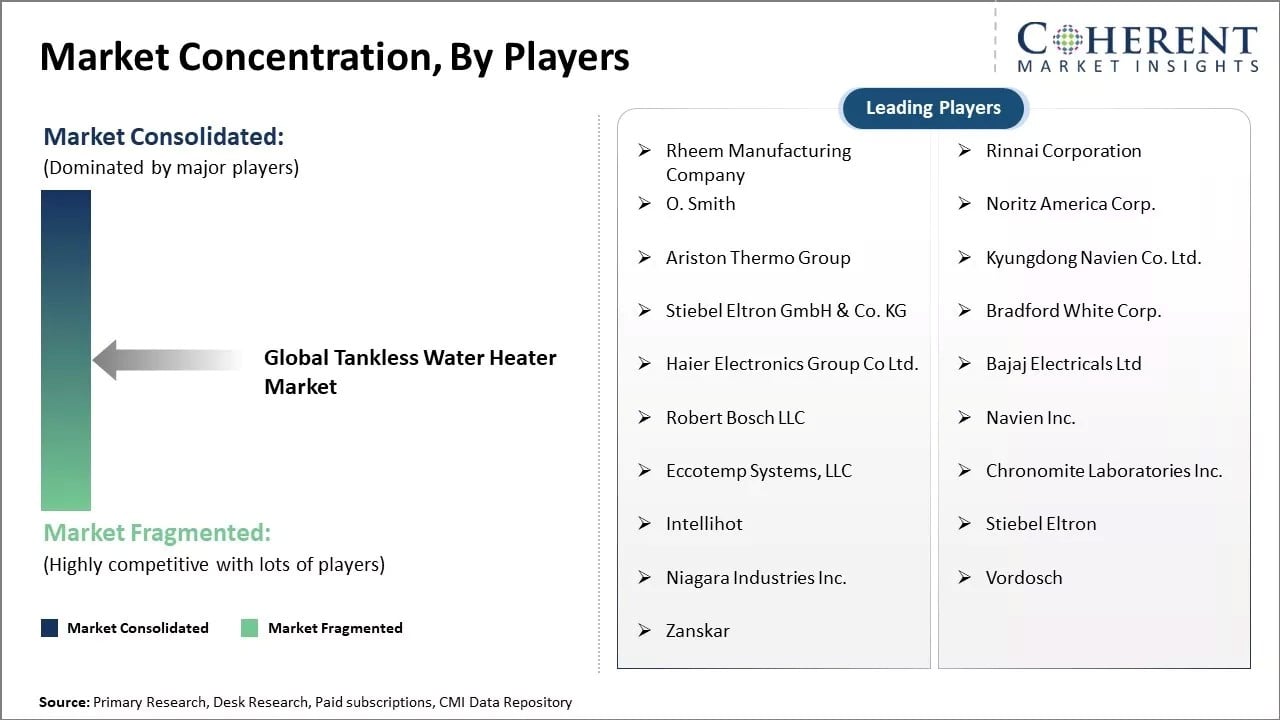
Market Concentration and Competitive Landscape
Tankless Water Heater Industry News
- In September 2025, Ariston Group announced the construction of a state-of-the-art facility in Albacina, Italy. This new plant will be used to produce next-generation electric water heaters.
- In January 2025, King Heating Products launched Heet 199, its new tankless water heater. The new tankless water heating system is designed for easy installation and reliable performance.
- In January 2024, A.O. Smith launched its Adapt™ Premium Condensing gas tankless water heater line featuring X3® Scale Prevention Technology. The line offers premium features, including an integrated recirculation pump, a patented heat exchanger, enhanced installation flexibility, and a high uniform energy factor.
Market Report Scope
Tankless Water Heater Market Report Coverage
| Report Coverage | Details | ||
|---|---|---|---|
| Base Year: | 2025 | Market Size in 2026: | USD 4.87 Bn |
| Historical Data for: | 2020 To 2024 | Forecast Period: | 2026 To 2033 |
| Forecast Period 2026 to 2033 CAGR: | 8.9% | 2033 Value Projection: | USD 8.84 Bn |
| Geographies covered: |
| ||
| Segments covered: |
| ||
| Companies covered: | Rheem Manufacturing Company, Rinnai Corporation, O. Smith, Noritz America Corp., Ariston Thermo Group, Kyungdong Navien Co. Ltd., Stiebel Eltron GmbH & Co. KG, Bradford White Corp., Haier Electronics Group Co Ltd., Bajaj Electricals Ltd, Robert Bosch LLC, Navien Inc., Eccotemp Systems, LLC, Chronomite Laboratories Inc., Intellihot, Stiebel Eltron, Niagara Industries Inc., Vordosch, and Zanskar | ||
| Growth Drivers: |
| ||
| Restraints & Challenges: |
| ||
Tankless Water Heater Market Drivers
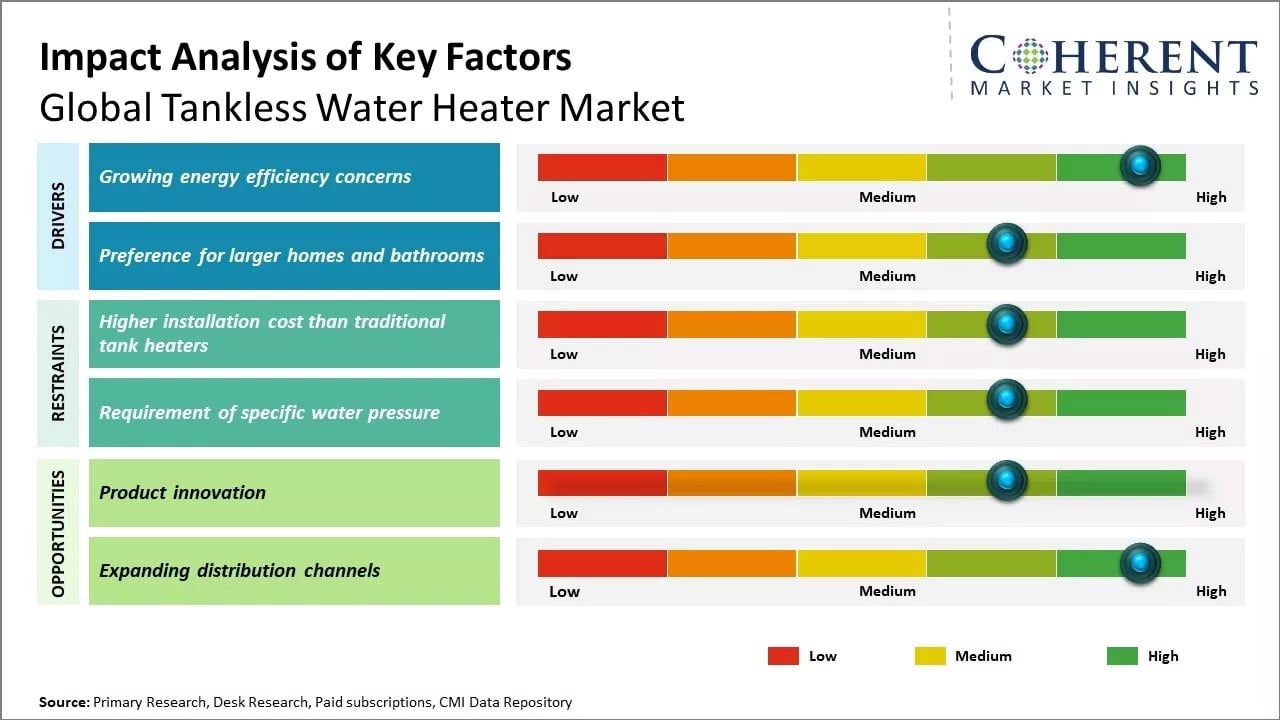
Growing Energy Efficiency Concerns
The rising costs of energy and growing concerns over carbon emissions have prompted many homeowners to seek ways to reduce their energy usage and lower utility bills. Tankless water heaters address these needs far better than traditional storage tank models.
Tankless water heating systems are able to heat water on demand only when it is needed, rather than continuously maintaining water temperature in a storage tank. This makes them much more energy efficient as heat energy is not lost through the insulated walls of a storage tank. Some tankless water heater models are over 30% more efficient than standard units.
As environmental stewardship and sustainable living continue to gain mainstream appeal, the energy savings potential of tankless water heaters becomes an important driver for many consumers. Their lower operating costs have them paying for themselves over time through savings on utility bills.
With gas and electricity prices projected to rise further in the coming years amid supply constraints, tankless water heaters offer homeowners a way to minimize the impact of higher energy rates on household budgets.
Preference for Larger Homes and Bathrooms
The average size of new single-family homes has steadily increased over the past few decades. Homebuyers now commonly seek out spacious floor plans with multiple bathrooms, sometimes even including master baths with soaking tubs and walk-in showers.
Larger homes naturally require more hot water, especially when multiple bathrooms need to be used simultaneously. Traditional tank water heaters struggle to keep up with the demand without running out of hot water.
Tankless systems solve this problem by being able to produce an unlimited supply. The on-demand heating avoids wasting energy maintaining a reserve and allows the entire home's fixtures to be used together without interruption. Their space-saving wall-mounted compact design is also preferable to homeowners instead of storing an often aging tank in the basement or garage.
As builders focus on offering larger luxury features, tankless water heaters become a necessity for reliable hot water supply. Their ability to meet the higher hot water requirements of expansive new homes remains an important consideration for builders and homeowners alike.
Tankless Water Heater Market Opportunity
Product Innovation
Product innovation remains a key growth strategy for tankless water heater manufacturers. As concerns over energy efficiency and environmental sustainability continue to rise globally, tankless water heaters are increasingly becoming the preferred choice over traditional tank water heaters.
Tankless water heaters provide a significant reduction in energy usage as they heat water only as it flows through the system versus keeping a large tank continuously heated. As consumers become more educated on the cost and carbon footprint savings of tankless water heaters, product innovation that further improves their energy efficiency could help accelerate adoption rates.
Tankless Water Heater Market Challenges
Higher Installation Cost than Traditional Tank Heaters
The global tankless water heater market outlook remains positive. However, high installation cost might limit growth of the tankless water heater market during the forecast period.
Tankless water heaters are more expensive to install than traditional tank heaters. Installing them often requires changes to the home’s existing water, gas, or electrical systems. Some older homes may even need new pipes or upgrades to meet the system requirements.
Because of these extra costs, installing a tankless system can be 2–3 times more expensive than a regular tank heater, and in some extreme cases, even more. This high upfront cost makes many homeowners hesitant to switch from their existing tank water heaters, even though tankless units save energy and last longer.
Analyst Opinion (Expert Opinion)
- Tankless water heaters are increasingly seen as premium, energy-efficient upgrades rather than mass-adoption solutions. Real-world energy savings depend heavily on household water usage and installation quality. For instance, DOE studies show savings can reach up to 33% compared to conventional tanks, but only in homes with high simultaneous hot-water usage.
- High up-front costs and installation challenges remain barriers. Many households face additional wiring or venting requirements, limiting adoption in older homes. This makes tankless solutions most suitable for new builds, multi-bath homes, or premium renovations.
- Smart and connected features are becoming essential differentiators. Units with Wi-Fi connectivity, remote monitoring, and predictive maintenance are gaining traction, especially in developed markets. Companies offering “product + installation + service” solutions are likely to outperform those selling units alone during the forthcoming period.
- Places like hotels, gyms, and apartment buildings have strong growth potential because they can benefit from the “on-demand” and “space-saving” features. Rising adoption across these industries is anticipated to boost sales of tankless water heaters.
Speak to the analyst
Want personalized insights?
Take the findings above to one of our principal consultants, or have the report rebuilt around the segments, geographies and competitors you actually track.
Market Segmentation
- Type Insights (Revenue, USD Bn, 2021 - 2033)
- Gas-Fired Tankless
- Electric Tankless
- End-user Insights (Revenue, USD Bn, 2021 - 2033)
- Residential
- Commercial
- Industrial
- Regional Insights (Revenue, USD Bn, 2021 - 2033)
- North America
- U.S.
- Canada
- Latin America
- Brazil
- Argentina
- Mexico
- Rest of Latin America
- Europe
- Germany
- U.K.
- Spain
- France
- Italy
- Russia
- Rest of Europe
- Asia Pacific
- China
- India
- Japan
- Australia
- South Korea
- ASEAN
- Rest of Asia Pacific
- Middle East & Africa
- GCC Countries
- Israel
- Rest of Middle East & Africa
- Key Players Insights
- Rheem Manufacturing Company
- Rinnai Corporation
- O. Smith
- Noritz America Corp.
- Ariston Thermo Group
- Kyungdong Navien Co. Ltd.
- Stiebel Eltron GmbH & Co. KG
- Bradford White Corp.
- Haier Electronics Group Co Ltd.
- Bajaj Electricals Ltd
- Robert Bosch LLC
- Navien Inc.
- Eccotemp Systems, LLC
- Chronomite Laboratories Inc.
- Intellihot
- Stiebel Eltron
- Niagara Industries Inc.
- Vordosch
- Zanskar
Sources
Primary Research interviews
- Manufacturers and suppliers of tankless water heaters (e.g., Rheem, Rinnai, Bosch)
- Industry experts and engineers in water heating technologies
- Building contractors and HVAC professionals
Databases
- US Energy Information Administration (EIA)
- International Energy Agency (IEA) databases
- U.S. Department of Energy (DOE) appliance efficiency data
Magazines
- Plumbing & Mechanical Magazine
- ACHR News (Air Conditioning, Heating & Refrigeration News)
- Home Energy Magazine
Journals
- Energy and Buildings
- Renewable & Sustainable Energy Reviews
- Journal of Cleaner Production
Newspapers
- The New York Times (Home & Living / Energy sections)
- The Wall Street Journal (Sustainability & Energy coverage)
- The Guardian (Environment & Energy sections)
Associations
- American Water Works Association (AWWA)
- Air-Conditioning, Heating, and Refrigeration Institute (AHRI)
- International Association of Plumbing and Mechanical Officials (IAPMO)
Public Domain sources
- U.S. Environmental Protection Agency (EPA) reports
- DOE’s Energy Star program data
- Government energy efficiency guidelines and building codes
Proprietary Elements
- CMI Data Analytics Tool
- Proprietary CMI Existing Repository of information for last 8 years
Get access to 250+ pages report
Every segment, forecast, competitor profile and data table behind the analysis above — available for instant download.
- ESOMAR Member
- ISO 9001:2015 Certified
- D-U-N-S Registered
- GDPR & CCPA Compliant
Missing comfort of reading report in your local language? Find your preferred language:
Transform your Strategy with Exclusive Trending Reports
Frequently Asked Questions
The global market is estimated to be valued at USD 4.87 Bn in 2026.
The global tankless water heater market value is expected to reach USD 8.84 Bn by 2033.
The global market is projected to exhibit a CAGR of 8.9% from 2026 to 2033.
Growing energy efficiency concerns and preference for larger homes and bathrooms are major growth drivers.
Higher installation cost and requirement of specific water pressure.
Gas-fired tankless water heaters.
Rheem Manufacturing Company, Rinnai Corporation, O. Smith, Noritz America Corp., Ariston Thermo Group, Kyungdong Navien Co. Ltd., Stiebel Eltron GmbH & Co. KG, Bradford White Corp., Haier Electronics Group Co Ltd., Bajaj Electricals Ltd, Robert Bosch LLC, Navien Inc., Eccotemp Systems, LLC, Chronomite Laboratories Inc., Intellihot, Stiebel Eltron, Niagara Industries Inc., Vordosch, and Zanskar are the major players.