

Middle East Tapentadol Market Size and Share Analysis: (2026-2033)
The Middle East Tapentadol Market size is anticipated to grow at a CAGR of 7.2% with USD 3.5 Mn in 2026 and is expected to reach USD 5.7 Mn in 2033. The growth is mainly owing to the rising chronic disease burden, especially diabetes and cancer. According to the International Diabetes Federation (IDF), approximately 34.2 million adults in the Middle East and North Africa region are living with diabetes, and the prevalence of diabetes is expected to rise further. In addition, the region is experiencing a steady increase in cancer rates, with projections indicating a substantial rise in both cases as well as mortality rates during the forecast period.
Key Takeaways
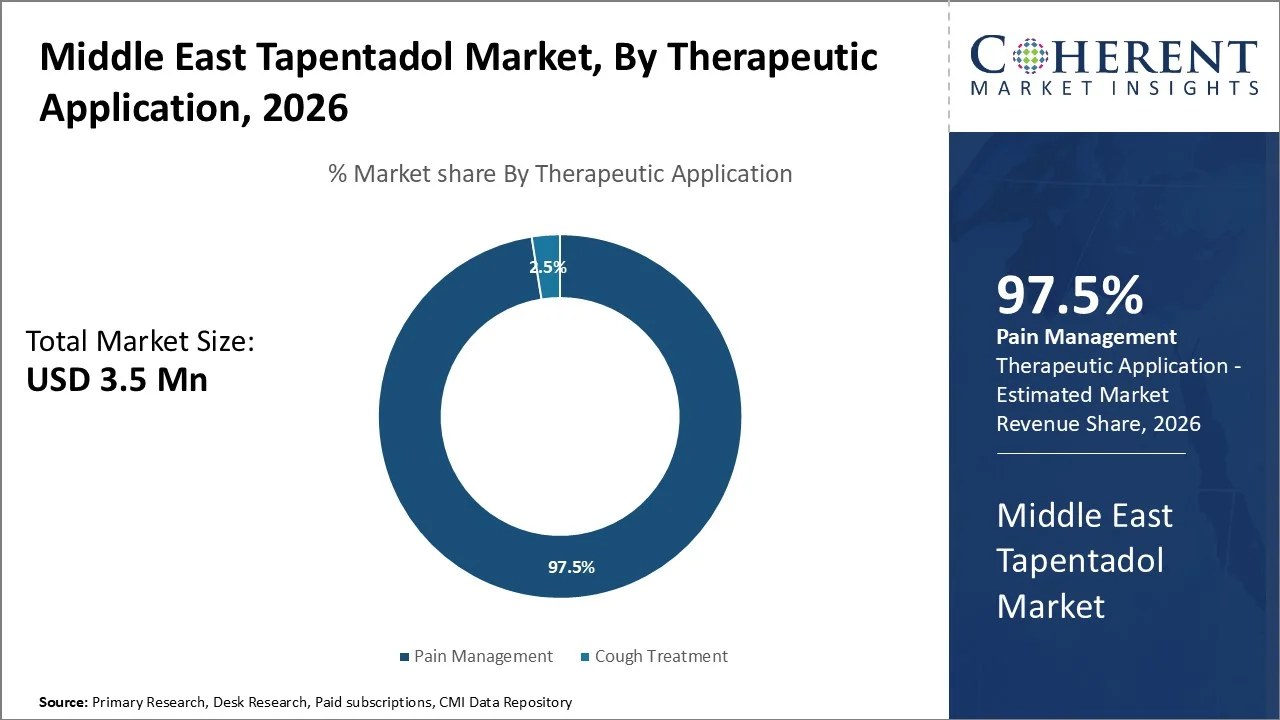
- The pain management segment is projected to account for the largest share of 97.5% in 2026. The segment’s growth is owing to the increasing prevalence of chronic pain conditions like cancer- and diabetes-related neuropathic pain in the Middle East. The hospitals and specialty clinics are adopting advanced injectable therapies like tapentadol in order to improve patient outcomes and ensure rapid pain relief. For instance, according to the International Diabetes Federation (IDF) Diabetes Atlas 2024, approximately 85 million adults in the Middle East and North Africa live with diabetes, thereby representing about one in six adults — the highest global proportion.
- KSA is projected to account for the largest share of 36.10% in 2026. The growth is owing to the country’s well-established healthcare infrastructure, government support for controlled substance regulation, and increasing incorporation of hospital-based injectable treatments.
Segmental Insights
Which Therapeutic Application Segment Dominates the Market?
The pain management segment accounts for the largest Middle East Tapentadol Market share of 97.50% in 2026. The growth of the segment is mainly driven by the escalating regional burden of severe oncology-induced and neuropathic conditions.
According to the official World Health Organization (WHO) Eastern Mediterranean Region database, more than 788,000 people were diagnosed with cancer in the region in 2022, which sharply accelerates the demand for advanced step-three pain ladder opioids like Tapentadol.
In addition, the data from the International Diabetes Federation (IDF) Atlas highlights the substantial burden of diabetes in the Middle East region. This prevalence is projected to spike by 92% to reach 163 million by 2050. Thus, massively increasing the population vulnerable to painful diabetic neuropathy.
In order to manage this acute public health volume, the regional market has shifted toward infrastructural development. The Ministry of Investment and the Saudi Food and Drug Authority (SFDA) have progressively driven pharmaceutical localization initiatives, scaling the domestic ecosystem to 56 licensed pharmaceutical facilities backed by over USD 2.6 billion (SR10 billion) in total investments to manufacture and package primary oral treatments locally.
- Current Industry Events of 2026
- Market Size Estimation
- Regional Breakdown
- Competitive Landscape
- Customer Intelligence
- Segmental Analysis
- Pricing Analysis
- Key Market Drivers, Challenges & Future Trends
- Customized Insights Section
Market Drivers
High Disease Burden is Transforming the Middle East Tapentadol Market
The rising prevalence of chronic diseases, particularly diabetes and cancer, is substantially transforming the tapentadol market in the Middle East.
According to the World Health Organization (WHO) in September 2025, the Eastern Mediterranean region has the highest adult diabetes prevalence globally, with 17.6% of adults affected. This growing diabetic population is increasing the need for neuropathic pain treatments such as tapentadol. In addition, the cancer rates are also rising in the region. According to WHO EMRO, in February 2024, around 788,000 new cancer cases were diagnosed in the region in 2022. This is creating stronger demand for effective pain management solutions.
In January 2026, the Saudi Food and Drug Authority (SFDA) strengthened its Drug Track and Trace System (RSD). This helped in improving the safety, traceability, as well as controlled distribution of pain medicines including opioids drugs like tapentadol. This regulatory measure aims to improve market reliability and ensure secure access to controlled pain relief therapies in the region.
A Major Breakthrough in the Middle East Tapentadol Market: Controlled, Traceable, and Specialist-led Opioid Pain Management
A major breakthrough in the Middle East Tapentadol Market is the shift from volume-driven opioid access to controlled, traceable, and specialist-led pain management. Tapentadol is expected to gain relevance mainly in severe acute pain, chronic musculoskeletal pain, post-surgical pain, and cancer-related pain, where physicians require stronger analgesics under strict supervision.
Saudi Arabia’s SFDA Electronic Controlled Drug System strengthens this direction because it monitors narcotic and psychotropic substances across importation, distribution, and end use through real-time oversight. In January 2026, the SFDA also released its Legal Classification and Distribution Status guideline. This strengthened the clarity of prescription as well as distribution categories for human medicines.
These measures make compliant hospital procurement, licensed distribution, and specialist prescribing central to future tapentadol adoption. Therefore, the market growth is likely to come from regulated hospital and pain-clinic use rather than broad retail expansion.
Current Events and Their Impact on the Middle East Tapentadol Market
Current Event | Description and its Impact |
Saudi Arabia Implements Raqeeb Electronic Controlled‑Drug Monitoring System (Ongoing Since 2024–2025) |
|
UAE Controlled Medicines Regulation and Prescription Requirements (2025–2026) |
|
Middle East Tapentadol Market Trends
- The demand for non-opioid alternatives in managing moderate-to-severe pain is rising, particularly in hospital settings. Tapentadol is preferred for conditions where traditional opioids are not viable, thus offering effective pain relief with a reduced risk of addiction. As of 2026, Tapentadol is gaining traction as an essential alternative for acute pain treatment in the region.
- The growing prevalence of diabetes in the Middle East is propelling the need for treatments for neuropathic pain. The International Diabetes Federation’s 2025 report estimates that the Middle East region will have 85 million adults with diabetes by 2024. This makes it the region with the highest diabetes prevalence globally.
- The increasing cancer rates in the region are enhancing the need for comprehensive palliative care. The International Agency for Research on Cancer (IARC), in its GLOBOCAN 2022 report, estimated 28,113 new cancer cases in Saudi Arabia. This underscores the rising demand for effective pain management options like Tapentadol in managing cancer-related pain.
- The Middle East is witnessing rapid advancements in healthcare infrastructure, including the reduction of surgery waiting times, which is leading to greater demand for post-operative pain management. The Saudi Arabia’s Ministry of Health reported in 2025 that surgery waiting times decreased from 53 days in 2022 to 21 days in 2024, thereby creating an increased need for effective post-operative analgesia.
- The region's efforts to combat opioid misuse are reshaping the landscape for prescription-based pain management. In 2025, the UAE and Saudi Arabia introduced stricter regulations on opioid prescriptions, thereby making Tapentadol a preferred alternative due to its efficacy and safer profile.
Country Insights
Expanding Chronic Pain Care is Accelerating the Tapentadol Demand in KSA
KSA accounts for 36.10% of the Middle East Tapentadol Market share in 2026. The region’s growth is owing to the increasing demand for specialist-led treatments for severe, cancer-related, and chronic pain. The country’s healthcare framework, which includes controlled-opioid governance and hospital-based prescribing, is driving the adoption of Tapentadol.
In addition, the rising burden of chronic diseases is contributing to the need for monitored analgesic support. According to Saudi Arabia’s General Authority for Statistics, the 2024 Health Status Statistics Publication revealed that 18.95% of adults aged 15 and above were living with a chronic disease.
Moreover, the 2024 Healthcare Statistics Publication reported that 95.9% of the population has access to basic healthcare services. This enables prescription-led access to pain management via hospitals, clinics, as well as specialists.
Iran Tapentadol Market Trends
The demand for tapentadol in Iran is expected to be primarily driven by the specialist-led treatment of severe and chronic pain, particularly cancer-related, post-surgical, and neuropathic pain, rather than wider retail usage.
The rise in cancer burden in Iran is a key factor of growth for the market. The International Agency for Research on Cancer (IARC) reported 137,198 new cancer cases and 357,906 five-year prevalent cancer cases in 2022. This creates sustained demand for controlled analgesics in oncology, palliative care, as well as hospital pain clinics.
The growing diagnosis of chronic diseases, expanding specialist care access, and the need for effective opioid-sparing pain management may further support tapentadol adoption locally.
Who are the Major Companies in Middle East Tapentadol Market
Some of the major key players in Middle East Tapentadol Market are Depomed, Inc., Janssen Pharmaceutical, Inc., Grünenthal, and Allergan Plc.
Key News
- In March 2026, Hikma introduced an authorized generic Nucynta ER (tapentadol) in the U.S. strengthens its global tapentadol portfolio and creates a relevant signal for the Middle East Tapentadol Market. Although the launch is U.S.-based, Hikma’s established MENA presence may support future regional access, regulated hospital adoption, and stronger availability of extended-release tapentadol for severe, persistent adult pain management needs locally.
Market Report Scope
Middle East Tapentadol Market Report Coverage
| Report Coverage | Details | ||
|---|---|---|---|
| Base Year: | 2025 | Market Size in 2026: | USD 3.5 Mn |
| Historical Data for: | 2020 To 2024 | Forecast Period: | 2026 To 2033 |
| Forecast Period 2026 to 2033 CAGR: | 7.2% | 2033 Value Projection: | USD 5.7 Mn |
| Geographies covered: |
| ||
| Segments covered: |
| ||
| Companies covered: | Depomed, Inc., Janssen Pharmaceutical, Inc., Grunenthal, and Allergan Plc. | ||
| Growth Drivers: |
| ||
| Restraints & Challenges: |
| ||
Analyst Opinion
- Tapentadol demand is driven by real pain-management need, not lifestyle trend. Chronic pain studies across the Middle East show high patient burden, with reported prevalence ranging from 19% in Al-Kharj, Saudi Arabia to 47.5% in Makkah. This creates steady need for stronger prescription pain therapies.
- Diabetic neuropathic pain is a major demand base. In 2024, the IDF reported 85 million adults living with diabetes in the Middle East, including 32 million undiagnosed adults, thereby supporting the demand for neuropathic pain treatment.
- Tapentadol has stronger relevance in controlled, specialist-led pain care. It is used for severe pain requiring opioid treatment and extended-release forms are used for severe diabetic nerve pain when other medicines are insufficient. Cancer and palliative pain also support demand, as GLOBOCAN 2022 recorded 781,574 new cancer cases and 485,347 cancer deaths in the WHO Eastern Mediterranean Region. However, opioid regulation means growth is mainly through hospitals, oncology, orthopedics, and pain clinics rather than open retail use.
Speak to the analyst
Want personalized insights?
Take the findings above to one of our principal consultants, or have the report rebuilt around the segments, geographies and competitors you actually track.
Market Segmentation
- By Therapeutic Application (Revenue, USD Mn, 2021-2033)
- Pain Management
- Neuropathic Pain
- Cancer Pain
- Others
- Cough Treatment
- Pain Management
- By Country (Revenue, USD Mn, 2021-2033)
- KSA
- UAE
- Bahrain
- Oman
- Qatar
- Israel
- Iran
- Key Players
- Depomed, Inc.
- Janssen Pharmaceutical, Inc.
- Grunenthal
- Allergan Plc.
Sources
Primary Research Interviews
- Pain Management Specialists
- Hospital Pharmacists
- Neurologists and Orthopedic Specialists
- Anesthesiologists
- Pharmaceutical Distributors and Importers
- Hospital Procurement Managers
- Regulatory Affairs Consultants
- Retail Pharmacy Chains
- Others
Databases
- IQVIA
- Bloomberg Terminal
- Thomson Reuters Eikon
- EvaluatePharma
- UN Comtrade
- World Bank Open Data
- Others
Magazines
- Pharmaceutical Technology
- PharmaTimes
- Medical Buyer Middle East
- Healthcare Middle East & Africa Magazine
- Arabian Business Healthcare
- Gulf Business Healthcare
- Others
Journals
- Journal of Pain Research
- Pain Medicine Journal
- Clinical Drug Investigation
- Pain and Therapy Journal
- Current Medical Research and Opinion
- Drugs Journal
- The Lancet Regional Health – Eastern Mediterranean
- Others
Newspapers
- Reuters
- Bloomberg News
- Financial Times
- Gulf News
- The National
- Arab News
- Saudi Gazette
- Others
Associations
- International Association for the Study of Pain (IASP)
- Middle East Pain Society
- Saudi Pain Society
- Emirates Society of Anaesthesiology
- World Federation of Societies of Anaesthesiologists (WFSA)
- GCC Health Council
- Others
Public Domain Sources
- Saudi Food and Drug Authority (SFDA)
- UAE Ministry of Health and Prevention (MOHAP)
- Dubai Health Authority (DHA)
- Department of Health – Abu Dhabi
- Qatar Ministry of Public Health
- Bahrain National Health Regulatory Authority (NHRA)
- Oman Ministry of Health
- Israel Ministry of Health
- Iran Food and Drug Administration
- World Health Organization – Eastern Mediterranean Regional Office (WHO EMRO)
- International Narcotics Control Board (INCB)
- U.S. Food and Drug Administration (FDA)
- European Medicines Agency (EMA)
- Others
Proprietary Elements
- CMI Data Analytics Tool
- Proprietary CMI Existing Repository of Information for the Last 8 Years
Get access to 250+ pages report
Every segment, forecast, competitor profile and data table behind the analysis above — available for instant download.
- ESOMAR Member
- ISO 9001:2015 Certified
- D-U-N-S Registered
- GDPR & CCPA Compliant
Missing comfort of reading report in your local language? Find your preferred language:
Transform your Strategy with Exclusive Trending Reports
Frequently Asked Questions
The Middle East Tapentadol Market is expected to reach USD 5.7 Mn in 2033.
Major players operating in the global Middle East Tapentadol Market include Depomed, Inc., Janssen Pharmaceutical, Inc., Grünenthal, and Allergan Plc.
The stringent government regulations on opioid prescribing, high risk of addiction and side effects, and intense competition from alternative pain management therapies are the key factors hampering growth of the market.
The rising prevalence of chronic diseases (especially cancer and diabetic neuropathy), increasing healthcare investments, and a growing demand for effective pain management is boosting demand for injectable drugs.
The Middle East Tapentadol Market is anticipated to grow at a CAGR of 7.2% between 2026 and 2033.