

Thermoplastic Polyurethane (TPU) Films Market Analysis & Forecast
Thermoplastic Polyurethane (TPU) Films Market is estimated to be valued at USD 4.24 Bn in 2026 and is expected to reach USD 7.03 Bn in 2033, exhibiting a compound annual growth rate (CAGR) of 7.5% from 2026 to 2033.
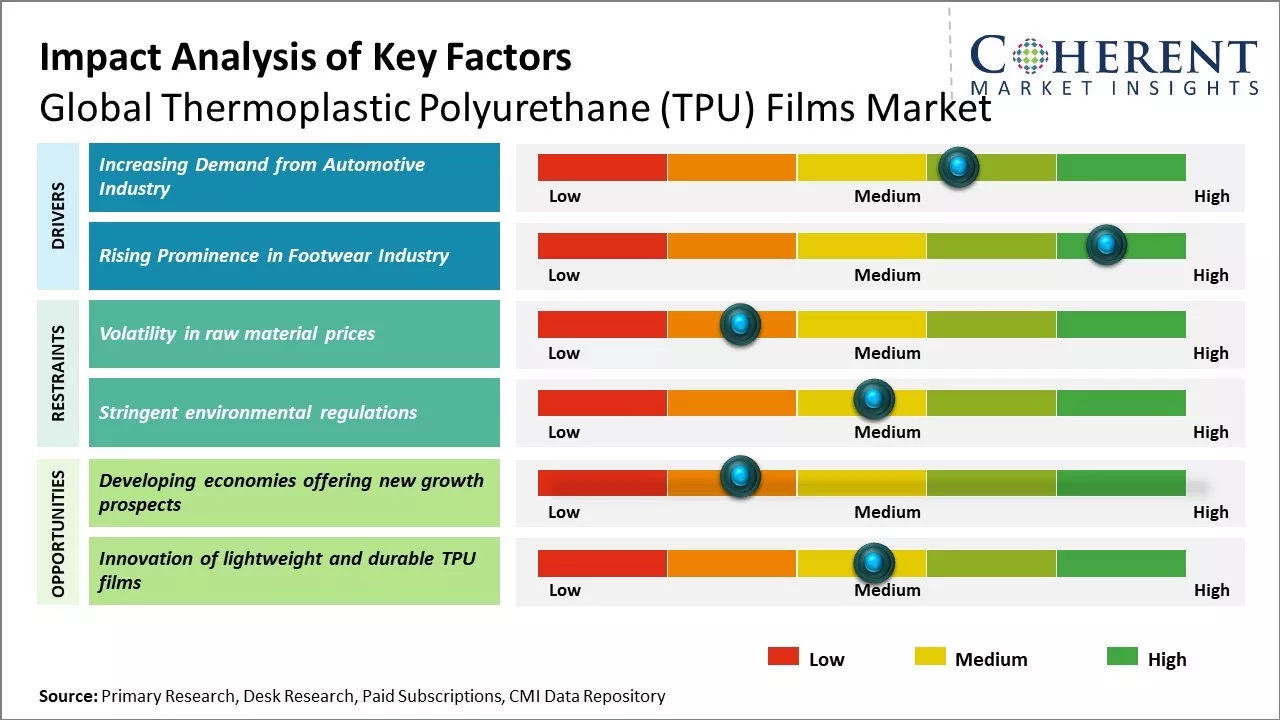
Key Takeaways
- According to Product Type, The Polyether Category is anticipated to account for the largest share of 69.1% for the Thermoplastic Polyurethane (TPU) Films market in 2026.
- According to Application, The Automotive Segment is anticipated to hold major share of 39.3% for the Thermoplastic Polyurethane (TPU) Films market in 2026.
- According to region, North America holds the largest market share of 33.8% for Thermoplastic Polyurethane (TPU) Films market growth by 2026.
Market Overview
A vibrant and growing sector of the larger materials industry, the thermoplastic polyurethane (TPU) films market is fueled by a growing need for flexible, high-performance materials as well as a wide range of applications. TPU films are frequently used for both interior and exterior protection, such as bumper protection, anti-stone chipping, and paint and scratch resistance.
Current Events and Its Impact on the Thermoplastic Polyurethane (TPU) Films Market
Event | Description and Impact |
Shift Toward Sustainability and Recyclability |
|
Volatile Raw Material Prices |
|
Role of Emerging Technologies
- Integration of nanotechnology is leading to TPU films with enhanced tensile strength, tear resistance, and abrasion resistance, meeting the needs of demanding industries such as automotive, aerospace, and medical devices.
- Additive manufacturing techniques are unlocking novel applications in wearable electronics, flexible sensors, and advanced medical devices, further broadening the market for TPU films.
- Development of bio-based and biodegradable TPU films is accelerating, driven by regulatory pressures and consumer demand for sustainable materials. Investment in closed-loop recycling initiatives and the use of bio-based polyols are reducing the carbon footprint of TPU film production and appealing to eco-conscious buyers.
- Current Industry Events of 2026
- Market Size Estimation
- Regional Breakdown
- Competitive Landscape
- Customer Intelligence
- Segmental Analysis
- Pricing Analysis
- Key Market Drivers, Challenges & Future Trends
- Customized Insights Section
Segmental Insights
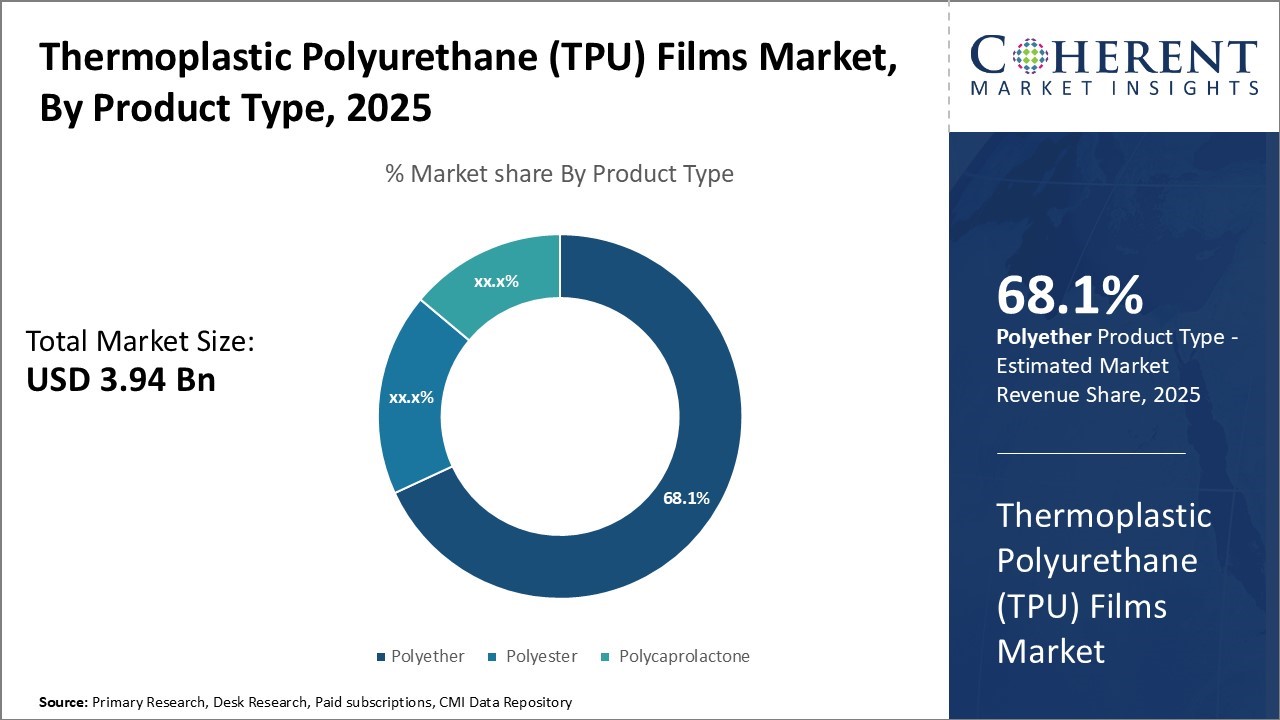
Thermoplastic Polyurethane (TPU) Films Market Insights, By Product Type
In terms of type, polyether is expected to contribute 69.1% share of the Thermoplastic Polyurethane (TPU) films market in 2026 owning to its excellent properties. Polyether TPUs are known for their elasticity, abrasion resistance, and tear strength. They can withstand high and low temperatures without losing their elasticity. The polyether segment is dominating due to the widespread use of these films in applications that require flexibility even at sub-zero temperatures, durable yet lightweight materials, and resistance to oils and solvents.
Polyether TPU films are effectively used in automotive interiors like airbag doors, instrument panels, etc. where damage resistance and surface elasticity over a wide temperature range is critical. Their elasticity and abrasion resistance make them suitable for protective films in flexible displays and touchscreens that require repeated flexing and bending.
Polyether TPUs create a conformable seal and facilitate stress-free movement in medical devices. They are also gaining prominence as insulation films for wires and cables to provide durability under extreme weather conditions. Rising demand from such divergent industries is fueling the growth of the polyether type in the TPU films market.
-films-market-by-application.webp "Thermoplastic Polyurethane (TPU) Films Market, By Application")
Thermoplastic Polyurethane (TPU) Films Market Insights, By Application
In terms of application, the automotive sector is expected to contribute 39.3% share of the Thermoplastic Polyurethane (TPU) films market in 2026 owing to extensive utilization of TPUs in both exterior and interior automotive parts. TPU films cater to the lightweighting and stylizing needs of the automotive industry while fulfilling functionality requirements such as abrasion resistance, flexural strength, and weatherability.
Within vehicles, polyurethane films are widely used as protective and decorative trims, airbag doors, console parts, door panels, air ducts, and floor mats. Their flexible yet durable nature makes them suitable for automotive exterior components like bumpers where elasticity and damage tolerance is paramount. Growing demand for customized and stylish interior designs is propelling the use of TPU films for in-mould labelling, instrument panels, and other trim components.
Similarly, the need to reduce vehicle weight for enhanced fuel efficiency is driving OEMs to incorporate versatile yet lightweight polyurethane parts. Stringent environmental regulations regarding emission norms are also steering the automotive industry towards innovative materials like TPU films. Thus, the unique blend of properties offered by TPUs is supporting their increasing role in modern vehicle manufacturing. This is expected to further augment the demand from the high-growth automotive application segment.
Regional Insights
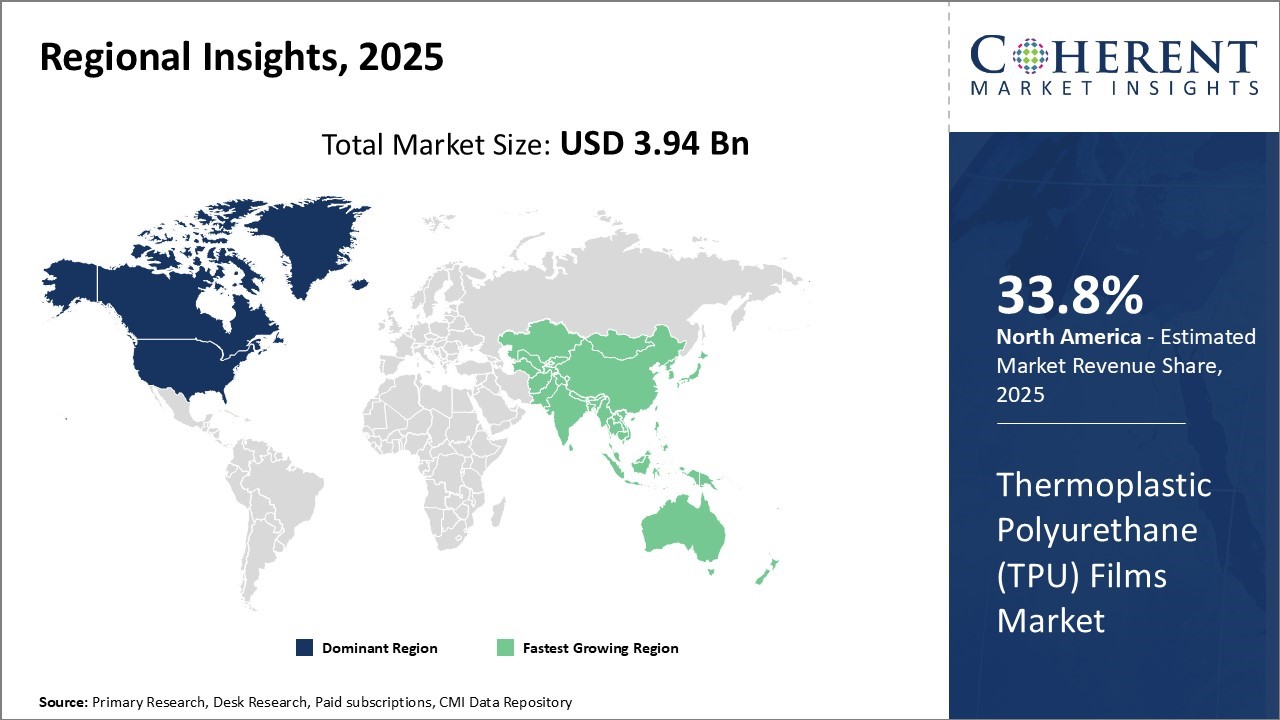
North America Thermoplastic Polyurethane (TPU) Films Market
North America has been the dominant region in the TPU films market, accounting for over 33.8% of global demand in 2026. Several factors have contributed to North America's leading position. These factors include a large automotive industry which is the biggest end-user of TPU films, reliance on lighter weight materials to improve vehicle fuel efficiency, and automakers pushing for more content per vehicle.
Additionally, the presence of major TPU films producers like BASF SE and Lubrizol with production facilities in the U.S. and Canada ensures strong supply availability and competitive pricing for converters and OEMs. However, the threat of China's exports gaining market share remains a challenge for North American TPU films manufacturers.
Asia Pacific Thermoplastic Polyurethane (TPU) Films Market
The Asia Pacific region has emerged as the fastest growing market for TPU films in recent years. Countries like China, India, Japan, and South Korea have seen expanding applications in key end-use sectors like footwear, consumer goods, and medical devices. This strong growth potential can be attributed to rising disposable incomes fueling the consumption demand as well as a shift of manufacturing bases to Asia Pacific from developed markets.
In China specifically, TPU film producers have flourished to meet the needs of burgeoning domestic industries while also becoming major exporters globally. Chinese TPU films companies are able to aggressively price exports by leveraging economies of scale from large capacity additions over the past decade. Their strong foothold in automotive and electronics applications across Asia Pacific and Europe positions China as an extremely competitive force in the TPU films landscape.
Thermoplastic Polyurethane (TPU) Films Market in Europe
TPU films in Europe are generally priced higher than commodity plastics due to superior performance characteristics. Pricing is influenced by raw material costs (such as MDI and polyols), production technology, and application requirements. Volatility in raw material prices can impact the final cost of TPU films, but strong demand from automotive and medical sectors helps maintain stable pricing for high-performance products.
Thermoplastic Polyurethane (TPU) Films Market Dominating Countries
U.S Thermoplastic Polyurethane (TPU) Films Market
The polyether segment leads the market, driven by strong demand from automotive, medical, and consumer goods sectors. The market is characterized by advanced manufacturing capabilities, high innovation, and a robust presence of key global players such as BASF SE. The U.S. also benefits from its mature industrial base and a focus on sustainable, high-performance materials.
India Thermoplastic Polyurethane (TPU) Films Market
India is emerging as a significant growth engine for the global TPU films market, particularly within the Asia-Pacific region. While specific market size figures for India are less frequently highlighted in global reports compared to the U.S. and China, India’s market is expanding rapidly due to the country’s booming automotive, footwear, and consumer goods industries.
Thermoplastic Polyurethane (TPU) Films Market In China
China is the largest and most influential market for TPU films globally, especially within the Asia-Pacific region, which accounts for the majority of worldwide demand. China’s dominance is driven by its massive manufacturing sector, particularly in automotive, electronics, and consumer goods, where TPU films are increasingly utilized for their flexibility, durability, and environmental advantages.
Market Report Scope
Thermoplastic Polyurethane (TPU) Films Market Report Coverage
| Report Coverage | Details | ||
|---|---|---|---|
| Base Year: | 2025 | Market Size in 2026: | USD 4.24 Bn |
| Historical Data for: | 2020 To 2024 | Forecast Period: | 2026 To 2033 |
| Forecast Period 2026 to 2033 CAGR: | 7.5% | 2033 Value Projection: | USD 7.03 Bn |
| Geographies covered: |
| ||
| Segments covered: |
| ||
| Companies covered: | PAR Group, BASF SE, The Lubrizol Corporation, American Polyfilm Inc., 3M, Avery Dennison, MH&W International Corporation, Plastic Film Corporation, Perfectex Plus LLC., Permali Gloucester Limited, Bayer Material Science, Huntsman Corporation, American Polyfilm Inc., Covestro AG, Ding Zing Advanced Materials Inc., Gerlinger Industries GmbH, Okura Industrial Co. Ltd, Schweitzer-Mauduit International Inc., and Wiman Corporation | ||
| Growth Drivers: |
| ||
| Restraints & Challenges: |
| ||
Thermoplastic Polyurethane (TPU) Films Market: Growth Drivers
- Increasing Demand from Automotive Industry
The automotive industry has been a major driving force boosting the thermoplastic polyurethane films market. TPU films are increasingly being used in various automotive applications such as instrument panels, automotive interior components, airbags, and others. Their exceptional properties like high flexibility, elasticity, abrasion, and tear resistance along with being lightweight make them a suitable material for automotive interiors.
As vehicles become more technologically advanced with features like touchscreen infotainment consoles, TPU films play a vital role in protecting and encapsulating delicate electronic components. With growing vehicle production worldwide, particularly electric vehicles, the consumption of TPU films is expected to rise substantially.
Moreover, continuous efforts by automakers towards improving occupant safety, comfort, and luxury in vehicles will augment the use of TPU films in floor mats, armrests, seating, door panels, and other interior applications.
- Rising Prominence in Footwear Industry
The footwear industry has emerged as another major end-use sector contributing to the rising demand for TPU films. Their high strength, flexibility, and durability make TPU films ideal for use in shoes, athletic footwear, sandals, and other footwear products. They are being increasingly used as lightweight substitutes to PVC and other conventional materials.
TPU films offer excellent solvent and chemical resistance allowing easy cleaning and long product life. Their breathable nature provides comfort and enhances the performance of shoes. Furthermore, TPU films allow intricate cutting and forming of detailed patterns for aesthetical enhancement of footwear products.
With growing health and fitness consciousness, demand for athletic and sport shoes is surging which bodes well for the TPU films market. Evolving footwear designs and rising fashion consciousness particularly in developing economies will further spur the use of TPU films in this industry.
Thermoplastic Polyurethane (TPU) Films Market: Trends
- Expansion into New Applications
TPU films are finding new uses in leisure and sports products, aerospace, furniture, and flexible packaging due to their superior strength, abrasion resistance, and chemical resistance. This diversification is opening new revenue streams and driving overall market growth.
Thermoplastic Polyurethane (TPU) Films Market: Opportunities
- Developing economies offering new growth prospects
Developing economies across Asia, South America, Middle East and Africa are expected to offer new growth prospects for the global thermoplastic polyurethane (TPU) films market in the coming years. With rising disposable incomes and growing consumerism, demand for consumer goods and automobiles is increasing rapidly in developing nations. TPU films are increasingly being used in applications like consumer goods packaging, protective automotive films and coatings.
Thermoplastic Polyurethane (TPU) Films Market: Key Developments
- May 2025, Amolen, a materials manufacturer known for its specialty 3D printing filaments, unveiled two new thermoplastic polyurethane (TPU) products at RAPID + TCT 2025 in Detroit: the Glow-in-the-Dark Series and the Transparent Series. Both filaments are part of Amolen’s expanding S-Series. The new Glow-in-the-Dark TPU material is formulated with a non-toxic compound that absorbs ultraviolet light from natural sunlight or artificial UV sources.
- December 2024, Cosmo First thinks so. Cosmo First has introduced its new Paint Protection Films (PPF) to safeguard vehicle exteriors with cutting-edge features. Designed for modern car fans, these PPFs offer lifetime protection, ensuring a showroom finish that stands the test of time. Cosmo First’s PPFs come in two variants, Platinum and Gold, addressing to different protection requirements. With its 8-mil thickness, the Platinum line offers deep scratch resistance, hydrophobic properties, and a lifetime warranty, making it the ultimate choice for premium vehicle protection.
- October 2024, Lubrizol Advanced Materials introduced four new biomass balance solutions under the thermoplastic polyurethane portfolio commercialized as ESTANE RNW TPU. These materials have the same quality and performance as our standard petroleum-based resins while using more sustainable mass balanced feedstocks.
- August 2024, Huntsman has developed a new range of innovative, high-performing thermoplastic polyurethane (TPU) materials for the footwear industry that offer game-changing possibilities for soling applications. The new AVALON GECKO TPU portfolio offers a series of products that have exceptional grip and durability and have been developed with circularity in mind.
Analyst Opinion
- The rise of electric vehicles and innovative automotive technology, analysts highlight the automotive industry as a major growth driver, pointing to the growing use of TPU films in protective coatings, electronic component encapsulation, and vehicle interiors.
- The elasticity, durability, and transparency of TPU films, as well as their growing use in flexible packaging, wearable technology, and medical devices, are further helping the industry.
Sustainability is a crucial topic, as analysts observe that consumers' and regulators' increasing desire for bio-based and recyclable TPU films is driving producers to create environmentally friendly products.
Speak to the analyst
Want personalized insights?
Take the findings above to one of our principal consultants, or have the report rebuilt around the segments, geographies and competitors you actually track.
Market Segmentation
- By Type (Revenue, USD Bn, 2021 - 2033)
- Polyether
- Polyester
- Polycaprolactone
- By Application (Revenue, USD Bn, 2021 - 2033)
- Automotive
- Railway
- Leisure
- Energy
- Building & Construction
- Furniture
- Aerospace
- Others
- By Region (Revenue, USD Bn, 2021 - 2033)
- North America
- U.S.
- Canada
- Latin America
- Brazil
- Argentina
- Mexico
- Rest of Latin America
- Europe
- Germany
- U.K.
- Spain
- France
- Italy
- Russia
- Rest of Europe
- Asia Pacific
- China
- India
- Japan
- Australia
- South Korea
- ASEAN
- Rest of Asia Pacific
- Middle East
- GCC Countries
- Israel
- Rest of Middle East
- Africa
- South Africa
- North Africa
- Central Africa
- Company Profiles
- PAR Group
- BASF SE
- The Lubrizol Corporation
- American Polyfilm Inc.
- 3M
- Avery Dennison
- MH&W International Corporation
- Plastic Film Corporation
- Perfectex Plus LLC.
- Permali Gloucester Limited
- Bayer Material Science
- Huntsman Corporation
- American Polyfilm Inc.
- Covestro AG
- Ding Zing Advanced Materials Inc.
- Gerlinger Industries GmbH
- Okura Industrial Co. Ltd.
- Schweitzer-Mauduit International Inc.
- Wiman Corporation
Sources
Primary Research interviews
- Product Managers at Lubrizol, Covestro, BASF, Huntsman
- Procurement heads in footwear & apparel manufacturing firms (e.g., Nike, Adidas vendors)
- Automotive OEMs’ interior material specialists
- Medical device manufacturing engineers
- Film extrusion plant supervisors and R&D chemists
Databases
- UN Comtrade Database
- U.S. International Trade Commission (USITC) DataWeb
- India’s Directorate General of Foreign Trade (DGFT)
- China Customs Statistics
- EIA (Energy Inputs for TPU production context)
Magazines
- Plastics News
- European Rubber Journal
- PU Magazine International
- Chemical Week
- Modern Plastics India
- Rubber World
Journals
- Polymer Testing
- Journal of Applied Polymer Science
- Materials Today
- Express Polymer Letters
- Journal of Elastomers and Plastics
- International Journal of Adhesion and Adhesives
Newspapers
- The Economic Times
- Financial Times
- The Wall Street Journal
- Nikkei Asia
- Business Standard
Associations
- Polyurethane Manufacturers Association (PMA)
- American Chemistry Council (ACC) – Polyurethanes Division
- Plastics Industry Association (PLASTICS)
- Indian Plastics Federation (IPF)
- China Plastics Processing Industry Association (CPPIA)
- Association of European Plastics Converters (EuPC)
Proprietary Elements
- CMI Data Analytics Tool, Proprietary CMI Existing Repository of information for last 8 years
*Definition: Thermoplastic Polyurethane (TPU) films market involves the manufacturing and selling of TPU films. TPU films are made from thermoplastic polyurethane which is a durable, flexible and elastic plastic material. It provides excellent abrasion and tear resistance. TPU films find wide applications in various industries such as automotive, building and construction, medical, and aerospace due to their unique properties.
Get access to 250+ pages report
Every segment, forecast, competitor profile and data table behind the analysis above — available for instant download.
- ESOMAR Member
- ISO 9001:2015 Certified
- D-U-N-S Registered
- GDPR & CCPA Compliant
Missing comfort of reading report in your local language? Find your preferred language:
Transform your Strategy with Exclusive Trending Reports
Frequently Asked Questions
The Thermoplastic Polyurethane (TPU) Films Market size is estimated to be valued at USD 4.24 Bn in 2026, and is expected to reach USD 7.03 Bn by 2033.
The CAGR of the global Market is projected to be 7.5% from 2026 to 2033.
Increasing demand from automotive industry and rising prominence in footwear industry are the major factors driving the growth of the global market.
Volatility in raw material prices and stringent environmental regulations are the major factors hampering the growth of the global market.
In terms of product type, polyether is estimated to dominate the market revenue share in 2026.
PAR Group, BASF SE, The Lubrizol Corporation, American Polyfilm Inc., 3M, Avery Dennison, MH&W International Corporation, Plastic Film Corporation, Perfectex Plus LLC., Permali Gloucester Limited, Bayer Material Science, Huntsman Corporation, American Polyfilm Inc., Covestro AG, Ding Zing Advanced Materials Inc., Gerlinger Industries GmbH, Okura Industrial Co. Ltd, Schweitzer-Mauduit International Inc., and Wiman Corporation are the major players.
North America is expected to lead the global market.