

Transcriptomics Technologies Market Size and Share Analysis - 2026 To 2033
The transcriptomics technologies market is anticipated to grow at a CAGR of 6.51% with USD 9.17 Bn in 2026 and is expected to reach USD 14.24 Bn in 2033. The market is primarily driven by the rising adoption of RNA sequencing technologies, growing demand for precision medicine, increased use of transcriptomic profiling in drug discovery, and wider application of gene-expression analysis in oncology, rare diseases, and infectious disease research. Transcriptomics technologies aid analyze RNA transcripts and gene expression patterns, thereby creating opportunities in biomarker discovery, personalized therapeutics, molecular diagnostics, pharmaceutical R&D, and advanced clinical research.
Key Takeaways
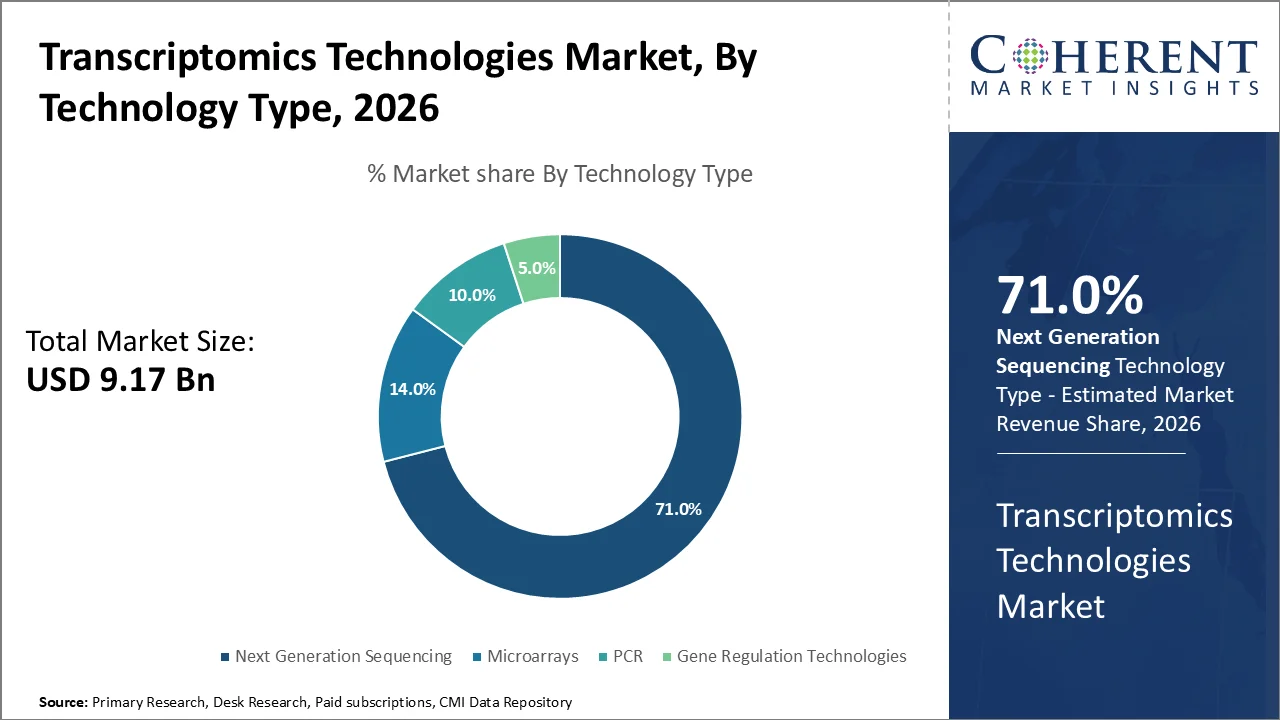
- Next generation sequencing is expected to account the largest share of 71% in 2026, due to its ability to provide high-resolution, large-scale transcriptome analysis as well as its increasing use in genomics research, personalized medicine, and biotechnology applications. India’s bioeconomy sector has grown majorly, increasing from around USD 10 Bn in 2014 to USD 195.3 Bn in 2025. This means the sector has become about 19 times larger in the past decade.
- Drug discovery & research will dominate with 35% in 2026, transcriptomics is widely used by pharmaceutical and biotechnology companies to identify new drug targets, understand disease mechanisms, discover biomarkers, study drug responses, and support precision medicine development. The global pharmaceutical industry is worth around USD 1.4 trillion. As companies are investing heavily in research and development (R&D) to make new medicines.
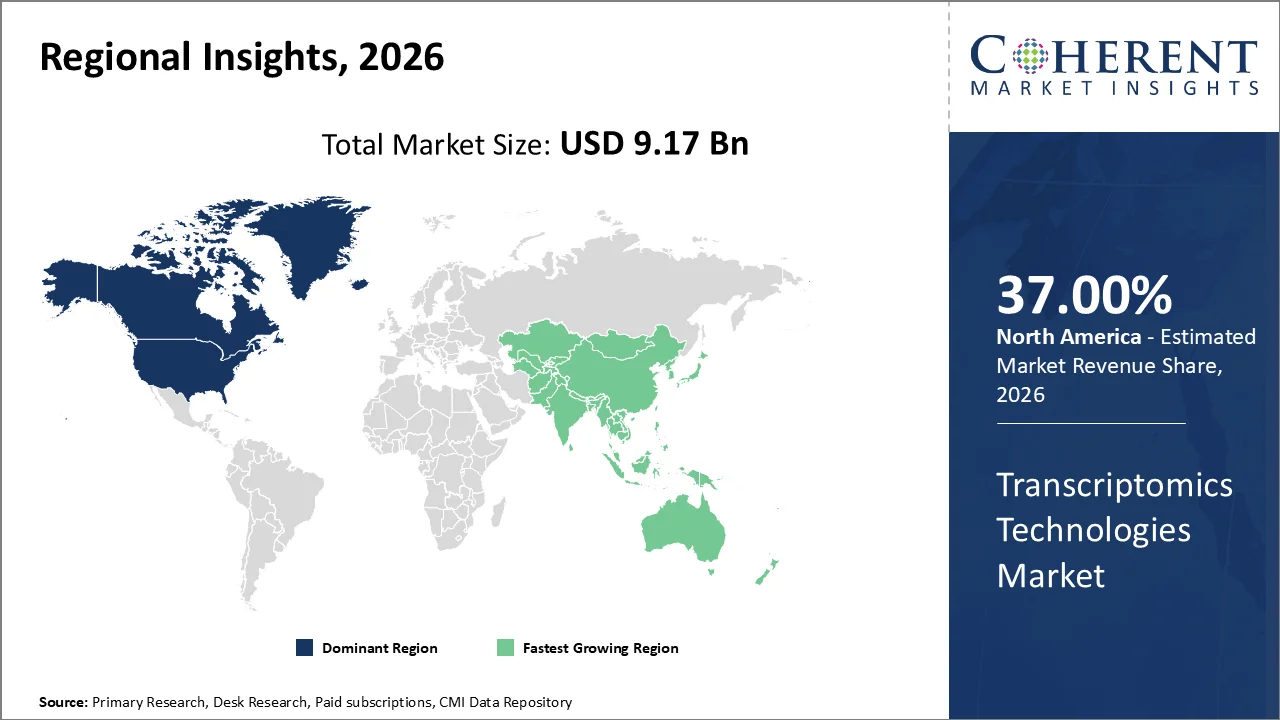
- North America is expected to acquire the dominant share of 37% in 2026, mainly because of its advanced research infrastructure, strong pharmaceutical as well as biotechnology presence, high healthcare spending, and leadership in genomic technologies. The U.S. healthcare spending reached about USD 5.3 trillion in 2024, increasing by 7.2% compared with the previous year.
Segmental Insights
Why is Next Generation Sequencing Acquiring the Largest Market Share?
Next generation sequencing is projected to account for the largest share of disease type in 2026, representing approximately 71% of the total volume. Next Generation Sequencing (NGS) is bolstering due to the leading technology in the transcriptomics landscape primarily because of its capacity to simultaneously sequence millions of RNA fragments without any prior knowledge of the genome, enabling both discovery-driven as well as hypothesis-driven research at a depth that no other technology can match.
The high adoption of RNA sequencing (RNA-Seq), which has transformed how researchers understand gene expression profiles in different tissue types, developmental stages, disease conditions, etc is further stimulating the market.
The National Institutes of Health (NIH) in the United States has consistently integrated NGS-based transcriptomics into its large-scale genomics programs, including the Genotype-Tissue Expression (GTEx) project, which uses RNA sequencing to systematically study the relationship between genetic variation and gene expression across multiple human tissues, generating data that supports biomarker discovery and therapeutic target identification.
- Current Industry Events of 2026
- Market Size Estimation
- Regional Breakdown
- Competitive Landscape
- Customer Intelligence
- Segmental Analysis
- Pricing Analysis
- Key Market Drivers, Challenges & Future Trends
- Customized Insights Section
Drug Discovery & Research holds the Largest Market Share
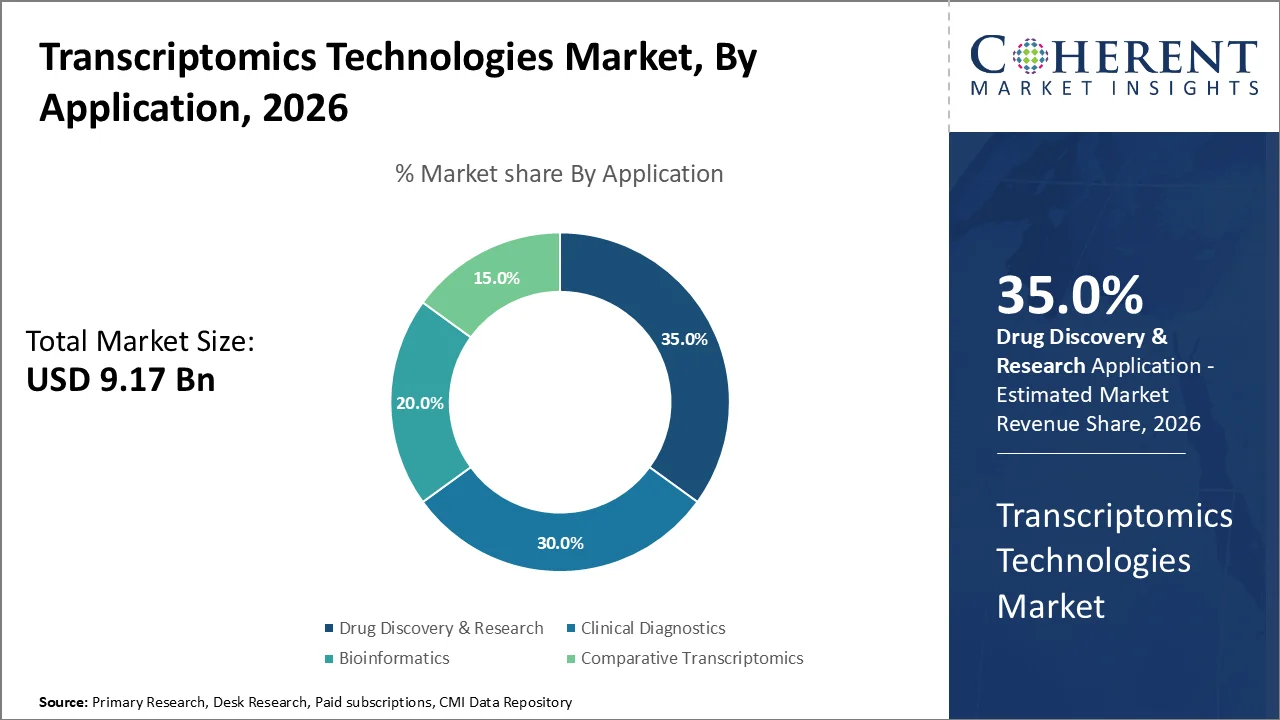
Based on application, drug discovery & research dominates the market, accounting for a significant 35% share in 2026. Its role in understanding gene expression mechanisms that underlie disease pathology, therapeutic target identification, as well as the validation of novel molecular compounds across preclinical and clinical development pipelines are the factors propelling the growth of the market.
Clinical development services are becoming the largest part of outsourced pharmaceutical R&D spending. By 2026, they are expected to account for around 65–70% of outsourced pharma R&D costs due to more complex clinical trials, increased use of digital technologies, and growing demand for advanced therapies.
The high adoption of RNA sequencing (RNA-Seq), single-cell transcriptomics, and microarray technologies within pharmaceutical as well as biotechnology laboratories is majorly supported the dominance of this segment.
Drug discovery workflows highly rely on transcriptomic profiling to decipher how candidate molecules interact with gene networks, assess toxicological responses at the molecular level, as well as identify biomarkers that can analyze drug efficacy or resistance patterns in patient populations.
The strength of the Drug Discovery & Research segment is further bolstered by the sheer volume of publicly funded and privately led genomic research initiatives that have strategically adopted transcriptomics as a central analytical tool. For instance, the National Institutes of Health (NIH) through its National Human Genome Research Institute (NHGRI) has consistently supported large-scale transcriptomic studies aimed at mapping disease-associated gene expression changes, providing pharmaceutical researchers with foundational datasets to anchor drug target discovery.
Market Drivers
RNA Sequencing (RNA-Seq) – Next-Generation Sequencing Based: A major breakthrough in Transcriptomics Technologies
RNA Sequencing (RNA-Seq) is an advanced technology that uses Next-Generation Sequencing (NGS) to understand all RNA molecules in a sample. It aid researchers understand which genes are active, measure gene expression, find new RNA transcripts, as well as identify genetic changes. Unlike older methods, RNA-Seq can analyze the complete transcriptome without depending only on known gene sequences.
One major type is Bulk RNA-Seq, which studies the average gene activity from millions of cells in a sample. Platforms such as Illumina NovaSeq, NextSeq, MGI DNBSEQ, PacBio, and Oxford Nanopore are widely used for RNA sequencing. This technology has supported large research projects like cancer studies, helping scientists discover disease-related genes, identify biomarkers, and improve drug development.
Current Events and Their Impact on the Transcriptomics Technologies Market
Current Event | Description and its Impact |
NIH genomic data sharing policies continue to support large-scale transcriptomics research |
|
Government funding support for precision medicine and genomics research |
|
Transcriptomics Technologies Market Trends
- The most disruptive trend augmenting the transcriptomics landscape is the hig adoption of single-cell RNA sequencing (scRNA-Seq) as well as spatial transcriptomics. More than 100 million individual cells have been analyzed worldwide using single-cell RNA sequencing (scRNA-seq), making it one of the fastest-growing genomics technologies for biological and medical research.
- The exponential volume of transcriptomic data being generated has made AI/ML-powered bioinformatics tools indispensable. Advanced algorithms are now being deployed to identify gene regulatory networks, predict disease trajectories, deconvolute complex cell populations, and integrate multi-omics datasets. State-of-the-art single-cell RNA sequencing (scRNA-seq) experiments now generate datasets containing 20,000 to 500,000 individual cells per study, each with thousands of gene-expression measurements.
- Transcriptomics is progressively being adopted not as a standalone technology but as a critical component of multi-omics research frameworks that simultaneously interrogate genomics, proteomics, metabolomics, and epigenomics.
- Historically confined to academic research, transcriptomics technologies are making major inroads into clinical diagnostics and translational medicine. RNA-based biomarker panels and liquid biopsy platforms that leverage circulating RNA (including mRNA, lncRNA, and miRNA) are being developed for early cancer detection, therapy response monitoring, and companion diagnostics.
- Instrument manufacturers are heavily investing in miniaturized, automated, and user-friendly platforms to lower barriers to adoption in settings beyond large research centers including mid-sized pharmaceutical companies, contract research organizations (CROs), hospitals, and clinical laboratories.
Regional Insights
North America dominates owing to the deeply entrenched research infrastructure
North America account 37% market share in 2026, owing to the deeply entrenched research infrastructure, federal funding mechanisms, and the robust presence of biotechnology and pharmaceutical companies that consistently drive demand for advanced transcriptomic tools and platforms. The U.S. biotechnology industry is growing rapidly, providing around 1.4 million jobs in 2023 with strong salaries for workers. The industry also recorded 9.2% revenue growth in 2022, growing faster than the overall S&P 500 market.
The United States alone houses a major proportion of world-leading genomic research institutions, including the National Institutes of Health (NIH), which has consistently allocated substantial funding toward RNA sequencing as well as gene expression profiling research through its National Human Genome Research Institute (NHGRI).
The NIH's All of Us Research Program, which targets to collect biological samples as well as health data from over one million participants, has majorly accelerated transcriptomic data generation across clinical and translational research settings within North America. Furthermore, the adoption of cutting-edge academic medical centers including Johns Hopkins University, MIT, Stanford University, the Broad Institute of MIT and Harvard, etc., reinforces the leadership of the region in adopting and advancing transcriptomics technologies.
Asia Pacific Transcriptomics Technologies Market Trends
The Asia Pacific region is poised to be the fastest-growing region through 2026-2033, expanding at a CAGR of approximately 6.8%. Driven by an extraordinary convergence of government-backed genomics initiatives, rapidly expanding biopharmaceutical sectors, and increasing investments in precision medicine infrastructure across China, Japan, South Korea, Australia, and India.
According to ITIF, China has become a major player in pharmaceutical innovation. From 2016 to 2025, China’s share of global clinical trials for the most innovative drugs increased six times, reaching 30%, while the U.S. share declined during the same period. This shows China’s growing role in drug research and development.
China's National Genomics Data Center, operated under the Beijing Institute of Genomics at the Chinese Academy of Sciences, has positioned itself as one of the world's largest repositories for transcriptomic data, actively facilitating large-scale RNA sequencing studies that demand continuous upgrading of transcriptomics technologies.
Japan's Ministry of Education, Culture, Sports, Science and Technology (MEXT) has actively supported transcriptomics research through its strategic funding of life science centers, while South Korea's government through its Ministry of Science and ICT has invested heavily in biodata infrastructure under the Korea Biodata Station initiative.
Substantial Federal Funding Allocations is Accelerating the Transcriptomics Technologies Market Demand in United States
The U.S. contributes the highest share in the transcriptomics technologies market in North America, owing to its deeply entrenched research infrastructure, substantial federal funding allocations, as well as the presence of world-leading academic and biotechnology institutions driving continuous innovation in RNA sequencing, single-cell transcriptomics, and spatial transcriptomics technologies.
The National Institutes of Health (NIH) with the NIH's National Human Genome Research Institute (NHGRI) is actively funding transcriptomics-related research programs, including the ENCODE (Encyclopedia of DNA Elements) project, which has generated massive transcriptomic datasets across human tissues and cell types is augmenting the growth.
Additionally, the NIH Common Fund's Human BioMolecular Atlas Program (HuBMAP), launched to map the human body at the single-cell level using transcriptomic tools, has positioned U.S. institutions at the forefront of biological discovery. The concentration of leading biotechnology companies as well as academic medical centers in innovation hubs such as Boston-Cambridge, the San Francisco Bay Area, and Research Triangle Park further reinforces U.S. leadership.
China Transcriptomics Technologies Market Trends
China contributes the highest share in the transcriptomics technologies market in Asia Pacific owing to its robust and heavily funded national genomics and life sciences infrastructure that has been systematically developed over the past decade.
China's dominance is primarily anchored in the extraordinary scale of operations undertaken by state-backed genomics institutions and biotechnology enterprises. The Beijing Genomics Institute (BGI), headquartered in Shenzhen, stands as a prominent example, as it operates one of the largest genomic sequencing capacities in the world and has consistently deployed transcriptomics tools including RNA sequencing as well as single-cell transcriptomics across large-scale research programs.
China's National Natural Science Foundation has channeled extensive funding toward transcriptomics-related research, particularly in oncology, agricultural genomics, and infectious disease surveillance.
Who are the Major Companies in Transcriptomics Technologies Industry
Some of the major key players in transcriptomics technologies market include, Affymetrix, Inc., Agilent Technologies, Inc., Bio-Rad Laboratories, Inc., Danaher Corporation, Illumina, Inc., F. Hoffmann-La Roche Ltd., Life Technologies Corporation, LC Sciences, LLC, and Qiagen N.V.
Key News
- In February 2026, Vizgen announced new technologies that are under development to improve spatial multiomics and single-cell research. These new tools are designed to help scientists discover new drugs faster, better understand how diseases progress, and support new medical research.
- In June 2026, Illumina has launched the StrataMap Spatial Solution, a new research tool for spatial transcriptomics. It helps scientists study gene activity in tissues with very high detail and understand diseases such as cancer and brain disorders better.
Market Report Scope
Transcriptomics Technologies Market Report Coverage
| Report Coverage | Details | ||
|---|---|---|---|
| Base Year: | 2025 | Market Size in 2026: | USD 9.17 Bn |
| Historical Data for: | 2020 To 2024 | Forecast Period: | 2026 To 2033 |
| Forecast Period 2026 to 2033 CAGR: | 6.51% | 2033 Value Projection: | USD 14.24 Bn |
| Geographies covered: |
| ||
| Segments covered: |
| ||
| Companies covered: | Affymetrix, Inc., Agilent Technologies, Inc., Bio-Rad Laboratories, Inc., Danaher Corporation, Illumina, Inc., F. Hoffmann-La Roche Ltd., Life Technologies Corporation, LC Sciences, LLC, and Qiagen N.V. | ||
| Growth Drivers: |
| ||
| Restraints & Challenges: |
| ||
Analyst Opinion
- The transcriptomics technologies market is experiencing major growth, driven by the growing adoption of next-generation sequencing (NGS) and single-cell RNA sequencing platforms across academic and pharmaceutical research settings.
- High investments in genomics and precision medicine initiatives by both public as well as private entities are majorly propelling market growth. In 2026 (up to March), genomics companies raised USD 173 million in equity funding across 17 funding rounds. This reflect that investors continue to support genomics companies developing new technologies as well as healthcare services.
- Furthermore, advancements in spatial transcriptomics are opening entirely new dimensions in understanding cellular heterogeneity within tissue microenvironments, making compelling research opportunities.
- However, the market is facing certain restraints, including the high cost of advanced sequencing platforms as well as associated bioinformatics infrastructure, which limits accessibility for smaller research institutions in developing economies.
- The expanding application of transcriptomics in drug discovery, biomarker identification, as well as companion diagnostics is showing growth avenues for market players.
- North America currently dominates the market due to its high research infrastructure and funding ecosystem, while Asia-Pacific is emerging as the fastest-growing region, fueled by increasing genomics initiatives by government authorities as well as expanding biopharmaceutical industries.
Speak to the analyst
Want personalized insights?
Take the findings above to one of our principal consultants, or have the report rebuilt around the segments, geographies and competitors you actually track.
Market Segmentation
- By Technology Type (Revenue, USD Bn, 2021-2033)
- Microarrays
- PCR
- Gene Regulation Technologies
- Next Generation Sequencing
- By Application (Revenue, USD Bn, 2021-2033)
- Clinical Diagnostics
- Drug Discovery & Research
- Bioinformatics
- Comparative Transcriptomics
- By Region (Revenue, USD Bn, 2021-2033)
- North America
- U.S.
- Canada
- Latin America
- Brazil
- Mexico
- Argentina
- Rest of Latin America
- Europe
- Germany
- U.K.
- France
- Italy
- Spain
- Russia
- Rest of Europe
- Asia Pacific
- China
- India
- Japan
- Australia
- South Korea
- ASEAN
- Rest of Asia Pacific
- Middle East
- GCC
- Israel
- Rest of Middle East
- Africa
- South Africa
- Central Africa
- North Africa
- North America
Sources
Primary Research Interviews
- Transcriptomics Technology Developers & Manufacturers
- Genomics & Bioinformatics Research Scientists
- Clinical & Pharmaceutical Research Professionals
- Academic & Government Research Institutions
- Others
Databases
- NCBI Gene Expression Omnibus (GEO)
- European Bioinformatics Institute (EBI) Database
- UCSC Genome Browser Database
- Ensembl Genome Database
- Others
Magazines
- Genetic Engineering & Biotechnology News (GEN)
- Bio-IT World Magazine
- Nature Biotechnology Magazine
- Genomics & Proteomics Magazine
- Others
Journals
- Nature Methods
- Genome Research Journal
- Nucleic Acids Research
- RNA Biology Journal
- Others
Newspapers
- The Scientist
- BioPharma Dive
- Genomeweb
- FierceBiotech
- Others
Associations
- American Society of Human Genetics (ASHG)
- Genomics & Proteomics Research Association
- International Society for Computational Biology (ISCB)
- Association for Molecular Pathology (AMP)
- Others
Public Domain Sources
- National Institutes of Health (NIH) – National Human Genome Research Institute
- World Health Organization (WHO) – Genomics & Health Reports
- U.S. Food and Drug Administration (FDA) – Genomics Publications
- European Medicines Agency (EMA) – Omics-Based Technologies Reports
- Others
Proprietary Elements
- CMI Data Analytics Tool
- Proprietary CMI Existing Repository of information for last 10 years
Get access to 250+ pages report
Every segment, forecast, competitor profile and data table behind the analysis above — available for instant download.
- ESOMAR Member
- ISO 9001:2015 Certified
- D-U-N-S Registered
- GDPR & CCPA Compliant
Missing comfort of reading report in your local language? Find your preferred language:
Transform your Strategy with Exclusive Trending Reports
Frequently Asked Questions
The Transcriptomics Technologies market is expected to reach USD 14.24 Bn in 2033.
Major players operating in the global transcriptomics technologies market include Affymetrix, Inc., Agilent Technologies, Inc., Bio-Rad Laboratories, Inc., Danaher Corporation, Illumina, Inc., F. Hoffmann-La Roche Ltd., Life Technologies Corporation, LC Sciences, LLC, and Qiagen N.V.
The high investment cost for advanced sequencing platforms, complex data analysis requirements, bioinformatics challenges, and shortage of skilled professionals is one of the major factors that is expected to hamper growth of the market over the forecast period.
The increasing adoption of RNA sequencing in clinical research, rising use of transcriptomics in drug discovery and biomarker identification, growing demand for precision medicine, and expanding use of gene expression analysis in oncology and rare disease research are driving growth of the global transcriptomics technologies market.
The transcriptomics technologies market is anticipated to grow at a CAGR of 6.51% between 2026 and 2033.
Among regions, North America is expected to account for a largest market share in the global transcriptomics technologies market over the forecast period.
Transcriptomics is the genome-wide study of RNA molecules to understand gene expression and regulation. The field is primarily divided into four main types based on the biological scale, resolution, and the specific RNA targets being analyzed.